

.webp)
Every staffing firm and corporate talent acquisition (TA) team evaluating AI staffing solutions in 2026 is starting with the same question. Which tools should we use?
There are enough suggestions for sourcing, screening, and onboarding. The lists keep growing, yet the returns keep disappointing.
The question that decides whether AI creates capacity or just adds noise is which operating problem you are trying to solve, and whether the architecture underneath the tool was built to solve it. Which tools you buy comes second.
In this blog, we will examine how eight AI staffing solutions actually compare, why the same technology solves two different problems for staffing firms and corporate teams, and what each side should evaluate before buying.
AI Staffing Solutions in 2026: Platform Comparison
The table below gives a quick snapshot of AI staffing solutions in 2026, with each platform’s AI strengths, best fit scenarios, and architectural capabilities:
| Platform | What It Is | Best Fit | AI Strength | Architecture Reality |
|---|---|---|---|---|
| Asymbl | Salesforce-based talent relationship management with intelligence and digital workers | Staffing firms and corporate talent acquisition teams on or open to Salesforce | Intelligent reasoning engine plus a digital recruiter that acts across the full cycle | One data model across CRM, recruiting, and post-placement |
| Bullhorn Amplify | AI agent suite on top of the Bullhorn ATS and CRM | Existing Bullhorn staffing customers | Source, match, and screen agents trained on placement history | An add-on that requires the underlying Bullhorn platform |
| Workday | Enterprise talent acquisition suite with embedded AI recruiting, internal mobility, and workforce planning | Large corporate enterprises managing hiring at scale across functions and geographies | HiredScore AI Recruiting Agent for task automation and candidate recommendations; Paradox-powered candidate engagement agent for scheduling and screening | Full enterprise HR platform. AI is embedded within Workday's unified data model alongside payroll, performance, and workforce planning |
| Eightfold AI | Talent intelligence and internal mobility platform | Large enterprise corporate TA | Skills inference and deep matching on a large career dataset | Enterprise-scale, built around corporate mobility |
| hireEZ | AI sourcing and outbound engagement | Corporate TA and agency sourcing teams | Open-web sourcing, rediscovery, outreach sequences | Top-of-funnel layer, relies on your ATS of record |
| Atlas | AI recruitment platform and CRM for agencies | Small to mid agencies | Natural-language database sourcing, multi-touch automation | Newer, agency-focused, smaller install base |
| Recruit CRM | Full ATS and CRM for recruitment agencies | Small to mid-sized staffing and search firms | Resume parsing, matching, and task agents | Standalone agency system, published per-user pricing |
| Manatal | AI-native ATS and recruitment CRM | SMB agencies and lean corporate teams | Candidate scoring, enrichment, and AI interviewer | Lightweight ATS, value-oriented pricing |
.png)
1. Asymbl
Asymbl is a workforce orchestration company that helps businesses manage human and digital (AI) workers together. Built on Salesforce, it combines recruiting software (Recruiter Suite), AI talent intelligence, autonomous digital recruiters, and consulting services, enabling staffing firms and corporate TA teams to scale hiring capacity without adding headcount.
Key Features:
- Salesforce-based unified data layer: Candidate, client, recruiting activity, and post-placement outcomes sit on one data model, so intelligence reasons against the live record.
- Talent Intelligence as the reasoning engine: Goes beyond resume parsing to incorporate pipeline history, interview feedback, and assignment outcomes into a continuously improving model of candidate fit.
- Native digital workers via Agentforce: Pre-built workers like Rosa (Digital Recruiter) onboard inside the same Salesforce environment as the human team, with shared governance, audit trail, and no separate integration to maintain.
Pricing:
- Recruiter Suite: $60/user/month (Launch core TRM on Salesforce), $125/user/month (Premier, adds Talent Intelligence), or custom-scoped (Ultimate, adds autonomous Digital Recruiter).
- Consulting: Fixed-fee, T&M, or retainer. Agentforce Jetpack ~$30K / Break-Fix $25K (both 4 weeks).
- Digital Labor Advisory: Phased, Design (60 days), Onboard (3–8 months), Coach (6+ months), all custom-scoped.
Best for: Staffing firms and corporate TA teams on or moving to Salesforce who want unified hybrid workforce orchestration.
2. Bullhorn Amplify
Bullhorn Amplify is an AI agent suite layered on top of the Bullhorn ATS and CRM, purpose-built for staffing firms already running on Bullhorn. Its agents automate sourcing, matching against historical placement data, screening, and candidate presentation.
Key Features:
- Placement history matching: Agents score candidates against historical placement data, surfacing fit based on what actually converted to successful placements rather than resume keywords alone.
- Sourcing and screen agents: Automates top-of-funnel sourcing and inbound screening so recruiters spend time on candidates worth a conversation rather than processing volume.
- Candidate presentation automation: Generates and formats candidate submissions for client delivery, reducing the manual preparation between a qualified candidate and a client introduction.
- Native Bullhorn integration: Runs inside the existing Bullhorn data structure, so there is no migration, no new system of record, and no parallel workflow to manage.
Best for: Staffing firms already running on Bullhorn who want AI capability without changing their core platform.
3. Workday
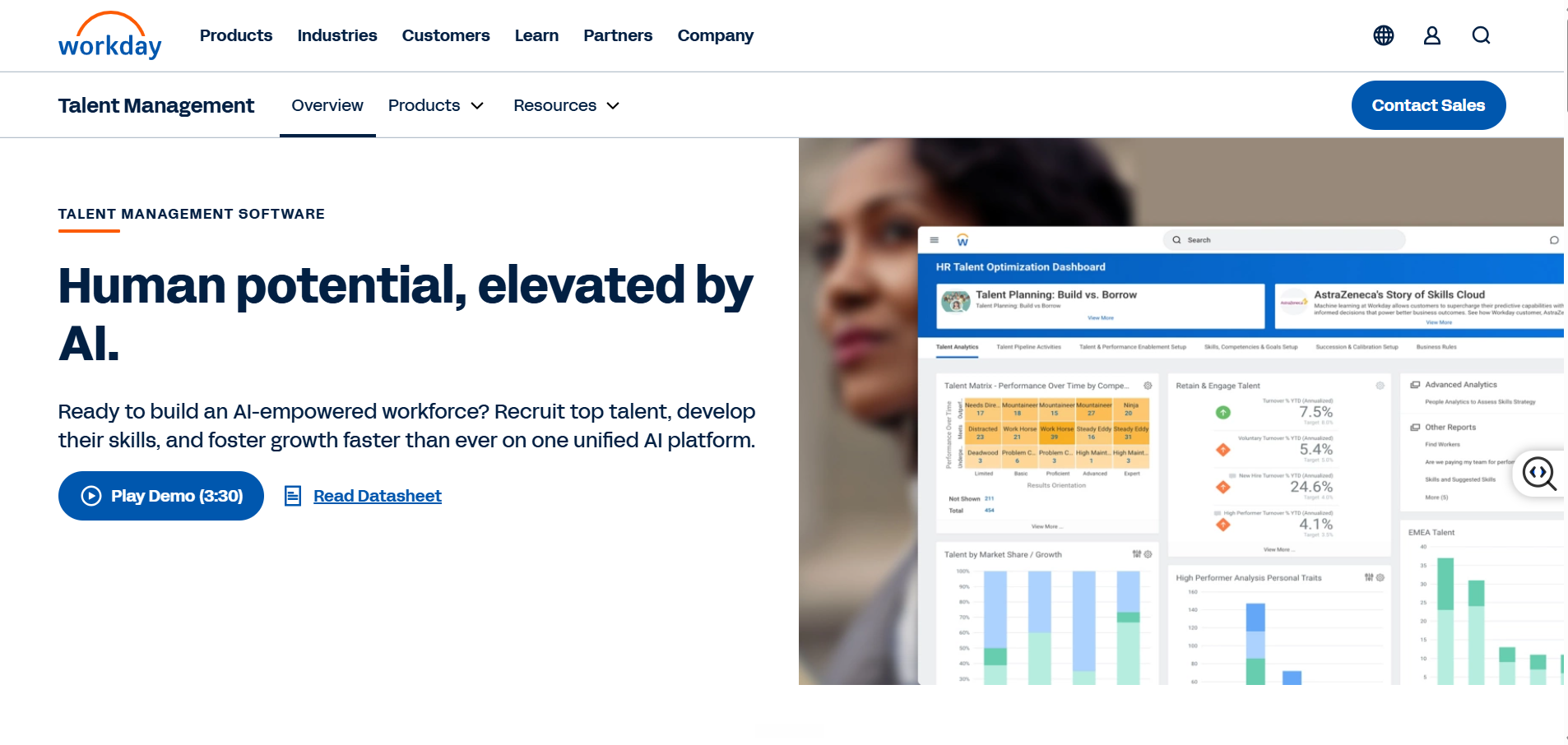
Workday is an enterprise talent acquisition suite that covers the full hiring lifecycle for large corporate organizations, from candidate marketing and sourcing through screening, offer, and internal mobility. Its AI capability comes primarily through HiredScore AI for Recruiting, a recruiting agent embedded within the platform that takes on time-consuming coordination tasks, surfaces the highest-fit candidates, and frees recruiter time for strategic work.
Key Features:
- HiredScore AI Recruiting Agent: Handles candidate recommendations, automates repetitive recruiter tasks, and helps teams reduce time-to-fill without adding coordination overhead between tools or systems.
- Internal mobility and pipeline management: Surfaces internal candidates against open roles before sourcing externally
- Recruiter hub with configurable workspaces: Centralizes all recruiter tasks, pipeline actions, and outstanding items in one view, with hiring manager collaboration running through Microsoft Teams and Slack, so feedback loops do not require platform switches.
- Enterprise-scale compliance and analytics: Built for the governance, reporting, and compliance requirements of large organizations managing hiring across geographies, with reporting and audit capability built into the core platform rather than added as a separate layer.
Best for: Large enterprises already running Workday HCM that want AI recruiting capability without adding a separate platform to their stack, particularly where internal mobility and workforce planning need to sit alongside talent acquisition
4. Eightfold AI
Eightfold AI is an enterprise talent intelligence platform built on a large career dataset, using deep-learning models to score candidate fit, infer skills, support internal mobility, and map career paths across a workforce.
Its core strength is skills inference across internal and external talent at enterprise scale.
Key Features:
- Deep-learning candidate matching: Scores candidates against roles using a career dataset and skills inference model that goes beyond resume structure to evaluate actual capability and trajectory.
- Internal mobility and career pathing: Surfaces internal candidates against open roles using skills inference and career history, helping enterprises fill roles from within before sourcing externally.
- Skills intelligence across the workforce: Maps skills supply against demand across a large employee population, giving talent leaders visibility into gaps and reskilling priorities.
- Enterprise-grade governance and compliance: Built for the regulatory and data security requirements of global enterprises with complex governance structures.
Best for: Large enterprises managing skills-based workforce planning and internal mobility at scale.
5. hireEZ
hireEZ is an AI-powered sourcing and outbound recruiting platform that combines open-web candidate search, database rediscovery, and personalized outreach automation.
It has added agentic capabilities for screening and scheduling. Its primary strength is finding and engaging passive talent at scale, making it a top-of-funnel engine for teams whose constraint is sourcing volume rather than workflow management..
Key Features:
- AI-first open-web sourcing: Searches across the open web and existing databases simultaneously, with AI ranking surfacing the highest-fit passive candidates per role from a broader pool than any single source.
- Database rediscovery: Resurfaces past candidates who match current requirements so firms can fill roles from relationships they already own before spending on new sourcing.
- Personalized outreach sequences: Runs multi-step, multi-channel outreach campaigns with response and engagement analytics tracked per recruiter, so teams can see what messaging converts.
- Agentic screening and scheduling: Newer capabilities extend hireEZ beyond sourcing into early-stage screening and interview scheduling without recruiter involvement at each step.
Best for: In-house recruiting teams and agency sourcers building proactive outbound pipelines from passive candidate pools.
6. Atlas
Atlas is an AI recruitment platform and CRM built specifically for recruitment agencies, with generative database sourcing, multi-touch automation campaigns, and call recording with AI summaries built into the core workflow.
It is designed for smaller agencies that want modern AI capabilities embedded from the start rather than added as a bolt-on.
Key Features:
- Natural-language database sourcing: Recruiters search their candidate database using plain-language queries rather than Boolean strings, so strong matches surface without requiring search expertise.
- Multi-step automation campaigns: Runs sequenced outreach across candidates and clients with automated follow-ups, reducing the manual coordination that consumes recruiter time between conversations.
- Call recording with AI summaries: Records recruiter calls and generates structured summaries automatically, so conversation context stays in the system without manual note entry after each call.
- Agency-native CRM: Built around how recruitment agencies manage candidate and client relationships simultaneously, rather than being adapted from a corporate HR or sales CRM.
Best for: Small to mid-sized recruitment agencies that want AI embedded in their core workflow from day one without enterprise cost.
7. Recruit CRM
Recruit CRM is a full applicant tracking system and CRM purpose-built for recruitment and executive search agencies. It includes AI resume parsing, natural-language candidate sourcing, and named task agents
Key Features:
- AI resume parsing and matching: Automates candidate profile creation from resumes and scores candidates against job requirements, reducing manual data entry and accelerating shortlisting.
- Natural-language sourcing: Searches the candidate database using plain-language queries so recruiters find relevant profiles without writing Boolean search strings.
- Named task agents: AI agents handle specific repeatable tasks, including email replies and candidate submissions, freeing recruiters from the administrative steps that interrupt relationship-focused work.
Best for: Small to mid-sized recruitment and executive search agencies that want a complete ATS and CRM with AI included.
8. Manatal
Manatal is an AI-native applicant tracking system and recruitment CRM built for agencies and lean corporate teams, with value-oriented pricing that makes enterprise-style AI capability accessible to smaller operations.
It combines AI candidate scoring, social and professional profile enrichment, semantic search, an AI video interviewer, and generated job descriptions in a lightweight platform designed for fast setup and ease of use.
Key Features:
- AI candidate scoring and enrichment: Scores candidates against job requirements and enriches profiles automatically with data pulled from social and professional sources, so recruiters work from richer records without manual research.
- Semantic search: Finds candidates based on meaning and context rather than exact keyword matches, so recruiters surface relevant profiles even when resume language does not precisely mirror the job description.
- AI video interviewer: Conducts structured video screening interviews autonomously, allowing teams to assess candidate responses at scale before a recruiter invests time in a live conversation.
- Generated job descriptions: Produces role-specific job descriptions from basic inputs, removing the drafting step that slows req creation and ensuring consistent structure across postings.
Best for: SMB agencies and lean corporate recruiting teams that want AI-native capability without enterprise implementation complexity.
The Same Technology, Two Different Operating Problems
The reason the same technology produces wildly different results is that staffing firms and corporate teams are not solving the same problem. They are buying similar tools to fix different things, and a tool that solves one problem can be irrelevant to the other.
Understanding which problem you own is the precondition for evaluating any AI recruitment tool intelligently.
What AI Staffing Solutions Deliver For Staffing And Recruiting Firms
For staffing firms, the operating problem is capacity. Placement volume is constrained by:
- How many job orders a recruiter can actively manage
- How fast they can source and qualify candidates
- How effectively they can turn conversations into placements.
Revenue scales with recruiter output, and for most of the industry, that has meant revenue scales with headcount.
AI-powered recruiting software shifts the constraint by taking the high-volume, repetitive work off the recruiter's desk:
- Sourcing and qualifying at a volume no human can match, so recruiters spend their hours on the candidates worth a conversation
- Writing job descriptions, screening inbound applications, and coordinating interviews without a recruiter in the middle of every exchange
- Surfacing the strongest matches from a database the firm already owns, instead of paying to source talent it already has
Where AI Shifts The Revenue Model For Staffing Firms
Most staffing revenue depends not just on placing a candidate, but on redeploying them when an engagement ends. Firms that identify redeployment opportunities early protect existing revenue rather than spending to replace it.
Redeployment is the highest-margin placement a firm can make because the relationship, the vetting, and the performance history already exist.
Unfortunately, fragmented systems lose redeployment signals. AI operating on a unified data foundation, where placement outcomes and post-engagement status are visible alongside the candidate record, can surface redeployment signals before a candidate goes inactive.
According to “Where’s the Value in AI?” 2024 Report by BCG, 74% of companies have yet to show tangible value from AI, with only a minority that have built the right underlying capabilities moving past proofs of concept.
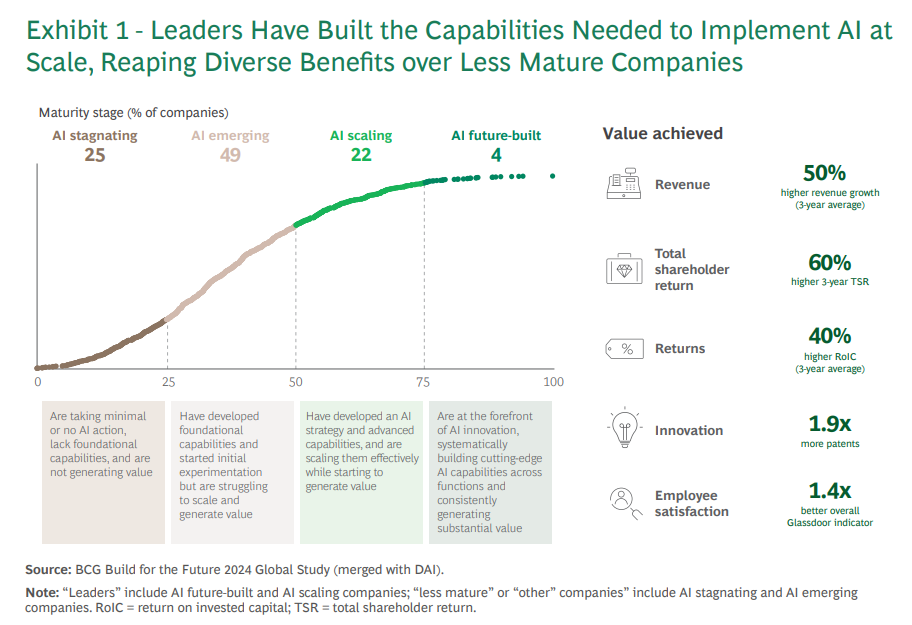
In staffing, the underlying capability that matters most is whether the data spans the full revenue cycle.
What AI Staffing Solutions Deliver For Corporate Talent Acquisition Teams
Corporate recruiting has to maintain talent pipelines across roles, geographies, and hiring cycles, often re-opening searches for similar profiles quarter after quarter.
The cost is not just speed on any single requisition. It is the relationships that go cold between requisitions, and the institutional knowledge about candidates that evaporates when a search closes.
AI hiring software addresses pipeline continuity differently than it addresses staffing capacity. Here, the work is maintaining candidate engagement at scale, surfacing reengagement signals from cold talent pools, and tracking which candidate relationships are aging toward disengagement before that happens.
The value is measured in quality of hire and in the ability to fill a role from a warm pipeline instead of starting cold. A strong corporate AI recruitment tool keeps a relationship alive across the months between the first conversation and the role that finally fits.
Where AI Reshapes Pipeline Continuity For Corporate TA
A requisition-based model treats every opening as a fresh start. A continuity model treats the pipeline as a standing asset that compounds, where every interaction with a candidate adds to what the team knows the next time a relevant role opens.
The shift only works if the intelligence persists across cycles instead of resetting when a requisition closes. Most corporate stacks reset, because the ATS attaches everything to a single requisition, and the engagement data lives in a separate system.
The result is that AI gets pointed at one stage, shows a local improvement, and never produces the systemic gain the team was promised.
According to the State of Generative AI 2024 Report by Deloitte, more than two-thirds of organizations expected 30% or fewer of their generative AI experiments to scale within three to six months. Stage-level pilots stall for the same reason in recruiting. The architecture underneath cannot carry a local win into a systemic one.
What Staffing Firms Should Actually Evaluate in an AI Staffing Solution
A staffing firm evaluating AI staffing solutions should stop scoring features and start scoring fit against the staffing revenue model. The right questions are about whether the platform understands how a staffing firm makes and protects money. Five criteria separate a platform built for that from a platform that will automate the wrong things faster.
1. A unified data foundation across CRM, recruiting, and post-placement outcomes
A unified data foundation means candidate records, client relationships, recruiting activity, placement outcomes, and post-placement engagement status are all visible within a single system.
Evaluate whether the platform unifies this data by design or assembles it through integrations. Integrated systems introduce sync lag, and sync lag is where redeployment signals and engagement signals die.
Asymbl was built for exactly this. Recruiter Suite runs on Salesforce, so client data, recruiting workflow, and post-placement outcomes live on one data model, and the intelligence reasons against the live record rather than the last successful sync.
2. Redeployment intelligence and per-recruiter revenue visibility
Staffing firms generate revenue at placement and protect revenue at redeployment. An AI staffing solution that ends its data capture at placement is misaligned with the staffing revenue model at a structural level.
Evaluate whether the platform surfaces redeployment signals proactively, through automated monitoring of engagement end dates, candidate availability windows, and relationship warmth, rather than through manual status reviews that depend on a recruiter remembering to look.
Evaluate whether the platform measures revenue and gross profit by recruiter and team natively, or whether it requires assembling data from multiple sources.
3. AI agents with defined roles and performance governance
The question to ask about any digital worker is whether it has a defined job. Does the platform offer AI agents with a specific scope, clear handoff protocols with human recruiters, and accountability for outcomes?
An agent with a vague mandate produces vague results, and an agent no one can review produces liability.
Performance governance means decisions are reviewable, outcomes are measurable, and behavior is adjustable. AI that operates as a black box creates risk rather than capability. This is the part of the market most platforms skip, because treating AI as a feature means there is nothing to govern.
Asymbl treats digital workers the way it treats human workers, with a defined role, a motivation for success, and a structured handoff model, because it runs roughly 200 of its own digital workers across 13 business functions and learned what governance the model requires by operating it first.
4. Capacity expansion without proportional headcount growth
Faster tasks feel productive and change nothing structural if the recruiter still owns every handoff between tasks. The question is whether a recruiting team can handle more volume meaningfully without a proportional increase in headcount.
The test is whether the platform can own the whole workflow. Three questions surface the answer:
- Can a digital worker carry a candidate from sourcing through screening to a scheduled interview without a recruiter managing each transition?
- Does freed recruiter time convert into more placements, or does it get absorbed by correcting the AI's output?
- Does capacity scale with consumption, so growth does not trigger a new hiring round just to manage the tools?
5. Multi-client workflow management that does not create data fragmentation
Staffing firms manage multiple clients at once. Each client has separate pipelines, compliance requirements, and relationship history.
A platform that handles multi-client environments by creating a separate data environment per client rebuilds the fragmentation problem at a new level, and the firm loses the cross-client view of its own talent.
Evaluate whether the platform can maintain client separation for pipeline management while preserving unified candidate data across clients.
A candidate should not appear as a separate record in each client pipeline. They should be one record visible across the relevant client relationships, so the firm can match the same person to the best opportunity regardless of which desk sourced them.
What Corporate Teams Should Evaluate in AI Staffing Solutions
Corporate TA teams carry a different burden than staffing firms, and their evaluation criteria follow from it. The criteria below reflect what changes when AI is embedded in decisions that a company is legally and reputationally accountable for.
.png)
1. Workflow configurability that recruiting teams control
Recruiting workflows evolve as market shifts and internal process changes require teams to adapt quickly. The question is who can make those changes.
Evaluate whether the recruiting team can configure workflows, adding stages, changing automations, and adjusting assignment rules, without an IT dependency.
Platforms that require developer intervention or a service engagement for routine workflow changes slow the team's ability to respond. This is a structural problem dressed as a convenience issue.
When the business owns the process, but IT owns the ability to change it, every adjustment becomes a ticket, and the AI that was supposed to create agility becomes another system the team works around.
Configurability in the hands of the recruiting team is what keeps the workflow current with how the team actually operates.
2. Responsible AI Governance And Auditability At Scale
AI embedded in screening, matching, and selection decisions creates compliance exposure if it cannot be audited. Evaluate whether the platform provides transparent decision logs, explainable scoring criteria, and override protocols at each AI-assisted decision point.
Under the 2026 EU Artificial Intelligence Act, AI systems used to filter applications and evaluate candidates are classified as high-risk under Annex III. Following the EU AI Act Omnibus Agreement reached in May 2026, compliance obligations for these systems are now set to apply from 2 December 2027, extended from the original August 2026 deadline.
In the United States, NYC Local Law 144 already requires a bias audit and candidate notice for automated employment decision tools, with daily penalties for violations.
Governance becomes more important at scale. A pilot running on 50 candidates is manageable without deep governance. An operational deployment running across thousands of candidates requires systematic auditability built into every AI-assisted decision, not added after a regulator asks.
3. A Documented Path From Pilot To Full Operational Deployment
Evaluate whether the vendor can show a documented path from pilot to production, including how governance, data, and workflows hold up as volume grows.
The reason most pilots stall is that they were never architected to scale. The intelligence was connected to one stage, the data stayed fragmented, and the win stayed local.
A platform with a real path to deployment is one where the same foundation that runs the pilot runs the full operation, with no architectural rebuild between the two.
Ask the vendor to describe that path concretely, because a vendor who cannot is selling a pilot.
4. What Corporate Teams Should Prioritize In The Same Evaluation
Across these criteria, one factor outweighs the others. The platform where intelligence and governance live in the same system as the recruiting workflow is the one to prioritize, because a separate AI layer creates a governance gap.
When the system making a decision and the system recording it are different, compliance becomes a manual reconciliation.
When AI scoring, the audit trail, and the recruiter's workflow run on one foundation, responsible AI is a property of the system. For a team that owns the final hiring decision, that property is the criterion that the others depend on.
Asymbl Recruiter Suite
Asymbl Recruiter Suite is a Salesforce-based talent relationship management platform that unifies the full hiring lifecycle, from first candidate touch through placement and beyond, for staffing firms and corporate TA teams.
Unlike traditional applicant tracking systems that reset when a requisition closes, Recruiter Suite keeps candidate relationships, client data, recruiting workflows, and post-placement outcomes on one connected data model, with AI and digital workers built in from day one rather than bolted on afterward.
Built For Workforce Orchestration, Not Applicant Tracking
Recruiter Suite is talent relationship management on Salesforce, covering the full cycle from first touch through placement and beyond, with client relationships, recruiting activity, and outcomes on one data model.
On top of that foundation sits Talent Intelligence, a reasoning engine that evaluates candidates the way a recruiter would, drawing on pipeline history, interview feedback, and assignment outcomes rather than keyword overlap.
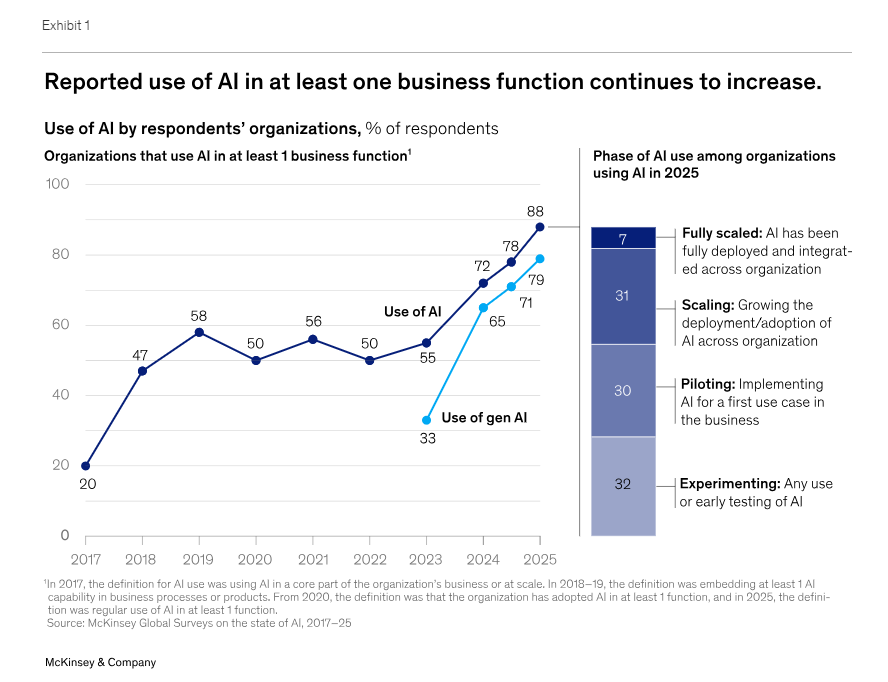
The intelligence and the workflow share one system, so every placement and every debrief makes the next match smarter. The system learns from the work instead of just storing it, which is the gap “The State of AI in 2025 Report by McKinsey” identified when it found that most organizations using AI have still not begun to scale it across the business.
How digital workers operate alongside human recruiters
Asymbl Digital Recruiter writes job descriptions, runs personalized candidate outreach at scale, screens inbound applications against role criteria, and schedules interviews, all inside the same environment where the human team already works.
It runs on the unified data model and draws on the same intelligence layer, so it acts on the full picture of a candidate and a client rather than a piped-in fragment.
What separates this from a bolt-on agent is how the digital worker is managed. Each one has a defined job, a motivation for success, and a structured handoff to its human teammates, with performance that is reviewable and adjustable.
Asymbl runs this model on itself first. Its own recruiting digital worker helped a two-person team hire 100 people in 100 days, processing 17,000 applications and freeing the humans to focus on relationships and judgment.
Conclusion
Staffing firms and corporate TA teams face the same technology landscape and different operating problems. Capacity, redeployment, and revenue visibility on one side, pipeline continuity, compliance, and post-hire measurement on the other.
The evaluation criteria follow from those differences, which is why a universal feature comparison leads so many buyers to the wrong tool.
The deeper pattern across every criterion is that architecture decides outcomes more than features do. A tool that automates a task on top of fragmented data produces a faster version of the same broken process.
A platform that unifies the data and manages AI as a governed workforce changes what the team is structurally capable of. The firms pulling ahead in 2026 are the ones who matched the technology to the problem they actually own, then put it on a foundation built to carry it.
The question to take into any evaluation remains simple. Does this solve my operating problem, or just add to my stack?
If capacity and redeployment are your constraints, or pipeline continuity and compliance are, the next step is seeing how a unified, Salesforce-based foundation handles them in your own workflows.
Book a demo with Asymbl, and we will walk through how Recruiter Suite, Talent Intelligence, and a governed digital recruiter work together on one data model, calibrated to the problem your team actually owns.
FAQs
An AI staffing solution operates across the full recruiting workflow on a connected data foundation, changing what the team is structurally capable of. An AI recruiting feature speeds up one task inside a system not built around it.
The metrics that matter are placements per recruiter, time-to-fill, redeployment rate, and gross profit by recruiter. The real test is whether freed recruiter time converts into more placements, not just less admin.
A digital worker is an AI built around a defined job, with structured handoffs to human teammates and reviewable performance. An automation tool executes a fixed task on a trigger with no role, no accountability, and nothing to manage or improve over time
A Salesforce-based platform keeps client data, recruiting workflow, and AI on one data model so intelligence reasons against the live record. A standalone ATS connects through integrations, which introduces sync lag.
A digital worker built on a unified foundation operates inside the existing workflow, picking up defined tasks and handing off at set points. One bolted onto a fragmented stack usually forces a redesign because it cannot see data spread across separate systems.
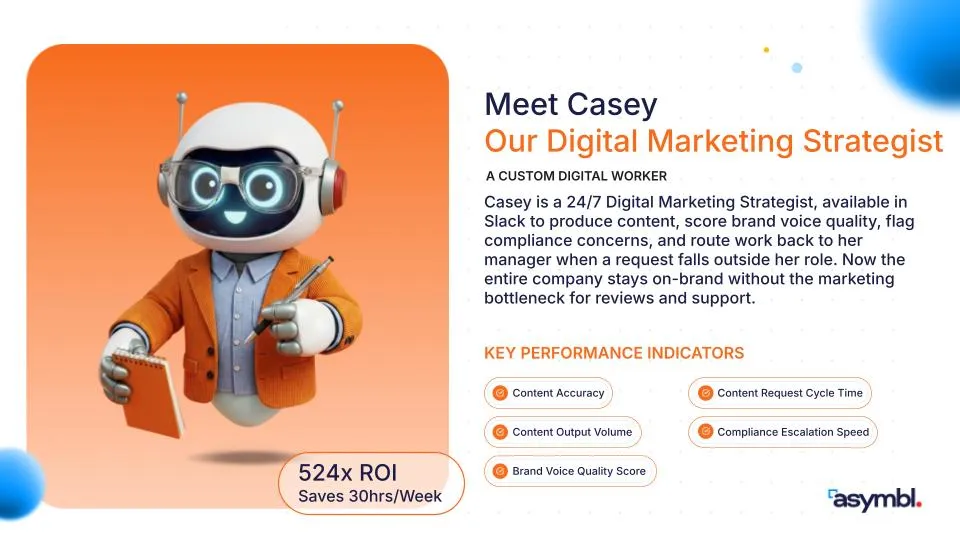
The Hybrid Workforce: Designing Roles Before Deploying AI Agents
Meet Casey: the AI agent that got promoted. Discover the management framework that turns standard AI tools into scalable digital teammates.

The Right Fit Starts With a Conversation.
See what working together could look like.
.webp)