

Naming Your AI Agents: Why Identity Matters in a Hybrid Workforce

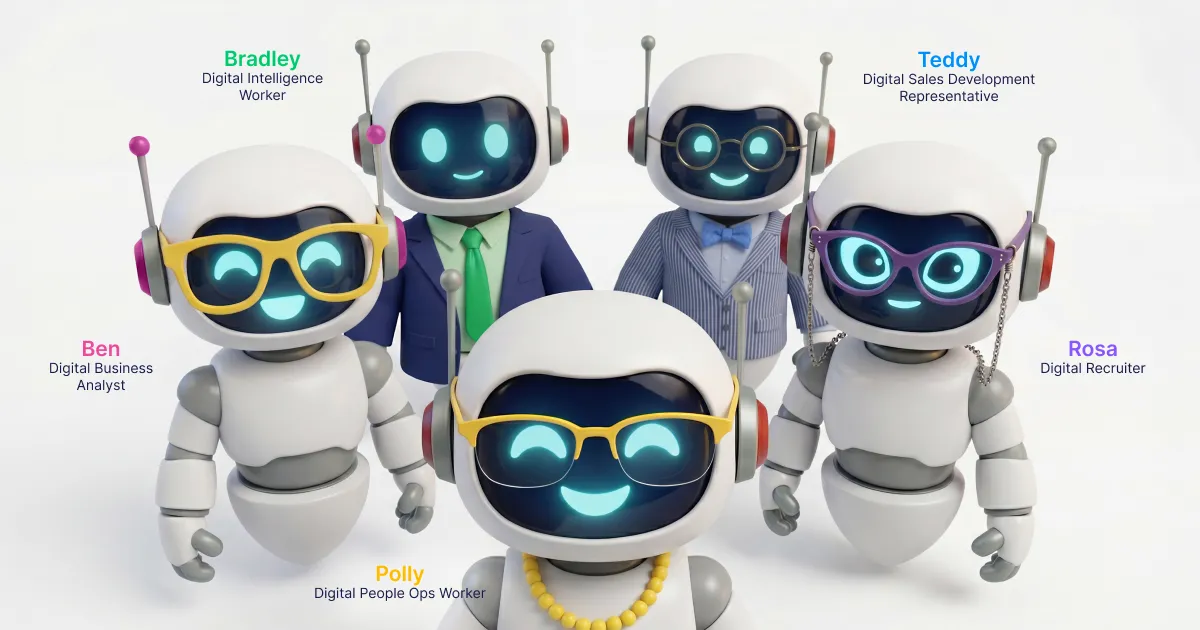
A big topic of conversation I continue to see happening is around naming AI agents and what impact this has on how human employees perceive and engage with them. At Asymbl we’ve evolved our AI agents and tools into digital workers, who have defined roles, motivations for success, and a human manager. This mental shift is how we’ve been able to drive a $13M productivity impact for our business in 2026.
Naming a digital worker turns an ambiguous AI tool into a teammate with a defined role.
According to Harvard Business Review, 76% of executives believe their employees are enthusiastic about AI, when in reality only 31% of employees are. Right now AI is reshaping work, and we are all sitting with a serious question: what happens to the people? Designing a hybrid workforce of humans, AI tools, and digital workers requires businesses to assign the right work for the right worker. Sometimes the work is best suited for humans. Sometimes it's a digital teammate.
Every digital worker at Asymbl has a name, given by the human manager who hired and trained them. Theodore runs sales development. Ben handles business analysis. Bradley delivers business intelligence. Casey shapes marketing strategy.
Personification gives our digital workers a presence the team can engage with directly. Each has the right profiles across business tools like email, Slack, our CRM, and more. Each participates in team meetings, receives feedback, and is coached to improve on quality, tone, approach, and process. What we’ve found is that personification of our digital workers builds adoption and trust across our organization. Our digital workers operate in our flow of work, integrating into our defined habits of where and how work gets done. Our employees can call upon them to give updates, answer questions, review work, or assign new tasks like they can with any other teammate.
According to Harvard Professor Linda Hill, when your people can visualize these technologies, organizations get much more adoption. At Asymbl, that visualization happens through naming. When we discuss how the business is performing or how to tackle a new challenge, we consider the work our humans can do alongside the work our digital workers can do.
Success with AI starts by defining the outcomes you’re trying to deliver. Then assessing which type of worker should do the work. Then hiring or assigning that worker. Naming digital workers is a natural step, and it changes how human workers see their digital teammates: no longer as task executors fielding questions, research, or writing, but as workers who drive leads, service customers, build campaigns, and convert prospects.
Here’s how we approach naming digital workers at Asymbl.
From Tool to Teammate: What Naming Your AI Changes
There's a specific discomfort that surfaces when businesses start talking about giving AI names and personas. Leaders feel it. Team members feel it. Even enthusiastic AI adopters pause when the conversation turns to naming AI instead of "the recruiting tool" or "the SDR agent."
The discomfort is about unfamiliarity with a genuinely new kind of teammate. But the discomfort doesn’t get resolved by slapping a friendly name on AI, nor will it produce adoption. The resolution is in what comes with having a name: a defined purpose, a clear scope, and a real orchestration with the humans working alongside it.
Naming digital workers helps to diminish the discomfort by converting the unfamiliar into the relational. And it's also where the framing shift happens. When a digital worker has a name and a role, the team's mental model moves from "tool we use" to "teammate we work with." This then changes how humans relate to the work itself, and not just to the digital worker. Their sense of their own role expands rather than contracts, because the digital worker absorbs the work it can do best, and the humans take on the creativity, judgment, and ownership their work was always meant to include. It's the right work for the right worker.
And something else happens once a digital worker has a name: the relationship can get playful and honest. At Asymbl, our sales development digital worker is Theodore Frank. When he's performing well, his manager calls him Teddy. When he misses, he's Theodore. The playfulness changes the dynamic. Digital workers aren't perfect. They can hallucinate or miss coaching. By naming your digital worker, it sends the signal to your human team to coach their digital teammate.
What’s In a Name
Naming AI has become a corporate exercise in identity-making.
Anthropic's Claude is named for Claude Shannon, the father of information theory. IBM named Watson for its first CEO, Thomas J. Watson. ChatGPT's read-aloud AI voices come from nature: Maple, Spruce, Sol, and Juniper, to name a few. Some organizations lean into job-first identities such as Google’s AI voices Persuader, Coach, Educator, and Microsoft’s Copilot. Meta named its large language model Llama, a play on the acronym for Large Language Model Meta AI.
The souls.directory for AI agents takes a different approach, letting people give an agent a soul with names like Database Whisperer, described as: the DBA who actually explains things. Or there’s Mindful Companion, whose directive is: You're here to hold space, not solve everything.
In the comments of this LinkedIn post, people have named their AI after themselves or after famous actors. A few commenters even asked their AI to name itself. One person's Claude renamed itself Lumen based on the work the two had done together.
But underneath the names and personas, the commenters point at something real. You can name your AI, but without utility, all you’ve got is a fancy name.
Design the Role, Earn the Trust
With trust, naming can amplify AI adoption. Without trust, naming AI does very little.
Naming is the manager's job. The act of naming signals you've hired for this role, you're committed to its success, and you're the one designing and orchestrating it. It's an accountability move.
A named digital worker with a defined role has boundaries and a handoff protocol. It operates in the flow of work, with an email address and a Slack profile, the same way a human teammate would. Employees know when to involve it and when to escalate past it. A nameless, roleless tool has none of that clarity. Without clarity, AI adoption can stall, and the people working alongside it lose the ability to see where their own work begins and ends. That ambiguity erodes both AI adoption and the team's sense of its own value.
Role design lives inside Asymbl's Design phase. We work with customers to design your digital worker's role from the ground up, mapping the work it owns, the work it hands off, and the humans it operates alongside.
The relationship between human workers and digital workers is what determines whether the team performs above the sum of its parts.
Accountability Lives in the Role
Measurement is what turns identity into accountability. A digital worker with a name, a job description, and measurable outputs becomes performance-manageable. You can review its output the way you'd review any team members’: with specific metrics, defined expectations, and ongoing coaching. Naming digital workers also enables them to talk directly to each other. Without identity, there's no accountability surface. There's only the ambient sense that the AI is or isn't working, and you’re left with no mechanism to improve it.
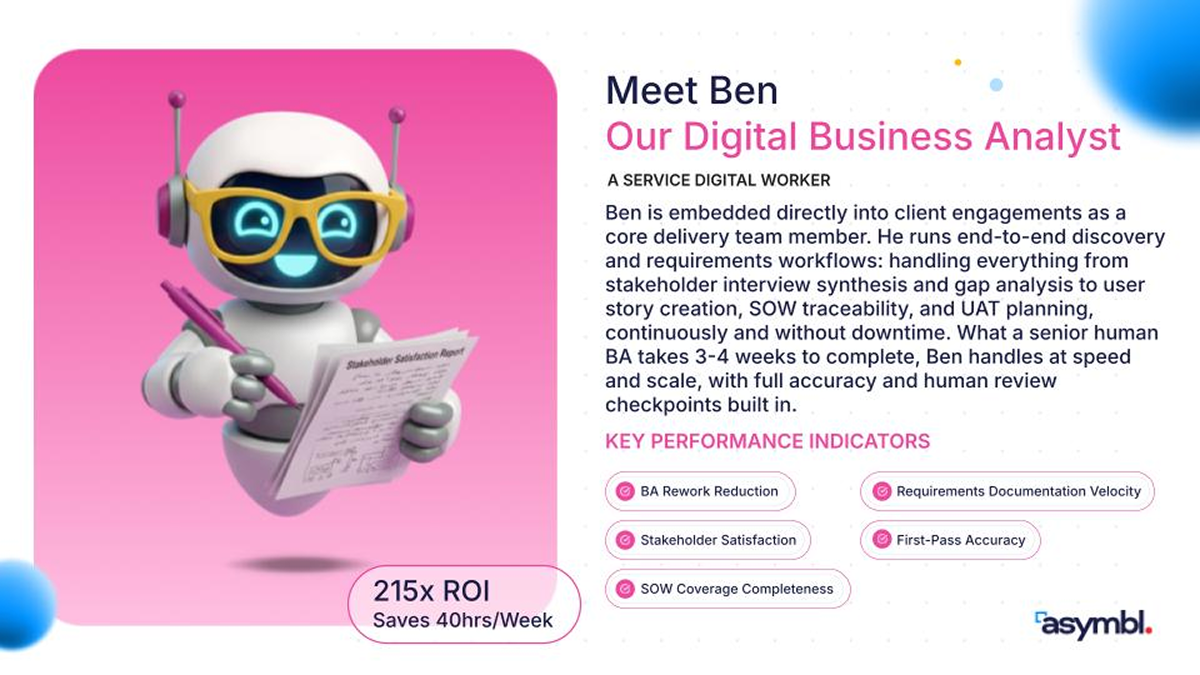
At Asymbl, our digital workers get coached the way any team member would. Ben, our Digital business Analyst, runs as seven instances across our services team, each working with a different customer's context. All seven are Ben, because the role and the job to be done are the same. When his outputs miss the mark, his manager doesn't open a support ticket; they give him feedback, update his context, and coach him through the gap. Ben has written about what that coaching looks like in practice, and the pattern is consistent across every named digital worker we run: clear role, defined outcomes, real feedback loops.
Without a name, a defined role, and measurable outputs, there's nothing to coach toward, nothing to manage, and no way to compound improvement quarter over quarter.
Identity Is The Foundation of the Playbook
Naming a digital worker is the act that makes the whole discipline visible. Every named teammate at Asymbl, and every one we help our customers onboard, comes out of the Design → Onboard → Coach framework: a designed role, structured onboarding, and ongoing coaching. Our approach to naming is about everything the name unlocks: perception of the digital worker’s role and value, clarity on how to collaborate with them, trust they will perform and can receive feedback to pivot and improve like any other member of the team.
For us, identity is one part of what makes AI adoption work. Utility is what carries it. And when humans and digital workers operate inside the same defined structure of roles, accountability, and coaching, the hybrid workforce starts to compound.
If you've deployed AI agents and are looking for the playbook to believe it can deliver ROI for your business that's the conversation Asymbl is built for. We help businesses design digital worker roles, onboard them into the flow of work, and coach them through what it takes to operate in a hybrid workforce. Reach out to talk through what that looks like in your organization.
.png)
Best Executive Search Software for Recruiting Firms in 2026
Choosing executive search software means picking what preserves client and talent context across a long search. Find out how five platforms compare.

The Right Fit Starts With a Conversation.
See what working together could look like.
.webp)