

The AI Project Quadrant: Mapping Every AI Investment You've Been Pitched

You've been pitched both versions of the AI story: the quick-win toolkit that promises ROI in 30 days and never quite scales, or the 18-month transformation program that swallows the budget and produces nothing measurable.
There’s a third option a lot of AI vendors hint at.
Emerj calls this third option sub-quadrant 3.2 on their AI Project Quadrant. Sub-quadrant 3.2 is the rare slice where the math works: measurable outcomes inside the first fiscal year and a durable, compounding digital workforce capability for the next three. It’s the quadrant most AI vendors cannot reach. But it’s the exact framework Asymbl was built to deliver.
The 3.2 test gives you a sharper question to ask every AI vendor you're evaluating and a clearer read on which projects in your current pipeline are drifting toward Q1, Q2, or Q4. If you're a Chief Operating Officer (COO), Chief Financial Officer (CFO), Chief Information Officer (CIO), or Chief Transformation Officer (CTO) trying to figure out which AI bets to keep and which to eliminate, the AI Project Quadrant belongs at the table.
The Map of Every AI Investment You've Been Pitched
Inside Q3, sub-quadrant 3.2 is the slice that pays back inside the budget year and builds capability that compounds.
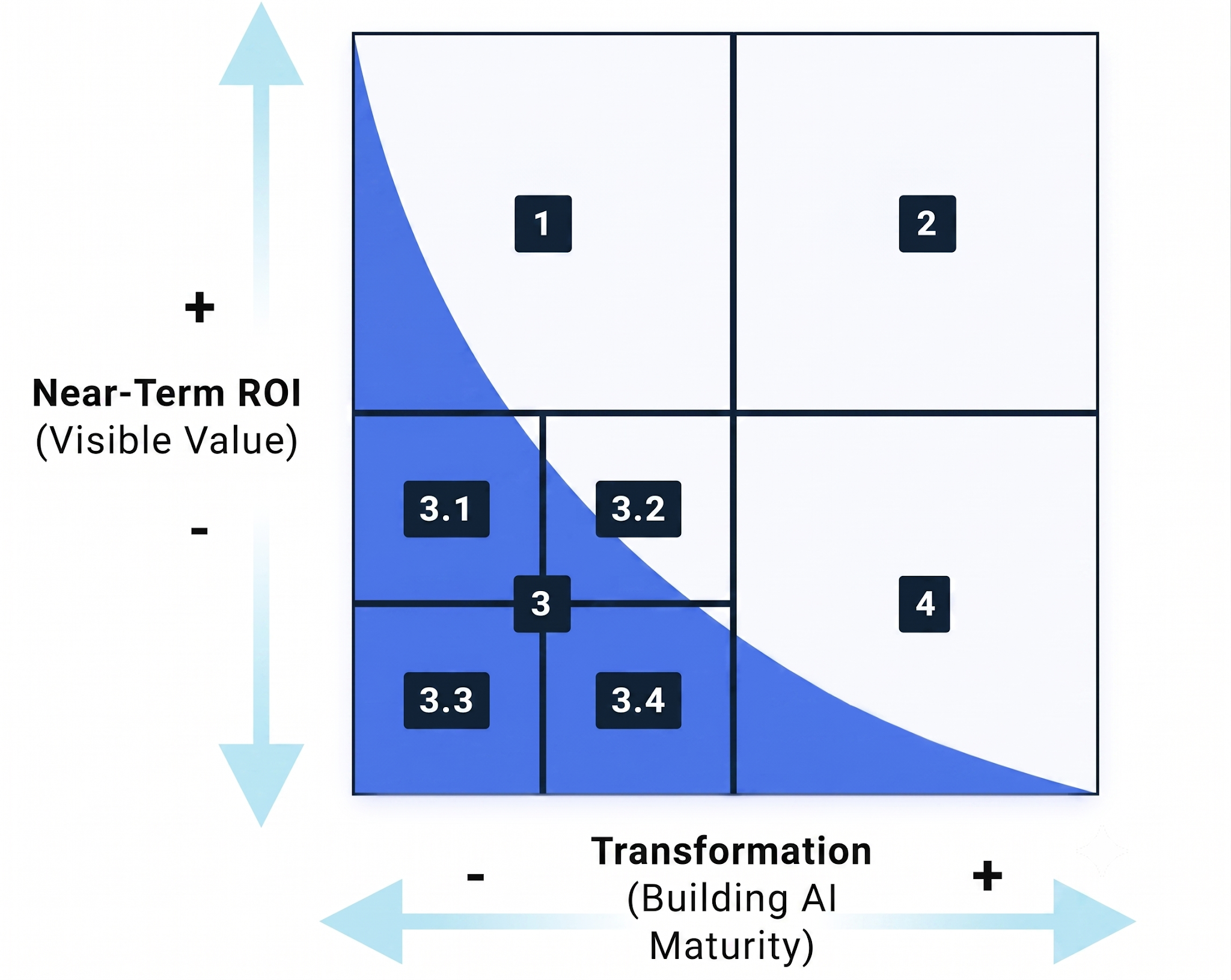
Image adapted from Emerj Artificial Intelligence Research
Emerj's framework maps every AI investment against two axes: near-term ROI (whether the work pays back inside the current budget cycle) and AI maturity (whether the work builds durable capability that compounds across future cycles). Q1 and Q4 are where the bulk of AI vendor tools and pitches live. Q2 is where vendors pretend to be somewhere else. Q3 is where the legitimate work happens.
The map breaks down into four distinct quadrants:
- Q1: The Plug-and-Play Edge. The plug-and-play AI assistant, the off-the-shelf bot, or standalone copilot. It plugs in fast, demos well, and returns something measurable inside a quarter. The catch is that it doesn't change how your operating model works. The technology lives at the edge of the business and the capability never crosses into the workforce. When the vendor sunsets the product or the contract gets renegotiated, you're back where you started.
- Q4: The 18-Month Black Hole. It’s the 18-month foundation build, the model factory, the enterprise-wide transformation program. The work is real, the capability is real, and the architecture is sound. But it also produces nothing measurable for a year or more, which means it shows up on the budget without a corresponding line on the Profit and Loss (P&L) statement. CFOs lose patience. CIOs get reassigned. The program ultimately gets repositioned and the original premise gets lost.
- Q2: The AI Mirage. This is the quadrant Emerj is most direct about. It's where vendors claim both near-term ROI and durable capability, and deliver neither. The execution here is closer to a heavy Q1 tool with a transformation label on it. The contract gets signed, the roadmap gets published, and 12 months later the customer has the same operating model they walked in with, plus a stalled pilot and a higher run rate.
- Q3 (Sub-Quadrant 3.2): The Sweet Spot. This is the balanced middle, where legitimate AI work tends to live. Inside Q3, sub-quadrant 3.2 is the slice that pays back inside the budget year and builds capability that compounds. The work is precisely scoped, the digital worker (read why we don’t call them AI agents) is woven into a real workflow, and the operating model evolves alongside the technology.
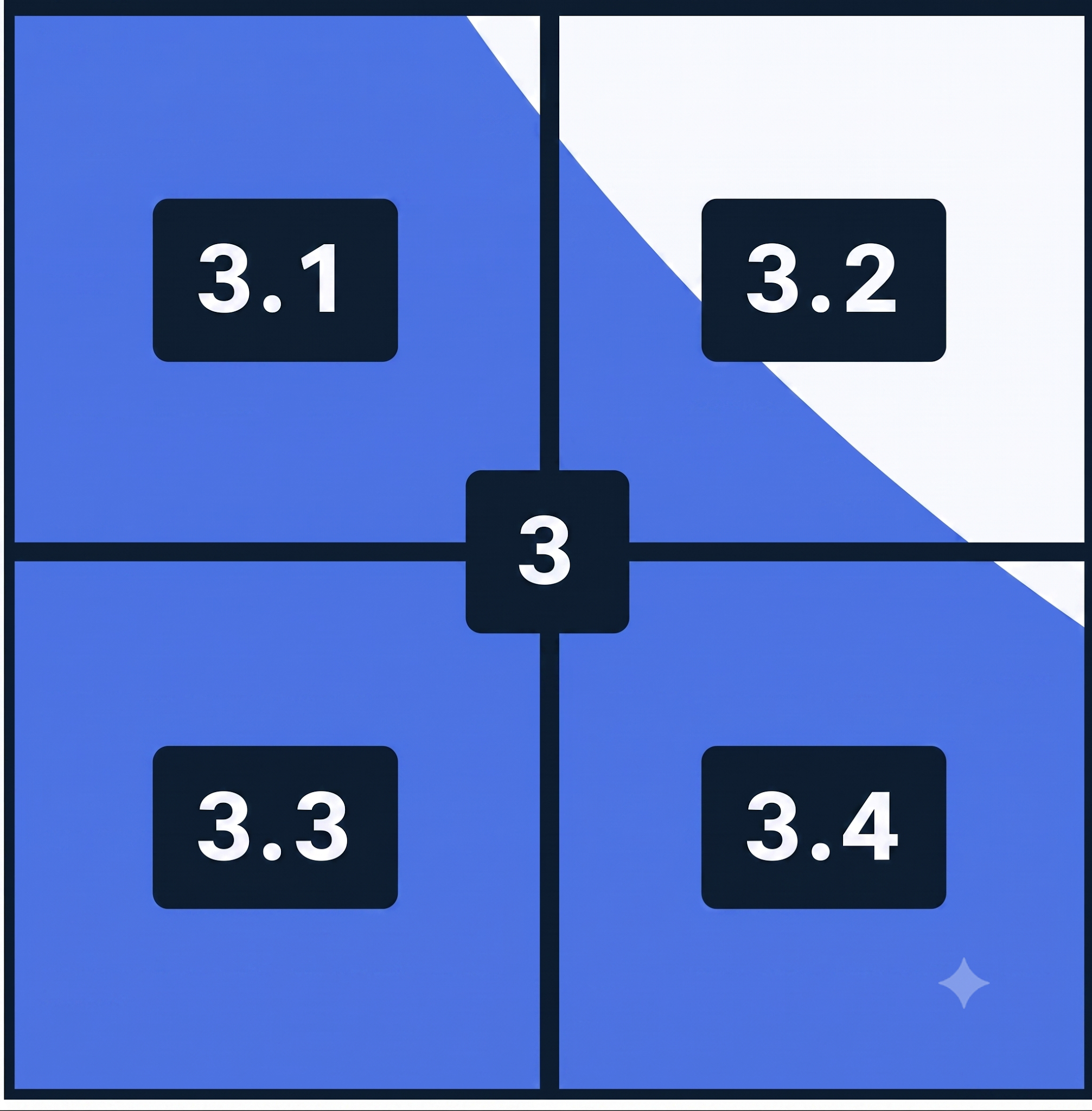
Image adapted from Emerj Artificial Intelligence Research
The 3.2 Reality: McKinsey's research backs this up at the macro level: only 21 percent of companies using generative AI have fundamentally redesigned their workflows, while the other 79 percent simply layered technology on top of outdated processes, and missed the transformation. The 21 percent are in 3.2. The 79 percent are spread across Q1, Q2, and Q4.
If you map your current AI pipeline against this framework, the pattern shows up fast. Enterprise pipelines tend to be Q1-heavy at the top and Q4-heavy at the bottom, with a thin and aspirational layer in the middle. That's the gap Asymbl was built to close.
The Two Things Every AI Vendor Should Have to Prove
Emerj is specific about how a project lands in 3.2. The vendor and the buyer each carry half of it:
- The Solution Fit: The vendor's solution has to be a precise fit for the client's needs, the actual workflow, roles, and data.
- Client Commitment: The client has to commit to building capability inside the same engagement that's delivering the near-term outcome.
That's a useful read for any AI vendor evaluation. It separates the vendors who were designed for both axes from the vendors who were designed for one and are getting retrofitted onto the other. A Q1 vendor pretending to be a 3.2 vendor will sell you an AI tool and disappear once the contract is signed. A Q4 vendor pretending to be a 3.2 vendor will sell you a multi-year transformation and check the ROI box on a future slide. A 3.2 vendor will tell you how the first measurable outcome will show up inside 120 days and how the capability gets built into the workforce over the next 24 months, in the same pitch.
It also raises the bar on the buyer. Procurement-only posture is a Q1 buying behavior, where the success criteria stops at "is the tool live." Capability-building posture means treating the engagement like a hiring decision: a defined role, an owner, a coaching plan, and a way to measure ongoing performance. That posture is what turns a 3.2 vendor's pitch into a 3.2 outcome. Without it, even a well-designed solution drifts back into Q1.
The sharper diagnostic question for your next AI vendor meeting is: Show me how your solution produces measurable outcomes inside the next budget cycle. Then show me how the same engagement compounds workforce capability across the next three years. Vendors who can answer both halves cleanly are sitting in 3.2. Vendors who default to one half of the answer are telling you which quadrant they're in.
The diagnostic question is your work to ask.
Next week, in Part 2, I’ll walk through what 3.2 looks like when it lands in execution: how Asymbl runs the model inside the budget cycle, how Customer Zero proves it, and how the discipline compounds across the workforce.
If you’re not sure which of your current AI projects are set up to deliver compounding value and which are quietly drifting toward a Q1 dead end, schedule a diagnostic working session with our team to map your current pipeline against the AI Project Quadrant. We will help you identify the projects that have a clear path to 3.2 and reshape the ones that are struggling to prove their worth.
.webp)
Talent Relationship Management: A Corporate TA Playbook
Talent Relationship Management is the infrastructure behind quality of hire, talent acquisition metrics, and warm pipelines.

The Right Fit Starts With a Conversation.
See what working together could look like.
.webp)