

Recruitment Process Automation: Beyond Task Automation to Process Continuity
.webp)
Most enterprise talent acquisition teams are running more recruitment automation than they ever have, and most recruiters are doing more orchestration work than they ever have.
However, the recruiter still decides when each step should happen, moves information from one stage to the next, monitors whether automation actually fired, and reconnects fragmented workflows by hand.
The same gap shows up in recruitment automation, where the tools execute their part, but the process between the parts still depends on a human.
What most talent acquisition (TA) teams call automation is task execution scattered across the funnel. Process automation moves the workflow itself by connecting stages, persisting context, and triggering next actions without manual prompting. Recruiters only intervene where judgment is required.
In this blog, we will examine why stage automation (executes specific tasks within a single step of the hiring process without connecting to or advancing the steps that follow) is not the same as process automation, where the orchestration burden actually sits, and the buying criteria talent acquisition teams should use to evaluate whether a platform delivers real process automation or partial assistance with extra supervision.
What Recruitment Process Automation Is And Why Most Definitions Are Incomplete
Recruitment process automation is often defined as the use of software or AI to automate repetitive recruiting tasks. Although it sounds correct, it also frames the problem at the wrong level because recruiting is an ongoing process
For example, a requisition that opens on Monday morning has to move through sourcing, engagement, screening, interview coordination, evaluation, offer, and acceptance. Among each of those steps sits a connected sequence of decisions, handoffs, data transfers, timing logic, and stakeholder coordination.
The output of one step becomes the input of the next, and the system carrying the requisition has to know what just happened, what should happen next, and which humans should be involved when.
When automation is defined narrowly, three substitutions get made silently:
- Automated actions get treated as automated workflows
- Speed in one stage gets treated as continuity across stages
- Software assistance gets treated as operational independence
Each substitution sounds reasonable inside a vendor demo, but they break under enterprise hiring volume. The recruiter who saved twenty minutes on outreach automation is the same recruiter manually moving the candidate from sourcing to screening, then from screening to scheduling, then from scheduling to interview prep.
The time saved at the task layer is absorbed by the time spent stitching the layers together.
Real recruitment process automation should advance the process through stages with minimal human intervention because the system preserves context, triggers next actions, manages handoffs across stakeholders, and operates inside defined rules. The unit of automation is the workflow itself.
According to the 2026 “State of AI in the Enterprise: The Untapped Edge” Deloitte Report, 34% of organizations are using AI to deeply transform their work, while 37% remain at surface-level use.
Most recruitment automation tools sit in the second tier. They execute discrete tasks faster, but do not change the operating model around them.
Why Automating Stages Separately Is Not The Same As Automating The Recruitment Process
Most enterprise hiring teams arrived at their current automation footprint one tool at a time.
- Sourcing got an outreach tool.
- Screening got a filtering tool.
- Scheduling got a meeting booking tool.
Each acquisition was justified on its own merits, often by a different stakeholder, and each ran on its own data model. Stitched together, the stack now covers most of the funnel.
On paper, each stage looks more efficient than it was, but in practice, the process is broken between stages.
The failure mode lives in the transitions:
- How does a candidate sourced through outreach automation become an active pipeline record that the screening tool can read?
- How does a screening outcome trigger the next step in the workflow without a recruiter manually moving the record?
- How does interview feedback affect downstream scheduling, follow-up, and offer logic without someone copying it across systems?
Stage automation handles a task inside a step, while process automation handles the movement, logic, and continuity between steps.
Each transition between steps is a manual moment. Multiply that across an active requisition load of 50-100 candidates per recruiter, and the orchestration work consumes hours that no automation tool reports on, because no automation tool owns the transition layer.
The cost is also distributed in a way that is hard to recover. Each manual transition takes two minutes here, three minutes there, and the aggregate of two-minute transitions across a recruiter's workload is significant.
The function does not see the bill, because the bill is paid in recruiter capacity instead of a vendor invoice, but the bill compounds across every cycle.
The Real Bottleneck: Manual Orchestration Between Stages
Recruitment automation conversations almost always start with the most visible work, like sending emails, parsing resumes, and scheduling interviews. These are repetitive, time-consuming, and easy to demo on a vendor call, but they are also the layer where most automation investment goes.
However, behind every visible task sits an invisible orchestration layer, the recruiter. They check whether the previous step happened, decide whether the candidate should advance, and maintain momentum so candidates do not stall in the gap between two automated stages.
It does not show up on the recruiter's job description or appear in the time tracker. It is invisible to the dashboard that the operations leader reviews, but it still consumes a meaningful share of the recruiter's working day, and it scales linearly with requisition volume, which is exactly the property a function trying to grow capacity cannot afford.
The orchestration tax compounds because no metric makes it visible. For example, recruiter capacity reports measure tasks completed, and time-to-fill measures duration.
The work happens, but the cost lands somewhere, and the operating model does not surface it as automation work because the recruiter performed it.
The reason talent acquisition leaders see automation investments and still hear recruiters describe their workload as overwhelming is that the automation reduced the visible work and left the invisible work untouched.
If the recruiter has to oversee every transition, approve every next move, and monitor every detail to keep the workflow alive, the process is partially assisted, with the supervision burden moved from doing the work to watching it.
Why Partial Automation Still Leaves Talent Acquisition Teams Stuck in the Loop
The vendor pitch for most recruitment automation tools sounds like full automation. The product demo backs the claim, but the implementation often delivers something narrower.
The recruiter has to:
- Review the AI output before the next step fires
- Trigger the movement after every stage transition
- Confirm that automation rules executed correctly
- Monitor outputs continuously and correct drift before it compounds
Each individual approval looks small, but aggregated across a hundred candidates and ten requisitions, the approval load becomes a full-time supervisory job, performed in fragments by recruiters who were supposed to be freed up to focus on relationships and decisions.
This is the gap between the automation that a talent acquisition leader thought they bought and the automation the team actually experiences.
According to the 2026 “State of AI in the Enterprise: The Untapped Edge” Deloitte Report, 42% of leaders believe their AI strategy is highly prepared, while most feel less prepared operationally.
What An Efficient Recruitment Process Automation Requires
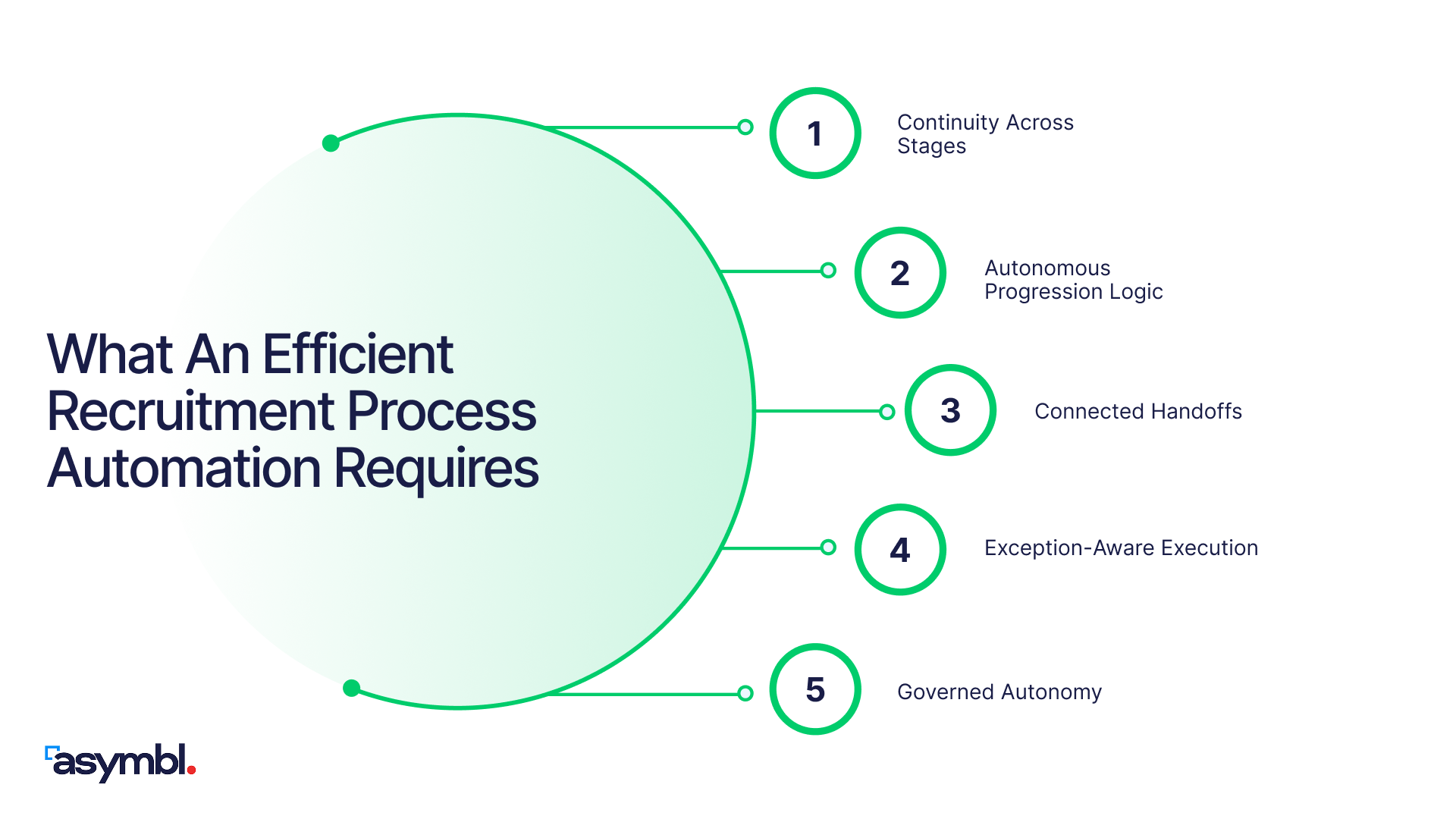
A real recruitment process automation platform looks different from a stage-automation tool with additional integrations. The architecture has to satisfy five structural requirements that determine whether the workflow can actually run with continuity, autonomy, and control across the full hiring cycle:
1. Continuity Across Stages
A platform whose sourcing tool, screening tool, and scheduler all live on different data models cannot deliver continuity, no matter how many integrations sit between them.
Every integration is a potential context loss, and every system change is a candidate moment when something stops being remembered.
The cost of context loss is rarely visible at the moment. It surfaces in time-to-fill drift, candidate experience inconsistency, and the periodic moment when a hiring manager asks why the firm is reaching out to a candidate the team interviewed and rejected six months ago.
Each of those moments is a downstream symptom of context that was held in one tool and not preserved in the next.
2. Autonomous Progression Logic
Stage transitions cannot wait for the recruiter to remember to trigger them manually. The system has to know that a screening outcome routes the candidate to scheduling, that a scheduling completion triggers interview prep, and that a positive interview feedback advances the candidate to the next round automatically.
This requires a platform that can read context, evaluate the rule, and decide whether the next action fires automatically or escalates to human judgment based on the specifics of the case.
A standard automation rule can move every candidate with a passing score forward. However, a platform with autonomous progression logic can move forward, hold for clarification, route to a different stakeholder, or escalate the case based on what the data actually says.
Asymbl Talent Intelligence is the learning layer underneath every recruiting workflow. It captures the judgment, context, and pattern recognition that accumulates across every workflow and decision on the platform.
Where most systems store data, Asymbl Intelligence learns from it, building a continuously richer model of what a defensible next-step decision looks like inside the organization's hiring workflow.
Digital Recruiter, Asymbl’s pre-built AI agent, operates against that intelligence, which is what allows it to advance candidates without constant prompting.
3. Connected Handoffs
Recruiting handoffs are where most of the operational time disappears because each transition involves data, decisions, and stakeholders. Each transition is also a manual moment in most automated stacks.
Connected handoffs require the platform to own every transition by design, which means the same system has to handle the data state, the decision logic, and the stakeholder routing.
The platform owns the bridge between two automated stages, with the recruiter stepping in where judgment is required.
Asymbl Digital Recruiter runs the full hiring cycle end-to-end on your Salesforce CRM data foundation, from outreach to offer drafting, and feedback summarization all happen inside the same data model.
Asymbl’s Customer Zero deployment shows the architecture in production. Rosa, Asymbl's recruiter agent built on Salesforce Agentforce, helped the firm hire 100 people in 100 days, processed 17,000 applications, pre-screened 1,800 candidates, and scheduled 800 interviews while operating at 152x ROI.
The recruiting digital worker division delivers $300,000 in projected productivity impact and reclaims 21 hours per week for the human team.
None of that output came from a recruiter manually pushing candidates between stages. The agent handles outreach generation in 30 seconds per candidate, voice qualification running 24/7, natural language ATS queries, resume screening at scale, and 100% screening compliance with full audit trail.
4. Exception-Aware Execution
A process that runs autonomously on the happy path and collapses into manual work on every edge case is not actually automated. It is automated for the easy cases, which are also the cases the recruiter needs the least help with.
The harder cases (the candidate who declined for personal reasons but stayed warm or the silver medalist who is over-qualified for the current opening) are where automation has to either resolve intelligently or escalate cleanly.
Exception-aware execution means the platform has rules for the non-standard cases, escalation logic for the cases that require judgment, and visibility for the operations leader who needs to know what was handled, what was escalated, and why.
The recruiter shouldn’t be surprised by what the system did, and the system shouldn’t be paralyzed by what the playbook did not cover.
Asymbl's Digital Recruiter operates against documented jobs to be done, motivations for success, and structured human handoffs, with the cases that fall outside the operating envelope routed to the human team automatically.
The Skills layer handles the routine cases, while Asymbl Intelligence handles the contextual decisions. The Digital Labor Advisory practice helps customers design the escalation rules so the agent runs with operational independence within the boundaries the customer sets.
5. Governed Autonomy
Autonomous execution without governance is a risk. Every automated decision has to be auditable, reversible, and tied to a defined accountability owner.
Escalations need to surface with enough context that the human can act without re-reading the entire case. Workflow changes have to be observable to operations, visible to compliance, and explainable to the candidate if asked.
Governance is the structural property that lets automation actually run independently. The functions that bought automation without governance ended up adding supervision back to compensate for the lack of control, which is how partial automation became the default outcome.
According to the same 2026 Deloitte Report, only 1 in 5 organizations has a mature governance model for autonomous AI agents.
The shortage of governance maturity is one of the clearest predictors of stalled AI implementations across enterprise functions, and recruiting is one of the most exposed because of compliance, bias mitigation, and candidate trust requirements.
Asymbl Digital Labor Advisory designs digital workers with governance, ownership, KPIs, accountable managers, and a coaching cadence built in from day one, so the autonomy is governed before it is granted.
Why "Run On Autopilot" Does Not Mean Unchecked Autonomy
The phrase "run on autopilot" has been used to sell two opposite things, where the vendor uses it to mean that an:
- AI that makes every decision without oversight
- AI that requires human approval at every step.
Both versions miss what autopilot actually delivers when it works.
Autopilot in recruiting describes a clear operating contract:
- Routine progression happens automatically without the recruiter's prompting
- Handoffs between stages move without manual chasing
- Next actions trigger without constant approval cycles
- Humans intervene where nuance, judgment, or exceptions require it
The vendors selling unbounded autonomy are setting up a compliance and quality-of-hire failure that surfaces six months into deployment.
The vendors selling automation that requires constant approval are selling a slower version of the manual process with extra software costs. Neither model is what TA leaders need.
Digital Recruiter and Asymbl Intelligence run as a connected platform on a single Salesforce-based foundation, which is the architectural property that makes governance practical.
Audit trails are not bolted on. They are the default state of the system, because every action recorded against the platform sits in the same data model that the team operates against.
What Recruitment Process Automation Should Actually Be Evaluated For
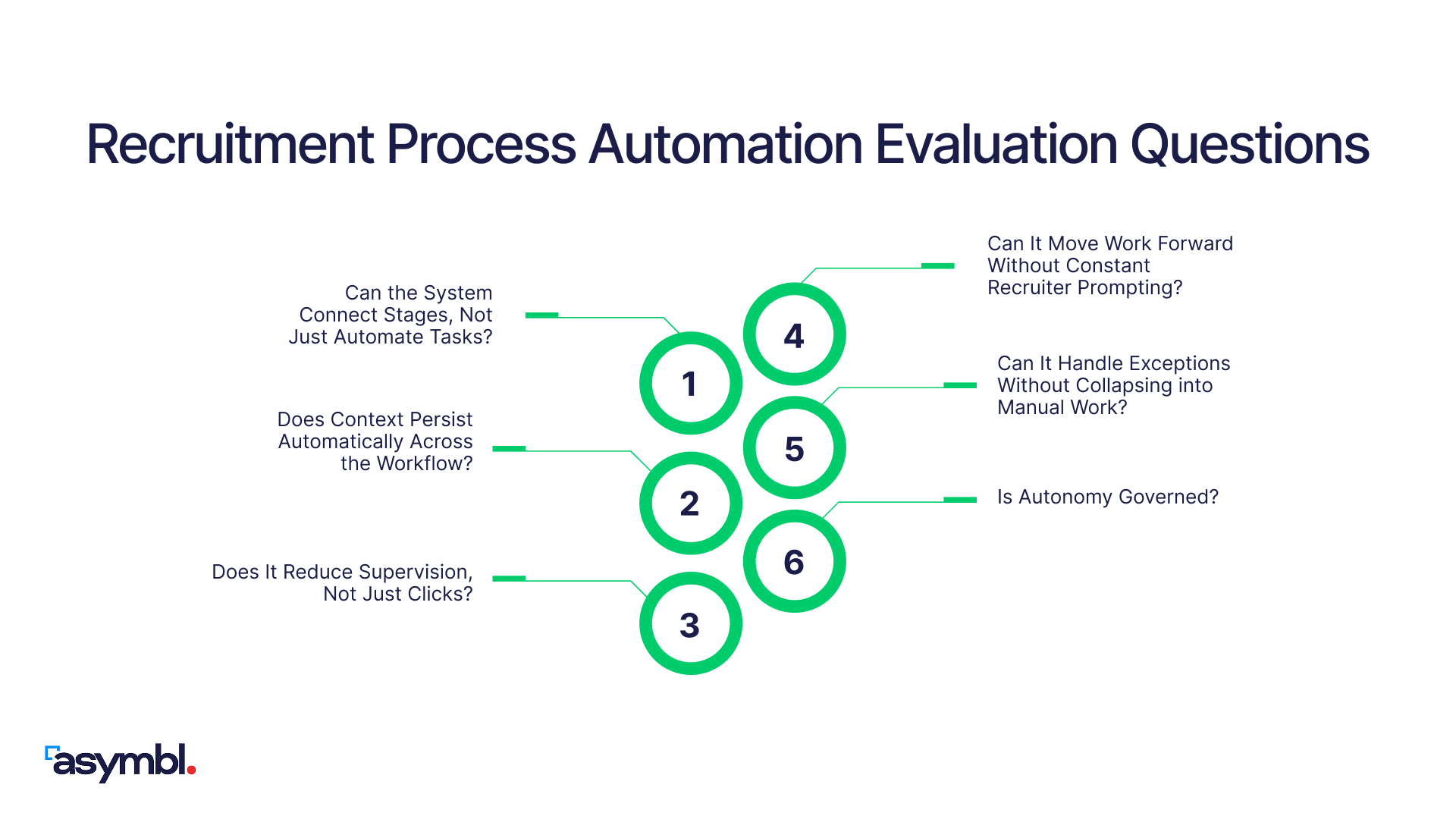
Six questions separate platforms that automate the process from platforms that automate tasks:
1. Can The System Connect Stages, Not Just Automate Tasks?
Buyers should look for connected progression logic across the recruiting lifecycle. For example, sourced interest should become an active pipeline record without a manual transfer.
A clear demonstration here is to ask the vendor to walk through, on a hypothetical role, what happens between every stage without the recruiter touching the system.
The vendors whose architecture supports process-level automation answer specifically, while the vendors whose architecture supports task-level automation redirect to feature lists.
2. Can It Move Work Forward Without Constant Recruiter Prompting?
If a recruiter has to initiate every next step, the platform delivers task automation with extra UI. Real process automation moves the candidate from screening to scheduling, the requisition from approval to posting, and the offer from drafting to delivery without continuous recruiter prompting.
A platform that requires constant approvals will scale linearly with the recruiter's working hours. A platform that moves work forward independently will scale with the requisition volume the team needs to absorb, which is the only kind of scaling that creates new capacity.
3. Does Context Persist Automatically Across The Workflow?
The third question is whether candidate history, prior decisions, engagement signals, and stage outcomes carry forward automatically.
The platform that requires a recruiter to manually annotate context at every stage transition is leaking the company's most valuable data asset, which is the cumulative understanding of every candidate the firm has touched.
This question is also the architectural test that exposes whether the platform is one system or several integrated tools. Integrated tools share data through periodic sync, whereas unified systems share data continuously, by design.
Asymbl is purpose-built based on Salesforce, which means the candidate, requisition, engagement history, prior interview outcomes, and hire decisions all live in the same primary record. Context persists automatically because there is nothing to sync.
4. Does It Reduce Supervision, Not Just Clicks?
A platform can reduce the number of clicks the recruiter performs and still leave the supervision burden untouched. The recruiter is no longer typing the message, but is now reviewing the AI-drafted message before it sends.
An efficient process automation platform reduces the recruiter's monitoring, chasing, and oversight load, which is a different category of work from clicks. The signal to look for is whether the recruiter's working day shifts from execution and supervision toward judgment, relationships, and exception handling.
If the working day still revolves around watching the system, the supervision burden moves to a different position on the screen.
5. Can It Handle Exceptions Without Collapsing Into Manual Work?
The platform should have branch logic, escalation rules, and exception routing built in, so the non-standard cases are handled inside the system rather than dumped back to the recruiter as manual work.
The vendors who pass this test demonstrate exception handling on demand. They show the escalation that fires when a candidate does not respond in the first cycle. They show the routing that triggers when a hiring manager requests an unusual evaluation. They show the override path for compliance review.
The vendors who fail this test describe the happy path in detail and treat exceptions as edge cases that the customer can configure later, which usually means the customer will configure them under pressure after a deployment surprise.
6. Is Autonomy Governed?
Buyers should evaluate ownership, auditability, controls, escalation logic, and the visibility the operations leader has into what the automation is doing and why. A platform that runs autonomously without producing an audit trail is one compliance event away from a re-implementation.
However, a platform that produces audit trails, role-based access controls, and clear ownership over each automated action gives the operations leader the structural ability to manage the automation as a governed function.
The governance question is also where most procurement processes underweight the actual risk. The vendors who pass the governance test invest in audit infrastructure, role-based access control, and operational visibility upfront, because the architecture demands it.
The vendors who fail the governance test describe their controls as roadmap items, configurable post-deployment, or partner-supported.
None of those answers survives a serious enterprise security review, and the function that signed before the review ends up running an unsanctioned automation layer that compliance has to retrofit.
Asymbl Digital Labor Advisory designs governance into every digital worker deployment from day one. KPIs, accountable managers, escalation rules, and a coaching cadence are part of the onboarding, which means the autonomy that the Digital Recruiter operates with is auditable and accountable from the first day it runs.
Conclusion
Spend a day shadowing a recruiter inside a talent acquisition function with a fully loaded automation stack, and the picture is consistent. The tools fire on time, and the reports look good.
However, the recruiter spends the day chasing the gaps between the tools, checking which automation actually ran, moving records of the integrations dropped, and approving the next step on dozens of candidates whose context the platform never captured.
That is the work process automation is built to absorb. Carrying the workflow across stages, holding the context that the integrations cannot, and triggering the next action without a recruiter sitting in the middle of every transition.
Platforms that absorb it do not look like a more aggressive version of the current stack. They run on a different data model, with progression logic the platform owns instead of the recruiter, and governance that the operations leader can audit without asking three vendors for screenshots.
If the gap between the automation you bought and the supervision your team is still doing has started to widen, that is the conversation to have.
Asymbl's Digital Labor Advisory designs the operating model before the platform questions
get answered, and Digital Recruiter and Asymbl Intelligence run the workflow on a single Salesforce-based foundation, governed from day one. Book a demo to see how it works
Reading Time to Fill: From Speed Score to Capacity Map
Break time to fill into stages to find the slow one, separate internal delay from your time to fill benchmark, and orchestrate capacity.

The Right Fit Starts With a Conversation.
See what working together could look like.
.webp)