

Staffing Firms Can't Scale on Single-Dimension Technology

Every company wants to grow quickly without wasting money, but two forces stand in the way. Skilled people are becoming harder to find, and AI has yet to deliver the returns many expected.
Underlying both challenges is the same problem: talent is no longer just about people, and that changes how work is done.
The workforce now includes AI and digital workers alongside people and enterprise software, yet most companies don’t know how to make them work as one. They layer AI onto work designed for an earlier era, then wonder why performance doesn’t improve.
Staffing firms feel this first.
Their product is talent itself, so as the workforce becomes hybrid, they’re among the first to rethink how work is organized, assigned, and delivered.
The Adecco Group and Altermind put numbers behind that problem this July. Across four modeled futures for the global labor market, three point in one direction for staffing firms: a shift from volume placement to hybrid workforce orchestration™.
With employment across OECD nations sitting at 72.1%, a near-record high, the labor market is healthy. However, fewer than one in 10 firms have integrated AI at scale.
That gap should keep staffing executives up at night.
The market is reorganizing around hybrid workforces of people and AI, yet the staffing industry's technology infrastructure was built for a version of recruiting that's already losing ground.
Asymbl was built on a single premise: staffing firms need one workforce that orchestrates hybrid teams across the full operation.
Why Does Staffing Tech Increase Coordination Costs?
The staffing technology market has, for years, been limited by specialization. The average staffing agency runs 5.5 software platforms, and only 25% have integrated most of them.
One vendor handles your applicant tracking. Another handles your CRM. A third manages your back office, and a fourth sells you AI capabilities you're supposed to bolt on top.
Each of these tools solves a real problem, yet they don’t solve the coordination problem they collectively create.
In staffing, that coordination problem hits the bottom line fast. Placements go to whoever finds the right person first, and legacy systems are too slow for that race. Sourcing, screening, and matching are being automated around firms that haven't adapted. Many firms still depend on LinkedIn and job boards for sourcing when their own systems hold the more valuable data, if it were maintained, connected, and put to work.
AI adoption among staffing agencies reached 61% in 2025, up from 48% a year earlier, according to ASA. Adoption alone isn't enough. Embedded across the full recruiting workflow, AI drives faster placements and protects margin. Their digital workers protect the spread between bill and pay, the core economics of the staffing business. The window to move first is still open. Only 10% of firms deploy digital workers across their full workflow.
The coordination cost becomes urgent when you see the scale of the opportunity. AI has created approximately 1.9 million jobs globally, roughly 1.3 million direct and 600,000 indirect. The opportunity is arriving now, in real deployments and placements. US temp hiring posted its first year-over-year gain since 2022, and staffing hours hit another 2026 high in July. And staffing firms are trying to capture it with a technology stack held together by integrations and workaround processes that break every time a vendor updates their API.
This is the real cost of "best of breed" thinking in 2026. You get the best of each category and the worst of the connections between them. A hybrid workforce creates value only when the work itself is redesigned, with each task assigned to the right person, software, or digital worker. Every worker, human or digital, needs access to the same correct data to do that work well. Redesigning that work takes a partner who understands staffing, the software, and digital labor.
Asymbl offers three capabilities within one system, delivering workforce orchestration together:
- Software to supply talent. Our software finds and hires people, supplies digital workers, and runs on a proprietary intelligence layer that makes every worker smarter.
- Enterprise AI expertise. We know where AI belongs, where it doesn't, and how to make it pay off.
- Consulting depth. Our consulting closes the gap between buying the software and the outcomes companies bought it for.
Together these capabilities deliver what none can alone. Software gives a company one modern way to hire. Expertise redesigns the work so the right work is done by the right worker across people, AI, and software. Consulting makes it real, from first design to daily operation.
Workforce Orchestration For Staffing
Staffing has always been about connecting the right person with the right work. What's changed is who's in the workforce. Digital workers now operate alongside people, and that changes how the work itself gets done. Agentic, generative, and predictive AI, along with automation, has created a new class of labor: digital labor.
Asymbl believes bringing people, AI, and software together as one hybrid workforce is workforce orchestration. When it's executed well, workforce orchestration elevates people, increases productivity, and grows profits.
And it starts by defining outcomes. What work needs to be done, who or what is best positioned to do it, and what does the new way of working look like? People focus on judgment, relationships, intuition, and oversight. AI and software handle scale, agility, automation, and consistent execution.
Once the outcomes and work strategy are defined, you need to bring them to life. That requires consulting depth to orchestrate your technology, connect and govern your data, drive adoption, and manage investment costs. It requires understanding when enterprise software is needed for reliability, security, and governance, and when AI solutions are the right choice for agility, scale, and speed.
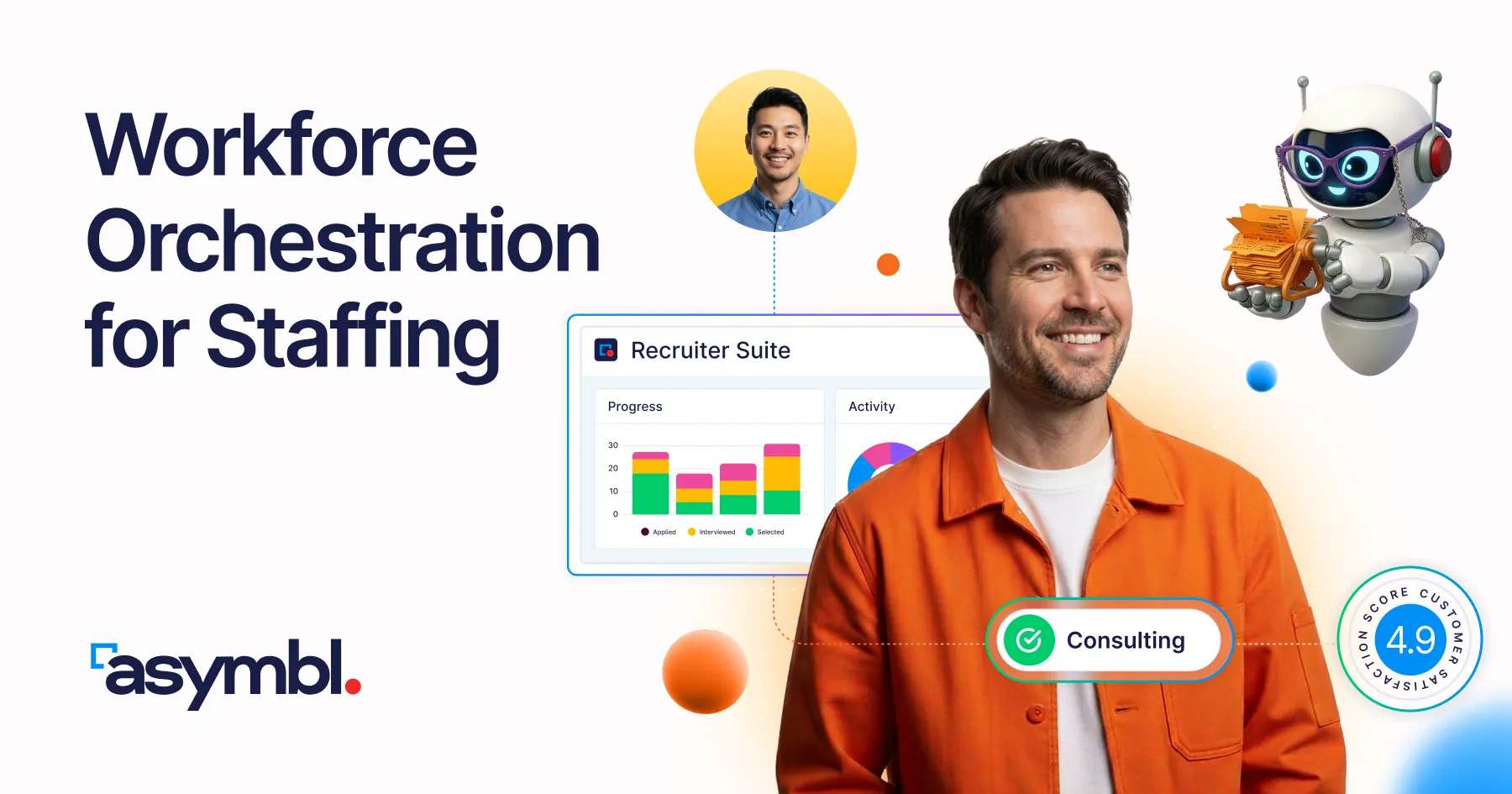
A staffing firm running Asymbl's Recruiter Suite operates within a trusted Salesforce-based platform, where its candidate records, job orders, client relationships, and placements live in the same workflow.
When that firm deploys any of our pre-built digital workers like Rosa, our Digital Recruiter handling candidate screening or Teddy, a Digital Sales Development Representative running outbound client prospecting, those teammates don't pull data from a separate system through an integration layer. They operate within the same software environment, reading and writing to the same records that human recruiters use every day. Every action is visible, auditable, and immediately available to the next person or digital worker in the workflow, and these interactions are captured as intelligence to help the hybrid team improve over time.
Building this required a team that understood staffing operations, enterprise software, data strategy, and AI deployment as one connected problem. Asymbl’s leadership has spent decades inside the staffing industry and created leading software, proven with customers in more than 40 countries, from small agencies to the largest staffing firms in the world. Our teams have worked on Salesforce for more than 20 years as users, creators, and consultants, and our consulting bench brings thousands of projects and certifications from across enterprise software.
To our competitors, one company offering software, digital labor, and consulting can look like a lack of focus. It’s the opposite. The workforce problem can’t be solved by software alone, AI alone, or consulting alone, so we bring all three together under one roof with a specific focus on staffing and talent. Asymbl is the only Salesforce Summit consulting partner dedicated exclusively to the staffing industry, and we bring more than 20 years of Salesforce ecosystem expertise to every engagement.
Our ability to innovate is how we get to outcomes: we understand what our customers need, design the solution, deliver it, and operate it. That's what staffing firms are looking for right now, and it's the work we were built to do.
Across the Adecco Group and Altermind research, a pattern holds: every firm that has integrated AI at scale built, or rebuilt, around a unified architecture first. None of them added AI to a fragmented stack and made it work. The Adecco Group is already proving this in its own operation. In its Q2 results, the company reported hitting its 50% agent-enabled revenue target and raised it to 70% by year end, running on Salesforce Agentforce across approximately 27,000 recruiters. That's the lesson. Firms choose between a unified system or an accumulating coordination tax.
Every person at your firm deserves to spend their time on relationships and judgment calls, the work that moves the business. Everything else is friction. Asymbl was built to remove it. See how at asymbl.com.
Where the Sales-to-Recruiting Gap Drains Staffing Firm Revenue
Your database is full. Your pipeline is empty. A staffing firm's data lives in four systems. See what that's really costing them.

The Right Fit Starts With a Conversation.
See what working together could look like.
.webp)