

.webp)
Corporate talent acquisition teams spend significant time and budget competing for the same candidates their peers are competing for, often discovering critical market signals only after a role opens.
By that point, the external talent map has already moved, salary anchors have shifted, and the candidates most relevant to the search are already in someone else's pipeline.
Most talent acquisition functions treat talent marketing intelligence as a research tool that activates only after a hiring need surfaces.
According to 2026 Gartner HR research, only 31% of recruiting teams use labor market data to inform their talent strategy, while the other 69% are competing without it.
In this blog, we will examine where internal workforce data goes blind, why reactive market research arrives too late to shape competitive outcomes, how talent mapping operates as continuous infrastructure rather than a one-time project, and what changes when market signal informs the reasoning layer that powers recruiting decisions.
Talent Market Intelligence Operates Where Internal Data Goes Blind
Internal workforce data tells an organization a great deal about the talent it already has, but it says almost nothing about the talent market it is competing in.
Most corporate talent acquisition functions run on data architectures that capture pipeline history, performance, and tenure with depth, while what is happening in the external market remains an annual benchmarking exercise, a recurring report subscription, or a research project commissioned when a strategic hire is on the line.
That asymmetry was workable when talent supply outpaced demand, but it is no longer workable. Quality of hire is increasingly being measured against the talent the organization could have hired alongside the talent it did hire, which makes external market visibility a precondition for the metric, instead of being a supporting context.
What the External Layer Captures
Talent market intelligence is a multi-dimensional dataset, not a single number on a dashboard. It is built from continuous monitoring across four distinct categories of external signal, each of which describes a different dimension of the market the organization is competing inside:
- Skills concentration data shows where capable talent exists at depth.
- Compensation data shows what acquiring that talent costs.
- Geographic data shows where it lives at different cost profiles.
- Competitor data shows who else is engaging with it.
None of the four answers the question on its own. Read together, they describe the competitive landscape with the precision an internal-only view cannot produce.
- Labor market supply and demand:
- Which skills are concentrated where
- How deep are specific talent pools
- How quickly supply is shrinking or growing relative to demand, and
- Where bottlenecks are forming before they show up in time-to-fill numbers.
- Salary and compensation benchmarks:
- What target candidates are actually earning at competitor organizations
- How offer competitiveness compare to current market rates, and
- Where compensation is shifting fastest by function, level, and geography.
- Geographic talent availability:
- Which cities and regions have high concentrations of target skills at different cost profiles, and
- Where hidden talent markets exist relative to current sourcing patterns, concentrated in saturated metros.
- Competitor hiring signals:
- Which organizations are scaling specific functions
- What role types are accelerating or decelerating across the competitive landscape
- Where hiring volume is being directed, and
- What talent flows between organizations reveals about strategic moves.
The four channels are not equally available in most TA functions. Compensation benchmarks are usually subscribed to. Competitor hiring signals are usually inferred from job postings.
Geographic data is usually limited to where the organization already recruits. Continuous skills demand monitoring is the rarest of the four, and it is the one with the most leverage on long-horizon decisions.
How It Differs From Talent Intelligence
Talent intelligence combines internal pipeline history, hiring outcomes, and engagement records with external market data, then applies a reasoning layer that evaluates individual candidates against open roles. The output is a candidate-level signal.
Talent market intelligence is entirely external. It does not evaluate candidates. It describes conditions, and the output is a market-level signal that informs where to source, when to source, what to pay, and which competitors to monitor.
The two are complementary. A talent acquisition function with only talent market intelligence sees the landscape but not the people who fit a role inside it, and with only talent intelligence, it sees its own pipeline clearly but cannot see what is happening in the market its pipeline is drawing from.
The most common failure mode for corporate TA is investing heavily in one and treating the other as optional. External-only investment produces dashboards that nobody acts on at decision time.
Internal-only investment produces a pipeline that compounds quality, but cannot tell the team when the market is moving against them. The two layers reinforce each other when both are present, and degrade each other's value when only one is.
Why Researching the Market After a Role Opens Is Already Too Late
The conventional approach treats talent market intelligence as a research phase that follows a hiring need. A requisition opens, sourcing begins, a market scan is commissioned to inform the search, and the team sets a strategy based on what the scan returns.
This sequence has been the default for decades. It is also the structural reason corporate TA teams are losing competitive engagements they should have won.
By the time a role opens and research begins, the market has already moved. Competitors who were monitoring continuously have built a pipeline for the same role type weeks or months earlier.
The candidates most relevant to the search have already been contacted, often more than once, by recruiters who knew their availability before the role existed. The compensation anchors the search assumes are accurate, based on benchmark data that was already months stale on the day it was published.
The research-on-demand model is not slow because TA teams are slow. It is slow because it is reactive by design. The information it produces is correct, but it arrives at the point in the process where it can shape tactics, but not outcomes.
How the Competitive Window Closes Before Most Searches Begin
In specialized skill areas, qualified candidates are typically engaged by multiple organizations within days of signaling availability.
The organizations that win those candidates are rarely the fastest to source after a role opens. They are the ones who already knew who was in the market, had been in conversation with them, and could move from interest to offer faster because the relationship was already in motion.
The competitive window is also closing measurably faster than it was two years ago. According to a 2025 Gartner HR research, 44% of prospective candidates received multiple job offers in 1Q25, down 28% from two years earlier.
Underneath the aggregate, the candidates most relevant to specialized and senior corporate roles continue to receive concurrent offers at high rates, while the broader candidate pool faces a tighter market.
The signal corporate TA teams need to act on is not the aggregate cooling. It is the concentration of competition around the candidates that matters most to a specific role type.
Competitor hiring surges for specific functions are visible in external data weeks before talent scarcity becomes apparent in the team's own sourcing funnel.
A competitor that begins hiring at volume for a specific role profile pulls candidates out of the available pool at a rate that internal sourcing analytics will register only after the easier candidates have already been engaged.
The organizations that read the surge in advance build a pipeline ahead of the scarcity. The organizations that read it through their own funnel compete at the peak of it.
This is what makes reactive market research structurally late. It correctly identifies what is happening in the market, but it identifies it at the moment when the team's options have already narrowed to whoever is left.
What Continuous Market Monitoring Changes About Pipeline Readiness
A TA team that monitors target talent pools continuously is not doing more sourcing. It is doing different sourcing, oriented around a different question. Instead of asking who can fill this role, it is asking who in the market would be relevant if a role like this opened, and how do we stay in conversation with them before it does.
.png)
The shift produces three operational changes:
- Engagement starts before demand: When a requisition is approved, the team is not opening a new search. It is activating a pipeline that has been warm for weeks or months. The candidates have heard from the organization before. The relationship is not starting from zero.
- Competitive intelligence informs timing: When a competitor begins hiring at scale for a function, the team sees the surge in advance and accelerates its own engagement before the pool depletes. Sourcing decisions become forward-looking rather than reactive to the scarcity already present in the funnel.
- Compensation strategy adjusts before offers: When market rates move in a function or geography, the team adjusts target compensation before offers are made, instead of losing candidates at the offer stage and adjusting in retrospect.
The cumulative effect is that the sourcing and awareness phases of hiring collapse. They have already been handled in the period before the role opened.
What remains is the work that only happens once a role is live:
- Matching
- Evaluation
- Decision.
That is where time-to-fill is actually spent. Compressing the sourcing and awareness phases is where time-to-fill is actually reduced.
Talent Mapping Is Infrastructure, Not a Research Exercise
Talent mapping is most often treated as a project. A senior hire is on the horizon, a new geography is being entered, or a function is being scaled, and a market scan is built to inform the move.
The deliverable is a slide deck or a database, the engagement closes, and the map ages from the day it is delivered.
It understates what talent mapping can do when it operates as a continuous organizational infrastructure rather than a one-time deliverable.
A project map is a snapshot, whereas an infrastructure map is a system that captures who is in the market for target roles, how they move between organizations, what credentials and trajectories tend to precede availability, and what engagement history exists between the candidate and the organization across years and roles.
The shift from project to infrastructure changes both what the map contains and who acts on it.
A project map is read once by the recruiter assigned to the specific search, while an infrastructure map is read continuously, by every recruiter sourcing in the function, and increasingly by the digital workers that screen and engage at scale.
What a Living Talent Map Tracks Over Time
A living talent map is built to answer questions the team will ask repeatedly, with answers that get more accurate the longer the map runs.
The data captured is a record of how a population of relevant talent has behaved over time, what signals precede movement, and how the organization has engaged with the population at every prior touchpoint.
.png)
The map tracks:
- Population composition:
- Who currently holds target roles at competitor organizations
- What their backgrounds and trajectories look like, and
- How the composition is shifting as the function evolves.
- Movement patterns:
- Which organizations are gaining talent and which are losing it for the role types being tracked
- What triggers tend to precede moves, and what the average tenure looks like at each.
- Availability signals: What public indicators tend to precede a candidate becoming open to a conversation, including company-level changes such as restructuring, leadership transitions, or strategic pivots that historically correlate with departures.
- Engagement history: Every prior contact between the organization and individuals in the map, including outreach attempts, conversations, declined opportunities, and the reasoning behind each, captured as a firm-level record that does not depend on any one recruiter's memory.
Each update to the map makes the next hire from the same talent pool faster, cheaper, and better informed than the one before. The market becomes familiar territory, and the team navigates with accumulated knowledge, rather than an unknown landscape that requires new mapping each time.
How Pre-Positioned Pipeline Changes Time-to-Fill
Time-to-fill is treated by most corporate TA teams as the variable to optimize after a role opens. Sourcing tools are tuned, recruiter capacity is added, and screening is automated, all to compress the days between requisition and offer.
Those optimizations reduce time-to-fill at the margins, but they do not change the underlying workflows.
The workflow conditions are set by how warm the pipeline is when the role opens. A pipeline that starts from zero on the day of approval has to absorb the time required for sourcing, initial outreach, awareness building, candidate consideration, and only then evaluation.
A pipeline that has been engaged for weeks or months before the role opens has already absorbed all of that work. What remains is evaluation and decision.
Pre-positioned pipeline does not just reduce time-to-fill at the aggregate level. It changes what time-to-fill numbers are even possible.
A team with pre-positioned pipeline can move from open requisition to offer for senior roles in weeks, whereas a team starting from cold sourcing would measure the same hire in months. The compression comes from removing entire phases of the process, not from accelerating them.
That compression also relieves a deeper pressure on corporate TA: the trade-off between speed and quality of hire.
When the pipeline is warm, the team is not pushed to evaluate quickly because the only candidates available are the ones who responded to inbound outreach in the last two weeks.
The team is evaluating across a population it has been tracking, with context on each candidate that exceeds what a cold search could produce in any amount of time. Quality of hire and time-to-fill stop being competing metrics. Both improve from the same underlying capability.
According to a 2024 Deloitte Private Company Outlook survey, 64% of private companies report difficulty attracting talent that matches their needs.
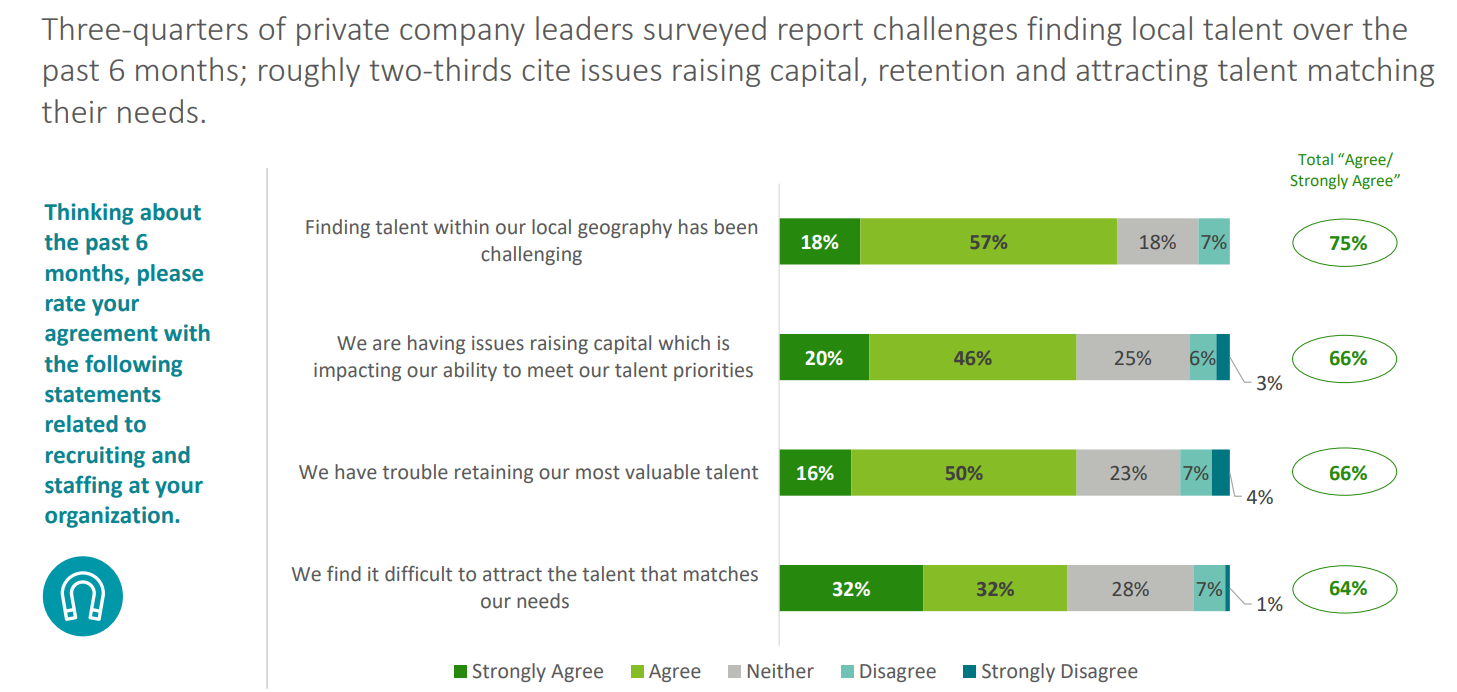
The teams that compete most effectively in that environment are the ones that have moved hiring from a reactive search to a continuously maintained relationship with the market.
Asymbl Talent Intelligence
Asymbl Talent Intelligence is the Recruiter Brain that powers the Asymbl platform. It is the reasoning layer that connects external market signals, internal pipeline history, and engagement records into a continuously improving model of candidate fit.
Market data does not live in a separate analytics tab nobody opens. It informs the same scoring and matching engine that human recruiters and digital workers operate against, every time they take an action inside the platform.
How Asymbl Turns Market Signal Into Recruiting Action
The structural problem with most talent market intelligence investments is that the data lives away from the decision.
Subscription benchmark reports, separate analytics platforms, and standalone market dashboards all produce useful information that recruiters cannot access at the moment they are making a sourcing or screening decision.
Asymbl Talent Intelligence resolves that architecture by living inside the recruiting workflow, on the same Salesforce foundation as Recruiter Suite. When a recruiter searches for a candidate, the intelligence layer is reading market context alongside the candidate record.
When a digital worker scores an inbound application, the model is weighing how the candidate's profile compares to the market the organization is competing in, not just the keywords in the job description.
The reasoning layer reads across the full talent relationship management record, so engagement history, hiring manager debriefs, and prior placement outcomes inform the scoring of every new candidate against every new role.
That same architecture is what allows Asymbl to learn from outcomes. Every placement, interview debrief, and offer that closed becomes a signal for the next decision.
The model becomes more accurate the longer it runs, because it is not reasoning against a static benchmark. It is reasoning against the organization's actual hiring patterns, calibrated against external market conditions captured continuously.
What It Means for Digital Workers at Scale
Digital workers operating without a rich intelligence foundation are doing faster keyword searches. They process more applications per hour than the same shallow signal a Boolean query has always used. The output looks like productivity, but it is not the same as judgment.
When digital workers operate on the intelligence layer that Asymbl Talent Intelligence produces, the work changes.
Rosa, Asymbl's pre-built Digital Recruiter built on Salesforce Agentforce, evaluates candidates against the full talent relationship management record.
Sourcing decisions weigh prior pipeline history, hiring manager preference patterns, and outcomes from similar past hires, alongside what the resume says and what the external market signal indicates about the candidate's profile.
Screening decisions reflect the same context. Outreach sequencing reads the engagement history that the organization has already built with candidates in the population.
The compounding effect changes what is operationally possible. The Digital Recruiter, operating on connected Talent Intelligence data inside Recruiter Suite, screened 17,000 applications, scheduled 800 interviews, and helped a two-person team hire 100 people in 100 days, with a 47% increase in fill rate and $575K in hiring cost savings.
The intelligence sat where the relationships were, and the relationships sat where the workflow ran. Every recruiter and every digital worker operated against the same record.
For corporate TA leaders being asked to deliver quality of hire, reduce time-to-fill, and prove that AI investment is producing operational capacity rather than faster output on shallow data, that architecture is the foundation on which the strategy depends.
Conclusion
Talent market intelligence is most often built as the wrong kind of capability. It is purchased as a research tool, activated when a role opens, and treated as supporting evidence for searches the team is already running.
The TA functions that compound advantage are the ones treating market intelligence as continuous infrastructure.
- The map updates as the market moves.
- The pipeline warms before demand surfaces.
- The competitive window is visible while it is still open, not after it has closed.
The reasoning layer reads the market the same way it reads internal pipeline history, so the people who do the work and the digital workers helping them are operating on the same picture of where the organization stands relative to its competition.
The teams that get there first will see the talent market clearly before their competitors do, and hire from it more efficiently when they need to. The teams that keep buying intelligence as research will keep being asked to demonstrate strategic value with information that arrives after the moment it could have shaped the outcome.
Explore what Asymbl Talent Intelligence makes possible for corporate talent acquisition teams.
With the Recruiter Brain operating on the same Salesforce data foundation as Recruiter Suite, and Rosa, the pre-built Digital Recruiter, acting on continuous market signal alongside internal pipeline history, request a demo to see how market intelligence as infrastructure changes time-to-fill, quality of hire, and recruiter capacity.
FAQs
Talent market intelligence is the continuous external discipline of monitoring labor market supply and demand, salary benchmarks, geographic talent availability, and competitor hiring patterns to inform hiring strategy before a role opens.
Talent intelligence combines internal pipeline history, hiring outcomes, and engagement records with external market data, and applies a reasoning layer to evaluate individual candidates against open roles. Talent market intelligence is entirely external and focused on market conditions rather than candidate evaluation.
Talent mapping is the practice of identifying and tracking relevant talent populations in the external market. When maintained as a continuous infrastructure rather than a one-time project, it becomes a living record of where target talent sits, how it moves between organizations, and when it is likely to become available.
Job postings show what a competitor states it is hiring for, often weeks or months after the strategy was set. Talent flow analysis shows what is actually happening. Which functions are losing talent, which are growing, where capability is concentrating, and what tenure patterns at specific organizations indicate about availability.
Reactive market research is correct but late. By the time a role opens and research begins, competitors who are continuously monitoring have already built a pipeline, engaged target candidates, and adjusted their compensation strategy. Proactive talent market intelligence runs continuously between hiring needs and accumulates signals in the period when it can shape outcomes rather than just inform tactics.
Best Talent Intelligence Software for Staffing in 2026
Compare the top talent intelligence platforms for staffing firms in 2026, the framework that fits placement economics, and vendor questions.

The Right Fit Starts With a Conversation.
See what working together could look like.
.webp)