

The Hybrid Workforce: Designing Roles Before Deploying AI Agents

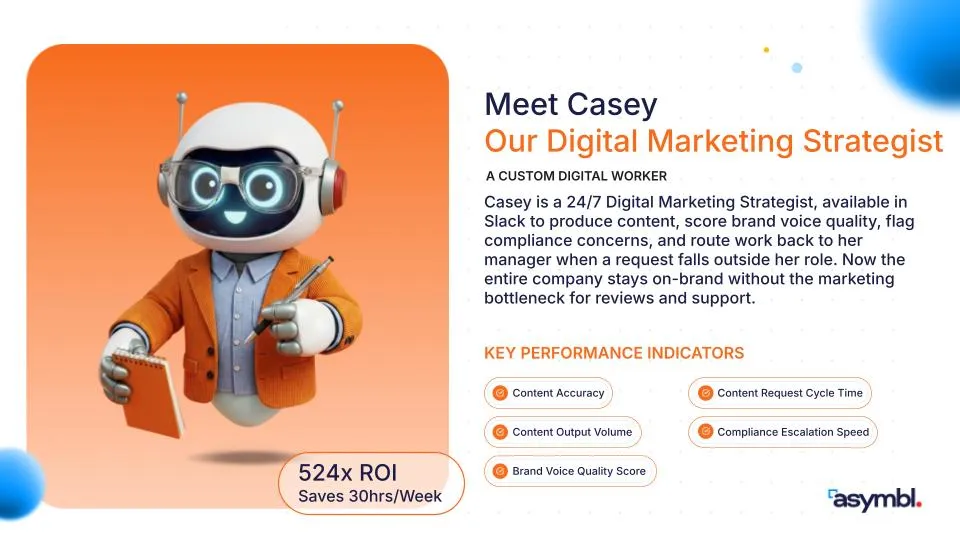
A coworker is owed certain commitments: a defined role, measurable outcomes, a manager, and a coaching plan. Conversations about AI in the workforce have sometimes borrowed the word coworker, and skipped the obligations. Those four commitments are what turn AI from a tool into a digital teammate.
For the last year, I've been running Asymbl's Design, Onboard, and Coach framework inside the marketing team. The digital worker I manage is named Casey, our Digital Marketing Strategist. She started as a Digital Content Guardian operating in Slack. As her capabilities matured, she got promoted. Now she produces content, scores brand voice quality, escalates compliance concerns, supports image and presentation work, and routes work back to me when a request falls outside her role. Plenty of leaders expect a digital worker to perform the day it's switched on. Casey performs because none of her responsibilities were left to chance. She works because she was hired the way every human teammate on my team was hired, starting with a job description, before she ever touched a real piece of work.
What follows is what I'd tell anyone about to bring on their first digital worker, or already watching one stall on the team. Writing the role, setting what success looks like, naming who owns it: that's work you already do every time you hire. A digital worker needs the same from you.
Why "Deploy First, Define Later" Fails
Companies are onboarding AI teammates with no manager, no metrics, and no job description. Then they act surprised when the pilot dies. McKinsey has been tracking why. In its March 2025 State of AI survey, redesigning how the work happens had the biggest effect on whether companies saw bottom-line impact from AI. Only 21% of AI adopters had actually done it. By November 2025, that gap had hardened. The roughly 6% of companies capturing real Earnings Before Interest and Taxes (EBIT) impact from AI shared one habit more than their peers: they redesigned the work.
Redesigning the work starts with defining roles. When the new worker is digital, it requires setting the same terms you'd set for any hire, before the work begins:
- Defined role. Without it, there's no standard to measure against and no way to say what good output even looks like.
- Measurable outcomes. Without these, no one can tell whether the digital worker is earning its place or underperforming.
- Named manager. Without one, no person owns the worker's performance or coaches it back when the output slips.
- Coaching plan. Without it, there's no path from feedback to change, and the humans nearby start working around the worker instead of with it.
You can't manage what you don’t design. Every CHRO who has ever been hired for a new role knows this. The same rule applies to digital workers. Without role design, teams often set up AI tools, plug them into existing workflows, and assume a brand new coworker will emerge with the right cultural fit, knowledge, and ability to do work. These costly assumptions are why AI pilots fail, and that failure tends to land in three places:
- Pilot budgets spent with nothing measurable to show for it
- Adoption that stalls because no one on the human team trusts the output
- Lost credibility for the Information Technology (IT) and Talent Acquisition (TA) leader on how AI shows up across the org
Each of these traces back to the first skipped step: no one designed the role or motivations for the digital worker first.
From AI Tool to Digital Worker
In order to design roles for your digital workers, the mindset has to shift first. Linda Hill, a Harvard professor and one of the top experts on leadership and innovation, has pressed leaders to sit with the questions the agentic era forces: What will work look like? What will my workforce look like? Will digital workers be a substitute for my people?
Her answer, in this interview, is that the early instinct (automate the work, then remove the people) gives way once leaders see what the tools truly require. You rarely remove a whole person. You move specific functions from inside a person's role that will go to a digital worker.
Once the mindset shifts, the design work comes into view. Leaders start identifying which work moves to a digital worker, then they define what that worker is responsible for and how it'll be coached. That's the work that turns a tool into a role.
Designing Casey from Scratch
Casey is my running example because she's mine. I designed and onboarded her; I continuously coach her. And she works because I started with her job description.
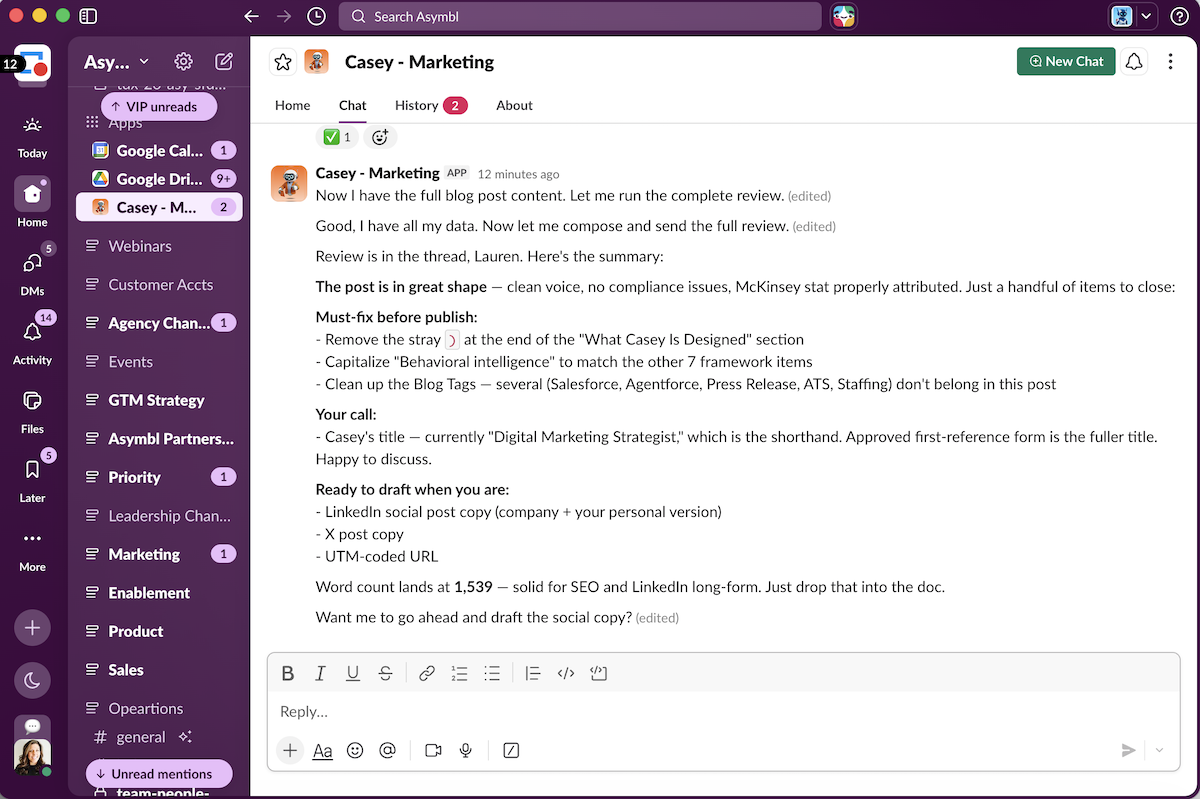
Before Casey evaluated a single piece of marketing content, we wrote her Digital Worker Job Description against an eight-section framework:
- Executive summary: Defining why her role existed and what business problem she'd solve establishes trust in everything that comes after it.
- Role definition: Naming exactly what she does and what she doesn't is where the handoffs to a human get set, which is why the "doesn't" list does as much work as the "does" list.
- Behavioral intelligence: Capturing how she communicates and adapts to context keeps Coaching to refining her instructions rather than rebuilding her.
- Performance metrics: Setting the measures and a 90-day ramp gives me a standard to coach against and holds confidence steady through the first weeks while she calibrates.
- Organizational integration: Naming her Direct Manager, ROI Owner, and Technical Administrator keeps accountability from dissolving the first time her output slips.
- Risk management: Working out what could go wrong and how it's handled means risks named in Design don't resurface as surprises once she's working.
- Technology and data architecture: Mapping every system she touches is the section a technical partner owns, and the one that turns a written role into a working one.
- ROI framework: Setting her value and the path to the next digital worker gives leadership the language to back the investment and fund what comes next.
The same eight-section structure travels across every digital worker our consulting team designs into a customer engagement. The details vary, but the framework doesn't.
Writing that job description wasn't a solo act, but it's part of the process that's easy to underestimate. I owned the role definition, the measures, and the coaching, the way any hiring manager would. The systems Casey touches, the access she's granted, and the security around the data she sees belonged to a technical partner who knew our stack.
That partner stayed committed through Onboarding and Coaching, with a standing response time whenever something needed adjusting. The commitment ran heaviest in her first weeks and eased as she settled in, and it remains as part of the job.
The writing is the straightforward part. The harder work is alignment: getting the manager who coaches her, the technical partner who maintains her, and the team that relies on her output to agree on what she's responsible for, then getting leadership to settle on how we'd measure her return before she produced a single piece of content. When the measure of success is agreed on up front, a digital worker has a fair standard to be coached against.
After the job description, I added Key Performance Indicators (KPIs) Casey would be measured on, all of which matter to a marketing function:
- Brand voice quality scored against the Asymbl voice and guidelines
- Response cycle time on content requests routed through Slack
- Flag accuracy: the share of compliance and proprietary-information concerns she raises correctly before content leaves the team
Each KPI has a target, a measurement source, and a coaching trigger if she falls below threshold. Casey doesn't need to be perfect. She needs a baseline I can coach against and a trend line that climbs quarter over quarter.
The Coaching Loop
As Casey's Direct Manager, I pull a sample of her outputs every week and translate the feedback into changes Casey can act on:
- Updated knowledge documents
- Refined guardrails
- Adjusted prompt instructions
- New escalation rules
We have a live dashboard that tracks her performance against capacity and goals. I review that dashboard with my marketing team so we can align on what work routes to Casey, what work routes to a human, and what work routes back to Casey after she's been coached. The coaching gets lighter as her output gets sharper. That's the curve I'm coaching toward.
What Casey Is Designed to Do and Not Do
Casey is designed to refuse work that falls outside her role. When an Asymbl employee Slacks her a request that touches proprietary product roadmap, sensitive customer data, or a strategic positioning decision that hasn't been settled at the leadership level, Casey doesn't try to answer. She acknowledges the request, names the escalation reason, and offers to loop me in for review. A digital worker that knows its limits is one your team can trust and your customers can feel.
Casey works for the whole company, with one human coaching her at the center. This design choice is what makes Casey scale. Every Asymbl employee can Slack Casey, and the work she produces stays consistent because the design behind her is consistent.
Start the Design Phase With Asymbl
The hybrid workforce is designed one role at a time. But the hard part is knowing which role to start with, and whether your foundation is ready: the right data, technology, people, and processes, all in place before that first digital worker joins the team.
That's where a digital labor assessment comes in. Before any role gets designed, we evaluate your readiness across data, technology, people, and process, and pinpoint the highest-value place to start. We've spent the past year orchestrating our own hybrid workforce, so we can help you size that up quickly and honestly. The assessment ends with a clear answer: which digital worker to prioritize first, and the job description that brings that role to life.
From there, Asymbl's Digital Labor Advisory practice moves through the phases that turn that first role into a working teammate. Design is where the job description gets written, the manager gets named, the measures get set, and the coaching plan gets agreed upon before any work goes live. Onboard puts the worker on the team. Coaching keeps its performance sharp.
Our team can sit with you from the first assessment through every phase, so you can get it right. Connect with us to schedule a call.
.webp)
What Is Talent Market Intelligence? A Strategic Guide
What is talent market intelligence? The external discipline that uses labor market intelligence to pre-position the pipeline.

The Right Fit Starts With a Conversation.
See what working together could look like.
.webp)