

Why Recruiters Should Be Running Talent on Their Business OS and Not Another Point Solution

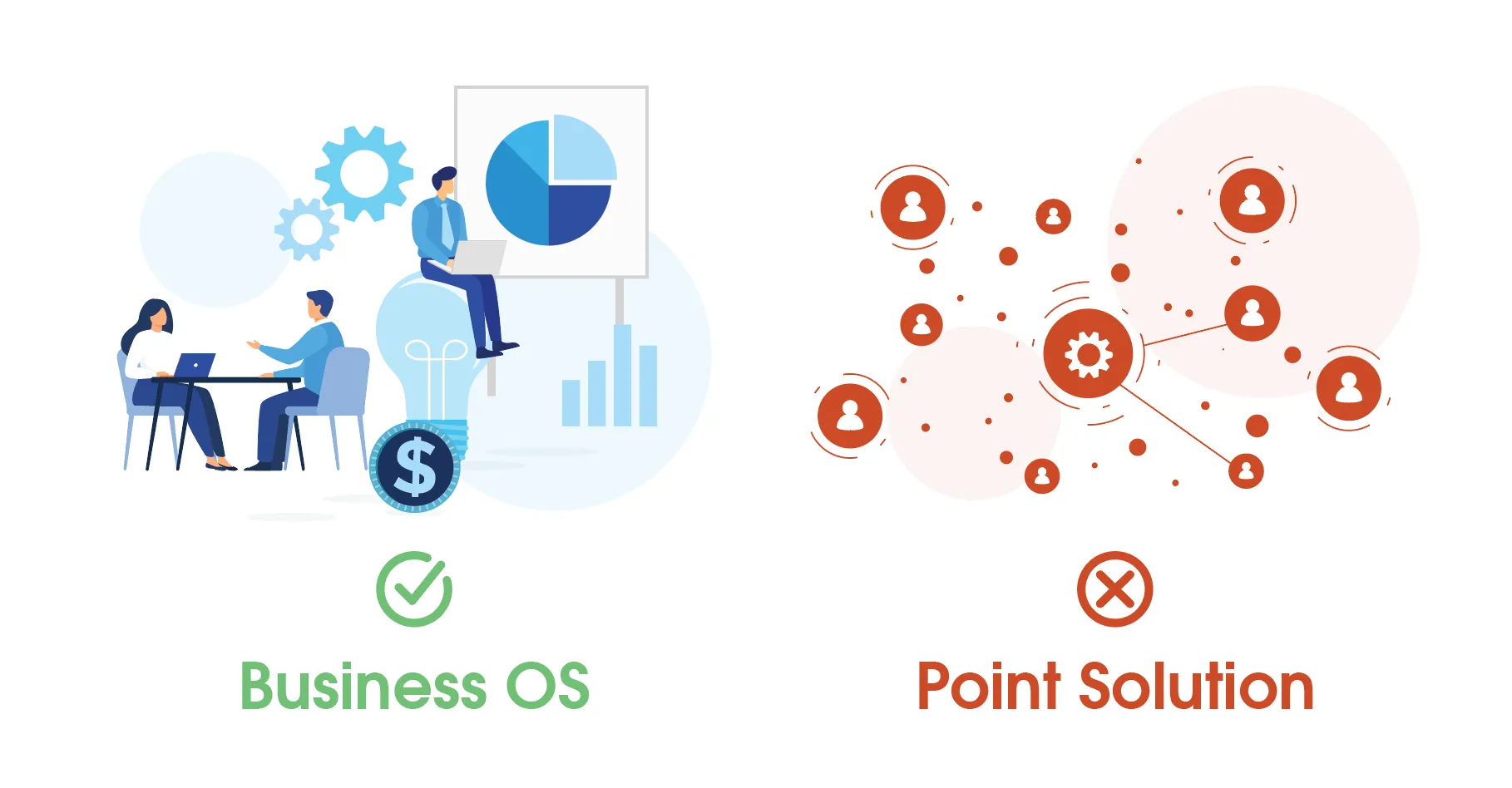
If recruiting is your company’s growth engine, why does it run like a sideshow?
Most organizations have already unified their business operations onto a single operating system because it creates visibility, automation, and predictability at scale. But, recruiting has been left behind. It’s still powered by a patchwork of tools: an ATS for transactions, spreadsheets for reporting, email for coordination, and point solutions for everything else. It’s why hiring feels reactive. It’s why strategic planning relies on vibes instead of visibility. And it’s why recruiters end up holding the process together with workarounds, hustle, and heroics.
That approach isn’t a reliable or sustainable engine for producing your organization’s most important asset. We all know that heroics don’t scale and we need to build infrastructure that can support a changing business. When recruiting sits outside the business OS, talent leaders lose what other executives take for granted: a shared data model, automated workflows, and reliable forecasting. If your business already trusts Salesforce, why wouldn’t recruiters want to take advantage of the same infrastructure the rest of the business is using.
So, your next question isn’t, “What ATS do we buy?” it’s: what problem did Salesforce solve for every other function, and why hasn’t recruiting benefited from that same model?
CRMs Are Operating Systems for Work
Sales, service, and marketing consolidated onto platforms like Salesforce because work became too complex, and too data-driven to manage across disconnected tools. They needed a shared system of record and an operating backbone where data, workflows, and outcomes could be visible, measurable, and governable across teams, and where shared intelligence could compound over time.
Recruiting faces the same reality because hiring is a multi-stage process with inputs, handoffs, decisions, and outcomes. Through the process recruiters generate critical data about skills, capacity, and workforce risk. When recruiting is disconnected from its organization’s unified operating system, business intelligence is fragmented and incomplete, automation remains shallow, and teams are forced to compensate manually.
Unification is how companies finally unlock the value of the platforms they already own. If recruiting is a growth engine, it deserves the same operational rigor, visibility, and forecasting the business expects everywhere else.
Pipelines Don’t Run on ATS Point Solutions
An ATS was never designed to be your talent operating system. It doesn’t behave like one, scale like one, or integrate like one. And yet many organizations still ask recruiting teams to run workforce decisions across separate, siloed systems. When data is fragmented, the result is predictable: costly mistakes, slower execution, and decisions made without a complete view of the business. And when hiring velocity slows, your business pays in missed capacity, missed growth, and missed outcomes.
When recruiting runs on point solutions, you absorb the cost in:
- Governance Risk: When workforce decisions are made from disconnected systems, high-impact contributions can disappear from view and leaders are forced to act on incomplete information. That creates space for subjectivity, influence, and internal politics to shape outcomes. A unified system reduces that risk, strengthens auditability, and makes decisions more equitable and defensible.
- Workforce Reporting Integrity (DEI, Compliance, and Auditability): Too often, talent leaders are forced to make high-stakes workforce decisions using data they can’t fully validate because it’s incomplete, inconsistent, and spread across systems.
- Workforce Capacity Planning Becomes Guesswork: Talent teams are expected to commit to growth plans without a unified pipeline view, making forecasts harder to trust and resourcing decisions harder to defend.
- Duplicated Spend and Vendor Waste (“Double Pay”): Budgets tighten while organizations still pay external agencies for candidates who already exist in their ecosystem, but aren’t visible because records live in disconnected databases.
- Talent Relationship Leakage (“Silver Medalists”): It’s expensive to generate top-of-funnel awareness and equally costly to let pre-vetted, high-quality finalists disappear simply because the system isn’t designed to retain and reactivate them.
- Inconsistent Candidate Experience: Fragmented systems create delays, inconsistencies, and missed handoffs, driving top candidates to employers who move with speed and coordination.
AI adoption stalls because fragmentation turns workforce data into a black box and keeps automation from scaling. AI stays trapped in pilot purgatory, while recruiters spend their time coordinating across tools instead of orchestrating the hiring engine. That won’t hold in a world of hybrid teams, where humans and digital workers operate side by side.
Even when companies invest in powerful platforms, complexity and technical debt often prevent those systems from reaching full capacity. McKinsey found that CIOs estimate technical debt represents 20 to 40 percent of the value of their core technology environment, creating drag that turns high-potential platforms into underused investments that quietly become shelfware.
Scale Requires Intelligent Systems
Without unified infrastructure and a single source of truth, the systems problem shows up fast. Adoption slows, integration debt piles up, and the platforms companies pay for never reach full capacity. At scale, a talent operating system needs to move beyond its role as a system of record and start acting like growth-enabling infrastructure with a baseline set of requirements:
- Bidirectional Data Flow: A scaled system cannot let data sit in a record. It must move in real time between sourcing, marketing, and core HRIS tools so recruiters are never operating from outdated information.
- Passive Talent Capitalization: The system must treat the existing database as an appreciating asset, surfacing internal and past candidates through intelligent discovery instead of treating every new req like a cold-start acquisition project.
- Operational Telemetry: Beyond time-to-fill, an operating system must show the health of the hiring engine, including interviewer load, bottlenecks, and channel ROI, so teams can course-correct mid-quarter rather than after the fact.
- Centralized Governance with Local Agility: Global teams need shared data standards and brand guidelines, while recruiters need automated tools to personalize outreach at high volume without breaking governance.
- Enterprise-Grade Auditability: Compliance cannot be a manual burden. The system must provide a complete, automated trail of candidate touchpoints to support legal review, auditability, and reporting integrity.
A talent OS with this structure is ready to build for a future workforce and scale with it. This is exactly what Asymbl Recruiter Suite on Salesforce is designed to support.
Asymbl Recruiter Suite: A Salesforce-Based System for End-to-End Hiring
Your business already has an operating system. The question is whether talent will run inside it or outside it.
Asymbl Recruiter Suite is a Salesforce-based recruiting system that brings end-to-end hiring onto the same operating platform your business already runs on. Talent data becomes part of the same intelligence layer leaders use to run revenue, service, and operations, rather than being a separate stack recruiters reconcile by hand.
This is a logical adoption. Recruiters aren’t starting from zero. For teams already fluent in Salesforce workflows, the shift is closer to moving from one to ten, not zero to one. That leverage frees recruiters to focus on higher-value work, including building human-centric job definitions that remain defensible as hybrid teams of humans and digital workers become the norm.
When hiring runs on the same operating system, you unlock:
- Unified intelligence and forecasting. Decisions are made from connected, current data. Leaders can trust the numbers and trace decisions back to source. Pipeline health, risk signals, and leading indicators make hiring forecastable like revenue, turning capacity planning into a first-class input for growth investments, not an afterthought.
- Talent data connected to revenue. This changes how leaders make growth decisions. Hiring more people isn’t always the answer, especially in sales, where adding headcount can dilute the customer pool and ramp time delays productivity. With talent intelligence connected to revenue signals, CROs can evaluate whether the right move is changing comp plans, rebalancing territories, or hiring more sellers. That decision only works when the CHRO is operating inside the same system as revenue leadership.
- Human and digital worker orchestration. As a result of this, a recruiter can review a five-page resume in minutes, generate a structured interview guide tailored to the role, and draft a calibrated assessment based on interview notes and transcripts. Instead of spending hours on administrative synthesis, they deliver a near-ready hiring recommendation quickly and consistently. The result is recruiters doing more of the work that requires judgment, context, and human trust.
- Smarter workforce decisions. When workforce decisions are made inside a connected operating system, leaders can see what work is being done, what outcomes it drives, and where digital assistance can improve productivity. Instead of defaulting to cuts, companies can refactor roles, redesign work, and reduce attrition by ensuring better role fit and clarity.
The future of people operations won't come from another point solution. It’ll come from bringing recruiting onto the same operating system that already runs your business, and equipping talent teams to operate with the same sophistication as every other function.
.webp)
Workforce Orchestration in Recruiting: A Guide for Corporate TA Teams
Corporate recruiting overload isn’t solved by more AI tools; it requires workforce orchestration. Learn how a hybrid workforce of digital and human teammates transforms end to end talent acquisition at scale.
The Right Fit Starts With a Conversation.
See what working together could look like.
.webp)