

.webp)
Most enterprises invest in AI for recruiting, pilots get launched, the tools get configured, and the demos go well. Twelve months later, the productivity gain doesn’t materialize at the system level, even when the individual tools work as advertised.
AI in recruitment has been, historically, treated as a set of features that improve individual steps in the hiring process. Sourcing got an AI tool. Screening got an AI tool. Outreach got an AI tool.
Each one solves a different problem, and each one ships outputs into a recruiting environment that was never redesigned around what AI can actually do.
It results in a stack of capabilities operating in isolation, generating partial value that the recruiting function cannot compound. Most leaders feel it is a paradox. More tools, more activity, but the same output.
In this blog, we will examine the current state of AI in recruitment, the structural reasons most implementations stall, the shift required to build an intelligent hiring system, the eight practical patterns that move AI from features to system, and a sequenced path to implement the shift without breaking the recruiting function in the process.
The Current State Of AI In Recruitment
According to the “State of AI in the Enterprise: The Untapped Edge” 2026 Report by Deloitte, workforce access to AI expanded by 50% in a single year, from under 40% of workers to roughly 60% now equipped with sanctioned AI tools.
Inside HR specifically, recruiting is the most common AI use case, accounting for 27% of HR's AI footprint. HR budgets are constrained at the same time as AI investment in HR is growing.
According to a 2026 Gartner Survey on AI & Technology Budget Trends, only 29% of CFOs are planning HR budget increases for 2026, while 22% expect cuts. Inside that constrained budget, AI is absorbing the capacity work that would otherwise require headcount.
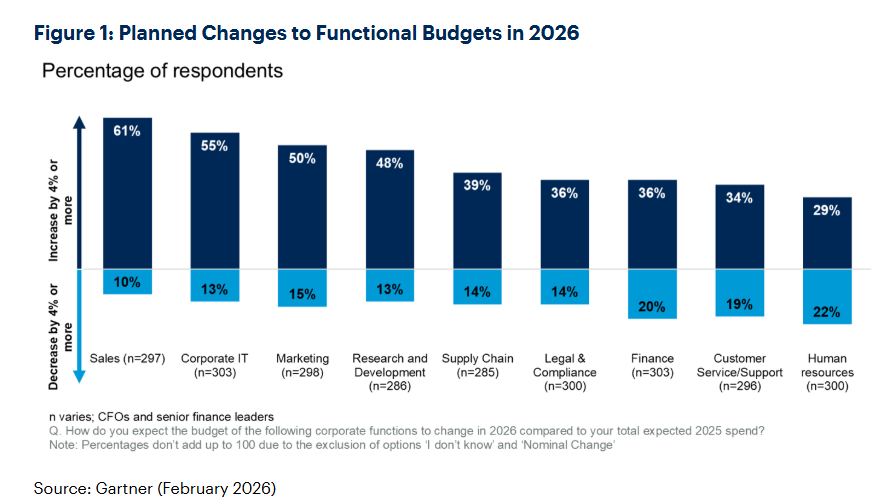
Recruiters are expected to do more with the same or smaller teams, and the AI stack is filling the difference. However, the returns on that bet are uneven.
The same 2026 Deloitte Report on State of AI notes that 66% of organizations are seeing productivity gains from AI, whereas according to another 2025 Deloitte Report on AI ROI, roughly 1 in 5 organizations qualify as AI ROI Leaders despite rising investment.
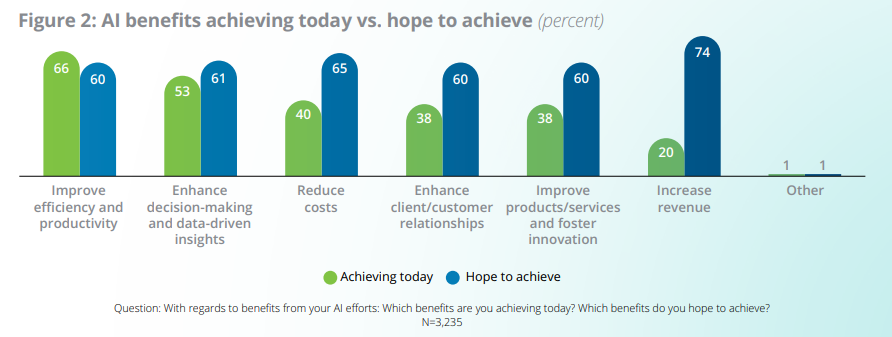
The gap traces back to a root cause that runs underneath every AI deployment in recruiting. Most implementations are operating inside an architecture that the technology was never going to fix on its own, and the small group seeing real returns is the group that redesigned the architecture before deploying the AI.
A typical AI stack in recruitment includes:
- Sourcing tools that surface candidates from external databases, social platforms, and passive talent pools.
- Screening tools that rank applications against job criteria.
- Chatbots that field candidate questions and capture intake responses around the clock.
- Scheduling assistants that coordinate interview availability and calendar invites.
Each of these tools solves a different problem in isolation. Sourcing tools surface candidates that the recruiter would never find through manual search. Screening tools rank resumes faster than a recruiter can. Chatbots field FAQ-level candidate questions around the clock.
AI Agents that work in isolation produce a recruiting environment where data is not shared, workflows stay disconnected, and the AI layer never compounds across stages.
The recruiting function ends up with AI as a layer of add-ons sitting on top of legacy infrastructure that was never designed to streamline it.
Why This Approach Is Failing (Even When The Technology Works)
A common pattern that shows up consistently across enterprise recruiting functions is that the teams invest in tools, adopt them, and use them. However, six months in, they realize that the pipeline quality, hiring predictability, and time-to-fill still remain the same.
.png)
The AI is doing its job, but the architecture that supports these AI tools isn’t. Five structural gaps explain why this happens, even when every individual tool in the stack is working exactly as advertised.
1. Fragmented Data Breaks Intelligence
AI depends on context to produce meaningful outcomes. The richer and more complete the data, the more accurate the inference.
Recruiting data inside most enterprises is the opposite of complete. It sits split across an applicant tracking system (ATS), a candidate relationship management (CRM) tool, separate sourcing platforms, and spreadsheets that operations teams maintain by hand.
Each AI tool plugged into that environment sees only a slice of the candidate journey. While the sourcing tool sees the candidates it found, the screening tool sees applications, and the chatbot sees conversations. However, none of them sees the full record.
When intelligence operates on partial data, the outputs are partial too. Decisions get made on incomplete signals, resulting in degraded accuracy.
The same candidate often gets ranked differently by two tools because each tool is reading a different fragment of the underlying record. The intelligence is present, but the data foundation underneath it is too fractured for the intelligence to do its job efficiently.
2. No Continuity Across Workflows
Recruiting is a connected process across stages. For example:
- Sourcing leads into engagement
- Engagement in screening
- Screening into interviewing
- Interviewing into offer.
Each stage produces signals that should inform the next.
Most recruiting systems handle each stage as an isolated workflow with its own tooling. Sourcing happens in the sourcing tool, while screening happens in the ATS, and engagement happens in the email automation tool. Each workflow is internally complete but externally disconnected from the others.
The result is that each stage resets context instead of building on it. A candidate who got engaged through a thoughtful sourcing campaign arrives at the screening stage as a row of resume fields. The screening tool ranks them on the resume.
Whatever signal the engagement campaign produced is invisible at this stage, and the screening tool's ranking is invisible to the engagement system later. The funnel does not compound because it restarts at every stage.
3. Undefined Role Of AI
In most recruiting environments, AI is often deployed without anyone defining what AI is responsible for, what humans are responsible for, or how AI's performance gets measured.
It results in operational ambiguity. For example:
- When the AI screening tool surfaces a candidate, is the recruiter supposed to trust the ranking, override it, or audit it?
- When the chatbot answers a candidate's question incorrectly, who notices?
- When the scheduling assistant mishandles a calendar conflict, who escalates?
- In a system without defined roles, every one of these questions falls to the recruiter to figure out in real time.
AI without a defined operational role produces outputs that the team has to validate, instead of a capacity that the team can rely on. Until the role is named, accountable, and measured, AI cannot become a contributor to the recruiting function. It remains an experiment that the recruiters are managing on top of their actual jobs.
4. Efficiency Without System Impact
AI tools deliver efficiency by reducing the time recruiters spend on individual tasks.
According to the 2025 McKinsey State of AI Report, 88% of organizations now report regular AI use in at least one business function, and the time savings inside individual workflows are positive.
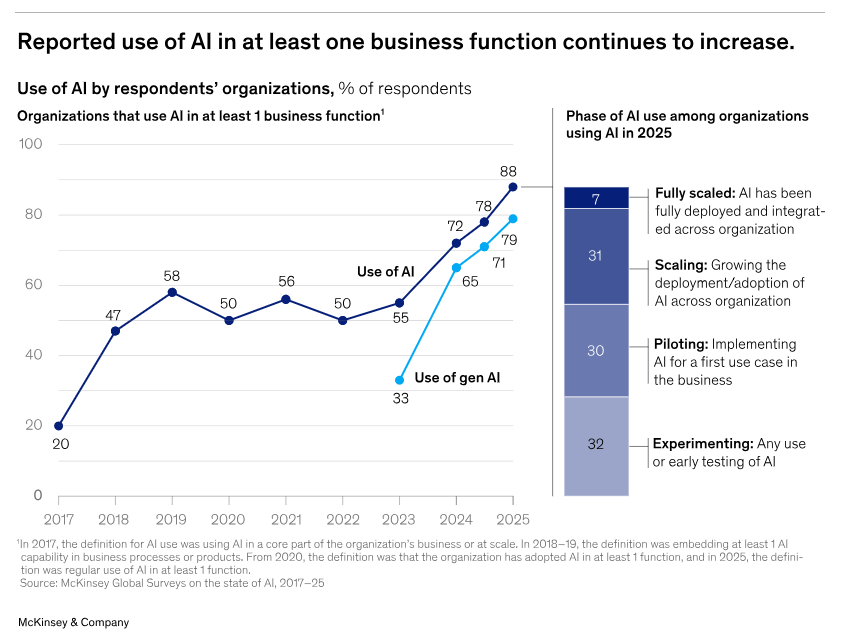
However, the system-level outcomes tell a different story. Time saved at one stage rarely translates into better outcomes at the next.
For example, a recruiter who screens twice as fast still produces the same pipeline quality if the screening criteria do not change. A scheduling tool that books interviews in seconds still books the same interviews against the same hiring manager bottlenecks.
The efficiency lives at the task level, and the constraint lives at the system level. Until the system gets redesigned around the new task speeds, efficiency gains stay local, pipeline quality, and hiring predictability hold steady. Capacity does not scale meaningfully because the design that constrains capacity has not changed.
5. Tool Layering Increases Complexity
Each new AI tool adds a layer to an already-complex stack. Although the intent is simplification, letting the tool handle the repetitive work, the effect runs in the opposite direction.
With more AI tools, recruiters switch between more interfaces, rather than fewer. They reconcile data between more systems and learn more vendor workflows. The cognitive load grows with the tool count.
The teams that feel this most are the ones running multiple AI tools, such as sourcing AI, matching AI, screening AI, and a chatbot, at once. Each tool has its own configuration, own quirks, own data exports, and own dashboard. Recruiters become responsible for stitching outputs together into a coherent candidate view.
Layering tools produces a fragmented operational surface where the recruiter ends up serving as the integration layer between AI tools that should have been part of the same system to begin with.
Why No One Is Rethinking The System (And Why That's Risky)
If the system-level limitations are visible, the obvious question is why the model persists. The answer is that the entire ecosystem reinforces it.
Vendors, buyers, legacy infrastructure, internal change appetite, and the prevailing mental model of what AI is for all push toward feature adoption and away from system redesign.
1. Market Incentives Favor Feature Innovation
Vendors compete on capabilities like:
- Faster parsing
- Better matching
- Smarter automation
- Voice interfaces
- Agentic flows.
Very few vendors compete on system design or operating-model transformation, because the buying motion does not currently reward it.
The innovation is fragmented by default, and the market produces more point solutions every year. Each one solves a specific problem better than the last generation, but not one of them solves the integration problem the buyer is going to face after the third tool ships into production.
2. Buyers Think In Tools, Not Operating Models
Most TA teams approach AI with a tactical question. Which tool should we add next? The structural question, how should recruiting work as a system, does not appear on the procurement form.
The reason is often institutional because tools are budgeted, procured, and rolled out by category. Operating-model redesign is not a procurement category, but a strategy project, and most TA functions do not have the mandate, the timeline, or the political cover to run a strategy project on top of their hiring targets.
Tactical adoption is what gets approved, while system redesign is what gets postponed.
3. Legacy System Constraints
Existing architectures, especially the ATS and the CRM, were designed before AI was a workforce input. Their data models assume requisitions are the unit of work, while workflows assume human recruiters drive every stage.
Putting AI on top of those systems does not change the assumptions baked into them. The AI works against the legacy data model rather than reshaping it. Continuous data flow, persistent talent records, and AI-native execution all require an architecture that the legacy stack was not designed to support.
4. Fear Of Disruption
Hiring is business-critical, where roles get filled, revenue gets booked, and projects get delivered. The cost of a recruiting outage is high and immediate.
Redesigning a recruiting system feels like inviting that outage. Adding a tool feels safe because it sits on top of what already works. Rebuilding the system feels risky because the existing system is what is producing this quarter's hires.
Most leaders default to the safer move, even when they know the safer move compounds the underlying problem.
5. Misunderstanding AI's Role
AI is widely viewed as an enhancement, an assistant, a productivity tool. The framing is so default that most teams do not even notice they are using it. The framing limits what AI can become inside the recruiting function.
When AI gets framed as a productivity tool, it gets treated as a productivity tool. It saves time on tasks, but does not get a job description, a manager, accountability, or a coaching loop.
It does not become a workforce contributor capable of executing defined responsibilities. It stays software, and the recruiting function never gets the structural capacity that would come from treating it as a worker.
AI As An Intelligent Recruitment System
The change begins by redefining what AI actually is in recruiting. AI is the foundation of an intelligent system, not a stack of features bolted onto a fragmented one.
In an intelligent recruitment system, three properties hold across the whole environment:
- Unified data that maintains continuous candidate context across every stage and every tool.
- Connected workflows that carry insights forward instead of resetting at each stage boundary.
- Defined roles where digital workers handle execution and human recruiters focus on judgment, relationships, and decisions that require context.
This creates a different and streamlined structure of work. Recruiters stop being responsible for every step, while digital workers handle repeatable, high-volume execution under a defined operational role.
Human recruiters focus on the work that requires judgment, including hiring manager calibration, candidate trust, complex evaluations, and offer decisions.
The system as a whole becomes interconnected, continuously learning, and capable of scaling without proportional increases in human effort.
Asymbl Intelligence is the layer that makes this learning easier. It captures the judgment, context, and pattern recognition that accumulates across every workflow and decision, and makes that signal available to every digital worker and every human teammate operating on the platform. The system gets smarter the more your team uses it.
AI In Recruitment: 8 Practical Ways To Build An Intelligent Hiring Engine
Each of these eight patterns represents a connected capability inside an intelligent recruitment system. They assume the data, workflow, and governance properties named above are in place. Together, they describe what AI in recruitment actually looks like when it operates as a system.
1. From Job Posts To Talent Pipelines: Always-On Candidate Discovery
Traditional sourcing waits for applications to source and match candidates, whereas an intelligent recruitment system runs sourcing continuously, independent of any specific requisition.
Digital workers scan internal alumni, silver medalists, internal mobility candidates, and external talent pools every day. They surface candidates whose profiles match anticipated roles before the requisition opens.
Asymbl Talent Intelligence is the Recruiter Brain powering this motion. It scores candidates against jobs and jobs against candidates using pipeline history, interview feedback, assignment outcomes, and the unstructured documents that most ATS platforms store but never learn from.
The AI Matching Engine highlights top talent across available, in-contact, and prior placement pools, so digital workers and recruiters work from fit and likelihood, not keyword overlap.
Every placement, debrief, and outcome feeds back into the model. The data the firm already owns turns from a static record into a continuously improving signal of candidate fit.
Sourcing becomes a continuous discovery motion that produces a warm pipeline at the moment the recruiter actually needs it
Sourcing becomes a continuous discovery motion that produces a warm pipeline at the moment the recruiter actually needs it.
2. From Keywords To Signals: Smarter Candidate Matching And Prioritization
Keyword matching is the lowest-fidelity form of candidate evaluation because it compares words on a resume to words in a job description. It misses context, trajectory, prior performance, and the institutional knowledge that experienced recruiters carry in their heads.
An intelligent matching layer evaluates fit across signals, instead of strings. Pipeline history, prior interview feedback, assignment outcomes, candidate behavior across engagement campaigns, and your organization's own historical placement data all feed the match score.
Asymbl Talent Intelligence is the reasoning layer that operates on these signals. It scores candidates against jobs and jobs against candidate profiles using AI fit analysis, surfaces top talent across available, in-contact, and prior placement pools, and returns a structured breakdown of why a candidate fits a role.
With Talent Intelligent, recruiters stop hunting through search results and start working from a prioritized, context-driven view of the right talent at the right time.
3. From Outreach To Engagement Systems: Personalized Communication At Scale
Manual outreach hits a ceiling fast because it relies on a human recruiter’s capacity. For example, a recruiter can personalize 30 messages a day before their quality/capacity drops.
At enterprise scale, the talent the firm should be engaging in a day is often in the thousands. A connected engagement system uses AI to personalize outreach at the candidate level using the business's own data.
Asymbl Digital Recruiter is built for this engagement motion. It scales personalized outreach across large talent pools, with messaging tailored automatically to each candidate's profile and the role requirements, and keeps conversations active through automated follow-up and re-engagement.
Recruiters set the strategy, while the digital recruiter handles the volume. It shifts outreach from a recruiter-bound activity to a continuous communication layer, removing one of the largest sources of time-to-fill variability in enterprise hiring
Each candidate receives messaging tailored to their background, the role under consideration, and their prior interactions with the company. Engagement runs continuously, with sequencing, follow-up, and re-engagement handled inside a single system that sees the full candidate record.
This transforms outreach from a campaign motion to an engagement infrastructure. Candidates receive timely, relevant communication without recruiters writing each message, while recruiters focus on the conversations that require judgment.
4. From Resume Screening To Structured Qualification
Manual resume screening is one of the most expensive and least consistent activities in recruiting because two recruiters reading the same resume might disagree.
The same recruiter reading the same resume on different days often disagrees with themselves. Variance compounds across hundreds of applications per role.
An intelligent recruitment system runs structured qualifications through a digital worker that applies consistent criteria to every application.
Asymbl Digital Recruiter uses Talent Intelligence to score inbound applications against job criteria, surfaces the strongest candidates for recruiter review, and returns a clear breakdown of how each candidate maps to what the role demands.
Every application gets a consistent first pass, and every strong candidate gets seen. The recruiter still owns the final call, but the variance, the time cost, and the risk of inconsistency move out of the recruiter's calendar.
5. From Scheduling Chaos To Coordinated Workflow Execution
Interview coordination is one of the most reliably underestimated costs in enterprise recruiting. Multi-stakeholder interviews, time zone differences, panel reschedules, candidate availability shifts, and hiring manager calendar conflicts can consume hours per requisition.
A coordinated workflow execution layer handles this end-to-end. Digital workers share real-time availability with candidates, manage logistics and calendar invites, and handle rescheduling without recruiter intervention.
The hiring cycle moves forward without a recruiter sitting in the middle of every logistics exchange.
The benefit is not just time saved. It is process predictability. Interviews land on the calendar fast enough that strong candidates do not slip out of the funnel waiting for a calendar slot.
6. From Pipeline Tracking To Pipeline Intelligence
Pipeline reporting in most recruiting environments is descriptive. It tells the leader what happened last week, but does not predict what will happen next quarter.
Pipeline intelligence applies the same data model in a forward direction. Predicted fill probability for each open requisition, predicted time-to-fill given current pipeline composition, and predicted shortfalls against headcount targets all become continuous outputs that the system produces from the underlying data.
This requires the data continuity property to be in place. Asymbl Intelligence is the layer that turns pipeline data into predictive signals, and Talent Intelligence is the layer that scores candidate fit and likelihood of placement against active requisitions.
Together, they move the recruiting function from reactive reporting into capacity planning, so that the rest of the business can budget against.
7. From Inconsistent Touchpoints To Designed Candidate Experience
Candidate experience inside most enterprise recruiting functions is inconsistent because the touchpoints are inconsistent. Some candidates get fast responses, while others wait two weeks. Some get personalized messages, and others get template emails that mention the wrong role.
A designed candidate experience runs the touchpoints as a structured sequence inside a single system. Every candidate gets a confirmation, a status update, and an explanation if they are not moving forward. The cadence runs whether the recruiter is at their desk or not.
Asymbl Recruiter Suite is the workflow layer that orchestrates the full candidate experience inside a connected platform. The candidate sees a coherent process, and the recruiter sees a coherent record.
The hiring manager sees the same view as the recruiter. None of them is reconstructing the candidate's journey from scattered tools.
8. From One-Time Hiring To Continuous Learning Systems
Most recruiting systems treat each hire as a closed transaction. The role gets filled, the requisition closes, and the data archives.
Whatever the organization learned from the hire, what kind of candidate succeeded, which sourcing channel worked, which interview signals predicted performance, does not feed back into the next hire.
A continuous learning system captures outcomes and feeds them back into sourcing, matching, screening, and engagement.
Hiring manager debrief data informs future matching. Post-hire performance ratings inform future sourcing channel weighting. Interview signal accuracy informs future interview design.
Asymbl Intelligence is the layer where this learning compounds. Every workflow, every decision, and every outcome feeds a continuously improving model that every digital worker and every human teammate on the platform acts on.
Over time, the recruiting function develops a structural advantage that competitors using disconnected AI tools cannot replicate, because the learning is happening at the system level.
How to Start Implementing AI In Recruitment (Without Breaking Your Process)
.png)
Process transformation does not require replacing the entire stack at once. It requires intentional sequencing. The right path moves through six steps that build on each other, from identifying the highest-friction workflows to scaling AI across the full hiring function.
1. Step 1: Identify Execution-Heavy Workflows
Start with the parts of the recruiting process where recruiters spend the most time on repeatable execution, like:
- Sourcing outreach
- Scheduling
- Follow-ups
- Early screening, and
- FAQ-level candidate communication are usually the highest-friction surfaces.
Pick one because the goal at this step is to find the workflow where digital labor has the clearest payoff and the lowest risk of disrupting decisions that require human judgment.
2. Step 2: Define Digital Worker Roles
Before deploying any AI tool, define what the digital worker owns and what stays human-driven. The role definition should include:
- The specific tasks the digital worker executes
- The boundary conditions where it hands off to a human
- The performance metrics it gets measured against, and
- The manager accountable for its outcomes.
This is the most-skipped step in enterprise AI adoption, and the absence of it is the largest single cause of pilot failure.
Asymbl's Digital Labor Advisory practice runs this step as a structured engagement using the Design, Onboard, and Coach framework. The role gets defined before the worker gets onboarded.
3. Step 3: Establish A Unified Data Foundation
AI without unified data is partial intelligence. Before scaling AI across workflows, ensure the underlying candidate, requisition, and engagement data lives in a single canonical model. The exact path depends on the existing stack.
Some businesses consolidate inside Salesforce, while others rebuild around a single talent record across the existing ATS and CRM.
Whatever the path, the principle holds. Until the data layer is unified, AI will produce partial intelligence, and the system-level gain will not materialize.
4. Step 4: Start With One Connected Workflow
Pick one end-to-end workflow and instrument it for AI. Sourcing through engagement, or screening through scheduling, are common starting points. Build the workflow as a connected system rather than as a sequence of isolated AI tools.
The goal at this step is to prove that the connected approach produces measurable system-level gains, not just task-level efficiency. Measure pipeline quality, time-to-fill, recruiter capacity, and candidate experience before and after.
5. Step 5: Introduce Governance And Accountability
Once one workflow is operating with digital labor, define the governance that goes with it. Performance metrics for the digital worker, escalation paths when the worker gets it wrong, audit trails the compliance team can reference, and a coaching cadence to refine the worker's outputs over time.
Governance turns the digital worker from an experiment into a managed operational role. Skipping this step is what produces the "AI purgatory" pattern, where pilots run indefinitely without scaling into production.
6. Step 6: Scale Gradually Across Workflows
With one workflow operating well, expand. Each new workflow should preserve the data continuity, role definition, and governance properties that made the first one work.
The expansion is gradual by design. Maintaining system coherence across workflows is more valuable than adding more workflows fast.
Over time, the recruiting function moves from running one connected workflow to operating as a connected system. The capacity gain compounds because each new workflow adds to the same intelligence layer instead of creating a new silo.
Conclusion
Most teams are optimizing AI around the edges in recruitment by adding tools, improving individual steps, and chasing task-level speed. The aggregate effect on hiring outcomes is small because the system itself was never redesigned around what AI changes.
However, the opportunity sits one layer deeper. The recruiting functions that will lead the next decade are the ones that move beyond feature adoption, design intelligent systems where data, workflows, and digital workers operate as one, and orchestrate human and digital teammates against shared outcomes. Three questions to sit with:
- If you removed every AI tool from your recruiting stack tomorrow, how much of the system-level capacity would actually disappear?
- When a candidate engages your firm, do all of your AI tools see the same record of that engagement?
- If a digital worker on your team underperforms next quarter, who notices, who escalates, and who coaches?
The answers tell you whether your AI investment is producing system capacity or just task speed.
Asymbl helps enterprise recruiting teams move from feature collection to an intelligent system. Asymbl Recruiter Suite, Talent Intelligence, and Recruiter Agent operate as one platform built on Salesforce, with Asymbl Intelligence as the learning layer underneath.
Digital Labor Advisory brings the Design, Onboard, and Coach framework that turns digital workers into governed roles. Book a walkthrough with Asymbl to see how the eight patterns above come together in practice, calibrated to your hiring volume and your operating model.
FAQs
AI in recruitment is the use of artificial intelligence technologies, including machine learning, natural language processing, generative AI, and agentic AI, to execute or augment specific stages of the hiring process.
Most AI recruiting implementations fail at the system level because they are deployed as isolated tools without unified data, defined digital worker roles, or workflow continuity. Each tool produces task-level efficiency, but the recruiting environment around the tools was not redesigned to compound those gains across stages.
Digital workers in recruitment are AI-powered roles that perform defined parts of the recruiting process autonomously or semi-autonomously, with measurable outcomes and structured handoffs to human recruiters. A digital worker carries a job description, performance metrics, escalation logic, and a manager, the same operational structure applied to any human contributor.
AI in recruitment extends far beyond resume screening. It powers continuous candidate discovery against external and internal pools, signal-driven matching that incorporates pipeline history and interview feedback, personalized outreach at scale, structured qualification across consistent criteria, etc.
Companies should start by identifying execution-heavy workflows where recruiters spend significant time on repeatable tasks, then define digital worker roles before deploying any tool, establish a unified data foundation, run one connected workflow end to end as a proof point, introduce governance and accountability for digital worker performance, and only then scale gradually across workflows.
.webp)
Search and Match Recruiting: Search, Match, Redeploy
Intelligent candidate matching goes beyond keywords to signals recruiters can defend to clients. See how AI should search and match candidates to score fit.

The Right Fit Starts With a Conversation.
See what working together could look like.
.webp)