

AI Investments for Recruiting That Compound Beyond the Budget Year

.webp)
Last week, in Part 1, I mapped the AI Project Quadrant: Q1, Q2, and Q4 are where most vendor pitches live, and sub-quadrant 3.2 is the rare slice where measurable outcomes inside the budget year compound into durable workforce capability. And I concluded with the diagnostic question you need to ask any AI vendor on your shortlist to understand whether they can produce both halves of that answer in the same pitch.
In this segment, I explain what sub-quadrant 3.2 looks like in execution, and how Asymbl was built to deliver it. The real-world proof of this model is already running inside our own business as Customer Zero, operating at more than a 50/50 output ratio with nearly 200 digital workers and a projected $11 million to $13 million in productivity impact for 2026.
But this is not just an internal experiment. We bring this firsthand operational experience into every client engagement, helping organizations build and scale their own orchestrated hybrid workforces with precision.
That impact is the result of pairing sub-quadrant 3.2 products, like Asymbl Talent Intelligence, with our sub-quadrant 3.2 operational framework, Design, Onboard, Coach.
Here is how the technology and the process compound on top of each other.
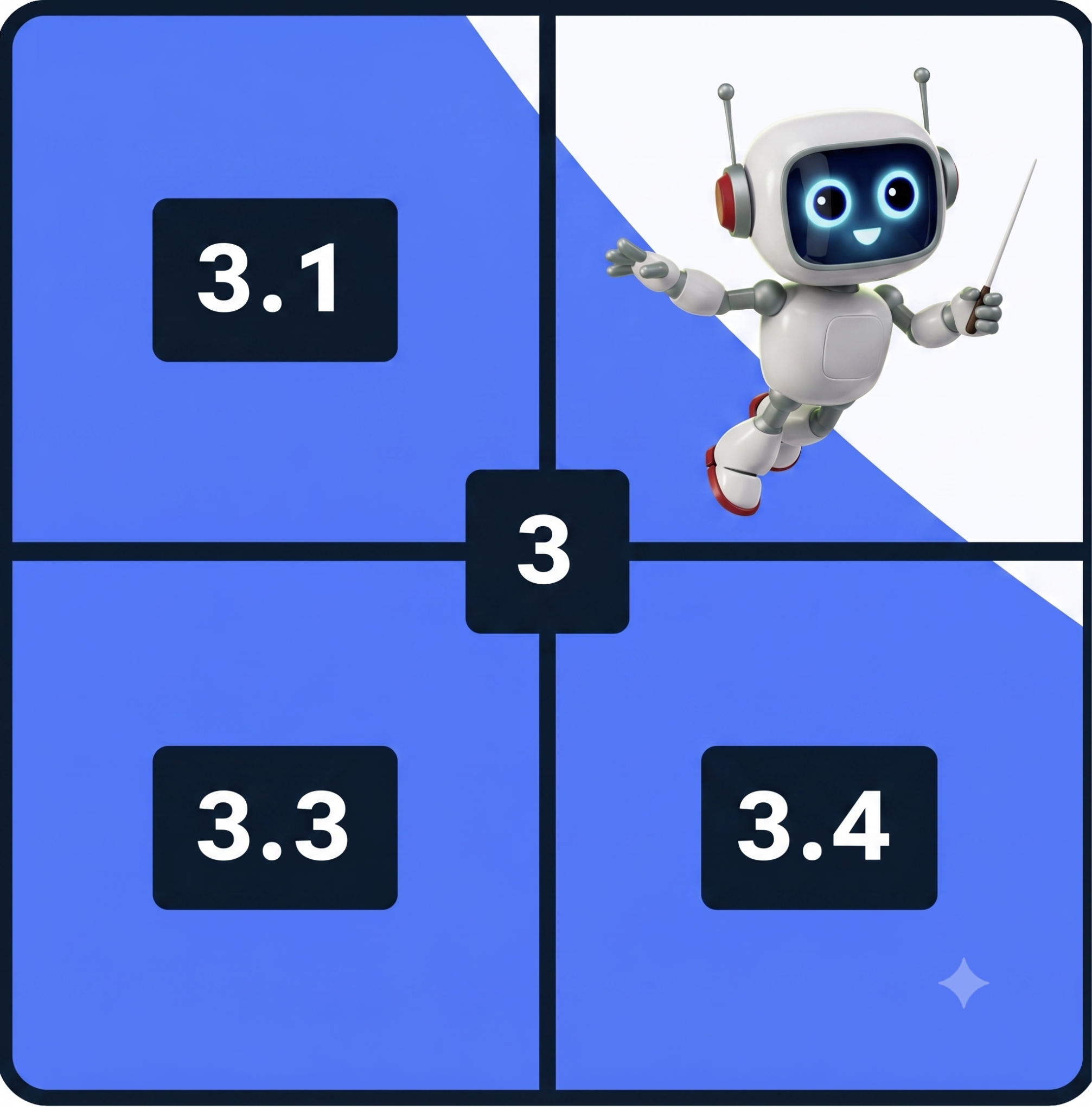
Image adapted from [Emerj's AI Project Quadrant]
How Asymbl Delivers Outcomes in 120 Days and Builds Capability for Years
Historically, candidate matching software has been a classic Q1 tool: a basic, off-the-shelf keyword search that plugs into your system, runs some fast resume matches, but never actually learns. It provides a minor speed boost, but it doesn’t build long-term capability.
Asymbl Talent Intelligence is designed to be the definitive 3.2 product. Internally, we refer to it as the "Recruiter Brain." Instead of relying on static keyword matching, it operates as an enterprise-grade learning engine that plugs directly into your existing talent system of record.
- On the Near-Term ROI Axis: It activates the talent data you already own to deliver immediate, highly accurate matching on open roles from day one.
- On the Compounding Capability Axis: It ingests every stage of the actual recruiting lifecycle: pipeline history, interview feedback, and eventual assignment outcomes.
Every time a recruiter moves a candidate forward, every time a hiring manager leaves a debrief note, and every time a successful placement is made, the Recruiter Brain gets smarter. It captures and codifies tribal knowledge that usually walks out the door when a recruiter leaves, turning individual recruiter actions into permanent, compounding organizational intelligence.
That's what 3.2 looks like operationally. Outcomes inside the budget cycle. Capability that survives it.
The Process: Design, Onboard, Coach
The mechanism is our framework that we run against every digital worker (read why we don’t call them AI agents) engagement: Design, Onboard, Coach.
Design is the precise-fit phase. Before any digital worker goes live, Asymbl's consulting team works with the customer to map the workflow, identify the highest-ROI roles, validate the data foundation, and define a digital worker's job description, performance metrics, and human handoffs. This is where the 3.2 test gets passed the first time. Use cases without a clear line to near-term outcomes and a path to compounding capability get reshaped or replaced before any work goes live. Design produces a roadmap with a clear path to near-term outcomes and a clear path to compounding capability.
Onboard is the near-term ROI phase. The first digital worker goes live inside 30-90 days, woven into the platforms the team already works in (Salesforce, Slack, and the existing email stack). The digital worker shows up with a defined role and a real workload from day one. At Asymbl, the same model put Teddy, our Digital Sales Development Representative (SDR), into production. Teddy works more than 1,000 leads a week with a 427 percent increase in qualified leads, all inside Salesforce. It's production work from week one, in the platforms the customer already runs, against the customer's real goals.
Coach is the AI maturity phase, where the second axis gets built. A human manager owns each digital worker. Asymbl's Coach phase includes weekly performance reviews, brand and voice quality scoring, knowledge updates, guardrail tuning, and explicit training on when to hand off to a human. Coaching makes each digital worker better quarter over quarter. The human team builds a coaching discipline they can apply to every new role they design.
The Combined Proof
When you pair purpose-built 3.2 products with a 3.2 operational framework, the results compound rapidly.
Our Customer Zero milestone is the proof. Operating at more than a 50/50 output ratio (with digital workers driving more than half of our overall business output), Asymbl currently employs more than 200 digital workers across 13 business functions alongside 150+ human teammates, yielding a projected $11 million to $13 million in productivity impact for 2026.
The first measurable wins landed inside the original 120-day window. The compounding capability is what continues to build the rest. That’s what 3.2 looks like operationally: outcomes inside the budget cycle, and capability that survives it.
The 3.2 Test, At Your Next AI Vendor Meeting
The 3.2 test gives you a buying discipline. The vendors who can answer both halves of the diagnostic are worth a board-level conversation. The vendors who can only answer one half are telling you which quadrant they belong in.
This is why we built Asymbl Talent Intelligence. It represents the ultimate 3.2 product: an enterprise-grade learning engine that plugs directly into your existing talent system of record, delivering immediate, highly accurate matching on open roles from day one while building a permanent organizational asset that compounds over time.
When you pair a purpose-built 3.2 product with a disciplined operational framework, you stop running expensive, isolated pilots and start building a high-performing hybrid workforce.
We have run this exact model from both sides, as Customer Zero inside our own operations and as a GTM partner delivering compounding results. The next move is to look at your own recruiting pipeline and identify which projects are set up for compounding value, and which ones are quietly drifting toward a Q1 dead end.
We will bring the framework, the data, and the operating discipline. You bring the talent bets you are being asked to defend, and we will work through which ones are truly 3.2-ready.
Ready to bring sub-quadrant 3.2 execution to your recruiting team?
Discover how Asymbl Talent Intelligence turns individual recruiter actions into permanent, compounding organizational intelligence.
Explore Asymbl Talent Intelligence or Schedule a Pipeline Audit Session to map your current recruiting technology stack against the AI Project Quadrant today.
.webp)
Enterprise Recruitment Software: What to Look for at Scale
Evaluating enterprise ATS software at scale? Compare data continuity, governance, and capacity modeling criteria. Explore the framework

The Right Fit Starts With a Conversation.
See what working together could look like.
.webp)