

Benefits of AI in Recruitment: What Actually Works in 2026
.webp)
Every talent acquisition leader has heard the same pitch over and over again that AI will save recruiters time, cut the cost per hire, and screen candidates faster. The pitch is not wrong, but are these benefits proven, well-documented, and easy to measure?
Most organizations report time saved at the recruiter level and stall at the business level. Hours come back, volume expands to absorb them, and leadership still cannot point to a recruiting investment that moved a revenue number.
In this blog, we will examine which benefits of AI in recruitment are floor-level, which ones most organizations never access, what separates an efficiency tool from a workforce intelligence layer, and how to measure the value that actually compounds.
First-Order Benefits Of AI In Recruitment
Most conversations about AI in recruiting start and end here:
- Faster screening
- Lower cost per hire
- Fewer hours on coordination work.
These are the reasons most organizations bought AI in the first place, and the easiest benefits to claim, but the hardest to convert into anything strategic.
Faster Screening, Lower Cost, Fewer Manual Tasks. No Greater Value Addition
The standard benefit list reads the same across every vendor deck:
- Resume screening that used to take a recruiter an afternoon now runs in minutes.
- Scheduling friction drops because automated workflows handle the back-and-forth.
All of it is real, but none of it is the question worth asking. The question that rarely gets asked after a successful rollout is what measurably changed at the business level.
- Recruiters report saving hours: Did the organization redirect those hours toward higher-value work, or did volume expand to fill the gap?
- Time-to-fill compressed: Did revenue-generating roles get filled meaningfully faster, or did the same roles close a little quicker without changing the business outcome they were tied to?
Most teams measure benefit at the point of automation, but only a few teams measure it at the point of business impact.
Why Efficiency Gains Plateau Without Structural Redesign
When AI is layered onto disconnected systems, an ATS for tracking, a CRM for engagement, spreadsheets for reporting, and email for coordination, each tool gets marginally faster.
The system as a whole gains no new intelligence. Data still stays siloed, while the insight stays local to whichever tool generated it. Recruiters still swivel between five screens to answer one question.
The plateau happens because the operating model was never redesigned. AI accelerated tasks inside the existing model rather than enabling a new model where human and digital teammates operate with different responsibilities, shared data, and unified measurement.
According to the 2025 “Superagency in the Workplace” Report by McKinsey, only 1% of C-suite leaders describe their AI deployments as mature, meaning fully integrated into workflows and driving measurable business outcomes, even though more than two-thirds of those same leaders launched their first-gen AI use cases over a year ago.
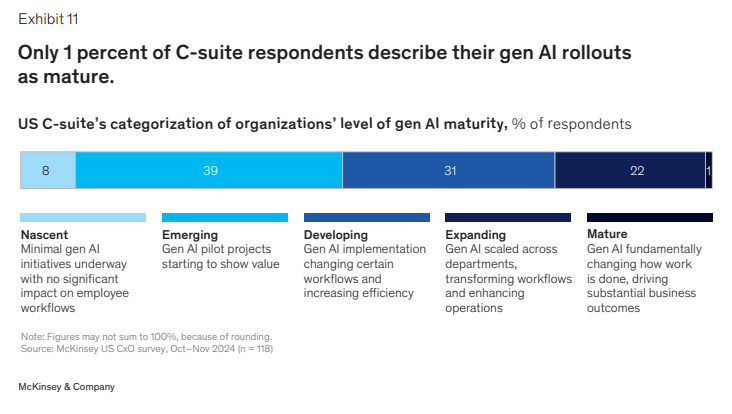
Most companies bought new technology and ran it on the same process map they had before because they think about AI in recruiting as something to deploy. A tool gets deployed, runs, and either works or does not.
However, a workforce gets designed, onboarded, and coached, but AI is not treated or onboarded the same way as a human worker.
The Benefits Most Organizations Never See Because Their Architecture Can't Surface Them
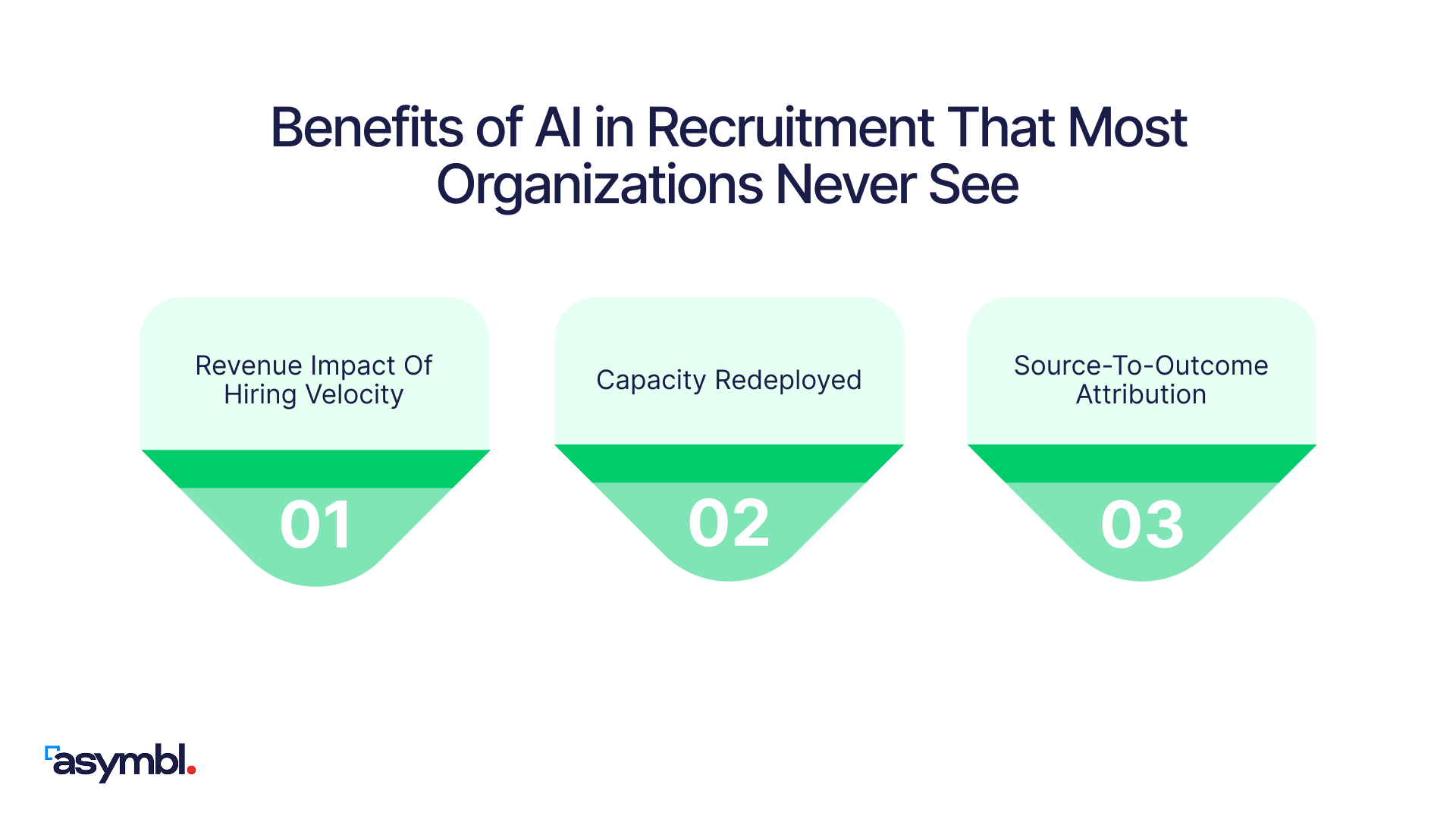
According to the “Talent Reinventors: Delivering Value With and For People in the Age of AI,” 2025 Research by Accenture, companies treating talent strategy as fully integrated with technology and AI, a small minority at 18% of organizations, saw revenue growth 1.8 percentage points higher and profit growth 1.4 percentage points higher than their peers.
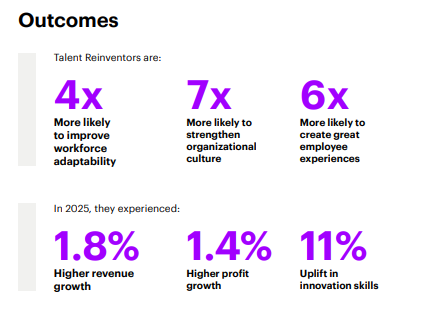
1. Revenue Impact Of Hiring Velocity
Every unfilled revenue-generating role has a cost, such as:
- Delayed product launches.
- Missed sales capacity.
- Constrained service delivery against committed client work.
Hiring velocity is a revenue timing metric, with recruiting as the lever.
AI can compress time-to-fill in ways that connect measurably to revenue acceleration, but only when hiring data lives inside the same architecture as revenue data.
When recruiting operates on an isolated ATS, the link between "role filled 14 days faster" and "revenue recognized sooner" is invisible to the people who need to see it. Finance signs off on the hire, but never sees the velocity number that justified the AI investment.
This is a benefit AI makes possible that human-only processes cannot. The ability to quantify the revenue impact of hiring speed as a data-driven calculation inside a unified system, rather than as an estimate inside a slide.
2. Capacity Redeployed
"AI saves recruiters 20 hours per week" is the most cited benefit. The question that determines whether that benefit is shallow or structural is what the organization does with those 20 hours.
Capacity redeployment is a workforce design decision. Without intentional role redesign, saved time gets absorbed by increased volume, additional administrative tasks, or simply faster output in the same model.
When organizations redesign roles intentionally, the work splits cleanly. Digital teammates own structured execution like screening, scheduling, follow-up, and workflow routing. Human recruiters own judgment-intensive work like candidate relationships, hiring manager advisory, and closing. The benefit moves from "time saved" to "strategic capability gained."
For staffing firms, redeployment carries a second meaning that compounds the first. Workers fall off assignment, contracts wind down, and recurring revenue depends on placing those workers somewhere else before the gap shows up in margin.
That requires signals from the field, surfaced fast, with enough context to act on. AI that runs on unified data turns those redeployment signals into a continuous stream, but AI that runs on a disconnected ATS lets them slip past until the worker is already gone.
3. Source-To-Outcome Attribution
Human processes can track the source of hire, but they cannot consistently track the source of successful hire at scale. The attribution requires connecting pre-hire engagement data with post-hire performance and retention data across time. The loop only closes on unified architecture.
Source-to-outcome attribution shifts how organizations invest in talent acquisition. Instead of allocating budget by channel volume, they allocate by channel quality.
Instead of measuring pipeline size, they measure pipeline predictiveness. Channels that produce high-performing, retained employees get more investment, whereas channels that produce closes without staying power get pruned.
What Separates An Efficiency Tool From A Workforce Intelligence Layer
The benefits above show up reliably in some organizations and not at all in others, and the variable is not the AI model itself. It is what the AI is operating on, and how it is orchestrated alongside the human team.
AI on Fragmented Systems Produces Faster Tasks. AI on Unified Data Produces New Insights
On fragmented systems, AI accelerates whatever task it is pointed at, such as:
- Faster resume screening inside the ATS.
- Quicker scheduling through a separate calendar tool.
- Automated outreach from the engagement platform.
Each task improves in isolation. However, the system as a whole gains nothing new because the data never converges. Engagement history sits in one tool, while screening outcomes sit in another. No single layer can see the full picture, so no single layer can learn from it.
On unified data, the same AI operates differently. One intelligence layer sees engagement history, screening outcomes, interview performance, offer conversion, and post-hire retention together. It can answer questions that the fragmented version cannot:
- Which screening criteria predict retention?
- Which engagement patterns correlate with offer acceptance?
- Where the pipeline leaks value, and what kind?
AI is not a tool you deploy on top of an existing stack. It is a workforce you orchestrate inside a unified system.
- Designed for a defined role.
- Onboarded with the right data, guardrails, and KPIs.
- Coached against actual outcomes.
The Workforce Orchestration model turns the same AI into either a faster version of yesterday's process or a measurably different operating capability.
Predictive Workforce Planning Becomes Possible Only When Hiring Data Connects To Business Data
The most strategic benefit AI can deliver to a recruiting function is forward-looking. Predictive workforce intelligence. Forecasting hiring needs against pipeline health, revenue targets, and capacity modeling, with enough confidence to plan against it.
This requires recruiting data to sit inside core business architecture, connected to revenue, operations, and workforce performance data.
When it does, hiring becomes a predictive function, helping leaders forecast time-to-fill for upcoming roles, model capacity scenarios under different demand curves, and make workforce decisions based on data rather than instinct.
Most recruiting tools cannot support this because they were built as standalone operational systems.
For staffing firms, the most expensive moment in the business cycle is the silent end of an assignment where the next placement was never set up.
Workers fall off contracts, and recurring revenue evaporates because the signals that should have triggered redeployment, an assignment winding down, a hiring manager's expansion plans, a former client posting a new role, were never connected to recruiter action.
Predictive systems running on a unified data surface those signals with enough lead time to act on them. Redeployment stops being reactive and starts being scheduled.
AI in Talent Relationship Management becomes strategic when it informs business planning, not just when it accelerates execution.
However, it can only happen when digital workers are operating on the same intelligence layer as the rest of the business, with access to candidate history, pipeline outcomes, client signals, and assignment data in one continuously learning model.
The richer the intelligence the digital workers operate on, the more they behave like a strategic teammate and the less they behave like a fast script.
When recruiters and their digital teammates both operate from the same signals, proactive planning turns into scale and velocity. That is the point where forecasting starts to produce a measurable business outcome instead of a slide.
The Compounding Curve: Why Governance And Role Design Determine Long-Term Benefit
For example, two organizations onboard the same digital worker on the same day. One sees a clean efficiency bump and then watches the curve flatten over the next quarter. The other sees the curve keep climbing for the next year
The variable is often the model, the training, and whether the digital worker was treated as a tool that runs or as a teammate that is coached.
According to Gartner’s 2025 Survey on Agentic AI Trends, 40% of agentic AI projects will be canceled by the end of 2027, largely because of escalating costs, unclear business value, and inadequate risk controls. The projects that survive are the ones with governance and performance management built in from the start.
Digital Workers Without Feedback Loops Deliver A One-Time Bump
Most organizations experience a measurable improvement when an AI capability is onboarded. However, the curve flattens quickly.
Although the AI operates on the same rules, data, and criteria it started with, no one reviews its outputs against actual hiring outcomes. No one adjusts its scoring against quality-of-hire data. No one corrects the patterns it picked up during onboarding that turned out to be wrong.
This is what happens when AI is treated as a tool. It delivers its value at activation and then drifts. The drift looks like stable performance from the outside, but it is actually decaying. Without structured performance management, digital workers move away from optimal performance the same way uncoached human workers do.
It is called “AI Purgatory.” Pilots that ran, generated a quarter or two of improvement, and never produced a second wave of value because nothing was in place to make a second wave possible.
Digital Workers With Structured Coaching Compound Value Over Time
When digital workers are designed with defined roles, KPIs, escalation logic, and ongoing performance review, the benefit curve changes shape. Instead of a one-time bump, the line bends upward.
This is the advantage of treating AI as a workforce component rather than a feature. It participates in the same continuous improvement cycle as the rest of the team. Coaching, performance review, and goal-setting make the system smarter.
Asymbl's Design, Onboard, and Coach framework was built around this principle. Digital workers are shipped with defined jobs to be done, motivations for success, KPIs, and a structured handoff model so they can be managed the same way human teammates are managed.
- Performance is monitored
- Outputs are reviewed, and
- The worker is coached against the outcomes that matter.
What This Looks Like When It Works, And How To Measure It
The benefits often show up in dashboards that look different from the ones most recruiting teams use today, because they measure different things.
From "Hours Saved" To Capacity Multiplier
Activity metrics, such as screens completed, interviews scheduled, and emails sent, were the right ones for an efficiency conversation, but not for an impact conversation.
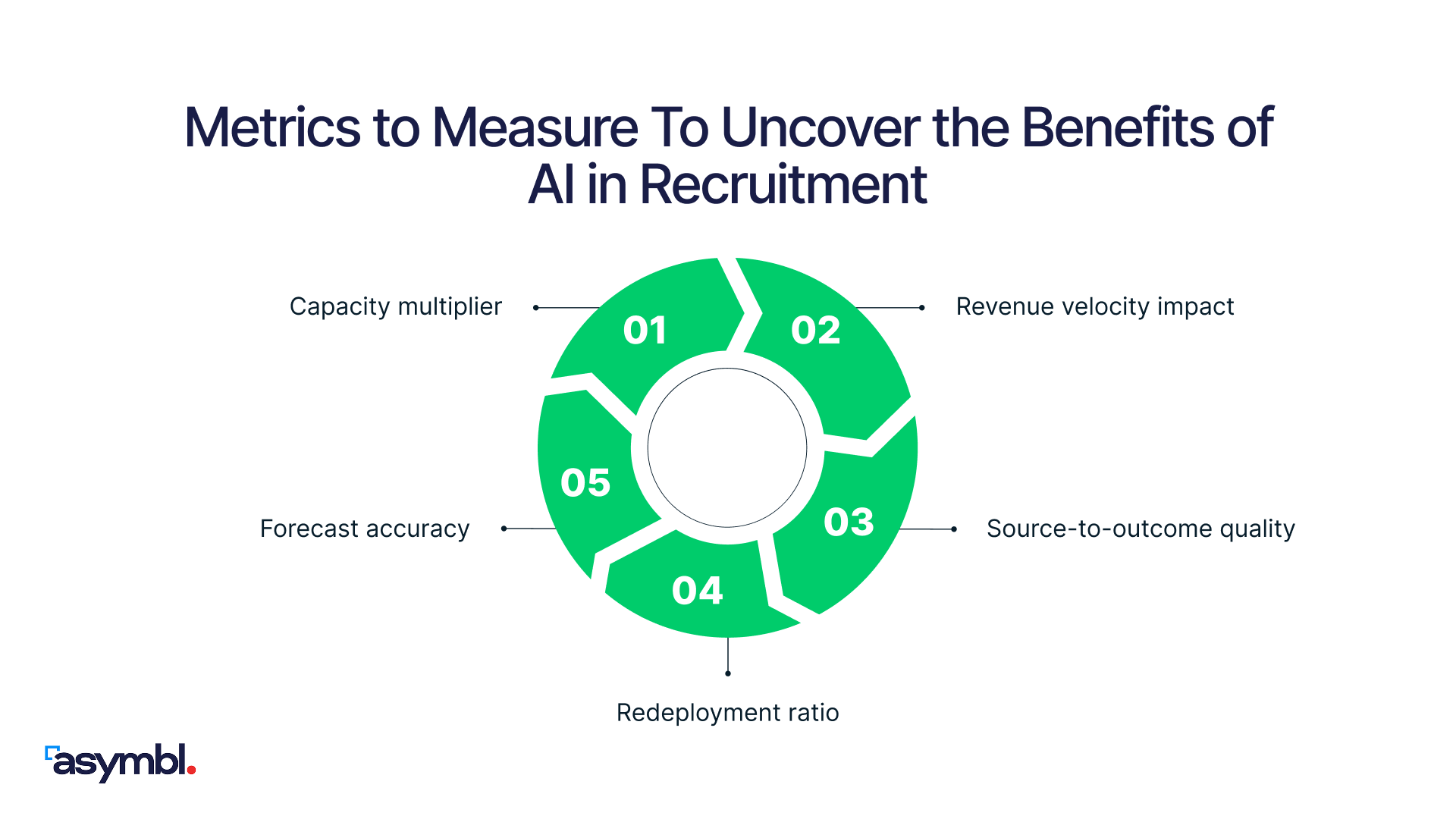
Five metrics matter when the goal is to measure benefit at the business level:
- Capacity multiplier: Output per hybrid team, a human recruiter plus their digital teammates, compared to a human-only baseline. This measures hires delivered per unit of capacity.
- Revenue velocity impact: Time-to-fill compression measured against revenue realization or project delivery timelines for the roles that drive revenue.
- Source-to-outcome quality: Which channels, methods, and engagement patterns produce hires that perform and retain?
- Redeployment ratio: Percentage of recruiter capacity shifted from administrative execution to strategic work like relationship-building, hiring manager advisory, and workforce planning. For staffing firms, the percentage of off-assignment workers redeployed within a target window.
- Forecast accuracy: The function's ability to predict hiring outcomes from pipeline data with increasing precision over time. The metric that proves the intelligence layer is actually learning.
These are the metrics that make a recruiting function strategic. They are only possible when AI operates on unified data with structured measurement designed in from the start.
How Asymbl Unlocked The Deeper Benefit Layer As Customer Zero
Asymbl built and tested the hybrid workforce model internally before offering it to anyone else. Our internal recruiting team was the first proof point.
Digital Recruiter, Rosa, Asymbl's pre-built digital worker for recruiting, handled the structured execution. It reviewed 17,000 applications, pre-screened 1,800 candidates, and scheduled 800 interviews. Human recruiters handled the work that required judgment, candidate relationships, cultural fit assessment, and closing.
The team hired 100 people in 100 days with a two-person human recruiting team. Fill rates went up 47%, and hiring costs dropped by $575K. ROI on the Digital Recruiter reached 1,529% in its first year.
The recruiting function scaled without a proportional headcount investment, and the gains held because the digital workers were coached against outcomes.
The benefits showed up where the first-order conversation said they would, in efficiency and cost. They also showed up in places the first-order conversation rarely reaches, such as capacity created, quality improved, and business impact measured.
This is the model Asymbl brings to staffing firms and corporate recruiting teams through Recruiter Suite and Digital Recruiter, Rosa, not AI features bolted onto a legacy ATS, but workforce infrastructure, built on Salesforce, with digital workers designed, onboarded, and coached the same way Asymbl coached its own.
Conclusion
The efficiency layer is where most organizations stop because the architecture and operating model underneath them cannot surface what lives above it. There is nothing wrong with the AI. There is something missing in how it was set up to work alongside the rest of the business.
The organizations pulling ahead in 2026 did not buy different technology. They redesigned the work. They treated digital workers as a workforce to orchestrate, not a tool to install, and built the data foundation, governance, and coaching practice required to make that real. The benefit curve they sit on today is different from the one their competitors are still trying to climb.
The question for recruiting leaders this year is not whether AI delivers benefits. It does. The question is whether the function is designed to access the benefits that actually move the business, and whether the leadership team is willing to redesign what needs redesigning to get there. Efficiency was a starting line. Workforce orchestration is the race.
Recruiter Suite and Digital Recruiter run on the same workforce orchestration model Asymbl built internally as Customer Zero, with the Design, Onboard, and Coach framework included. Book a demo to see Workforce Orchestration in action.
FAQs
Beyond hours reclaimed, the deeper benefits include revenue impact tied to hiring velocity, recruiter capacity redirected from administrative work to strategic advisory, source-to-outcome attribution that traces successful hires back to the channel that surfaced them, and predictive workforce intelligence that connects pipeline data to business planning.
Most companies layer AI onto disconnected systems without redesigning the operating model around it. AI accelerates tasks inside a broken architecture, producing faster fragmentation rather than new intelligence. The deeper benefit layer requires unified data, defined digital worker roles, performance management, and governance that connect hiring outcomes to business results.
When hiring data lives inside the same architecture as revenue and operations data, organizations can quantify how time-to-fill compression affects revenue timing, which talent sources produce high-performing hires, and how recruiter redeployment influences pipeline quality.
Capacity redeployment is the intentional redesign of recruiter roles so that time freed by AI gets directed toward higher-value activities like candidate relationship-building, hiring manager advisory, and workforce planning, rather than absorbed by higher volume.
Move beyond activity metrics like screens completed and interviews scheduled. Track impact metrics that connect to the business, such as capacity multiplier per hybrid team, revenue velocity from faster fills on revenue-generating roles, source-to-outcome quality scores, recruiter redeployment ratios, and forecast accuracy over time.
.webp)
12 Recruitment Metrics Every TA Team Should Be Tracking
Modern recruitment metrics need pipeline readiness and capacity. See 12 talent acquisition metrics that matter beyond speed.

The Right Fit Starts With a Conversation.
See what working together could look like.
.webp)