


Hiring teams face a compounding crisis on two fronts. Staffing firms must protect margins while accelerating placement velocity to survive a hyper-competitive market. Corporate recruiting teams are mandated to improve the quality of hire while navigating shrinking budgets and reduced headcount.
Meanwhile, AI is ubiquitous across the recruiting stack, yet measurable ROI remains rare. Pilots are launched and dashboards are built, but for most organizations, the needle barely moves.
The failure pattern is not the technology itself but the Architecture behind it. Most platforms were designed to solve the applicant tracking problem of 2010, with AI "bolted on" as a modern facade.
Since the data remains fragmented and recruiting stays siloed from the core business OS (the CRM and revenue systems), digital tools operate in isolation rather than as coordinated workers within a governed system.
Evaluating the best recruitment automation software in 2026 requires moving beyond "table stakes" features. The real differentiators are:
- Architecture: Does the platform connect recruiting to the rest of the business natively, or does it operate on its own data island?
- Orchestration: Does AI behave as a superficial feature, or as a Digital Worker with defined accountability and roles inside the workflow?
- Business Impact: Can the platform measure outcomes against revenue, retention, and capacity, rather than just transactional metrics like time-to-fill?
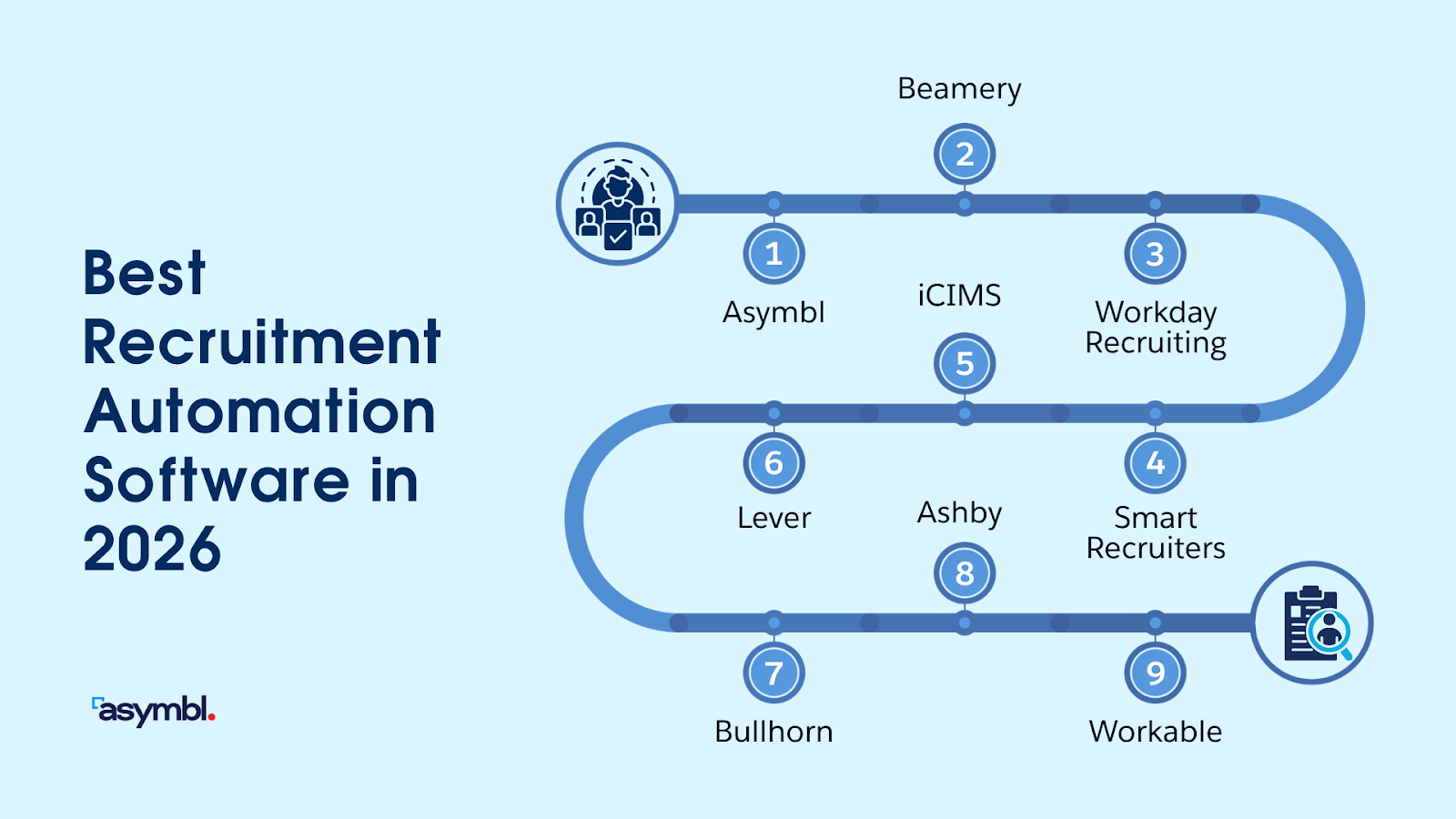
Best Recruitment Automation Software In 2026
The platforms below represent the tools that enterprise recruiting teams most frequently evaluate.
1. Asymbl
Asymbl is a Salesforce-native recruitment software provider that specializes in Workforce Orchestration.
Unlike traditional Applicant Tracking Systems (ATS) that function as standalone databases, Asymbl is designed as the operational infrastructure for a hybrid workforce, where human recruiters and digital workers operate together within a single, governed system
Key Capabilities:
- AI-Powered Digital Workers: Deploys digital workers with defined roles, KPIs, and governance to execute repetitive tasks such as sourcing, screening, scheduling, and workflow automation.
- Salesforce-Native Architecture: Built directly on Salesforce so all recruiting, workflow, and operational data live inside the enterprise system of record with security, governance, and cross-department visibility.
- Unified Workforce Data Model: Centralizes recruiting, engagement, and workflow data in a single system to enable better analytics, forecasting, and decision-making across the workforce lifecycle.
- Automated Workflow Execution: Digital workers automate high-volume operational tasks such as candidate sourcing, screening, scheduling, follow-ups, and data updates within existing workflows.
Pros:
- Enables hybrid workforces with human and digital workers
- Built on Salesforce for enterprise-grade data and governance
- Helps organizations scale operations without adding headcount
- Provides both technology products and consulting expertise
Best for:
Mid-market and enterprise teams that need recruiting to run on the same foundation as their CRM and revenue systems, and TA leaders moving from task automation toward hybrid workforce execution.
Rating:
Rated 5/5 on Salesforce AppExchange
2. Beamery
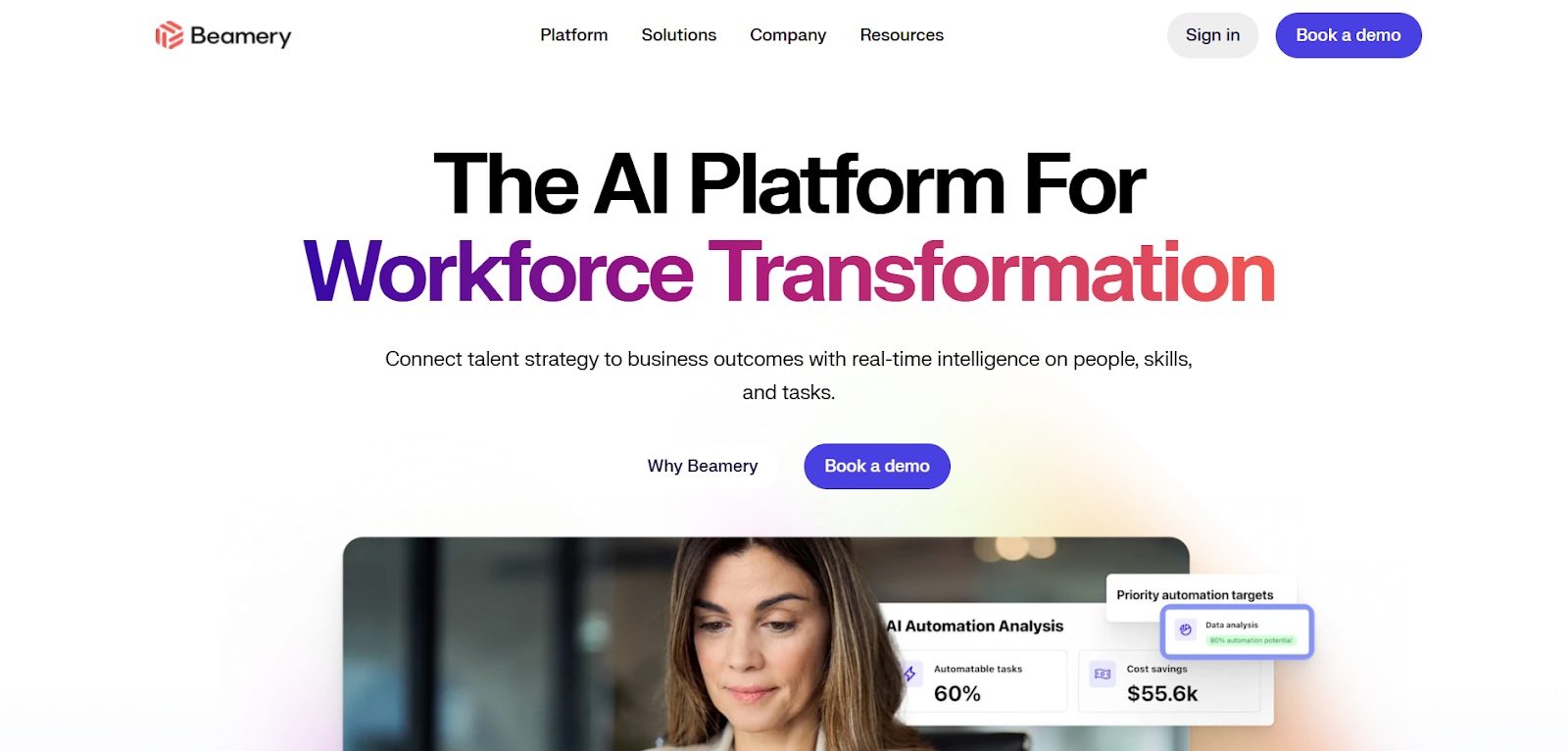
Beamery is an AI-powered workforce intelligence platform that helps enterprises align talent strategy with business outcomes by connecting workforce data, skills intelligence, and recruiting workflows in one system.
Key capabilities:
- Unified Talent Data Platform: Connects fragmented workforce data across HR systems, talent platforms, and market insights to create a single, reliable source of truth for workforce planning.
- Skills Intelligence: Uses AI to analyze job descriptions, employee data, and market trends to build a dynamic skills framework that supports skills-based hiring, workforce planning, and internal mobility.
- AI-Powered Talent Matching: Matches candidates and employees to roles based on skills, potential, and career pathways rather than traditional job history or keyword-based searches.
- Talent CRM & Candidate Engagement: Helps recruiting teams build talent pipelines, nurture candidates, and maintain long-term engagement with potential hires through automated communication and talent communities.
Pros:
- Strong skills-based hiring and workforce planning capabilities
- AI-driven talent matching and workforce intelligence
- Integrates with major HR platforms like Workday and SAP
- Enables long-term talent pipeline management
Cons:
- Typically requires existing HR system integrations to unlock full value
- Can be complex to implement and configure
- Pricing and packaging are not publicly transparent
- Focused primarily on talent intelligence rather than full HR operations
Best for:
Enterprises focused on proactive candidate engagement, relationship-driven recruiting, and long-term talent pipeline development.
Pricing:
Does not publicly list full pricing details on its website. Pricing typically depends on factors such as company size, number of active job postings, features selected, and contract terms. Organizations must contact the vendor or request a demo to receive a customized quote.
Rating:
3. Workday Recruiting
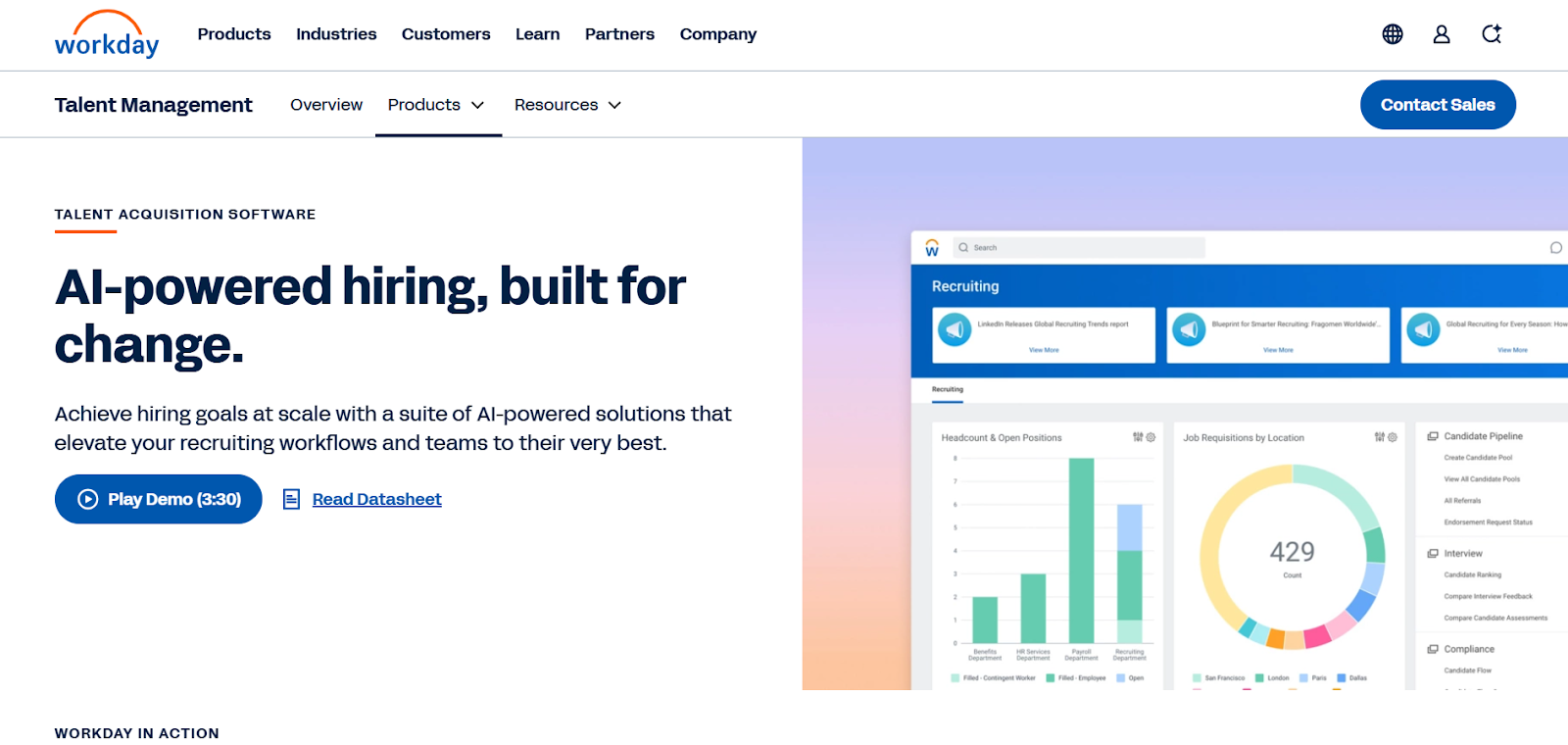
Workday is a cloud-based enterprise platform that helps organizations manage HR, finance, planning, and analytics in one unified system, using AI to automate workflows and provide real-time business insights.
Key capabilities:
- Unified Enterprise Cloud Platform: Combines HR, finance, planning, and analytics in one system, enabling organizations to manage workforce, financial operations, and business planning from a single platform.
- Human Capital Management (HCM): Provides tools for employee lifecycle management including hiring, payroll, workforce planning, performance management, and employee experience.
- AI-Powered Automation: Uses AI and machine learning to automate processes, generate insights, and support decision-making across HR, finance, and operational workflows.
- Workforce Planning & Analytics: Offers real-time analytics and forecasting tools to help leaders plan workforce capacity, manage budgets, and align talent strategies with business goals.
- Financial Management System: Handles accounting, procurement, expense management, and financial reporting in a unified system designed for enterprise financial operations.
- Open Integration Platform: Integrates with third-party business systems, payroll platforms, and enterprise applications to connect data across the organization.
Pros:
- Comprehensive HR and financial management platform
- Unified system for people, finance, and planning
- Strong enterprise analytics and reporting capabilities
- AI-driven insights across operational workflows
Cons:
- Complex implementation and configuration
- Higher cost compared to smaller HR systems
- May require specialized training for administrators
- Customization can be time-consuming
Best for:
Large enterprises already invested in the Workday HCM ecosystem that prioritize centralized HR compliance and governance over front-office orchestration.
Pricing:
Offers subscription-based pricing, but detailed plans are not fully disclosed on its website. Costs generally vary based on hiring volume, number of users, and selected features. Businesses can request a demo or free trial to receive tailored pricing.
Rating:
4. SmartRecruiters
SmartRecruiters is an AI-powered talent acquisition platform that helps organizations attract, select, and hire candidates through a unified recruiting system with automation, analytics, and workflow management.
Key capabilities:
- End-to-End Talent Acquisition Platform: Provides a complete hiring system covering candidate attraction, applicant tracking, selection, offer management, and onboarding within a single recruiting platform.
- AI Talent Matching Engine: Uses AI to identify qualified candidates by analyzing skills, experience, and job requirements to recommend high-fit applicants faster.
- Applicant Tracking System (ATS): Centralizes candidate applications, hiring workflows, interview management, and evaluation processes in one system for recruiters and hiring managers.
- AI-Powered Candidate Screening: Automates candidate qualification by analyzing resumes, application responses, and job requirements to prioritize the most relevant applicants.
- Dynamic Interview Scheduling: Automates interview scheduling, reducing manual coordination and administrative workload for recruiting teams.
Pros:
- Strong AI-driven recruiting automation
- Comprehensive end-to-end hiring platform
- Easy-to-use interface for recruiters and hiring managers
- Strong ecosystem of integrations and recruiting tools
Cons:
- Advanced features may require higher-tier pricing plans
- Some customization may require technical configuration
- Integration may be needed for full HR lifecycle management
Best for:
Mid-market and enterprise recruiting teams seeking flexible, modular automation within a modern ATS framework.
Pricing:
Offers subscription pricing, but detailed plan pricing is not publicly disclosed. Organizations typically request a demo or trial to receive pricing based on hiring volume, company size, and required features.
Rating:
Rated 4.3/5 on SmartRecruiters
5. Lever
Lever is an AI-powered recruiting platform that combines applicant tracking, candidate relationship management, and automation tools to help organizations streamline hiring workflows and make faster, data-driven hiring decisions.
Key capabilities:
- Applicant Tracking System (ATS): Centralizes candidate applications, hiring workflows, interview coordination, and evaluation processes so recruiters and hiring managers can manage hiring in one system.
- AI Candidate Matching: Uses AI to analyze candidate skills, experience, and job requirements to recommend the best-fit applicants and prioritize recruiting efforts.
- Recruiting Automation: Automates repetitive recruiting tasks such as follow-ups, interview scheduling, and offer generation, reducing administrative workload for recruiters.
- Fraud Detection & Candidate Verification: Uses automated safeguards to detect potential fraud signals, identity mismatches, or suspicious applications during candidate screening.
Pros:
- Strong automation and AI-driven recruiting insights
- User-friendly interface for recruiters and hiring managers
- Helps reduce administrative workload in hiring processes
- Supports collaborative hiring and candidate evaluation
Cons:
- Advanced automation features may require higher pricing tiers
- Some customization and reporting features may be limited compared to enterprise HR systems
- Full HR lifecycle management may require additional integrations
Best for:
Engagement-driven recruiting teams that prioritize candidate relationships and structured pipeline management within a combined ATS and CRM model.
Pricing:
Lever uses a custom, quote-based pricing model tailored to each organization. Pricing depends on hiring needs and platform usage.
The core platform includes ATS, CRM, AI-powered hiring tools, analytics, automation, and integrations, with optional add-ons such as onboarding, advanced automation, and AI interview assistance. Organizations must request a quote for exact pricing.
Rating:
6. iCIMS
iCIMS is an enterprise talent acquisition platform that helps organizations attract, engage, hire, and onboard talent using AI-powered recruiting tools and a unified recruitment software suite.
Key capabilities:
- Enterprise Applicant Tracking System: Centralizes job postings, applications, interview management, and hiring workflows in a scalable system designed for high-volume and enterprise recruiting.
- AI-Powered Recruiting (Coalesce AI): Uses AI to automate and accelerate hiring tasks such as candidate matching, screening, and communication while giving teams full control over how AI is applied.
- Employer Branding & Career Sites: Provides tools to create branded career sites, employee storytelling content, and recruitment marketing experiences that attract and engage candidates.
- Recruitment Chatbots & Text Recruiting: Enables automated candidate communication through chatbots and messaging tools to answer questions, schedule interviews, and guide applicants through hiring steps.
- Offer Management & Onboarding: Streamlines offer creation, approval workflows, and onboarding processes to ensure a smooth transition from candidate to employee.
Pros:
- Designed for large-scale enterprise recruiting environments
- Strong AI-powered recruiting automation
- Comprehensive end-to-end hiring platform
- Robust candidate engagement and employer branding tools
Cons:
- Implementation can be complex for smaller organizations
- Advanced customization may require technical configuration
- Some organizations may require additional integrations for full HR lifecycle management
Best for:
Large enterprises managing high-volume, multi-geography hiring with complex compliance requirements.
Pricing:
Pricing for iCIMS is tailored to each organization. Costs depend on factors such as hiring volume, number of employees, and selected HR or recruiting modules.
Rating:
7. Bullhorn
Bullhorn is a cloud-based recruitment platform designed for staffing and recruitment agencies. It combines applicant tracking, CRM, automation, and analytics to help agencies manage candidates, clients, and placements in one system.
Key capabilities:
- AI-Powered Recruitment Automation: Automates repetitive recruiting tasks such as sourcing, screening, and administrative follow-ups to help recruiters focus on candidate relationships and placements.
- Bullhorn Amplify AI: Uses AI to replicate recruiter workflows at scale, helping agencies improve candidate sourcing, screening, and submission quality while increasing recruiter productivity.
- End-to-End Recruitment Platform: Supports the entire recruitment lifecycle including job management, candidate sourcing, onboarding, and placement management.
- Open API & Marketplace Integrations: Offers open APIs and a marketplace of pre-integrated partners so agencies can customize their recruiting technology stack.
- Onboarding & Workforce Management: Helps agencies manage onboarding tasks, compliance requirements, and worker documentation once candidates are hired.
Pros:
- Built specifically for staffing and recruitment agencies
- Combines ATS and CRM in one platform
- Strong automation and AI-driven recruiting workflows
- Large ecosystem of integrations and marketplace partners
Cons:
- Primarily designed for staffing agencies rather than corporate HR teams
- Customization and configuration may require technical setup
- Some advanced features require additional modules
Best for:
Staffing firms and recruitment agencies seeking integrated candidate and client management within a familiar front-office model.
Pricing:
Bullhorn offers custom quote-based pricing tailored to recruitment agencies by company size and industry. Pricing includes core solutions like ATS & CRM, automation, analytics, onboarding, and AI-powered tools such as Amplify. Exact costs are not publicly listed and require contacting Bullhorn for a customized quote.
Rating:
8. Ashby
Ashby is an all-in-one recruiting platform that combines applicant tracking, candidate relationship management, sourcing, scheduling, and analytics with AI embedded throughout the hiring workflow.
Key capabilities:
- AI-Embedded Recruiting Workflows: Integrates AI across sourcing, candidate evaluation, automation, and analytics to improve hiring decisions and reduce manual recruiting work.
- Applicant Tracking System (ATS): Centralizes candidate applications, hiring stages, interview coordination, and feedback management within structured recruiting workflows.
- Recruiting Automation: Automates repetitive hiring tasks such as candidate outreach, stage transitions, and interview scheduling to reduce administrative workload.
- Interview Scheduling & Collaboration Tools: Streamlines coordination between recruiters and hiring managers through automated scheduling and collaborative candidate evaluation tools.
Pros:
- Strong automation and AI integration across recruiting workflows
- Highly customizable reporting and analytics capabilities
- Supports structured hiring and collaborative evaluation
- Scales from startups to enterprise organizations
Cons:
- Advanced customization may require initial configuration effort
- Some organizations may require integration with broader HR systems
- Full HR lifecycle management may require additional HR platforms
Best for:
Data-driven recruiting teams that prioritize reporting maturity and structured pipeline intelligence.
Pricing:
Ashby offers tiered pricing based on company size. The Foundations plan starts at $400/month for startups (up to 100 employees). Growth and Enterprise plans provide scalable pricing based on usage and commitment. Ashby also offers a separate Analytics product that integrates with existing ATS platforms and is priced based on usage.
Rating:
9. Workable
Workable is an AI-powered HR and recruiting platform that helps organizations manage hiring, employee data, onboarding, time tracking, and payroll through a single integrated system.
Key capabilities:
- AI-Powered Candidate Sourcing: Provides tools to source candidates from job boards, social platforms, and a database of hundreds of millions of profiles, with AI helping identify and reach passive candidates.
- AI-Assisted Resume Screening: Uses AI to evaluate resumes, rank applicants, and help recruiters identify qualified candidates faster.
- Talent CRM & Candidate Database: Stores candidate profiles in a searchable database, allowing recruiters to manage talent pipelines and re-engage past applicants.
- Career Site & Job Distribution: Creates branded career pages and distributes job postings across hundreds of job boards and social platforms to increase candidate reach.
- HR Information System (HRIS): Manages employee data, onboarding, performance reviews, and internal HR workflows in a unified employee management system.
Pros:
- Combines recruiting and HR management in one platform
- Strong AI-powered candidate sourcing and screening
- Extensive job board distribution network
- Supports end-to-end hiring and employee lifecycle management
- Integrates with hundreds of HR and productivity tools
Cons:
- Some advanced HR features may require additional integrations
- May be more complex than basic ATS solutions for smaller teams
- Advanced customization may require configuration effort
Best for:
Small and mid-sized businesses seeking reliable, easy-to-deploy recruiting automation without the complexity of enterprise platforms.
Pricing:
Workable offers transparent subscription pricing with three plans: Standard ($299/month), Premier ($599/month), and Enterprise ($719/month). Plans bundle recruiting and HR tools, with pricing scaling by company size. Some features are included in higher tiers, while add-ons such as texting, video interviews, and assessments may cost extra.
Rating:
Evaluation Criteria For The Best Recruitment Automation Software In 2026
In 2026, selecting a recruitment automation platform has evolved beyond simple feature checklists. Candidates, recruiters, and executives now operate in an "AI-on-AI" landscape where raw automation is table stakes.
What separates a capable tool from a strategic investment is architecture, orchestration, and accountability.
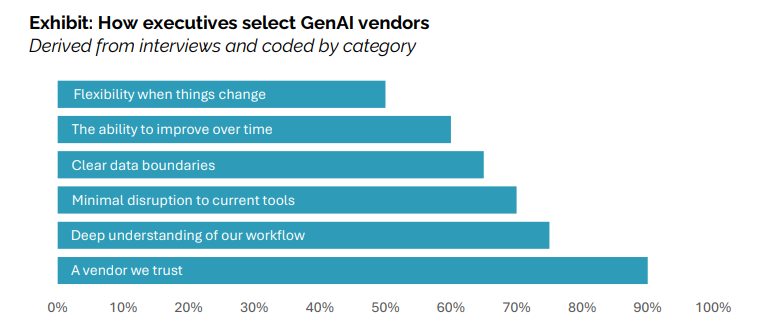
The following five criteria represent structural questions that determine whether a platform scales with your business or creates new bottlenecks as you grow
1. Unified Data Foundation (CRM + Hiring + Post-Hire Visibility)
Recruiting does not operate in isolation. Every hire connects to revenue capacity, retention rates, and workforce planning. When recruiting data lives in a separate system from the CRM, sales pipeline, and HR records, that connection is severed by design.
The downstream consequences are predictable. Teams export data to reconcile it. Leaders make workforce decisions without full context. Revenue and talent functions run on misaligned timelines. Post-hire performance stays invisible to the people who made the hiring decision.
A unified data foundation eliminates this operational friction by connecting CRM activity, hiring workflows, and post-hire outcomes in a single system of record. It is not about eliminating integrations entirely, but ensuring that recruiting data is a native part of the business intelligence layer, not a separate stream that must be periodically synchronized.
Critical Evaluation Questions:
- Structural Integration: Does recruiting data live in the same system as CRM and post-hire records, or does it require a separate, latency-prone sync?
- Business Intelligence: Can leaders measure the impact of hiring decisions on revenue ramp, retention, or margin without building manual, custom reports across disparate tools?
- Data Integrity: Is there a single source of truth that governs candidate records across the entire lifecycle from initial sourcing to hiring and eventual onboarding?
Platforms built on top of existing CRM systems, like Asymbl on Salesforce, rather than as parallel stacks, possess a structural advantage that point solutions cannot replicate through API integration alone.
This architectural alignment ensures that talent acquisition is a native input to enterprise planning rather than a delayed report from a disconnected system.
2. Orchestration of Human and Digital Workers
The critical differentiator of Workforce Orchestration in 2026 is not the presence of AI, but its orchestration model. There is a fundamental distinction between treating AI as a "feature" versus treating it as a "digital worker."
AI as a Feature vs. AI as a Digital Worker
- AI as a Feature: These are additive tools, such as resume summarizers, email drafters, or candidate ranking systems, that require a human to initiate and coordinate every step. The human remains the primary "operator," while the tool provides assistance.
- AI as a Digital Worker: These are autonomous agents, like Asymbl’s Agentforce Suite, that hold defined roles within the workflow. They execute multi-step processes with clear handoff logic, governance guardrails, and measurable performance standards.
The Orchestration Model In Practice
In a true orchestration environment, the recruiting function operates as a hybrid workforce. Capacity is expanded by assigning "digital labor" to high-volume, repeatable tasks, allowing human experts to focus on the high-fidelity aspects of the hiring process:
- Sourcing Agents: Autonomously identify and engage passive talent matching specific criteria across multiple channels.
- Screening Agents: Qualify inbound applications, answer candidate FAQs 24/7, and ensure only the top-fit profiles reach the human recruiter.
- Scheduling Agents: Coordinate complex panel interviews and handle reschedules without the back-and-forth friction that consumes recruiter time.
- Human Recruiters: Focus on nuanced judgment, relationship quality, cultural evaluation, and "closing" the top candidates.
What separates orchestration from automation:
3. Revenue And Business Outcome Visibility
Recruiting metrics have historically been operational:
- Time-to-fill
- Application volume
- Interview-to-offer ratios.
While these numbers describe the mechanics of the hiring process, they fail to describe the impact of hiring on the business. In 2026, the leading platforms have shifted from tracking activity to measuring institutional value.
The true indicators of success are quality of hire, retention alignment, and workforce planning visibility. A platform that cannot connect a hiring source to 12-month performance or recruiter capacity to revenue ramp-up leaves leaders making strategic decisions from an incomplete picture.
The 2026 Business Impact Standard:
- Quality of Hire (QoH): Measuring post-hire performance, manager satisfaction, and cultural alignment 6–12 months into the role to validate the initial hiring decision.
- Time-to-Productivity: Moving beyond "time-to-fill" to measure how quickly a new hire reaches full contribution, a metric that directly impacts the P&L.
- Revenue Per Recruiter: Directly linking individual recruiter performance to billable revenue or departmental growth milestones.
The best recruitment automation platforms in 2026 close the gap between the "hire" and the "result." This requires architectural alignment between the recruiting system and the enterprise platforms where revenue and workforce outcomes are tracked.
When built natively on a platform like Salesforce, this data becomes an immediate, actionable input for executive leadership.
4. Configurable Workflows Without Heavy Services
Recruiting environments are rarely static. Industry-specific compliance, geography-based process variations, and role-level evaluation differences create a constant need for adaptation.
The problem is that many enterprise platforms make this configuration expensive. Workflow changes often require IT tickets, while evaluation updates demand development support. Every modification creates a latency gap between what the business needs and what the system provides.
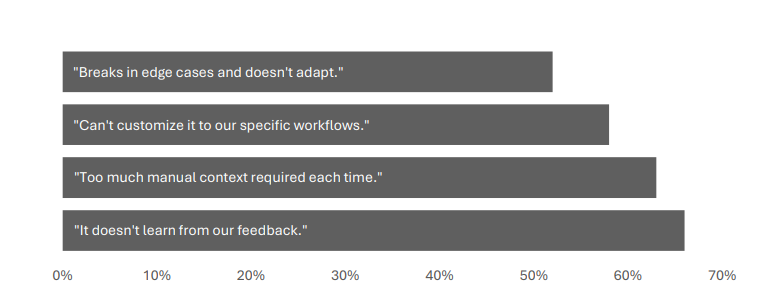
Barriers to core workflow integration
In 2026, a "clicks-not-code" architecture is a strategic necessity for operational agility. When talent acquisition leaders can modify stage logic, update workflow triggers, and adjust scoring criteria without a third-party services engagement, the platform remains an asset. When they cannot, it becomes a structural constraint.
- Agility vs. Lock-in: The practical test is speed. If the recruiting environment changes, how long does it take the platform to reflect it? Weeks signal architectural lock-in, while days signal operational agility.
- Self-Service Governance: Platforms like Asymbl empower non-technical users to build and update applications independently. Low-code/no-code platforms can reduce development time by up to 90%, saving millions in annual IT costs.
- Modular Precision: A configurable system allows for role-specific workflows (e.g., an abbreviated path for internal mobility vs. a rigorous technical assessment for external hires) without over-complicating the global architecture.
Questions For Workflow Evaluation:
- Can our team add a custom compliance check or feedback trigger to a specific stage without writing code?
- Does the platform allow for drag-and-drop pipeline management (like Kanban views) that immediately updates back-end status models?
- Can we deploy industry-specific templates (e.g., Healthcare vs. Engineering) natively within the same environment?
By adopting a modular, configurable architecture, organizations ensure their recruiting stack evolves at the speed of their business, transforming the ATS from a rigid record-keeper into a flexible workflow engine.
5. Responsible AI Governance And Scalability
The gap between an AI pilot and a scaled, governed operation is a primary risk factor for enterprise recruiting. While pilots demonstrate feasibility, they rarely establish the oversight structures needed to manage AI with confidence.
As regulations like the EU AI Act (enforceable for high-risk employment systems by August 2026) and NYC's Local Law 144 harden into strict liability frameworks, AI governance is a non-negotiable part of your infrastructure.
The 2026 Standards For Defensible Hiring
Responsible AI governance means moving from "Black Box" automation to evidence architecture. A truly governed system ensures:
- Explicit Scope and Roles: Digital workers operate within defined boundaries. A "Sourcing Agent" should not have the autonomous authority to "Reject" a candidate unless that specific permission and its logic have been governed and logged.
- Explainable Decision Logic: You must be able to move beyond "the model said so." In 2026, the standard for transparency is a Decision Package, an automated audit trail for every material event that shows the specific inputs, the rubric used, and the candidate's consent.
- Meaningful Human Review: Governance is not a rubber stamp. Systems must be architected to present AI outputs as probabilistic insights rather than deterministic verdicts, ensuring human recruiters have the authority and data context to interrogate and override AI recommendations.
- Continuous Bias Monitoring: Rather than a one-time audit, a governed system uses statistical safe harbors (like the 4/5ths Rule) to monitor for disparate impact in real-time. If a workflow change causes a spike in drop-off for a specific demographic, the system should trigger an immediate governance alert.
If a candidate or regulator asks why a specific decision was made, your system should produce a defensible, plain-language export in minutes, not weeks.
Platforms that build governance into the foundation, such as Asymbl, have a compounding advantage.
By utilizing Salesforce's native trust layer, Asymbl ensures that data residency, model boundaries, and telemetry logs are handled at the system level. It allows recruiting teams to scale their AI usage without scaling their legal and compliance risk.
The Shift From Recruitment Automation To Workforce Orchestration
Recruitment automation was built to solve a throughput problem. In high-volume environments with an overwhelming amount of application volumes and manual coordination, the response was to automate repetitive steps to free recruiters for higher-value work.
While this logic remains sound, many organizations hit a productivity plateau as they focus more on automating tasks rather than re-engineering the system.
Automating a fragmented architecture simply makes the broken parts move faster. Workforce orchestration moves beyond task speed to focus on system design, creating a unified environment where humans and digital workers operate with shared accountability and measurable business impact.
- Digital workers handle repeatable, high-volume execution: Sourcing candidates against defined criteria, screening applications, answering candidate inquiries, coordinating interview logistics, sending follow-up communications.
- Human recruiters focus on the work that requires judgment, relationship quality, and contextual decision-making: Evaluating cultural fit, building candidate trust, advising hiring managers, closing offers.
- Leaders gain visibility not just into recruiting activity, but into how recruiting performance connects to workforce capacity, revenue outcomes, and business planning.
A recruiting team of two human recruiters supported by defined digital workers does not perform like a team of two. It performs at a scale that headcount alone cannot replicate.
This is not a theoretical model. Asymbl operates its own recruiting function this way. Two human recruiters, assisted by the Recruiter Agent, processed 17,000 applications, pre-screened 1,800 candidates, and scheduled 800 interviews during a high-growth hiring phase, completing 100 hires in 100 days.
The digital worker did not replace the recruiters. It expanded what two people could accomplish without adding to the team.
Scaling recruiting capacity without scaling headcount is not achievable through automation alone. It requires an operating model that is designed for it from the start.
That operating model has three components that automation-only approaches do not address:
- Workforce design: Before digital workers can operate effectively, the division of responsibility between human and digital roles must be explicitly defined. Which tasks belong to digital workers? What are the boundaries of their authority? Where does the human recruiter take over? Without this design work, AI either underperforms because its scope is too narrow, or creates problems because its scope is too broad.
- Unified data foundation: Orchestration depends on shared visibility. Human and digital workers need to operate from the same data, not from parallel systems that occasionally sync. When recruiting data lives on the same foundation as CRM, sales pipeline, and post-hire performance, leaders can measure the full impact of hiring on business outcomes, not just the mechanics of the hiring process itself.
- Performance measurement: Digital workers need to be held accountable the same way human workers are. That means defined KPIs, regular performance review, and an ongoing coaching model that refines how digital workers operate over time. Organizations that deploy AI without this framework find that performance degrades or plateaus. Organizations that apply the same rigor to digital workers that they apply to human team members find that performance compounds.
The shift from recruitment automation to workforce orchestration is ultimately a shift in how organizations think about recruiting as a business function. Automation optimizes the process. Orchestration redesigns the system. One produces incremental gains. The other produces structural advantage.
Asymbl Recruiter Suite: Salesforce-Native Workforce Orchestration Platform
Most applicant tracking systems were designed to manage candidates through a defined hiring process. Asymbl Recruiter Suite was designed to serve as the operational infrastructure for a hybrid recruiting team where human recruiters and digital workers share accountability inside a single, governed system.
1. Salesforce-Based Architecture
Most recruiting platforms operate as "data islands" that connect to Salesforce via third-party APIs or middleware. This creates a perpetual integration tax, ongoing maintenance of field mappings, sync schedules that cause data lag, and the inevitable "system of record" conflict.
Recruiter Suite eliminates this friction by running natively on Salesforce. Recruiting workflows, CRM interactions, and candidate engagement history all share the same universal data model.
- Zero Sync: Updates to a candidate record are reflected across Sales, Service, and Recruiting in sub-second time.
- Unified Security: Your recruiting data is protected by the same enterprise-grade permissions, encryption, and compliance frameworks as your primary Salesforce instance.
- Single Source of Truth: A "Candidate" isn't a separate entity from a "Contact" or a "Lead," but a single identity throughout the entire talent lifecycle.
For corporate talent acquisition, this architecture transforms recruiting from a parallel reporting exercise into a core component of enterprise intelligence. Since your hiring data sits alongside your revenue and workforce data, you can finally answer high-stakes strategic questions:
- Retention Attribution: Which specific sourcing channels or recruiters are delivering hires with the highest 12-month retention rates?
- Revenue Correlation: How does the "Time-to-Fill" for account executives in a specific region directly correlate to revenue ramp-up and quota attainment?
- Capacity Forecasting: Where are hiring bottlenecks currently creating downstream constraints on the company’s ability to execute its 2026 growth plan?
By utilizing Salesforce Flow and the Lightning App Builder, Recruiter Suite delivers "Operational Agility" that hard-coded ATS platforms cannot match.
- Self-Service Configuration: Recruiting ops teams can adapt stage logic, update evaluation criteria, and modify engagement sequences using a drag-and-drop interface.
- No "Services Gap": Changes that used to require a 6-week IT project or an expensive consultant engagement can now be deployed in days.
2. Digital Workers With Defined Roles
Asymbl Recruiter Suite does not treat AI as a superficial feature layer. Instead, digital workers are embedded directly into the recruiting workflow as role-based contributors with explicit responsibilities, performance expectations, and governance guardrails.
The Asymbl Recruiter Agent, powered by Salesforce Agentforce and Asymbl Intelligence, operates as an autonomous recruiting coordinator within the systems your team already uses.
It handles the high-volume, repeatable execution that typically consumes 60–70% of a recruiter's week, requiring zero human intervention for routine tasks.
The Recruiter Agent independently executes the "administrative heavy lifting" across the talent lifecycle:
- Job Description Generation: Polished, on-brand postings created in minutes using guided prompts and custom templates that ensure SEO optimization and bias reduction.
- Intelligent Outreach: Hyper-personalized candidate engagement at scale. The agent tailors content automatically for each individual across vast talent pools, increasing response rates by reaching candidates with the right message at the preferred time.
- Interview Scheduling: Autonomous coordination directly within Salesforce. By sharing real-time availability with candidates and managing the back-and-forth, the agent eliminates the "scheduling gap" that often costs firms top-tier talent.
- Candidate Insights and Summaries: Structured strength narratives and hiring manager briefings are generated for every candidate in the funnel, grounded in factual data from resumes and initial screenings.
- Offer Letter Generation: Professional, compliant offer letters produced in seconds for recruiter review, ensuring speed during the critical "closing" window.
The Human-Agent Handoff
This division of responsibility is a fundamental design choice. While digital workers bring precision and 24/7 scale, human recruiters are elevated to focus on high-fidelity engagement, including relationships, cultural evaluation, hiring manager advisory, and final hiring decisions.
However, Digital workers are not "set and forget" tools. They are onboarded with the same rigor as human employees. This includes:
- Defined KPIs: Measuring the agent's contribution to pipeline velocity and candidate satisfaction.
- Governance Frameworks: Utilizing the Einstein Trust Layer to ensure data privacy and auditable decision logic.
- Ongoing Coaching: Iterating on agent prompts and actions based on real-world hiring outcomes to improve matching accuracy over time.
The result is a recruiting operation that scales without a linear increase in headcount. Pipeline quality improves because no candidate falls through the gaps of an under-resourced team, and recruiter attention remains fixed on the strategic decisions that drive business growth.
3. Proven Internal Model
Asymbl operates the workforce orchestration model internally at massive scale. By treating AI as a workforce initiative rather than a technical one, Asymbl has moved beyond the "productivity paradox" that often hampers AI adoption.
The "93 Hires in 94 Days" Case Study
During a hyper-growth phase in 2025, Asymbl’s own recruiting team was tasked with nearly doubling the company's headcount. Operating with just two human recruiters and one digital Recruiter Agent, the team achieved results that would typically require a significantly larger staff:
- Applications Processed: 17,000+
- Pre-screens Conducted: 1,800
- Interviews Scheduled: 800
- Hires Completed: 93 in 94 days (eventually reaching 111 in 120 days)
- Impact: A 1,529% ROI for the HR function and a 47% increase in fill rates.
Asymbl currently maintains a 5:1 digital-to-human worker ratio across ten business functions, including sales, engineering, and marketing. This hybrid workforce generated over $5 million in productivity impact in 2025 alone, with an 18% ROI within the first 90 days of deployment.
When Should Companies Reevaluate Their Recruitment Automation Stack
Technology evaluations in recruiting are often triggered by a visible pain like a platform slows down, a vendor raises prices, or a competitor switches systems.
While these are legitimate triggers, they frequently lead organizations to swap one tool for a similar one rather than questioning the underlying architecture.
The trigger signals below are the operating model symptoms. When these appear, the problem is rarely solved by a license upgrade or a new integration. They indicate that your recruiting system was built for constraints your business has already outgrown.
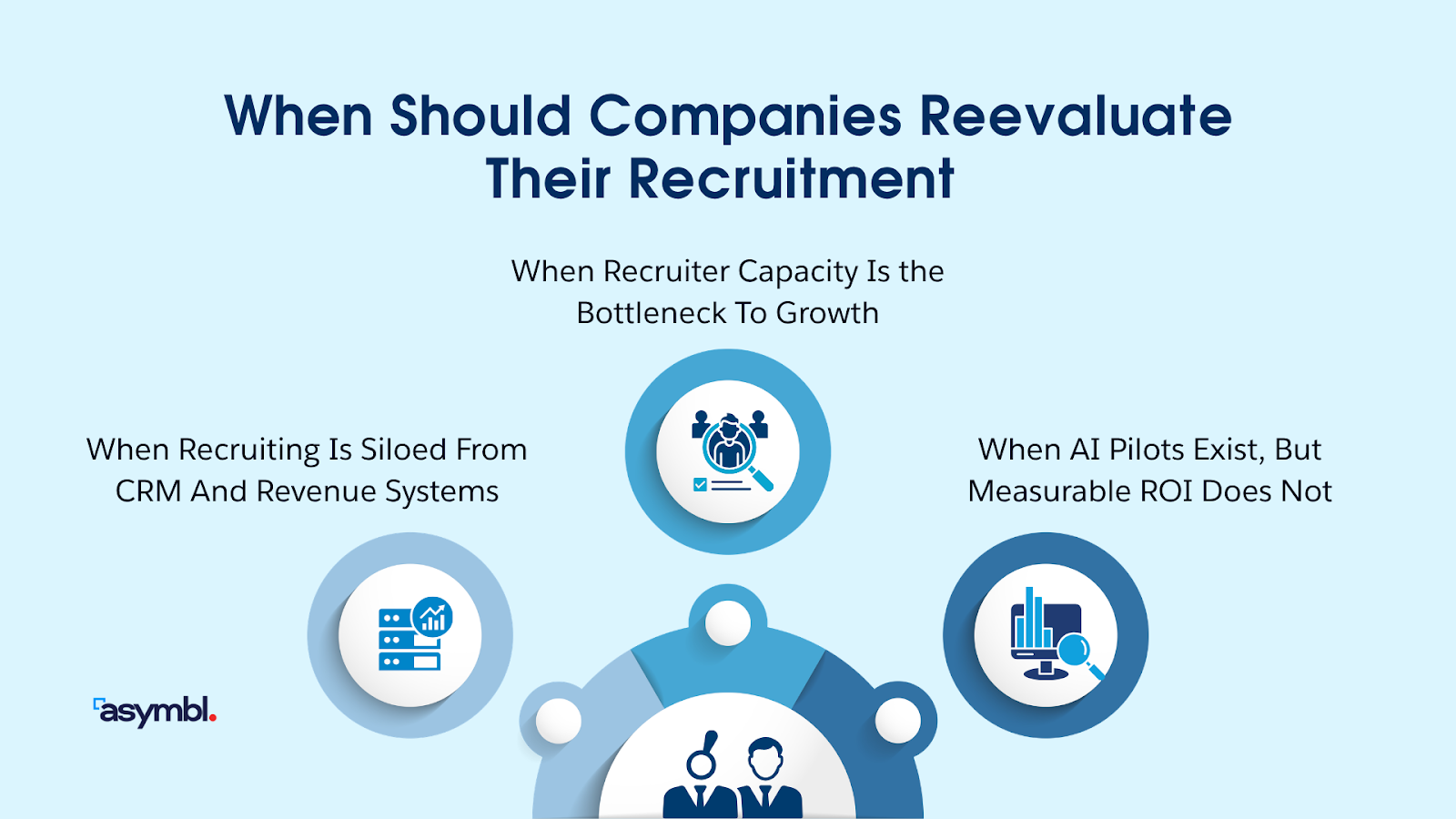
1. When Recruiting Is Siloed From CRM And Revenue Systems
When the recruiting system operates separately from the CRM, the gap between talent acquisition and business performance becomes structural. Hiring managers make decisions without full context. TA leaders report on time-to-fill without connecting those metrics to revenue ramp or retention outcomes.
The Symptoms Of Structural Silos:
- Manual Reconciliation: Reporting requires exporting data from multiple systems and reconciling it manually before any meaningful analysis can occur.
- Fragmented Planning: Workforce planning conversations between HR, Finance, and business leaders rely on disconnected data sets that represent the same organization differently.
- Post-Hire Blindness: Post-hire performance stays invisible to the recruiting team, making it impossible to learn which sources, assessments, or hiring criteria actually predict long-term success.
The Automation Fallacy
Adding automation on top of this architecture does not resolve the underlying problem. Faster workflows and smarter AI features still operate within the same data boundary. The visibility gap persists because the system was not designed to close it.
The right question to ask is whether the platform's architecture allows recruiting data to be part of the same intelligence layer as the rest of the business. When the answer is no, the evaluation conversation needs to start at the architecture level.
2. When Recruiter Capacity Is the Bottleneck To Growth
There is a version of this problem that looks like a headcount problem but is actually an operating model problem.
The pattern is recognizable. Business growth accelerates, hiring demand increases, the recruiting team runs at full capacity, and the response is to add more recruiters. Output expands, costs increase proportionally, and within a few hiring cycles, the team is at capacity again. The ceiling follows the headcount.
Identifying The Operating Model Failure
What makes this an operating model problem rather than a resource problem is the misallocation of human judgment. A significant portion of recruiter time is consumed by work that does not require recruiter expertise:
- Application review and screening
- Interview scheduling coordination
- Candidate status updates and follow-up
- Offer letter preparation and data entry
When these tasks consume the majority of recruiter bandwidth, the team's capacity to do the work that actually requires them, building relationships, advising hiring managers, evaluating cultural fit, and closing competitive offers, is constrained by volume rather than expanded by it.
This is the signal that hybrid orchestration is needed. The solution is a deliberate redesign of who or what handles each category of work.
Organizations that have reached this inflection point often discover that the constraint is the absence of a governed model for deploying digital workers alongside human recruiters.
- The Scaling Dividend: Two recruiters supported by well-designed digital workers can operate at a scale that four or five recruiters running a traditional model cannot match.
- Preserving Experience: By offloading the "administrative friction" to digital workers, the human recruiters can spend more time in high-fidelity conversations with candidates, maintaining experience quality even under volume pressure.
If your recruiting headcount doubled tomorrow but the operating model stayed exactly the same, would the bottleneck actually be resolved? If the honest answer is "only temporarily," then the operating model is definitely the problem.
3. When AI Pilots Exist, But Measurable ROI Does Not
Most enterprise recruiting functions have deployed AI in some form, like resume screening, chatbots, or scheduling assistants. The technology is present across the stack, yet in many cases, the measurable impact is missing.
According to The Gen AI: The State of AI in Business 2025 Report by MIT NANDA, only about 5% of integrated AI pilots are generating millions in measurable value, while the majority remain stuck in experimentation with little clear P&L impact.
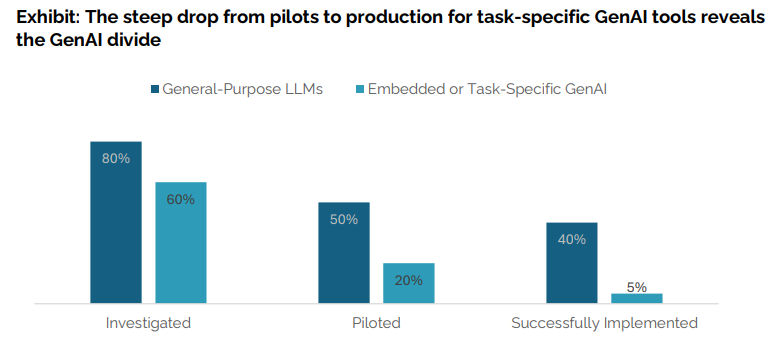
Organizations that see meaningful returns tend to treat AI as part of their operating model rather than as a standalone tool.
According to a 2024 McKinsey Survey on Gen AI & Business Impact, 63% of early adopters report strong alignment between their AI strategy and overall business strategy, compared with only 17% of organizations still in the experimentation stage.
The divide is rarely caused by model quality or regulation. Instead, it is usually determined by how organizations operationalize AI inside real workflows.
The failure to move from "experimentation" to "impact" usually stems from four structural gaps:
- Unclear Ownership: Tools are often implemented by a technical team without a business owner who is accountable for outcomes. Usage occurs, but nobody is measuring whether the tool's performance is improving or degrading.
- Undefined Roles: Digital workers are added to the workflow without explicitly designing their specific responsibilities or the precise "handoff" logic to a human recruiter. This leads to overlap, confusion, and inconsistent execution.
- Untracked Performance: The same rigor applied to human recruiters, activity targets, conversion rates, quality-of-hire contribution, is rarely applied to AI. Without these baselines, ROI remains a guess.
- Absent Governance: Compliance, auditability, and escalation logic are often treated as afterthoughts. Without these, leadership cannot confidently expand the AI's scope because they cannot fully account for its decisions.
When these gaps appear, the solution is a shift in operating discipline. This means treating digital workers with the same structure applied to human hires:
- Defined Roles: Explicitly scoping what the AI owns (e.g., "Screening Agent" vs. "Sourcing Agent").
- Onboarding Structure: Integrating the tool into the actual workflow, not just giving it a login.
- Performance Expectations: Measuring the digital worker against business KPIs (e.g., pipeline velocity, candidate satisfaction).
- Accountability: Establishing clear human oversight and coaching cycles to refine AI outputs.
Organizations that make this shift create the infrastructure for responsible scale. They move past a collection of disconnected pilots and build a governed, hybrid workforce that fundamentally changes how recruiting operates.
Conclusion
In 2026, the shift from Recruitment Automation to Workforce Orchestration marks the transition from "hiring as a task" to "hiring as a strategic capability." Asymbl serves as the primary example of this new standard, moving beyond the traditional ATS model to create an integrated infrastructure for the hybrid workforce.
Instead of "AI features" that recruiters have to use manually, Asymbl deploys Digital Workers (like the Asymbl Recruiter Agent). These agents have defined job descriptions, KPIs, and autonomous authority to handle scheduling, screening, and outreach, freeing humans to focus on relationship-driven closing.
The organizations that thrive this year will be those that stop trying to make their recruiting tools work faster and start designing a system where human and digital labor operate as one.
See how Asymbl Recruiter Suite unifies hiring, CRM, and digital workers on Salesforce. Book a demo

Staffing Firms Can't Scale on Single-Dimension Technology
Staffing technology fragmentation creates a coordination tax. Asymbl's workforce orchestration approach delivers ROI differently.

The Right Fit Starts With a Conversation.
See what working together could look like.
.webp)