

Designing for Headless 360: Build Your Hybrid Workforce Now

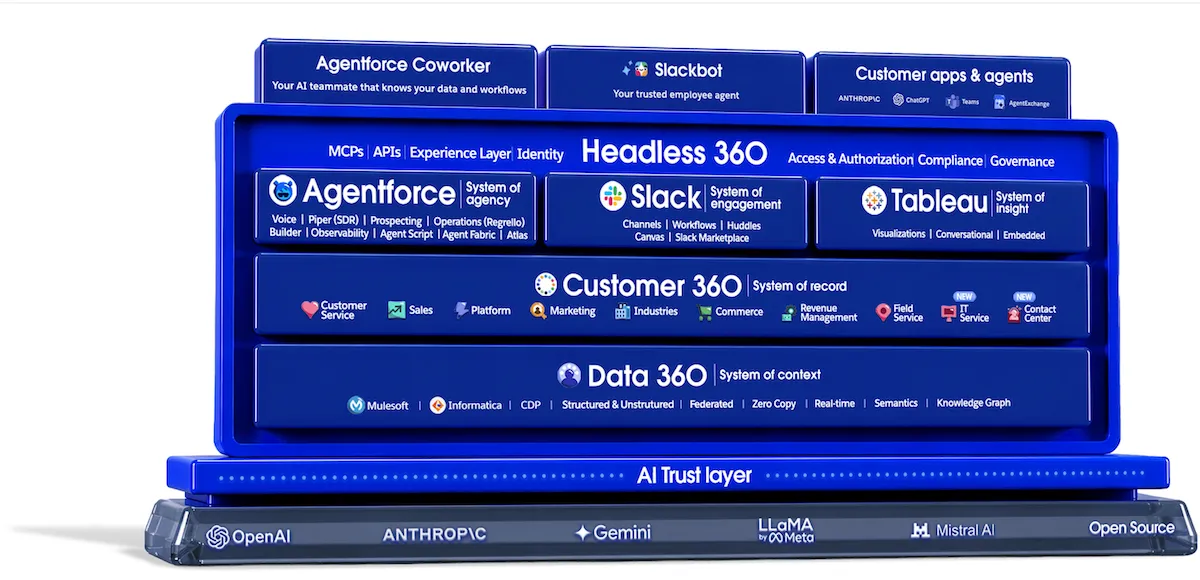
Headless 360 didn't catch us by surprise.
We work closely with Salesforce. So when Salesforce made Headless 360 official, the announcement landed as confirmation of the work we'd already been doing.
Here's what changed in practice.
- Your digital workers can navigate Salesforce through standardized APIs (Application Programming Interfaces) and the new MCP (built on Model Context Protocol) tools, the agent-facing surfaces behind the UI.
- CLIs (Command Line Interfaces) round out the access pattern for developers and DevOps teams.
- What was possible-but-rare is now standard operating procedure.
The Salesforce investment your team made over the last decade is the foundation. With Headless 360, your human and digital workers operate together against the same data, workflows, and business logic. Your leverage lives upstream of the screen.
At Asymbl, we run nearly 200 digital workers alongside 150+ people across 13 business functions. Hybrid workforce orchestration is how the work holds.
Here's what I've learned designing for it.
The Architectural Shift Underneath Headless 360
Four Systems, One Platform
In my experience, designing for Headless 360 starts with the architecture, because it's what's changed. Salesforce's Agentic Enterprise architecture is built on four primary systems:
- System of Context (Data 360): the records, fields, and relationships that store everything your business runs on (accounts, contacts, opportunities, candidates, cases)
- System of Work (Customer 360): where business logic and workflows live (approval chains, stage transitions, validation rules, automated routing)
- System of Agency (Agentforce): where digital workers are built, deployed, and managed at scale
- System of Engagement (Slack): where humans and agents come together to get work done
For two decades, the System of Context was reachable through APIs. Developers could integrate Salesforce data into other systems freely. The System of Work was reachable too. The APIs existed, and workflows could fire on API-driven changes. But in practice, almost no one ran Salesforce headless, because it took bespoke integration code, deep platform knowledge, and there was no standard way for a digital worker to discover and invoke those capabilities.
The challenge was that a developer could write a script that bulk-updated 500 records overnight. Moving those records to the next stage, getting approvals on them, or routing them anywhere almost always meant a human did it in the UI. There was no standard, governed path for a digital worker to invoke those workflows safely at scale.
Headless 360 makes that the default.
A New Operator Class on the Platform
Your human workforce used to be the only operator class on the UI, which meant your people were also the only execution path for the System of Work. With the combined capability of a headless platform and orchestrated digital workers that can natively operate behind the UI, your hybrid workforce expands the platform's capability and business capacity at the same time. Your digital workers open up a second execution path to unlock work the platform was already built to support.
Before Headless 360, a digital worker could technically update an opportunity via API, but it required bespoke integration code, knowledge of Salesforce-specific endpoints, and custom error handling. Now, with MCP tools, a digital worker can invoke that same workflow through a standardized, natural-language-accessible interface, with governance built in. Digital workers are also becoming the integration layer between systems. They reach across the System of Context, System of Work, and System of Engagement to surface insights, updates, and alignments without humans needing to switch platforms.
But a new operator class on the platform raises a new question: what will your technical team build now?
The Technical Team's Role Shifts Upstream
Years ago, a developer could use deterministic code to write rules. Often these rules struggled to handle edge cases. For example an easy rule might say, "If the lead score is above 80 and the territory is West, route to Sarah." But that same rule wouldn't be able to handle a lead that scored 78 and came from a strategic account, or the lead that scored 92 and came in at 11pm on a Friday when Sarah is offline.
The solution to those edge cases meant writing in more rules. But eventually the rule sets became too large to maintain, and businesses fell back on their most flexible resource: humans in the UI who could handle the ambiguity.
In this environment, the ceiling is that while rules can execute, they can't reason.
Headless 360 plus digital workers raises that ceiling. The technical team's work pivots away from maintaining rules to the architectural work of designing the reasoning environment digital workers operate inside. Designing data models, APIs, workflow definitions, and the governance is the new craft. And it allows every digital worker the business onboards to operate with accountability on the rails the technical team builds.
This is where Salesforce earns its place as the enterprise foundation. Salesforce has spent decades building the trust layer: the security model, the governance, the deterministic rules businesses depend on. Models like Claude, ChatGPT, and Gemini bring the reasoning. What they don't bring on their own is the system of record, the security model, and the governance an enterprise runs on. Headless 360 puts that intelligence to work inside the platform that does. Businesses get the agility of digital workers and the trust of an enterprise platform in the same operating model.
Workforce Orchestration with Headless 360
Because Headless 360 is built into the Salesforce platform your team already runs, product leaders can redesign how digital workers reach the System of Work in the products they already have. Who reaches their existing products, how, and through which surfaces are part of the design discipline that allows hybrid workforces to operate well. Asymbl's been running this discipline for the past year. And now, Headless 360 is changing the surface area where the discipline is applied. With the Salesforce System of Work standardized for digital workers, the workforce design discipline reaches more of the platform than it did a year ago. For product leaders, BDMs, and CIOs, three areas of design work move from theoretical to concrete inside Salesforce:
#1 Turn Data Architecture into the Core User Experience
For humans, the user experience lives on the screen. For digital workers, the user experience lives inside your data model. Product leaders own data hygiene as a design discipline: the hard work of cleaning up legacy integrations, custom fields, and undocumented changes.
#2 Map Capabilities and Execution Rails
Your business logic is already inside Salesforce. Product leaders are designing the boundaries that let digital workers invoke it safely: which APIs are open to the digital worker, which MCP tools it's permitted to call, which workflows it's authorized to execute. Mapping the rails is how digital workers stay accountable.
#3 Orchestrate the Seams of the Hybrid Workforce
Orchestration without discipline breaks at the handoff. Product leaders are naming where digital workers escalate, what triggers the escalation, what context the human needs to act, and how the work returns to the digital worker once a human decision lands. Orchestrating the seams is what makes the hybrid workforce hold.
Headless 360 with Asymbl
Headless 360 is a contribution to the broader AI expansion conversation: AI expanded what humans can do, and now headless architecture expands what platforms can do.
Headless 360 changes the surface area and expands what’s possible. With the Salesforce System of Work now standardized for digital workers across every business already built on the platform, the design discipline Asymbl has been applying internally can now be applied directly inside the Salesforce environment your team already runs.
For Asymbl, this opens a new way to deliver our products. Imagine Recruiter Suite reaching customers directly in their flow of work through MCP tools, no toggling required between systems. That's the kind of work Headless 360 makes possible, and it's the direction we're building toward.
Skip the guesswork. Use our blueprint. Contact Us
.webp)
Digital Labor Strategy: 10 Rules for Business Leaders
Digital labor strategy is where AI experiments turn into real workforce results. Brad Owens shares 10 rules for business leaders.

The Right Fit Starts With a Conversation.
See what working together could look like.
.webp)