

.webp)
An applicant tracking system was built to track candidates through one requisition. A talent acquisition platform is supposed to reason across many of them. When you run both through the same evaluation matrix, the matrix cannot tell you which is which.
Buyers in 2026 are also confronting a question that did not exist three years ago. Where do digital workers fit, and which platforms can actually onboard them inside the workflow recruiters already use without standing up a parallel system?
In this blog, we will examine the architectural gap that buying guides ignore, the five evaluation criteria that actually separate platforms, the eight options most enterprise TA (Talent Acquisition) teams compare in 2026, and the warning signs that the current platform is the real constraint.
The Architectural Distinction Between an ATS and a Talent Acquisition Platform
Most ATS vs Talent Acquisition Platform evaluations compare features, pricing, and integrations, and miss the one question that actually predicts whether the platform will work: what was it built to do at the data layer?
What ATS Platforms Were Actually Designed to Manage
Applicant tracking systems were built for a narrow administrative problem. Post a job, receive applications, move candidates through pipeline stages, and generate the offer.
When the requisition closes, the ATS work is finished. The candidate record stays in the database. The relationship intelligence (what that candidate is like to work with, how their post-hire performance compared to the interview signal, when they might be available again) does not accumulate in a form the system can reason against when a similar role opens next quarter.
The gap traces directly to the data model. Every interaction is attached to a single requisition. When the req closes, the context that gave those interactions meaning closes with it.
Cross-Cycle Candidate Intelligence and Why the ATS Data Model Cannot Support It
A talent acquisition platform operates across many hiring cycles instead of inside a single one. The intelligence it holds about a candidate compounds with every interaction recorded over time.
A candidate sourced for a senior role in 2024 who declined the offer is still a known entity in 2026, with documented context, prior conversations, and recruiter notes from each touch available to whoever searches for them next.
When a recruiter searches the system, the platform reasons against the full relationship history. The match the recruiter sees reflects everything the company has learned about that candidate over the years, including conversations from prior roles the candidate considered.
Although ATS systems can store the same history, they cannot reason against it because the data model was never built to surface it as a decision context.
Why Running Both Architectures Through the Same Checklist Produces the Wrong Shortlist
The standard evaluation process puts every vendor through one matrix.
- AI matching
- Job board integrations
- Calendar scheduling
- Reporting dashboards
Most modern systems check most boxes, but the checklist does not separate architectures because architecture is not what the checklist is asking about.
The criteria that would have separated them are architectural. For example:
- Where does the data live?
- What does the intelligence learn from?
- Where in the workflow does that intelligence operate?
- What happens to institutional knowledge when a recruiter leaves and takes the spreadsheet with them?
A checklist cannot ask those questions, but a serious evaluation has to.
The Evaluation Criteria Enterprise TA Leaders Should Actually Be Using
.png)
Each one of the evaluation criteria below determines what the platform can and cannot do once it is live.
Data Architecture: Unified Foundation vs. Integration-Dependent Stack
The intelligence a platform produces is a direct function of the data it can access. A platform built on a unified data foundation, where candidate records, engagement history, hiring decisions, and post-hire signals live in the same environment, provides reasons against complete information at every step.
| Comparison | Unified Foundation | Integration-Dependent Stack |
|---|---|---|
| Where data lives | Candidate, job, hire, and outcome data in one environment | Spread across ATS, CRM, HRIS, and spreadsheets, synced on a schedule |
| How current the data is | Real-time, always current | Only as fresh as the last successful sync |
| What the AI reasons against | The full record, every interaction, every outcome | Whatever made it through the last integration run |
| When a sync fails | Nothing breaks, data is already there | Recommendations run on stale or incomplete data |
| What happens when a recruiter leaves | Relationships and history stay on the platform | Relationships walk out with the person |
| Governance and audit trail | Single environment, single audit trail | Fragmented across systems, hard to reconstruct |
| Time to stand up reporting | Query the data layer directly | Custom export, data engineering, and three weeks |
| Digital worker readiness | Workers onboard inside the same data environment that the human team uses | Requires a separate integration and a new data plane |
Pull the integration architecture diagram in any vendor demo. The number of hops the data takes before it reaches the recruiter's screen tells you how stale the recommendation is going to be when it gets there.
AI-Native vs. AI-Layered
AI-layered platforms add intelligence features on top of an existing system. The matching model, the recommendations, and the scoring operate on a separate data layer. The recruiter switches between the workflow they know and the AI view they have to remember to consult.
AI-native platforms treat intelligence as a structural component. The reasoning operates on the same data the recruiter works with, in the same interface, producing recommendations that update with each interaction rather than refreshing on a sync schedule.
| Comparison | AI-Native | AI-Layered |
|---|---|---|
| Where intelligence lives | Built into the data layer the recruiter already works in | Sits on top of the existing system as a separate feature |
| How recommendations update | With every interaction, in real time | On a sync schedule, after the fact |
| Where the recruiter sees it | Inside the workflow they already use | In a separate view they have to remember to open |
| What it reasons against | The same live data the recruiter works with | A separate data layer that may not reflect the current state |
| Adoption pattern | Used because it's already there | Ignored because it requires a context switch |
| What happens at scale | Intelligence compounds as more interactions accumulate | Recommendations stay static between syncs |
| Integration overhead | None, it's structural | Ongoing, any drift breaks the AI layer |
| What it feels like in production | A recruiter who thinks faster | A tab nobody opens after week three |
Intelligent Signals: Whether the Platform Surfaces Decision Context the Recruiter Would Otherwise Miss
An intelligent signal is a piece of decision context that the system produced because the data it has access to allowed it to.
For example, a recruiter looking at a candidate sees that the candidate's manager at a previous role is now a hiring manager for an open requisition in another business unit.
These signals are the by-product of a platform that holds a single, accumulating record of every interaction and can reason against it. Bolting an AI feature onto a search box does not produce them.
Most evaluations miss this because the checklist does not have a row for it. A platform either operates on intelligence that compounds, or it operates on whatever the recruiter remembered to enter into the form.
Asymbl's Talent Intelligence layer is built around this property. The reasoning engine sits on the same Salesforce data the rest of the workflow uses, so every interaction is observable, every observation is queryable, and every queryable observation can become a signal the moment the right question is asked.
Evaluate by asking the vendor to walk you through three real decision moments where the platform surfaced, something the recruiter would have otherwise missed. If the answer is the matching score, the platform is operating at the same depth as everyone else.
Digital Labor Readiness: Whether the Platform Can Scale Capacity Without Adding Headcount
Evaluate: Does the platform treat digital workers (AI Agents) as a native capability, or does it require external tooling and a new data plane?
A platform built on Salesforce Agentforce, for example, allows digital workers to onboard inside the same data environment as the human recruiters, with the same governance, audit trail, and no separate integration to maintain.
A digital worker that lives outside the data the recruiter works in becomes a productivity tax. The integration overhead eats up the capacity the worker was supposed to add.
Business Outcome Connectivity: Whether Recruiting Data Reaches Revenue and Workforce Planning
Time-to-fill and offer acceptance are lagging indicators of a process that has already happened. Talent Acquisition leaders accountable for quality of hire, retention impact, and workforce strategy need the platform to connect a hiring decision to what happens after day one.
Evaluate: Does the platform operate inside a data environment where post-hire performance signals, CRM revenue data, and workforce planning inputs are accessible without a separate export? Or does measuring business impact require a custom analytics layer and three months of data engineering to stand it up?
If "did the hires from Q2 produce" is a question the platform cannot answer without an export, the platform was built to track the process. The business question lives somewhere else.
Top Talent Acquisition Platforms Compared in 2026
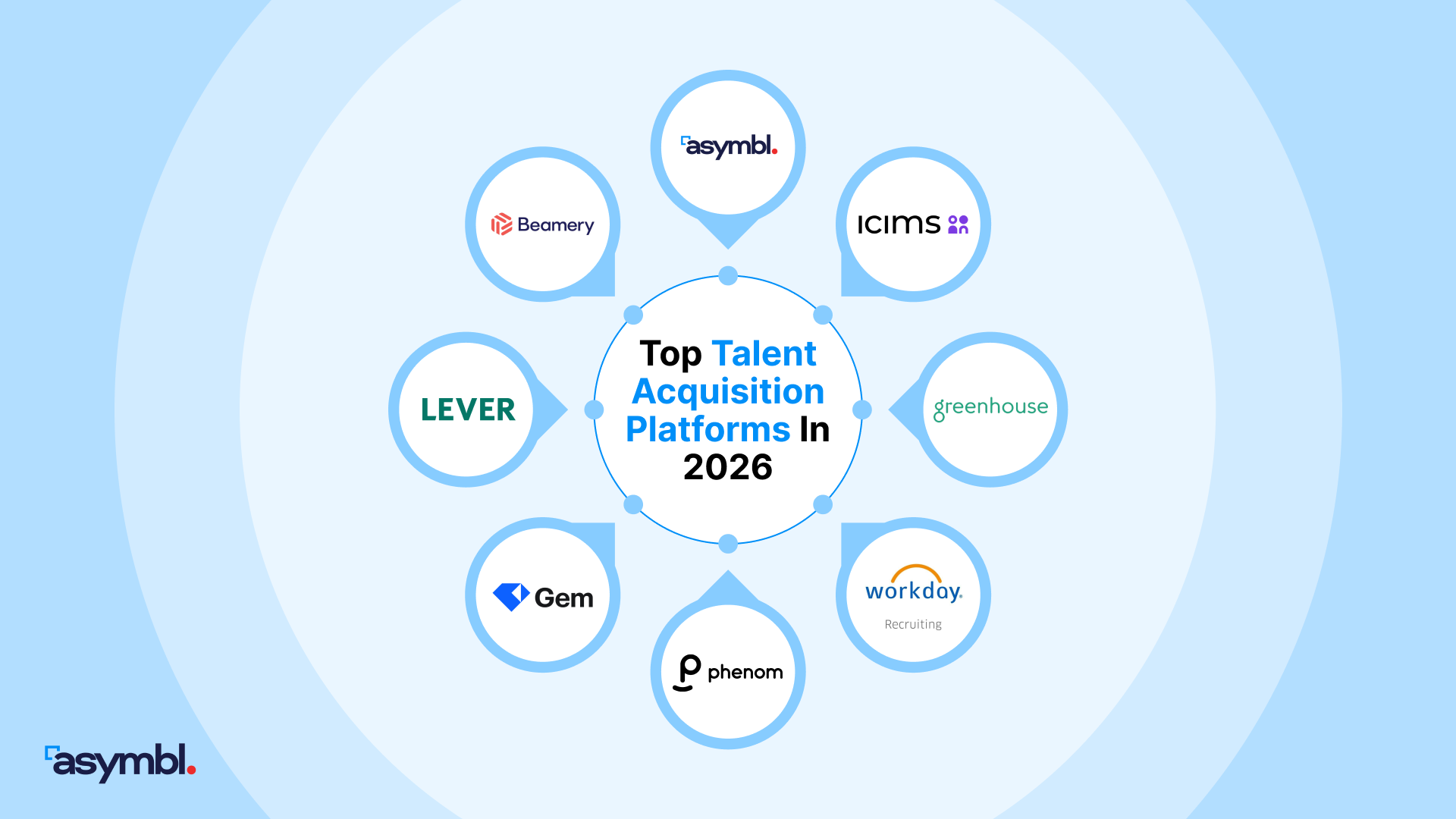
The platforms below represent the most commonly evaluated options for enterprise TA teams in 2026. The comparison table covers the snapshot view. Each tool sub-section that follows expands on what the platform does, its key features, pricing posture, pros, cons, and verified ratings.
| S.No | Tool | Core Strength | Pricing | Best for |
|---|---|---|---|---|
| 1 | Asymbl | Salesforce-based unified workforce orchestration | Based on the solution | Enterprise TA teams running on or moving to Salesforce |
| 2 | iCIMS | Enterprise-scale ATS depth | Custom pricing | Large enterprises with mature, high-volume hiring operations |
| 3 | Greenhouse | Structured hiring workflows | Custom pricing | Mid-market and growth-stage teams formalising hiring rigor |
| 4 | Workday Recruiting | Native HCM integration | Custom pricing | Workday HCM customers wanting recruiting inside one system |
| 5 | Phenom | Candidate experience and CRM | Custom pricing | Large employers competing on employer brand and pipeline depth |
| 6 | Gem | AI sourcing and outreach automation | Custom | In-house recruiting teams building proactive sourcing motion |
| 7 | Lever | Recruiter-friendly ATS with CRM | Custom pricing | Mid-market companies prioritising recruiter usability |
| 8 | Beamery | Talent CRM and skills intelligence | Custom pricing | Global enterprises running long-cycle pipelining and reskilling |
A comparison table can tell you what each platform has. It can't tell you what each one was designed for, where the architecture runs out of road, or what the contract looks like six months in. That's what the detail below is for.
1. Asymbl
Asymbl is a workforce orchestration platform that helps businesses manage human and digital (AI) workers together. Built on Salesforce, it combines recruiting software, AI talent intelligence, autonomous digital recruiters, and consulting services, enabling staffing firms and corporate TA teams to scale hiring capacity without adding headcount.
Key Features
- Salesforce-based unified data layer: Candidate, account, hire, and revenue data sit in one environment, so intelligence reasons across the full lifecycle instead of stitching together five sync schedules.
- Talent Intelligence as the reasoning engine: The Asymbl Intelligence platform turns every accumulated recruiter interaction into a queryable decision context, surfacing signals that compound across cycles instead of closing when a req closes.
- Native digital workers via Agentforce: Pre-built workers like Rosa (Digital Recruiter) and Polly (People Ops) onboard inside the same Salesforce environment as the human team, with shared governance and a single audit trail.
Pros
- Salesforce-based foundation eliminates the integration tax that other platforms pay in terms of freshness and governance gaps
- Talent Intelligence reasons against accumulated cross-cycle data, with every interaction queryable
- Pre-built digital workers onboard inside the same workflow the human team already uses
- Configurable editions match the buyer's maturity curve from process modernisation through to enterprise-scale orchestration
Pricing:
- Recruiter Suite: $60/user/month (Launch core TRM on Salesforce), $125/user/month (Premier, adds Talent Intelligence), or custom-scoped (Ultimate, adds autonomous Digital Recruiter).
- Consulting: Fixed-fee, T&M, or retainer. Agentforce Jetpack ~$30K / Break-Fix $25K (both 4 weeks).
- Digital Labor Advisory: Phased, Design (60 days), Onboard (3–8 months), Coach (6+ months), all custom-scoped.
Best for: Enterprise TA teams running on or moving to Salesforce who want a unified hybrid workforce platform instead of a recruiting silo.
2. iCIMS
iCIMS is an enterprise applicant tracking and recruiting suite designed for high-volume hiring environments.
It covers the full hiring lifecycle from job advertising and candidate management through to offer and onboarding, with a deep configuration model that allows large employers to tailor workflows to complex organisational structures.
Key Features
- iCIMS Talent Cloud: A modular suite covering attraction, hiring, and advancement with consistent data flowing across recruitment marketing, ATS, CRM, and onboarding inside one ecosystem.
- Recruitment marketing tools: Career sites, content management, and programmatic advertising help large employers control employer brand and demand generation at scale.
- Deep configuration and workflow control: Granular permissions, custom fields, and approval chains map to complex enterprise governance and compliance requirements.
- Extensive integration marketplace: Hundreds of pre-built integrations with HRIS, assessment vendors, background-check providers, and job boards reduce the cost of point-to-point integration.
Pricing: Custom Pricing
Pros
- Mature, enterprise-grade ATS with deep workflow configurability
- Strong recruitment marketing and career site capability
- Wide integration ecosystem reduces stack-assembly cost
- Reliable for high-volume, multi-region hiring operations
Cons
- The user interface can feel dated compared to newer platforms
- Reporting is powerful but has acknowledged export and customisation limits
- AI capability sits on top of the existing architecture as a separate layer
Best for: Large enterprises with mature, high-volume hiring operations that need a deeply configurable, full-suite ATS.
3. Greenhouse
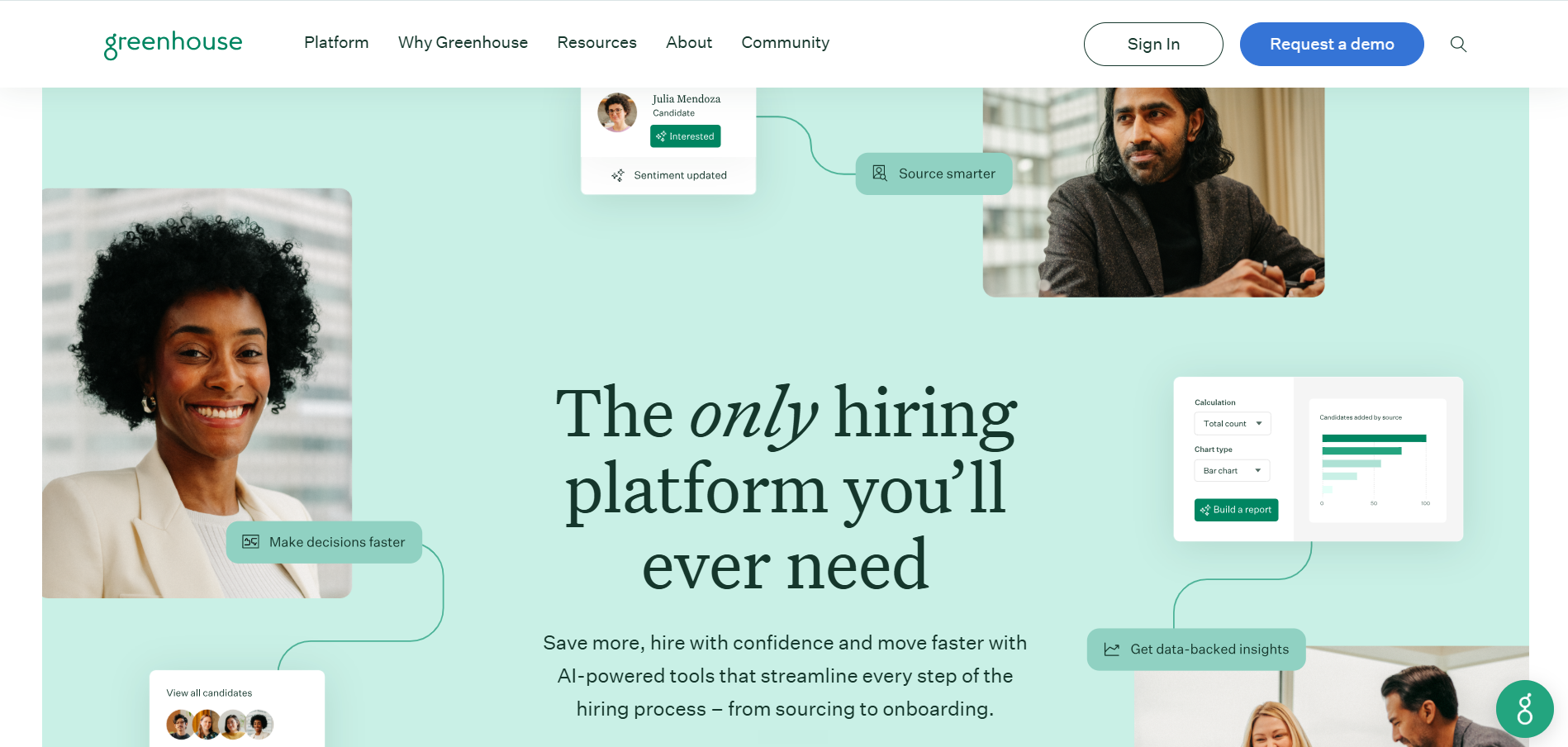
Greenhouse is a structured-hiring ATS designed to bring rigor and consistency to the interview process. The platform is widely adopted by mid-market and growth-stage companies that want to formalise scorecards, interview kits, and approval workflows. Greenhouse has built a reputation for the discipline of its hiring methodology and the depth of its third-party integration marketplace.
Key Features
- Structured interview kits and scorecards: Standardises how hiring teams evaluate candidates, reducing variance between interviewers and improving the downstream quality-of-hire signal.
- Approval workflows and governance: Configurable requisition approvals, offer chains, and compliance controls suited to companies maturing their hiring rigor.
- Greenhouse Recruiting and Onboarding integration: Candidate data flows from hire to day-one onboarding inside one suite, reducing rekeying and handoff loss.
- Reporting and analytics layer: Pipeline metrics, source effectiveness, and DEI reporting surface across hiring stages and time windows.
Pricing: Custom pricing
Pros
- Structured hiring methodology is one of the strongest in the market
- Large third-party integration marketplace
- Clean, recruiter-friendly user interface
- Strong implementation and onboarding support
Cons
- Cost is frequently flagged as high for smaller organisations
- Some customisation requires upgrading to a higher tier
- The reporting layer is solid but less flexible than analytics-first platforms
- AI capability is comparatively lighter than newer AI-native entrants
Best for: Mid-market and growth-stage teams formalising hiring rigor and looking for structured interview methodology.
4. Workday Recruiting
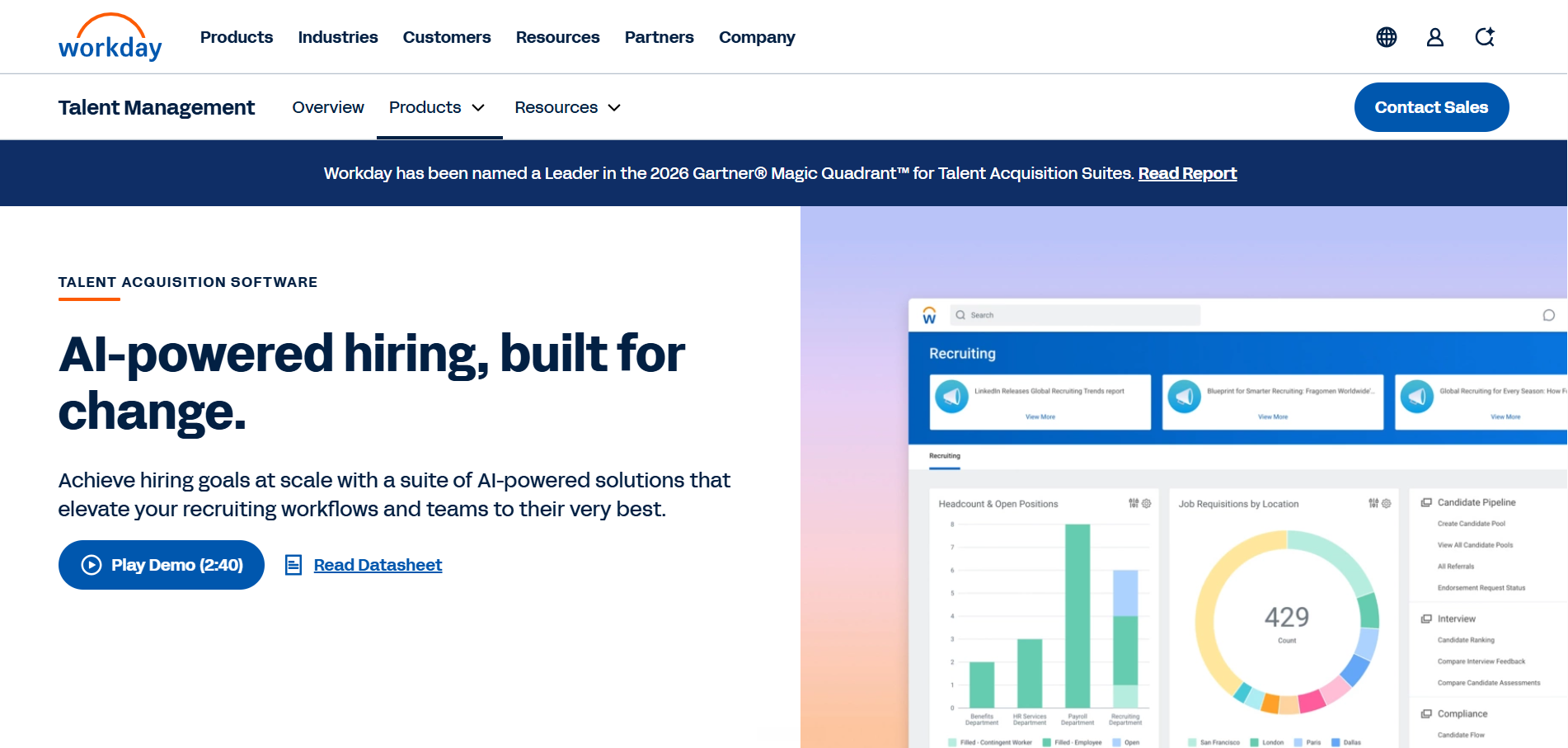
Workday Recruiting is the talent acquisition module of the Workday HCM suite, designed to operate inside the broader Workday data model alongside core HR, payroll, and talent management.
Its value comes from the unified data layer between hire and employee records, allowing recruiting data to flow into Workday HCM with no integration. It is most commonly adopted by enterprises already running Workday HCM.
Key Features
- Native Workday HCM integration: Candidate data becomes employee data with no integration, removing the rekey-and-sync gap between recruiting and core HR systems.
- Configurable requisition workflows: Approval chains, offer flows, and onboarding workflows map directly to the enterprise's Workday HR structure.
- Reporting and analytics: Reporting flows across recruiting, employee data, and talent management for unified workforce analytics.
- Mobile recruiter experience: Recruiters can review, approve, and interview-schedule from the Workday mobile app.
Pros
- Unified data layer with Workday HCM removes recruiting-to-HR integration cost
- Strong governance and compliance fit for global enterprises
- HiredScore AI brings native intelligence into the workflow
- Consolidation under one vendor simplifies vendor management
Cons
- ATS depth lags purpose-built recruiting platforms
- User interface for recruiters and hiring managers is widely criticised for clicks and rigidity
- Mostly viable only for organisations already standardised on Workday HCM
- Implementation and configuration cost is significant
Pricing: Custom Pricing
Best for: Workday HCM customers wanting recruiting inside the existing HR data layer.
5. Phenom
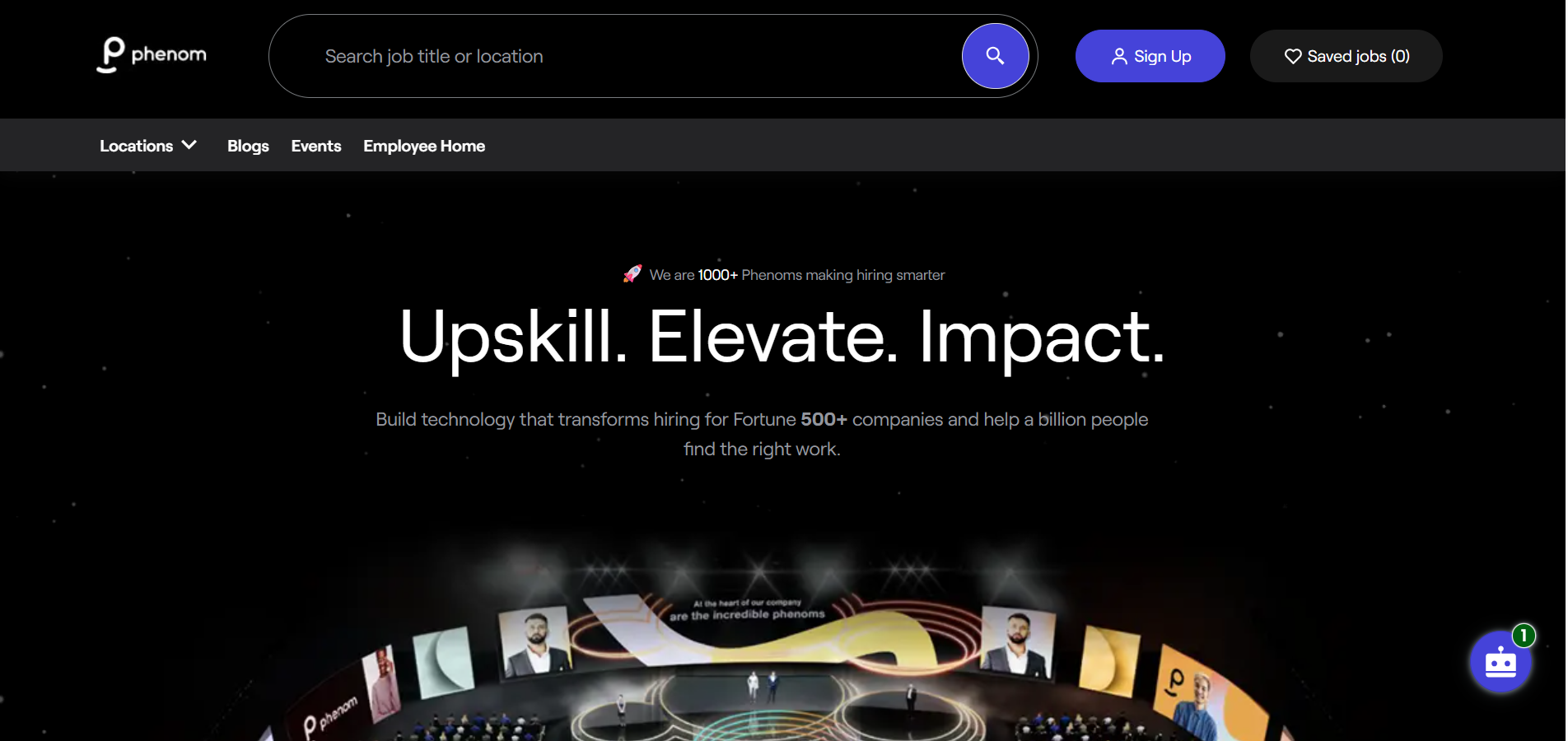
Phenom is a talent experience platform that combines a career site, candidate CRM, and AI matching layer to help large employers build a pipeline and improve candidate engagement at scale.
Key Features
- Career site and personalisation: AI-powered career sites tailor job recommendations, content, and chatbot interactions to each visitor's profile and behaviour.
- Talent CRM and campaign management: Outreach campaigns, talent pools, and event registration for proactive pipeline nurture across passive candidates.
- AI matching and ranking: Phenom's AI scores candidates against jobs and surfaces silver-medalists from historical applications.
- Internal mobility module: Surfaces internal candidates against open roles using skills inference and career history.
- Conversational chatbot: Captures candidate intent on the career site and routes high-intent visitors into application flows.
Pros
- Strong candidate experience and career site capability
- Robust CRM and campaign tooling for proactive pipelining
- Internal mobility and employee experience extend the use case beyond recruiting
- Native AI matching across external and internal candidate pools
Cons
- Implementation complexity and timelines are frequently flagged
- AI is layered across modules rather than running on a single unified data layer
- Long ramp-up for full power-user productivity
Pricing: Custom Pricing
Best for: Large employers competing on employer brand and building deep proactive pipelines.
6. Gem
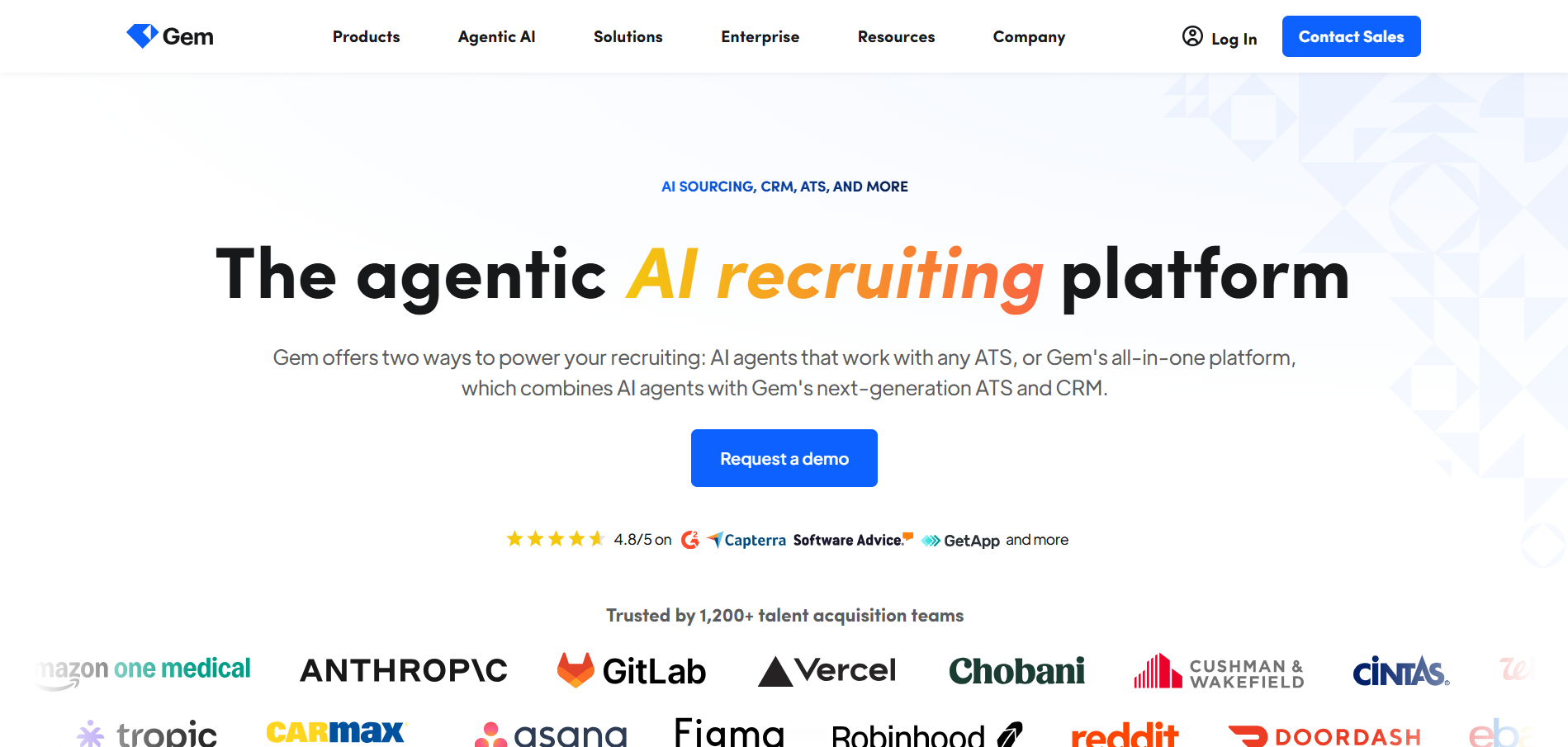
Gem is an AI-first recruiting platform that combines sourcing, outreach automation, candidate CRM, and analytics into a single workflow. The platform is widely adopted by in-house recruiting teams running outbound sourcing motions.
Key Features
- AI-first sourcing: Native search across an expansive profile dataset, with AI ranking surfacing the highest-fit passive candidates per role.
- Outreach sequence automation: Multi-step, multi-channel sequences for cold outreach with response, open, and reply analytics tracked per recruiter.
- Unified recruiting CRM: Centralised candidate pipelines, projects, and tagging that work across active and passive talent populations.
- AI agents inside the workflow: Unlimited AI agents (sourcing, screening, scheduling) included in newer Gem editions, removing point-tool sprawl.
- Pipeline analytics and forecasting: Recruiter productivity, sequence performance, and pipeline health reporting at the team and individual recruiter level.
Pros
- Strong AI-first sourcing and outreach motion
- Bundled platform reduces point-tool sprawl
- Pipeline analytics are deeper than most ATS-first platforms
Cons
- Integrations are growing but less extensive than legacy ATS marketplaces
Pricing: Custom Pricing
Best for: In-house recruiting teams building a proactive sourcing motion and consolidating sourcing, CRM, and outreach.
7. Lever
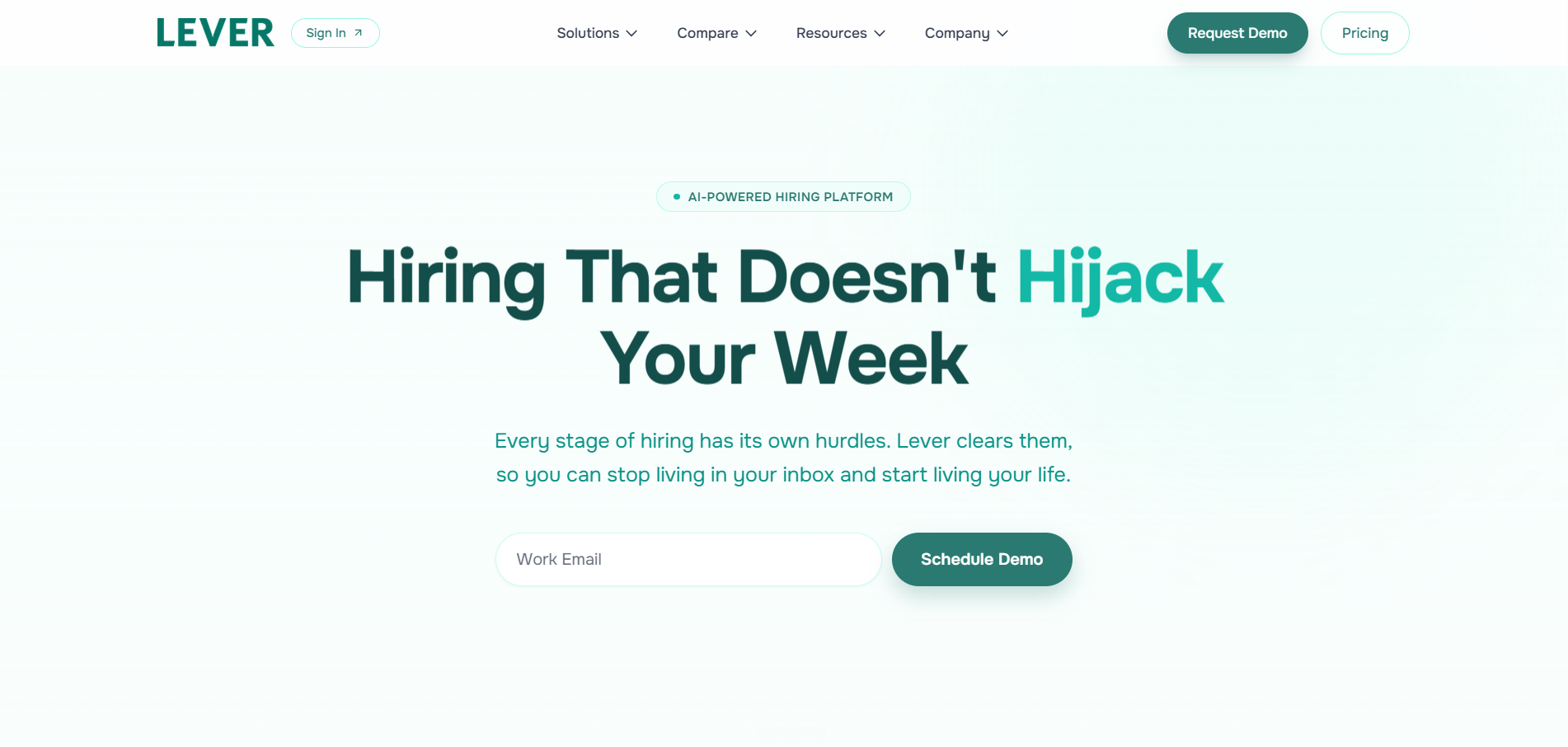
Lever is a recruiter-friendly ATS and CRM platform designed for mid-market companies that want pipeline visibility and outbound capability alongside core applicant tracking.
Lever was an early proponent of combining ATS and CRM in one platform, and it remains one of the more usable interfaces in the category. The product is well-suited to teams running both inbound and outbound recruiting motions inside the same system.
Key Features
- Combined ATS and CRM: Active applicants and passive prospects live in the same pipeline view, so sourcing and screening operate inside one data model.
- Nurture campaigns and outreach: Email sequencing and campaign templates for proactive sourcing and re-engagement of past applicants.
- Interview scheduling and automation: Automated scheduling, interviewer load balancing, and feedback workflows reduce coordination overhead.
- Analytics and reporting: Pipeline conversion, source effectiveness, and DEI reporting available across hiring stages.
- EasyBook and self-scheduling: Candidates self-schedule against recruiter availability, cutting back-and-forth on interview coordination.
Pros
- Recruiter-friendly user interface with consistently high usability scores
- Native CRM alongside ATS reduces tool sprawl
- Strong customer support reputation
- Solid mid-market fit on both feature depth and cost
Cons
- AI capability is comparatively lighter than newer AI-native entrants
- The reporting layer requires higher tiers for advanced analytics
- Automation customisation has acknowledged limits per reviewers
- Integrations are solid but less expansive than enterprise-tier ATS marketplaces
Pricing: Custom pricing
Best for: Mid-market companies prioritising recruiter usability and running a combined inbound plus outbound motion.
8. Beamery
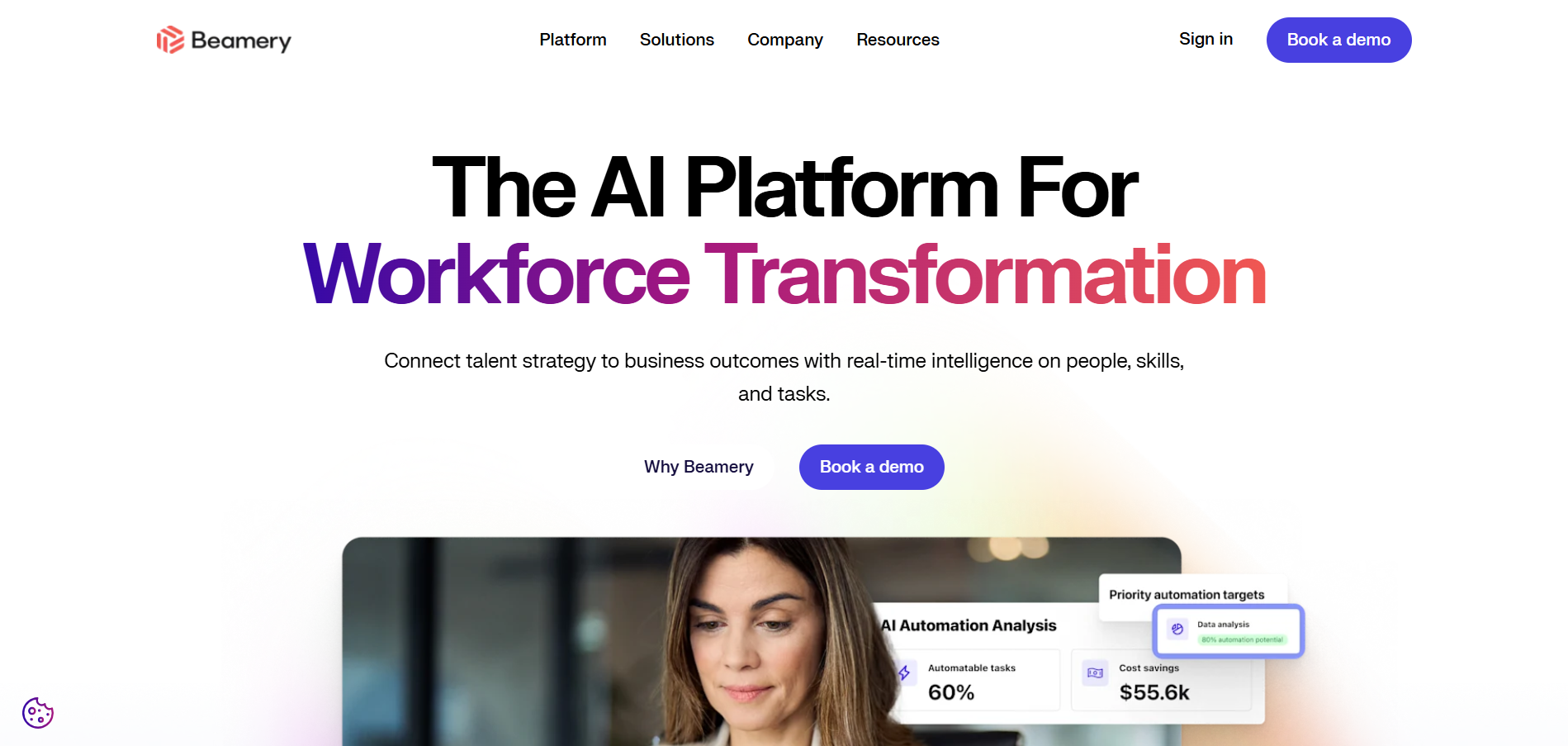
Beamery is a talent lifecycle platform built around candidate relationship management, talent pipelining, and skills intelligence. The platform is designed for global enterprises running long-cycle hiring and internal mobility programs against the same talent dataset.
Key Features
- Talent CRM and pipelining: Long-horizon candidate relationships, talent pools, and nurture campaigns for roles that recruit on a six-to-twelve-month cycle.
- Skills intelligence and inference: Skills inferred from candidate profiles and internal employees power matching across external pipeline and internal mobility.
- Workforce planning module: Connects skills supply against demand to support workforce strategy and reskilling investment decisions.
- Candidate experience automation: Branded career sites, candidate portals, and automated nurture sequences for global pipeline programs.
Pros
- Strong talent CRM and long-cycle pipelining capability
- Skills inference and internal mobility extend use beyond hiring
- Enterprise-grade compliance and governance
- Workforce planning ties recruiting to broader workforce strategy
Cons
- Implementation and learning curve are flagged as steep
- The reporting layer described as less flexible than recruiting-first platforms
- Integration coverage is rated lower than market-leading ATS marketplaces
Pricing: Custom Pricing
Best for: Global enterprises running long-cycle pipelining, internal mobility, and skills-based workforce planning.
Warning Signs Your Current Platform Is the Real Constraint
The following three patterns below help you identify when the architecture is limiting your talent management and expansion goals:
When Workarounds Become the Workflow
- Spreadsheets running in parallel candidate tracking because the ATS handles a particular flow poorly.
- Shared docs for notes that do not fit the system's data model.
- Manual handoffs between stages because the platform-enforced workflow does not match how the team actually places candidates.
Each workaround is a hidden cost. By the time the team has built five workarounds, the institutional knowledge of how hiring really works lives in those workarounds, instead of the system you paid for.
When the Intelligence Cannot Be Trusted Because the Data Might Not Be Current
Platforms that depend on external integrations for candidate data, job order information, or outcome signals produce recommendations against the last completed sync.
When a sync fails or lags, the recommendation operates against stale data. A recruiter who has been burned by a stale recommendation once stops trusting the recommendation, which means the intelligence feature has effectively shut itself down.
Run this test, and ask any recruiter on the team if they trust the platform's recommendations enough to act on them without verifying first. If the answer is "I always check the source," the intelligence layer is not working, regardless of what the vendor demo shows.
When Recruiting Activity Cannot Be Connected to a Business Outcome
If answering "what did last quarter's hires produce" requires a manual data pull from three separate systems and a custom export, the platform was built to track process rather than impact. No dashboard can fix architectural gaps.
The same pattern shows up when leadership asks for quality-of-hire reporting, and the team spends two weeks producing it. The data exists, but is not easily accessible or straightforward, because the platform was not designed to ask that question.
Conclusion
A platform that cannot unify data, cannot reason against institutional knowledge, cannot surface signals in the moment of decision, and cannot connect a hire to a business outcome will underperform against the actual business requirement, no matter how complete its feature set looks in the demo.
The eight platforms compared above were architected for different problems. Evaluate against the five architectural properties first. Use the feature checklist as a final filter, not the first one.
Asymbl was built based on a unified Salesforce data foundation, intelligence that compounds across cycles, and Digital workers that onboard inside the workflow.
Book a demo to see Asymbl in action
FAQs
An ATS manages workflow within a single hiring cycle. from post to offer, then closes. A talent acquisition platform accumulates intelligence across cycles, keeping candidate relationships, engagement history, and post-hire outcomes in one compounding data layer.
Prioritise a unified data foundation, AI woven into workflows (not layered on top), digital labor readiness, and the ability to connect hiring activity to business outcomes without manual exports.
AI-native platforms embed reasoning into the data layer, and matching and scoring happen inside the same interface recruiters already use. Bolt-on AI requires switching between tools, which kills adoption.
Candidate, account, and revenue data sit in one environment, the platform reasons across, with no silos or middleware. Digital workers onboard in that same environment, and hiring decisions connect directly to business outcomes.
Only if the platform's foundation supports it natively (like Salesforce Agentforce). Otherwise, you need a separate orchestration layer and parallel data plane, adding complexity that often cancels the productivity gain.

Legacy ATS Limitations: Why Your Recruiting System Is Holding You Back
The ATS platforms are not fundamentally flawed. They’re simply not built to support today’s dynamic recruiting environment. As strategies shift to emphasize early engagement, automation, and cross-functional coordination, the supporting systems must shift too.

The Right Fit Starts With a Conversation.
See what working together could look like.
.webp)