

How to Measure AI ROI: A Framework for Outcomes-Based AI Implementation

.webp)
From enterprise resource planning (ERP) in the 1990s to customer relationship management (CRM) in the 2000s and cloud migration in the 2010s, every major enterprise technology wave has repeated the same adoption failure: purchase technology, direct it at tasks, measure output, and blame it when ROI doesn’t materialize.
Businesses are now repeating this cycle with AI.
What's clear from each wave is that a results-first approach has been key to ROI. But, you might be wondering whether that approach can work in the agentic AI era too.
At Asymbl, we've already proven it does.
From Use Cases to Outcomes
McKinsey's 2025 State of AI survey found that 88% of organizations are using AI in at least one business function, yet only about 6% qualify as high performers seeing meaningful earnings before interest and taxes (EBIT) impact. The 6% share one distinction: they fundamentally redesigned how work gets done.
Asymbl’s built outcomes-based thinking into a framework for the agentic era to increase ROI and prevent the risks that affect your people, operations, and bottom line. An outcomes-based approach guides businesses to focus on prioritization, curb unnecessary spending, align teams, and turn their AI investments into workforce capability with clear ownership and measurable returns. To make this shift inside your organization, start with this question: in this market, and over the long term, what result does your business need?
A use case answer sounds like: work JIRA tickets, summarize meetings, or document requirements. A business outcome sounds like: "We need to accelerate delivery velocity on enterprise implementations while maintaining documentation quality and reducing rework across the team.”
We applied this thinking to our own operations function. Ben, our Digital Business Analyst, joined a live enterprise Salesforce implementation alongside our human delivery team with one goal: keep project knowledge sharp, connected, and accurate so the engagement delivers on time and on scope. Working alongside human analysts and led by Asymbl's SVP of Delivery, that hybrid team contributed to a 10.4x ROI and $312K in projected productivity impact for our operations function. The use cases Ben performs, requirements documentation, gap analysis, meeting summaries, risk identification, all organized themselves underneath the outcome.
Read Ben’s story: Here's What Managing AI Like an Employee Actually Looks Like
With outcomes-based thinking, the downstream work gets clear: which roles belong to human workers, which belong to digital workers, where the handoffs sit, and how each part of the workflow connects to the business result. Start with tasks and 18 months later, you'll have your tools deployed and teams allocated, yet no way to tie any of it back to revenue, cost savings, or capacity gained.
A Proven Outcomes Thinking Framework: Design, Onboard, Coach
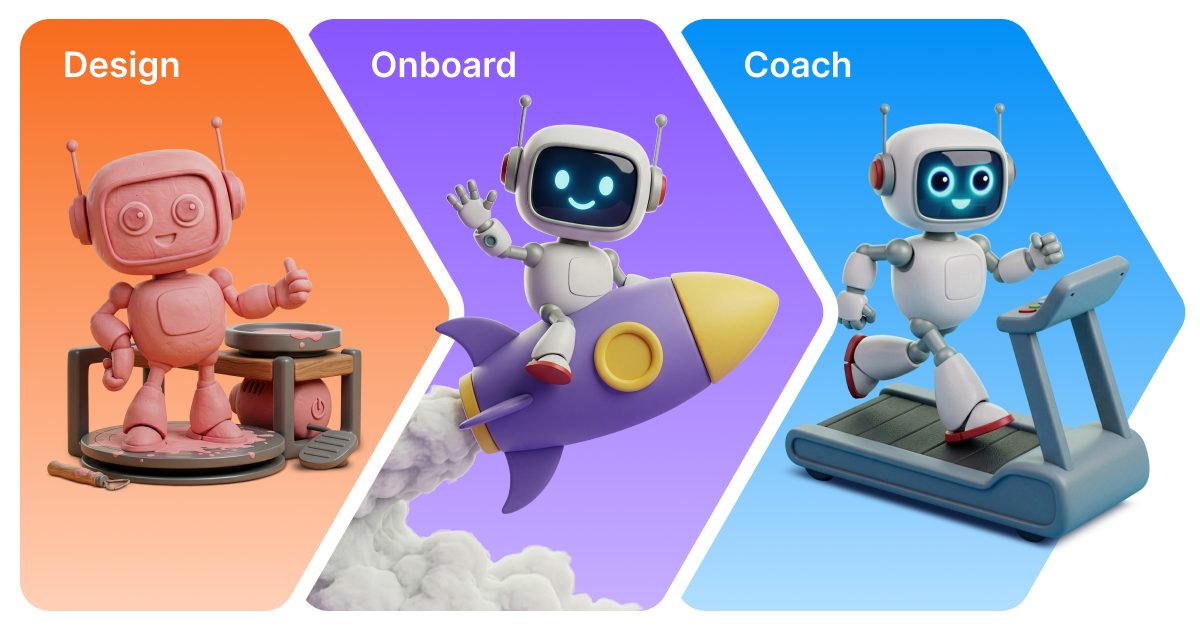
Outcomes-based thinking becomes operational through a framework. Ours is a Three-Step Playbook we've proven internally and with our customers: Design, Onboard, Coach.
Design. We define the jobs to be done, identify the highest-value use cases, establish the roles and rules of engagement for your human and digital workers, and deliver a validated roadmap backed by governance and organizational readiness.
Onboard. We build, configure, test, and launch digital workers directly into your flow of work, connecting data sources, granting system access, and ensuring everything is production-ready before go-live.
Coach. Over time, performance can drift as edge cases surface and the business evolves. Without ongoing coaching, a digital worker can become a zombie agent.
Skip Design and you’ll be left with automation.Skip Onboard and you'll have a strategy that never goes live.. Skip Coach and you’ll create a zombie agent. Run all three in sequence and you’ll enhance the capacity of your entire workforce.
How Outcomes Get Measured
Several things change when organizations measure outcomes instead of output.
When human and digital workers contribute to the same result, the systems around them have to catch up. How accountability is assigned, how the hybrid workforce is governed, and how success gets measured all shift immediately.
Asymbl operationalizes these shifts through structured digital worker training, performance assessments tied to business KPIs, and continuous optimization. For leaders managing hybrid teams, here are a few of the straightforward measurements you'll need to quantify:
Accountability
- Ownership redistributes across human and digital workers who share the same business outcome.
- Every worker, human or digital, needs a defined role, a manager, and KPIs tied to the result. Performance gaps can no longer default to whoever's closest to the problem.
- Handoffs between human and digital workers need defined accountability so context is preserved and nothing falls through the cracks.
Governance
- Digital workers need structured coaching cadences, feedback loops tied to outcomes, and escalation paths for edge cases so the playbook evolves with the business.
- Without that operating rhythm, even well-designed digital workers drift. Governance becomes the system that keeps the hybrid workforce aligned over time.
- Hybrid workforce governance requires a dedicated operational function, responsible for performance monitoring, optimization, and ensuring digital workers stay aligned to business KPIs.
Success Metrics
- KPIs expand from individual output to hybrid team contribution, measured across four areas: cost efficiency, time-to-fill reduction, productivity gains, and quality of outcomes. (For a deeper look, read How to Measure Digital Labor ROI.)
- Baseline measurement matters. Understanding what the work costs today, in time, headcount, and spend, is what makes the ROI of digital labor visible and defensible.
- Measurement is ongoing. Quarterly performance reviews and optimization cycles ensure digital labor ROI compounds over time rather than plateauing after initial onboarding.
While hybrid workforce metrics are easy to define, they're harder to maintain as digital workers multiply across business functions and the volume of handoffs, coaching cadences, and performance reviews grows with them. Managing this complexity is what our team does every day, for our own workforce and our customers.
Outcomes-Based Thinking, Proven at Scale
Asymbl is rooted in decades of staffing and recruiting expertise, a track record of measurable results, and the experience of building what we advise on. We understand how businesses hire, manage, and grow human teams, and we know what it takes to onboard digital workers alongside them. We're rapidly approaching 200 digital workers across 13 business functions, operating at a 5-to-1 output ratio: 5x the output at 1/5th the cost. Because we've proven ROI in every function of our business, we advise our customers with precision on where digital labor will deliver the highest returns and how to get there.
When we walk a client through Design, Onboard, and Coach, we're drawing from decisions we've already made, mistakes we've already corrected, and results we've already measured. We know what an outcomes-based onboarding looks like, and we know where it breaks, because we've built and rebuilt hundreds of them. That depth of experience is what allows our customers to compress their learning curve, moving from strategy to measurable results faster than they could on their own.
Outcomes-based thinking works in the agentic era. We know because we've operationalized it, measured it, and now we help our customers do the same.
.png)
AI Recruiting Software: What Separates the Best Platforms
Compare 11 AI recruiting software platforms, then apply the filters AI talent acquisition software buyers miss to find the best platform for your hiring needs.

The Right Fit Starts With a Conversation.
See what working together could look like.
.webp)