


To quantify the impact of digital labor, organizations need to measure differently. It requires a shift away from legacy two-dimensional workforce metrics and toward a hybrid, three-dimensional model that reflects how humans and digital workers operate together.
Instead of measuring what AI might enable in the future, businesses must focus on what digital labor delivers today through cost-to-hire efficiency, time-to-fill reduction, productivity gains, and quality of outcomes. These metrics capture real, measurable results rather than speculative potential.
The companies gaining a competitive edge are the ones putting this measurement discipline into practice. They deploy the right digital workers for specific outcomes, weave them seamlessly into existing workflows, and track impact across teams. This is how digital labor ROI becomes visible, scalable, and repeatable.
The Digital Labor Measurement Gap
Most businesses invest in AI without clear ROI metrics. In July of this year, an MIT study from Project NANDA brought this to light when its survey results revealed that 95% of businesses were getting zero return from their AI pilots. The primary factor impacting businesses' ability to harness ROI was their approach. These businesses rejected AI solutions that required process-specific customization, where quantifiable outcomes exist, and instead adopted generic AI solutions that enhanced individual productivity, where capturing P&L performance is more challenging.
The 5% of businesses who realized positive ROI approached AI differently:
The organizations and vendors succeeding are those aggressively solving for learning, memory, and workflow adaptation…[they] build systems that learn from feedback, retain context, and customize deeply to specific workflows. They start at workflow edges with significant customization, then scale into core processes. (MIT NANDA, p. 14).
Recent Digital Labor Economy research from IDC reinforces why this workflow-first approach matters. IDC found that when digital labor is implemented correctly at scale, ROI extends far beyond direct cost savings. The value becomes diffuse, spanning multiple functions and generating new capabilities that traditional cost-out calculations cannot capture. However, IDC also warns that this ROI is contingent, not inherent. Organizations cannot realize these gains without first addressing data quality, governance, and change management challenges. The message is clear: ROI depends on strategic implementation instead of just technology deployment.
In exploring other reports on AI ROI, there's a mixture of results. Positive AI ROI is sometimes captured in cost savings, productivity gains, bottom-line profitability, Earnings Before Interest and Taxes (EBIT) impact, or sheer guesswork. And they show AI ROI success rates ranging from 39% to 88%, but as Deloitte Insights AI and Tech Investment ROI notes, this stark variation may stem from businesses overestimating their AI success, validating MIT's finding that most organizations lack clear ROI measurement frameworks.
Given the variation in how AI ROI is quantified, it might be safe to assume that there’s a lot of guesswork being baked into AI ROI, and it’s costly. And with so many budgets expanding for AI investment, it’s critical for buyers to understand how to measure AI ROI for business optimization, scaling, business leverage, and value creation.
The 3D Workforce Equation Driving Real ROI:
(C + E) × Digital Labor
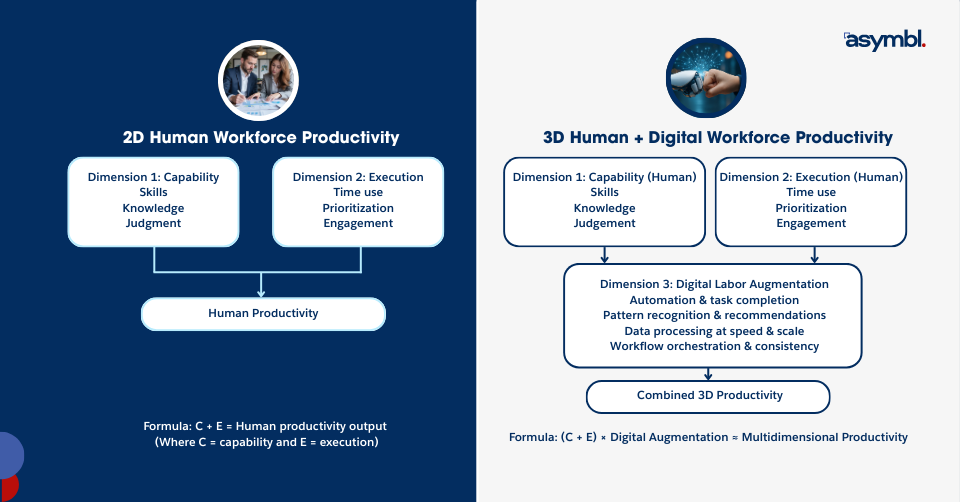
Businesses are accustomed to evaluating talent using what are essentially two-dimensional metrics, how much capability an employee brings and how effectively they execute. McKinsey’s talent research reinforces this, showing that human productivity is shaped by three core behavioral drivers: skills, engagement, and time allocation. Together, these determine how effectively human talent converts input into output.
However, when organizations introduce digital workers, they add an entirely new dimension of capability that reshapes this equation. Human talent alone can be conceptualized through two overarching factors: capability (skills, knowledge, judgment) and execution (time use, prioritization, engagement).
At its core, digital labor ROI is calculated as: ROI = (Net Benefits minus Cost of Investment) / Cost of Investment x 100. Net benefits include time saved, productivity gained, cost reductions, and revenue unlocked. Cost of investment includes configuration, integration, and ongoing management. Establishing baseline metrics before deployment is essential. Without a pre-deployment benchmark, you cannot accurately quantify what digital labor delivered.
Kawin Ethayarajh, Assistant Professor of Applied AI at Chicago Booth, extends this thinking, noting that AI systems, including digital workers powered by machine learning, are bound not only by hardware and software but also by the behaviors of real-world actors. This introduces a third dimension: the interaction between human workers and their digital teammates. The third axis transforms productivity.
A classic example of this shift happened with the Second Industrial Revolution when early factories measured output using two-dimensional metrics: labor and time. With electrification and later automation, a third dimension emerged: machine augmentation. Productivity shifted from human-limited to human and machine systems, creating nonlinear gains.
Today, productivity shifts from linear into nonlinear because digital labor changes both how work is done and what work is possible. This third dimension forces organizations to consider what digital workers can do, how humans collaborate with them, and how the organization orchestrates both to unlock higher, multidimensional returns on talent, both human and digital.
4 Core Metrics for Digital Labor ROI
Measuring ROI for digital labor starts with outcomes-based thinking. Before onboarding any digital worker, define the specific business outcome you're trying to drive. This disciplined approach transforms ROI from a post-implementation calculation into a strategic decision-making framework that guides where and how to deploy digital workers.
Outcomes-based thinking answers critical questions upfront: What business metric will this digital worker improve? Is this a volume problem, a speed problem, or something else? Without clear answers, organizations risk treating digital workers as experimental projects rather than strategic workforce additions.
Here's the strategic filter: Digital workers excel at solving volume and speed problems. If you're limited by how many emails can be sent, how quickly candidates can be screened, or how fast data can be processed, digital workers deliver measurable impact. But if the task requires building trust in your product, organization, or individuals, keep it human.
Some companies now use AI-first hiring policies, requiring teams to prove that existing digital workers cannot accomplish a task before hiring additional human staff. This creates a measurable, disciplined assessment that ensures digital workers handle what they do best, while humans are hired for their uniquely human strengths.
Once an organization identifies where a digital worker can contribute across technical, non-technical, and even non-traditional roles, it can measure ROI using four core metrics: cost-to-hire efficiency, time-to-fill reduction, productivity gain, and quality of outcome.
1. Cost-to-Hire Efficiency
When you hire a human employee, you invest in recruiting, onboarding, training, ongoing development, and the tools they need to perform. But when that employee eventually leaves, much of their knowledge goes with them, forcing the organization to reinvest in rebuilding that expertise. A digital worker functions differently. Once configured and trained, it memorializes institutional knowledge and can distribute it consistently to everyone who uses it. While there are upfront costs such as configuration, integration, and change management, as well as periodic maintenance, a digital worker does not require repeated onboarding, licensing, or retraining. The result is a more durable and scalable return on your initial investment.
2. Time-to-Fill Reduction
Your People Operations and Talent teams already track traditional hiring timelines. Use these benchmarks to compare how quickly digital workers move from decision to deployment to productive output. Because digital workers onboard faster than humans, they can materially increase business agility, and those speed gains compound over time, creating a sustained competitive advantage.
3. Productivity Gain
As digital workers increase output volume, they unlock throughput improvements that translate directly into productivity gains. Track tasks completed, processing speed, and capacity expansion. Be sure to distinguish between automating existing work and enabling entirely new capabilities, this is how you measure the multiplier effect digital workers create for your human teams.
4. Quality of Outcome
Digital workers can still make mistakes, especially when data is incomplete, outdated, or inconsistent, so measuring quality of outcomes is essential, not optional. Beyond speed, consistency, accuracy, and error reduction, organizations should track defect rates, rework requirements, compliance adherence, and ultimately how well their digital workers support customer and stakeholder satisfaction, including your human teams.
Whether you're preparing to purchase digital labor or beginning onboarding now, establish baseline metrics to accurately quantify ROI. Our AI ROI Guide walks you through a step-by-step blueprint for doing exactly that. Clarify whether your team is aiming for quick wins or long-term value. Define success criteria for your digital workers, ensure they align with business objectives and realistic timeframes, and confirm that all stakeholders share a unified understanding of what success looks like.
Real-World Application: Asymbl's Hybrid Workforce Results
Asymbl's implementation of a Sales Development Representative (SDR) digital worker brought in $5M in operational savings through our Digital Labor Advisory with 90 digital workers in five months.
Initially, our SDR worker brought in $500,000 of revenue in the first week of onboarding. From there, we established baseline measurements before deciding to scale, which allowed us to track improvements across all four core metrics. We also identified another metric, revenue unlocked, when we realized we'd saved 70% of our human workers' time. We're helping our customers achieve the same results.
Productivity gains emerged not only in raw output volume but also in the ability of human team members to focus on higher-value strategic work. Quality improvements were tracked through error rates and consistency metrics, showing that digital workers maintained standards while scaling operations. The measurement process itself revealed unexpected benefits, including insights into workflow optimization and bottlenecks that weren't visible before systematic tracking began. These measurements gave leadership the confidence to scale digital worker investments and informed decisions about where to deploy resources next.
With Asymbl's People Operations digital worker, Polly, who handles questions about the business for human new hires, we can measure the direct time our human team members save by no longer fielding hundreds of administrative questions each month. This translates directly to cost savings from eliminating repetitive work.
Digital labor introduces multiplicative, compounding gains rather than simple additive improvements. Workforce orchestration acts as a multiplier on human capability and execution, where each improvement reinforces the others: faster execution leads to more learning, which leads to better use of digital workers, which leads to even faster execution. This creates a compounding productivity loop instead of a one-time boost.
FAQs
Q1: What is digital labor ROI?
A: Digital labor ROI is the measurable return an organization generates from deploying digital workers. It is calculated by comparing net benefits such as time saved, cost reductions, and productivity gains against the total cost of deploying and managing those digital workers.
Q2: What metrics should I use to measure digital labor ROI?
A: The four core metrics are cost-to-hire efficiency, time-to-fill reduction, productivity gain, and quality of outcome. Organizations should establish baseline measurements before deployment so improvements can be accurately tracked and attributed.
Q3: How long does it take to see ROI from digital labor?
A: Timeline varies by deployment. Asymbl's SDR digital worker generated $500,000 in revenue within its first week of onboarding. More complex deployments typically show measurable ROI within 90 days when baseline metrics are set upfront and digital workers are deployed against specific outcome-defined tasks.
Q4: Why do most AI pilots fail to show ROI?
A: According to MIT's Project NANDA, 95% of businesses saw zero return from AI pilots because they adopted generic AI tools rather than deploying digital workers against specific workflow-level tasks where outcomes are measurable. ROI requires customization, governance, and outcome-based deployment from the start.
.webp)
Recruitment Agency Software: What Actually Matters in 2026
Choosing the best recruitment agency software in 2026? See how architecture and AI decide the winner.

The Right Fit Starts With a Conversation.
See what working together could look like.
.webp)