

.webp)
Every recruitment agency software on the market can track candidates, manage open reqs, and automate parts of the hiring workflow. Those capabilities used to separate the leaders from the field. In 2026, they are the price of entry.
For a staffing firm, the deciding factor is often not the list of features. It is whether the software you buy lifts placements per recruiter or adds another login your team works around.
It depends on whether sales and recruiting run on one record. Whether the platform raises capacity without raising headcount. Whether its AI reads the full history your firm already owns. Feature-count answers none of those questions.
In this blog, we will examine the leading recruitment agency platforms for staffing firms in 2026, then walk through the six criteria that decide which one actually fits how a staffing business makes money.
Top Recruitment Agency Software in 2026
.png)
Recruitment agency software spans everything from traditional ATS platforms to workforce orchestration systems. The table below highlights how the leading platforms compare across architecture, AI capability, staffing focus, and pricing.
| Platform | Core Category | AI Capability | Staffing-Focused | Starting Price |
|---|---|---|---|---|
| Asymbl | Workforce orchestration and talent relationship management | Talent Intelligence, Digital Recruiter, Agentic Skills, Asymbl Intelligence | Yes | $60/user/month |
| Beamery | Talent lifecycle platform | Skills-based matching, AI Talent Advisor | No | Custom |
| SmartRecruiters | Enterprise recruiting platform | Winston AI Hiring Agent, AI Matching | Partial | $14,995/year |
| Lever | ATS + CRM | AI-powered automation and nurturing | Partial | Custom |
| iCIMS | Enterprise talent acquisition suite | AI sourcing and engagement capabilities | Partial | Custom |
| Bullhorn | Staffing ATS and CRM | AI matching, search, and automation | Yes | $99/user/month |
| Loxo | Recruiting platform and sourcing suite | AI recruiting agents, AI search | Yes | Free; paid plans from $169/user/month |
| Ashby | All-in-one recruiting platform | AI Notetaker and workflow automation | No | $400/month |
| Workable | Recruiting and HR platform | Workable AI Agent | Partial | $299/month |
The detailed overviews below examine what each solution offers, its standout capabilities, pricing model, and the organizations it serves best.
1. Asymbl
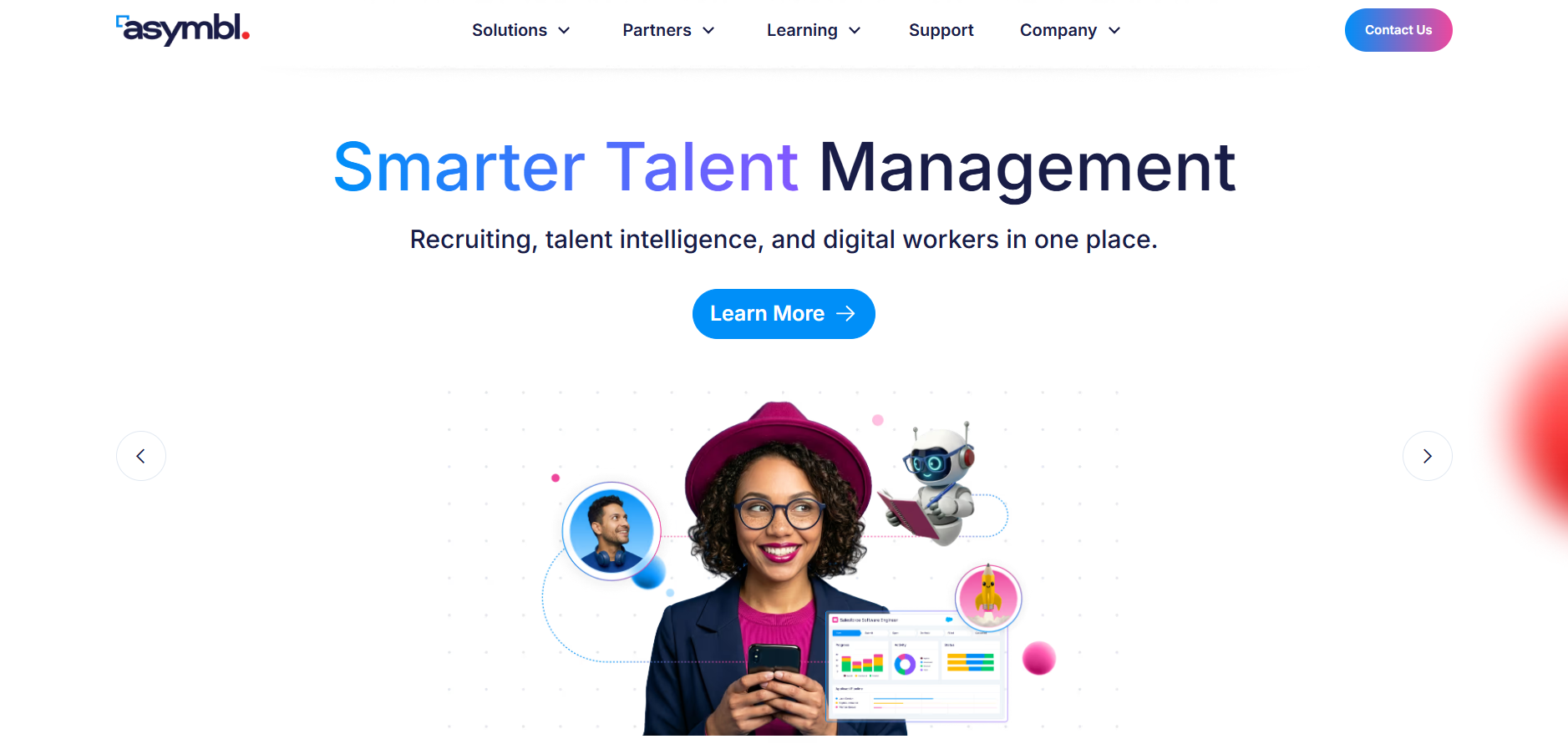
Asymbl is a workforce orchestration platform built on the Salesforce data foundation that unifies talent relationship management, AI, automation, and digital workers in one system. It enables staffing firms and talent acquisition teams to orchestrate recruiting workflows, connect hiring data, and deploy AI across the entire placement lifecycle rather than individual recruiting tasks.
Key Features
- Salesforce-Based Recruiter Suite: Unifies talent relationship management across the hiring lifecycle on a single Salesforce foundation, reducing fragmented workflows and improving recruiter productivity.
- Talent Intelligence: Uses pipeline history, interview feedback, placement outcomes, and unstructured data to score candidate fit beyond keywords, helping recruiters prioritize the strongest talent.
- Digital Recruiter, Rosa: Executes sourcing, screening, outreach, interview scheduling, and follow-up autonomously, increasing recruiting capacity while allowing recruiters to focus on relationships and hiring decisions.
- Pre-Built Agentic Skills: Delivers ready-to-deploy AI Skills for recruiting workflows without custom development, enabling teams to automate common tasks from day one.
- Asymbl Intelligence: Continuously learns from recruiting decisions, workflow activity, and hiring outcomes to improve search, matching, and digital worker performance over time.
Case Study: How Asymbl Used Its Own Platform to Scale Recruiting
Asymbl operates as its own Customer Zero, using its workforce orchestration platform internally before releasing capabilities to customers.
During a rapid growth phase, the company needed to fill 100 roles with two recruiters in 100 days while supporting growth across multiple departments without proportionally increasing headcount.
Instead of expanding recruiting teams, Asymbl deployed digital workers alongside human employees. Its Digital Recruiter (Rosa) automated resume screening, candidate outreach, qualification, and interview scheduling, while other digital workers supported business analysis, sales development, executive reporting, and HR operations.
Its digital labor model now spans 13 business functions, with digital workers managed using defined KPIs and governance, delivering an average 20× ROI while allowing human employees to focus on relationship-building and strategic decision-making.
Pricing: Asymbl offers three Recruiter Suite editions. Launch starts at $60/user/month and includes Recruiter Suite with pre-built Skills. Premier costs $125/user/month, adding Talent Intelligence. Ultimate uses custom pricing and adds an autonomous Digital Recruiter. Consulting and Digital Labor Advisory services are scoped separately using fixed-fee, retainer, or custom engagement models.
Best for: Staffing firms and corporate talent acquisition teams that want to unify recruiting on Salesforce while using AI, talent intelligence, and digital workers to automate hiring workflows and scale recruiter productivity
2. Beamery

Beamery is an AI-powered talent lifecycle platform that combines talent relationship management, workforce planning, recruiting, and internal mobility in one system. It helps organizations build talent pipelines, match candidates and employees to opportunities, and use skills and workforce data to support hiring and long-term talent planning across the employee lifecycle.
Key Features:
- Skills-Based Talent Matching: Uses AI to infer candidate skills and match people to roles beyond keywords, improving talent discovery and hiring quality.
- Talent CRM: Maintains a unified candidate database enriched with AI, enabling recruiters to build shortlists and nurture talent pipelines from a single source.
- Workforce Intelligence: Models workforce scenarios, identifies talent risks, and supports workforce planning using connected skills, roles, and labor market data.
- Talent Marketing: Delivers targeted candidate engagement across channels, helping recruiters nurture talent with personalized campaigns and improve application rates.
- AI Talent Advisor: Beamery's AI assistant surfaces contextual recommendations and accelerates recruiting workflows, helping teams make faster, more informed hiring decisions
Best for: Large enterprises that want to combine talent acquisition, workforce planning, internal mobility, and skills intelligence into a single talent lifecycle platform.
3. SmartRecruiters
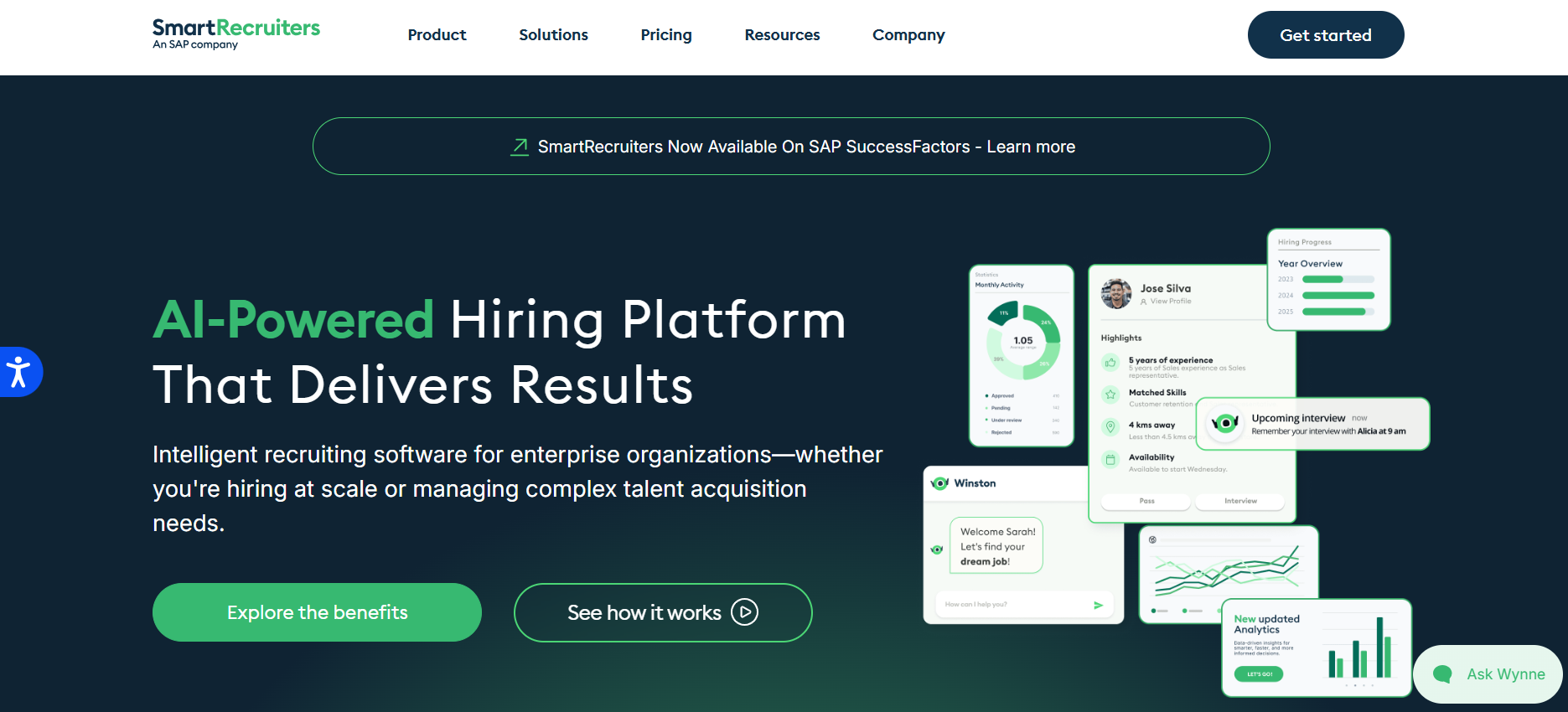
SmartRecruiters is a cloud-based recruiting platform that unifies applicant tracking, recruitment marketing, candidate relationship management, interview management, and hiring workflows. It provides a centralized system for managing the recruiting process from requisition creation through offer and hiring while supporting collaboration between recruiters, hiring managers, and candidates
Key Features:
- Applicant Tracking System: Centralizes recruiting from job posting through onboarding, giving hiring teams a single platform to manage the hiring lifecycle.
- AI Hiring Agent: Winston automates repetitive recruiting work, including screening and scheduling, reducing administrative effort and accelerating hiring.
- Unified Candidate Profiles: Consolidates application history and candidate interactions into one record, improving recruiter visibility and collaboration.
- Collaborative Hiring: Built-in messaging, notifications, and shared workflows keep recruiters and hiring managers aligned throughout the hiring process.
Pricing: SmartRecruiters offers four pricing tiers. Essential starts at $14,995 and includes core recruiting features such as ATS, CRM, onboarding, messaging, and job distribution. Professional, High Volume, and Complete add progressively more AI capabilities, analytics, and enterprise features, with pricing available through custom quotes.
Best for: Mid-sized and enterprise organizations looking for a scalable recruiting platform with built-in AI, structured hiring workflows, and support for high-volume hiring.
4. Lever
Lever is a talent acquisition platform that combines applicant tracking and candidate relationship management in a single system. It enables recruiting teams to source, nurture, interview, and hire candidates while maintaining long-term talent pipelines and collaboration across recruiters and hiring managers throughout the recruiting process
Key Features:
- Unified ATS and CRM: Combines applicant tracking and candidate relationship management in one platform, giving recruiters a complete view of every candidate relationship.
- Visual Insights: Provides recruiting analytics and dashboards that help teams monitor pipeline performance and identify hiring bottlenecks.
- AI and Workflow Automation: Automates candidate screening, interview scheduling, and talent nurturing, reducing manual recruiting work.
- Integration Marketplace: Integrates with HRIS, payroll, background screening, and communication tools to support connected recruiting workflows.
- Talent Nurturing: Helps recruiters build and engage long-term talent pipelines instead of managing only active applicants.
Pricing: Custom
Best for: Organizations that prioritize proactive recruiting, candidate relationship management, and building long-term talent pipelines alongside applicant tracking.
5. iCIMS

iCIMS is an enterprise talent acquisition platform that supports recruiting, applicant tracking, candidate engagement, onboarding, and talent marketing. It centralizes hiring workflows and candidate data while providing organizations with tools to attract, evaluate, hire, and onboard talent across high-volume and enterprise recruiting environments.
Key Features
- Enterprise Applicant Tracking: Provides a configurable ATS for managing enterprise recruiting workflows, approvals, and hiring processes at scale.
- Candidate Relationship Management: Supports automated sourcing and nurture campaigns to engage prospects before they apply.
- Employer Branding: Includes career sites, recruitment chatbots, and employee testimonial tools to strengthen employer brand and candidate experience.
- Text Recruiting: Enables recruiters to communicate with candidates through integrated text messaging, improving engagement and response times.
- Onboarding Management: Extends hiring into onboarding with workflows that help organizations transition candidates into new hires efficiently.
Pricing: Custom
Best for: Large enterprises with complex hiring needs that require an end-to-end talent acquisition platform spanning recruiting, onboarding, and candidate engagement.
6. Bullhorn
Bullhorn is a cloud-based staffing and recruiting platform that combines applicant tracking, customer relationship management, and recruitment operations in one system. It enables staffing firms to manage clients, candidates, job orders, placements, and recruiting workflows while maintaining a unified view of sales and recruitment activities.
Key Features:
- Applicant Tracking and CRM: Combines applicant tracking and customer relationship management in one platform, giving staffing firms a unified view of candidates, clients, and placements.
- Automation Engine: Automates repetitive recruiting and sales tasks using configurable workflows, helping recruiters reduce manual work and improve productivity.
- Submission Management: Tracks candidate submissions, interview progress, placements, and client activity from a centralized recruiting workflow.
- AI Assistance: Includes AI-powered capabilities for candidate matching, search, summaries, and recruiting workflows to accelerate hiring decisions.
- Marketplace Integrations: Connects with payroll, onboarding, VMS, sourcing, communication, and HR systems through an extensive partner ecosystem.
Pricing: Bullhorn uses per-user pricing with three tiers for small staffing agencies. Starter costs $99/user/month, Core costs $165/user/month, and Pro is available through custom pricing. Each tier adds features progressively, with Pro including AI, automation, analytics, and recruitment CRM capabilities.
Best for: Staffing and recruitment agencies that need a unified platform to manage recruiting, sales, client relationships, and placement workflows in one system.
7. Loxo
Loxo is a recruiting platform that combines applicant tracking, candidate relationship management, sourcing, and recruiting automation. It provides recruiters with tools to discover talent, manage hiring pipelines, communicate with candidates, and organize recruiting workflows within a single platform designed for search and placement activities.
Key Features:
- Recruiting CRM and ATS: Combines applicant tracking and recruiting CRM in a single platform, enabling recruiters to manage candidates and hiring workflows without switching systems.
- Loxo Source: Searches a database of candidate profiles with integrated contact information, helping recruiters identify and engage talent from one interface.
- Natural Language Search: Lets recruiters search candidates using conversational language instead of Boolean queries, making talent discovery faster and more intuitive.
- AI Recruiting Agents: Provides AI agents that automate sourcing, screening, outreach, and recruiting tasks, helping teams reduce repetitive manual work.
- Omnichannel Outreach: Runs personalized recruiting campaigns across email, SMS, and LinkedIn from one platform, improving candidate engagement throughout the hiring process.
Pricing: Loxo offers four plans. Free includes its ATS and recruiting CRM for one user. Basic starts at $169 per user/month (billed annually). Professional adds sourcing, AI agents, and automation, while Enterprise includes custom integrations, security, and AI configurations. Professional and Enterprise require custom pricing.
Best for: Executive search firms, staffing agencies, and recruiting teams that want an AI-powered recruiting platform combining sourcing, CRM, ATS, and outreach automation.
8. Ashby
Ashby is a recruiting platform that combines applicant tracking, scheduling, analytics, sourcing, and recruiting operations in a unified system. It centralizes hiring workflows and recruiting data while providing structured processes for candidate evaluation, interview coordination, reporting, and collaboration throughout the talent acquisition lifecycle.
Key Features
- All-in-One Recruiting Platform: Combines applicant tracking, sourcing, scheduling, analytics, and recruiting operations in one system, reducing the need for multiple recruiting tools.
- Advanced Analytics: Delivers real-time recruiting dashboards and customizable reports that help teams monitor hiring performance and make data-driven decisions.
- Advanced Scheduling Automation: Automates interview scheduling and interviewer coordination, reducing administrative effort and improving candidate experience.
- AI Notetaker: Records, transcribes, and summarizes interviews automatically, allowing interviewers to stay engaged while capturing structured feedback.
- Custom Recruiting Workflows: Supports configurable hiring pipelines, approval processes, and recruiting operations to adapt the platform to different hiring processes.
Pricing: Ashby offers three All-in-One recruiting plans and a standalone Analytics product. The Foundations plan starts at $400/month for startups with up to 100 employees. Plus and Enterprise use custom pricing based on company size, usage, and commitment, while Ashby Analytics is priced separately based on usage.
Best for: Fast-growing startups, scale-ups, and enterprise companies seeking an all-in-one recruiting platform with advanced analytics and structured hiring operations.
9. Workable
Workable is a cloud-based hiring platform that combines applicant tracking, candidate sourcing, interview scheduling, evaluation, and hiring workflows. It provides organizations with a centralized system for attracting, managing, assessing, and hiring candidates while supporting collaboration among recruiters and hiring teams from job posting through offer acceptance.
Key Features
- Applicant Tracking System: Manages the complete hiring process from job posting to offer management within a centralized applicant tracking platform.
- Candidate Sourcing Suite: Searches more than 400 million candidate profiles and distributes jobs across 200+ job boards, expanding recruiter reach.
- Workable AI Agent: Sources, screens, and qualifies candidates using a credit-based AI recruiting agent that automates early-stage recruiting tasks.
- HR Information System: Combines recruiting with employee onboarding, document management, time-off tracking, and employee records in one platform.
- Automated Interview Scheduling: Enables candidates to self-schedule interviews with synchronized calendars, reducing coordination effort and speeding up the hiring process.
Pricing: Workable offers three subscription plans. Standard starts at $299/month, Premier at $599/month, and Enterprise at $719/month (annual billing). All plans include recruiting and HR features, while the Workable Agent is priced separately using a credit-based model, with 1,000 free credits included for paid accounts.
Best for: Small to mid-sized businesses that want a straightforward recruiting and HR platform with integrated hiring tools, HR management, and optional AI-powered recruiting capabilities.
How to Evaluate Recruitment Agency Software
.png)
The criteria below decide which platform fits how a staffing firm actually makes revenue:
| What to evaluate | The failure it guards against | What it costs a staffing firm |
|---|---|---|
| Unified CRM and ATS on one record | The sales and recruiting data divide | Submissions made without client context, lost deals |
| Recruiter capacity without added headcount | The capacity limitation | Growth that scales payroll at the same rate as revenue |
| Redeployment and talent rediscovery | Cold-start sourcing | Net-new sourcing cost on roles the bench should fill |
| Revenue, margin, and back-office visibility | Placement-to-invoice lag | Delayed billing, payroll errors, margin you cannot see |
| AI that runs on connected data | Fragmented intelligence | AI that speeds up the fragmentation instead of fixing it |
| Implementation speed and configurability | The implementation tax | Months to value and dependence on paid services |
A Unified CRM and ATS on One Record
A staffing firm runs two businesses at once. One is a sales business built on client relationships and job orders, while the other is a recruiting business built on candidate pipelines.
The data divide between both the systems shows up in a specific, daily way. Three pieces of context a recruiter needs to make a strong submission sit in three different places:
- The account manager's most recent client conversation lives in the CRM.
- The candidate's interview history and prior assignment outcomes live in the ATS.
- The margin target for the account lives in a reporting tool or a spreadsheet.
The recruiter about to submit needs all three, and the system hands over none of them in one view. It results in two costs, and neither appears on an invoice.
The first is the integration tax, paid in the seconds a recruiter loses switching systems, multiplied across every submission until it adds up to the capacity of a recruiter the firm never hired.
The second is less visible. A firm that keeps CRM and ATS apart also keeps its AI half-blind, because intelligence built on fragmented records can only reason about the fragment it can reach.
There is a third cost that only shows up when a top producer leaves. When client and candidate relationships live at the recruiter level instead of the firm level, they walk out the door with the person who built them.
The next recruiter inherits a name and a phone number with none of the history behind it, and the account effectively restarts from cold. A shared record changes the ownership model from one recruiter to the whole firm.
Every call logged, every debrief captured, and every placement outcome stays attached to the client and candidate rather than to an individual inbox, so continuity survives turnover. The relationships a recruiter builds become an asset the business keeps when that recruiter resigns.
Asymbl Recruiter Suite keeps client records, job orders, candidate history, and placement data connected to one record, so the full path from client requirement to submission to placement is visible in a single view, with nothing to reassemble manually.
Recruiter Capacity Without Added Headcount
A firm that grows only by adding recruiters grows its payroll at the same rate as its revenue, and margin never widens. This is the capacity limitation, and it explains why so many firms feel busy, profitable, and stuck at the same time.
The ratio of administrative work to judgment work has shifted the wrong way. The work that fills a recruiter's day is necessary, and none of it requires the relationship skill that makes a recruiter worth their commission:
- Writing and posting job descriptions
- Screening inbound applications
- Chasing interview schedules
- Logging status updates in the system of record
This is the gap digital workers are built to close. Automation that raises output without raising headcount changes the cost structure of the firm, which is the difference between scaling profit and scaling payroll.
Asymbl Digital Recruiter, Rosa, handles job description drafting, outreach at scale, application screening, and interview scheduling.
When Asymbl ran this model on its own hiring, a two-person team hired 100 people in 100 days, processed 17,000 applications, pre-screened 1,800 candidates, and lifted the fill rate 47%, reclaiming roughly 21 hours a week for the human recruiters.
Those recruiters moved off the administrative treadmill and back to the conversations and closings only they can do.
When a digital worker absorbs the screening, scheduling, and follow-up, the human recruiter spends more time on the relationship-heavy work that earns commission, so capacity and take-home both rise together.
Hiring more recruiters to clear administrative volume is an expensive approach in a margin-compressed market, because it raises fixed costs to solve what is really a process problem.
Redeployment and Talent Rediscovery
The cheapest, fastest, highest-margin placement a firm can make is a candidate it has already vetted and placed. The recruiter knows how they performed, the client already trusts the relationship, and the sourcing cost was paid long ago.
Redeployment is where staffing margin is quietly won or lost, and whether the software surfaces known talent at the right moment decides which one happens.
Most platforms surface it poorly, because their search runs on a cold start. Every query treats a candidate the firm placed twice the same as a stranger it has never spoken to, ranking both on profile fit alone.
The contractor rolling off an assignment next Friday never surfaces against the open req they would fill, so the firm sources net-new talent for a role its own bench should have covered.
The organization pays a second acquisition cost it already paid once, the requirement stays open longer, and a proven candidate sits idle while a stranger is screened. The margin lost never appears as a line item, because it never had a chance to reach the profit and loss statement.
Strong recruitment agency software makes rediscovery a function of data rather than memory. It reads proven talent across three pools at once:
- Available candidates ready to engage now
- In-contact candidates already in a recent conversation
- Prior placement pools, the finalists, silver medalists, and contractors the organization has worked with before
Asymbl Talent Intelligence reads all three and scores candidates on pipeline history, assignment outcomes, and placement likelihood, so a contractor nearing the end of an assignment is matched to open job orders on the day they become available, while the requirement is still open.
Re-engaging proven talent costs a fraction of net-new sourcing and tends to hold better with clients, which protects the account revenue as well as the placement margin.
Redeployment also protects the relationship on the client side, which is where recurring revenue actually lives. A contractor the client already knows, redeployed into the next assignment, carries less ramp risk than a brand-new placement and keeps the account active between requisitions.
Candidate falloff drops in parallel, because a known candidate placed into familiar work is far less likely to renege than a cold hire pushed through a rushed process. The organization that rediscovers its own talent is protecting three things at once:
- The margin on the placement
- The continuity of the account
- The reliability of the start.
Revenue, Margin, and Back-Office Visibility
For contract and temporary staffing, the time between placement and invoice is lost margin. Manual timesheet collection introduces errors that delay billing cycles, create payroll disputes, and pull operations off revenue-generating work. Three back-office gaps quietly erode margin when time lives outside the recruiting platform:
- Billing cycles slip while timesheets are collected and corrected manually.
- Complex rate rules, shift differentials, and multi-state compliance produce errors and audit exposure.
- The recruiter closest to the placement cannot see or fix time data before it locks into payroll.
Multiply those gaps across a growing contract book and the back-office burden scales faster than the revenue that funds it.
The hidden cost here is cash as much as margin. Every day between a completed shift and a sent invoice is a day the firm has already paid its contractor and has not yet been paid by its client, and that gap is funded out of working capital.
A firm running high contract volume on manual timesheets carries a larger cash drag than its revenue suggests. Leaders rarely trace it back to the back office, because the delay never shows up as a recruiting metric on any dashboard they read.
Compressing the placement-to-invoice cycle is a cash-flow lever disguised as an administrative one, and on a growing contract book it frees capital the firm would otherwise borrow against.
Asymbl Time runs time capture, complex rate rules, approvals, and multi-jurisdiction compliance inside the same platform as recruiting, so billing cycles compress and the front office can see and correct time data before it locks into payroll.
Recruiter Suite then surfaces gross profit and fill rates in real time on the same records the team already works in.
Leaders read revenue and profitability as they happen, well before the quarter-late reconciliation where firms usually discover the margin they already lost. Margin you cannot see is margin you cannot protect, and a connected back office is what keeps it visible while there is still time to act.
AI That Runs on Connected Data
Intelligence is only ever as good as the data beneath it, and most recruiting AI is bolted onto systems that were never unified.
AI built on one connected record can match in full context, read a candidate's real history with the firm, and automate reliably because it can see what it is acting on. AI bolted onto fragmented systems mostly accelerates the fragmentation. The failures are specific:
- It surfaces a placed candidate as available because the sync had not caught up.
- It recommends a contractor who rolled off on Friday.
- It teaches recruiters to verify every output by hand, until the intelligence layer costs more time than it saves.
Connected data also changes what the AI can do, alongside how reliable it is. A model reading the full record can search the way a recruiter thinks, in natural language rather than boolean strings, and score a candidate on pipeline history and assignment outcomes instead of keyword overlap.
Every debrief and placement it observes improves the accuracy of the next recommendation, so the advantage compounds quarter over quarter.
Asymbl Intelligence and Talent Intelligence run on the same live record as the recruiting workflow, so the reasoning engine reads the firm's full candidate, client, and placement history rather than a synced snapshot of part of it.
Every placement, debrief, and outcome makes the model more reliable, because the model and the source data are the same thing. The right question for any vendor is simple. Does your AI read my full history, or only a copy of the slice it can sync?
Implementation Speed and Configurability
A tool that needs a long, services-heavy rollout to reflect a firm's actual workflow can sit idle for months before it produces a single faster placement.
The variable that decides this is configurability. When adapting a workflow requires custom development, every change becomes a project with a cost, a queue, and a dependency on the vendor's professional services.
When the same change can be made through configuration, the firm shapes the platform to how it already works and keeps shaping it as the business evolves. The gap compounds over years, because a staffing firm's process never sits still.
When a platform holds recruiting in its own data model, moving to something better later means a fresh migration, a re-implementation, and the same disruption the firm was trying to avoid the first time. This switching cost is a large part of why so many firms stay on a system they have already outgrown.
A platform that adds capability on the foundation it started on removes the penalty for growing, so the firm is never forced to choose between the tool it already runs and the tool the business now needs.
Conclusion
Two firms can buy from the same shortlist, run the same workflows, and look identical at go-live, then diverge sharply over three years. The firm that chose architecture compounds capacity, margin, and intelligence with every placement.
The firm that chose for feature-count keeps paying the integration tax and the implementation tax on a foundation that cannot compound.
Three questions worth sitting with before the next renewal.
- How many systems does a recruiter open to make one submission decision?
- When a contractor rolls off, does anything surface the open req the bench should fill?
- Does the platform's AI read the firm's full history, or only a synced copy of part of it?
A tool that only manages reqs leaves the firm to grow by hiring. A platform built around orchestration grows the business itself.
See how Asymbl Recruiter Suite grows placement capacity and revenue for staffing firms on one connected foundation, with sales, recruiting, intelligence, and back-office on a single record.
Book a demo to walk through how contextual, capacity-lifting recruiting works against your own placement volume and operating model.
FAQs
Recruitment agency software is a platform for staffing firms that place talent on behalf of clients. It combines an applicant tracking system and a client CRM with sourcing, engagement, and often back-office functions like time capture and billing.
Staffing firms should prioritize features tied to how the firm earns. The ones that matter most are a unified CRM and ATS on one record, automation that raises placements per recruiter without added headcount, redeployment and talent rediscovery, real-time revenue and margin visibility, AI that runs on connected data, and clicks-not-code configurability.
Recruitment agency software differs from a corporate ATS in the business model it is built around. A corporate ATS supports a company hiring into its own headcount and usually stops at the point of hire. Agency software supports a firm placing talent across many clients, so it adds client relationship management, job-order tracking, redeployment, and placement-to-invoice back-office functions.
Implementation time depends mostly on configurability and how much data migration the platform requires. Tools that need custom development to match a firm's workflow can take months and lean heavily on paid professional services. Platforms with clicks-not-code configuration and a shared data foundation shorten time to value, because workflows are adapted through configuration and new capabilities are added without re-implementing.
AI and automation improve recruitment agency software when they run on connected data, because intelligence is only as reliable as the records beneath it. On one unified record, AI can screen applications at scale, score candidates by fit and placement likelihood, draft outreach, and schedule interviews, which raises placements per recruiter without added headcount.
Time to Hire vs Time to Fill: What the Gap Tells You
The Right Fit Starts With a Conversation.
See what working together could look like.
.webp)