

Salesforce for Recruiting: Orchestrating a Future-Ready Talent Function
Corporate recruiting teams are under increasing pressure to move faster, deliver exceptional candidate experiences, and provide clearer visibility to the business.
According to a 2025 Report on Priorities & Perspectives of Recruiting Executives by SHRM, over 1 in 5 recruiting executives have identified improving sourcing (21%) or their recruiting strategy (21%) as top priorities.
This underscores the expectation from leadership that talent acquisition (TA) teams must build stronger, future-ready sourcing and strategy capabilities.
Salesforce provides the enterprise-grade foundation required to unify customer data, sales, and marketing into a single source of truth. It is a powerful engine for business intelligence, yet it is not a specialized recruiting environment.
On its own, the platform lacks the preconfigured workflows and hiring logic that high-performance talent teams use to drive velocity. This distance between a robust data foundation and the daily reality of recruiting execution is where specialized orchestration becomes essential.
Without a dedicated recruiting layer, organizations risk turning their system of record into a data silo that slows down the very teams it was meant to support.
This is the same failure mode we see when recruiting sits outside the business OS, leaving the talent execution to run on disconnected tools.
For a deeper look at why recruiting belongs inside the operating system your business already trusts, read “Why Recruiters Should Be Running Talent on Their Business OS and Not Another Point Solution.”
Asymbl Recruiter Suite is purpose-built on top of Salesforce to transform Salesforce from a data foundation to a specialized environment for workforce orchestration.
As a Salesforce-native application, Asymbl helps replace the friction of generic CRM configurations with a disciplined structure designed specifically for the demands of talent acquisition.
This native architecture ensures that every candidate movement and hiring decision is captured within your primary system of record, providing the absolute visibility required to manage a hybrid workforce of human and digital teammates with precision.
In this blog, we’ll explore how Asymbl enables recruiting teams to build fully customized workflows on top of their existing Salesforce data foundation, turning centralized data into a purpose-built, end-to-end recruiting system.
Why Recruiting Leaders Are Rethinking The System Of Record
Recruiting has shifted from a linear administrative task to a complex orchestration of data, human recruiters, and digital workers.
Digital workers are not simply automation scripts or AI features bolted onto software. They are defined digital roles with clear responsibilities, guardrails, and measurable outcomes. Just like a human recruiter owns sourcing, screening, or coordination, a digital worker can own repeatable execution such as job requirement validation, candidate matching, interview scheduling, or follow-up.
When designed intentionally, digital workers operate alongside human recruiters inside the same system, capturing context, preserving process memory, and executing with consistency at scale.
This shift changes what a recruiting system must do.
Salesforce was built as a centralized system of record for sales, customer, and marketing teams, and later expanded to support other business functions.
However, it was not originally designed to coordinate hybrid recruiting teams where both human and digital workers must operate with shared data, defined workflows, and accountable outcomes.
Many recruiting teams attempt to bridge this gap by using basic activity tracking and custom objects to approximate recruiting workflows, but this approach inevitably creates operational drag.
As hiring complexity increases, generalist systems struggle to manage specialized requirements like hiring logic and multi-stage candidate journeys. Relying on an unspecialized framework prevents teams from scaling their efforts and leads to fragmented processes.
However, introducing a third-party applicant tracking system creates a new data silo, undermining the very visibility that Salesforce was intended to provide. The challenge for modern leadership is maintaining the integrity of the Salesforce foundation while achieving the execution speed of a specialized recruiting environment.
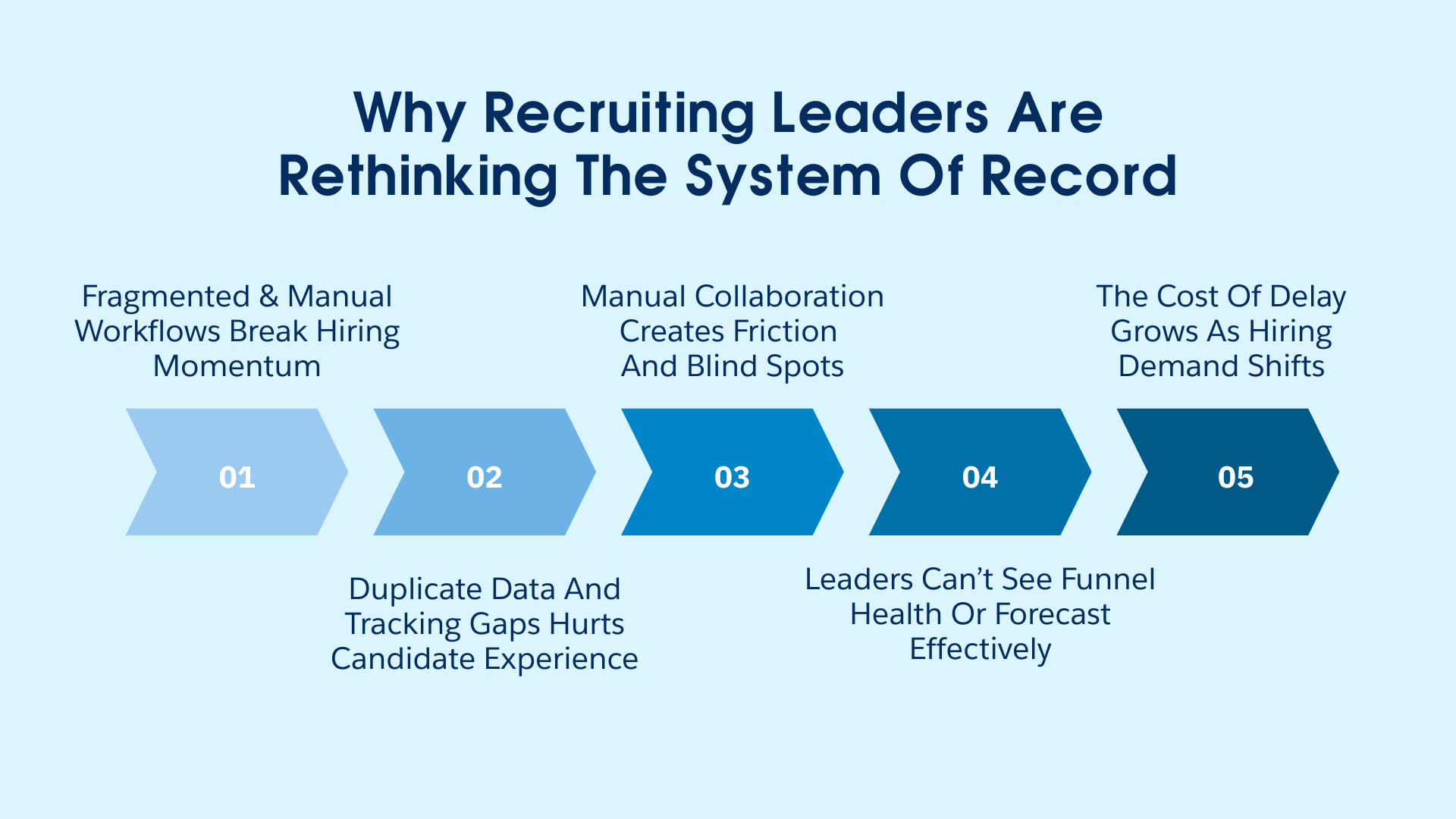
1. Fragmented & Manual Workflows Break Hiring Momentum
Recruiting teams often manage five to seven disconnected tools across sourcing, scheduling, and reporting. Even within Salesforce, the lack of a specialized recruiting layer forces recruiters into manual workarounds and fragmented workflows.
This creates significant operational drag at a time when speed and margin are critical. Without a dedicated orchestration layer, Salesforce remains a passive system of record rather than a strategic driver of placement velocity.
Asymbl Recruiter Suite resolves this friction by transforming Salesforce into a specialized environment for hiring execution. Built natively on the platform, it unifies CRM, hiring, and post-hire data so talent acquisition and HR leaders can measure impact on revenue, retention, and broader business outcomes.
Instead of layering another point solution onto the stack, Recruiter Suite introduces a coordinated system of applicant tracking, AI-powered search, engagement, and analytics in one place. This transition moves recruiting beyond simple tool consolidation and toward structured workforce orchestration.
By defining digital workers as accountable roles inside the recruiting workflow, teams can automate repeatable tasks such as job requirement validation, candidate matching, scheduling, and follow-through while keeping all activity grounded in their primary system of record. Recruiters hire faster, reduce operational drag, and demonstrate measurable impact to the business without sacrificing data integrity.
2. Duplicate Data And Tracking Gaps Hurts Candidate Experience
When recruiting workflows operate across disconnected systems, data integrity declines. Duplicate candidate records, inconsistent resume versions, and incomplete evaluation notes distort the talent picture.
Without a structured data model, search accuracy degrades. Qualified candidates are missed because skills are captured inconsistently. Engagement history becomes unreliable. Recruiters lose confidence in the system and revert to manual review and shadow tracking.
Even when Salesforce serves as the primary system of record, the absence of a specialized recruiting layer prevents the discipline required to normalize candidate data across stages, roles, and teams.
Inconsistent data makes it harder to identify high-fit candidates, compare performance across roles, and build a predictable funnel. Leaders struggle to interpret pipeline health because stage definitions and evaluation signals lack standardization. What appears to be a sourcing issue is often a data architecture issue.
Asymbl Recruiter Suite resolves this by enforcing a structured recruiting data model natively within Salesforce. Candidate profiles, engagement history, stage progression, and evaluation criteria are captured in a consistent, governed framework.
By grounding every search and workflow in clean, normalized data, recruiters surface higher-fit talent faster. Leaders gain reliable visibility into funnel health and forecasting accuracy. Human recruiters and digital workers operate from the same high-fidelity data foundation, enabling true workforce orchestration rather than reactive hiring.
3. Manual Collaboration Creates Friction And Blind Spots
Recruiting decisions require precise coordination across recruiters, hiring managers, and finance. While Salesforce provides a shared data model, it lacks the native logic to enforce the time-sensitive collaboration these stakeholders demand.
When feedback remains siloed in inboxes and scorecards are chased manually, decision timelines slip. The fundamental limitation is a lack of workflow orchestration.
Asymbl Recruiter Suite resolves this by embedding recruiting-specific governance directly into your Salesforce foundation.
By introducing structured evaluation scoring, automated decision gates, and workflow-triggered notifications, the system enforces momentum rather than just recording history.
This architecture allows digital workers to manage high-volume tasks like interview scheduling and follow-up automatically, ensuring no candidate stalls between stages.
By centralizing these interactions within a single system of record, collaboration becomes visible and measurable.
This transition moves the organization beyond simply tracking hiring activity toward true workforce orchestration, where human expertise and digital labor operate within a disciplined, high-velocity framework.
4. Leaders Can’t See Funnel Health Or Forecast Effectively
Recruiting leaders are required to deliver absolute visibility into time-to-fill, source effectiveness, and hiring velocity. While Salesforce provides robust reporting capabilities, the lack of a specialized recruiting data model often renders funnel health difficult to interpret.
When stage definitions vary and progression lacks consistency, reporting becomes reactive rather than strategic. The fundamental challenge is the absence of disciplined funnel design, not dashboard capability.
Asymbl Recruiter Suite transforms Salesforce from a general reporting engine into a specialized recruiting intelligence platform.
By enforcing a structured data model for stage definitions, engagement touchpoints, and evaluation data, Asymbl ensures that dashboards reflect the real-time health of your hiring engine.
This native architecture allows human and digital workers to capture high-fidelity data at every touchpoint, eliminating the need for manual reconciliation.
With this operational telemetry, leaders can identify bottlenecks and constraints with greater precision. This shift enables organizations to forecast hiring outcomes and align talent acquisition with broader business objectives, all within the same Salesforce foundation they already trust.
5. The Cost Of Delay Grows As Hiring Demand Shifts
Hiring demand is rarely static, yet recruiting responsiveness depends on more than simple system capacity. While Salesforce provides a scalable foundation for the enterprise, it lacks the native logic to enforce recruiting momentum during periods of rapid growth.
Without a specialized orchestration layer, teams rely on manual efforts that inevitably lead to extended cycles and candidate disengagement.
Asymbl Recruiter Suite resolves this by embedding a disciplined, recruiting-specific workflow layer directly into Salesforce. This native architecture introduces AI-driven prioritization and automated engagement sequences that maintain hiring velocity regardless of volume.
By integrating digital workers to manage repeatable tasks like screening and scheduling, organizations can scale their sourcing and engagement efforts without increasing operational overhead.
This transition moves the recruiting function from reacting to hiring swings toward maintaining a structured, high-velocity operating model.
By grounding these processes in the Salesforce foundation, organizations achieve the agility required to meet demand without introducing data silos or sacrificing the integrity of the candidate journey.
Why Salesforce Is The Right Solution For Recruiting
Salesforce alone was not designed to manage the complexities of modern talent acquisition. But as the enterprise operating system for revenue, finance, and customer data, it provides the foundation where recruiting should live.
The strategic question is not whether Salesforce can replace a recruiting system.
It is whether recruiting should remain disconnected from the platform that governs growth, forecasting, compliance, and operational visibility.
When paired with a purpose-built orchestration layer like Asymbl Recruiter Suite, Salesforce becomes the right environment for modern recruiting.
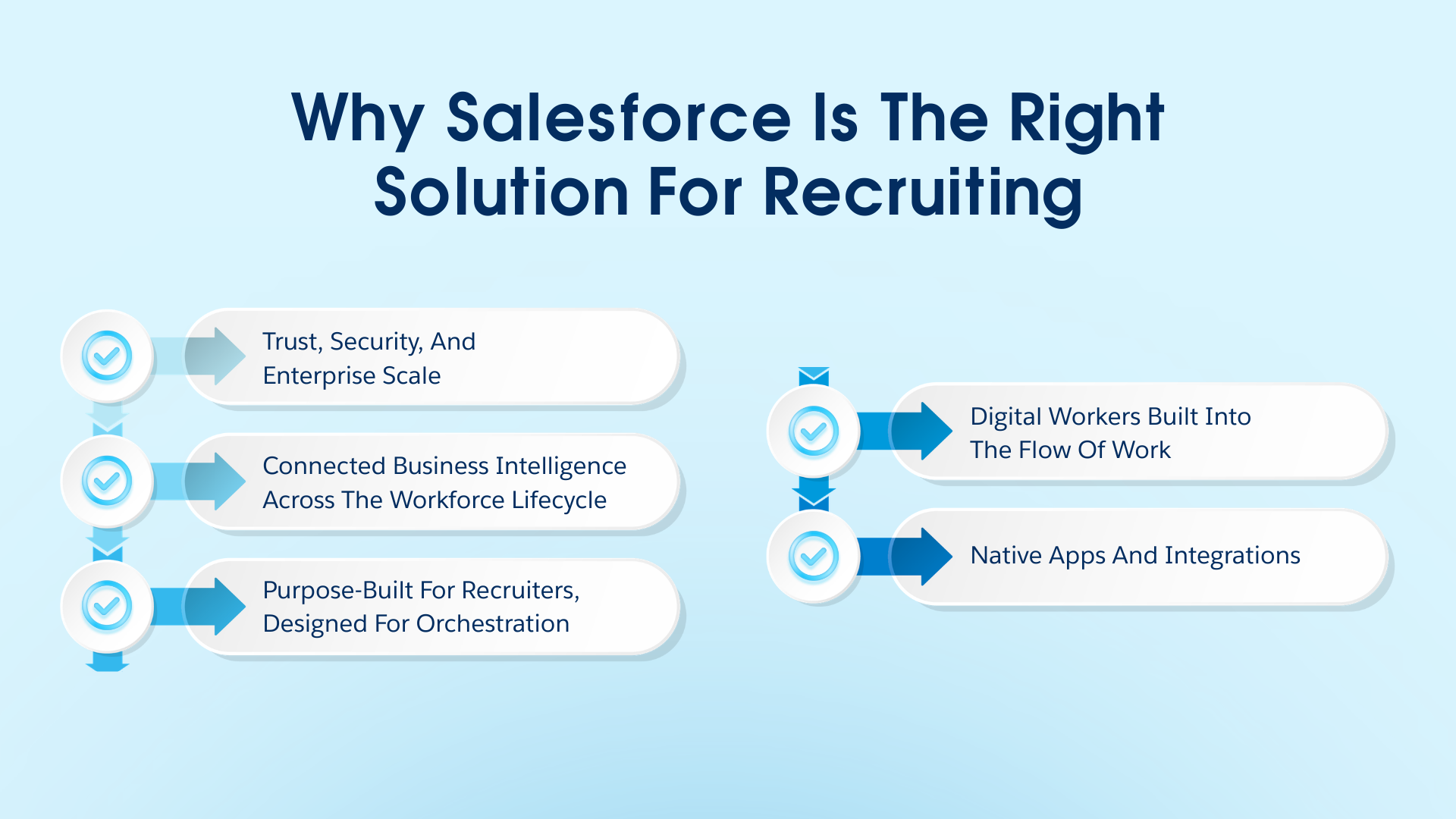
1. Trust, Security, And Enterprise Scale
Recruiting data carries real business weight. Offer approvals affect budget forecasts. Hiring velocity impacts revenue readiness. Candidate data carries compliance and privacy implications across regions.
Salesforce already serves as the trusted infrastructure for enterprise-scale security, role-based access, audit trails, and global governance. Recruiter Suite extends that foundation into talent acquisition without introducing a parallel system that must be reconciled later.
For global organizations managing multiple business units and regions, this matters. Governance stays centralized. Data models remain aligned. Security and compliance policies apply consistently across both revenue and talent functions.
Recruiting becomes integrated into enterprise operations instead of operating on the edge of it.
2. Connected Business Intelligence Across The Workforce Lifecycle
Recruiting does not operate in isolation. Hiring decisions affect revenue capacity, retention, margin, and long-term workforce planning.
Recruiter Suite anchors applicant tracking, engagement, and hiring workflows directly into Salesforce’s unified data model. Because hiring data lives alongside sales, customer, and financial data, leaders can measure how talent outcomes influence broader business performance.
This is especially powerful when paired with:
- Structured funnel stage governance
- Standardized evaluation criteria
- Engagement telemetry captured in real time
- Post-hire performance tracking inside Salesforce
With this structure, TA leaders can answer questions that traditional ATS platforms struggle to connect:
- How does time-to-fill impact revenue ramp?
- Which sources drive long-term retention?
- Where are hiring bottlenecks affecting growth targets?
- How does recruiter capacity align with pipeline demand?
Recruiting becomes part of enterprise intelligence, not a separate reporting exercise.
3. Purpose-Built For Recruiters, Designed For Orchestration
Instead of relying on generic objects and custom fields, Asymbl delivers recruiter-specific workflows built around how modern hiring actually operates:
- Role-based stage configurations
- Structured job requirement processes
- Interview coordination logic
- Offer governance and approval routing
- Engagement and nurture workflows
- Embedded reporting aligned to funnel health
These workflows are built to support both corporate recruiting teams and high-velocity talent environments, without forcing teams into rigid templates that ignore operational nuance.
Recruiter Suite also extends into Slack environments, enabling collaboration and visibility where work already happens. This ensures recruiting remains embedded in the flow of business execution rather than isolated inside a static system.
4. Digital Workers Built Into The Flow Of Work
Modern recruiting requires more than workflow automation. It requires defined digital roles operating with accountability inside the system.
Asymbl’s Digital Labor framework treats digital workers as role-based contributors with clear responsibilities, guardrails, and measurable performance. Inside Recruiter Suite, these digital workers are powered through Agentforce and Asymbl Intelligence, and operate directly within Salesforce.
Pre-built recruiter agents can support:
- job requirement validation and data completeness
- Contextual candidate matching using semantic search
- Interview scheduling coordination
- Automated follow-up and engagement sequences
- Pipeline monitoring and stage progression alerts
These are not background automations. They are structured digital teammates operating within governed workflows, with every action captured in the system of record.
Because digital workers and human recruiters operate from the same unified data model, performance becomes measurable. Leaders can evaluate how digital roles impact sourcing efficiency, cycle time, and recruiter capacity.
This is where recruiting evolves from managing tools to orchestrating a hybrid workforce.
5. Native Apps And Integrations
No recruiting tool operates in a silo, and Salesforce recognizes that. Recruiting teams often rely on various external tools for assessments, background checks, scheduling, document signing, and more. Salesforce’s integration capabilities make it easy to extend the platform’s capabilities without disrupting existing workflows.
Why this matters:
- Adding third-party apps or new tools becomes simpler because everything is anchored to a single system of record. Salesforce’s robust AppExchange offers hundreds of pre-built integrations for popular recruiting tools and HR systems.
- By keeping everything centralized in Salesforce, teams avoid the pitfalls of using disconnected point solutions, which can lead to data fragmentation and inefficiencies.
Salesforce allows recruiting teams to integrate seamlessly with job boards, assessment platforms, background check services, and scheduling tools. This streamlines workflows and ensures that the candidate experience remains consistent across all touchpoints.
Asymbl Recruiter Suite: Role In Salesforce Recruiting
Asymbl transforms Salesforce into a specialized environment for talent acquisition by unifying essential recruiting workflows within your primary system of record.
Its native architecture ensures that applicant tracking, AI-powered search, and candidate engagement operate as a coordinated system rather than a series of disconnected tasks.
By grounding these processes in your existing Salesforce infrastructure, your team gains the operational discipline required to move faster while maintaining absolute data integrity across the entire workforce lifecycle.
1. Advanced Applicant Tracking
Fragmented tools and siloed data often make managing the candidate lifecycle a source of friction rather than a strategic advantage. Asymbl Recruiter Suite transforms your Salesforce instance into a centralized system of record, providing complete visibility into every stage, conversation, and hiring decision.
Key Strategic Benefits:
- Unified Candidate Management: Manage candidates, roles, and submissions within a single Salesforce-native environment. By eliminating the need to toggle between disconnected systems, teams reduce data duplication and maintain a single source of truth for the entire business.
- Synchronized Interview Coordination: Integrate interview scheduling and feedback collection into a structured workflow. This alignment ensures that recruiters and hiring managers remain responsive without the need for manual email updates, which directly improves the candidate experience.
- Configurable Hiring Velocity: Design stages, approvals, and workflows that reflect your specific hiring model. This flexibility allows your team to maintain discipline and speed, reducing time-to-fill by removing operational bottlenecks.
2. AI-Powered Talent Search
Traditional recruitment tools rely heavily on keyword matching, a process that frequently overlooks high-fit candidates who use different phrasing or terminology.
Asymbl Recruiter Suite and Asymbl Talent Intelligence addresses this limitation by utilizing AI-powered search to move beyond basic keyword matching. By leveraging natural language processing and interaction signals, it identifies top-tier candidates often missed by traditional search methods, ensuring your pipeline is built on merit rather than just exact word choice.
How Recruiter Suite’s Ai-Enhanced Talent Search Improves Hiring Efficiency:
Traditional sourcing often fails due to the limitations of keyword matching, forcing recruiters into manual cycles of sifting and sorting. Asymbl Intelligence moves beyond these static methods by transforming search from a mechanical task into a strategic orchestration of talent data.
Strategic Capabilities:
- Contextual Candidate Matching: Move beyond word-for-word similarity with integrated semantic search. Asymbl understands the intent behind job descriptions and the context of a candidate’s experience, surfacing high-fit talent that traditional tools often overlook due to phrasing differences.
- Condensed Sourcing Cycles: Eliminate the administrative burden of manual resume review. By automating the initial evaluation against objective criteria, Asymbl delivers a validated shortlist in minutes. It allows your team to shift their focus from discovery to engagement and high-value decision-making.
- Data-Informed Candidate Outreach: Use engagement signals, including past interactions and application history, to move past generic templates. By grounding outreach in actual candidate data, recruiters create personalized experiences that increase reply rates and build stronger talent brands.
3. Candidate Engagement And Nurture
Maintaining candidate momentum in a high-volume environment is a matter of operational discipline. Asymbl Recruiter Suite provides a unified engagement hub that integrates email, SMS outreach, and event coordination directly into Salesforce.
By centralizing these touchpoints, your team moves from reactive communication to a proactive orchestration of the candidate experience.
Strategic Execution Areas:
- Centralized Communication History: Run branded email and SMS outreach with the confidence that every interaction is automatically logged in Salesforce. It creates a transparent system of record, ensuring that any recruiter can step into a conversation with full context, which eliminates the risk of fragmented or redundant messaging.
- Disciplined Nurture Workflows: Use structured workflows to maintain candidate interest throughout the hiring lifecycle. Automated follow-up reminders and scheduled touchpoints ensure that high-fit talent remains warm and engaged, directly reducing candidate drop-off and protecting your investment in the sourcing process.
- Contextual Personalization: Capture every interaction, from interview notes to communication preferences, to tailor the candidate journey. When outreach is grounded in actual engagement data rather than generic templates, reply rates increase, and your talent brand becomes a competitive advantage.
What This Looks Like For Corporate Talent Acquisition
Corporate TA leaders are increasingly held accountable for consistency, governance, and measurable business outcomes. The combination of Salesforce and Asymbl Recruiter Suite provides the enterprise-grade structure required to manage complex hiring needs while maintaining the flexibility to adapt to changing market conditions.
- Standardized Governance with Local Flexibility: Implement standardized stages and processes across the organization while allowing for role-specific variations. This balance ensures compliance and data integrity without stifling the unique needs of different departments or regions.
- Transparent Hiring Manager Collaboration: Provide hiring managers with real-time visibility into the pipeline without the need for manual status updates. Centralized feedback loops ensure that hiring teams stay aligned and candidates move through the funnel without unnecessary delays.
- Actionable Operational Insights: Generate reliable reporting across the entire funnel to identify bottlenecks and optimize resource allocation. With all data residing in Salesforce, TA leaders can measure the true ROI of their hiring initiatives and digital labor investments.
- Orchestrated Hybrid Teams: Deploy Agentforce-enabled digital workers to support tasks such as job requirement validation, candidate summaries, and pipeline management. This hybrid approach ensures that routine execution is handled with machine-like consistency, freeing the TA team to serve as strategic advisors to the business.
The Path Forward
The Asymbl Recruiter Suite provides the essential workflow layer that transforms Salesforce into a specialized environment for talent acquisition.
By moving beyond a simple database, your organization can implement a disciplined structure to manage the entire worker lifecycle within a single system of record.
This unified approach replaces fragmented tools with a coordinated system of work, allowing leaders to maintain absolute visibility and control over hiring outcomes.
Whether your objective is to manage high-volume staffing placements or to evolve a corporate talent strategy, Asymbl provides the governance required to turn operational complexity into a competitive advantage.
By grounding your recruitment process in Salesforce, you create a scalable foundation where human expertise and digital labor operate in harmony to drive measurable business impact.
Discover how the Asymbl Recruiter Suite can help you streamline workflows, improve candidate engagement, and optimize your use of Salesforce.
FAQs
Workflow orchestration in recruiting is the intentional design of how human recruiters and digital workers operate together inside a structured system.
It is not simply automating tasks or connecting tools. Orchestration defines who owns what work, how decisions flow across stages, how data is governed, and how performance is measured across the entire hiring lifecycle.
In a workforce orchestration model, digital workers are assigned defined responsibilities such as sourcing support, initial screening, scheduling coordination, and engagement follow-up. Human recruiters focus on relationship building, judgment, cultural alignment, and closing candidates.
Both operate inside the same governed system, with shared data and measurable outcomes.
This approach replaces fragmented AI point solutions with structured, accountable hybrid teams. The result is higher capacity, stronger funnel visibility, improved candidate experience, and measurable impact on hiring velocity and quality
Salesforce supports multi-department recruitment through a unified data layer that connects hiring activity across teams, regions, and business units inside a single system of record.
When paired with Asymbl Recruiter Suite, recruiting workflows are structured on top of Salesforce’s common data model. This ensures that candidate records, stage progression, engagement history, and evaluation data are standardized across the organization while still allowing role-specific flexibility.
Instead of each department running separate tools or disconnected configurations, every team operates from the same governed data foundation.
Yes, Salesforce is highly customizable. However, building a recruiting system from raw CRM objects requires significant configuration, development resources, and ongoing maintenance.
That is exactly why the Asymbl Recruiter Suite exists.
Instead of asking recruiting teams to design workflows, data models, stage logic, and reporting structures from scratch, Asymbl provides a purpose-built recruiting application that is already structured for modern talent acquisition.
Recruiter Suite delivers:
- Pre-configured recruiting data models
- Structured stage governance and evaluation frameworks
- Built-in engagement workflows
- AI-powered search and digital worker integration
- Reporting aligned to funnel health and business impact
Because it is native to Salesforce, teams retain all the flexibility of the platform without having to engineer a recruiting solution themselves.
Salesforce provides the infrastructure. Asymbl provides the recruiting intelligence, workflow discipline, and orchestration layer that makes customization practical and scalable.
AI-powered candidate matching goes beyond simple keyword matching by using semantic analysis and natural language processing to understand the context of job descriptions and resumes. It evaluates skills, experience, and fit more accurately, reducing biases and uncovering candidates that might be overlooked by traditional methods
The advantage is not Salesforce alone. It is the combination of Salesforce as the enterprise foundation and Asymbl Recruiter Suite as the purpose-built orchestration layer for recruiting.
Traditional ATS platforms operate as standalone systems. They manage candidate pipelines but often sit outside the broader business infrastructure. As a result, recruiting data becomes isolated from revenue forecasting, workforce planning, finance, and post-hire performance insights.
Asymbl Recruiter Suite changes this by operating natively on Salesforce.
This means:
- Candidate tracking, engagement, AI-powered search, and analytics run inside the same system that governs your business data.
- Recruiting workflows are structured specifically for hiring velocity, stage governance, and measurable outcomes.
- Digital workers operate directly within the system of record, not as disconnected AI tools.
- Hiring performance can be connected to revenue readiness, retention, and operational impact.
Salesforce supports collaborative hiring by connecting recruiting data to the broader business lifecycle, not just by providing shared access to candidate records.
When recruiting operates inside Salesforce with Asymbl Recruiter Suite, every stage of the talent journey, from search and engagement through interview, offer, onboarding, and post-hire performance, is captured within a unified data model.
Time to Hire vs Time to Fill: What the Gap Tells You

The Right Fit Starts With a Conversation.
See what working together could look like.
.webp)