

Recruitment Automation Explained: The Gaps Most Hiring Teams Miss
Most recruiting teams have spent the last decade automating their biggest complaints rather than their biggest problems.
Screening was painful, so they automated screening. Scheduling was slow, so they automated scheduling. Status updates were inconsistent, so they triggered notifications. In isolation, every one of these decisions appeared to be a victory for efficiency.
Despite these upgrades, the function has not become more predictable. Hiring still surprises the business and capacity questions remain unanswered. The same structural gaps surface every quarter, only now they have faster execution wrapped around them.
Most orgs mistake reduced clicks for increased impact. When we strip the recruiting process back to its foundation, we see that the primary challenge is not a lack of speed, but a lack of orchestrated capacity.
In this blog, we’ll explore what actually needs to change and why most teams missed the mark. It is time to stop asking how we can make the old process faster and start asking how we build a system that is predictable, scalable, and built for the reality of modern work.
What Challenges Is Traditional Recruitment Automation Currently Solving
Traditional recruitment automation effectively reduced visible friction, removed repetitive administrative burdens, and brought consistency to workflows that previously lacked structure.
This focus on visible friction has led many organizations to address isolated steps in a process without considering the broader workforce orchestration required to drive business outcomes.
The gap between technology investment and measurable ROI, cannot be solved by simply layering on more software features. These challenges require a structural shift in how work is designed.
While automation reduced the time it takes to send an email, it did not address the fundamental need for a coordinated system where human and digital workers operate with shared accountability and clear decision rights.
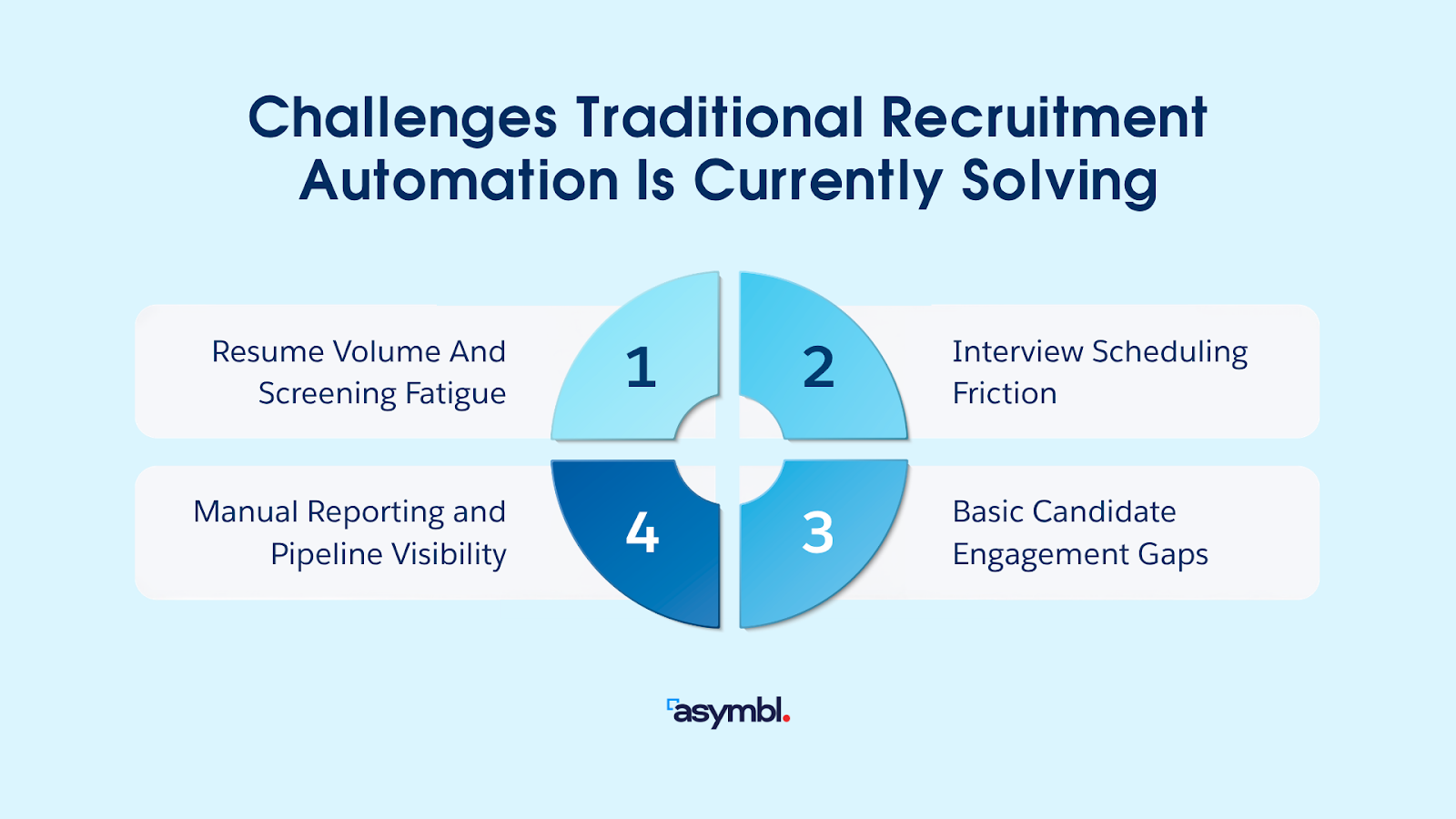
1. Resume Volume And Screening Fatigue
When hundreds of applications arrive for a single opening, manual review inevitably introduces fatigue at scale. A recruiter screening their fortieth resume of the day cannot bring the same level of nuanced judgment they applied to the fourth.
Traditional solutions, such as automated resume parsing and keyword-based filtering, addressed this issue directly. These tools brought consistency to structured screening criteria and significantly accelerated initial qualification.
Recruiters recovered hours previously lost to administrative triage, and the visible friction in the funnel decreased. This was the first wave of automation, and it performed exactly as designed.
However, the success of these tools created a secondary, more consequential problem. While automation could reduce the time spent on a task, it could not determine whether the criteria being applied were the right ones.
It could not verify whether structured parsing was surfacing the most relevant signals or whether the talent being filtered out was actually the talent the business required.
2. Interview Scheduling Friction
The back and forth across calendars during interview coordination often delayed hiring cycles by days, creating a bottleneck where candidates grew impatient and hiring managers became frustrated. Recruiters spent meaningful portions of their week on logistics that added no administrative value.
The introduction of automated scheduling tools promised to remove this friction. By allowing candidates to self-select available times, these tools closed confirmation loops without human intervention. Time to interview improved, and for high volume environments, that improvement was significant.
While these tools solved a coordination problem, they failed to address the underlying capacity problem. It does not change the fundamental math of the recruiter’s day. It does not increase how many roles a recruiter can carry, how many hiring managers they can support, or how predictably a team can hit targets under growth pressure.
3. Basic Candidate Engagement Gaps
Automated sequences move candidates from "applied" to "under review" with high efficiency. The communication cadence improves, but the information asymmetry remains. Knowing you are in "Stage Three" tells a candidate nothing about their actual standing or the likelihood of progression.
Automation addressed the symptom of candidate drop-off, but it ignored the cause. Candidates do not leave because of a lack of emails, but they lack the signals required to remain committed to the process.
While a candidate receives automated updates from one employer, they are simultaneously evaluating competing alternatives. In many cases, they are not choosing between one role and none. They are choosing between multiple active conversations.
According to a 2024 Deloitte Survey on Tech Talent Shortage, 70% of technical workers had multiple job offers when they accepted their most recent role.
A triggered message stating an application is under review carries the same functional value as silence. Candidates quickly decode these templated sequences and assign them the same weight as a generic "we will be in touch" sign-off.
True talent orchestration requires a reciprocal value exchange. The candidate must learn about the team’s genuine interest, while the employer learns about the candidate’s specific motivations and competitive timeline.
Automated engagement is structurally one-directional. It pushes information on a pre-set schedule. It was never designed for exchange.
Trust is built through two factors, transparency and reciprocity. Traditional automation excels at transparency, providing data points on "where a candidate is," but it fails at reciprocity, which is the human-to-human exchange of value and insight.
- The Transactional Trap: Automated sequences are designed for "throughput," not "thoughtfulness." When a candidate receives a templated update, their psychological distance from the employer remains the same. They are less likely to disengage, but they are not more likely to feel a genuine connection to the brand.
- The Context Gap: Real engagement requires context that a standard trigger cannot provide. It requires an understanding of a candidate’s career aspirations, their specific fears about a role change, and the nuances of the team culture.
- The Capacity Ceiling: Organizations often mistake "high volume outreach" for "high quality engagement." Since recruiters are still tethered to the manual execution of the "middle office" of recruiting, they lack the cognitive bandwidth to move beyond the automated template.
4. Manual Reporting and Pipeline Visibility
Historically, recruitment reporting was a manual exercise. Metrics were assembled in spreadsheets, often lagging by days or weeks. It created a purely historical view of the business. Leaders could see what had happened, but they could not see what was coming.
The introduction of automated dashboards changed the visibility layer. Pipeline stages became trackable in real time. Conversion rates and source of hire data moved from weekly exports to live views. While this was a necessary evolution for managing daily execution, it created a false sense of security.
Dashboards typically show the "state" of a pipeline, which is how many candidates are in which stage. However, predictability requires an understanding of velocity and capacity.
- The Static Data Problem: A real-time view of 100 candidates in a funnel is a snapshot in time. It does not account for the drag of manual recruiter tasks or the friction of hiring manager schedules. Without factoring in the human and digital labor required to move those candidates, the data remains a lagging indicator.
- The Capacity Blind Spot: Current reporting tells a VP of Talent where candidates are today. It does not tell them if the team has the operational bandwidth to hit next quarter’s hiring plan. Visibility into the work is missing, even if visibility into the worker is present.
- The Forecasting Fallacy: True forecasting requires a coordinated system that connects recruiting data to business outcomes. Most automated reporting exists in a silo, disconnected from the broader workforce orchestration.
Visibility is not the same as predictability. Traditional automation has improved reporting by making the past and present more visible, but it has not achieved true forecasting.
A dashboard is a rearview mirror with higher resolution. It helps you see the obstacles you have already passed or the ones you are hitting right now. It does not provide the navigation required to avoid those obstacles in the future. We have optimized for tracking the process, while remaining blind to the physics of the work required to complete it.
How Modern Hiring Outgrew Traditional Recruiting Automation
Traditional recruitment automation was designed when hiring was primarily an administrative coordination problem. The goal was to move candidates through a defined sequence of steps with less manual effort.
That framing was logical when hiring functioned as a support department, relatively isolated from strategic business planning.
The business context around recruiting has changed substantially ever since, yet most automation architectures remain stagnant. We have moved from a world of talent acquisition to a world of workforce orchestration.
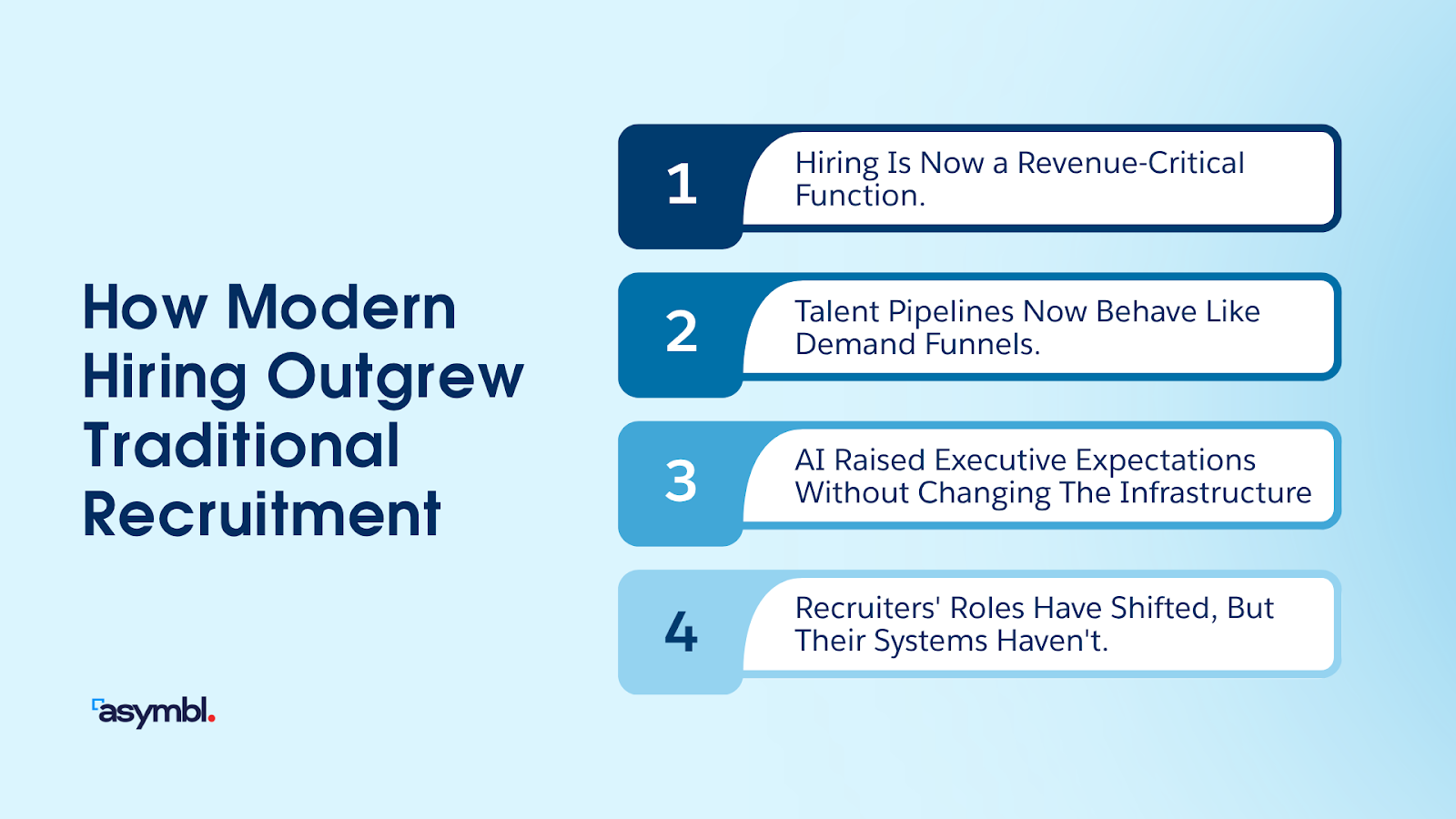
1. Hiring Is Now a Revenue-Critical Function
Hiring velocity is a core component of financial planning and risk management. Product roadmaps are scoped against expected headcount, and sales capacity models are built on specific hiring timelines.
Operational scaling decisions carry implicit assumptions about when roles will be filled and how quickly new hires will reach full productivity.
When these assumptions break, the consequences are not limited to the recruiting team. They surface as missed revenue targets, delayed market entry, and compressed margins.
A system that dictates revenue timing and growth capacity is not an administrative workflow. It is a business-critical engine that requires rigorous design, measurement, and governance.
Most organizations focus on process speed (how fast a candidate moves) rather than system predictability (the certainty of the outcome).
Traditional automation was built to reduce screening time. It was not built to provide the output modeling required by a revenue-aligned function. A faster process that cannot answer how many hires a team can produce next quarter under current capacity doesn’t solve the primary business problem.
We have given recruiters faster tools, but we have not given them more capacity. Since the middle office of recruiting remains a fragmented manual process, the recruiter is still the bottleneck. In a revenue-critical function, a human bottleneck is a systemic risk.
When hiring is disconnected from the broader workforce orchestration, the business loses relationship capital. Every day a role stays open is not just a cost-per-hire data point. It is a lost opportunity for market share and innovation.
2. Talent Pipelines Now Behave Like Demand Funnels
Traditional recruiting automation was built around a transaction: a candidate applies, enters the system, and moves through stages. The relationship begins at application and ends at hire or rejection.
It describes a shrinking portion of how talent actually moves. Candidates engage with employer brands long before they apply. They read content, attend events, respond to outreach, enter talent communities, and stay in contact across months or years before a specific opening becomes relevant to them.
- Referrals reactivate.
- Alumni return.
- Passive prospects convert when timing aligns.
This is demand funnel behavior. Relationships compound over time. The value of an early engagement is not visible at the time it occurs. It surfaces months later when a warm candidate converts faster, accepts more readily, and onboards with stronger context about the employer.
Most organizations have not built their systems around that reality. According to McKinsey’s 2025 HR Monitor Report, 73% of organizations conduct operational workforce planning, only a small share connect it to future skill needs.
In the United States, just 12% of HR leaders say they plan workforce needs with a three-year horizon. The result is a system optimized for immediate openings, not long-cycle talent development.
Systems that reset context with every new job requirement, that treat each hire as an isolated event rather than a point in a longer relationship, cannot capture the compounding value that a lifecycle-oriented talent model creates because the architecture was not built for continuity.
3. AI Raised Executive Expectations Without Changing The Infrastructure
When AI entered the recruiting conversation in earnest, it arrived with significant momentum. The expectation it created, at the executive level, was that hiring could scale without proportional headcount growth.
AI-powered tools would compress timelines, improve candidate quality, reduce bias risk, and produce measurable return on workforce investment.
Some of that expectation was reasonable, while some of it outpaced what the underlying infrastructure could actually support.
The gap that opened was not a capability gap in isolation. It was an infrastructure gap. AI tools were layered onto recruiting architectures that were still application-centric, still fragmented across disconnected systems, and still governed as workflow enhancements rather than workforce components.
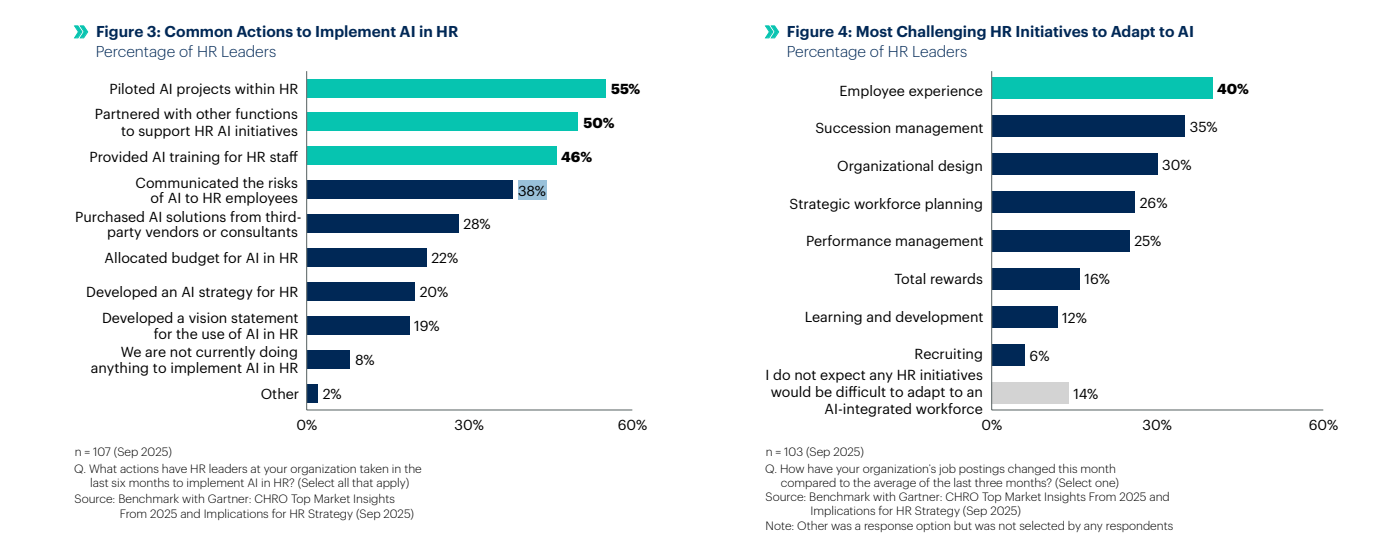
According to a 2024 Gartner Survey of HR Leaders on Gen AI, 38% of HR leaders are already piloting, implementing, or planning to implement generative AI, up from 19% just months earlier.
However, the primary use cases remain concentrated in surface-level execution, like employee-facing chatbots (43%), administrative tasks and document generation (42%), and recruiting activities like job descriptions and skills data (41%).
Adoption is accelerating, but it is largely being applied to existing workflows rather than used to redesign how the work itself is structured.
Executives are now asking questions that recruiting systems were not designed to answer.
- What is our hiring capacity under a growth scenario?
- What is the measurable ROI of our recruiting investments?
- How do we audit automated screening decisions?
- How does our recruiting output connect to revenue forecasting?
These are the most important questions about system design and automation, deployed without a redesigned operating model underneath it, cannot answer them.
4. Recruiters' Roles Have Shifted, But Their Systems Haven't
The recruiter's job description has changed in practice, even when it has not changed on paper. Hiring managers increasingly expect recruiters to advise on workforce strategy, interpret labor market signals, model capacity scenarios, and bring intelligence to headcount planning conversations.
The recruiter who operates only as a pipeline coordinator is no longer delivering the value the business expects from the function. Most recruiting systems are still built to support a coordinator, not a strategist.
The tools anchor recruiters to triage, status management, calendar coordination, and administrative reconciliation. The workflows were designed to make coordination faster, not to elevate the recruiter's contribution to business planning.
This creates a structural mismatch. The expectations placed on recruiters have risen. The systems they operate within were designed for a role that no longer reflects what the business actually needs.
Automation reduces the friction of execution, but does not redesign the recruiter's capacity to contribute at a higher level, because that would have required a different kind of infrastructure, where structured execution is genuinely handled by digital workers, and human recruiters operate at the level of judgment, strategy, and relationship that machines cannot replicate.
Even as AI adoption in HR accelerates, most organizations are still focused on surface-level implementation rather than redesigning how work actually gets done.
Where Is the Gap, And Why Is This Gap Happening
The gap is not in the tools. Most recruiting teams have plenty of those. The gap is in how the work was redesigned, or more accurately, how it was not.
Hiring evolved into a strategic business function. The systems running it were built for a coordination problem. Those two things were never reconciled, and that misalignment is where most of the real dysfunction lives.
1. Automation Is Still Application-Centric
The best candidate for a role is not always someone who applied this week. It might be the person a recruiter spoke with three months ago or a referral who came in through a side conversation.
Each new opening creates a new record, a new workflow, and usually a new version of the truth. Context gets scattered. Prior conversations lose visibility. Relationship history gets trapped inside old records that do not carry forward in a meaningful way.
So the recruiter who already invested time building trust has to start over. The candidate the system already knows shows up like a stranger. The team loses the very thing that should compound over time, relationship equity.
Modern recruiting runs on continuity, knowing who this person is, what happened last time, what they cared about, and why they may matter now.
You cannot create that by layering more automation onto architecture that was built to process tickets. You need a system that holds context across the full talent relationship, so recruiters can spend more time building trust and less time reconstructing history.
2. Digital Workers Are Deployed Without Role Design
Most organizations treat AI as an IT project rather than a workforce initiative. They identify a friction point, like resume screening or interview scheduling, and turn on a tool to solve it. While the logic seems sound, this approach skips the most critical question in modern orchestration about what does an AI agent actually own?
Without intentional role design, you end up with AI features that lack accountability. We see this pattern repeatedly in the market. Organizations deploy features without defining what the AI handles independently versus what requires a human handoff.
No one sets the threshold for escalation, decides how outputs are evaluated, or who is responsible when a process breaks.
A digital worker is a defined workforce role, with its own job description, clear KPIs, structured handoffs to human teammates, and an owner responsible for its performance.
Just like a human recruit, a digital worker needs to be onboarded into the flow of work, coached over time, and held accountable to outcomes, not just activity.
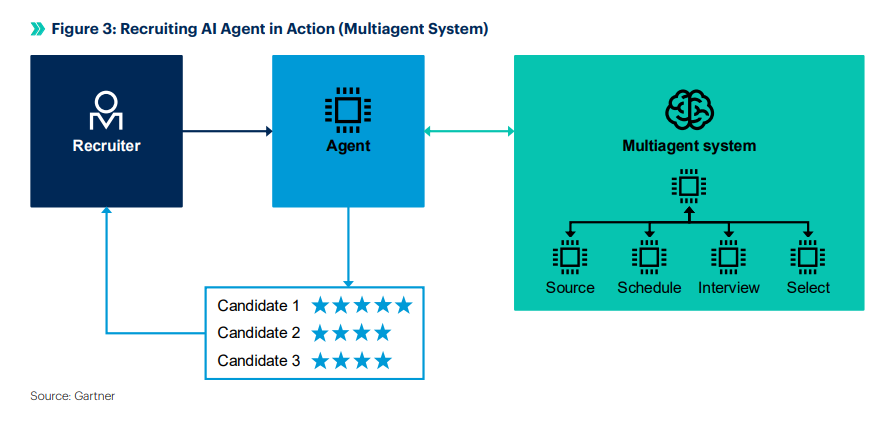
Asymbl's own Recruiter Agent is the clearest proof of what this looks like in operation. During a period of explosive growth, a two-person recruiting team used it to review 17,000 applications, pre-screen 1,800 candidates, and schedule 800 interviews, delivering a 1,529% ROI and a 47% increase in fill rates.
The digital worker did not replace the recruiters. It took structured execution off their plate so they could focus on candidate relationships, quality of hire, and decisions that require human judgment.
3. Efficiency Was Measured, But Capacity Was Never Modeled
In traditional automation, success is measured by looking backward. We celebrate when time-to-fill improves, when screening hours drop, or when coordination effort decreases. These metrics look good on a slide, and for a long time, corporate TA teams accepted them as the gold standard.
The problem is that none of these metrics answer the fundamental question a CFO asks during workforce planning about how much hiring output can this team reliably produce next quarter?
There is a significant structural difference between measuring what already happened and modeling what is actually possible. Efficiency metrics tell you how fast the process ran in the past.
Capacity modeling tells you if your team can hit a 20% growth plan, what happens to your pipeline during a demand spike, or where the output floor sits when your lead recruiter is OOO.
At Asymbl, we’ve learned that predictability only arrives when you define the division of labor. If you haven't clearly mapped which tasks are owned by digital workers and which require human intuition, you aren't managing a system. You are managing a collection of individual efforts.
4. Governance Has Not Kept Pace with Automation
When a recruiter makes a screening decision, there is a human judgment behind it. When an automated screening tool makes that same decision, there often is not a clear owner, an audit trail, or a defined threshold for when a human should step in.
Recruiting leaders are now fielding questions they were not being asked two years ago.
- How does the screening tool make decisions?
- How do we know it is not filtering out qualified candidates based on patterns that introduce bias?
- What happens when a candidate challenges a rejection?
- Who reviews the digital worker's outputs on an ongoing basis?
These are governance questions and most automation deployments were never set up to answer them. The tools were configured as workflow enhancements, not as workforce components that require the same accountability and performance management as any other member of the team.
Digital workers without governance create compliance risk, a slow erosion of confidence in the hiring process itself. People stop trusting the pipeline and start adding manual checkpoints. The efficiency gains get eaten by the oversight that should have been designed in from the start.
Why Recruitment Should Shift From Automation To Workforce Design
Most recruiting functions already have enough tools. The modern recruiting function needs a different kind of thinking about what recruiting is supposed to be and who, or what, is supposed to do the work.
Automation was the right first step. It removed friction that was genuinely slowing things down. However, friction removal is not the same as system redesign and the businesses that will build recruiting functions capable of supporting real growth are the ones that stop asking "what can we automate?" and start asking "how do we design this workforce?"
1. From Task Automation to Role Architecture
There is a fundamental difference between automating a task and designing a role. Task automation focuses on the clock, identifying a slow step and applying a tool to make it faster.
Role architecture focuses on the system. It asks what work belongs to a digital worker, what requires human intuition, and where the critical handoff points live.
Task automation produces efficiency, while role architecture produces a functioning team.
When digital workers are onboarded with defined roles, they operate with the same clarity as a high-performing human hire. They have ownership. They know when to escalate. Their outputs are measured against specific KPIs, and they are coached when performance drifts.
At Asymbl, we have seen this play out in our own journey to a 40% digital workforce. When we stopped installing features and started hiring digital workers, our ROI shifted from incremental to exponential.
Without this architecture, you end up with what most organizations already have, which is AI features layered onto a process that was never redesigned to support them. Work happens faster in isolated pockets, but the system does not get smarter or more predictable.
2. From Time Saved to Capacity Engineered
While knowing that automation saved forty hours last month demonstrates efficiency, it fails to answer the questions that matter to leadership. It does not tell you if your team can support a hiring plan that doubles headcount in six months.
It does not predict if you can absorb a sudden surge in volume. It offers no assurance of output quality when a senior recruiter leaves the organization.
Recruiting has historically been exempt from the operational discipline found in Sales or Operations. Sales leaders know exactly how many opportunities their team can manage. Operations leaders understand throughput under peak demand.
Recruiting has struggled to earn a strategic seat because it has lacked this level of predictability. At Asymbl, we have learned as Customer Zero that capacity is an engineered outcome.
Predictability only arrives when you move from automating tasks to orchestrating a hybrid workforce. When digital workers have defined roles and measurable outputs, capacity becomes a variable you can control.
- Define the Output Floor: Establish the minimum predictable output of your digital labor.
- Model Growth Scenarios: Use the scalability of digital workers to forecast how your team will handle volume spikes.
- Secure the System: Ensure your "system of work" is not dependent on the institutional knowledge of a few individuals.
3. From Feature Governance To Workforce Governance
Governance is often dismissed as a compliance conversation, where as in reality, it is a trust conversation.
When a human recruiter makes a decision, there is a clear line of accountability. When a digital worker performs the same task, that accountability does not vanish. It must be intentionally designed.
Someone must define the decision rights. Someone must audit the outputs. Someone must own the bias monitoring, set the escalation thresholds, and maintain the audit trails required to answer the hard questions.
Most organizations that have deployed AI in recruiting skipped this step. This failure did not stem from a lack of care, but from a fundamental misframing. They treated the deployment as a feature rollout rather than a workforce expansion. Features do not need managers, but workers do.
If you are not managing your digital labor with the same rigor you apply to your human teams, you are creating a liability.
To achieve true workforce orchestration, your governance model must address three pillars:
- Performance Ownership: Who is responsible for the digital worker’s coaching and output quality?
- Escalation Logic: At what point does the digital worker’s autonomy end and human intervention begin?
- Audit Integrity: Is there a transparent record of every decision made by the digital worker to ensure compliance and fairness?
4. From Hiring Process to Hybrid Workforce Infrastructure
Recruiting should not be a collection of disconnected tools. It must function as a unified infrastructure where human and digital workers operate on a single data foundation.
This requires clear roles, connected workflows, and shared performance visibility. This is the difference between using AI and orchestrating work.
When this infrastructure is in place, human recruiters are finally elevated into roles that require judgment, strategy, and relationship management. The structured, repetitive execution is genuinely handled elsewhere.
This is what workforce orchestration looks like inside a high-performing recruiting function. It runs as an operating model designed for a reality where the business depends on recruiting to be predictable, scalable, and connected to revenue outcomes.
To move from a process-heavy past to an orchestration-led future, leaders must focus on three structural pillars:
- Data Unification: Breaking down silos so that human and digital workers see the same truth in real time.
- Workflow Connectivity: Ensuring handoffs between humans and agents are seamless and governed by clear logic.
- Outcome Alignment: Measuring success by business impact and capacity created, not just tasks completed.
Conclusion
The strategy behind traditional recruitment automation was simple. Automate a single task and move on. It ignores the reality of the work and fails to account for edge cases, ignores the necessity of clean handoffs, and lacks the escalation logic required for enterprise-grade accountability.
If a digital worker owns candidate screening, it must own the entire sequence. This includes the qualification logic, the resolution of edge cases, and the handoff to a human recruiter with full context attached.
When a digital worker owns the whole job, it generates the performance data and audit trails that leadership needs to trust the system.
This clarity, ownership, and accountability is what separates digital labor that compounds value from traditional automation that quietly creates more work for humans downstream.
Ready to move beyond task automation?
Book a demo to see how Asymbl helps recruiting teams design hybrid workforces where every worker, human and digital, has a defined role, measurable output, and end-to-end accountability.
Reading Time to Fill: From Speed Score to Capacity Map
Break time to fill into stages to find the slow one, separate internal delay from your time to fill benchmark, and orchestrate capacity.

The Right Fit Starts With a Conversation.
See what working together could look like.
.webp)