


.webp)
Most corporate talent acquisition teams are asked to build a pipeline ahead of demand and align hiring with where the business is heading. The day-to-day work moves one requisition at a time, opening when a role is approved and going quiet once it is filled.
Each search starts over with every new requisition. The strong runner-up from last quarter, the hiring manager's debrief notes, the relationship a recruiter spent weeks building, all of it goes cold once the requisition closes, because nothing was built to hold it between searches.
The debate over talent acquisition vs recruitment gets settled with a new title and a reorg, while the system underneath keeps running the same reactive cycle. The rename describes an intention the infrastructure was never built to support.
In this blog, we will examine what recruitment actually is, what talent acquisition requires, the four differences that decide it, and why most rebranded teams still run recruitment underneath, and how to tell which one your business needs.
What Is Recruitment?
Recruitment is the tactical work of filling a specific open role. A position becomes vacant or a new one gets approved, and the job is to find the right person and hire them well and quickly.
Recruitment runs on a discrete cycle tied to a single requisition. The team writes the posting, sources and screens candidates, runs interviews, extends the offer, and closes the role.
Every requisition is a self-contained unit with a clear start and a clear finish, and the next one begins as its own cycle.
Why Recruitment Is Measured on Speed and Cost
The objective of recruiting is to close an open role, so the natural measures are how fast and how efficiently the team gets there. Time to fill and cost per hire are the metrics that fit the job.
A long-open vacancy carries a running cost to the business, so speed and efficiency are the right metrics to track when the goal is filling the role.
These metrics measure the closing of the role and say nothing about whether the person hired can actually do it. Speed tells you that the role is filled, but carries no signal about quality.
According to Deloitte’s 2025 Global Human Capital Trends research, 66% of managers and executives said most of their recent hires were not fully prepared for their roles. A function optimized purely for speed and cost can hit every target on the dashboard and still be feeding that number, because the dashboard was never built to register it.
What Talent Acquisition Actually Is: The Strategic Work of Building Ahead of Demand
Talent acquisition is the strategic, continuous work of building relationships and readiness before hiring demand arrives, and aligning the workforce with where the organization is heading. It starts from the direction of the business rather than from an open requisition, and it has no natural endpoint.
The challenge is that talent acquisition is usually adopted as a posture, a set of better intentions layered onto the same req-by-req machine. The actual work it names is continuous, and continuous work needs infrastructure that a tactical model was never designed to provide. The two capabilities below are where that becomes concrete.
Building a Pipeline of Qualified Professionals Before the Role Opens
An active pipeline means the company stays connected to qualified professionals whether or not a role is open today. The relationship begins before the requisition exists, and it persists after a given search ends.
In practice, this is the accumulated work of employer brand, candidate engagement sustained over months, and a known pool of talent for the roles that are hard to fill and expensive to get wrong.
When one of those roles finally opens, the search starts from a warm, qualified pipeline instead of an empty one. The silver medalist from last quarter’s senior search is already a known quantity, already engaged, and already reachable.
A pipeline is an asset that compounds only when it is tended to continuously. Tend it only while a role is open, and what you actually have is a contact list that decays between searches, a pattern worth naming directly as talent memory decay, the steady loss of everything the firm learned about a candidate the moment the requisition that introduced them closes.
Aligning the Workforce With Where the Organization Is Headed
Workforce planning translates where the company is going into the capabilities it will need and the timing of that need. The input is a forecast of demand, and the output is a hiring plan built against roles the org chart does not yet contain.
Aligning the workforce with future goals means hiring against that forecast, building pipeline strength in the functions the business knows it will lean on, and closing skill gaps before they harden into open vacancies. This is the strategic core of the function.
The job extends past filling roles well to making sure the organization has the right people positioned ahead of the growth, the market shift, or the gap that is already visible on the horizon.
According to the 2025 HR Monitor Report by McKinsey, only 12% of HR leaders in the United States said they do strategic workforce planning with at least a three-year horizon.
Talent Acquisition vs Recruitment: The Differences That Actually Matter
Talent acquisition and recruitment differ across four dimensions that decide what each is built to do. The table below sets them side by side, and the subsections trace why each difference changes the outcome.
| Dimension | Recruitment | Talent Acquisition |
|---|---|---|
| Timeframe | Bounded by a single vacancy, start to fill | Continuous, with no natural endpoint |
| Trigger | When a requisition opens | The direction of the business shifts |
| Scope | The individual role in front of you | The roles you do not have yet |
| Measure | Time to fill and cost per hire | Quality of hire and workforce readiness |
Timeframe: Immediate Vacancy vs Future Workforce Need
Recruitment is bounded and starts when the role opens and stops when it is filled. Everything inside that window is in scope, and everything outside it belongs to a different requisition or to no one.
Talent acquisition runs on a continuous horizon measured in quarters and years. The work concerns the workforce the company will need well before any single role is approved, so there is no point at which it is finished.
A bounded process and a continuous one cannot be run the same way, on the same cadence, with the same tooling. The moment a team treats future workforce needs as a series of bounded vacancies, it has quietly converted talent acquisition back into recruitment.
Trigger: A Requisition vs a Business Direction
Talent acquisition is triggered by where the business is heading. The work begins from a forecast of demand, often long before any individual role is signed off. This difference in trigger is the one most teams underestimate.
A function that only moves when a requisition lands is structurally incapable of building ahead of demand, because the thing that is supposed to prompt the work, the business direction, never reaches it as a signal it can act on. The requisition is the only input the system knows how to receive.
Scope: The Role in Front of You vs the Roles You Do Not Have Yet
Recruitment fills the role in front of you and is done. Its scope is the individual opening, fully defined by the job description on the requisition.
Talent acquisition builds for roles that do not exist yet, in the functions the company already knows it will have to staff. Its scope is the future org chart, which means it works from a picture that is partly forecast and partly judgment.
Scope is where the two functions feel most different day to day. A recruiter measures progress by reqs closed. A talent acquisition function measures progress by how ready it is for roles that have not been written, which is a fundamentally harder thing to see, manage, and prove.
Measure: Time to Fill and Cost per Hire vs Quality of Hire and Workforce Readiness
Recruitment is judged on time to fill, cost per hire, and the efficiency of closing a role. Talent acquisition is judged on the quality of hire and whether the workforce is ready for what the business is about to ask of it.
Quality of hire only resolves after the hire, once performance and retention data exist. Workforce readiness is a forward-looking judgment about a future that has not arrived.
A function held to these measures needs data that connects recruiting activity to outcomes downstream of the hire, which is precisely the data a requisition-bound system never captures.
The measure a team is actually held to reveals which function it is really running, whatever the title on the door says.
Why Most Teams That Say Talent Acquisition Are Still Running Recruitment
The easiest way to tell whether a company is practicing talent acquisition is by looking at what happens after one hiring cycle ends and before the next one begins:
The Pipeline Resets Every Time a Requisition Closes
In a requisition-driven model, the pipeline exists only while a role is open. Sourcing, screening, and engagement all happen against that one req, funded by it and scoped to it. The instant the role is filled, the activity stops and the context scatters.
Follow what actually happens to the assets that the search produced. The strong candidates who came second go back to being rows in a database that no one is working on.
The debrief notes live in an email thread or a recruiter’s memory. The relationship a recruiter built over three weeks of calls has no owner once the req that justified it is closed.
The next role opens, and the team starts from zero again. A function that resets to zero on every cycle is recruiting in sequence, and it never gets a chance to build an active pipeline. The work that would compound is the work that gets discarded first, every single cycle.
A Strategic Label on a Reactive System Is Still Reactive
A reactive process wearing a strategic label stays reactive. The team is asked to build ahead of demand on infrastructure that can only respond to an open req, and the infrastructure wins that argument every time, because that is what infrastructure does.
This is the same pattern that has stalled most corporate AI initiatives, where strategy outpaces the system it is supposed to run on.
According to AI Adoption in 2024 by BCG, only 26% of companies have developed the necessary set of abilities to move beyond the proof-of-concept stage to generate tangible value from their AI projects.
What Strategic Talent Acquisition Demands That Corporate Teams Cannot Fake
Corporate teams answer to the business for the quality of the people they bring in, for workforce readiness, and for the budget the function consumes.
An Active Pipeline Needs One Source of Truth, Not Four Disconnected Systems
An active pipeline works only when candidate history, engagement, and outcomes live in one connected place the whole team can see and act on. Building ahead of demand is impossible when the record of who you know disappears into the gaps between requisitions.
In most corporate environments, that record is split across an applicant tracking system (ATS), a human resources information system (HRIS), a customer relationship management (CRM) tool, and a set of spreadsheets maintained manually.
When the record of a relationship is scattered across four systems, the relationship effectively does not exist at the firm level. It lives in an individual recruiter’s head and walks out the door when they leave, taking the pipeline with them.
One source of truth is the precondition for a standing pipeline, the foundation on which it is built before anything else. Without it, every requisition really is the first requisition.
Workforce Alignment Needs Data Your Current Stack Cannot Produce
Aligning the workforce with future goals requires connecting recruiting activity to business outcomes, the quality of hire, retention, and readiness signals that leadership actually plans against.
On a fragmented stack, the connection is severed by design. Quality of hire can only be measured when recruiting data meets performance and retention data, and those live in a different system that the recruiting tools do not see.
A team can report time to fill all day and still have no idea whether it is hiring well, because the data that would answer the question is not connected.
Strategic alignment depends on labor market signals and internal capability data, and most functions are flying without it.
Capacity to Build Ahead of Demand Without Adding Headcount in Lockstep
Talent acquisition demands ongoing engagement, nurturing, and pipeline work on top of filling today’s roles. Both streams of work compete for the same recruiter hours, and on a linear capacity model, the strategic stream loses that competition every time.
When hiring volume spikes, the urgent work of closing open reqs consumes the calendar, and the pipeline work that has no deadline gets dropped first. Capacity scales only by adding recruiters, so the strategic work is permanently one volume surge away from being abandoned.
A function structured this way will always fall back to reactive recruiting under pressure, not because the team chose to, but because the model gave them no other option. Building ahead of demand requires capacity that does not have to be hired in lockstep with the work, and a purely human team cannot offer that.
When to Focus on Recruitment and When to Invest in Talent Acquisition
Recruitment is the right primary focus when hiring is low volume, episodic, and tied to clear one-off needs. A role opens now and then, the requirement is well defined, and filling it well and quickly is the entire job.
A tactical process is the correct tool here, and adding the overhead of pipeline and workforce planning to genuinely episodic hiring is wasted motion.
Talent acquisition becomes necessary when hiring is continuous, growth-driven, or concentrated in roles that are hard to fill and expensive to get wrong.
In those conditions, the cost of starting from zero on every search is high, the lead times are long, and having a pipeline and a workforce plan in place ahead of demand changes the outcome rather than just the experience.
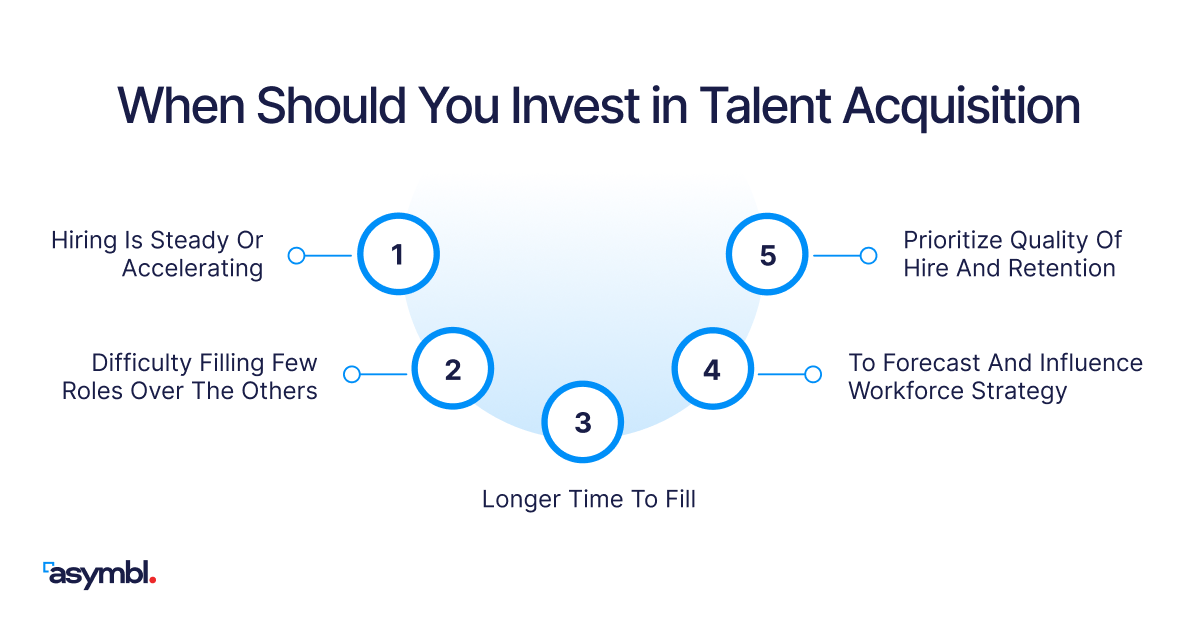
The signals that point toward investing in talent acquisition include:
- Hiring is steady or accelerating rather than occasional
- Critical roles routinely take too long to fill from a cold start
- The same hard-to-fill functions come up search after search
- Leadership is asking talent to forecast and influence workforce strategy, not just close reqs
- Quality of hire and retention, alongside speed, are how the function is judged
Ask whether the work the business actually needs is filling today’s vacancies or preparing for tomorrow’s workforce. A team that needs the second but operates the first, on a system that cannot hold a pipeline or align to a plan, is running recruitment regardless of what its title says.
That is the right diagnosis to start from, because it tells you whether the gap you are facing is a process gap or a foundation gap, and those call for very different fixes.
How Asymbl Helps Corporate Teams Run Strategic Talent Acquisition
Asymbl treats recruiting as one connected system on a Salesforce foundation, the same platform the business already runs sales and customer data on, so the function gets the source of truth, the outcome data, and the capacity that strategic talent acquisition actually requires.
Recruiter Suite Puts Recruiting on the Same Foundation as the Rest of the Business
Recruiter Suite is a Salesforce-based talent relationship management platform that unifies applicant tracking, candidate engagement, and pipeline in one system instead of four disconnected ones.
An active pipeline can persist between requisitions because the record of every relationship lives at the firm level, where it survives a recruiter’s departure and the close of any single req.
It also connects to business data and post-hire outcomes, so corporate teams can measure quality of hire and tie recruiting to the workforce plan in the terms leadership cares about, well past time to fill.
Since it was purpose-built for talent relationship management rather than adapted from an HR system or a CRM that added hiring later, governance, audit trails, and bias mitigation are part of the workflow from the start, which matters when your team owns the final hiring decision and answers for how it was made.
Talent Intelligence Turns Scattered History Into a Quality of Hire Signal
Talent Intelligence is the Recruiter Brain on the Asymbl Intelligence platform. It evaluates candidates on pipeline history, interview feedback, and outcomes the way an experienced recruiter would, rather than on keyword overlap with a job description.
Talent Intelligence activates the relationships an active pipeline depends on, surfacing the strong candidate who came second last quarter at the moment the right role finally opens.
Working from the full record instead of a fragment, its matching and prioritization reflect genuine fit and readiness, which turns the scattered history a fragmented stack throws away into the quality-of-hire signal that strategic talent acquisition is measured on.
Digital Workers Add Capacity to Build Pipeline Without Adding Headcount
A Digital Recruiter, Rosa, and the broader roster of digital workers absorb the repeatable execution that pipeline building runs on, the outreach, screening, scheduling, and follow-up that have to happen continuously, and have no one to do them on a linear model.
This is the capacity layer that lets a corporate team sustain ongoing engagement work without dropping it the moment hiring volume climbs.
Asymbl runs this model on itself, an approach it calls Customer Zero. A two-person recruiting team, working alongside a digital recruiter, hired 100 people in 100 days, processing 17,000 applications and lifting the fill rate by 47%.
Conclusion
Strategic talent acquisition asks for three things a tactical stack cannot supply. It needs one source of truth, data that connects recruiting to what happens after the hire, and capacity that grows without adding recruiters in lockstep.
A team that holds the mandate but none of those is running the right strategy on the wrong foundation, and no amount of effort closes that gap.
So the question worth sitting with is whether the work the business needs is filling today’s vacancies or building tomorrow’s workforce, and whether the system underneath you could tell the difference.
Ready to Build Talent Acquisition on a Foundation Built for It?
See how Asymbl puts recruiting on one data foundation with intelligence and digital workers built in. Request a demo, and we will walk through what strategic talent acquisition looks like on a system built for it.
FAQs
A recruiter is structured around filling current openings, moving hiring managers and candidates through one requisition at a time. A talent acquisition specialist works on a longer horizon, building pipelines, employer brand, and relationships for roles before they open, and often partners with leadership on workforce strategy.
No, though they are often used interchangeably. Recruitment is one part of talent acquisition, the tactical work of filling a specific open role. Talent acquisition is the broader, continuous discipline that includes recruitment and adds pipeline building, employer brand, and workforce planning ahead of demand
Consolidate candidate data into one source of truth so relationships survive between requisitions, connect recruiting data to post-hire outcomes so quality of hire becomes measurable, and add capacity that does not require hiring a recruiter for every increment of pipeline work.
Talent acquisition carries more ongoing investment because pipeline building, employer brand, and workforce planning run continuously rather than only when a role opens. The straight cost comparison is misleading, though. For hard-to-fill and high-stakes roles, the cost of starting cold on every search, in extended vacancies and weaker hires, usually exceeds the cost of maintaining a pipeline.
Recruitment is the right primary focus when hiring is low volume, episodic, and tied to clear one-off roles. Talent acquisition is necessary when hiring is continuous, growth-driven, or concentrated in roles that are hard to fill and expensive to get wrong.
.webp)
Talent Intelligence: What It Actually Means and Why It Matters
Talent Intelligence should mean more than matching. See how Asymbl built a product that reasons the way your best recruiters already do, every day.

The Right Fit Starts With a Conversation.
See what working together could look like.
.webp)