

The AI Maturity Framework: Moving from Automation to Intelligent Orchestration

Do you find yourself thinking, "We automated a bunch of stuff, the numbers improved, but now what? Our AI investment isn't producing the kind of strategic impact we were promised."
In this market, the AI maturity gap is surfacing. Companies have invested in AI, and they're seeing efficiency returns from automation. Except, their gains are plateauing because there's only a finite amount of value you can extract from automating tasks.
At Asymbl, the Digital Labor Value Pyramid (DLVP) is how we help our customers move from the red ocean of AI point solutions into the blue ocean of orchestration. It's a framework we use to identify where their digital workforce is stuck, name the ceiling they can feel but can't yet diagnose, and chart the path to the top.
The Digital Labor Value Pyramid
The Digital Labor Value Pyramid (DLVP) adapts a classic human knowledge hierarchy (first articulated by Russell Ackoff, "From Data to Wisdom," Journal of Applied Systems Analysis, 1989) for the age of digital labor. The pyramid has four levels: Data Automation, Knowledge Synthesis, Wisdom Application, and Intelligent Orchestration. They're sequential by design. Each level builds on the one below it. And Intelligent Orchestration, the apex, requires all three prior levels to be functioning before it becomes possible.
Data Automation: Act; ingesting and structuring raw data into a format digital workers can use.
Knowledge Synthesis: Combine; connecting data points into business-relevant meaning.
Wisdom Application: Use; evaluating and recommending with appropriate weight given to context.
Intelligent Orchestration: Coordinate; the hybrid workforce operating as one system with shared accountability.
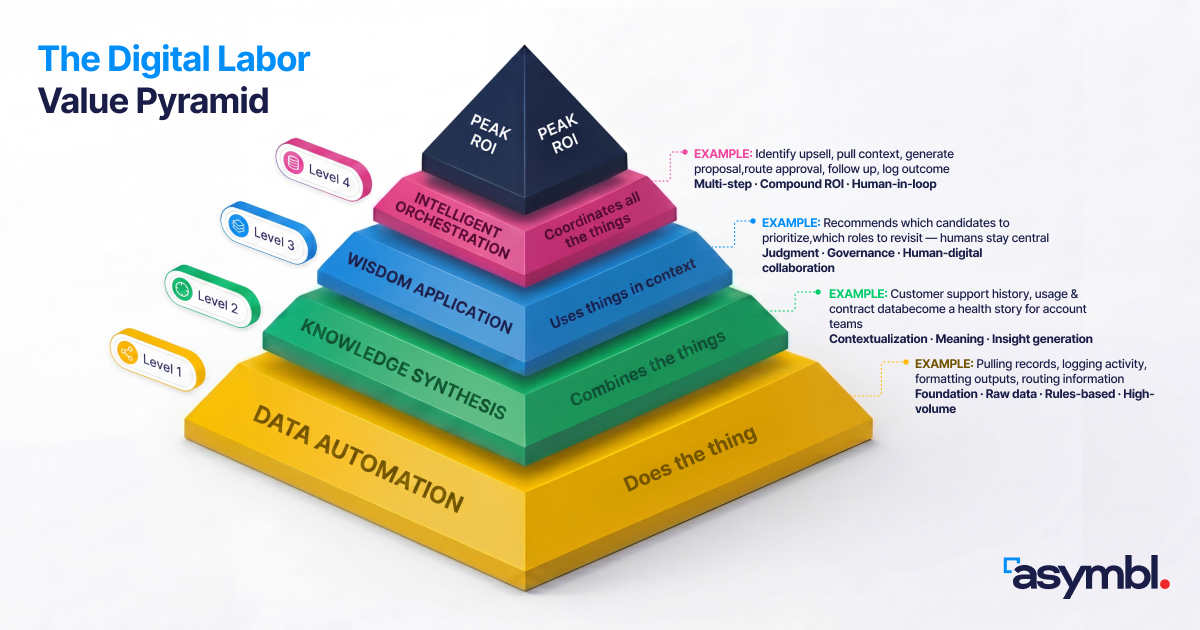
Generally, organizations heavily invest at the base, measuring the value of Data Automation while expecting the results of Intelligent Orchestration. These two levels are orders of magnitude apart. Each level is a foundation for the next, and skipping ahead is where most digital labor strategies break down.
Value creation starts at the foundation.
#1 Data Automation
Data Automation is unglamorous, and yet, essential. It's the ingestion of chaos and turning of messy, unstructured raw data into a format digital workers can finally use. The digital workers designed for this level handle high-volume, rules-based work: pulling records, logging activity, formatting outputs, and routing information.
Incomplete, unstructured, or siloed data prevents digital workers from acting reliably or scaling across workflows.
The data needs to be clean, accessible, and consistent across systems. A digital worker should be able to consume it without constant human correction. If any of these conditions aren't met, data quality suffers and every goal, KPI, or desired outcome above this level becomes unreliable.
This is where most AI investments produce their first clear ROI. It's also where the settlers tend to stay. Asymbl's Design phase begins here: configuring data and systems, mapping integrations, and ensuring that what's flowing into your hybrid workforce is accurate enough to act on. We treat this level as the launchpad, the infrastructure our customers' digital workforce needs before progression through the rest of the pyramid becomes possible.
#2 Knowledge Synthesis
Knowledge Synthesis is the contextualization phase. Digital workers at this level are connecting data points into business-relevant meaning. While a customer's support history, their product usage patterns, their contract value, and their recent engagement signals are four separate data points at the Data Automation level, at the Knowledge Synthesis level they become a customer health story that tells an account team where to focus and why. At this level digital workers begin surfacing insights that can inform action.
Without Knowledge Synthesis, AI efforts remain fragmented, and the insight that justifies the investment to leadership never surfaces.
Connecting digital workers at this level is deliberate work. It requires understanding how the business thinks and how data flows. Asymbl's Onboard phase is where this comes together: translating business requirements into orchestration logic, defining data models, and building the connected workflows that give digital workers the ability to synthesize across systems.
#3 Wisdom Application
Wisdom Application is where digital workers move from understanding to evaluation. At this level, a digital worker can look at a candidate's talent story and recommend what should happen next: which candidates to prioritize, which roles to revisit, and which hiring manager relationships need attention, with appropriate weight given to context that doesn't fit neatly into the data model. Wisdom Application is where digital workers begin to operate with something that resembles judgment.
The governance implications at this level are significant. Digital workers producing consequential recommendations require disciplined human oversight and clear escalation protocols. Human workers stay central to the decision. Digital workers bring the reasoning so that their human teammates can act with confidence. Getting this collaboration right is where the value of the entire pyramid starts to compound.
Asymbl's Coach phase is built for this level: performance monitoring, enablement, and continuous optimization of digital workers operating in the flow of work. As recommendations become more consequential, the coaching layer ensures that governance, accuracy, and trust scale with your hybrid workforce.
#4 Intelligent Orchestration
Intelligent Orchestration is the apex. This is where the hybrid workforce operates as one system: human and digital workers coordinating across tools, workflows, and multi-step outcomes with shared accountability. Humans design the orchestration, set the goals, and own the decision points. Digital workers execute the motion surrounding those decisions with consistency and speed.
For example, Asymbl's digital worker, Theodore (Teddy), is a Sales Development Representative (SDR). He engages prospects across every major marketing channel, qualifies leads, and hands them off to human sellers at exactly the right moment. Teddy has a job description, clear KPIs, and a manager: our Chief Revenue Officer. He's coached like any other team member. Theodore reached 37x ROI because he operates within an orchestration framework that lets a hybrid team move as one, with humans directing strategy and digital workers carrying the execution at scale.
At Asymbl, we're operating at a 5:1 output ratio with over 200 digital workers. This is what Intelligent Orchestration looks like in practice. This is where the investment in clean data, in knowledge synthesis, in wisdom application compounds. Every level of the pyramid feeds this one.
What’s next
For us, quantity stopped being the indicator metric that mattered. The real measure is where on the pyramid those digital workers are operating, and whether the organizational intelligence underneath them is keeping pace. The value isn't in how many digital workers you've onboarded. It's in how high on the pyramid they're operating. This is an intelligence game.
And none of it works, at any level of the pyramid, without capturing the knowledge that makes digital workers coherent because the data flowing through the DLVP is only as valuable as the organizational memory surrounding it, including the human tribal knowledge that lives in relationships, decisions, and institutional context. I unpacked this in an earlier blog, The Brain of Workforce Orchestration: the architecture that gives digital workers access to the reasoning behind the data, and the infrastructure that makes the entire pyramid possible. The blue ocean of orchestration is where we’ve built our home as Customer Zero. If you can feel the ceiling but can't yet name it. Start your path to the apex with us.
.webp)
AI Investments for Recruiting That Compound Beyond the Budget Year
Recruiting AI that compounds needs ROI now and capability later. Asymbl Talent Intelligence plus Design, Onboard, Coach delivers both.

The Right Fit Starts With a Conversation.
See what working together could look like.
.webp)