


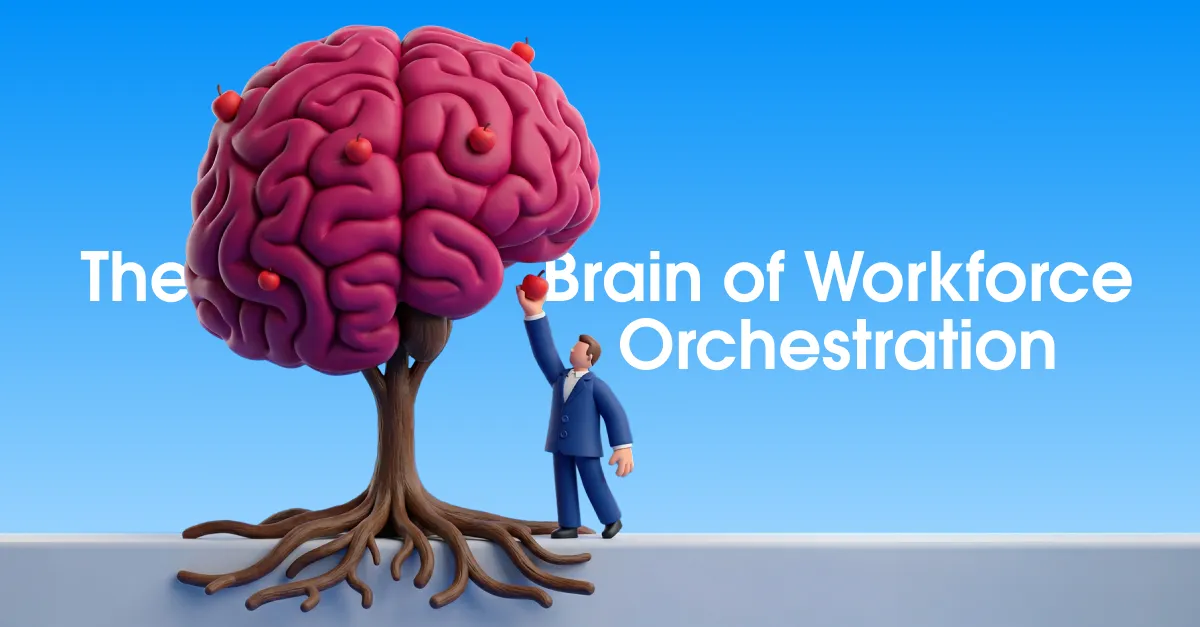
A real constraint in enterprise AI right now is memory. Your digital workers need to know everything about your organization: the decisions that shaped it, the reasoning behind those decisions, and the context that makes new information meaningful. That knowledge changes constantly. And right now, most digital workers can access almost none of it.
Consider how decisions get made: A feature lands on your engineering roadmap because a product manager thought it would be valuable, because a sales leader mentioned customer demand on an SLT call, or because a partnership decision earlier in the year created a dependency. Your engineers often don’t know this history, and in a large organization they frequently have no way to ask. Digital workers are in the same position, but without the informal networks that at least give humans a path to the reasoning. The inaction of not remembering is what takes a workforce out of alignment.
Organizational memory is what lifts this constraint. It's the connective tissue that makes context accessible to any worker, human or digital, at the moment they need it. Building it isn’t primarily a technical project. It’s an infrastructure decision that determines whether your digital workforce can coordinate or just execute. That distinction is where this piece begins.
What Is Workforce Orchestration?
To understand why organizational memory is foundational to workforce orchestration, it helps to be precise about what orchestration means.
- Automation efficiently and repeatedly executes a task in isolation: a specific input, a specific output. While it’s genuinely valuable, it doesn’t coordinate.
- Workforce orchestration coordinates human and digital workers toward a shared outcome, with each worker acting on relevant context that governs its piece of the work. Coordination, unlike automation, requires a shared frame of reference.
A shared frame of reference is what most organizations are missing when they deploy digital workers. Every enterprise already has information infrastructure: systems of record that capture what happened, tools where decisions get discussed, platforms where outcomes get logged. What those systems don’t capture, individually or together, is the why. Why was this deal closed at that margin? Why is that feature on the roadmap? Why was that candidate moved forward or passed over? These are the questions that separate a worker who can execute from a worker who can exercise judgment.
For human workers, the reasoning lives in relationships and institutional memory. People know who to ask, what decisions set precedent, which exceptions got approved and why. Digital workers have no equivalent. Salesforce is where most organizations start: it captures the deterministic outcome reliably. What it doesn’t capture is the organizational reasoning that produced it. When someone asks why a deal closed at a low margin, the answer isn’t in Salesforce. It’s in the meeting where that decision got made, and the history that made it reasonable at the time.
Building an organizational memory layer means making that reasoning accessible, not to replace systems of record, but to enrich them. This is what workforce orchestration requires.
Why Your Tech Stack Needs a Shared Brain
Every tool in your stack already does a job. Slack is your communications worker. Salesforce is your record-keeping worker. Your analytics platform is your reporting worker. Each performs a defined function, takes inputs, processes them, produces outputs. The problem isn’t that these tools are inadequate. The problem is that they don’t know about each other. And neither do the digital workers built on top of them.
Consider what this means in practice for Theodore, Asymbl’s SDR digital worker. Theodore isn’t sitting in on sales team reviews. He isn’t attending pipeline health calls or business reviews. But because his context is connected to what gets recorded and captured across the sales organization, he learns what the sales team knows. When a territory priority shifts, when an ICP criterion gets refined, when a particular objection pattern gets identified, Theodore gets that context through the organizational memory layer that connects him to what the team already knows. He’s part of the sales team without occupying a seat at every meeting.
This is the architecture most organizations haven’t built yet. Humans navigate distributed context through relationships. We know to check in with the right person before making a decision. We remember what was decided last quarter. We carry institutional knowledge and surface it when it’s relevant. Digital workers don’t have a similar network. Without an organizational memory layer, each digital worker operates on a slice of context it can directly access, which is usually just a fraction of what’s relevant.
The problem compounds at scale. With one digital worker, fragmented context is manageable. With ninety, a workforce running on different assumptions about the same organization isn't orchestrated. It's a collection of capable tools. That's not a failure of the technology. It's a design gap in how we think about connecting those tools. Getting a workforce coherent requires a shared brain.
The Orchestration Brain
Organizational memory, as I’ve come to think about it, has three distinct layers. Together, they form what we call the Orchestration Brain: the reasoning layer that turns a collection of digital workers into a coherent workforce.
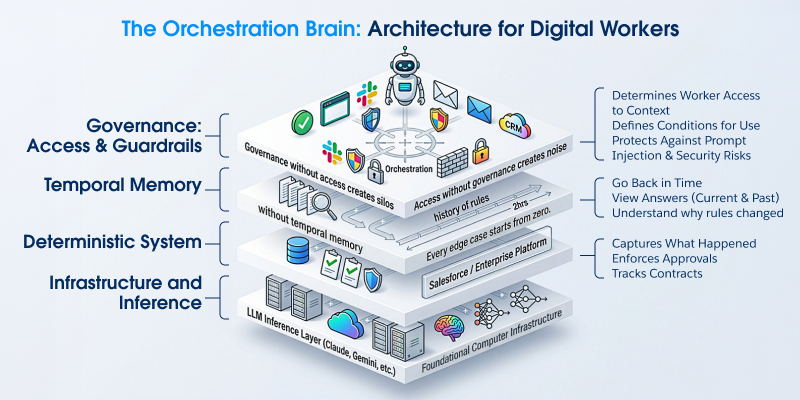
Layer 1, Temporal memory: the record of decisions over time. Temporal memory is the organizational equivalent of being able to go back to a specific point in time to view an answer today, what the answer was before, when it changed, and what triggered the change. A digital worker with access to temporal memory knows: the current rule and the history behind it, which matters significantly when a new situation doesn’t fit the current rule cleanly. Without temporal memory, every edge case starts from zero.
Layer 2, Deterministic system: The concept of deterministic systems traces to Alan Turing's foundational work on computable functions, which established that a system's outputs can be fully determined by its inputs and current state. For most enterprise organizations running on Salesforce, this is where recorded outcomes live. The platform captures what happened, enforces approvals, and tracks contracts. Organizational memory doesn’t replace this layer or compete with it. It enriches it. The reasoning that produced the recorded outcome becomes its own layer, sitting alongside what the platform captured. The why lives next to the what.
Layer 3, Governance: The framework that determines which digital workers access which context under what conditions. This matters for security; the risk of prompt injection into a poorly governed memory layer is real, as organizations running external-facing agents have already discovered. But governance is equally a design principle. Governance without access creates silos. Access without governance creates noise. Getting both right is where orchestration happens.
The practical implication of getting this architecture wrong isn’t just suboptimal performance. It’s a specific kind of waste. Organizations that deploy digital workers without organizational memory find themselves compensating for context gaps, correcting decisions that were technically sound but organizationally misaligned. The efficiency gains from digital labor don’t disappear, they get substantially offset by the human overhead required to keep a context-agnostic workforce coherent with an organization it doesn’t know.
At Asymbl, we built this architecture inside our own organization before we had digital workers to serve it. The principle is straightforward: capture organizational context as it happens, structure it for retrieval, and make it accessible when decisions get made.That sequencing matters. You can turn on an agent six months from now and it will catch up quickly once connected to your memory layer. But if you haven’t been capturing organizational memory in the meantime, you lose the multi-year record of decisions that is the difference between a digital worker that knows your organization and one that’s still learning from scratch.
It's a design principle. The right context, for the right worker, at the right moment.
Build the Brain Before You Need It
The technology to reason across data sources exists today. What most organizations are missing is the substrate that makes reasoning possible: an organizational memory layer that gives digital workers access not just to what happened, but to why, when, and with whom. Without it, digital workers execute in isolation and coordination fails.
Building organizational memory is a preparedness decision that determines whether your digital workforce will know your organization or just know your data. The organizations that start building this infrastructure now, before they need it, are the ones whose digital workers will compound in capability over time. The ones that wait will find themselves compensating for context gaps that should never have existed.
2026 is going to be the year organizational memory becomes visible as a competitive variable. You can build this foundation today, or wait to learn its value through the friction of a disjointed workforce.
Want to start building your organizational memory? Connect with us
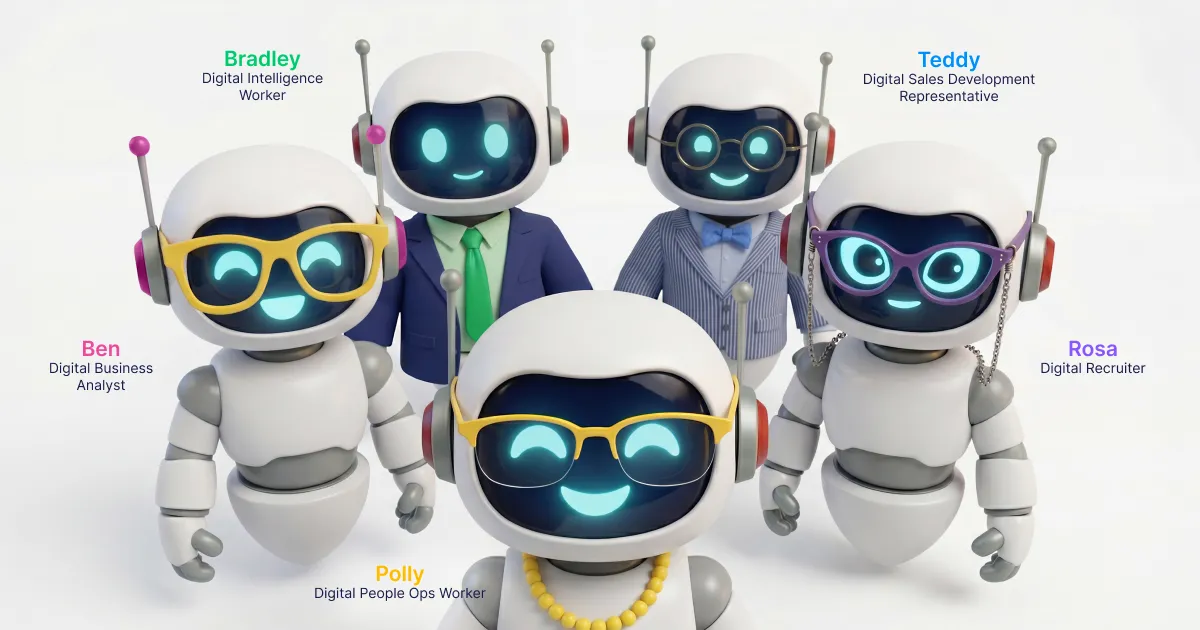
Naming Your AI Agents: Why Identity Matters in a Hybrid Workforce
Why does AI adoption feel uncomfortable? See how naming digital workers can bridge the gap and build operational trust.

The Right Fit Starts With a Conversation.
See what working together could look like.
.webp)