


Most teams consider time to fill as a speed metric, and assume that a lower time to fill automatically means an efficient process, a higher one means a problem, and the entire job becomes pushing it down.
However, looking at time to fill as a number means missing almost everything the metric could tell you. It hides where the delay actually lives, and it hides how much capacity the team has to begin with.
Time to fill actually covers two things:
- The first is how much open-role volume your recruiters can carry.
- The second is which stage of the hiring process is quietly causing the delays.
Improving it starts with understanding what it reports before touching the process itself.
In this blog, we will examine how time to fill is calculated, the stage-level delays the single metric hides, why the usual fixes stop working, and how to read the metric as a capacity signal you can actually act on.
How Time to Fill Is Calculated
Before time to fill can tell you anything useful, it has to be measured the same way every time:
The Time to Fill Formula
Time to fill is the number of calendar days from the moment a job requisition is approved or opened to the day a candidate accepts the offer.
Time to Fill = Date offer accepted − Date requisition opened
To track it across a team, you average it.
Average Time to Fill = Total days to fill all roles ÷ Number of roles filled
The start date has to be the requisition open or approval date, not the day the role went live on a job board, because the span between those two events is often where the delay hides.
The end date is offer acceptance, not the candidate's first day, since the start date depends on notice periods that the recruiter does not control.
What the Metric Tells You About Recruiter Capacity
Time to fill helps to understand recruiter capacity, meaning how much open-role volume a team can carry and keep moving at once.
When requisition load climbs faster than the team can absorb it, every role waits longer in the queue, and the average rises. The days are reporting the relationship between demand and capacity. They say nothing about how hard any individual recruiter worked.
For example, a recruiter carrying fifteen open roles will post a higher time to fill than the same recruiter carrying six, working at the exact same pace, making the exact same calls.
A rising time to fill in a quarter where every recruiter picked up four more reqs is a capacity signal telling you the team has more demand than it can carry. It leads to pressure and burnout.
However, from a capacity standpoint, it leads to a different and more useful question about how to ensure the team operates at a better efficiency without simply telling it to run faster.
The Stage-Level Delays Time to Fill Metric Does Not Reveal
A fifty-day fill can come from a dozen different combinations of stage-level delay, and each combination calls for a different fix:
The Internal Delay Before a Role Is Ever Posted
The first span runs from requisition approval through budget sign-off, role definition, and the moment the job actually gets posted. This is your organization's own latency, the time the company spends before the market ever sees the role.
The delays here come from slow approvals, unclear role definitions, and stakeholder back-and-forth about title, level, and compensation.
A requisition that sits four days waiting for a second approver, then another week while the hiring manager and finance settle on a band, has already spent eleven days before a single candidate could have applied. This is decision speed inside the business, a function of how the organization makes choices.
Most teams never measure this stage at all. Their attention is fixed on the recruiter-facing half of the process, so this delay sits in plain sight and stays invisible. It never appears as a problem because no metric is pointed at it.
The Sourcing and Screening Delay
The second span runs from posting and active sourcing through resume review and shortlisting. The delays here come from a thin pipeline, limited sourcing reach, or a recruiter carrying more open roles than one person can move through screening at once.
This is usually a capacity or talent-market constraint. The role is live, candidates exist somewhere, and the question is how quickly the team can find, contact, and evaluate enough of the right ones.
This is the stage teams instinctively blame first. When the number rises, the reflex is to assume recruiters need to source faster or work harder, which is why most fixes land here even when the delay is somewhere else entirely.
The Interview and Decision Delay
The third span runs from the first interview through final decision, offer, and acceptance. The candidate is identified and engaged, and now the process depends on the hiring managers.
The delay here comes from hiring manager availability, slow feedback after interviews, scheduling friction, and plain indecision. A strong candidate who interviews on a Monday and waits nine days for a debrief is nine days closer to taking another offer.
According to Gartner’s 2023 Voice of the Candidate Survey, half of the candidates accepted a job offer over a twelve-month period and then backed out before starting. Every day spent waiting on an internal decision is a day a competing offer has to win them away.
Time to Fill vs Time to Hire, and Why the Gap Between Them Matters
Time to hire counts from a candidate's first application or contact to offer acceptance. Time to fill counts from the moment the requisition opened. Time to hire lives inside time to fill as a subset, covering only the market-facing stages where recruiters are working with real candidates.
Subtract time to hire from time to fill, and what remains is the internal latency, the requisition-to-engagement span that time to hire never sees.
Internal Latency = Time to Fill − Time to Hire
A strong time to hire paired with a weak time to fill is the clearest possible signal that the delay is structural and upstream rather than a recruiter execution problem.
For example, a team has a fifteen-day time to hire and a forty-five-day time to fill. The recruiters are moving candidates from first contact to accepted offer in just over two weeks.
However, the other thirty days are gone before a candidate ever enters the funnel, lost to approvals, role definition, and posting lag. No amount of sourcing speed closes the thirty-day gap.
How Teams Typically Try to Fix Time to Fill
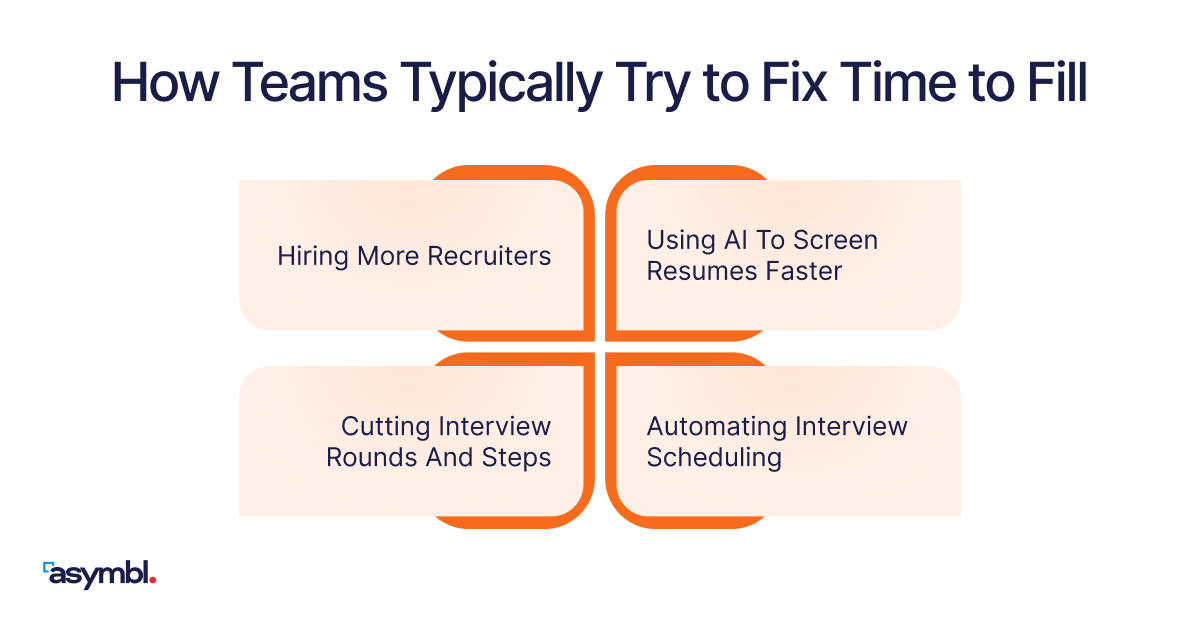
When the time to fill climbs, the instinct is to find the fastest lever and pull it, such as:
- Hiring More Recruiters: The most direct response to hiring delays is to add recruiters and spread the requisition load so queues get shorter. It addresses the capacity challenge head-on and is easy to justify when volume is high.
- Using AI to Screen Resumes Faster: The next step is automated or AI-driven resume screening to clear the top of the funnel quickly. Screening is visibly time-consuming and obviously repetitive, so handing it to software feels like an unambiguous speed gain.
- Automating Interview Scheduling: Aimed at removing the back-and-forth of booking interviews across calendars. The friction is visible, and automating it removes the calendar delay that everyone can feel.
- Cutting Interview Rounds and Steps: The last common move is to compress the process itself by removing interview stages or approval steps. Fewer steps look like a direct, immediate reduction in days, and it is the one lever a team can pull entirely on its own authority.
Why These Fixes Do Not Move the Metric for Long
According to the 2024 “Where’s the Value in AI?” Report by BCG, Seventy-four percent of companies have yet to show tangible value from their investments in artificial intelligence:
1. Adding Recruiters Raises Cost Faster Than It Raises Capacity
When finance is already pressing on cost per hire, adding headcount to lower time to fill is a hard case to make and a harder one to keep.
If the delay is due to approval latency or fragmented data rather than to the number of recruiters, more recruiters cannot reach it. You have added a fixed cost without touching the constraint.
A team waiting eleven days for requisitions to clear approval does not wait fewer days because two more recruiters joined. The new recruiters wait in the same queue.
2. Faster Screening Cannot Reach a Delay That Starts Before Screening
Automating resume screening speeds up a stage that was not frequently the bottleneck. When a large share of the delay sits in the internal approval phase, a faster funnel only means candidates arrive sooner at the next closed door and wait there instead.
Screening automation makes the working stage slightly faster, while the broken stage upstream keeps setting the real pace. The total barely moves because the total was never governed by screening speed.
3. Automating Broken Handoffs Only Speeds Up the Fragmentation
Scheduling and workflow automation layered on top of disconnected systems move data faster between tools that were never designed to integrate seamlessly.
A scheduling tool that books interviews quickly but pulls availability from a calendar that the applicant tracking system cannot see produces fast double-bookings instead of slow ones.
4. Cutting Interview Steps Trades Quality of Hire for Days
Removing interview rounds or approvals reduces the delay, but it comes at the cost of the quality and fit of the selected person. A round cut to save four days is a round of judgment removed from the decision.
A faster bad hire reopens the requisition within months, which is the most expensive way the time-to-fill metric can improve on paper, while the underlying function gets worse. The metric looks better for a quarter, and then the same role is back in the queue, now carrying the cost of a failed hire on top of the original search.
5. The Shared Flaw: Treating a Structural Delay as an Effort Problem
When the delay is structural, sitting in internal latency, fragmented data, or fixed capacity, working harder cannot overcome it. This is the gap the broader data keeps exposing.
According to the 2025 McKinsey Survey on the State of AI, nearly 80 percent of organizations that report using generative AI have not fundamentally redesigned any workflows, even though workflow redesign has the biggest correlation with EBIT impact of any organizational attribute McKinsey tested.
The same survey found that, across twenty-five organizational attributes, redesigning workflows had the biggest effect on whether organizations realized EBIT impact from generative AI. Yet only 21 percent of organizations using gen AI reported fundamentally redesigning at least some workflows.
The lesson is the same for hiring. Lasting improvement comes from changing how the work flows, not from layering new tools onto the existing process. The number does not move for long because the constraint was structural the whole time. It lives in architecture and capacity, where more effort cannot reach it.
How Teams Should Read and Improve Time to Fill
The practices below build on each other, moving from how you measure the metric to how you give the team the capacity the metric is asking for.

1. Break the Number Into Stages and Find the Slow One
Track the time inside each stage, including the internal approval phase, the sourcing and screening phase, and the interview-to-decision phase. The stage carrying the most delays is the actual problem to solve, and it is invisible until you separate it out.
A fifty-day fill driven by approval latency and a fifty-day fill driven by thin sourcing call for opposite actions. One needs faster internal decisions, the other needs more pipeline reach.
Although the totals are identical, the stage view tells you which one you are holding, and therefore which fix will work and which will waste a quarter.
2. Separate Your Internal Delay From Your Market Delay
Use the gap between time to fill and time to hire to isolate how much of the delay is the organization's own internal latency versus the market-facing work recruiters control. A wide gap points to the fix at internal decision speed and role readiness, away from the recruiting team.
Reading the metric this way depends on having an actionable insight about your own process and your market, and most teams are working without it.
3. Measure Recruiter Capacity Against Open-Role Demand
Track open-role volume per recruiter alongside time to fill. When you do, a rising number reads as a capacity signal rather than a performance verdict, and the conversation changes.
Once capacity is visible as the constraint, the question stops being how to make recruiters faster and becomes how to add more efficiency that the team can actually use.
4. Connect the Data So the Number Is Accurate and Visible
The stage view, the internal-versus-market split, and the capacity ratio are none of which are possible when the start date lives in one system, pipeline movement in another, and offer acceptance in a third.
Bring the data behind each stage into one connected system, and the metric can finally be trusted and broken down. When the requisition open date, pipeline movement, and offer acceptance live in one place, the stage view is consolidated, and the metric stops being reconstructed by hand in a spreadsheet every month.
Fragmentation across the applicant tracking system, the human resources information system, the customer relationship management platform, and a stack of spreadsheets is the reason most teams quietly default back to the single flattened number. They cannot break it apart, so they stop trying.
Asymbl Recruiter Suite is a talent relationship management application that unifies applicant tracking, candidate engagement, and recruiting workflow in one system, so the full hiring timeline lives in one place instead of being scattered across tools.
Recruiting data sits alongside customer relationship and post-hire data, which is what makes the stage-level view possible and lets a talent acquisition team measure what it is actually accountable for.
5. Source and Match on Your Full Recruiting History, Not Just Keywords
Most teams source with a keyword search run against one recruiter's memory. It is slow and skips strong candidates already sitting in the database because their resumes happened to use different words.
The best recruiters remember which candidates performed well on a given assignment type, how far someone got in a past process, and what a hiring manager said in a debrief two years ago. That signal usually lives in one person's head, and it walks out the door when they leave.
Matching on the full recruiting record changes the sourcing and screening stage directly. This is what Asymbl Talent Intelligence does. It evaluates pipeline history, interview feedback, and assignment outcomes the way a recruiter would, rather than scoring a resume against a job description for keyword overlap.
Natural-language search and placement-likelihood scoring surface the right candidate faster, and from talent the organization already owns.
Two outcomes follow:
- The stage compresses because the search reaches further with less manual effort, and quality of hire stays protected because the match rests on evidence of fit rather than a literal keyword string.
- The institutional knowledge that used to live in one recruiter's head becomes a shared signal, so the ability to source well stops depending on who happens to be staffed on the role.
6. Put AI to Work on Feedback, Insights, and Outreach
The interview-to-decision delay is mostly waiting on the hiring manager's feedback. The sourcing delay is mostly due to the outreach volume that one recruiter cannot personally handle. Both stages respond to the same kind of help, and it is not faster resume screening.
This is where Asymbl's Digital Recruiter, Rosa, a pre-built AI Agent, does its most useful work. On the decision side, it consolidates and chases interview feedback and summarizes interview notes into a clear readout, so a hiring decision can happen the same day instead of the following week.
On the front end, it sends personalized candidate outreach at scale, drafting and tailoring messages to each candidate, so the sourcing stage keeps moving without a recruiter writing every note by hand.
Used this way, AI reaches the two stages that actually carry the delay, decision coordination, and outreach volume, instead of only the screening step that teams reflexively automate.
The work that consumes a recruiter's day, the chasing, drafting, and note-taking, moves to a digital teammate, and the recruiter spends the reclaimed time on judgment and relationships.
7. Add Capacity Without Adding Headcount
Move the repeatable, high-volume work off the recruiting team, and existing recruiters can carry more open roles without each one waiting longer in the queue. That is added capacity, and it arrives without added payroll.
The model that makes this work is a hybrid one. Digital workers own the repeatable execution, the job descriptions, the outreach, the scheduling, and the status updates, while human recruiters concentrate on judgment, relationships, and moving candidates forward.
The ratio of administrative work to high-value work, which had drifted in the wrong direction, gets reset. Capacity grows when headcount cannot, because the team is no longer spending its hours on work that never required human judgment in the first place.
How Asymbl Helps Teams Orchestrate Recruiting Capacity
Asymbl treats recruiting as workforce orchestration, pairing human recruiters with digital workers on the same Salesforce foundation. Each capability below maps to a stage where time to fill actually accumulates, which is what turns the practices above from good intentions into something operational.
Recruiter Suite: One Connected Foundation for the Full Hiring Timeline
Recruiter Suite is a talent relationship management platform that unifies applicant tracking, candidate search, and engagement in one system. Recruiting data lives alongside customer relationship and post-hire data instead of being scattered across disconnected tools.
Since the full timeline lives in one place, the stage-level view becomes possible, and talent acquisition can measure recruiting impact that reaches past time to fill into the business outcomes leadership actually cares about.
The connected foundation is also what lets approval workflows and process updates run inside the same system where the rest of the hiring work happens, which is where the internal delay quietly accumulates.
Talent Intelligence: Finding the Right Candidate on Full Context, Not Keywords
Talent Intelligence is the recruiter's brain running on the Asymbl Intelligence platform. It matches candidates on pipeline history, interview feedback, and assignment outcomes rather than keyword overlap.
Natural-language search, an AI matching engine, and placement-likelihood scoring let recruiters find the right candidate faster without trading away fit, so the sourcing and screening stage compresses while quality of hire stays protected.
Hiring quality stops depending on which recruiter remembers what. The institutional knowledge that usually lives in one person's head becomes available to the whole team and to every digital worker on the platform.
Skills: Automating Repeatable Work on a Foundation That Is Already Connected
Skills are pre-built agentic building blocks designed for specific workflows, such as status updates, outreach triggers, and follow-up sequences, with no build project required.
Since Skills run on the connected Recruiter Suite foundation rather than across fragmented systems, automation amplifies the structure instead of scaling the fragmentation that made earlier automation backfire.
This is the difference between speeding up a clean handoff and speeding up a broken one.
The Digital Recruiter: A Digital Worker That Absorbs the Volume Across Stages
Asymbl Digital Recruiter, Rosa, is a pre-built digital worker that handles job description generation, candidate outreach, application screening, interview scheduling, interview summaries, and offer drafting alongside the human team.
It absorbs the repeatable execution across sourcing, screening, and interview coordination, so existing recruiters carry more open roles without each role waiting longer in the queue. This is added capacity without added headcount, applied to exactly the stages where the delays pile up.
Asymbl's own Digital Recruiter, Rosa, helped drive a 47 percent increase in fill rate and 100 hires in 100 days with a two-person team, an outcome of orchestrated capacity rather than faster effort.
Conclusion
The teams that improve the time-to-fill metric durably ask a harder set of questions, including:
- Which stage is absorbing the days?
- How much of it is the organization's own latency?
- Where has demand simply outgrown the capacity the team was given?
These answers come from connected data, separating internal delay from market delay, and giving recruiters back the hours that repeatable work was quietly consuming.
The next time the number climbs, the useful move is to resist the reflex to push harder on the visible stage. Break it apart instead, read it as a map rather than a verdict. It shows you where the capacity is missing, and that is a problem you can actually orchestrate your way out of.
See how Asymbl's approach to workforce orchestration and recruiting capacity is different from demanding more effort from a stretched team. Book a demo to walk through how a connected foundation of human recruiters and digital workers can move the stages that the usual fixes never reach.
FAQs
Time to fill equals the number of calendar days from the date a requisition is opened or approved to the date a candidate accepts the offer. To measure it across a team, divide the total days to fill all roles by the number of roles filled to get an average.
Time to hire counts from a candidate's first application or contact to offer acceptance, covering only the market-facing stages. Time to fill counts from when the requisition opened, so it includes the internal approval and posting delay that comes before any candidate appears.
A good average time to fill varies widely by industry, role seniority, and how scarce the required skills are, so a single benchmark across all hiring is misleading. Specialized, senior, and licensed roles take far longer than high-volume or entry-level ones. The more useful comparison is against your own history for similar roles and against labor market data for that specific skill, which separates a genuinely slow process from a genuinely scarce candidate pool.
Reduce time to fill by breaking the number into stages and fixing the slowest one, rather than compressing the whole process.
- Cutting interview rounds lowers the number while spending on the quality of hire, which reopens the role later.
- Durable reductions come from removing internal approval latency, matching candidates on full recruiting history instead of keywords, and moving repeatable execution to digital workers so recruiters carry more roles.
- Capacity improvements lower the days without trading away fit.
Hiring more recruiters only helps when recruiter capacity is the actual constraint. When the delay sits in slow internal approvals or fragmented data, added recruiters wait in the same queue, and the metric barely moves, now at a higher fixed cost. More headcount also scales linearly with payroll and is the first cut in a downturn. Diagnosing which stage carries the delays first tells you whether capacity, coordination, or internal decision speed is the real bottleneck.

Human Workforce Orchestration: Why a People-First Approach Wins
Digital labor fails without humans at the center. Learn why workforce orchestration requires human oversight to unlock productivity and avoid costly risks.

The Right Fit Starts With a Conversation.
See what working together could look like.
.webp)