


.webp)
Every recruiting team is already tracking candidates in a shared spreadsheet, an inbox, or a folder of resumes sorted by role. The candidate tracking system sells itself as the solution to that chaos with one structured view, every candidate in a stage, every next step visible.
It does deliver on that promise with a much cleaner pipeline and less chaos. For a while, that feels like progress.
The problem surfaces when the team starts asking the questions that actually matter.
- Who in the existing database fits the role that just opened?
- Which past candidate was strong but had a timing issue?
- Why are the best hires consistently coming from one source and not another?
The tracking system has no answer, because tracking was never designed to answer them.
Candidate tracking systems hold candidates in stages, while the work that actually fills jobs happens somewhere else entirely.
In this blog, we will examine what a candidate tracking system is, the workflow it runs, why the category was never built for the way recruiting actually happens, and what separates the candidate tracking software that scales from the software that becomes the next system you outgrow.
What Is Candidate Tracking System?
A candidate tracking system, often used interchangeably with an applicant tracking system, sits at the intersection of three things:
- A structured database where candidate records live
- A pipeline view that shows what stage each candidate is in, and
- A workflow engine that runs the rules and automations that move work forward.
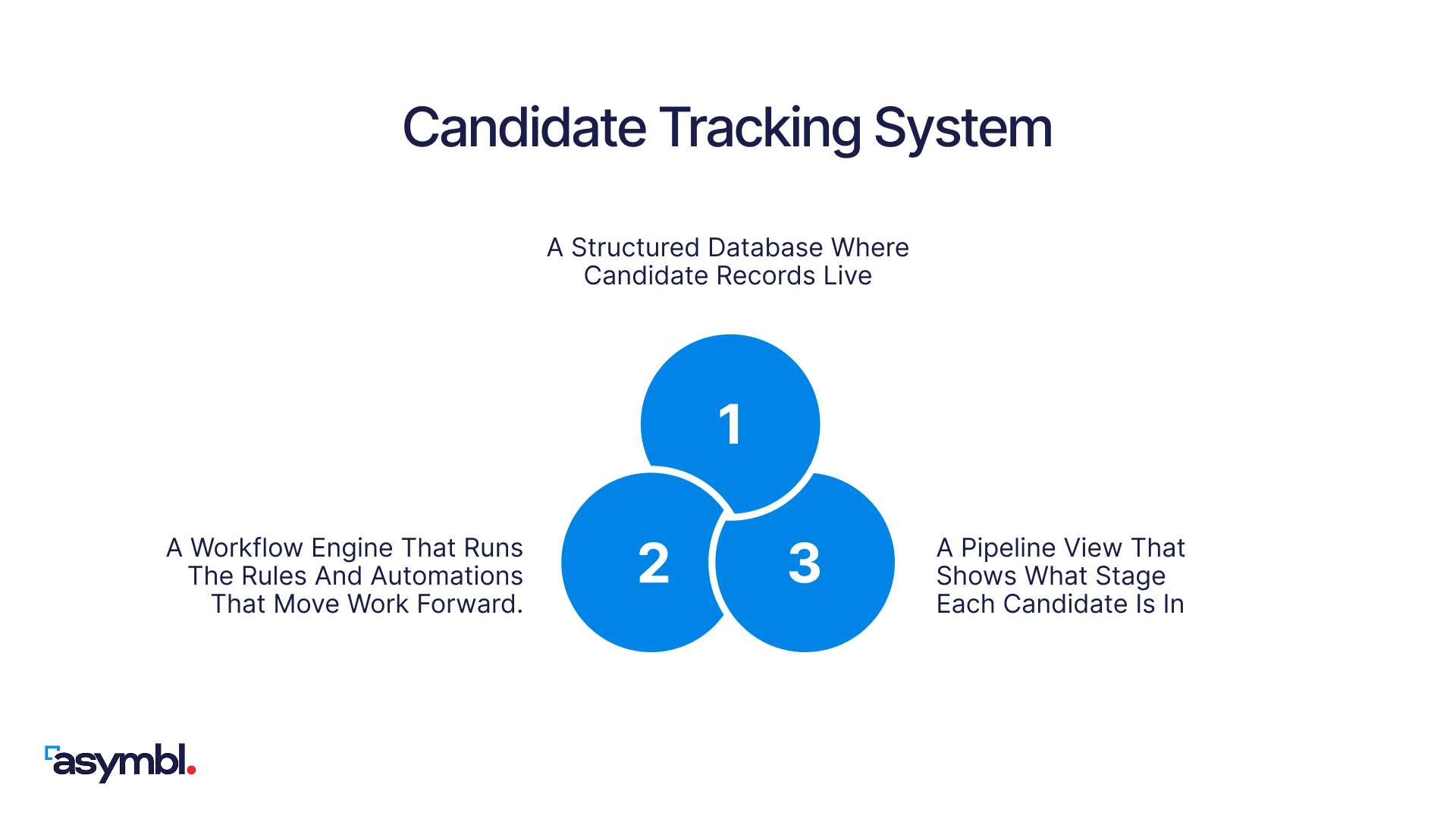
Each of the three matters on its own, but the value of a CTS comes from how the three operate together. Without the database, the pipeline is a list. Without the pipeline, the database is a folder. Without the workflow engine, both are inert.
The Hiring Workflow a Candidate Tracking System Runs
Most candidate tracking software runs the same core workflow, with variations in depth and configurability. Understanding what the workflow actually does and where it breaks at the seams is the precondition for understanding why most CTS platforms underperform once volume, complexity, or AI ambitions enter the picture.
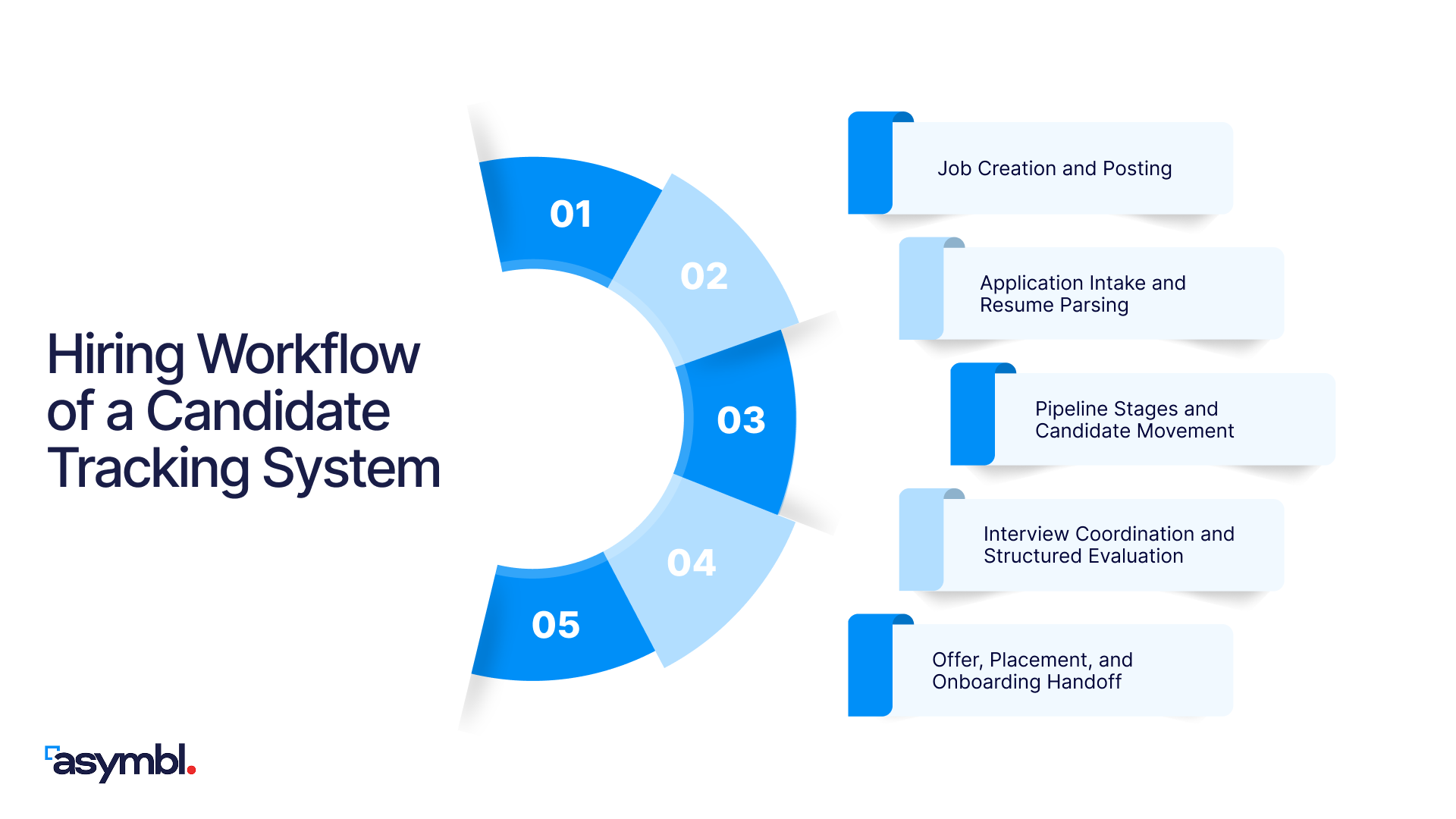
1. Job Creation and Posting
The hiring process often begins in the system, where a recruiter or hiring manager defines the role, sets the screening criteria, and assigns a workflow template based on the job type, function, or, in the case of staffing firms, the client.
Multi-channel job posting distributes the opening to external job boards and the company's careers page from a single record, without manual re-entry on each platform.
Configurable job management means the right workflow template attaches automatically based on defined criteria, so the right recruiting process runs against the right role from day one.
A high-volume hourly role gets a high-volume workflow with bulk screening and automated outreach, whereas an executive search gets a structured workflow with longer evaluation windows and committee approvals.
When this stage works, the rest of the pipeline starts on a clean foundation. When it does not, the wrong process attaches to the wrong job, and the friction compounds at every later stage.
2. Application Intake and Resume Parsing
As applications arrive, the parsing engine extracts structured data from resumes like:
- Contact information
- Education
- Work history
- Skills.
The parsed profile becomes a searchable candidate record, the starting point of the CTS database. Bulk intake handles high volume without manual re-keying, and de-duplication logic prevents the same candidate from appearing as three records because they applied through three different sources.
Resume parsing is the layer that the rest of the system depends on. If the parser miscategorizes skills, misattributes a current employer, or fails on non-standard resume formats, every downstream search, filter, and match degrades.
Most CTS platforms parse well enough on standard resumes and poorly on anything outside the template, which is a problem in industries where resumes do not look the same across regions, roles, or seniority levels.
3. Pipeline Stages and Candidate Movement
Candidates move through defined stages:
- Applied
- Reviewed
- Screened
- Interviewed
- Offered
- Hired, or declined.
Recruiters work the pipeline in a way that fits how they think. Kanban for visual movement, a list for bulk action, split for working on a job, and a candidate in parallel.
Stage changes trigger workflow actions, such as automated candidate communications, task assignments to the right team member, and approval routing when an offer needs sign-off.
This is the stage of the workflow that defines whether a CTS feels like a tool or a system of work. The pipeline is the interface that most recruiters spend their day inside. If it forces recruiters to switch contexts, log activity in a separate place, or wait on system updates that lag the actual conversation, recruiters stop trusting it.
Once that trust breaks, the data in the system stops reflecting reality, and the reporting that depends on the data stops being usable.
4. Interview Coordination and Structured Evaluation
Scheduling automation shares real-time interviewer availability with candidates, sends calendar invitations, and manages rescheduling without pulling a recruiter into every logistics exchange.
Structured feedback collection keeps interviewer evaluations, scoring, and notes attached to the candidate record, so the full evaluation is visible to everyone making the decision.
Interview guides and evaluation templates ensure consistency across roles and reviewers. A panel that evaluates three candidates for the same role should be answering the same questions, scoring against the same rubric, and submitting feedback against the same record.
When that consistency is missing, hiring decisions drift toward whoever spoke last in the debrief or whoever had the strongest opinion in the room. Structured evaluation is the difference between a hiring process you can audit and a hiring process you defend after the fact.
5. Offer, Placement, and Onboarding Handoff
The CTS closes the loop on each hire. Create and track offers, record outcomes (accepted, declined, withdrawn), and log placement completions.
For staffing firms, this is where placement data feeds revenue and gross profit tracking per recruiter, the operational metric that determines how the front office actually performs.
For corporate teams, the hire record triggers the onboarding workflow inside the same system, or passes to the HRIS where that process lives.
How cleanly candidate data travels into post-hire workflows determines whether recruiting outcomes stay connected to business performance.
A handoff that loses context means the new hire's record starts empty in the HRIS, the recruiter who placed them has no visibility into their first 90 days, and the data needed to measure quality of hire never makes it back to the system that produced the hire.
The seam is invisible until someone tries to measure whether recruiting is producing the outcomes the business is paying for, and the answer comes back as "we cannot tell.
Why Candidate Tracking Systems Were Never Built for Modern Hiring Needs
Candidate tracking systems track candidates, but modern hiring is not a tracking problem. It is a relationship, context, and execution problem, and the parts of that problem that the CTS does not address are the parts that determine whether the function works.
Limited to Candidate Tracking
A CTS holds discrete data about the candidate in the hiring network, including their:
- Resume
- Application
- Current stage.
The data model is built around the candidate as the central entity, and most workflows are scoped to actions taken on or about the candidate record.
However, hiring decisions are never made about the candidate in isolation. They are made against context. For example:
- What the client needs right now, for a staffing firm.
- What the hiring manager said last week and what the panel agreed to last quarter, for a corporate team.
- What the business is trying to build over the next 18 months.
- What the labor market looks like for this role type in this geography, at this compensation band, with this competing offer profile.
None of that lives in the CTS. The system holds candidate data as if it exists independently of all the context that gives the data meaning.
The recruiter has to carry that context mentally, switching between the CTS, their inbox, their phone, a separate CRM if one exists, and their own notes to assemble a complete picture before making a call.
The system is doing what it was built to do, which is to track. The recruiter is doing what the system cannot, which is connecting the tracking to everything outside it.
A Recruiter's Job Extends Far Past the Pipeline
Recruiters spend a fraction of their actual working day on what a CTS was built to support. The rest of the job happens outside it entirely.
Stage updates and pipeline movement consume some recruiter time, but the work that produces revenue or quality consumes much more, and almost none of it is captured by the tracking system.
For staffing firms, client relationship management and business development run alongside every active search. For example:
- Understanding what clients actually want beyond the job description
- Managing the relationship between placements
- Identifying new revenue opportunities
None of this is a CTS function. The most productive recruiters in a staffing firm are the ones running the deepest client relationships, and the system tracks none of it.
For corporate teams, hiring manager advisory is the part of the job that separates a TA function that adds strategic value from a TA function that processes requisitions.
Coaching hiring managers on realistic expectations, facilitating alignment across an interview panel, and translating business needs into candidate criteria, this is judgment work and relationship work that a tracking system cannot support.
According to the 2024 McKinsey Study on Using Generative AI in HR Function, talent acquisition, recruiting, and onboarding represent the largest single value pool for generative AI in HR, roughly 20% of total HR value potential.
However, the value pool is not in faster tracking. It is in the work that happens around tracking, judgment, and execution work that the CTS leaves entirely to humans.
Every Meaningful Conversation Happens Outside the System
The interactions that actually move a hiring process forward, the phone call that rebuilds a candidate's interest after a competing offer, or the check-in that reveals someone is actively looking again, none of these are captured by a CTS unless someone manually logs them.
Communication in most tracking systems is a human responsibility, which means it is inconsistent, incomplete, and non-transferable.
A recruiter who has spoken with a candidate four times over six months, learned their timing, understood their preferences, and built a genuine rapport carries all of that in their head. The system has a record with a status and a date.
When that recruiter leaves, the relationship walks out the door with them. The CTS has the candidate's resume and a few stage transitions. The institutional knowledge of who this person is, what motivates them, when they are most likely to move, and what role profile actually fits their trajectory is gone.
Most candidate tracking software treats this as a feature limitation rather than what it actually is, which is a structural failure to capture the most valuable signal recruiting produces.
The Relationship Continues. The System Doesn't
Most CTS platforms are requisition-centric. When a job closes, every candidate associated with that job freezes in their final stage. The record persists, the relationship the record represents has moved on, and the system stops tracking it.
A candidate who was not the right fit last quarter could be the right fit for a role that opens today. A contractor who finished an assignment six months ago might be available and ready for redeployment right now.
The tracking system knows each of these people exists, but it does not know the relationship is still relevant, and it has no mechanism for surfacing them at the moment they become relevant again.
The structural assumption of requisition-centric design is that hiring is a series of discrete events with start and end points. The structural reality is that hiring is a continuous relationship across thousands of candidates and dozens of jobs, with the right match emerging from connecting work that the system was never built to do.
What the Best Candidate Tracking Systems Do Beyond the Pipeline
The best candidate tracking systems share three architectural properties:
Unified Data That Doesn't Break at System Boundaries
The CTS that connects to CRM (client relationships and sales activity, for staffing), HRIS (post-hire outcomes and employee records, for corporate), and the rest of the business architecture is categorically different from one that operates as a standalone tool.
Standalone means every connection to the rest of the business depends on integrations that need maintenance, breaks in upgrades, and loses context in the translation between data models.
Data that breaks at system boundaries creates three problems:
- Reporting requires manual reconciliation, so the numbers the business sees are always at least a quarter behind the work that produced them.
- AI has no access to the full picture, so any model that runs against the data operates on partial information and produces unreliable results.
- Recruiting impact cannot be measured beyond time-to-fill, so the function's strategic value stays invisible to anyone outside the team.
For staffing firms, a CTS that does not sit alongside the CRM means sales and recruiting operate on separate realities. Client context does not inform candidate decisions, and candidate signal does not inform client conversations. The two sides of the marketplace each see half the picture.
For corporate teams, a CTS that does not connect to post-hire data means:
- Quality of hire stays a gut call rather than a measurable outcome.
- Time-to-fill becomes the only metric the function can report, and
- Time-to-fill alone tells the business nothing about whether the people being hired are succeeding once they are in the role.
Configurable for How Your Business Actually Hires
No two hiring environments are identical. Different industries, geographies, role types, and client relationships require different workflows.
A staffing firm placing IT contractors in three states runs a different process than a healthcare staffing firm placing travel nurses across the country. A corporate TA team hiring engineers runs a different process than the same team hiring frontline retail.
The best candidate tracking software is configurable through clicks, instead of code.
- Workflow templates
- Stage sequences
- Automation rules and
- Approval paths are adapted by the operations team without an IT ticket for every change.
The platform bends to how the business actually hires, not the other way around. Configurability is the property that separates platforms that scale with the business from platforms that the business eventually outgrows.
The hiring environment in any given firm changes faster than the technology that supports it. New role types, new clients, new geographies, and new regulatory requirements show up every quarter.
A CTS that cannot absorb those changes inside its existing data model becomes a constraint on the business within 18 months of go-live, and the cost of replacing it is the next cycle of disruption everyone wants to avoid.
Architecture That Makes AI Reliable, Not Just Possible
When candidate history, job data, interview feedback, and client context live in separate systems, the AI operates on partial information, and partial information produces unreliable results.
The model can be excellent, but the data feeding it is incomplete, and the output is only as reliable as the worst input.
According to the 2024 BCG Report on “Where’s the Value in AI?”, only 22% of companies have advanced beyond the proof-of-concept stage with AI, and 74% have yet to show any tangible value from their AI investments.
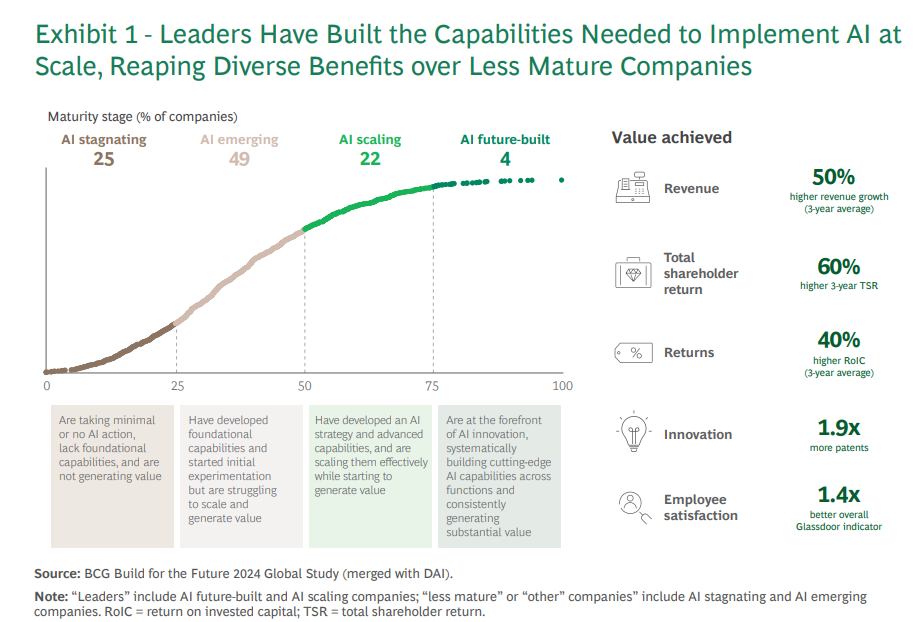
The diagnosis BCG offers is consistent across sectors. The companies generating value have built the data foundations first. The companies stuck in pilot purgatory layered AI onto fragmented architecture and discovered the model is not the bottleneck.
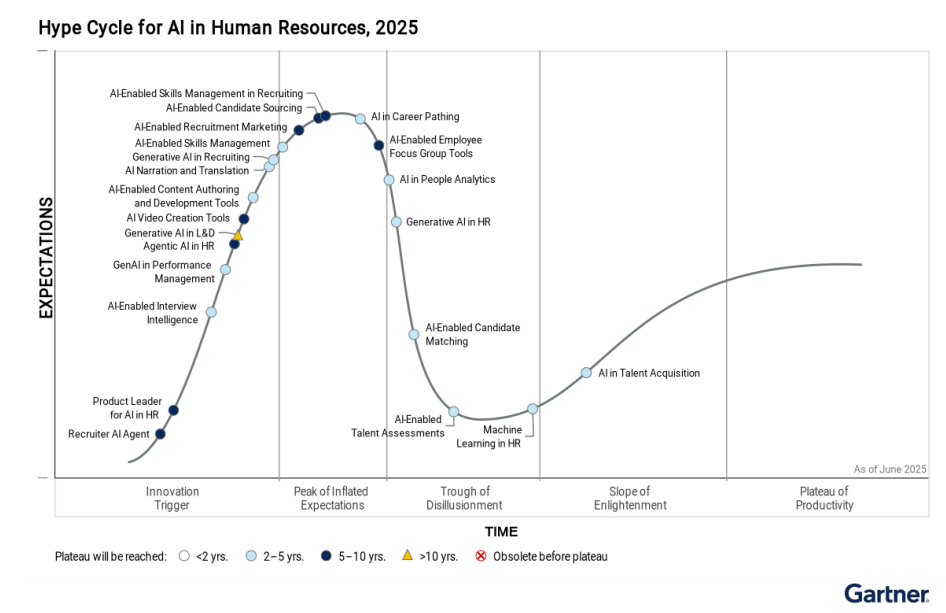
For a candidate tracking system, this means the question to ask about any AI feature is not "what does it do" but "what data does it operate on."
Asymbl Recruiter Suite: Candidate Tracking Built for What Comes After Tracking
The boundary between a candidate tracking system and a system that can scale with the business runs through the architecture, not the feature list.
Asymbl Recruiter Suite is built on Salesforce, which means candidate data, client relationships, and business performance live on the same foundation, not connected through integrations that need maintenance, but unified from the start.
One Connected System for Staffing Firms and Corporate Teams
For staffing firms, CRM and ATS are unified inside Recruiter Suite. Sales and recruiting work from the same client and candidate record.
Redeployment intelligence surfaces inside the recruiting workflow, instead of a separate system that nobody checks. Front-office decisions happen with full context.
Every relationship stays at the firm level, instead of the recruiter level, which means when a top producer leaves, the relationships do not walk out with them. The complete talent relationship management cycle, from first touch through placement and beyond, runs in a connected environment.
For corporate teams, recruiting connects to post-hire outcomes and business data because both already live on Salesforce. Quality of hire becomes measurable.
Talent Acquisition leaders can connect hiring performance to revenue impact, retention, and workforce planning, which is the strategic value the function is being asked to demonstrate. Compliance, bias mitigation, and data security are built into the workflow rather than retrofitted after the fact.
The same foundation runs both teams. Staffing and Corporate TA are fundamentally different businesses with different economic models and different languages, but the underlying architecture they need is the same: unified data, configurable workflows, and a foundation that AI can run reliably against.
Talent Intelligence Turns Candidate History Into a Hiring Signal
Talent Intelligence is the Recruiter Brain that powers candidate search and matching inside Recruiter Suite.
It goes beyond resume parsing and keyword matching to incorporate pipeline history, interview feedback, assignment outcomes, and unstructured documents into a continuously improving model of candidate fit.
The signals it generates are available to every member of the team and every digital worker in the platform, so placement quality stops depending on who remembers what.
Natural language search replaces Boolean queries. Recruiters find candidates the way they actually think, not the way a database was built to be queried. The system gets smarter with every interaction, because the data feeding it expands with every placement, every debrief, every outcome.
Start With Tracking and Scale to Intelligence
Recruiter Suite is the foundation for everything that comes after tracking. Customers who start with the Launch edition modernize their candidate tracking on the same Salesforce-based infrastructure that, when ready, runs Talent Intelligence and the pre-built Digital Recruiter.
There is no architectural rebuild between editions. The system you buy to solve the tracking problem is the same system that scales to solve the intelligence and digital labor problems when the business is ready.
The teams investing in candidate tracking software today are making a decision that compounds across the next five years. The architecture they choose now determines what they can build on later.
Conclusion
Tracking where candidates are does not tell you who to call first, which past applicant fits the role that just opened, or why your best placements consistently come from a particular source.
Those answers come from a system that does something with what it tracks and connects what it tracks to the broader context that gives hiring decisions meaning.
The teams that will lead the next decade of recruiting are not the ones with the most polished tracking. They are the ones whose tracking is the foundation for what comes after it: unified data, contextual intelligence, and digital workers operating alongside the human team.
See how Recruiter Suite turns candidate tracking into a foundation for unified data, contextual intelligence, and digital workers built alongside your team.
Book a demo with Asymbl to walk through what your team is tracking today, where it breaks, and what the next twelve months of recruiting could look like on a system designed for what comes after tracking.
FAQs
Applicant tracking system (ATS) is the older label, focused narrowly on managing applicants once they apply. A candidate tracking system (CTS) is the broader framing, covering both active applicants and passive candidates that a recruiter is engaging.
A candidate tracking system works by combining three layers:
- A database that stores candidate records
- A pipeline view that shows where each candidate is in the hiring process, and
- A workflow engine that automates actions like communications, task routing, and stage progression.
Candidate tracking captures candidate state inside an active hiring process. Talent relationship management is the broader discipline of managing relationships with candidates across the full talent lifecycle, including nurturing, engagement, sourcing, interviewing, placement, and post-hire.
Staffing firms use a candidate tracking system to manage placements across multiple clients, where the candidate is the product and revenue depends on placement velocity, redeployment, and gross profit per recruiter. Corporate TA teams use a candidate tracking system to fill internal roles, where the candidate becomes an employee, and the metrics that matter are quality of hire, candidate experience, and connection to business outcomes.
Implementation timelines for candidate tracking software range from a few weeks for small-team configurations on pre-built workflows to six months or more for enterprise rollouts with data migration, integration with HRIS or CRM, and configuration across multiple business units.
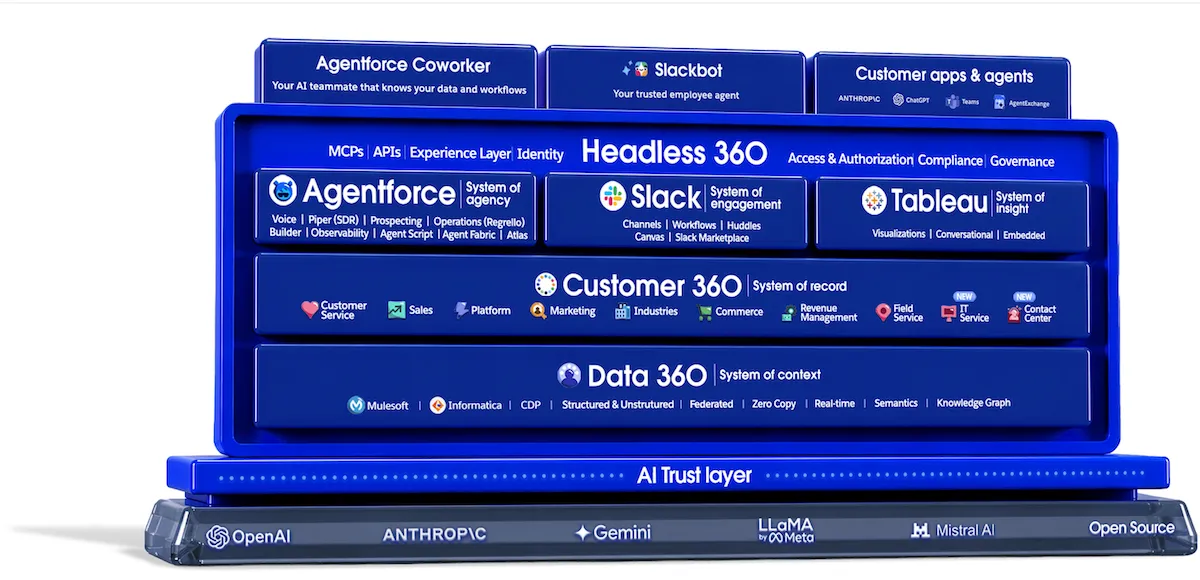
Designing for Headless 360: Build Your Hybrid Workforce Now
Headless 360 makes Salesforce's System of Work agent-ready by default. See how to design for hybrid workforces with discipline.

The Right Fit Starts With a Conversation.
See what working together could look like.
.webp)