

Chapter 4: The Math of Digital Labor: Measuring ROI
In the agentic enterprise, time saved is just tempo. Real ROI is musicality: tempo aligned to interpretation and intent. In digital labor terms, this means outcomes that no longer depend on humans reassembling context, coordinating systems, or advancing work manually. It's the capacity to deliver better outcomes, more consistently, without adding more players to the orchestra. To move the P&L, stop reporting how quickly the notes are produced and start measuring what the performance actually produces.
.avif)
Moving Beyond the Vanity Metric Trap
Most organizations measure tempo: time saved, tasks automated, hours reclaimed. But tempo isn't capacity. Digital labor creates a third dimension of productivity that multiplies rather than adds. When digital labor carries the orchestration layer, your existing talent operates at greater scale and impact through a multiplicative formula that 2D metrics can't capture.
As organizations adopt AI, one of the most common ways progress gets reported is through time saved: hours reclaimed, tasks automated, and slides filled with productivity gains. These metrics are easy to calculate and easy to present, but they rarely translate cleanly to financial outcomes because time saved often disappears back into coordination, oversight, and rework when integration remains human-bound.
That’s because ROI from digital labor isn’t universal. It varies by team, by workflow, and by business model. Time saved in one function might unlock revenue growth. In another, it might reduce risk, improve service quality, or increase capacity without lowering headcount. When those distinctions aren’t made, leaders end up measuring activity instead of impact.
Capacity only materializes when the system carries work forward instead of requiring humans to do so repeatedly. That requires a different approach to ROI.
The Three-Tiered ROI Framework
Since we’ve established that agents are digital workers, we will apply a labor-based financial model. This requires a shift from cost-per-seat thinking to value-per-outcome. Outcomes scale only when integration, context, and learning are reusable system behaviors rather than recurring human effort.
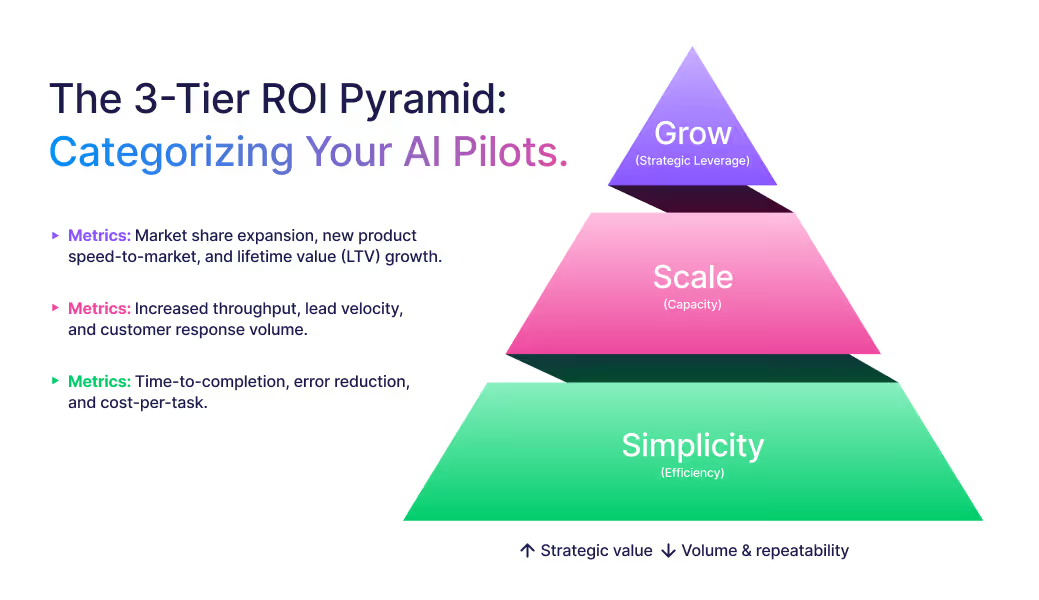
The Pilotitis Test: If you can't map your AI pilot to one of these three buckets: simplify, scale, or grow, you’re likely suffering from pilotitis, doing AI for the sake of AI. True leadership in the agentic era requires the discipline to demand a financial return on digital labor while building a strategic moat that technology alone can't replicate. That return comes from eliminating repeated human integration work and replacing it with durable system capability.
Tier 1: Simplify: The Efficiency Play
Efficiency is the price of entry. At this level, ROI comes from removing swivel-chair integration work that burns cognitive energy without moving outcomes forward.
- Process Complexity Reduction: Count manual hand-offs removed from a workflow.
- Error Rate Decline: Digital labor doesn't get tired at 4:00 PM on a Friday. Measure the reduction in compliance misses.
- The Swivel-Chair Index: Track the decrease in applications your digital worker has to toggle between to complete a unit of work.
Tier 2: Scale: The Capacity Play
Scale is what your humans do with the time returned to them. That time only becomes capacity when humans are no longer required to coordinate, reconcile, and advance work across fragmented systems.
- Human Output Multiplier: Calculate the increase in units-of-work produced per human head, such as interviews per recruiter.
- Cost Avoidance: The delta between current capacity and the cost of hiring more humans to reach the same output.
- Response Velocity: Measure the reduction in time-to-first-action.
Tier 3: Grow: The Revenue Play
This is the only tier the CEO truly cares about: tangible outcomes that move the bottom line. Growth becomes possible when human judgment and creativity are no longer consumed by integration labor.
- Revenue Conversion Rate: Measure the increase in leads, opportunities, or engagements that result in closed revenue when digital workers handle the coordination work between them.
- Pipeline Velocity: Track the reduction in time it takes to move a qualified opportunity from first contact to close.
- Customer Lifetime Value (LTV) Growth: Calculate the increase in long-term revenue per customer when human effort shifts from administrative tasks to relationship-building and retention.
Because revenue impact varies by function, the table below maps Tier 3 outcomes to the department closest to the work.
By categorizing your initiatives into these three tiers, you move from AI for the sake of AI to a disciplined financial model for digital labor.
Customer Zero Proof: The Agentic P&L in Action
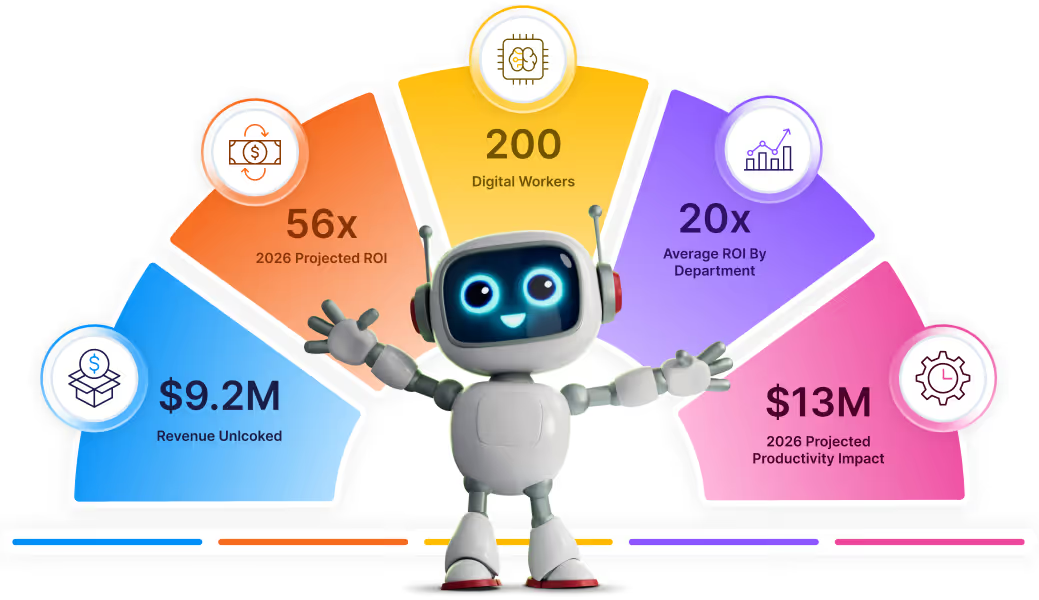
At Asymbl, we don’t just theorize about these metrics; we live them. Today Asymbl has 200+ digital workers across 10 business functions and 30 systems, we’ve moved from experimentation to core operational capacity. Here’s how that looks across engineering, sales, and recruiting. In 2025 our hybrid workforce generated approximately $5M in productivity impact and we expect that to grow $13M in 2026.
1. Engineering: The Scale Tier
- The Problem: Development teams face technology blockers and logic hurdles taking up to three months to resolve, stalling product velocity.
- The Action: We trained 40+ engineering digital workers to monitor issue queues and propose fixes in real time.
- The ROI: Blockers are now addressed in days instead of months, delivering a 23.7x ROI by reclaiming high-value engineering time.
2. Sales: The Growth Tier
- The Problem: Sales leaders are buried in CRM hygiene and lead-routing logistics, leaving only a fraction of their time available for actual customer-facing empathy and negotiation.
- The Action: We onboarded an SDR Agent digital workers to handle data enrichment and initial lead qualification, ensuring that by the time a human stepped in, context and preparation were already in place. The system carried the context forward so humans didn't have to reconstruct it.
- The ROI: A 427% increase in qualified leads and a 20x ROI for our sales team. More importantly, it created a direct lift in human moat activities: more high-level boardroom time, less administrative friction.
3. HR & Staffing: The Simplify Tier
- The Problem: Our recruiting team spent the majority of their time on repetitive candidate matching and data verification across fragmented systems. This work kept them from the strategic interviews that drive placements.
- The Action: We onboarded 5 recruiting agent digital workers to conduct the initial matching and data verification at the top of the funnel, operating 24/7 without fatigue.
- The ROI: A 24x ROI for our HR team, driven by a 60% reduction in manual tasks and 47% faster placements, allowing our human recruiters to focus on the high-value conversations that actually close candidates.
Escaping purgatory requires the courage to stop testing and start orchestrating. ROI isn't a mystery; it’s a choice of what to measure. And the most important choice is whether the coordination layer is going to remain an invisible human tax or become a reusable system capability. If you treat AI as a tool, you’ll get tool-level returns. If you treat it like labor, you’ll gain a workforce you can scale, govern, and trust.