

AI Agents for Recruiting: What Hiring Teams Must Know

Sales functions deploy AI to generate pipeline and accelerate revenue and marketing functions deploy AI to drive qualified demand. Most business units measure performance against business outcomes.
However, HR teams deploy AI agents solely to save time, reduce administrative load, and screen faster. The ambition frequently stops at operational efficiency and this gap in perception is costing businesses significantly more than most finance teams have calculated.
Every unfilled role is a revenue liability. Delayed hiring slows product delivery, extends sales cycles, and forces existing teams to absorb work they were not resourced to carry. Recruiting is not a support function with an efficiency problem. It is a revenue-adjacent function with an operating model problem.
AI agents for recruiting are capable of far more than scheduling interviews and parsing resumes. When designed as digital workers inside a hybrid team, they own meaningful portions of the hiring workflow and free human recruiters for high value execution.
This shift directly accelerates the speed at which a business becomes productive. The bottleneck is the choice to treat AI as a tactical tool rather than a strategic workforce component.
When leadership views AI as a mere feature in a software stack, their investment never translates into a measurable move in the bottom line.
By reframing recruiting as a core workforce initiative, organizations can scale their capacity with the same discipline used in sales and marketing.
In this blog, we cover what AI recruiting agents actually are, why most deployments underperform, the operating model mistakes driving that gap, and what a disciplined hybrid workforce design looks like in practice.
Why Corporate HR Teams Are Reaching For AI Agents
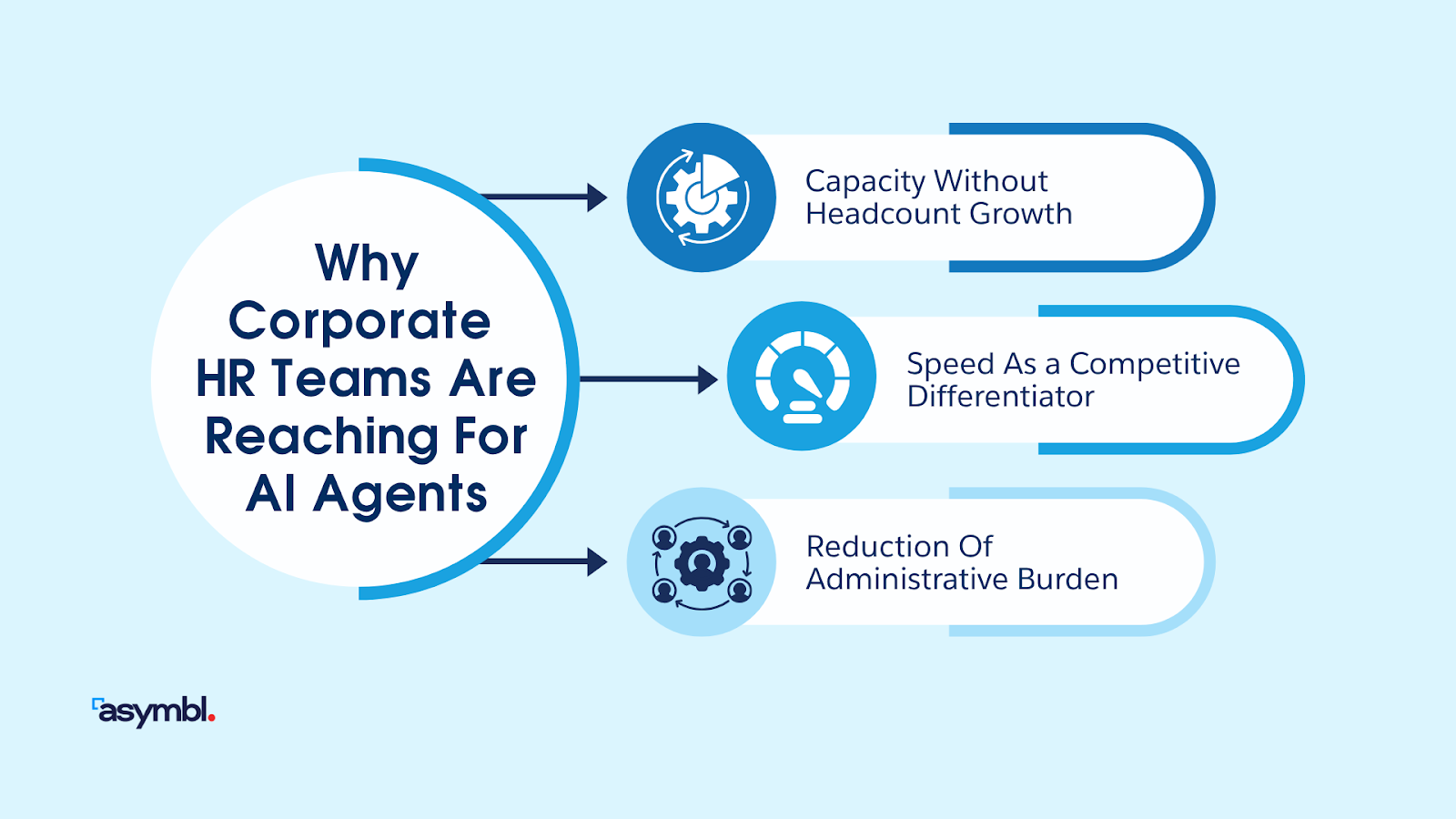
The pressure of driving AI adoption in HR teams is a survival response to capacity crunch and it has been building for years.
Recruiting functions are being asked to do more with the same headcount, sometimes even less. Hiring targets expand quickly when business conditions change, but budgets do not move at the same speed.
Also, the expectation from leadership has shifted from "fill the roles" to "fill the right roles, faster, with data to prove it."
AI recruiting agents appear to solve that equation. The promise is compelling enough that most teams are at least piloting something. However, the reasons organizations reach for these tools reveal a lot about the failure patterns that follow.
1. Capacity Without Headcount Growth
Recruiters often carry high-volume hiring loads that were never designed for human scale. When a team of five is tasked with managing the output historically requiring twelve, the structural integrity of the hiring process begins to fail.
Quality in the candidate experience diminishes, pipeline velocity slows, and reporting becomes a reactive exercise. It forces strategic work to be sidelined by the sheer weight of operational volume.
Digital labor offers a path toward scalable capacity without the need for payroll expansion. Unlike human counterparts, a digital worker operates without a maximum load.
- They do not require time off
- They are not diverted by competing priorities
- They process volume with total consistency.
- They operate at any hour against a set of criteria that remains unaffected by mood or fatigue.
However, when digital agents are deployed to solve a volume problem on top of fragmented infrastructure, they do not reduce the organizational burden. Instead, they automate the fragmentation.
It creates a scenario where candidates are processed faster through a system that was already producing inconsistent outputs. Speed without structural improvement is simply the acceleration of existing inefficiency.
To move past this, organizations must recognize that they are no longer just managing people, but orchestrating work. True capacity is found not just in adding "digital hands," but in designing a coordinated system where human and digital workers operate in harmony.
2. Speed As a Competitive Differentiator
The most qualified candidates often engage in multiple professional conversations simultaneously, and the recruiting teams that operate with clear intention secure the talent that others lose. When a business moves slowly, it signals a lack of internal coordination to the very talent it is trying to attract.
Response latency during the screening and scheduling phases represents one of the most significant and measurable drop-off points in the hiring funnel. A candidate who submits an application and receives no communication for several days has already formed a lasting impression of the company culture.
If a competing offer arrives before a first interview is even scheduled, the candidate’s decision is often made before a human recruiter has the chance to make meaningful contact. This delay creates a cumulative drag on the entire business unit awaiting that new team member.
A frictionless, rapid hiring process signals to the market that an organization is decisive, technologically mature, and respectful of a candidate’s time. Conversely, slow response times suggest a business that is struggling to manage its own internal work.
This transforms speed from a tactical advantage into a form of employer brand equity. In a modern, orchestrated workforce, speed is the primary mechanism for preserving human connection.
By removing the administrative latency that stalls the funnel, teams can ensure that the "human" parts of the process occur while the candidate is still highly interested and available.
3. Reduction Of Administrative Burden
A disproportionate amount of a hiring team’s working hours is consumed by tasks that require little to no professional judgment like:
- Scheduling coordination
- Status update emails
- Manual resume parsing
- Record updates
The core value of an experienced recruiter lies in relationship development, stakeholder advisory, candidate evaluation, and offer negotiation. These are the areas where human skill moves business outcomes.
However, when administrative requirements consume the majority of available time, this high value work is compressed into whatever capacity remains, resulting in a productivity paradox.
The true pain is not just the time lost, but the cognitive load required to switch between these low value tasks. Every hour spent on manual data entry or logistics is an hour lost to deep talent sourcing or candidate engagement.
This creates a cumulative drag on the organization, leading to burnout and a hiring process that feels transactional rather than strategic.
While identifying the administrative burden is essential, it exposes a deeper organizational challenge regarding how time is reclaimed. In many cases, if administrative friction is reduced without a fundamental shift in workforce orchestration, the saved time is simply absorbed back into unstructured availability.
Without a strategic plan for redeployment, time savings tend to be consumed by more volume without producing a meaningful improvement in quality or experience.
For an organization to move from a reactive cost center to a proactive growth driver, it must address the structural failure that allowed administration to take precedence over advisory in the first place.
The goal is not merely to do the work faster, but to ensure that the human workforce is freed to focus exclusively on the high value activities that a digital worker cannot perform.
Why Your AI Agent Strategy In HR Might Be Failing
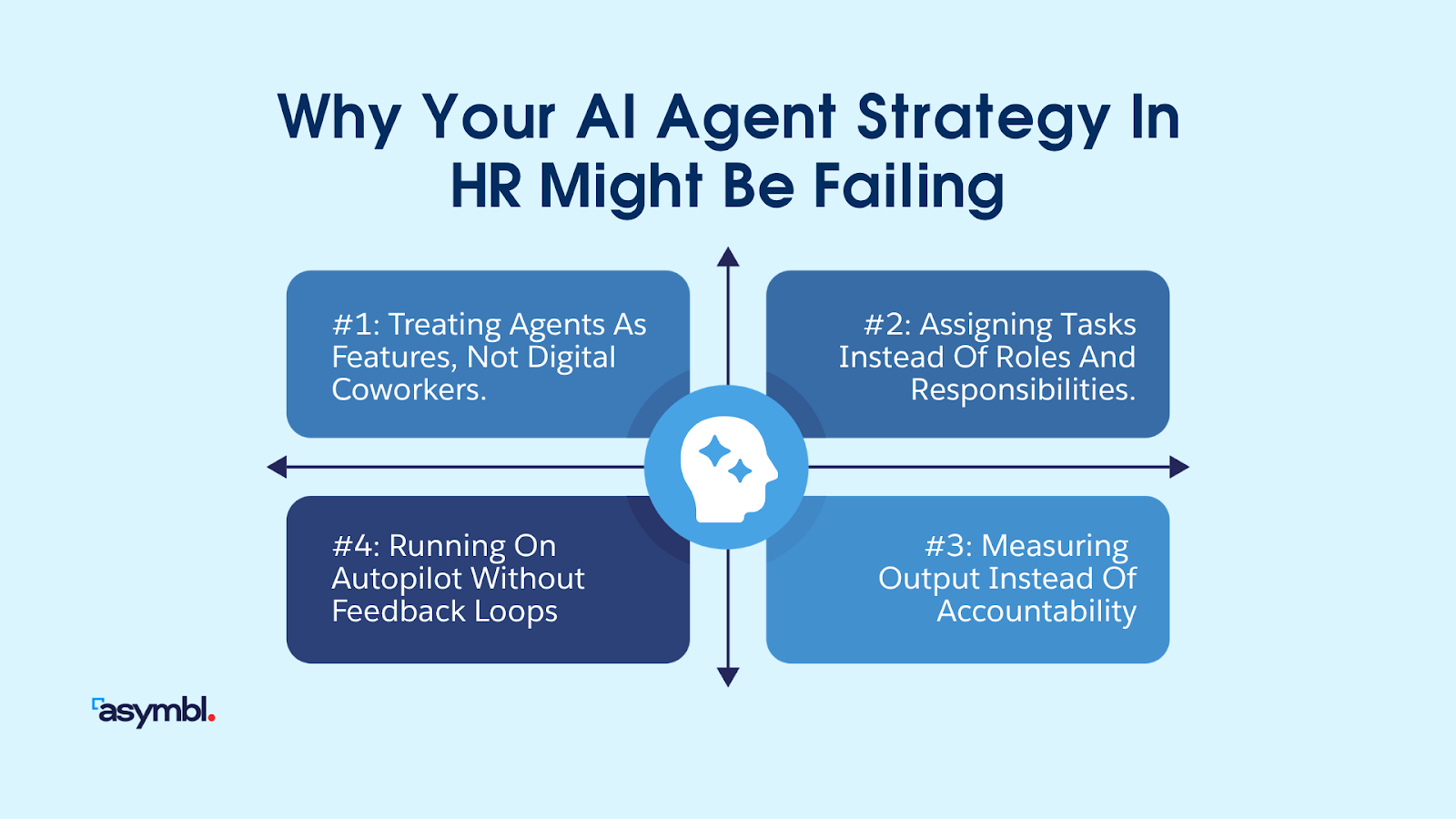
When you examine why AI initiatives stall, the same patterns appear almost every time. The issues are structural rather than visible and easy to overlook until the conversation regarding ROI becomes uncomfortable.
Mistake #1: Treating Agents As Features, Not Digital Coworkers
Most organizations introduce AI agents in the same way they adopt new software features. A scheduling tool is added to the interview stage, or a screening application is layered into the initial review process.
When AI agents are treated as tactical add-ons, they lack the three pillars of effective work:
- Ownership
- Context
- Accountability.
They may execute tasks with high speed, but because they are not integrated into a coordinated system, no single entity is responsible for the final outcome. This is where the belief gap often begins to widen.
Leadership sees improvements in isolated pockets of efficiency, but the overall velocity and quality of the hiring system remain stagnant.
To move beyond this plateau, the focus must shift from deploying tools to orchestrating a workforce. According to a 2025 Accenture Research Report on Accelerating Collaboration between Humans and AI, 84% of executives expect generative AI and other AI-powered agents to work alongside humans within the next three years, signaling a clear move toward hybrid workforce models rather than standalone automation.
It requires defining digital worker roles with the same discipline applied to human employees. It involves establishing performance expectations, structuring handoffs between human and digital workers, and ensuring that every action contributes to a measurable business outcome.
When organizations stop seeing agents as features and start seeing them as members of a hybrid team, they move from simple automation to true workforce maturity. Without this structural shift, technology will continue to solve for tasks while leaving the most pressing organizational problems unaddressed.
Mistake #2: Assigning Tasks Instead Of Roles And Responsibilities
There is a fundamental difference between delegating a task and defining a role. Most organizations focus on the former while expecting the strategic outcomes of the latter.
A task is a narrow, isolated instruction, such as "screen resumes for this job requirement," whereas a role is a set of defined responsibilities.
A role involves owning structured candidate qualification for all inbound applications, scoring them against defined criteria, and routing qualified candidates to the next stage. It includes the responsibility to flag edge cases for human review and maintain a completion rate above a specific threshold.
When AI agents are given tasks instead of roles, they function as a loose collection of automations rather than a coordinated system. Since tasks occur in isolation, nothing connects and the system does not learn.
The talent pipeline does not improve because no single component of the system is accountable for the end outcome.
True workforce orchestration requires that every worker, whether human or digital, has a clearly defined position within the organization. A well-defined role must include:
- Defined Scope: Clear boundaries that prevent overlap and confusion.
- Measurable KPIs: Performance indicators directly tied to business outcomes.
- Escalation Pathways: Predefined protocols for when an exception or edge case occurs.
- Accountability Boundaries: A clear understanding of what the agent decides independently versus what requires human oversight.
Defining these roles is a fundamental workforce design decision. In the shift from managing people to orchestrating work, the design of the "Digital Employee" must be as rigorous as the hiring of a human employee.
When organizations fail to make this distinction, they continue to treat AI as an IT project rather than a workforce initiative.
Mistake #3: Measuring Output Instead Of Accountability
Corporate HR teams often focus on resumes screened, interviews scheduled, emails sent, or total time saved. While these metrics may appear compelling in a quarterly review, they are often disconnected from actual business impact. They measure the volume of work rather than the value of the outcome.
True accountability metrics focus on the health of the system rather than the speed of the task. For an organization to bridge the belief gap, it must shift its reporting toward outcomes that reflect a coordinated system of work. Strategic accountability looks like:
- Pipeline Conversion: Measuring the journey from application to hire specifically in revenue-generating roles.
- Quality of Downstream Performance: Evaluating the long term success of candidates advanced by a digital worker.
- Cost Per Qualified Candidate: Focusing on the value of the talent pipeline rather than the volume of screened applications.
- Revenue Capacity Impact: Assessing how reduced time to fill directly influences project delivery timelines or business growth.
- Capacity Redeployment: Tracking whether freed recruiter capacity is directed toward high value work or simply absorbed back into volume.
When a digital worker compresses administrative friction and returns time to a human recruiter, the value of that time is not inherent. It depends entirely on what happens next.
If the reclaimed capacity is redirected toward deeper candidate relationships, higher quality evaluations, and sophisticated hiring manager advisory, the ROI compounds. If that time disappears back into undifferentiated activity, the operational savings are real but the business impact is marginal.
Mistake #4: Running On Autopilot Without Feedback Loops
Many organizations deploy digital labor with the expectation of immediate, self-sustaining results. In practice, however, digital workers require a structured system of feedback to remain effective and aligned with the business.
Recruiting environments are inherently dynamic. Role requirements shift as markets evolve, hiring manager expectations change with team growth, and candidate behavior fluctuates across different industries.
Without intentional feedback loops, agents continue to operate on outdated assumptions. This leads to process drift, where the technology begins to solve yesterday's problems while the organization has moved on to today’s challenges.
Over time, this drift leads to an erosion of trust. When recruiters can no longer rely on the consistency of the digital output, they inevitably revert to manual workarounds.
That is why continuous optimization is essential for a coordinated system of work. Valuable feedback must be captured from multiple touchpoints:
- Recruiter Decisions: Understanding why a recruiter accepted or rejected a specific recommendation.
- Hiring Outcomes: Tracking whether the candidates advanced by the system ultimately successfully integrated into the business.
- Candidate Interactions: Monitoring how the market responds to digital outreach and engagement.
This data should inform how the digital workforce refines its logic and adjusts its workflows. In a mature workforce orchestration model, the digital worker is never operating in isolation. It is part of a living system that requires consistent alignment with business goals.
Without this ongoing commitment to feedback, the digital labor force will eventually become a legacy burden rather than a competitive advantage.
The Structural Fix: Designing AI Agents As Digital Workers
The correction for the failures is conceptually straightforward, but the execution requires significant organizational discipline.
To bridge the belief gap and overcome the productivity paradox, AI agents must be designed as digital workers within a hybrid recruiting team. They should not be viewed as software features configured inside an existing tool stack.
This fundamental shift changes every aspect of the talent acquisition strategy. It redefines how roles are structured, how performance is managed, how governance is established, and how human and digital workers divide responsibility. This is the transition from simply managing tools to true workforce orchestration.
1. Workforce Orchestration
The most stable foundation for the deployment of AI agents in recruitment is workforce orchestration. Workforce orchestration is the strategic coordination of human and digital workers to operate as one unified, high-performing team.
Both human and digital workers operate with clearly defined responsibilities that complement rather than duplicate the other. The digital worker handles structured execution, which includes repeatable, criteria-driven, high-volume work that does not require human judgment, relationship intelligence, or contextual reasoning.
The human recruiter manages the aspects of the process where judgment and wisdom are essential. It includes evaluating candidates whose profiles fall outside standard criteria, building strategic relationships with hiring managers, navigating complex offer negotiations, and making final hiring decisions.
Workforce orchestration directly elevates the performance of the human recruiter. When administrative volume is transitioned to the digital worker, the recruiter is no longer forced to ration their attention across dozens of low-value tasks. Instead, they are freed to deploy their judgment where it actually influences business outcomes.
Asymbl’s own internal recruiting team utilized this exact framework to hire 100 people in 100 days without scaling the human team or compromising the quality of the candidate experience.
By ensuring the digital recruiting agent owned the structured execution while the human recruiters owned the relationships, the team achieved measurable impact:
- Fill Rate: A 47% increase in total fill rate.
- Return on Investment: A 1,529% ROI for the talent acquisition function.
- Operational Velocity: The ability to review 17,000 applications and schedule 800 interviews with precision.
The success did not stem from simply adding a tool and hoping for improvement. It was the result of a coordinated system where human and digital workers functioned as a single, orchestrated unit.
2. Clear Division Of Labor
When responsibilities overlap or remain undefined, both human and digital workers fill the gap with inconsistent behavior. This causes the recruiting process to become unpredictable at exactly the moments that matter most.
True workforce orchestration requires a deliberate architecture that separates structured execution from contextual judgment. In a mature operating model, the division of labor is based on the specific strengths of each worker class.
The digital recruiting worker owns structured execution:
- Resume parsing and structured scoring against defined criteria.
- Criteria-based pre-screening and qualification routing.
- Interview scheduling and calendar coordination.
- Workflow stage progression and record updates.
- Compliance enforcement and documentation requirements.
- Candidate follow-up and status communication at defined touchpoints.
The human recruiter owns strategic outcomes:
- Defining what success looks like in each role.
- Evaluating candidates whose profiles require nuanced, contextual judgment.
- Stakeholder advisory and hiring manager alignment.
- Candidate relationship development and experience quality.
- Final hiring decisions and offer negotiations.
- Coaching and optimizing the performance of the digital worker over time.
When administrative volume moves to the digital worker, the recruiter is no longer rationing their attention across dozens of low-value tasks. This shift ensures that the work only humans can do well receives the majority of their time because the work machines can do better is no longer competing for it.
3. Decision Rights And Guardrails
Every AI agent in a recruiting environment must operate within a defined decision rights framework. This is not merely optional governance documentation but a structural boundary that determines whether the agent builds long term trust or erodes it through unpredictable behavior.
Many organizations assume that this governance is already in place. Leaders often express confidence that they have defined the necessary structures around ethics, data responsibility, and decision-making.
However, the reality on the ground tells a different story. According to a 2025 Accenture Research Report on Accelerating the Collaboration between Humans and AI, workers report significantly lower confidence, with gaps of up to 14%, and many remain unclear on how AI impact is measured.
Also, 53% say they do not know who is accountable when something goes wrong. This disconnect highlights that governance that exists in theory but is not operationalized through clear decision rights creates ambiguity at the exact moment clarity is required.
Decision rights provide the "wisdom born of experience" required to manage a hybrid workforce. They must answer three specific questions for every action a digital worker is capable of taking:
- Independent Execution: What can the digital worker decide and execute independently, without human review?
- Collaborative Input: What requires the digital worker to flag a human recruiter for input before proceeding?
- Mandatory Override: What specific conditions trigger a mandatory human override, regardless of the conclusion the digital worker reaches?
Without this framework, agents often make consequential decisions that were never explicitly authorized.
Guardrails are not restrictions that limit the value of digital labor. Instead, they are the essential conditions under which autonomy is earned and maintained. They protect the candidate experience, the integrity of the business, and the human recruiters who are ultimately accountable for the outcomes.
As trust builds through demonstrated performance, these guardrails can evolve. A digital worker that consistently produces high quality screening outputs earns broader decision rights over time through a process of workforce maturity.
This progression requires a structured review of data and performance, ensuring that the expansion of authority is based on evidence rather than assumption. By establishing these rights from day one, organizations ensure that their digital workers remain aligned contributors within a coordinated system of work.
4. Performance Management for Digital Workers
A digital worker without performance management is merely a script running unsupervised. Without a disciplined approach, technology remains a "black box" that operates in isolation rather than a coordinated part of the team.
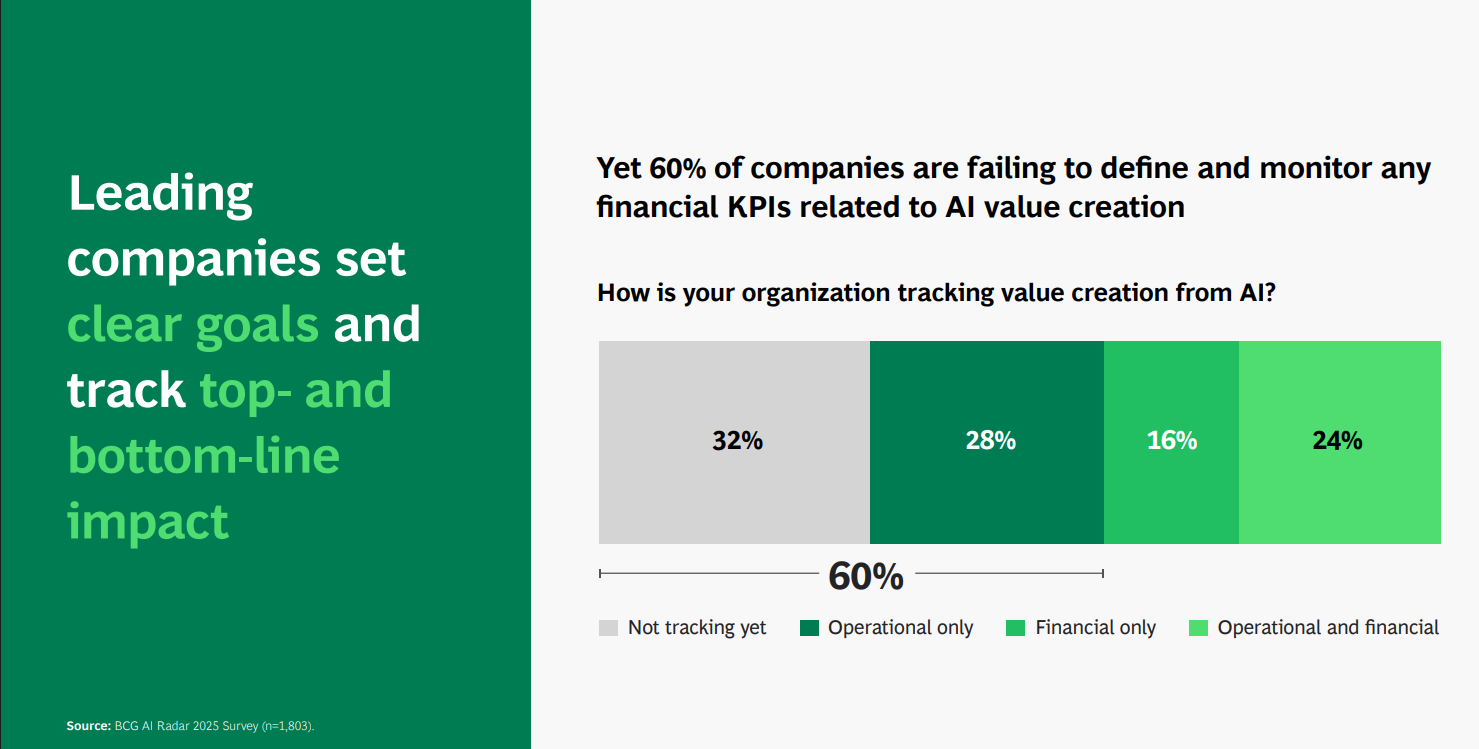
This lack of visibility is already happening at scale. According to the “From Potential to Profit: Closing the AI Gap” 2024 Report by BCG, 60% of companies are failing to define and monitor any financial KPIs related to AI value creation.
It means a majority of organizations are deploying digital workers (or AI Agents) without a clear understanding of the business outcomes they are generating.
Performance management for digital labor requires:
- Outcome-Based KPIs: Establishing metrics before deployment that are tied to business impact rather than simple activity volume.
- Visible Performance Dashboards: Creating reports that make digital worker outputs visible to the humans who are ultimately accountable for pipeline results.
- Structured Review Cycles: Implementing regular checkpoints for optimization, moving away from reactive troubleshooting that only occurs when something breaks.
- Defined Quality Standards: Documenting exactly what acceptable performance looks like and identifying the specific triggers for a refinement conversation.
The objective of this framework is to enforce continuous improvement through structured feedback and clear accountability. When digital workers are managed with professional discipline, they cease to be a technology experiment running in the background.
It ensures that every digital worker has the "motivations" and "responsibilities" required for success. By treating digital labor as a genuine component of the workforce strategy, organizations can scale their capacity while maintaining the high standards of quality and candidate experience that define an employer brand.
5. Coaching and Continuous Optimization
Deployment of digital workers is not the end of the design process, rather the beginning of the optimization cycle.
While coaching a digital worker looks different from coaching a human one, the underlying principle is identical. It requires a commitment to reviewing real world outputs, identifying gaps between expected and actual performance, making targeted adjustments, and measuring whether those adjustments produced a defensible improvement.
Embedding optimization into the operating rhythm of the recruiting team is what separates a technical pilot from a successful workforce initiative. In practice, this disciplined approach involves:
- Reviewing Screening Outputs: Assessing whether current scoring criteria are producing the required candidate quality as market conditions shift.
- Refining Role Definitions: Updating the digital worker’s responsibilities as the hiring needs of the business evolve.
- Updating Guardrails: Adjusting the structural boundaries of the agent when edge cases expose gaps in the original design.
- Tuning Decision Frameworks: Refining the underlying logic and decision rights based on observed patterns in agent behavior.
- Identifying Friction Points: Pinpointing where the agent may be inadvertently creating bottlenecks rather than removing them.
Asymbl’s Digital Workforce Activation approach is built around this continuous optimization model. The sequence of design, onboarding, and coaching is an ongoing operating discipline.
The organizations that achieve durable ROI from digital workers are the ones that manage them with the same intentionality they bring to managing their human employees.
Businesses that treat optimization as a post-launch maintenance task will consistently see their results stagnate, while the ones that embed these feedback loops into their core operating rhythm will see compounding improvement over time.
Conclusion
The teams seeing significant returns with digital workers are not necessarily using more sophisticated technology. Instead, they are making more deliberate design decisions.
- They define digital worker roles with precision before deployment begins.
- They establish a clear division of labor between human and digital teammates.
- They build governance frameworks that specify decision rights and guardrails
- They measure performance against business outcomes rather than simple activity volume.
This approach creates a hybrid recruiting team where digital workers handle structured execution with consistency and scale, while allowing human recruiters to deploy their judgment, relationship intelligence, and strategic influence where those qualities actually change outcomes.
Recruiting has always been a discipline that rewards intentionality, and that has not changed. What has changed is the scale at which intentional design can now be executed.
By moving toward a coordinated system, businesses ensure that their human talent is elevated, their digital labor is disciplined, and their hiring process is future ready.
Asymbl Agentforce Suite gives recruiting teams pre-built agent templates, defined roles, and recruiting-specific workflows designed to deploy digital workers the right way from day one. Book a demo to see Agentforce Suite in action.
.webp)
Reskilling for Relevance: The New Core Skills of the Orchestrated Workforce
When digital workers join your org chart, who's accountable? Discover the new core skills employees and leaders need inside coherent, hybrid workforces that amplify human growth.

The Right Fit Starts With a Conversation.
See what working together could look like.
.webp)