


Recruiters in staffing firms lose a third of their week to administrative work that their software should handle. The remaining time goes toward relationships, pipeline activity, and placements, but even that time is fractured by disconnected systems.
Client relationships sit in one tool, candidate pipelines in another, job orders somewhere in between.
No one holds a complete picture, while signals get missed, decisions happen on incomplete data, and when a top recruiter leaves, the relationships they built walk out with them because nothing was captured at the firm level.
The Applicant Tracking System at the center of most staffing operations wasn't designed to solve any of this because it was built for corporate HR teams managing internal requisitions, and staffing firms adopted it because nothing purpose-built existed at scale.
The misalignment often shows up as a cost structure that is hard to reduce and a revenue ceiling that is hard to raise. Most staffing leaders treat it as a workload problem, but it is an infrastructure constraint.
Why Staffing Firms Adapted Corporate ATS Systems
The traditional applicant tracking system wasn't built with staffing firms in mind. Corporate HR teams were the target market, the design constraint, and the primary customer.
ATS platforms emerged to solve a specific set of problems for corporate teams, like compliance documentation, structured applicant tracking, and workflow management for organizations hiring into defined internal roles.
Staffing firms were not the intended use case. However, they adopted these systems anyway, and four conditions explain why that adoption became permanent infrastructure rather than a temporary workaround.
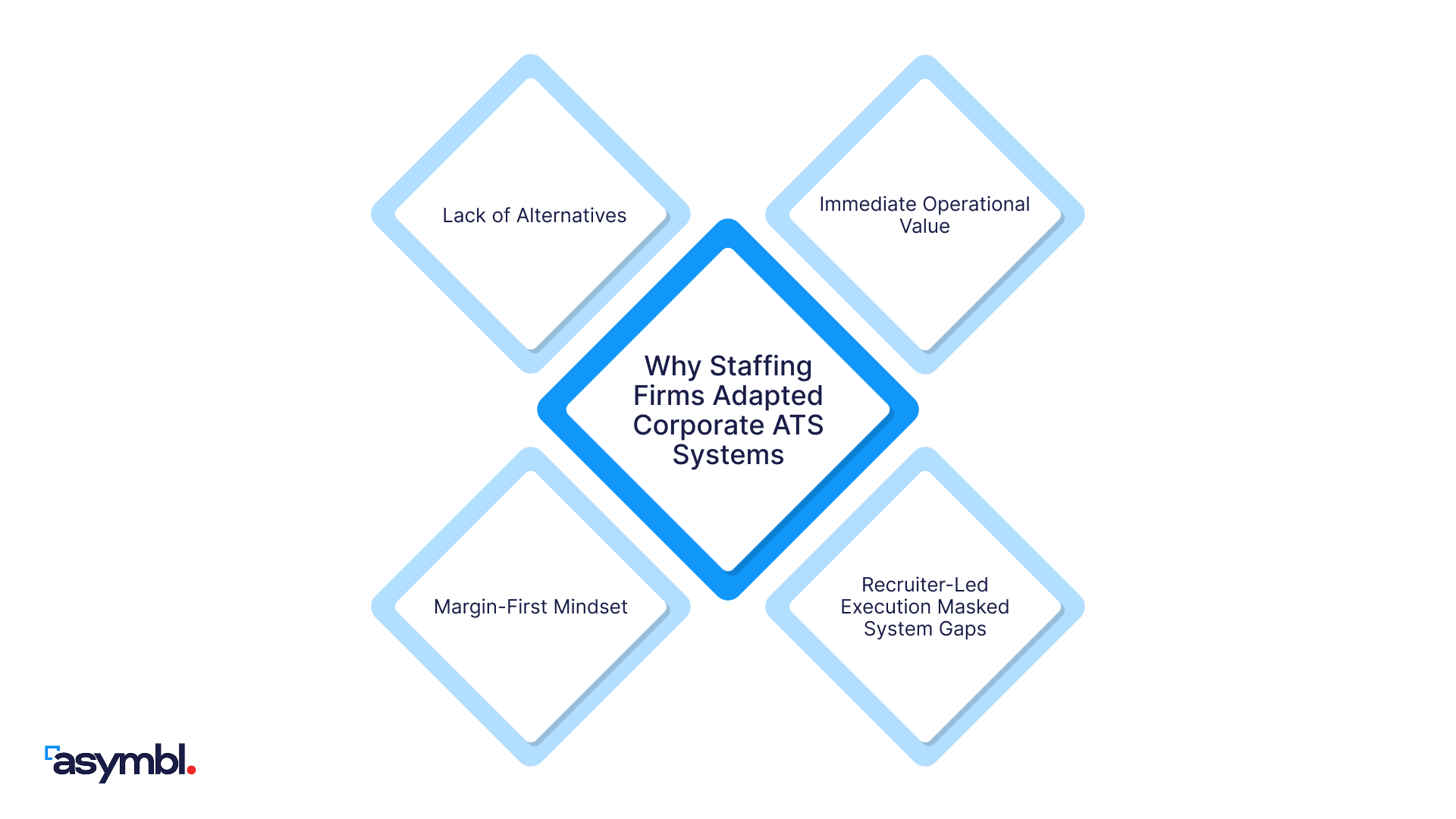
1. Lack Of Alternatives
When staffing firms reached the point where spreadsheets and shared drives could no longer carry the volume, they evaluated what existed. Purpose-built systems for staffing operations did not exist at scale. The choice was corporate ATS or no structured system at the same volume.
Most firms chose the ATS and built around its limitations because a system with friction was still more manageable than no system at all.
For a long stretch of the industry's growth, corporate ATS was the only option with the depth, vendor support, and market presence to make adoption practical. Default infrastructure becomes permanent infrastructure when nothing else is available long enough.
2. Immediate Operational Value
Before ATS adoption, many staffing firms ran on spreadsheets, email chains, and individual recruiter knowledge that walked out the door when people left. An Applicant Tracking System brought structure to processes that had none.
With ATS, candidates were tracked, requisitions were logged, and pipelines had a visible shape.
The structure it brought to the processes justified the investment at the time. The system was solving a problem the firm actually had.
The fact that it was solving a smaller version of the problem, and creating a structural mismatch in the process, wasn't visible until the firm had grown past the point where the workarounds were still manageable.
3. Margin-First Mindset
Staffing is a margin business. Placements drive revenue, speed drives placements, and recruiters drive speed. A dollar invested in a better recruiter had a measurable return, while a dollar invested in better infrastructure did not.
The math kept system investment low and recruiter investment high across most of the industry's growth.
An industry built on relationship intensity and recruiter execution had limited evidence that better systems would outperform better recruiters. The cost of that tradeoff only became visible when the ceiling on recruiter-driven growth became the ceiling on firm growth entirely.
4. Recruiter-Led Execution Masked System Gaps
High-performing recruiters are remarkably effective at operating around misaligned systems.
A recruiter who knows their pipeline, maintains mental maps of candidate availability, and manages client relationships through personal contact can generate strong results even when the underlying architecture was built for a different business model.
When numbers were good, the system wasn't the variable under scrutiny. The friction was absorbed by individual effort and individual memory, and the structural problems stayed invisible at the aggregate level.
ATS adoption was not a strategic decision about what infrastructure staffing firms needed. It was a practical workaround to a lack of alternatives that was never revisited as an architectural question. It became permanent because the workarounds kept working, until they stopped.
The Hidden Cost: What Staffing Firms Sacrificed By Using Corporate ATS
Most staffing firms could point to the numbers, such as roles filled, clients retained, and revenue growth, and call the decision justified
The cost of the wrong infrastructure accumulates in what recruiters had to do manually to keep those numbers moving, in the redeployment opportunities the system couldn't surface, and in the headcount additions that became the standard answer every time the firm needed more capacity.
The Fundamental Difference: Corporate Recruiting Vs Staffing Firms
The operational model of a corporate recruiting team and a staffing firm share surface-level vocabulary but almost nothing else.
A corporate recruiting team's goal is to fill internal roles. The process is linear and requisition-based, a role opens, a candidate pool assembles, interviews happen in sequence, and an offer is extended.
The success metric is time-to-fill, and the system needs to support workflow control for that process, nothing more.
A staffing firm's goal is to fulfil external demand at scale, continuously, across a portfolio of clients with different requirements, timelines, and compliance expectations.
The process isn't linear and runs in parallel across dozens or hundreds of active job orders simultaneously.
Success is measured in placements, revenue, and margin per recruiter. The system needs to support pipeline orchestration and relationship continuity across both sides of the transaction, including client demand and candidate supply.
| Aspect | Corporate Recruiting | Staffing Firm |
|---|---|---|
| Goal | Fill internal roles | Fulfill external demand at scale |
| Process | Linear, requisition-based | Continuous, multi-role, multi-client |
| Success metric | Time-to-fill | Placements, revenue, margin |
| System need | Workflow control | Pipeline orchestration, relationship continuity |
The Corporate Applicant Tracking System assumes hiring starts with a requisition. Staffing firms operate where talent pipelines exist before roles open, and candidates move across clients and roles on a continuous basis.
What Happens If You Don't Change
The consequences of maintaining the wrong infrastructure compound in stages:
- Recruiter overload increases as volume grows because the system doesn't coordinate the way it should.
- Manual work persists at every handoff:
- Between ATS and CRM
- Between submission and client feedback
- Between placement and redeployment.
Pipeline visibility stays fragmented because the system wasn't designed to surface it, and these consequences feel like management/execution problems. However, they are infrastructure problems presenting as execution problems.
In the medium term, the firm hits a growth constraint. The only lever available to add capacity is headcount. Margins compress as recruiter costs grow faster than revenue.
According to the McKinsey “The State of AI in 2025: Agents, Innovation, and Transformation” Survey, nearly 90% of companies have invested in AI capabilities, but fewer than 40% report measurable performance gains.
For staffing firms, this gap almost always traces to AI layered onto systems that weren't built to support it, generating review tasks instead of reducing them.
In the long term, the exposure becomes competitive. Clients increasingly work with firms that provide real-time delivery visibility, forecast fill timelines, and demonstrate capacity that doesn't depend on headcount additions.
Firms running fragmented infrastructure can't compete on those dimensions. The accounts with the highest standards, and typically the highest margins, migrate to firms that can meet them.
Why Staffing Firms No Longer Have To Rely On Corporate ATS Systems
For most of the staffing industry's history, the infrastructure gap wasn't a choice. Purpose-built systems didn't exist at scale, so firms adapted corporate tools and worked around the mismatch.
That condition has changed. Four developments have converged to make this the first moment where staffing firms can build infrastructure around their actual operating model.
1. Technology Evolution Made Purpose-Built Systems Viable
Building a system capable of managing multi-client pipelines, continuous candidate-to-role matching, and real-time delivery visibility requires a data model complex enough to hold those relationships and an enterprise infrastructure reliable enough to run them at scale.
Until cloud platforms matured to that level, the cost and complexity of building purpose-built staffing systems on top of them made it economically unviable for most vendors.
CRM-native recruiting platforms built on enterprise foundations now carry the full operational complexity of a staffing firm without requiring custom development to fill what corporate ATS cannot. The infrastructure that was aspirational five years ago is in production today.
2. AI Only Performs On The Right Foundation
According to the 2026 Recruiting Trends Report by Gartner, AI revolution and cost pressure are the two primary forces reshaping talent acquisition in 2026.
For staffing firms, both forces point to the infrastructure that can carry AI-executed work at volume without producing outputs that require more human correction than the AI saved.
AI needs to act on signals, and signals require connected, current, structured data. A fragmented system produces fragmented data, and AI operating on that environment produces outputs that reflect the gaps, like:
- Sourcing recommendations without context.
- Matches that miss prior placement history.
- Screening outputs that require review instead of reducing them.
You cannot separate the performance of an AI capability from the quality of the data environment it operates in. Staffing firms that treat AI as a feature layer and the ATS as a legacy concern have the relationship inverted.
3. The Shift From Tools To Systems Of Work
The question staffing leaders are asking now is different from the one they asked five years ago.
- Before: Can this tool make my recruiters more efficient?
- Now: What is this system determining about what my operation can produce?
These are different questions because they locate the constraint in different places. A tool amplifies what a recruiter can do within the system they are already running.
A system of work sets the ceiling on what the operation can deliver, regardless of individual recruiter performance. When recruiter skill was the binding constraint, tools were the right investment.
When system capacity became the binding constraint, when adding more recruiters stopped solving the growth problem, the investment had to move to the infrastructure setting that ceiling.
Most staffing firms hit that inflection point and responded by adding headcount. The firms that recognized it as an infrastructure question are the ones now scaling output without proportional cost growth.
4. The Market Has Reached Recognition
Earlier technology cycles in staffing produced capability questions like can this system do what we need? The question defining the current cycle is different and asks what this system determines about our revenue ceiling?
According to the 2026 Gartner HR Research, only 31% of recruiting teams use labor market data to inform their talent strategy.
The gap between that number and full adoption is the gap between firms making infrastructure decisions on evidence and firms making them on instinct. The firms closing that gap are doing it through systems that make data usable, not through better analysis of data scattered across disconnected tools.
For the first time, staffing firms can build infrastructure designed for the business model they actually run. The tools exist, and the platforms have depth. The AI can execute at the required fidelity. All three conditions are true simultaneously, and that is what makes this cycle different from the ones before it.
ATS For Staffing Firms: What It Should Actually Do
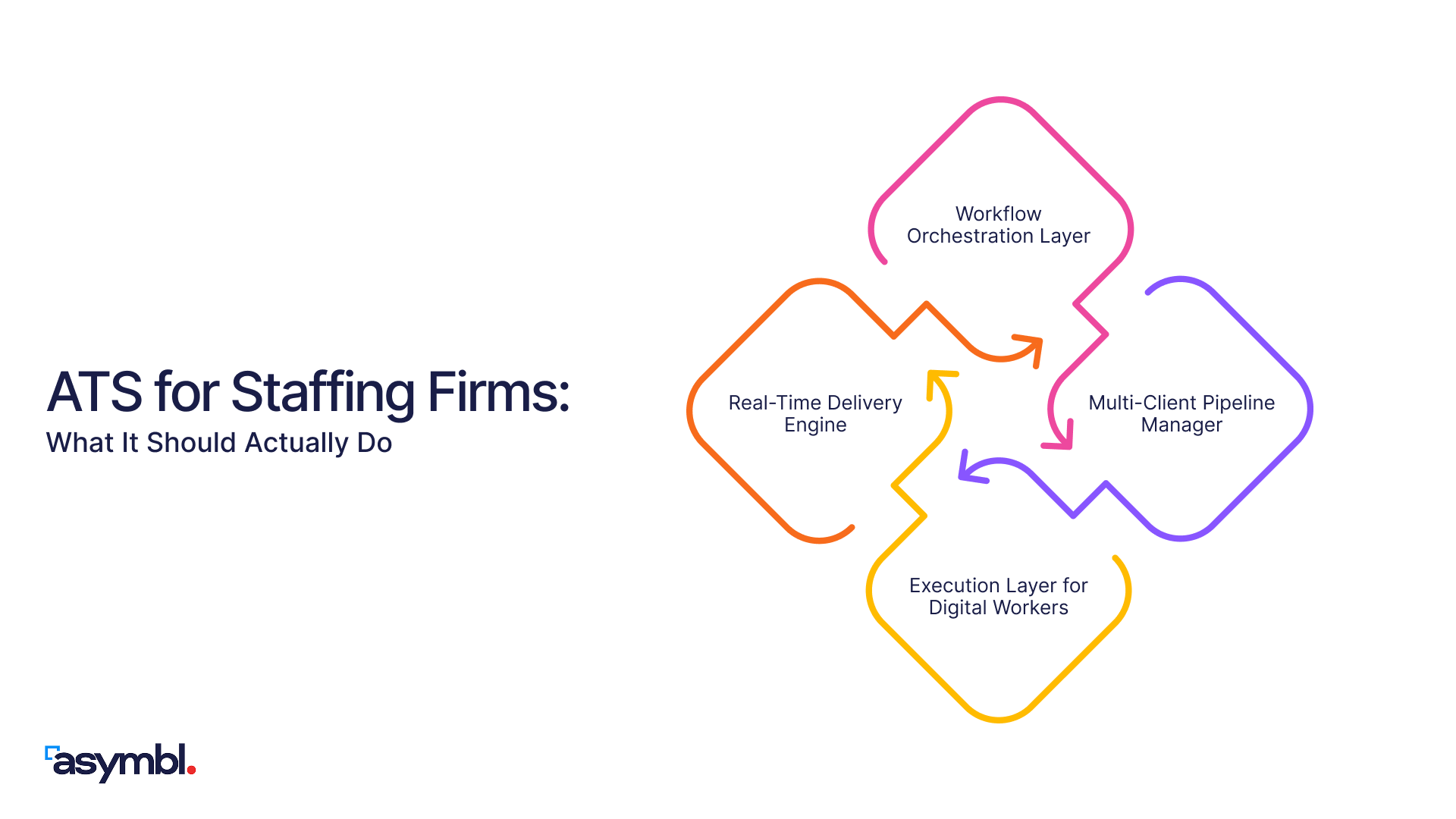
The right ATS systems for staffing firms in 2026 should be categorically different, across four dimensions:
1. Workflow Orchestration Layer
Workflow orchestration means the system coordinates activity across the entire delivery chain, not just the candidate pipeline. That includes candidates moving through sourcing, screening, and submission.
It includes client accounts receiving submissions, providing feedback, and confirming placements. It also includes recruiter workload distribution across an active job order portfolio that spans multiple clients simultaneously.
When those three threads are coordinated within a single system rather than managed across separate tools, the friction that consumes recruiter time disappears by design. Status updates stop requiring manual checks. Submissions stop requiring duplicate entry. Client feedback loops directly into pipeline movement.
The system becomes the coordination mechanism, and recruiters redirect that recovered time toward work that requires human judgment, like relationships, negotiation, and assessment.
2. Multi-Client Pipeline Manager
A staffing firm's candidate relationships don't end at a single placement. A qualified candidate might be relevant to three different clients across a six-month window.
The system needs to track that candidate across roles, clients, and time, maintaining continuity of the record so that the next recruiter picking up the relationship has full context without reconstruction.
Multi-client pipeline management also means the system holds the client-side demand picture alongside the candidate-side supply picture, so that matching happens within the system rather than in a recruiter's memory.
When a new job order opens, the platform surfaces candidates from the existing pool before external sourcing is required. It reduces time-to-fill and improves margin on every role filled from an existing relationship.
The data continuity matters as much as the architecture. A system that duplicates records, loses availability status after placements close, or breaks the candidate record when it moves across job orders is not a multi-client pipeline manager. It is a series of disconnected applicant logs.
3. Real-Time Delivery Engine
Real-time delivery visibility means pipeline status, submission progress, interview scheduling, and expected fill timelines are accessible without a manual status request from anyone in the chain.
Recruiters see where gaps are before they become delivery failures. Account managers see submission activity without interrupting recruiters. Clients can be given delivery forecasts instead of vague timelines.
According to the 2025 Deloitte Talent Acquisition Technology Trends, organizations that integrate AI into recruiting workflows see up to a 54% increase in recruiter capacity.
Recruiter capacity gain depends entirely on the condition that the system must surface the right information at the right stage without requiring a recruiter to assemble it manually. Real-time visibility is the condition that makes everything downstream perform.
When delivery visibility is real, decisions get made earlier. Problems surface when they're still recoverable. The relationship with the client strengthens because the firm can demonstrate progress, not just report outcomes after the fact.
4. Execution Layer For Digital Workers
The execution layer for digital workers is the capability that separates a modern staffing system from every previous generation of ATS. It means the platform supports not just human recruiters executing workflows but AI digital workers executing structured, repeatable tasks within those same workflows, with defined roles, shared data, and clear handoff points.
Digital workers perform most effectively when the underlying system is built to include them. Defined roles require structured data, and structured data requires a data model designed to produce it.
When AI is layered onto fragmented infrastructure not designed for it, the outputs require significant human correction, which negates the capacity gain and creates a new category of administrative overhead.
When the execution layer is built correctly, digital workers handle sourcing, initial screening, candidate outreach, and scheduling at volume. Human recruiters focus on assessment, client relationships, and closing. The division of labor is productive because the system was designed to make it so.
How To Evaluate ATS Software Built For Staffing Agencies
Evaluating ATS platforms for staffing agencies requires a different lens than standard software procurement.
Most evaluation frameworks default to feature comparisons. The more productive frame is to check whether the system's architecture was designed for the staffing operating model or adapted from a different one. These five dimensions reveal the difference.
1. Dual-Sided Pipeline Visibility (Client + Candidate)
The most fundamental question is whether the system maintains visibility on both sides of the staffing relationship simultaneously.
Candidate pipeline visibility without client demand visibility produces a system that can track applicants but can't connect them to the business need they're filling. Client demand visibility without candidate pipeline visibility produces a CRM without the execution layer.
A system built for staffing holds both in real time within the same environment. Ask specifically:
- Can the team communicate expected fill timelines and fill probability to clients directly from within the system?
- Can clients receive delivery visibility without a separate reporting process?
If the answer to either is no, the platform is managing one side of a two-sided business, and the gap between those two sides is where operational friction accumulates.
2. Pipeline Intelligence And Forecasting
Reporting tells you what happened, but forecasting tells you what is likely to happen and where the gaps are before they become delivery failures.
According to the 2026 Gartner HR Research, only 31% of recruiting teams use labor market data to inform their talent strategy. The majority are operating on internal reporting and historical data alone.
For staffing firms managing delivery across multiple clients simultaneously, that gap between available data and actual use is where fill rates slip, and clients go unserved
The evaluation question here is whether the system moves beyond historical reporting to predictive insight.
- Can it surface a role with weak pipeline depth before the fill window closes?
- Can it measure fill probability per job order based on current sourcing activity?
- Can it flag sourcing gaps early enough for the team to respond rather than recover?
A system that only reports is a lagging indicator, while a system that forecasts is an operational tool. For the accounts where delivery timelines are under the most pressure, that distinction determines whether the firm meets the SLA or misses it.
3. Capacity Without Headcount Growth
When the only way to handle more volume is to hire more recruiters, the platform is limiting capacity.
The evaluation question is whether the platform increases what a recruiter can carry without increasing their manual coordination burden.
This means automation for structured, repeatable tasks and digital worker support for high-volume execution. A recruiter managing 15 active job orders with the right system support should outperform a recruiter managing 10 without it.
Ask whether digital workers are supported within the platform's native workflows, or whether AI capabilities require a separate tool or manual integration. The former creates genuine leverage, while the latter adds another fragmentation point and synchronization problem.
4. Revenue And Margin Impact
A platform that increases placements per recruiter improves revenue without a proportional cost increase. A platform that reduces dependency on headcount growth to scale protects margin as the business expands.
Evaluate vendors on this dimension directly:
- Can they show data on placements per recruiter before and after implementation?
- Can they demonstrate margin improvement or cost reduction in comparable firms?
The metrics that govern staffing economics, placements per recruiter, revenue per recruiter, and margin per recruiter should be the metrics the vendor uses to describe their own impact.
According to the 2025 Deloitte Survey on AI ROI, only 6% of executives globally see AI ROI within a year, and only 13% within 12 months. The firms that do are operating on purpose-built systems where AI functions within the workflow rather than around it.
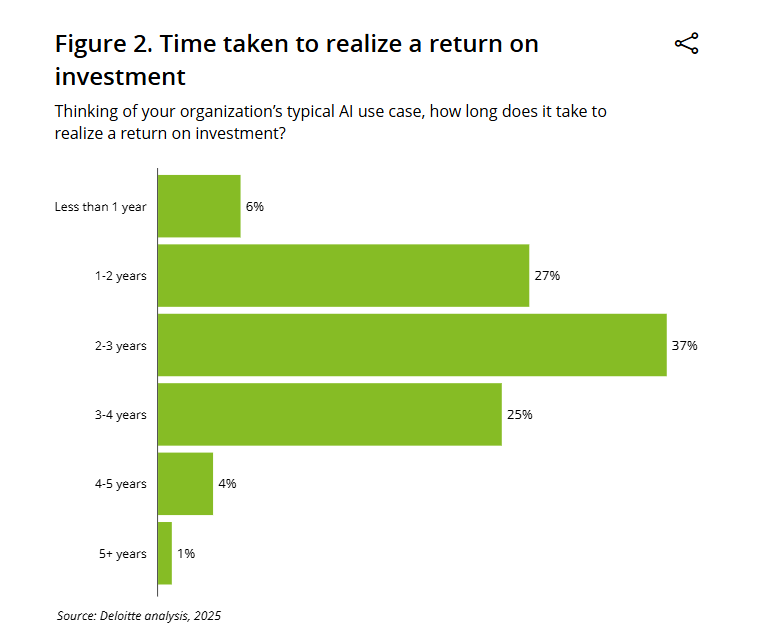
This gap is the margin of difference between technology that compounds output and technology that generates a new category of administrative overhead in the name of automation.
5. Architecture Fit For Staffing Firms
The architecture question is the one most commonly skipped in vendor evaluations and most consequential to long-term performance.
A system adapted from corporate hiring infrastructure carries the assumptions of that model in its data structure, workflow logic, and reporting framework. Configuring it for staffing requires constant workarounds that accumulate as operational debt over every quarter the system is in use.
Ask directly:
- Was this system designed for multi-client workflows and high-volume recruiting from the start, or was staffing functionality added to a corporate foundation? The answer reveals itself in the data model.
- Can the system represent a candidate across multiple active job orders with multiple clients simultaneously?
- Can compliance requirements be configured differently by clients without custom development?
- Does the pipeline architecture reflect continuous, parallel matching or linear, requisition-based hiring?
The answers to those questions tell you everything the feature list doesn't.
Where Asymbl Fits: Designed For Staffing Firms From The Ground Up
The evaluation criteria above describe a natively built architecture for staffing operations, unified across ATS and CRM, capable of supporting digital workers within the workflow, and designed around the economics of a revenue-generating delivery business.
Asymbl was built to that specification, on Salesforce, with staffing firm economics as the design constraint from the start.
1. Unified System
Asymbl Recruiter Suite unifies CRM and ATS functionality within a single Salesforce environment. Client account records, job orders, candidate pipelines, submission history, compliance documentation, and delivery activity all exist in the same data model.
There is no synchronization problem between CRM and ATS because there is no separation between them.
The unified architecture eliminates the primary source of operational friction in staffing firms that have grown beyond their original setup: the gap between where client relationships are managed and where candidate work gets done.
Recruiters and account managers work from the same data, updated in real time, without manual reconciliation across systems. Submissions are tied to client accounts, feedback is visible to recruiters, and pipeline status is current for everyone in the workflow.
2. Designed For Staffing Economics
The platform was built around the metrics that define staffing firm performance:
- Placements per recruiter
- Revenue per recruiter
- Delivery speed, and
- Fill rate across an active client portfolio.
Reporting surfaces those dimensions natively. The system doesn't need to be configured to speak the language of staffing economics because staffing economics were the design brief.
Asymbl Talent Intelligence extends this with active talent pool management.
Candidate profiles are enriched over time, availability is tracked as workers complete placements, and redeployment workflows surface existing candidates for new job orders before external sourcing is required.
The economics of redeployment, faster fills, lower sourcing cost, and stronger candidate relationships are built into how the system operates, not layered on top of a framework that wasn't designed for it.
3. Digital Workers As Part Of The System
Asymbl's Digital Recruiter, known as Rosa, is not an AI feature added to the platform. Rosa is a digital worker with a defined role, structured responsibilities, and measurable output that operates within the same workflows as human recruiters.
Rosa handles high-volume application screening, candidate outreach, interview scheduling, and pipeline management at a scale that human recruiters cannot sustain alone. The output is documented.
In one deployment, two recruiters working alongside one digital worker produced 93 hires in 94 days. That result is achievable because the digital worker operates within a system built to support that model of work, such as
- Clean staffing-specific data
- Defined handoff points to human judgment, and
- Workflow architecture designed with AI participation as a first-order requirement.
The distinction from AI layered onto legacy infrastructure is architectural. Digital workers perform when the system was designed to include them. They generate administrative overhead when they are added to a system that was never built to carry them.
Conclusion
Staffing firms have spent years running a revenue-generating, multi-client delivery business on infrastructure designed for internal hiring administration. The cost of that mismatch has resulted in recruiter overload, growth that required headcount instead of system leverage, and AI investments that promised capacity and delivered complexity.
Purpose-built systems exist at the production scale. Digital workers can carry out structured execution work. CRM and ATS can operate as one. Pipeline visibility can be real-time on both sides of the business.
Staffing firms no longer have to choose between maintaining margins and improving systems. Those are not competing priorities when the system was designed for the right business model.
The question that surfaces the right answer is not "What is the best ATS?" It is: Is the system you are running designed for the business you are actually operating?
If the honest answer is no, the cost of staying is now higher than the cost of changing.
Asymbl was built for the operational model this evaluation describes. If the fit question surfaces a gap between your current system and what staffing operations actually require, see how Recruiter Suite, Talent Intelligence, and Digital Recruiter work together on a platform designed for staffing economics.
Book a demo with the Asymbl team to see how it maps against your actual workflow.
FAQs
Yes, but the right system is not an ATS in the narrow sense, a tool for tracking applicants through a defined workflow. It is a unified operating platform that combines applicant management, CRM, pipeline intelligence, and digital worker support within a single architecture designed for staffing economics. Staffing firms need a system of work, not a standalone tracking tool. The distinction is whether the platform was built for the operational model of a revenue-driven, multi-client delivery business or borrowed from someone else's.
ATS infrastructure directly influences the revenue metrics that define staffing performance. Placements per recruiter, time-to-fill, and delivery capacity across an active job order portfolio all depend on how well the system supports workflow execution and pipeline visibility. A system built for staffing increases those metrics by eliminating manual coordination overhead and enabling each recruiter to carry more volume. A system adapted from corporate hiring introduces friction at every stage, compressing output and requiring more headcount to maintain the same level of delivery growth.
Staffing firms should look for systems that provide dual-sided pipeline visibility across both client demand and candidate supply, support multi-client workflows natively rather than through configuration, measure placements and revenue per recruiter rather than corporate HR metrics, and include an execution layer where digital workers participate in structured recruiting tasks alongside human recruiters. Architecture is the most important evaluation criterion. The question is whether the system was designed for staffing operations or adapted from a corporate hiring foundation with limitations built into the structure.
Most ATS platforms were designed for corporate recruiting workflows: one employer, one candidate pool, requisition-based hiring with a defined endpoint. Staffing firms operate a fundamentally different model. They manage simultaneous job orders across multiple clients, measure success in placements and margin rather than time-to-fill, and require pipeline orchestration rather than workflow control. A corporate ATS adapted for staffing creates structural workarounds that accumulate as operational friction and eventually become a ceiling on growth without proportional headcount increases.
An applicant tracking system for staffing agencies manages candidate workflows and job orders across multiple clients, roles, and hiring processes simultaneously. Unlike a corporate ATS built around a single employer and a linear process, a staffing-specific system must support continuous multi-client matching, candidate redeployment across roles, compliance configuration by client and jurisdiction, and pipeline visibility across both the demand and supply sides of the business.
.webp)
AI-Driven Recruitment: 10 Rules for Smarter Hiring
Chris Davis shares 10 rules for hiring teams ready to work smarter with AI, without overhauling everything at once.

The Right Fit Starts With a Conversation.
See what working together could look like.
.webp)