

Context Graphs: The Missing Layer Between Data and Autonomous Work

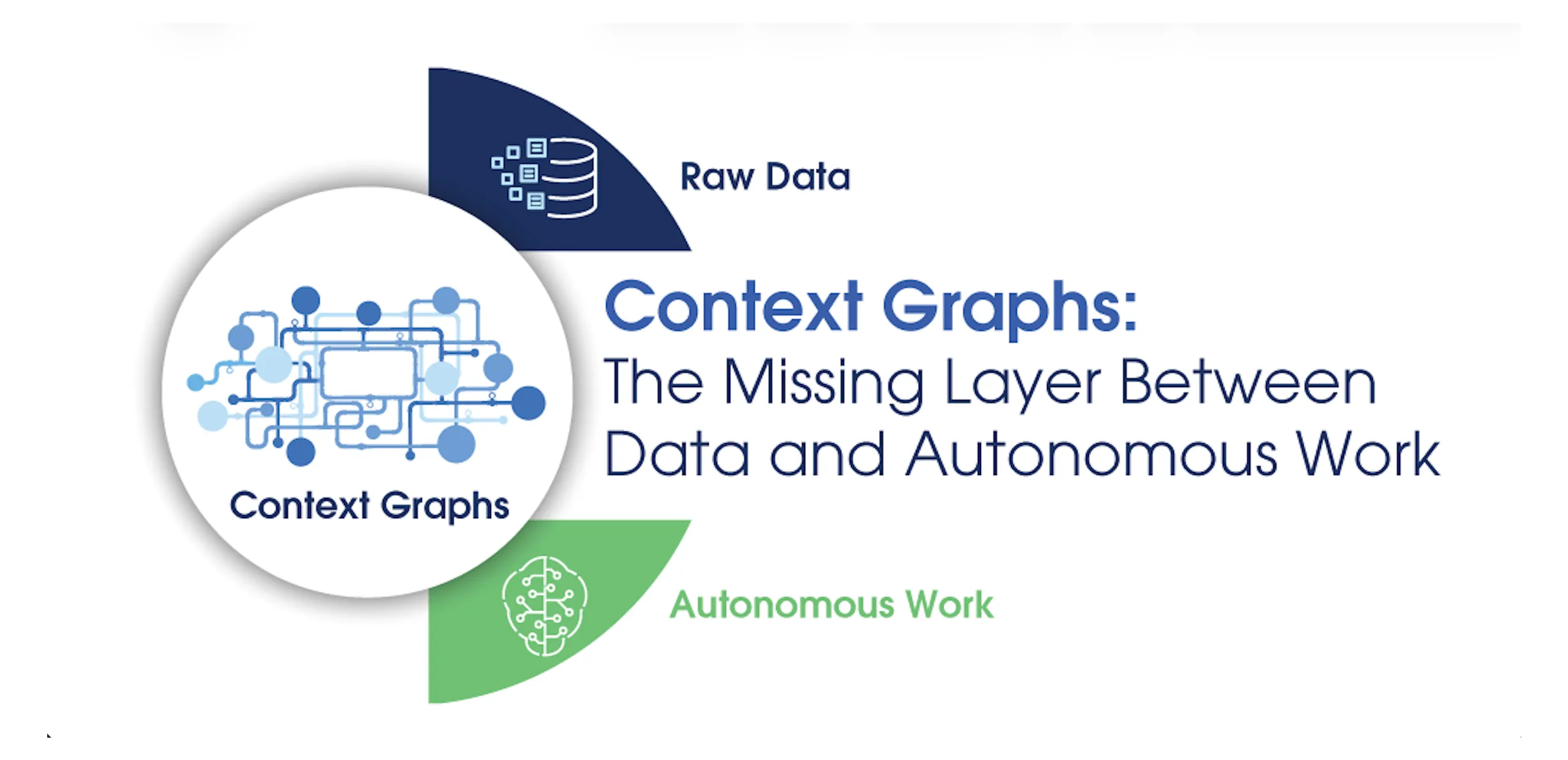
There's a concept gaining momentum in AI circles that I believe has profound implications for how we think about workforce orchestration: context graphs.
Context graphs capture the why behind work, and the signals that shape it. They’re generated through human decisions to preserve rationale, context, and exceptions that explain how outcomes are reached. They also include how digital workers are making decisions, creating data, or reasoning. In a hybrid workforce of human and digital workers, understanding the value of context graphs is essential for anyone serious about enterprise AI in 2026.
The Problem No One Talks About: Preserving Decision Lineage
Here’s a scenario that plays out in every enterprise: A digital worker needs to assemble a customer health score for a quarterly business review. Simple enough, right?
Except which inputs matter? Customer success has engagement metrics. Support has ticket volume and resolution times. Finance tracks payment history and expansion revenue. Product has usage data that tells a different story entirely.
Ask four departments, get four answers. Each is correct within its own context. None is universally canonical.
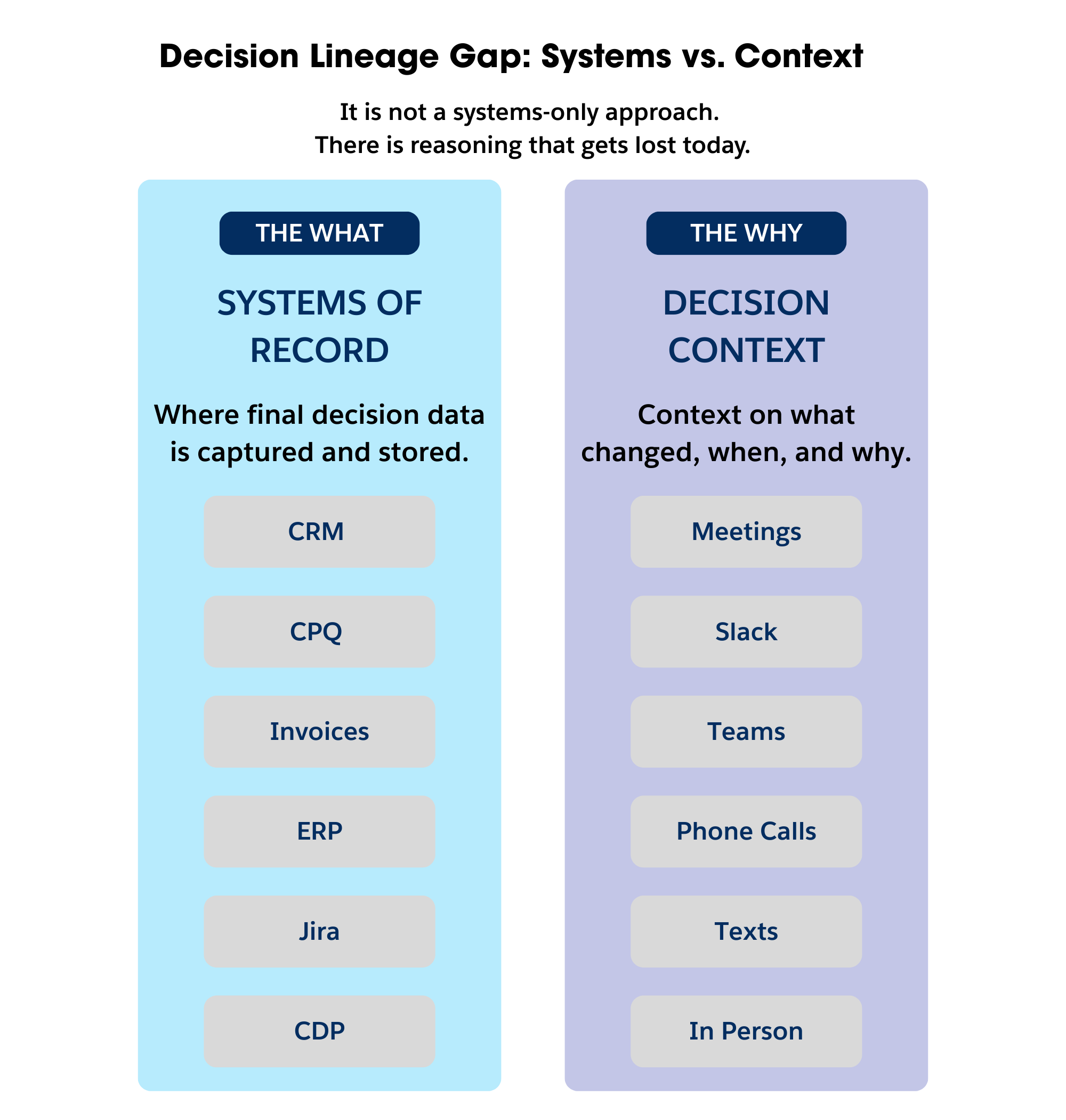
The deeper problem isn’t data access. Modern data architectures have largely solved that. The problem is that systems of record are excellent at storing state, but terrible at preserving decision lineage. So your digital worker can see what happened, but not why it happened.
Your CRM knows a renewal closed at a significant discount, but it has no idea why that discount was approved. Was it churn risk? Product gaps? A strategic bet? That reasoning lives in a Slack thread, a hallway conversation, or someone’s memory. It lives everywhere except where AI agents and digital workers can query it. And without that context, a customer health score is just a guess with a few numbers attached.
This is what context actually means: organizational memory of a business’s decisions, decision footprints, metrics that capture the reasoning, and the outcomes behind them.
The What vs. Why Gap On Measurement
A crucial distinction in agentic systems is the difference between rules and decision traces. Rules tell AI what should happen in general. They’re the policies, guardrails, and logic you can codify. Decision traces capture what actually happened in a specific case, and critically, why it was allowed to happen. The gap between the two is where enterprises actually operate.
Now, let’s consider the tribal knowledge that lives in every organization:
- "We always extend payment terms for manufacturing clients because their cash cycles are longer. " That's not in any CRM. It's passed down through onboarding and side conversations.
- "We gave a similar concession to a company in this situation last quarter, so we should be consistent.” That precedent lives in memory, not in a queryable database.
- "I caught my director between meetings, asked if we could waive the implementation fee, she nodded and kept walking." The record shows the final contract value. It doesn't show who approved the deviation, or why.
This tribal knowledge actually runs enterprises. It’s one part of the organizational memory layer that’s often missing or unrecorded. When that tribal knowledge influences a real decision, it leaves a decision trace. It’s the decision traces, exceptions, overrides, precedents, and cross-system context that live in conversations, escalation calls, and people’s heads. These are the decision footprints that define how work actually gets done, not how policy says it should.
So the question becomes simple: where do these decision footprints live when your best people aren’t in the room? They need to live in a system where digital workers can query.
What a Context Graph Actually Is
A context graph is, in essence, the connective tissue between your static data and your dynamic decisions. It’s the accumulated sum of decision traces: who approved what, which precedents governed the outcome, how conflicts were resolved, and where exceptions were granted. They don’t replace systems of record or redefine canonical truth.
Decision traces don’t carry system authority. They guide judgment rather than enforce state. The context graph informs agents and humans about how decisions have been made in the past and why, while systems of record like Salesforce remain the source of truth for final state, constraints, and enforcement.
To see this in action, let’s look at how a context graph handles a routine but nuanced business event: an upsell.
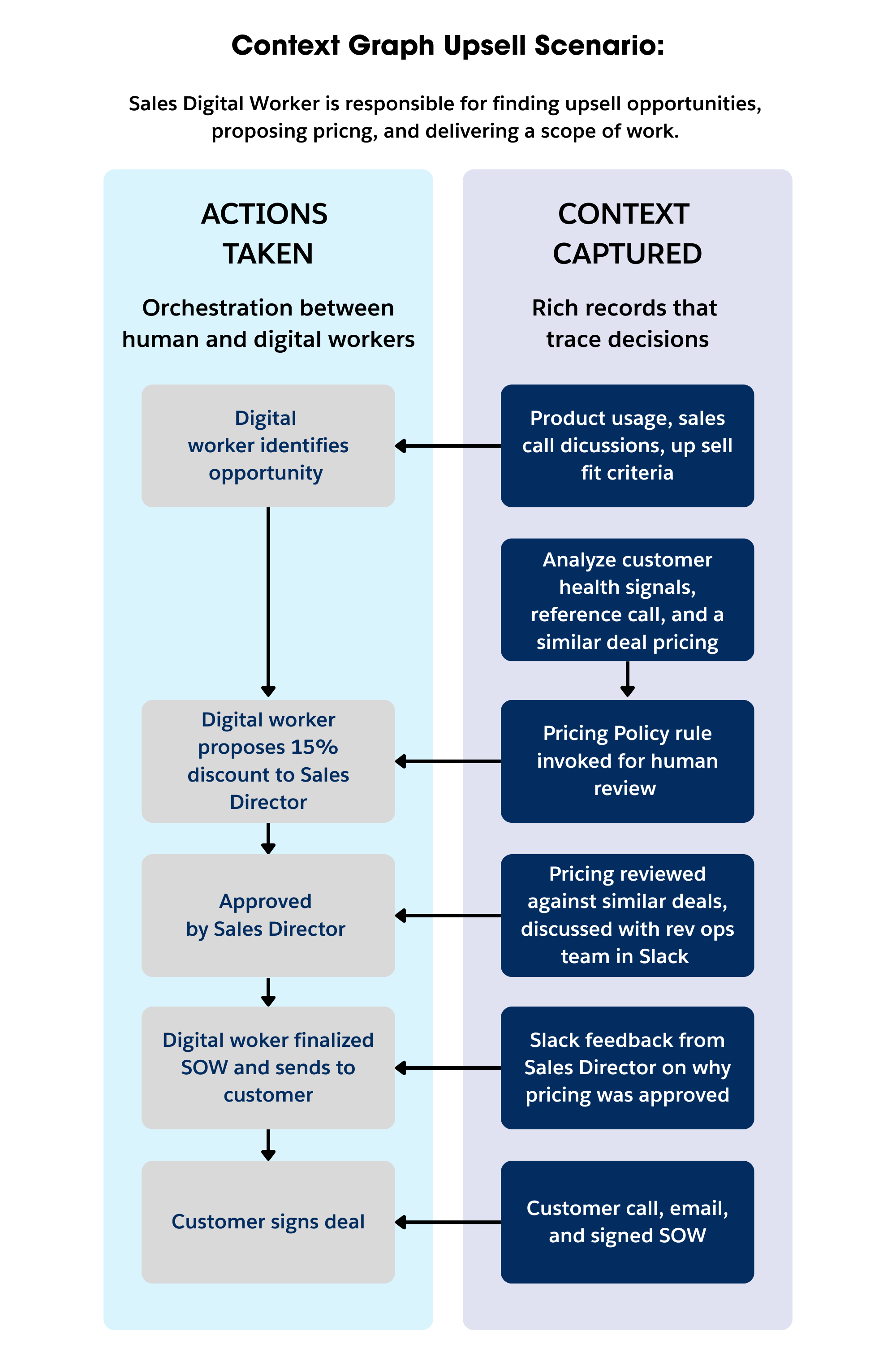
- A digital worker identifies an expansion opportunity and proposes a bundled pricing offer
- Standard pricing policy requires approval for any bundle discount above 15%
- The digital worker surfaces the customer's support history showing three critical escalations resolved favorably, a reference call they provided last quarter, and a similar bundled deal approved for a comparable account two months ago
- The sales director approves the exception
Today your CRM records only that: the bundled deal closed at custom pricing. The current system enforces pricing rules, approval limits, and contractual constraints, but it doesn’t explain the judgment behind the outcome.
The context graph records the entire decision architecture: the inputs gathered, the policy evaluated, the exception route invoked, the approval chain, the precedent referenced. The why becomes first-class data.
Think of the context graph as the organization's decision memory made explicit. It captures the footprints of every judgment call, creating a searchable layer of institutional knowledge that previously existed only in people's heads. This is important because once decision memory becomes queryable, orchestration stops being guesswork.
Why This Matters for Workforce Orchestration
Here's where context graphs connect directly to how we think about a hybrid workforce where human and digital workers operate as one team.
The fundamental challenge in workforce orchestration isn't just routing work to the right resource. It's ensuring that whoever handles the work, human or digital, has the context necessary to make good decisions. And when a digital worker makes the wrong call, you need to be able to debug autonomy, to see what it saw, which rule fired, what precedent applied, and why the outcome made sense in the moment.
In practice, this means context traces sit alongside operating systems like Salesforce workflows rather than replacing them. Salesforce continues to enforce approvals, validations, and system constraints, while Agentforce executes work within those boundaries. Context graphs enrich that execution by surfacing prior decisions, relevant precedent, and operating rationale at the moment of action. An Agentforce digital worker proposing an exception, routing an approval, or escalating an issue isn’t acting independently. It draws from the organization’s decision memory while remaining fully governed by Salesforce’s workflow, policy, and authorization model.
When a human worker handles an exception, they bring judgment, relationships, and institutional memory. They know when a policy is more guideline than rule, and when a situation calls for flexibility.
When a digital worker handles the same task, they have access to data but often lack contextual substrate. They can follow rules perfectly while missing the judgment that makes rules useful.
Context graphs bridge this gap. They make the decision substrate explicit and queryable, which means:
- Digital workers can access precedent, not just policy.
- Human workers can see how similar situations were resolved.
- Escalations become more intelligent, routed based on exception patterns rather than just rule violations.
- The organization learns from its own decisions rather than relearning edge cases every quarter.
This is the difference between a digital worker that requires constant oversight and one that operates with increasing autonomy over time. The context graph provides the decision memory that enables that progression. Over time, this changes how decisions compound across the organization.
The Economics of Judgment
Once you’re systematically capturing decision traces, something more powerful than recall emerges: the cost of making good decisions begins to fall.
Precedent becomes reusable rather than rediscovered. New hires ramp faster because judgment is explicit. Digital workers escalate less because boundaries and exception patterns are clearer. Over time, decisions stop resetting to zero. They compound.
This creates a feedback loop. Every decision, human or automated, adds another trace to the graph. Those traces reveal which exceptions are truly one-offs and which represent rules-in-practice. Governance evolves from evidence rather than debate. Autonomy scales because trust is grounded in demonstrated patterns, not optimism.
For workforce orchestration, this changes the economics of scale. As more work flows through a hybrid workforce, judgment becomes more consistent even as volume increases. Humans spend less time teaching context and more time handling novel situations. Digital workers take on more sophisticated tasks without increasing risk, because escalation paths and decision boundaries are explicit.
This is the compound advantage that separates organizations experimenting with AI from organizations operationalizing it. Not because they remember more decisions, but because they make judgment reusable. The context graph becomes a form of organizational decision memory that lowers coordination cost and increases confidence with every decision made.
Let Your AI Coach You
One of the most counterintuitive insights from the context graph design is that you probably shouldn't predefine your graph structure. This doesn’t mean governance is unnecessary, but rather that governance should be informed by evidence over assumption. Emergent patterns in a context graph surface how decisions actually happen, and those patterns become the raw material for updating policy, controls, and organizational standards.
Traditional knowledge graphs often struggle because they require predefining schema upfront, before there is evidence of which entities and relationships actually matter in practice. But organizations are messier than their org charts suggest.
The better approach is to let digital workers discover the organizational ontology through use. As they traverse systems, query documentation, and resolve decisions, they reveal which entities actually matter and how they genuinely relate.
That extended payment terms pattern for manufacturing clients? When a digital worker processes hundreds of contracts and sees the pattern, the de facto policy reveals itself from usage rather than predetermined assumptions. What looks like an exception may actually be a rule-in-practice that governance hasn’t yet codified.
This emergent approach aligns with how we think about workforce orchestration more broadly. You don't design the perfect hybrid team structure in a workshop. You observe how work actually flows, where handoffs create friction, which decisions require human judgment, and you let the optimal structure emerge from reality. The decision footprints reveal the true organizational structure. If structure emerges through real work, the only way to design it is to live inside it.
From Customer Zero to Employee Zero
At Asymbl, we talk about being Customer Zero, deploying digital labor solutions internally before recommending them to clients. This philosophy ensures we understand the real operational challenges, not just the theoretical ones.
But context graphs suggest an adjacent concept: Employee Zero. If Customer Zero is about being your own first customer, Employee Zero is about becoming your own first data point. It means that as your human workforce makes decisions, resolves exceptions, and applies judgment, they're not just doing their jobs. They're building the contextual substrate that makes digital workers more capable.
Every time a human worker decides to deviate from policy and documents why, they're training the future workforce. Every exception that gets escalated and resolved becomes precedent. Every piece of tribal knowledge that gets made explicit becomes queryable context. These are the decision footprints that build organizational memory.
Employee Zero means recognizing that your human workforce isn't just performing work. They're generating the decision traces that compound into organizational intelligence.
This reframes the relationship between human and digital workers. It's not just about humans overseeing digital teammates or digital teammates augmenting humans. It's about both contributing to a shared context graph that makes the entire hybrid workforce more capable over time. The decision metrics you track today become the organizational memory that powers tomorrow's autonomy.
And that changes what human work actually is.
The Individual Contributor as Manager
This brings us to the question everyone is asking: If digital workers can access decision traces and build context graphs, what's left for humans?
I'd argue: the most important work.
The decision traces that make up context graphs are inherently human artifacts. They represent moments of judgment, where rules were bent, patterns were broken, novel situations were navigated. They're the decisions that respond to reality as it presents itself, not as policy imagined it.
A useful way to frame it is simple: “The individual contributor of today becomes the manager of digital workers in the future.” That management role is fundamentally about judgment. Providing oversight, coordinating across the hybrid workforce, and shepherding work through exceptions and edge cases.
This is why digital workers aren’t set-and-forget. They’re digital teammates that improve with coaching, because the context graph expands what they can handle safely.
In workforce orchestration terms, humans increasingly become the decision-makers at the margins. They handle the novel situations that create new precedent. They exercise the judgment that shapes how future decisions get made. They contribute the context that makes autonomy possible. Over time, every human decision becomes a data point in the organization’s memory.
Practical Implications
If you want to be ready for context graphs, start here.
- Start capturing decision traces now. Even before you have systems that can consume them. When exceptions are approved, document the reasoning. When conflicts are resolved, record the logic. Build the muscle of making "why" explicit. These decision footprints are the raw material of organizational memory.
- Design for emergence, not prescription. Resist the urge to over-architect your context schema. Let patterns reveal themselves through actual usage. The organizational ontology you discover will be more accurate than the one you design.
- Treat precedent as a first-class asset. Decision traces are valuable not just for digital workers but for organizational learning. Make them searchable. Make them accessible. Turn tribal knowledge into institutional knowledge.
- Invest in human judgment. The more you automate, the more valuable human judgment becomes at the margins. The humans on your team aren't just doing work.
They're generating the decision traces that make future automation possible.
Together, these shifts point to a broader change in how enterprise AI will evolve.
The Path Forward
We're at an inflection point in enterprise AI. The first wave was about giving digital workers access to data. The second wave is about giving them access to context: organizational memory, decision footprints, and the metrics that capture reasoning, not just outcomes.
For those of us working on workforce orchestration, figuring out how human and digital workers operate as cohesive teams, context graphs aren't just an interesting concept. They're the connective tissue that makes a true hybrid workforce possible.
The organizations that build this layer will compound their advantage over time. Every decision enriches the graph. Every exception that gets resolved adds to the precedent base. The system gets smarter in a way that's defensible and proprietary.
Because the difference between a digital worker that automates and one that truly operates isn't just about AI capability. It's about organizational knowledge.
And organizational knowledge isn't just data.
It's the decisions that shaped it.
Shivanath Devinarayanan is Chief Digital Labor & Technology Officer at Asymbl, a Salesforce
Summit Partner specializing in workforce orchestration that integrates human and digital
workers into hybrid teams.
Best Recruitment Automation Software: A 2026 Buyer's Guide
Compare the best recruitment automation software in 2026. See which platforms deliver real workforce orchestration, not just faster hiring tasks

The Right Fit Starts With a Conversation.
See what working together could look like.
.webp)