

CRM vs ATS: From Applicant Tracking to Pipeline Orchestration
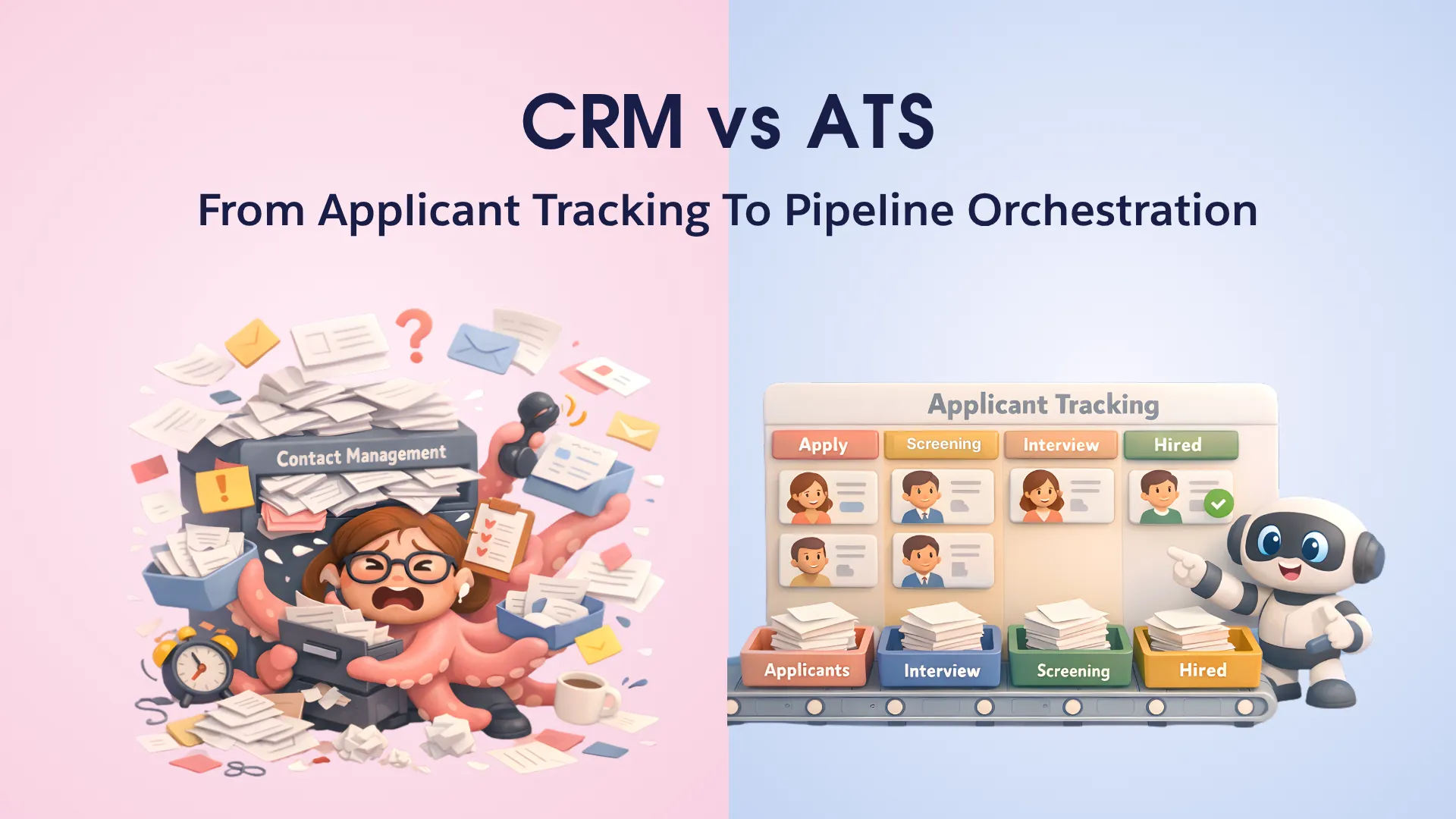
Recruiting software was originally designed to manage a discrete transaction between applicants and hiring teams. Once the position is filled, the cycle resets. This model functioned effectively when hiring was sequential and self-contained, where the primary role of technology was to log status changes and archive resumes.
Talent relationship management now operates on a timeline that precedes the application and extends far beyond the offer. Candidates engage with employer brands months before entering a pipeline,
Meanwhile, leadership demands forecasting accuracy and finance requires talent data tied directly to capacity planning.
Most organizations continue to ask “Do we need a CRM or an ATS?” This question is the first symptom of a deeper structural problem. These tools were designed for divergent purposes, and most current architectures are forcing one to perform the duties of both.
It results in a structural mismatch, a foundational gap that no amount of feature-rich updates or "bolt-on" AI can resolve.
To build a high-velocity hiring engine, the conversation must shift away from tool selection and toward architectural alignment. Understanding why modern talent acquisition has outgrown these systems in isolation is the first step toward moving from a transactional utility to a strategic environment of action.
The Structural Mismatch In Modern Talent Acquisition
The modern hiring process spans multiple touchpoints, multiple functions, and multiple timelines. Yet the technology most organizations rely on was designed when hiring was a contained, linear workflow.
The gap between how recruiting actually works and how the systems supporting it were architected is the structural mismatch most organizations are living inside without fully diagnosing it.
Candidate Experience Breaks At System Boundaries
Candidate journeys begin long before an application is submitted. A prospective hire might attend a virtual event, engage with content, respond to an outbound message, or enter a talent community months before a relevant role opens.
Each of those interactions carries a signal and shapes the relationship between the candidate and the employer. These early interactions rarely live in the same system that manages the eventual application.
Talent brand campaigns, sourcing outreach, event registrations, referral pipelines, and content engagement are typically managed inside CRM or marketing automation platforms. These systems are built to track relationship activity over time.
Once a candidate applies, the process moves into an applicant tracking system where interview scheduling, approvals, offer management, and compliance documentation live. The relational history that preceded the application does not transfer to the ATS
At an enterprise level, the same individual can exist simultaneously as a lead in a CRM, an applicant in an ATS, and an employee in an HRIS. Three records in three systems with no shared context.
From the candidate's perspective, the experience feels disjointed. A recruiter who engaged them six months ago has no visibility into that prior conversation when a new role opens.
From a leadership perspective, data cannot be traced end-to-end. Reporting requires reconciliation across platforms that were never designed to work together.
The breakdown is architectural. Stitching systems together with integrations and manual workarounds treats the symptom without addressing the cause.
Administrative Architecture Vs. Relationship Architecture
The applicant tracking system was designed around a single primary object, which is the job requirement. Everything flows from it.
- Candidates are attached to openings.
- Stages are defined by workflow milestones.
- Compliance is enforced through structured process controls.
The ATS is optimized for internal governance, tracking who approved what, documenting status changes, and ensuring process consistency across hiring managers.
The limitation is that structure built around job requirement management cannot prioritize the candidate relationship.
A CRM was designed around a different primary object, which is the relationship. It tracks interactions over time. It segments audiences by behavior, intent, and engagement history. It supports nurture journeys that sustain interest before a hiring moment arrives.
Engagement scoring, campaign management, and longitudinal record-keeping are native to how a CRM operates. The CRM does not reset after a transaction. It compounds relationship value over time.
Candidates engage over months or years before they become applicants. Talent pools shift as skills, availability, and career priorities evolve. Hiring velocity for strategic roles depends not on the quality of job postings, but on the depth of pipeline built before those roles ever opened.
Yet most recruiting infrastructure still assumes every hiring cycle starts at the moment of application. The system resets. The prior engagement disappears. The relationship that was months in the making carries no weight in the new process.
At the pace and complexity of enterprise hiring today, this assumption becomes a liability.
Why ATS-Centric Systems Cannot Support Pipeline Orchestration
The limitations of an ATS are most visible not during a single hiring cycle, but across multiple cycles over time. Within one hiring cycle, a well-configured ATS can perform adequately. The structural failure surfaces when organizations attempt to operate a talent pipeline that spans roles, timeframes, and candidate relationships that predate any open job requirement.
Pipeline orchestration requires a system that holds talent context persistently, surfaces the right candidates at the right moment, and connects prior engagement history to current hiring needs. ATS-centric architecture cannot deliver that because of how the underlying data model was designed.
Applicants Are No Longer the Primary Asset
In an ATS-centric system, value is created at the moment of application. It treats the hiring funnel as a series of discrete inbound events rather than as the output of a continuously managed talent ecosystem. High-performing talent acquisition teams operate on a different premise.
Their most strategic asset is the warm pipeline they have been building for the past six months, including the silver medalists from prior searches, the referral network that signals culture fit before a formal interview ever occurs, and the talent community members who have been consuming employer brand content for a year.
These relationships hold conversion value that far exceeds cold inbound volume. A candidate who already knows the company, has had a prior touchpoint with a recruiter, and has demonstrated interest over time is structurally more efficient to hire than a net-new applicant.
ATS-centric systems cannot see them. The pipeline that was built before this role opened does not exist as an accessible, actionable record inside an ATS. That history either lives in a CRM that does not connect to recruiting workflows, in a recruiter's personal inbox, or nowhere at all.
Applicants are episodic. Relationships are cumulative. When the system of record was designed around the episodic event, cumulative relationship value has no place to live.
Talent Now Moves Across Functions
Enterprise hiring has become multidirectional.
- A candidate considered for one role may be a stronger fit for a different function.
- A contractor placed in one business unit may convert to full-time in another.
- A former customer becomes an applicant.
- An employee referred in one geography gets re-engaged for a role in another.
These movements are common patterns in organizations with complex workforce structures, internal mobility programs, and talent communities that span traditional organizational boundaries.
This shift toward long-horizon talent pipelines is increasingly visible in enterprise workforce strategies.
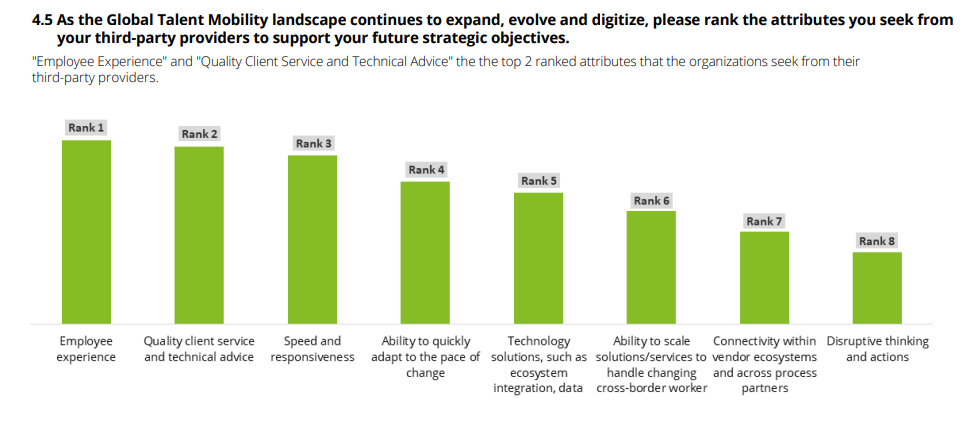
According to a Global Talent Mobility 2024 Survey by Deloitte, 33% of organizations plan to invest in generative AI to support future global talent mobility, reflecting a broader effort to manage talent movement across geographies, roles, and workforce models rather than treating hiring as isolated position-filling events.
The data model of an ATS is designed to track one person through one process for one role. When that role closes, the relationship context that accumulated during the process is effectively frozen. When the same candidate becomes relevant to a different role, the system offers no mechanism to surface that prior history in a useful, proactive way.
The consequences compound in organizations managing large talent pools across multiple functions or geographies. The same candidate may exist as multiple discrete records across different job requirements, with no unified longitudinal view that connects the full arc of their relationship with the organization.
Modern talent acquisition requires infrastructure that tracks individuals across time and across contexts, not just through a single pipeline stage. It requires the ability to surface a candidate's engagement history, prior interview performance, and relationship signals regardless of which role they were originally considered for.
The Enterprise Shift: From ATS Management To Talent Pipeline Orchestration
The organizations redefining talent acquisition are not simply adding new tools to existing workflows but redesigning the operating model around a different central question.
Legacy recruiting infrastructure asked “how do we manage this new job requirement?” The emerging model asks “How do we build and maintain a pipeline that makes every future job opening easier to fill?”
This shift in thinking changes what data needs to be captured, what workflows need to be supported, and what infrastructure needs to sit at the center of the recruiting function.
Rise of Talent Relationship Management
The recruiting function is undergoing a structural evolution, shifting from a reactive cost center to a proactive growth engine.
High-performing talent teams no longer rely on passive inbound volume, rather they operate as high-fidelity sales organizations, utilizing outbound sequencing, audience segmentation, and engagement scoring to ensure funnel velocity.
These are the new operational requirements of a data-driven enterprise HR function. By adopting a "Revenue Engine" methodology, recruiting functions can apply the same rigor to talent lead management as sales teams apply to pipeline forecasting.
The move to a revenue engine model to workforce planning allows for predictable capacity planning, where hiring success is no longer left to market chance but is instead a result of disciplined, automated orchestration.
Achieving this level of operational maturity requires a unified foundation. When the talent engine sits natively within the same Salesforce environment as the revenue engine, the business gains cross-functional intelligence.
It eliminates the data silos that typically separate talent acquisition from business outcomes, allowing leaders to manage the entire workforce lifecycle with the same precision and governance as their customer lifecycle.
- Campaigns: Recruiters building the talent pipeline for anticipated roles operate the same way a sales development team builds pipeline ahead of a product launch. They design outreach sequences, test messaging by audience segment, monitor open and response rates, and adjust based on signal strength. This workflow capability requires CRM-grade infrastructure and a siloed ATS workflow tool cannot support it.
- Segmentation: Talent pools in enterprise organizations are not homogeneous. A pipeline for software engineers in one geography has different engagement dynamics than a pipeline for operations talent in another. Effective pipeline management requires the ability to segment by skills, location, career stage, prior engagement history, and role fit, and to activate those segments with targeted outreach, which cannot be supported by an ATS tool.
- Nurture journeys: A passive candidate who attended a talent brand event eighteen months ago and downloaded a careers guide six months ago is not a cold lead. They have demonstrated sustained interest. A system that can track that engagement history and trigger relevant touchpoints at the right moments converts that interest into application at a fraction of the cost of net-new sourcing. This nurture logic requires a system designed for longitudinal relationship management.
- Engagement scoring: Not all pipeline relationships carry equal weight. Open rates, event attendance, response rates to outreach, and prior interview history are all signals that inform how recruiters should prioritize their time. Engagement scoring surfaces the warmest relationships so recruiters focus effort where conversion probability is highest. This signal aggregation does not exist in an ATS-centric system.
Executive Expectations Are Changing
Talent acquisition teams are now accountable for outcomes beyond transactional metrics such as time-to-fill and offer acceptance. They are expected to operate within the domains of integrated business intelligence, cross-functional financial planning, and predictive workforce forecasting.
Traditional recruiting software prevents talent leaders from aligning hiring velocity with real-time financial planning. To meet the new executive mandate, recruiting must move from a back-office utility to a primary driver of institutional agility.
This requires a platform built on a unified foundation like Salesforce, where talent data coexists with sales, marketing, and operational metrics.
When recruiting is integrated into the enterprise system of record, talent leaders gain the operational sovereignty needed to manage the workforce as a high-fidelity business asset. By bridging the gap between talent acquisition and business strategy, organizations can transition from reactive backfilling to disciplined, data-driven Workforce Orchestration.
- Forecasting hiring like revenue: Sales organizations do not wait until a deal closes to measure pipeline health. They track pipeline at every stage, assign probability weightings, and forecast revenue outcomes weeks or quarters in advance. Leading organizations now expect the same discipline from talent acquisition. Pipeline stages should predict hiring outcomes, rather than simply documenting where candidates currently sit. The predictive capacity requires a system that holds relationship data across time and surfaces leading indicators of conversion, not a workflow tool that tracks applicant status.
- Data transparency for workforce planning: Finance and operations need visibility into headcount. The difference now is the expectation that hiring data integrates directly into broader planning cycles rather than arriving as a disconnected report. When recruiting data lives in an isolated system, the manual translation required to feed it into workforce planning introduces lag, inconsistency, and distrust. Leadership stops relying on it and recruiting loses credibility as a strategic input.
- Alignment with finance and sales leadership: Growth targets, capacity models, and headcount plans are set in systems that recruiting has historically had no connection to. When those conversations happen, talent acquisition arrives with data from a separate environment that does not speak the same language as the operating systems that finance and sales live in. This disconnection is the reason recruiting is consistently underrepresented in strategic planning conversations.
Regardless of operational excellence, architectural isolation prevents talent acquisition from evolving into a high-fidelity strategic partner. When recruiting is disconnected from the core business systems, it remains a reactive service rather than a proactive driver of institutional value.
Asymbl eliminates this barrier by building Workforce Orchestration on top of Salesforce. By anchoring recruiting within the same environment that governs revenue, customer success, and operational performance, the traditional latency gap between talent activity and business planning is removed.
Talent pipeline data becomes a deterministic input to enterprise forecasting, allowing leadership to view workforce capacity with the same real-time precision as sales pipelines.
The Requirements Of Modern Recruiting Have Evolved
Treating the evolution of recruiting as a mere technology adoption story is a strategic error. It frames the transition as a matter of change management by onboarding new tools to perform old tasks.
It misses the more profound shift. The functional requirements of recruiting have not expanded because software improved, but the fundamental nature of work has evolved.
The modern workforce is no longer a static collection of human employees in defined silos. Similarly, the hiring process is no longer a linear sequence of manual handoffs between recruiters and hiring managers.
The expectations placed on the recruiting function transcend the traditional boundaries of talent acquisition, moving into the domains of Workforce Orchestration and deterministic execution.
Legacy systems are built for a human-only, manual-first era and act as passive record repositories that cannot absorb the complexities of a hybrid team, where human judgment and digital labor must operate on a unified foundation.
To meet these new requirements, the enterprise requires a system of record capable of bridging the gap between talent acquisition and broader business strategy.
When the recruiting infrastructure is built as a native extension of the core business OS, Salesforce, it moves from being an administrative burden to a strategic engine capable of driving Workforce Orchestration and long-term institutional value.
Recruiting Is No Longer Human-Only Execution
Across enterprise recruiting, the transition to Digital Labor is no longer a future roadmap item. Sourcing agents identify talent, screening agents evaluate qualifications against deterministic criteria, and scheduling agents manage logistics without human intervention.
The strategic challenge is no longer about the participation of digital workers, but the architectural integrity of the systems they inhabit.
In most organizations, automation has been bolted on to legacy infrastructure that was never built for hybrid execution. It results in automation silos, where digital agents operate in isolation rather than as integrated teammates.
According to McKinsey’s HR Monitor 2025 Report, only 19% of core HR processes are currently enhanced with generative AI, while 32% remain in pilot phases, signaling that most organizations are still far from realizing the technology’s full operational potential.
The Cost Of Fragmented Automation
When a recruiting stack lacks a unified data model, digital workers create more work than they eliminate. A sourcing agent may populate records that a screening agent cannot access, and a scheduling agent might coordinate logistics in an environment disconnected from the candidate’s history.
This fragmentation forces human recruiters to act as "data bridges," manually reconciling outputs across disparate tools. This "swivel-chair" friction erodes the productivity gains promised by AI. True efficiency requires a system where:
- Sourcing Agents deposit high-fidelity records directly into a unified pipeline.
- Screening Agents utilize a shared evaluation framework accessible by human reviewers.
- Scheduling Agents maintain 360-degree visibility into both candidate availability and interviewer capacity.
Designing For Hybrid Execution
To move from fragmented automation to true Workforce Orchestration, your infrastructure must be designed for hybrid execution from the foundation up.
By anchoring these processes within a single system of record, like Salesforce, organizations ensure that every digital worker and human recruiter operates on the same data foundation, turning isolated tasks into a cohesive, high-velocity engine.
Automation Exposes Architectural Weakness
In a manual environment, a recruiter invisibly absorbs system friction, bridging data gaps through memory, personal workarounds, and inbox management.
When Digital Labor enters this same environment, it lacks the human intuition to navigate these "cracks," turning minor inconsistencies into visible, large-scale failures.
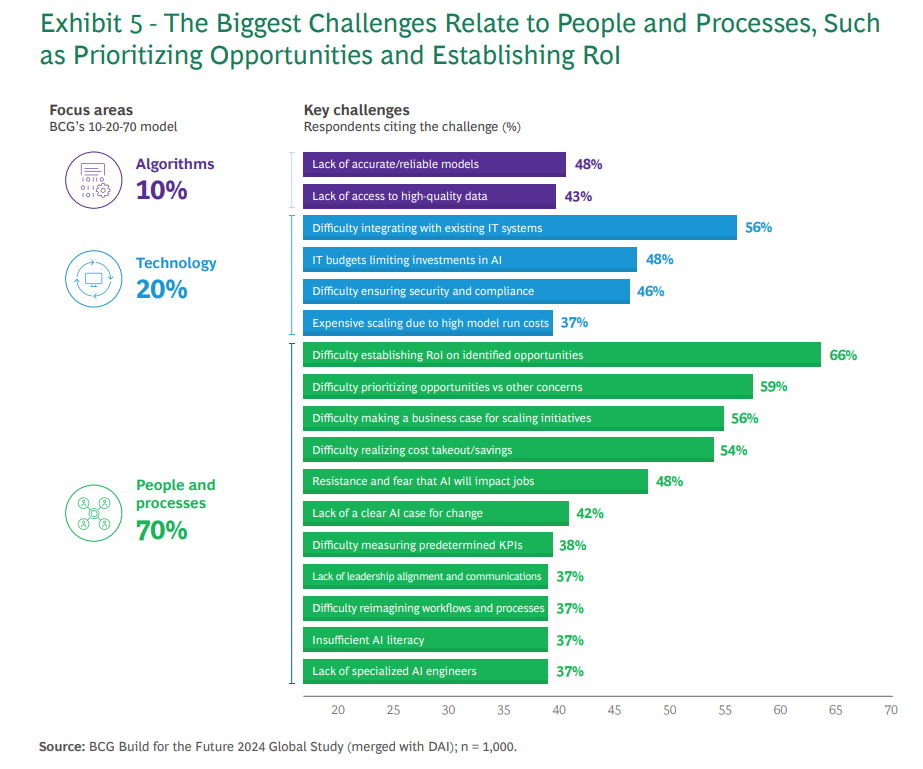
This pattern helps explain why many AI initiatives stall before delivering operational value. According to “Where’s the Value in AI?” 2024 BCG Report, 74% of companies have yet to show tangible value from AI, and only 26% have developed the capabilities needed to move beyond proofs of concept.
In many cases, the limitation is not the intelligence of the automation itself but the fragmented systems underneath it.
The Signals Of Architectural Failure
Organizations that attempt to automate on top of fragmented infrastructure typically encounter four recurring operational failures:
- Record Proliferation: Sourcing agents create duplicate entries because disconnected systems lack a single source of truth for candidate identity.
- Reporting Paralysis: Contradictory pipeline data emerges when disparate tools utilize conflicting status models for the same candidate.
- Ownership Erosion: Automated handoffs move candidates between stages without clear protocols, leaving accountability undefined at critical transitions.
- Contextual Blindness: Engagement bots trigger outreach logic that ignores the candidate’s actual history, damaging the employer brand.
AI and Digital Labor are force multipliers and they amplify the existing structure. If the foundation is unified, automation scales efficiency. If it is fragmented, it scales chaos.
The organizations achieving measurable ROI from recruiting AI are not those with the most complex agents, but those with the most disciplined data foundations.
By activating automation within a unified system of record, such as Asymbl on Salesforce, these leaders ensure that data flows consistently and every digital worker operates with the same context as the human team.
This sequencing is the fundamental difference between automation that compounds operational drag and automation that builds institutional capability.
Why Talent Systems Must Sit Inside Core Business Architecture
Treating talent acquisition as an adjacent function rather than a core business component is a structural error that limits an organization's strategic velocity.
Over time, the adoption of siloed point solutions creates a credibility gap between recruiting activity and enterprise performance.
The distance between recruiting and the core business manifests as systemic inefficiency that no amount of manual effort can bridge. Organizations operating on disconnected stacks frequently encounter:
- Operational Lag: Workforce planning conversations are stalled by the time required to sync disparate data sets.
- Data Integrity Deficits: Manual reconciliation between recruiting reports and finance models leads to errors and eroded trust at the executive level.
- Reactive Decision-Making: Strategic pivots are made without real-time visibility into talent pipeline health or capacity.
When recruiting data resides within the same architecture as revenue, customer, and operational performance data, such as Asymbl built on Salesforce, the role of talent acquisition changes fundamentally.
By unifying these foundations, talent acquisition achieves architectural parity with the rest of the business. It allows for predictable capacity planning, where hiring velocity is directly linked to business outcomes.
In this unified environment, recruiting is no longer an isolated utility but a core driver of institutional value, capable of scaling with the same discipline and precision as a high-performing revenue operation.
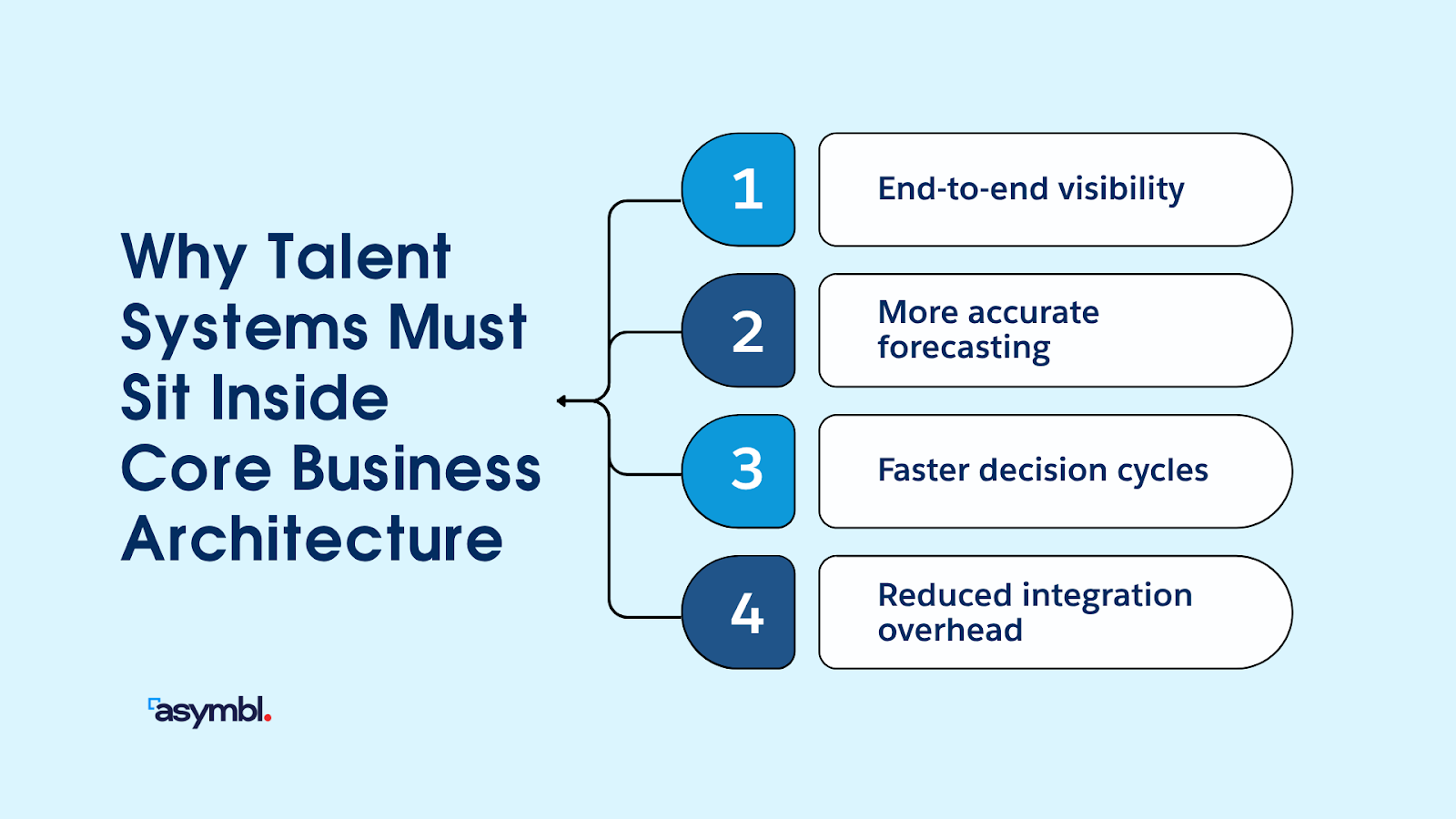
- End-to-end visibility: When a candidate moves from first engagement through sourcing, pipeline, assessment, offer, and onboarding, that journey should produce a continuous data trail that any authorized stakeholder can interrogate. In most enterprise recruiting environments, candidate data trail is fragmented across three or four systems, each with its own data model and its own reporting logic. Unifying this trail inside a single architecture changes the quality of decisions that can be made at every stage of the talent lifecycle.
- More accurate forecasting: Hiring forecasts built from recruiting data that lives inside the same system as revenue forecasts and workforce capacity models are structurally more reliable than forecasts assembled by manually translating data between disconnected environments. Translating data between the systems introduces error, lag, and interpretation gaps. Eliminating it improves the integrity of the numbers that executives use to make growth decisions.
- Faster decision cycles: When talent pipeline data requires a separate reporting process to surface, decisions slow down. Leadership waits for the recruiting team to produce a formatted report rather than accessing pipeline health directly. In a unified architecture, that data is available in real time, without a translation step, inside the same environment where business decisions are already being made.
- Reduced integration overhead: The engineering and administrative cost of maintaining integrations between a standalone ATS and the rest of the enterprise stack is not trivial. Data sync configurations break. Fields fall out of alignment. Integration maintenance consumes technical resources that could be directed toward higher-value work. When recruiting infrastructure is built natively inside the core business platform, the overhead disappears because the data is already where it needs to be.
Recruiting is the primary mechanism through which an organization builds the capacity to execute its growth objectives. Consequently, that function belongs within the same operational environment where those growth plans are authored, measured, and adjusted.
When recruiting is siloed, it creates a strategic ceiling that limits the function’s ability to influence the P&L or long-term workforce agility.
Organizations making the architectural shift to a unified platform, like Asymbl on Salesforce, are intentionally raising the strategic ceiling of their talent function.
By integrating recruiting into the core business OS, they ensure that talent velocity and business performance are monitored through a single lens. It transforms recruiting from a back-office cost center into a high-fidelity engine for institutional value, capable of driving the enterprise forward with disciplined, data-driven precision.
ATS As A Workflow Layer And CRM As A Unified Data Foundation
Organizations treat the debate between CRM vs ATS as a binary choice, which misidentifies the problem. The challenge is not the existence of the ATS, but its misapplication as a foundational system of record.
An ATS is designed for structured workflow execution, like compliance, job requirement management, and stage progression, not for managing longitudinal relationships or enterprise-wide planning.
The Layered Model: Strategic Positioning
True architectural maturity requires a layered approach where each system operates within its intended functional domain. In this model, the CRM serves as the unified data foundation, while the ATS functions as the execution layer.
- The Foundation (CRM): Holds the longitudinal talent record. Engagement history, outreach sequences, and referral context persist across time and roles. The relationship does not reset when a position is filled, but evolves as a continuous asset.
- The Execution (ATS): Governs the active hiring process. It handles stage transitions, interview scheduling, and compliance documentation. It performs its specific task with discipline, but it no longer carries the burden of being the primary system of record.
Resolving Structural Failures
Adopting the approach, where CRM acts as the data foundation and the ATS as the workflow layer resolves three critical operational pain points simultaneously:
- Collapse of Manual Data Entry: When these layers are unified, specifically on a platform like Asymbl on Salesforce, the "swivel-chair" experience disappears. Data entered once flows through the architecture without the need for manual translation or duplicate records.
- Preservation of Institutional Memory: Relationship history remains accessible. A "silver medalist" from a prior search is not an unknown entity. Their interview signals and engagement history are surfaced natively within the new requisition.
- Native Enterprise Integration: Since the CRM foundation is the same platform that holds revenue and customer data, recruiting becomes a native input to enterprise planning. Pipeline health and hiring forecasts are available in the same environment used by Finance and Operations.
Strategic recruiting functions are defined not by the tools in their stack, but by whether their foundation was designed to sustain longitudinal relationships and support the Hybrid Execution required by the modern enterprise.
Why Salesforce As A CRM-Native Recruiting Model
Selecting a CRM foundation is a commitment to an organization's data architecture. Salesforce wasn't built for recruiting, but it was built for precisely what modern recruiting requires, unified data governance, native automation, and a platform where human and digital workers operate within a single system of record.
Four Pillars Of The Salesforce-Native Model
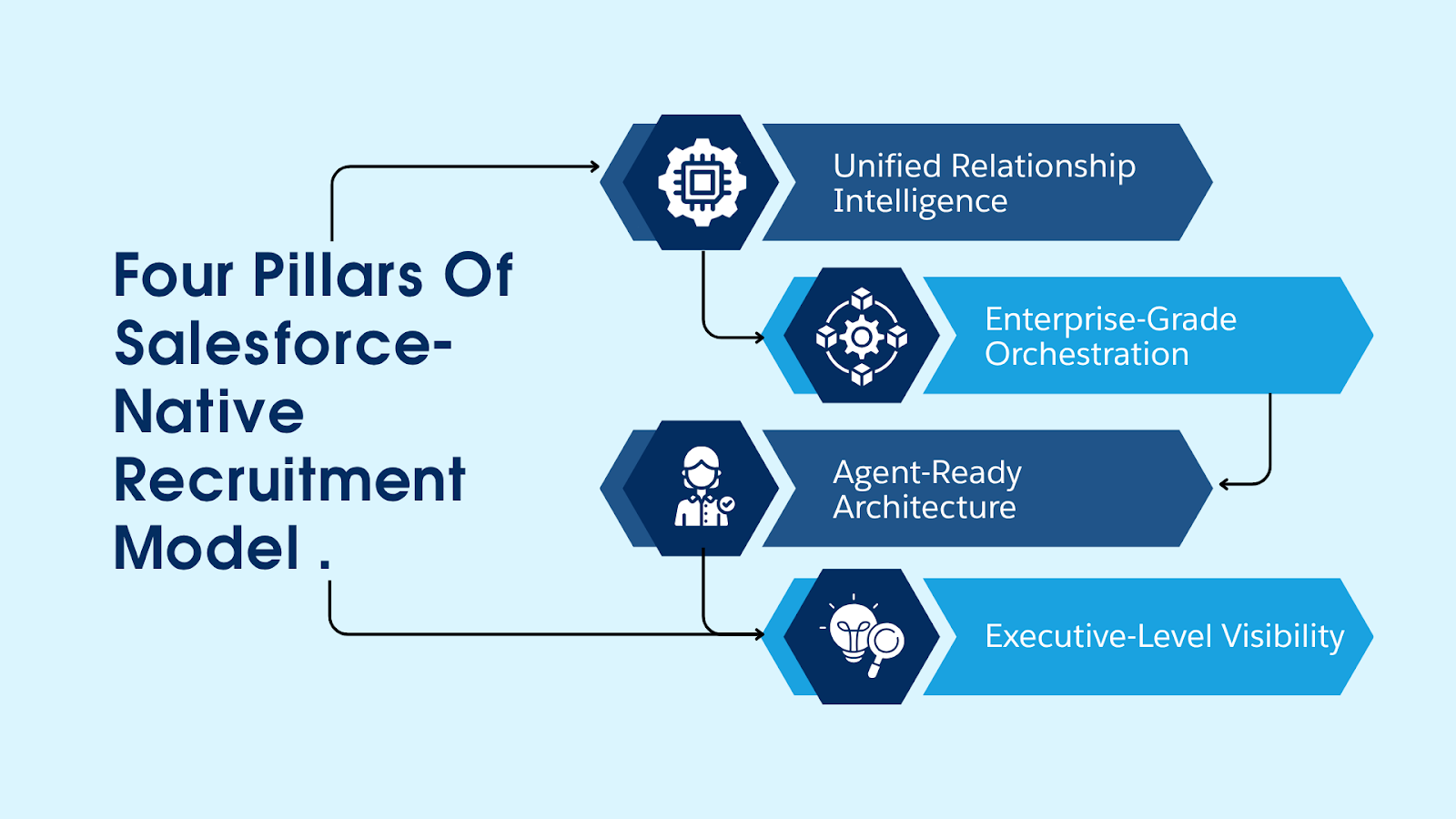
When recruiting is built natively on Salesforce, it becomes a core component of the business OS:
- Unified Relationship Intelligence: In disconnected stacks, a person might exist as a sales prospect, a marketing lead, and a candidate in three unrelated records. On Salesforce, these are three perspectives of a single individual. Recruiting inherits existing relationship context, transforming "cold" outreach into high-fidelity engagement.
- Enterprise-Grade Orchestration: Using Salesforce’s native Flow and orchestration tools, recruiting workflows, from sourcing sequences to approval routing, are built with the same governance discipline as revenue operations, eliminating the need for fragile third-party integrations.
- Agent-Ready Architecture: With Agentforce, digital workers are not "bolt-on" tools. They are native participants in the same environment as human recruiters, ensuring a true Hybrid Workforce without data fragmentation.
- Executive-Level Visibility: Recruiting KPIs, such as pipeline health and hiring forecasts, reside in the same reporting environment used by Finance and Operations. This places talent data exactly where enterprise growth decisions are made.
Asymbl Recruiter Suite
Asymbl Recruiter Suite is a native architectural extension that transforms Salesforce from a general CRM into a high-velocity environment for Workforce Orchestration. By delivering org-specific hiring logic directly within your primary system of record, Asymbl eliminates the "swivel-chair" friction and data fragmentation inherent in standalone ATS platforms.
- Native Structural Integrity: Asymbl operates entirely within Salesforce, ensuring your talent data shares the same governance and security frameworks as your revenue and customer operations. This removes the "integration tax" and ensures a 360-degree view of the candidate lifecycle.
- Modular Process Excellence: Whether you need advanced semantic search, automated interview coordination, or branded candidate engagement, Asymbl allows you to configure specific workflows using clicks, not code, matching the software to your unique operating model.
- Agentic AI Integration: Unlike "bolted-on" AI features, Asymbl is Agent-Ready. It provides the underlying structure for Digital Labor (via Agentforce) to execute deterministic tasks, like screening and scheduling, directly inside the flow of work, allowing human recruiters to focus on high-fidelity relationship building.
- Predictive Workforce Intelligence: By unifying hiring data with Salesforce’s powerful analytics, Asymbl moves you from delayed reporting to forward-looking decision support. Identify bias patterns, forecast time-to-hire, and measure the direct impact of talent acquisition on business growth.
Conclusion
Organizations operating on ATS-centric architectures are hitting a structural ceiling inherent in their chosen systems. Optimizing workflows within a legacy framework merely delays the friction.
To achieve true scale, the shift must be architectural, moving from a system of "job requirement management" to a foundation of candidate relationship management.
A reconfiguration of the recruiting function requires an environment that supports:
- Relationship Continuity: Maintaining candidate intelligence across multiple years and hiring cycles, ensuring every interaction builds institutional memory.
- Enterprise Alignment: Connecting talent data directly to the financial and workforce planning systems where strategic growth decisions are made.
- Hybrid Execution: Orchestrating seamless collaboration between human judgment and Digital Labor without the "swivel-chair" data reconciliation caused by disconnected tools.
- Actionable Intelligence: Surfacing pipeline health and capacity metrics in real-time, eliminating the translation lag between recruiting reports and executive action.
The CRM-native model, utilizing Asymbl on Salesforce, provides the structured workflow execution required for compliance while maintaining a unified data foundation. This architecture removes the integration overhead typical of multi-tool stacks and fundamentally changes recruiting’s position within the enterprise.
If your recruiting team is navigating the limits of disconnected systems, Asymbl can help you think through what a CRM-native recruiting architecture looks like in practice. Recruiter Suite is purpose-built on Salesforce, unifying ATS capabilities, candidate engagement, and pipeline intelligence in one platform. Book a demo to see how it works.

Applicant Tracking System Problems: Why Your ATS Isn’t Working
Most ATS platforms weren’t built for the way staffing firms actually work. This blog breaks down the hidden flaws holding teams back—and how next-gen solutions like Asymbl’s are fixing them.

The Right Fit Starts With a Conversation.
See what working together could look like.
.webp)