



Job descriptions ask for "Python developers" and "cloud engineers" and "AI/ML specialists." Applicant tracking systems dutifully match those keywords to resumes. The match tells you what a candidate typed. It doesn't tell you what they can execute on day one.
Keyword matching was never good at this.
Recruiters have compensated with judgment for decades, and the best ones got very good at it. What changed isn't that the roles got harder. It's that we finally have systems that can read a career the way a seasoned recruiter reads one, at the scale of an entire database.
I came into Salesforce through the MapAnything acquisition and spent the following years helping build its Sales Performance Management business, including the acquisition of Spiff. That work was all one problem: the gap between what a person is nominally assigned and what they actually produce, and building systems that can see it. Recruiting has the same gap. We just call it a resume.
A keyword match can’t tell you whether a developer listing "Python" built production-grade data pipelines or completed a brief online tutorial. It can’t clarify whether a "cloud engineer" architected an enterprise environment or executed a pre-written runbook. Equally important, standard keyword filters frequently overlook experienced technical professionals who spent years solving complex infrastructure problems using tools that weren't marketed as 'AI' when they learned them.
This disconnect creates a widening gap between what ATS keyword searches surface and what clients need in senior technical talent.
Three Limits of Traditional Technical Matching
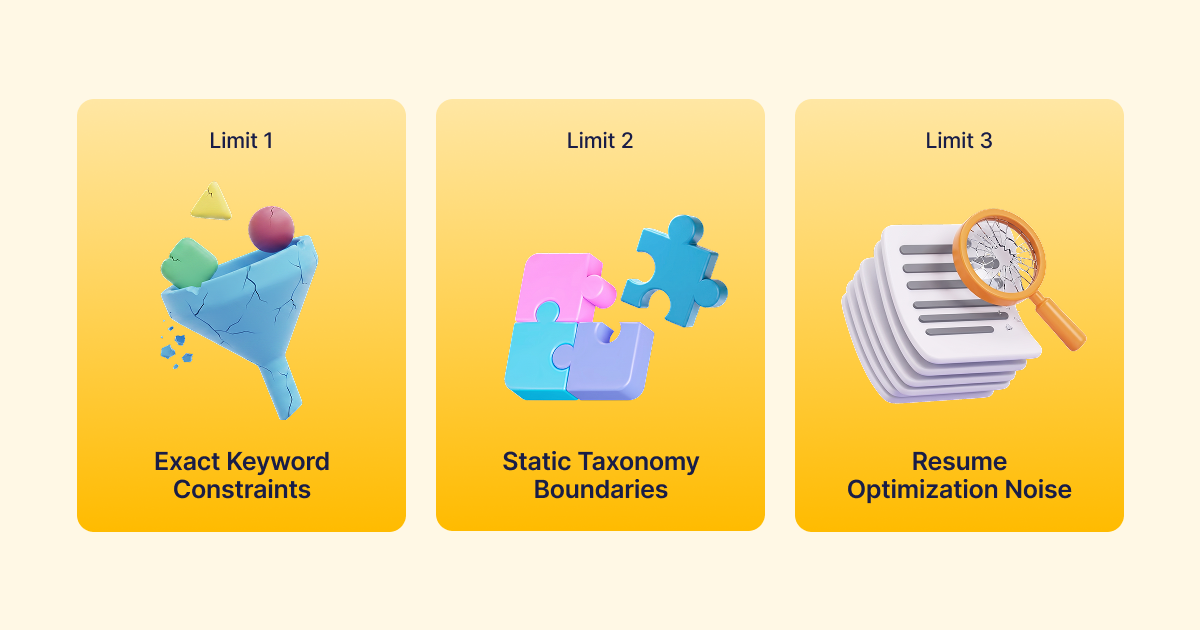
Three limits show where keyword matching loses the candidate.
Limit 1: Exact Keyword Constraints
When a recruiter searches inside an ATS or CRM database for a term like "Kubernetes," the system filters strictly by that exact alphanumeric text string. Candidates who spent years orchestrating enterprise containers using equivalent frameworks or custom environments before Kubernetes became standard don't surface. The underlying technical capability is present. Rigid keyword filtering leaves qualified candidates buried in the database simply because their profile uses adjacent terminology.
Limit 2: Static Taxonomy Boundaries
First-generation semantic tools attempt to bridge literal keyword gaps by mapping synonyms and skills taxonomies, linking "Kubernetes" to broader terms like "container orchestration." This approach captures immediate synonyms. It still evaluates candidate data purely through static labels. It fails to evaluate the surrounding career trajectory, missing how a candidate applied those tools within complex production environments over time.
Limit 3: Resume Optimization Noise
Candidates have learned to engineer their resumes specifically for keyword algorithms, stuffing documents with trending terminology to trigger automated matches. As a result, recruiters spend significant time reviewing profiles optimized for parser scores rather than demonstrated execution. The recruiter who trusts the keyword match is increasingly reading a document written for an algorithm.
These three limits aren't new. They've been present in every ATS and CRM database for years. Research from Harvard Business School and Accenture found that:
- 88% of employers acknowledge their hiring systems filter out qualified candidates who don't match exact criteria.
- 27M workers in the U.S. are estimated to be hidden from consideration by the very processes designed to find them.
What's new is the cost of leaving them unaddressed. As IT roles hybridize and candidate volumes grow, the gap between what keyword systems surface and what recruiters need to evaluate widens with every requisition.
How Seasoned Recruiters Read Capability Over Keywords
Exceptional technical recruiters evaluate career progression rather than static resume line-items. They recognize when a candidate moving from systems administration to DevOps and platform engineering has built the exact architectural judgment a client needs, even if no single job title explicitly says so.
That judgment rests on distinguishing individual skills from broader capabilities. A skill is a tool someone uses, such as writing Python code. A capability is the operational outcome that tool achieves, such as architecting a data pipeline that processes tens of millions of records daily without failure. The skill is a tool. The capability is the outcome that the tool enables. Standard database searches index individual tools. Evaluating capability requires understanding trajectory, context, and the candidate's history of execution across complex environments.
Capability is also shaped by where someone did the work. A data scientist at a 200-person startup and one inside a Fortune 50 built different muscles under the same title. Reading a career well eventually means reading the businesses inside it. That's the direction this is heading.
Consider the difference between finding someone who owns a hammer and identifying the builder who can review a blueprint, calculate load-bearing requirements, and construct the building. Standard search engines catalog the tools. Seasoned recruiters evaluate the blueprint. The question is whether that blueprint-level evaluation can work at the scale of a full database, across every open requisition, without burning out the recruiters who carry it.
In Practice: How Burtch Works Scaled Capability-Based Matching
When you look at specialized staffing leaders like Burtch Works, ranked No. 8 on SIA's 2025 Fastest-Growing US Staffing Firms list, you see what happens when talent matching moves beyond static keywords.
Their team operates in one of the most technically demanding placement sectors in the country, placing professionals with advanced degrees, niche specializations, and career histories that defy simple keyword categories. Burtch Works CEO Michael Butts identified the core challenge early: keyword-based search tools couldn't differentiate between a data scientist with five years of production NLP experience and an applicant with a fresh bootcamp certificate listing identical terms.
Unifying candidate data on Asymbl's Job object gave Burtch Works a single, structured record for every engagement. Because the Job object is built on Salesforce, that record carries the same reporting, governance, and automation as the rest of the business. From there, Recruiter Suite indexed more than 74,000 candidate and job records, surfacing career patterns and capability signals that keyword searches had left buried for years.
The results were specific: interview-to-offer rates increased 67%, and offer-to-acceptance rates climbed 60%. Better-structured data and stronger candidate-to-role matching created immediate alignment on both sides of the placement, clients see higher-quality candidates on the first submission, and candidates accept offers more consistently because the match aligns with their demonstrated experience.
Now, Burtch Works is specifically looking to validate real technical quality. CEO Michael Butts points to a market increasingly full of fraudulent or inflated candidate claims, which makes validating real technical quality harder than it has ever been.
Recruiter Suite gave them the record layer. Talent Intelligence can give them the read.
Reimagining Tech Talent Acquisition for the AI Era
Industry conversations about technical talent often focus on temporary trend lists: mandated programming languages, prioritized certifications, or newly trending frameworks. Because technical tools evolve rapidly, static skill taxonomies decay within quarters, keeping staffing firms trapped in a continuous cycle of updating search filters.
Placing IT talent in this era requires interpreting careers: reading the natural trajectory from systems administrator to cloud architect to AI infrastructure lead, and recognizing the proven execution capability behind those evolving titles. Achieving this scale means orchestrating the right work to the right worker by assigning digital workers to handle high-volume screening, profile structuring, and candidate communications, freeing experienced recruiters to apply the judgment that drives successful placements.
Recruiter Suite gives staffing firms the record layer. Talent Intelligence gives them the read, evaluating candidates at the capability level and interpreting the career signals that keyword systems have always flattened into text. For decades, the best recruiters carried that interpretive work alone. The constraint just lifted.
See how Talent Intelligence surfaces the candidates your keyword searches miss.

Recruiting Technology Trends: Why Specialized Tools Beat All-in-One Platforms
The all-in-one dream is fading. This blog explores why the future belongs to flexible, specialized solutions powered by unified data and AI—and how platforms like Salesforce and Asymbl are leading the charge.

The Right Fit Starts With a Conversation.
See what working together could look like.
.webp)