


Most enterprises evaluate recruitment software through a narrow lens, including feature parity, licensing costs, and polished demonstrations of automated scheduling. What rarely enters the decision matrix is the high cost of operational drag, the systemic friction that accumulates when software is misaligned with the workforce.
Technical implementation is frequently mistaken for operational transformation. A platform may be "live," yet recruiters still revert to spreadsheets and email threads to maintain velocity.
This adoption illusion occurs because most systems are built as static repositories rather than dynamic environments of action. When hiring volume spikes, these structural weaknesses are exposed, revealing a lack of orchestration and contextual memory.
The current obsession with AI features has intensified this tension. Most AI initiatives stall in "pilot purgatory" because they function as isolated add-ons rather than being embedded into the flow of work.
The fundamental challenge is not technological capability. It is Workforce Orchestration. In this blog, we examine the hidden challenges, from implementation fatigue to the "belief gap,” that create long-term drag.
We will outline how to evaluate recruiting software not as a tool purchase, but as a Workforce Infrastructure decision that determines whether your hiring engine scales with discipline or succumbs to friction.
Recruiting Software Implementation: Hidden Challenges
When evaluating the best recruiting software, talent leaders frequently prioritize feature parity over implementation strategy. This oversight often results in a productivity plateau where the new system adds more complexity than it removes.
The fundamental challenge of recruiting software implementation is not technical configuration, but the alignment of the software with a disciplined system of work.
1. Workflow Design And Process Mapping
Software is an accelerator of the underlying architecture. If applied to a fractured process, it merely scales operational drag. High-performance organizations recognize that digital transformation requires a rigorous redesign of workflows before technology is introduced.
A common failure in high-volume hiring environments is the automation of manual chaos without clarifying the governance of the hiring funnel. Without precise process mapping, recruiting software becomes a digital replica of existing friction.
Organizations must establish clear structural answers before deployment:
- Decision Ownership: The system must explicitly define the accountability for screening and selection at every stage.
- Orchestration Boundaries: There must be a designated threshold where deterministic execution ends and high-value human judgment begins.
- Stakeholder Handoffs: The transition between recruiters, hiring managers, and finance must be governed by structured data rather than side-channel communication.
While technology can automate tasks, the true value is unlocked when workflows are redesigned to augment human capability. This means mapping out every stage of your funnel, from the first sourcing touchpoint to the final offer letter, and identifying the "friction points" that software often ignores.
Without this level of design, implementation remains a purely technical exercise that fails to resonate with the actual work happening on the recruiting desk.
2. Data Migration
Transferring candidate records between databases is an administrative task. However, migrating Institutional Intelligence is a strategic challenge that determines the long-term efficacy of the recruiting engine.
Institutional intelligence represents the high-fidelity context, the historical rationale behind previous selection decisions, that provides an organization with its competitive advantage.
The failure to migrate the "why" behind previous outcomes leads to immediate system fragility. When legacy data is exported without historical notes, interview context, and outcome signals, recruiters lose the ability to rediscover "silver medalists" or leverage past evaluations.
This fragility is amplified in high-volume hiring environments, where data integrity itself is under pressure. According to a 2026 Gartner Report on Work Trends, 84% of recruiters report grappling with candidate fraud, ranging from resume inflation to AI-generated deepfake identities.
The same report estimates that by 2030, 25% of candidate profiles could be fake. At a time when inbound information is increasingly unreliable, historical evaluation context becomes even more valuable. Your internal signal is often more trustworthy than the resume in front of you.
When that signal is lost during migration, recruiters are forced to rely on surface-level data again.
This data decay forces teams to repeat previous efforts, creating a cycle of manual rework that erodes hiring velocity and undermines the integrity of the talent pipeline.
Preserving this historical context is essential for maintaining a defensive talent advantage. Organizations treating data as a strategic asset are significantly better positioned to leverage advanced automation for predictive hiring.
A successful migration must do more than move rows of data. It must ensure that the collective knowledge of the recruiting function remains intact and structured within the new system of record.
3. Integrations
When recruiting data exists within a silo, isolated from sales, payroll, and core operations, the organization suffers from significant operational latency.
Organizations frequently rely on brittle third-party middleware to synchronize data across disconnected platforms, a practice that introduces systemic risk and prevents the talent function from acting on real-time business signals.
Maintaining end-to-end visibility across the hiring lifecycle is essential for informed decision-making and workforce forecasting. When recruiting data is disconnected from the primary system of record, organizations lose the ability to maintain compliance traceability and accurate capacity planning.
A professional recruiting tools comparison must move beyond simple API availability to evaluate Integration Depth. Without a single, cohesive data foundation, the recruiting function remains a reactive department rather than a strategic driver of the business OS.
Recruiting Software Adoption: Common Challenges
While implementation marks the technical launch of a platform, adoption is the primary driver of organizational ROI.
In a high-volume recruitment environment, the success of a technology investment depends entirely on its ability to integrate into the recruiter’s existing flow of work. When technology introduces unnecessary friction, the system fails to achieve its intended scale.
This pattern is not unique to recruiting. According to a 2025 Deloitte Research Report on AI ROI, only 6% of executives globally report seeing ROI on their AI investments in under a year, and even among the most successful initiatives, just 13% realized returns within twelve months.
The gap is less about model capability and more about operational integration. When recruiting software or AI features are layered onto fragmented workflows, value stalls.
The system may be technically functional, but if recruiters must verify outputs manually, navigate multiple platforms, or rely on shadow systems to maintain velocity, the promised efficiency never materializes.
1. Rigid Implementation And The "Square Peg" Problem
Adoption frequently collapses when a platform is built on an unspecialized database structure that forces recruiters into unnatural behavioral patterns. When software is too rigid to accommodate the fast-paced reality of the hiring desk, it creates a "square peg" scenario where the technology becomes a barrier to execution rather than an enabler.
This misalignment leads to shadow-system proliferation, where recruiters revert to spreadsheets and personal notes to maintain velocity, ultimately compromising the integrity of the system of record.
A significant, yet often overlooked, driver of adoption failure is the "Swivel-Chair Experience."
When recruiting teams are forced to manage multiple disconnected platforms, switching tabs to move between a CRM, an ATS, and communication tools, they suffer from acute operational fatigue. This context-switching drains the cognitive capacity required for high-value human judgment.
If the recruiting software demands more energy for administrative maintenance than it provides in functional value, adoption will remain stagnant.
To ensure enterprise-wide success, a platform must offer Workflow Orchestration, allowing recruiters to execute their daily tasks within a single, unified environment. Without this structural alignment, the technology remains an isolated tool rather than a dynamic extension of the workforce.
2. Workflow Friction And Operational Latency
In high-volume recruitment, even marginal increases in administrative requirements can lead to significant operational latency. When a new platform introduces additional procedural steps, such as manual data entry or complex tagging, it ceases to be a functional asset and becomes a structural burden.
Every moment redirected toward administrative maintenance is a moment diverted from the strategic orchestration of talent.
Salesforce-native recruiting platforms like Asymbl enable Workforce Orchestration, where the digital workers automate deterministic execution within the user's primary workspace, Salesforce.
By minimizing the friction associated with record-keeping and status updates, organizations allow their human talent to remain focused on high-value judgment work, such as candidate rapport and stakeholder calibration.
3. The AI Belief Gap and "AI Purgatory"
A significant barrier to digital transformation is the "belief gap" that emerges when leadership keeps technology in a state of perpetual experimentation. This "AI purgatory" occurs when AI initiatives are tested in isolation without a clear trajectory toward full-scale operationalization.
When recruiting teams witness high-level demonstrations that fail to translate into functional utility on their desks, they experience strategic cognitive dissonance, leading to a breakdown in institutional trust.
The primary obstacle to HR tech adoption is the absence of a clear operationalization framework. Without a path that integrates technology directly into the daily flow of work, AI remains a peripheral distraction rather than a capacity-expanding asset.
This lack of integration often leads to "Capability Fragmentation." When AI features are added without being rooted in the primary system of record, they create additional layers of administrative maintenance rather than removing them.
For a high-volume recruiting team, the value of technology is not found in the "coolness" of the demo, but in its ability to reliably absorb deterministic workloads.
Ultimately, the belief gap is a failure of orchestration. When the boundary between digital execution and human judgment is poorly defined, the front-line team views technology as an external burden.
Bridging this gap requires a transition from seeing AI as a "project" to seeing it as a fundamental component of the workforce architecture that requires the same level of governance and support as any human hire.
Signs Your Recruiting Software Isn’t Fitting Into Your Process
In many organizations, the gap between technology acquisition and operational utility is bridged by manual effort rather than system design. Recognizing the indicators of a misaligned platform is essential for preventing long-term operational drag and ensuring that the recruitment function remains a strategic asset.
1. Implementation Fatigue And Post-Launch Stagnation
Implementation fatigue occurs when the resource depletion required for system setup leaves the recruiting team without the capacity to leverage the platform’s advanced capabilities.
This often manifests in organizations that experience a high-visibility "go-live" event, only to find their core processes remain unchanged twelve months later. If the technology functions as a static repository rather than a dynamic driver of efficiency, it indicates a fundamental misalignment with the organization’s workflow.
Post-launch stagnation is a critical indicator that the software architecture is too rigid to accommodate the evolving needs of the business. High-performance recruitment functions require systems that support continuous optimization rather than a "set and forget" deployment.
When a platform lacks the flexibility to adapt to market shifts or internal process improvements without significant technical intervention, it becomes a liability. This process calcification forces teams to work around the software rather than through it, leading to a fragmented system of record and a significant loss in hiring velocity.
2. Heavy Reliance On IT For Implementation
Recruiting is a high-velocity business function that requires immediate adaptability to market shifts. However, many enterprise platforms are built on rigid architectures that necessitate an IT intervention for basic workflow modifications.
When a talent acquisition team is forced to rely on external departments for minor adjustments, such as updating evaluation criteria or modifying communication templates, the result is deployment latency.
This structural dependency creates a critical bottleneck that stifles innovation and prevents the hiring engine from responding to real-time business demands.
Organizations that lack administrative sovereignty over their tech stack find themselves unable to pivot during sudden hiring surges or shifts in candidate behavior. This friction creates a disconnect between the talent strategy and the software’s execution layer.
A resilient recruiting operation requires a platform that provides talent leaders with the autonomy to manage their own configurations. Without this operational agility, the recruitment function remains reactive, tethered to the prioritized backlogs of IT departments rather than the urgent needs of the business.
What To Evaluate Before You Choose A Recruiting Platform
The primary criterion for evaluating any recruitment technology is its architectural integration with the rest of the business. Organizations must distinguish between a siloed point solution and a unified operating system.
Selecting a platform built on an enterprise foundation, such as Salesforce, allows recruiting data to coexist with sales, marketing, and core operational data, creating a centralized intelligence layer.
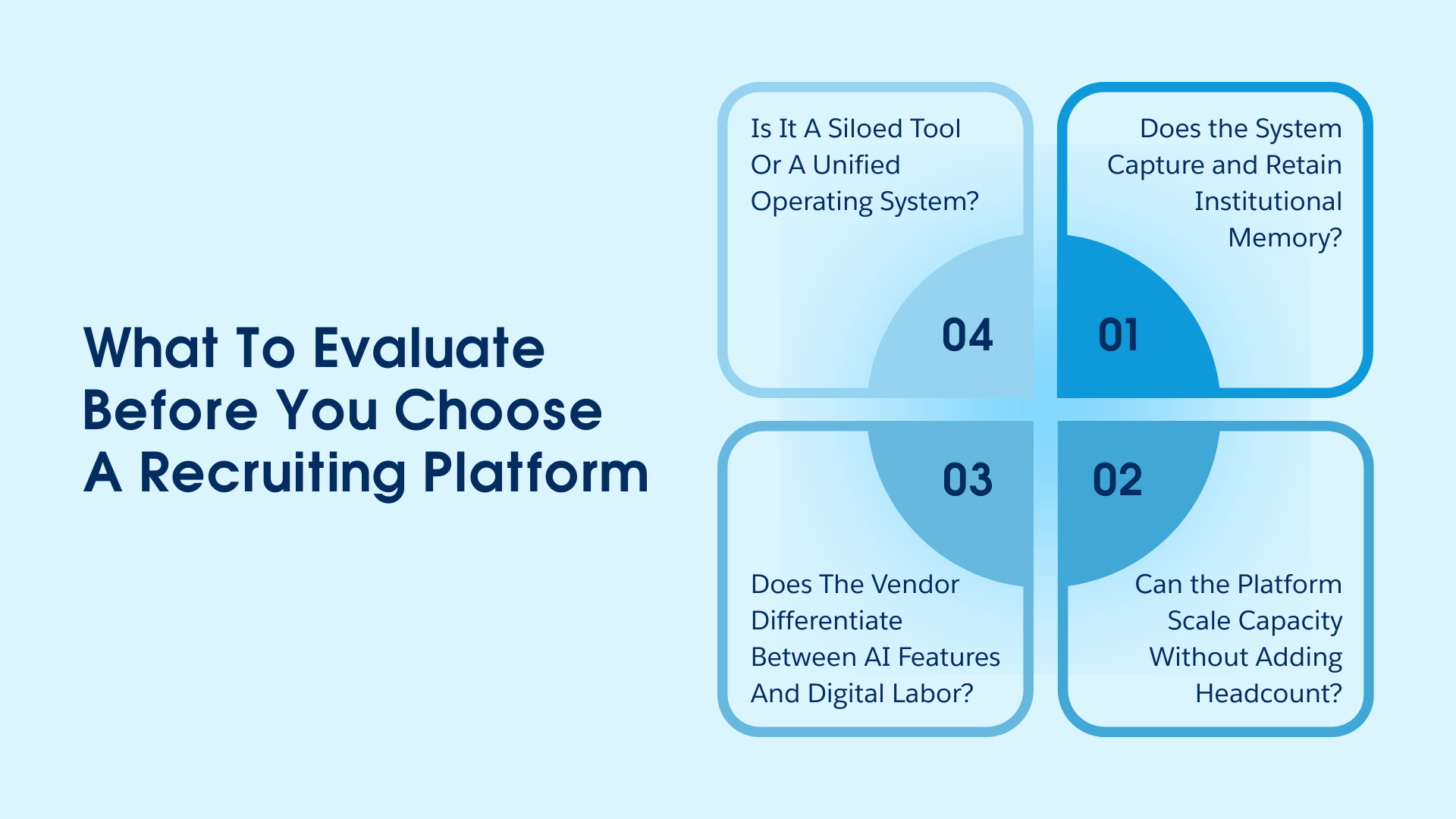
1. Is It A Siloed Tool Or A Unified Operating System?
A siloed tool necessitates manual data synchronization and inevitably leads to data fragmentation, where critical information is trapped in an unspecialized environment.
In contrast, a unified operating system prevents the erosion of data integrity that occurs when information is transferred between disparate applications. This architectural alignment ensures that talent acquisition is not a peripheral activity, but a core component of the institutional infrastructure.
Maintaining a "single source of truth" is the foundation of a modern, defensible HR strategy. End-to-end visibility across the employee lifecycle, from initial candidate lead to long-term performance, requires a system that eliminates data silos.
By integrating recruiting into the primary system of record, like Salesforce, organizations gain the cross-functional intelligence needed to align hiring velocity with real-time business demands and long-term workforce planning.
2. Does The Vendor Differentiate Between AI Features And Digital Labor?
Most vendors offer "assisted automation,” discrete tools like chatbots or text summarizers that still require significant human management. True digital labor represents agentic technology capable of autonomous execution and deterministic decision-making within a governed framework.
The strategic objective is not to find a faster way to execute isolated tasks, but to deploy a digital workforce that manages entire roles within the recruitment workflow.
This represents the shift from "tools" to "capacity,” where AI agents are capable of executing end-to-end processes autonomously, effectively absorbing high-frequency, repeatable workloads.
3. Can the Platform Scale Capacity Without Adding Headcount?
The primary metric for a resilient hiring engine is its ability to scale capacity without a corresponding increase in human capital expenditures.
Organizations must evaluate whether a platform provides the Operational Leverage necessary to manage hiring surges through technology rather than headcount expansion.
Traditional talent functions often face a binary choice during a hiring blitz
- Overwhelm the existing team or
- Initiate costly, slow-moving recruitment for internal staff.
A modern orchestration strategy resolves this through Workforce Orchestration. By utilizing digital workers to absorb the surge in deterministic execution, such as high-volume screening and initial candidate engagement, organizations can "burst" their capacity in real-time while maintaining a lean, high-judgment human team.
The Asymbl Solution
Asymbl Recruiter Suite is designed to provide this exact level of systemic flexibility. Because Asymbl’s digital workforce is native to Salesforce, scaling your capacity does not require new infrastructure or fragmented process mapping.
You simply calibrate your digital agents to handle the increased volume within your existing system of record.
This approach ensures that during peak demand, your human recruiters remain focused on stakeholder management and offer negotiations, while Asymbl’s recruiting agents maintain the velocity of the funnel.
When demand stabilizes, your digital labor scales back without the organizational friction or financial liability associated with headcount reductions. Asymbl transforms recruitment from a fixed-cost burden into a variable, high-efficiency business asset.
4. Does the System Capture and Retain Institutional Memory?
In enterprise recruiting, the most significant risk to long-term efficiency is Knowledge Attrition. When a recruiter leaves an organization or a system is migrated, the "why" behind years of hiring decisions often disappears.
Organizations must evaluate whether a platform is designed for high-fidelity data retention, the ability to capture and preserve the subtle context that transforms raw data into actionable intelligence.
Institutional memory encompasses every interview evaluation, candidate interaction, and hiring manager preference. When this information is siloed in disconnected tools, it becomes a depreciating asset.
A modern talent acquisition strategy requires these signals to be captured directly within the flow of work, ensuring that the collective "wisdom" of the recruiting department is searchable, auditable, and accessible for future hiring cycles.
Asymbl: A Self-Learning System of Record
Asymbl Recruiter Suite solves the problem of knowledge attrition by functioning as a native extension of your Salesforce ecosystem. Since every interaction is captured within Salesforce, Asymbl ensures that institutional memory is never lost to system transitions or personnel changes.
This unified architecture allows Asymbl’s digital workers to leverage historical context when engaging with candidates. By surfacing past silver-medalists or identifying previous hiring manager preferences, Asymbl transforms your database from a static archive into a dynamic, self-learning asset.
With Asymbl, your organization retains its competitive intelligence, ensuring that every new hire is informed by the successes and failures of the past.
How Asymbl Recruiter Suite Stands Out
Asymbl Recruiter Suite is not a legacy Applicant Tracking System (ATS) retrofitted with AI features. It is a purpose-built recruiting application designed for the orchestration of hybrid workforces.
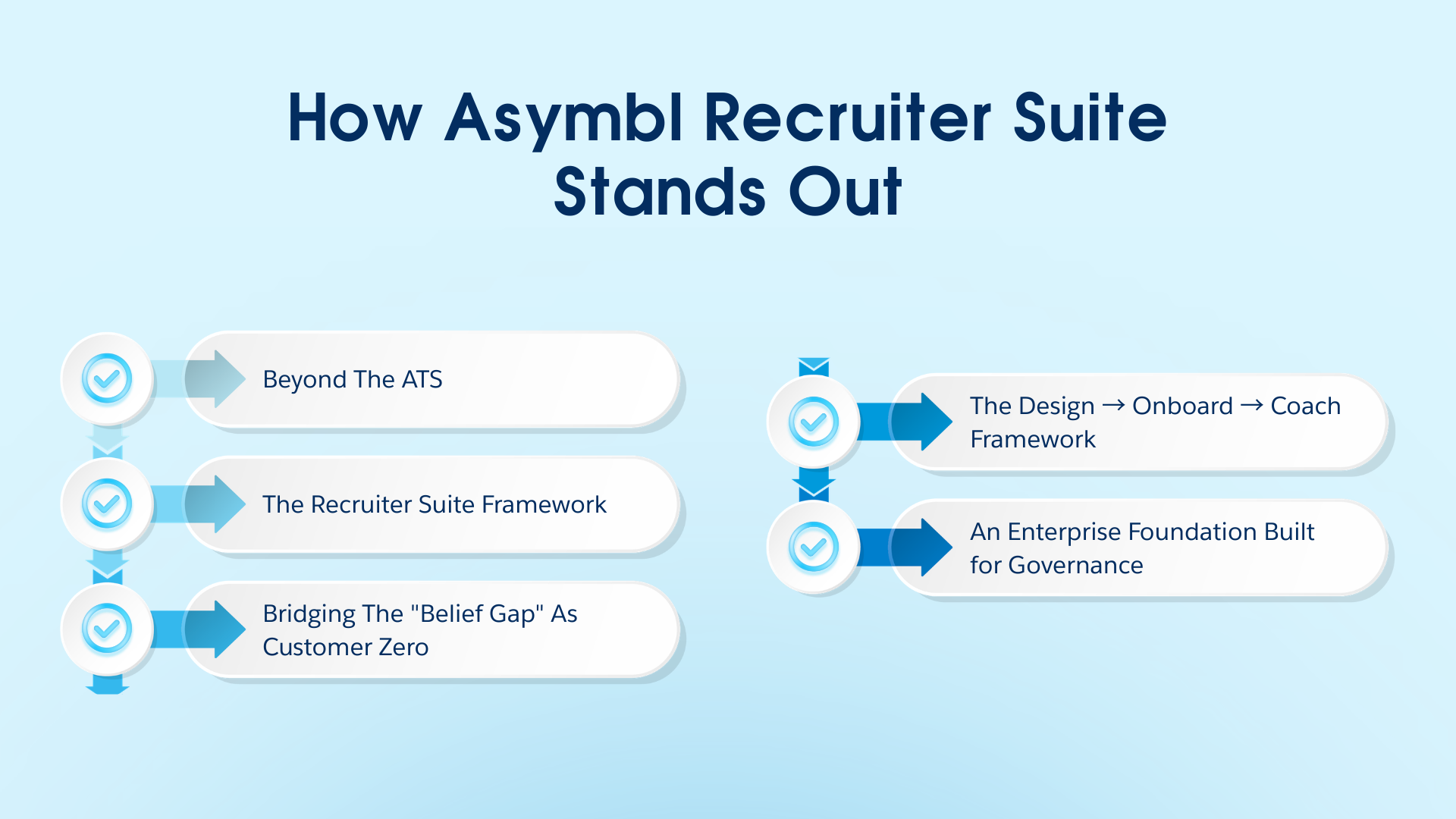
By unifying nurturing, sourcing, matching, and placement within a single environment, and on top of Salesforce, Asymbl eliminates the "swivel-chair" friction that traditionally erodes recruiter productivity.
1. Beyond The ATS
Modern talent acquisition requires a shift from managing static records to managing operational flow. Asymbl reframes the recruiting platform from a "digital filing cabinet" into an environment of action.
By unifying the full hiring lifecycle into one workspace, we transition the recruiter’s role from administrative record-keeping to proactive workforce orchestration. This architectural alignment ensures that talent acquisition is a core component of your Salesforce ecosystem, not a peripheral silo.
2. The Recruiter Suite Framework
The Asymbl ecosystem is built on three functional pillars designed to maximize enterprise throughput:
- Recruiter Suite: The primary workspace where human recruiters focus on high-value strategic judgment, such as candidate trust, cultural alignment, and closing negotiations.
- Agentforce Suite: The domain of digital labor. These digital workershandle deterministic bottlenecks, including high-volume screening, 24/7 sourcing, and complex scheduling, at a scale impossible for human teams alone.
- Asymbl Intelligence: Proprietary data-driven logic that serves as the connective tissue, providing real-time visibility into candidate behavior, fit, and process velocity.
3. Bridging The "Belief Gap" As Customer Zero
We mitigate the risk of "pilot purgatory" by serving as our own Customer Zero. Asymbl uses its own technology to solve complex internal hiring challenges, providing empirical proof of the platform’s efficacy.
In a recent high-volume hiring cycle, our internal Recruiter Agent reviewed 17,000 applications, pre-screened 1,800 candidates, and scheduled 800 interviews. This was not an isolated pilot. It was a live operation managed through the Recruiter Suite that delivered a 1,529% ROI.
4. The Design → Onboard → Coach Framework
To ensure long-term ROI, Asymbl moves beyond "set-and-forget" implementation toward a continuous optimization model:
- Design: We define the optimal workforce mix, establishing the functional boundaries between human recruiters and digital workers.
- Onboard: We align digital workers into the flow of work, ensuring they are governed by the same KPIs and operational guardrails as your human team.
- Coach: We provide iterative refinement as the business scales, ensuring the orchestration model evolves alongside market demands to prevent process calcification.
5. An Enterprise Foundation Built for Governance
While Asymbl anchors on Salesforce, the value lies in the Institutional Governance that this foundation provides. By leveraging Salesforce as the single source of truth, Asymbl provides enterprise-grade security and "clicks-not-code" configurability.
This allows talent leaders to connect hiring velocity directly to business outcomes, such as revenue and retention, within a unified data model that requires zero manual synchronization.
Conclusion
By shifting from a "tools-first" mindset to a strategy of Workforce Orchestration, you can scale your capacity, improve your candidate experience, and align your talent acquisition with your core business goals.
The future of hiring is about having the best coordination between the talented people you employ and the powerful technology you deploy. It’s about building a hybrid workforce that is greater than the sum of its parts.
As you look at your own recruiting function today, here are a few questions to reflect on:
- Are your recruiters spending more time fighting your software than talking to candidates?
- If your hiring volume doubled tomorrow, would your current system break?
- Is your technology capturing the "wisdom" of your team, or is that knowledge walking out the door every time someone leaves the company?
The answers to these questions will tell you everything you need to know about your next move.
If your team is still fighting spreadsheets and "swivel-chair" workflows, you haven't reached true scale. Book a demo to see how Asymbl delivers Workforce Orchestration without adding headcount.
FAQs
Recruiting software improves quality of hire when it enforces structured workflows, standardized scorecards, and measurable success criteria. Instead of relying on memory or subjective impressions, teams evaluate candidates against defined competencies and performance signals.
When integrated with performance data, the system can surface patterns between hiring decisions and long-term outcomes. The impact depends on governance and data integrity. Software alone doesn’t improve quality. Structured execution does
Beyond time-to-fill, leaders should measure quality of hire, pipeline conversion rates, recruiter capacity per requisition, and candidate response velocity. Additional indicators include reduction in manual hours spent on administrative tasks and improved hiring manager satisfaction.
ROI becomes visible when digital workflows consistently reduce variability and increase decision confidence. The strongest signal of value is sustained improvement across hiring cycles, not short-term activity spikes.
A strong migration plan includes workflow redesign, data mapping, historical note preservation, compliance validation, and stakeholder training. It should define ownership for each hiring stage and establish governance rules before data transfer begins. Testing should simulate real hiring scenarios, not just technical validation. Migration success depends on protecting institutional memory and ensuring recruiters can operate at full velocity immediately after go-live
A recruiting CRM is designed for top-of-funnel orchestration, focusing on nurturing passive leads and building long-term talent pipelines before a vacancy exists.
Conversely, an ATS governs deterministic execution and compliance for active applicants moving through structured hiring stages. Integrating both into a single operating system eliminates data fragmentation and the "swivel-chair" experience for recruiters.
Recruiting workflows should be reviewed quarterly or whenever business priorities shift significantly. Role requirements evolve, labor markets change, and performance criteria adjust over time. Without recalibration, automation scales outdated assumptions. A structured review process ensures digital execution aligns with current hiring goals and prevents process calcification. Continuous optimization sustains long-term recruiting software ROI
.webp)
Quality of Hire: From Vague Metric to Measurable Signal
Improving quality of hire starts before the offer. Find out how corporate and staffing teams raise their quality of hire.

The Right Fit Starts With a Conversation.
See what working together could look like.
.webp)