

AI Sourcing Tools That Activate the Right Candidates at the Right Time
Most enterprise hiring teams are still buying AI sourcing tools the way they bought job boards in 2014. Feature parity, dataset breadth, and query speed dominate the evaluation.
Sourcing gets treated as a discrete capability inside the recruiting workflow, and the tool sits in the stack as an isolated layer that the recruiter has to integrate manually with the ATS, the CRM, the outreach tool, and the scheduling system.
According to “The State of AI in the Enterprise: The Untapped Edge” Deloitte 2026 Report, 60% of the largest enterprises have AI implemented in HR, with recruiting holding the biggest share at 27%.
While the category has matured, the sourcing pipelines have not. The gap is often seen in how sourcing is defined. Traditional AI sourcing tools for recruiters answer one question well. Who matches this query in the external talent pool right now?
In this blog, we will examine what AI sourcing tools do today, where they break against enterprise hiring, and the buying criteria that separate pipeline-grade tools from list-grade tools.
What AI Sourcing Tools Do Today
The current generation of AI sourcing tools for recruiters is built around external candidate discovery. The unit of work is the search query, the data source is the public internet plus licensed third-party datasets, and the output is a ranked list of candidates the tool believes match the query.
Every major vendor in the category, from the LinkedIn-native suites to the standalone AI sourcing platforms, is operating against roughly the same architecture.
The tools scrape and aggregate profile data from LinkedIn, niche job boards, talent marketplaces, GitHub, professional communities, and any other public surface where candidates leave a footprint.
The data layer enriches each profile with external signals such as estimated tenure, inferred skills, public contributions, and behavioral patterns that the vendor has trained on across its dataset.
Boolean search, keyword search, and semantic search all run against this aggregated external pool. The recruiter types a query, the tool returns candidates, and the workflow proceeds to outreach.
The AI layer adds three capabilities on top of the search foundation:
- Semantic search: Interprets the intent behind a recruiter's query rather than matching it literally, returning candidates whose profiles describe the same work in different words.
- Ranking algorithms: Score each candidate against the query and order the result set so the strongest fits surface first.
- Automation: Handles the repetitive parts of the workflow, such as draft outreach, sequencing, and follow-up cadence, freeing the recruiter from manually composing every message in the campaign.
The result is a sourcing motion that is faster, broader, and less manual than the Boolean-driven approach the function ran a decade ago.
For example, a recruiter who once spent three hours building a candidate list now spends fifteen minutes.
However, the current model is still search-driven and externally focused. Generic AI sourcing tools answer one question well “Who in the external talent pool matches this query right now?”
They skip the questions that matter most when enterprise hiring outcomes get measured at the system level:
- Who is already in our system?
- Who has shown interest in us before?
- Who is most likely to respond now, given the engagement signals we already hold?
The architecture was designed to acquire candidates, but not to activate them.
Where Traditional AI Sourcing Tools Break
The same architecture that gives traditional AI sourcing tools their reach also defines their ceiling. The tools were built for external candidate discovery as a standalone activity, and the assumptions baked into that design no longer match how enterprise talent acquisition functions actually need sourcing to work.
.png)
Five structural breakdowns show up consistently across enterprise teams running the standard AI sourcing stack.
1. Limited To External Data, Not Your System Of Record
Traditional AI sourcing tools operate on external data, like:
- Public profiles
- Scraped social signals
- Licensed third-party datasets
- Aggregated marketplace records
The assumption is that the most valuable candidates for the next requisition are somewhere in that external pool, waiting to be discovered.
However, most enterprise recruiting teams already have thousands of past applicants, hundreds of silver medalists, dozens of finalists who declined, and a CRM full of previously engaged candidates.
Unfortunately, conventional AI sourcing tools cannot read any of that. The internal candidate system is invisible to a tool whose architecture only knows how to query external data sources, and the function ends up paying to acquire the same candidates twice.
The hiring teams end up rediscovering the same candidates through cold sourcing, paying the acquisition cost a second time, and writing off the prior investment without realizing it ever happened.
2. No Access To Relationship Context
Even where traditional AI sourcing tools can read internal data through an integration, they cannot read relationship context.
The recruiter's prior conversations with the candidate, the engagement history across campaigns, the response patterns, the interview feedback from a previous round, all of that context lives in the recruiter's head, the ATS notes, the CRM activity log, and the outreach platform separately, and the sourcing tool sees none of it.
The result is that every search the tool runs is a cold start. A candidate the firm has interviewed three times surfaces the same way as a candidate the company has never spoken to.
The tool ranks them on profile fit, ignores the fact that one of them already knows the company well, and produces a list where the recruiter has to manually annotate which candidates carry warm relationships and which do not.
The relationship context that should be the organization’s most valuable sourcing asset becomes invisible at the moment of search, and the recruiter has to reconstruct it, candidate by candidate.
The cold-start problem also limits what AI ranking can do. Ranking algorithms work best when they have a rich signal to score against.
Strip out the relationship signal, and the algorithm falls back on profile-fit alone, which is a fraction of what determines whether a candidate will respond, engage, or accept.
3. Keyword Matching Instead Of Intent And Interest Signals
Even with semantic search layered on top, generic AI sourcing tools still rely fundamentally on what candidates ARE. Job titles, listed skills, tenure, location, and inferred experience populate the match. The tool is comparing the candidate's static profile to the static job description and producing a score based on the overlap.
What the model misses is the dynamic signal. For example:
- Candidate engagement behavior
- Responsiveness to prior outreach
- Recent career movement
- Public signals of intent to switch
All of these signals carry information about what a candidate is likely to do next. A passive candidate who matches the role on paper but never opens a recruiter message is a different prospect than a passive candidate who matches the role on paper and recently liked three of your company's posts.
The mismatch has measurable downstream cost. Outreach response rates plateau because the candidates surfaced by profile fit are not the candidates with the highest current intent.
The function ends up working harder on lists that are mathematically optimized for the wrong objective. The score the tool produces describes who looks right on paper, and the question the function actually needs answered is who is most likely to respond and convert this quarter.
4. Mechanical Search Instead Of Contextual Understanding
Conventional AI sourcing tools execute a mechanical pattern of the following steps
- Query in
- Filter applied
- Results scanned
- List returned.
The tool does the search faster than a recruiter could, and the search itself is the same kind of operation a recruiter would have run manually. The intelligence is in the speed and the ranking, not in the understanding of what the query actually represents.
What the model misses is context. The same job title, "Senior Account Executive", means different things in two different parts of the same organization.
Hiring urgency varies sharply across requisitions, with some roles needing a fill in two weeks and others operating on a six-month strategic window. Team composition shapes which candidate profile actually fits, with a balanced team needing a different hire than an imbalanced one.
A mechanical search engine treats every query the same. The recruiter gets the same kind of result for an urgent backfill and a strategic future hire. The hiring manager who needs a specific functional skill profile gets the same kind of result as the hiring manager who needs cultural fit above all else.
The contextual nuance that experienced recruiters carry in their judgment, the read on which kind of candidate this team actually needs, has nowhere to live inside a generic sourcing tool.
The recruiter applies the context manually after the tool produces the list, which is where the workflow stops feeling like AI and starts feeling like a slightly faster version of the old job.
5. Sourcing Stops At Discovery, Not Pipeline Creation
An AI sourcing tool produces a list and hands it off, saying, "Here are the candidates who match." The recruiter takes the list, runs the outreach, manages the responses, schedules the conversations, and shepherds the warm candidates through the rest of the funnel.
The sourcing motion ends at discovery, and everything downstream is on the recruiter and the rest of the stack.
The handoff is where most of the value leaks out. The candidates who respond enter the company’s pipeline, but the tool that surfaced them stops tracking the relationship the moment the message is sent.
The candidates who do not respond stay in the external pool the next time someone runs a search, with no record that the firm already reached out, what the message said, or how the candidate behaved.
The non-responders who later show interest, who change roles, who become more accessible, never get re-surfaced automatically because the tool was never designed to maintain ongoing pipeline activation.
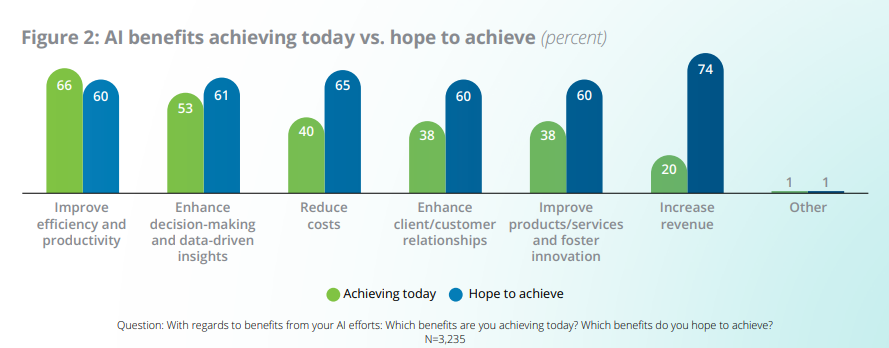
According to Deloitte’s “State of AI in the Enterprise: The Untapped Edge” 2026 Report, 74% of organizations expect to grow revenue through their AI initiatives in the future, while only 20% are already doing so today.
The investment-to-outcome gap shows up every time discovery hands off to a manual workflow downstream
Sourcing as discovery and pipeline creation are different operations. Discovery is one-time, whereas pipeline creation is continuous.
AI Sourcing: From External Search To Contextual Pipeline Intelligence And Building
The modern AI sourcing model is contextual, continuous, and connected.
- Contextual means the sourcing layer reads the organization's own engagement history, prior interactions, and outcome data alongside the external candidate pool, and produces matches that reflect the full picture rather than the public profile.
- Continuous means the sourcing motion runs whether or not a specific requisition is open, maintaining persistent pipelines and re-evaluating candidates as situations change, rather than restarting from scratch each cycle.
- Connected means the sourcing layer feeds and is fed by the rest of the recruiting function, with engagement data, screening outcomes, interview feedback, and hire decisions all flowing back into the model that decides who gets surfaced next.
Four structural changes define this shift:
- Internal and external data unify into a single talent picture, so the sourcing layer reads silver medalists, prior applicants, engaged passives, and external candidates against the same scoring model.
- Sourcing operates on signal-based logic rather than keyword logic, scoring candidates on engagement behavior, intent indicators, response patterns, and current readiness alongside profile fit.
- Pipeline activation runs continuously, with the system re-engaging warm candidates when situations change rather than waiting for a recruiter to remember they exist.
- The sourcing layer integrates natively with the rest of the recruiting platform, so every signal generated downstream feeds back into the model that decides who gets surfaced next.
Sourcing in this model is an intelligent system that activates the right candidates at the right time, with the right context, against the right requisition, drawing on every signal the firm holds about every candidate it has ever touched.
What To Look For In AI Sourcing Tools
The questions that separate sourcing tools that produce lists from sourcing tools that build pipelines are different.
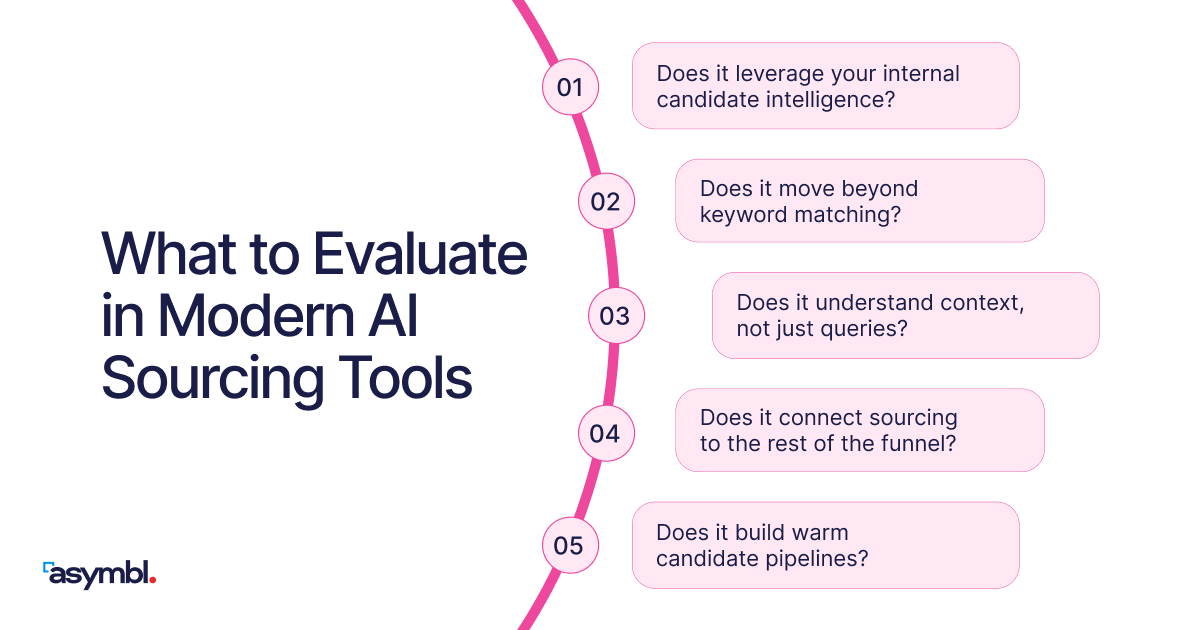
The following five buying criteria define the difference, and each one corresponds to one of the structural breakdowns named above.
1. Does It Leverage Your Internal Candidate Intelligence?
A sourcing tool that ignores the existing talent pool data is operating on a fraction of the candidate pool that actually matters for the company's next hire.
A tool that lives outside the organization's system of record can integrate with the ATS or CRM through an API, but the integration produces a partial picture at best.
The sourcing tool reads what the integration exposes, misses what it does not, and operates on a delayed copy of the data while the live record updates somewhere else.
The architecture that produces a unified view of the candidate is one where sourcing, engagement, screening, interviewing, hiring, and post-hire data all share the same primary record.
Asymbl Talent Intelligence is Salesforce-based, which means the candidate, requisition, engagement history, prior interview outcomes, and hire decisions all live in the same data model.
Talent Intelligence reads the organization's database natively, surfaces top talent across available, in-contact, and prior placement pools, and treats internal candidates as first-class results rather than as data the tool happens to be able to query.
2. Does It Move Beyond Keyword Matching?
Keyword and Boolean matching look for string overlap between the query and the profile. Semantic search improves on this by interpreting intent, but still operates fundamentally on the static profile.
The richer evaluation reads the full context behind each candidate, including pipeline history, prior interview feedback, assignment outcomes, and the unstructured documents the firm has accumulated across years of engagement.
Asymbl Talent Intelligence is the recruiter brain leveraging the Asymbl Intelligence platform. It goes beyond resume structure and keyword matching to incorporate pipeline history, interview feedback, assignment outcomes, and unstructured documents into a continuously improving model of candidate fit.
The AI Matching Engine scores candidates against jobs and jobs against candidate profiles using AI fit analysis, and returns a structured breakdown of how each candidate's qualifications map to what the role demands.
A function evaluating sourcing tools should ask the vendor to walk through a scored candidate against a real role and explain the score. The vendors whose tools operate on keyword matching cannot answer the question past surface-level fit. The vendors whose tools operate on reasoning over rich signals can.
3. Does It Understand Context, Not Just Queries?
Two queries with identical strings can describe two different hiring situations, and a tool that treats them the same misses the read that experienced recruiters apply automatically. Hiring urgency, team composition, and business priorities all shape what kind of candidate actually fits, and the sourcing tool needs to read that context as part of the search rather than after it.
Asymbl Intelligence is the learning layer that captures the judgment, context, and pattern recognition that accumulates across every workflow and decision on the platform.
Every placement, debrief, and outcome makes the model smarter, and the natural language search experience that replaces Boolean lets recruiters ask questions in the way they think about the role rather than translating the role into a query syntax.
Natural language search is the surface signal that the underlying model understands context. A recruiter asking for "a senior product manager who has shipped at zero-to-one stage and would consider relocating for the right role" is describing a hiring situation, not a Boolean string.
4. Does It Connect Sourcing To The Rest Of The Funnel?
A sourcing tool that lives outside the recruiting platform produces lists that have to be moved into the ATS, the CRM, the outreach tool, and the scheduling system manually, with the recruiter doing the integration work that the architecture should have done. Each handoff loses signal, and the sourcing-to-hire data round-trip never closes.
Asymbl Digital Recruiter operates end-to-end inside the same Salesforce-based platform. Sourcing flows directly into engagement, engagement flows directly into screening, screening flows directly into interview coordination, all working off one record per candidate, in one data model.
Asymbl Talent Intelligence is the Recruiter Brain underneath that funnel. It lives inside Recruiter Suite, not bolted on through an integration, and powers every signal Digital Recruiter acts on like:
- Candidate fit
- Role match
- Placement likelihood
- Pipeline context.
Every action the agent takes and every outcome the team records, a hiring manager debrief, an interview score, a placement, a drop-off, feeds straight back into the intelligence layer that decides who gets surfaced next.
There is no separate integration to sync, no candidate data going stale in a sourcing tool that cannot see what happened downstream. The funnel is the platform, the platform is the data model, and the data model is the one Talent Intelligence learns from.
The Digital Recruiter runs candidate outreach at scale, screens responses against role criteria, schedules interviews, and feeds qualified candidates into the active pipeline, with every action recorded in the same data model the human team operates against
The recruiter and hiring manager see one record per candidate, while the candidate sees one coherent process.
According to the 2025 Gartner Survey on AI Candidate Evaluation Fairness, only 26% of job applicants trust AI to fairly evaluate them, which means the difference between a fragmented stack and an integrated one is also the difference between candidates who self-select out and candidates who stay in the process
5. Does It Build Warm Candidate Pipelines?
Does the sourcing tool produce a warm candidate pipeline that the function can operate against, or a list that the recruiter has to work through? A list is one-time, but a pipeline is continuous.
Asymbl Talent Intelligence surfaces top talent across available, in-contact, and prior placement pools.
- Available candidates are the active prospects ready to engage now.
- In-contact candidates are the warm relationships in active or recent conversation.
- Prior placement pools are the silver medalists, finalists, and previously placed candidates whose context the business already holds.
A sourcing tool that produces a pipeline reads all three pools and returns candidates from whichever pool offers the best combined fit and intent.
When Asymbl launched Rosa, our Digital Recruiter Agent, launched on Salesforce Agentforce, the agent helped the firm hire 100 people in 100 days, processing 17,000 applications, pre-screening 1,800 candidates, and scheduling 800 interviews, driving a 152x ROI.
The recruiting digital worker division operates at 26x ROI, with $300,000 in projected productivity impact and 21 hours per week reclaimed for the human recruiting team. None of that output comes from running faster external searches.
It comes from sourcing operating as a continuous pipeline activation engine, with resume screening at scale, personalized outreach generation in 30 seconds per candidate, voice qualification running 24/7, natural language ATS queries, and 100% screening compliance with a full audit trail.
A function evaluating AI sourcing tools should test the pipeline question explicitly. Ask the vendor to demonstrate, on a hypothetical role, what the system surfaces from the company's prior pipeline alongside the external pool. Also, ask
- What happens to a candidate who does not respond on the first cycle?
- Does the tool reactivate warm candidates when their situation changes?
- How does sourcing signal feed back into the model that decides who gets surfaced next?
The vendors whose architecture supports pipeline-grade sourcing answer these questions concretely, whereas the vendors whose architecture supports list-grade sourcing redirect the conversation back to query speed and dataset breadth.
Conclusion
Two enterprise talent acquisition functions running identical AI sourcing stacks will produce different pipeline outcomes a year from now.
The difference shows up upstream of the search itself, in whether the system reads the organization's ecosystem alongside the external pool, scores candidates on intent alongside fit, and treats every prior interaction as a signal that compounds into the next hire.
The functions still optimizing for faster external discovery are sharpening the part of sourcing that no longer creates separation, while the functions building contextual pipeline intelligence are accumulating an asset every cycle.
By the third year, the gap between the two is unrecoverable. Three questions are worth sitting with before the next sourcing renewal.
- If sourcing ran tomorrow on a live role, how many of the strongest candidates would come from your company’s existing database rather than external search?
- When a candidate does not respond on the first outreach, does any system in the stack remember the attempt and re-evaluate the candidate when the situation changes?
- When sourcing surfaces a candidate, does the rest of the recruiting function see the full prior history with the company, or does the workflow restart at engagement?
Asymbl helps enterprise recruiting teams move from list-grade sourcing to pipeline-grade sourcing. Book a demo with Asymbl to see how contextual pipeline sourcing operates in practice, calibrated to your hiring volume and operating model.
FAQs
AI sourcing tools for recruiters are technologies that automate parts of candidate discovery, evaluation, and outreach using machine learning, natural language processing, and increasingly agentic AI.
Most AI sourcing tools fall short because they are built for external candidate discovery as a standalone activity. They search public data, ignore the firm's internal candidate ecosystem, miss the relationship context that determines response probability, rank on profile fit rather than current intent, and stop at discovery instead of building pipelines.
Sourcing is the act of discovering candidates for a specific need. Pipeline building is the continuous practice of maintaining persistent talent pools, segmented by readiness, against current and anticipated hiring needs.
Recruiters should use AI for sourcing as a pipeline operation, not a search transaction. The strongest pattern combines internal-ecosystem access, signal-driven matching, contextual understanding of the role, native connection to the rest of the recruiting funnel, and continuous activation of warm candidates as their situation changes.
An AI sourcing tool works well when it can read the firm's past applicants, silver medalists, finalists who declined, engaged passives in the CRM, alumni, internal mobility candidates, prior engagement history, interview feedback, assignment outcomes, and post-hire performance data, all against a single canonical candidate record.
Measure AI sourcing tools on pipeline-grade outcomes rather than search-grade outputs. Pipeline coverage by skill family, share of hires sourced from prior pipeline, response and conversion rates by candidate segment, recruiter capacity reclaimed, and time-to-fill against forecast all describe whether the tool is producing system-level lift.
.webp)
The Candidate Tracking System Built for Modern Hiring
Understand what applicant tracking is, how candidate tracking software works, and where most platforms break at the seams

The Right Fit Starts With a Conversation.
See what working together could look like.
.webp)