

Voice AI Screens Candidates. Recruiters Nurture and Place Them

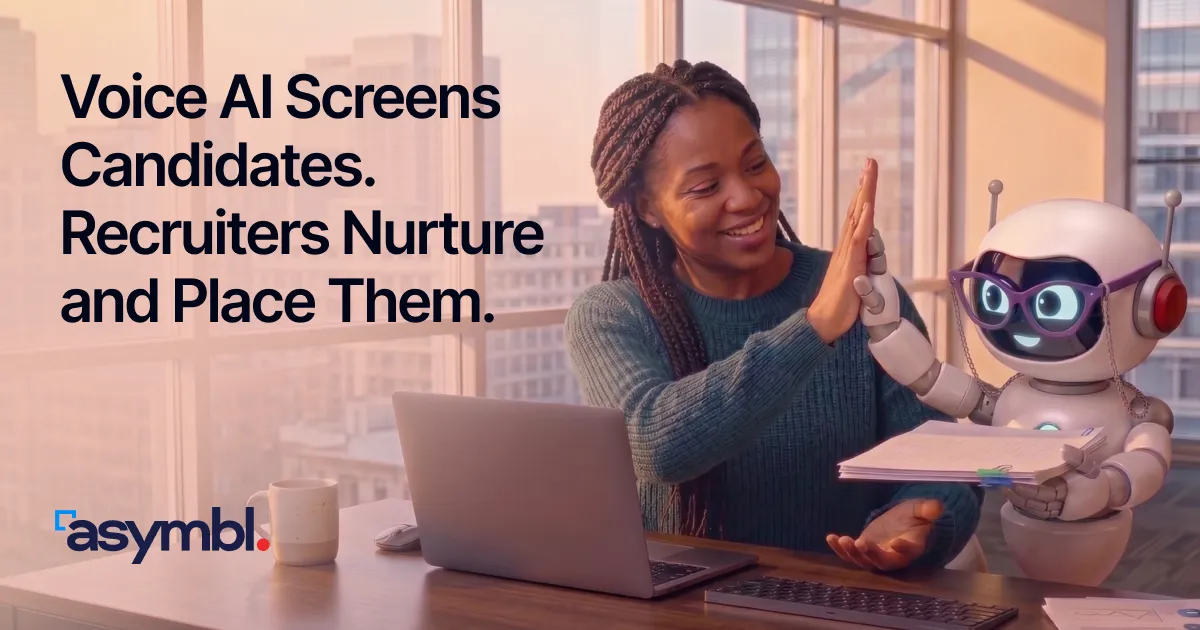
An AI voice reached a candidate no recruiter had called in three years and placed him. The candidate was so impressed by the experience, he emailed the staffing firm's founder with praise. The story, reported by Staffing Industry Analysts earlier this summer, pinpoints the question every staffing leader is already sitting with: what changes for the recruiter when voice AI can run the front end of recruiting.
I've spent the last year building voice into our pre-built AI-powered digital worker; Rosa, a Digital Recruiter. The first thing I'll tell you is that vocal realism isn't what made that placement.
Voice capabilities can add capacity and speed to a recruiter's workflow, but their work begins before when they have to start by:
- Searching three years of records
- Matching the candidate to the right role
- Deciding he was worth the re-engagement call
While voice delivered the conversation, the recruiter's skills and staffing software supported the sourcing, matching, and screening logic to drive the outcome. Understanding how to design the system across people, AI, and software is what we call workforce orchestration.
When staffing leaders evaluate voice AI we recommend they think of it as a delivery channel rather than the core intelligence. Firms should first design their ideal recruiting workflow and then identify the right software or AI solutions that can help drive their outcomes.
Where Voice Earns Its Place in the Funnel
Voice capabilities pay off when they’re supporting recruiting tasks that don't need a recruiter's judgment to complete. While conceptually simple, it's the core design decision lots of firms skip.
The SIA piece highlights the clearest example: re-engagement. A candidate sits in your database for years simply because recruiters lack the bandwidth for routine check-ins. Voice AI removes that constraint. A digital worker can reach across an entire ATS stage or contact list in a single action, confirm interest, ask screening questions, and sort candidates by fit before a recruiter ever picks up the phone.
Scheduling is the other place voice earns its keep. We built Rosa's voice scheduling to work the way a recruiter would if they had unlimited time. She places the call, confirms the candidate's interest, checks the interviewer's live availability in Salesforce, and books the interview directly on the record. The calendar block, meeting link, and call summary write back into Recruiter Suite automatically, eliminating system toggling. This is a purpose-built recruiting workflow with a specific step operating over the phone.
Timing matters too. Adecco Group reported that most of their voice AI conversations in the UK happen outside business hours. This data aligns directly with our observations in the product. Candidates respond on their own schedules, and Rosa maintains 24/7 availability without requiring extra staffing shifts, reducing overhead for firms.
The throughline across re-engagement, scheduling, and after-hours coverage is clear: voice AI excels at volume-heavy, highly structured work that is valuable enough that leaving it unaddressed actively drains pipeline potential. It expands total reach rather than replacing human contact, capturing high-volume touchpoints recruiters would otherwise never have time to make.
Where Human Judgment Stays in Charge
Voice AI can execute front-end tasks flawlessly, but it can’t evaluate whether a candidate is the right hire.
As voice technology matures, staffing leaders need to maintain a clear boundary between automated execution and human verdict. While some in the industry argue AI should never run end-to-end, the reality is more nuanced: AI-powered digital workers can manage far more of the funnel than many organizations realize, provided human judgment is intentionally built into the handoff points.
Closing is where human expertise matters most:
- Navigating complex compensation negotiations
- Reading emotional resonance versus superficial interest
- Evaluating cultural alignment, a judgment living in a recruiter’s experience rather than a data field
SIA research confirms that candidate conversion remains the single most critical step in the hiring process. We designed Rosa around this dynamic: running structured execution upstream so recruiters receive pre-qualified, scheduled candidates ready for high-stakes closing conversations.
Governance and regulatory compliance present another critical boundary. Regulations like the EU AI Act and NYC Local Law 144 mandate human oversight in automated employment decision-making. Organizations deploying unmonitored voice tools face unseen legal and audit risks. Ensuring every conversation summary and decision log is recorded directly within Salesforce converts passive compliance hope into verifiable governance.
This aligns with our core operating principle: the right work for the right worker. Voice AI handles high-volume execution, while recruiters focus on the human evaluation that closes hires. Achieving that balance, however, requires designing those transition points before turning on the phone.
Design the Handoffs Before You Turn on the Phone
Evaluating voice AI requires looking past vocal realism to focus on the underlying workflow design.
Designing Rosa required mapping every transition point before launching outreach: defining where automated execution runs, where the recruiter steps in, and what structured context crosses over. Recruiters receive pre-screened candidates with complete call logs embedded directly into their workflow, allowing them to initiate closing conversations without administrative friction.
When voice capabilities are embedded directly within the recruiting workflow engine (linked to candidate records, calendars, and audit logs) the handoff becomes an automated transition rather than a manual gap. The voice delivers the conversation, but the workflow engine creates the placement.
Adopting voice AI is ultimately an operational design exercise. Staffing organizations that prioritize workflow architecture first unlock scalable capacity while preserving the human connections that convert candidates into placements.
Explore the voice capabilities of Rosa, a Digital Recruiter.
.png)
Start Your Agentic AI Implementation in Recruiting
Autonomous AI hiring tools stall without defined roles and escalation rules. See how to implement AI agents in hiring the right way

The Right Fit Starts With a Conversation.
See what working together could look like.
.webp)