


For years, recruitment management systems promised structure, visibility, and compliance in what had traditionally been a manual, linear process. However, the assumption that hiring is linear no longer exists.
Candidates now engage with employer brands long before they submit an application. Talent moves fluidly across functions, roles, and engagement types. Digital workers participate in screening, coordination, and outreach. Executives require hiring data tied not to job requirement counts but to revenue forecasts and capacity plans.
Yet most recruitment management systems still operate on an architecture designed for administrative control. They were built to manage candidates. The workforce most enterprises are actually building requires something different.
Most organizations already have some version of a recruitment management system. However, the important question to ask is whether it was designed for the workforce your organization is planning to build.
What Are Recruitment Management Systems?
A Recruitment Management System (RMS) is a software platform that manages and automates the entire hiring process, from job posting and candidate sourcing to screening, interviewing, and hiring decisions.
It centralizes candidate data, tracks applicants through the recruitment pipeline, and enables collaboration between recruiters and hiring managers. Recruitment management systems often include automation, analytics, and integrations with job boards and HR tools to improve hiring efficiency, visibility, and decision-making.
By organizing recruiting workflows and candidate information in one platform, an RMS helps organizations streamline hiring operations, reduce administrative work, and make more data-driven talent acquisition decisions.
Why Traditional Recruitment Management Systems Are Breaking Down Under Modern Hiring Demands
Legacy recruitment systems were stress-tested by two shifts they were never designed to absorb
- Hiring stopped being a discrete event
- Volume stopped being manageable through human effort alone.
Neither problem is new. Both have been building long enough that the architectural weaknesses are now difficult to ignore.
Hiring Is No Longer Episodic
Legacy recruitment management systems were designed around a single trigger, job requirement opening.
- A role opens.
- The system activates.
- Candidates apply.
- The role closes.
- The system resets.
This architecture made sense when hiring was discrete and bounded. Modern talent engagement does not follow that sequence.
Candidates join talent communities months before a relevant role exists. Internal employees explore lateral moves while still performing their current jobs. Silver medalists from a previous search resurface when a new role opens. Referral pipelines develop continuously, independent of any active job requirement.
Legacy systems never built to capture this context. When a candidate interviews, engages with outreach, and gets flagged as a strong future fit, those signals are usually in a recruiter's head, their email thread, or a sticky note. The system just holds the status of the application, while the human holds the context behind it. This gap is the architectural failure.
Relationships compound over time but most recruitment management systems reset instead. A recruiter spends weeks building context with a candidate. They learn how that person communicates, what motivates them, where they hesitated in the last process, why they were not quite right for the previous role but could be right for the current one.
A new role opens. The system presents that candidate as a fresh record. The recruiter is back at the beginning, rebuilding trust and context that already existed, because the system has no way of knowing it did
Volume Has Exposed Architectural Weaknesses
When hundreds or thousands of applications hit a platform built around manual review and human-dependent decision points, specific failure patterns emerge:
- Status changes replace signals: Recruiters are evaluated time-to-fill, pipeline activity, and stages completed. When these are the metrics that determine performance, advancing a candidate becomes a way to hit a number rather than a record of genuine evaluation. The stage of the candidate moves but the signal never forms.
- Recruiter fatigue introduces inconsistency: Evaluation criteria that seemed clear in week one drift by week four, producing a candidate pool assessed against shifting standards.
On the surface, the process appears to be working. Underneath, performance plateaus. The constraint is not recruiter effort or candidate quality but the architectural design of the system, which was never built to govern high-volume, continuous hiring at enterprise scale.
How Legacy Recruitment Systems Are Failing Modern Hiring Teams
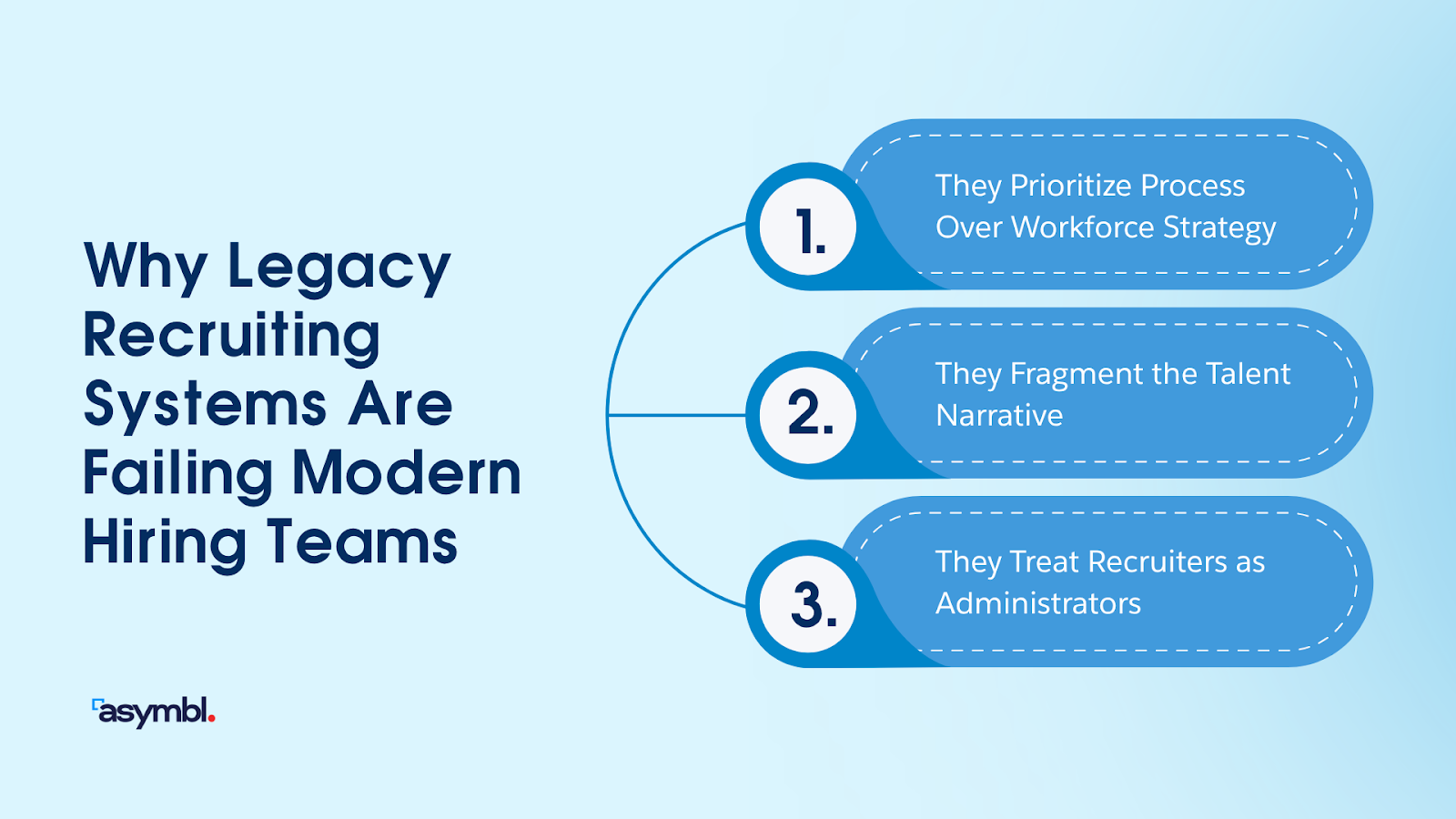
The failure of legacy recruitment systems is rarely visible at the transaction level. It accumulates beneath the surface activity, in the strategic decisions that never get made, the workforce data that never gets unified, and the recruiter capacity that gets consumed by work a well-designed system should never have required of a human in the first place.
1. They Prioritize Process Over Workforce Strategy
Most legacy recruitment management platforms were optimized for workflow routing.
- Applications received.
- Resumes reviewed.
- Interviews scheduled.
- Offers approved.
- Positions closed.
Hiring determines workforce composition, skill distribution, and cost structure. The cumulative effect of thousands of individual hiring decisions shapes whether an organization has the capacity to execute its roadmap, whether its teams are built for the work ahead, and whether its labor costs are aligned with its growth model.
When recruitment management software focuses solely on moving candidates through stages, it it has no answer for the talent problem executives are actually trying to solve. Revenue growth and margin improvement increasingly depend on people who can adopt and manage AI inside real business processes.
Legacy systems were not built to evaluate that. They were built to match keywords to job descriptions and move records through a pipeline. This requires a judgment call that requires contextual intelligence most recruiting systems were never built to surface
It manages individual transactions but does not inform the strategy those transactions are supposed to serve. It results in TA teams executing at high volume while operating with limited visibility into whether that volume is producing the workforce the business actually needs.
2. They Fragment the Talent Narrative
A single individual can exist across a modern enterprise in multiple forms simultaneously.
A marketing professional who applied for a role two years ago, contracted on a project last year, and is now being considered for a full-time position may have records scattered across an ATS, a vendor management system, a CRM, and a spreadsheet maintained by a hiring manager who remembered them.
Each system holds a fragment and none holds the full picture. This fragmentation distorts reporting that compounds over time.
Candidate experience suffers because recruiters lack context when re-engaging someone with a history in the organization. Workforce visibility weakens because no consolidated view of talent across relationship types and time periods exists. Strategic decisions get made on partial data.
Without a unified talent record that persists across roles, engagement types, and time, the business pays for it in ways that rarely get attributed to recruiting infrastructure.
Longer time-to-fill means delayed revenue capacity. Rebuilding relationships from scratch with candidates already in the pipeline means wasted recruiter hours. Missed re-engagement opportunities with former candidates mean external search costs that internal data could have avoided.
The efficiency loss shows up in revenue targets and margins
3. They Treat Recruiters as Administrators
The architecture of most legacy systems implicitly defines what a recruiter's job is and in most cases, it defines that job as moving records.
- Update the stage.
- Log the call.
- Send the status email.
- Schedule the interview.
- Generate the report.
Modern recruiting demands something different from the humans doing it.
Today's recruiter is expected to advise business leaders on workforce mix, interpret labor market shifts in the context of specific hiring needs, partner with finance on headcount planning, and increasingly, oversee the digital workers handling the repeatable execution work that used to consume the recruiter's day.
When system architecture buries recruiters in administrative throughput, it limits their ability to operate at that level. The problem is not that recruiters lack the capability to advise on workforce strategy or interpret labor market signals.
The problem is that the system consumes the time and attention those contributions require before recruiters ever get the chance to make them.
Architecture shapes role definition. In organizations still running legacy recruitment management platforms, it often keeps recruiters operating well below the strategic contribution they could otherwise make.
The Core Assumption Behind Most Recruitment Systems Is Now Wrong
Every system is built on assumptions. The assumptions embedded in most recruitment management systems were reasonable when those systems were designed. They reflected how hiring actually worked at the time.
The core assumption was that the recruitment is a contained workflow owned by HR, with a defined beginning, a defined end, and limited intersection with the rest of the business.
Hiring in 2026 intersects with functions that legacy recruiting architecture was never designed to serve.
- Finance requires headcount forecasts tied to hiring timelines before budgets are approved.
- Operations needs role fulfillment data to plan capacity and project delivery.
- Product teams feel the downstream impact of every engineering hire that takes six weeks longer than planned.
Talent acquisition has become a cross-functional input into how the business performs, not a downstream HR process that executes after the real decisions have been made.
This shift has two significant implications for how recruitment management systems need to be evaluated.
The first is a data problem. When recruitment operates in a system isolated from the rest of the business, the data it generates stays inside that system.
Data like:
- Hiring velocity
- Offer acceptance rates
- Time-to-fill by function
- Quality of hire trends
accumulates in a platform that finance cannot query, operations cannot model against, and executives cannot incorporate into forward-looking plans. The data exists but its value never reaches the people who could use it.
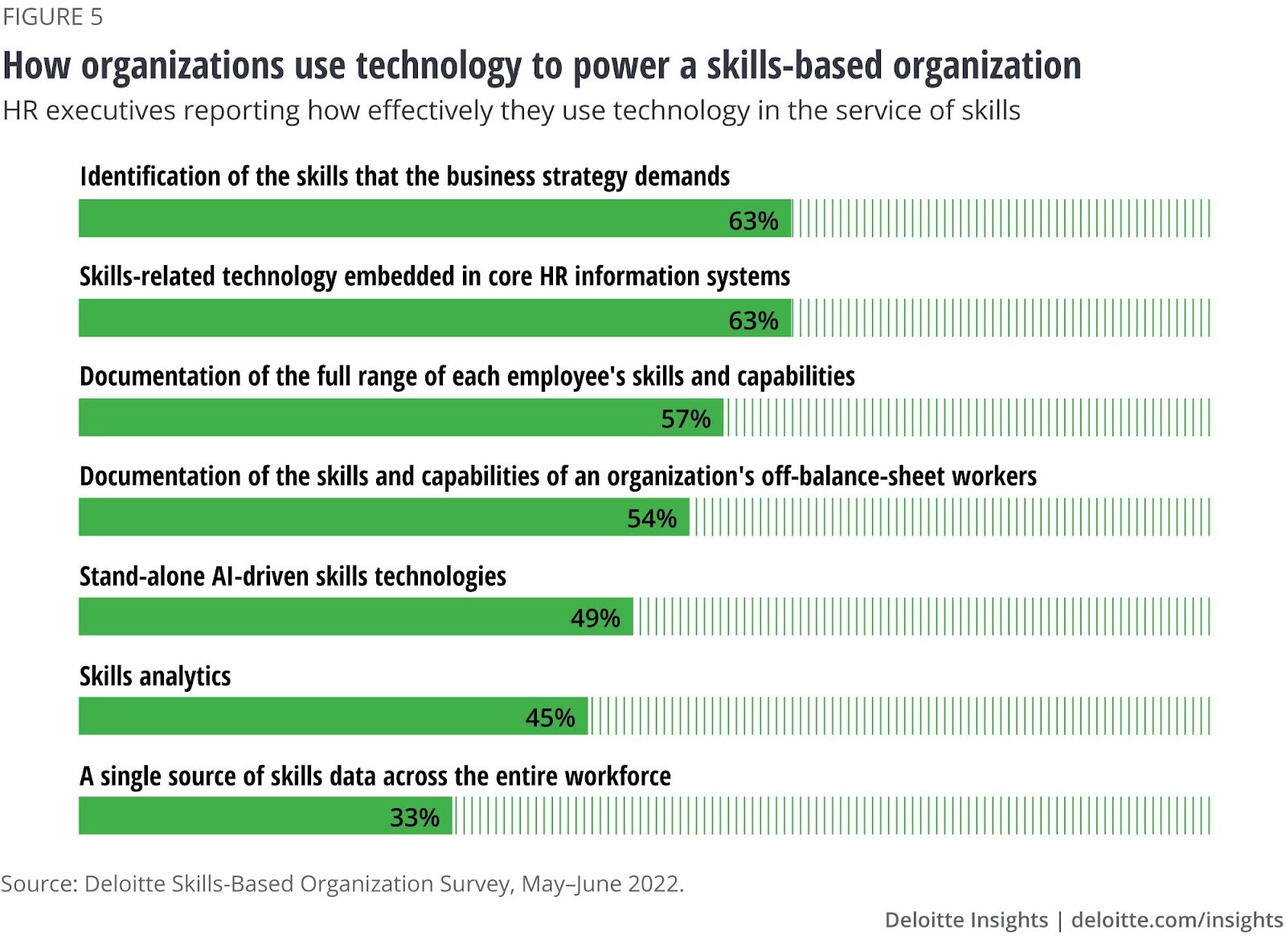
Source: https://www.deloitte.com/us/en/insights/topics/talent/organizational-skill-based-hiring.html
The second is a design problem. Systems built for departmental control optimize for departmental outcomes like:
- Time to fill.
- Number of applicants.
- Number of interviews.
These are familiar metrics for an HR function managing its own internal process. They are insufficient metrics for a talent acquisition function that is expected to inform revenue forecasts and workforce capacity planning at the executive level.
The organizations that recognize this distinction are not simply evaluating whether their recruitment management platform has better analytics. They are asking a more fundamental question: whether their recruitment infrastructure was designed for the role talent acquisition now plays inside the business, or for the role it played a decade ago.
Most systems were designed for a version of recruiting that no longer reflects the organizational reality they are being asked to support.
Recruitment Is No Longer A Workflow. It Is An Orchestration Engine
Every hiring decision carries consequences that extend far beyond roles filled. A new engineer changes a product team's delivery velocity. A regional sales hire shifts revenue capacity in a specific market.
A cluster of contract workers brought on for a peak period affects cost structure, knowledge retention, and team coordination in ways that outlast the engagement itself. These are business outcomes that happen to originate in the recruiting function.
As organizations deploy digital workers inside recruiting workflows, screening candidates, scheduling interviews, coordinating communications, and managing pipeline outreach, the hiring function begins to manage a workforce that is itself a mix of human and digital contributors.
At Asymbl, we define a digital worker as an autonomous, role-based teammate integrated directly into your workforce. They are powered by Salesforce Agentforce and Asymbl Intelligence designed to execute end-to-end business processes with the same accountability and performance standards as their human counterparts.
This shift requires organizations to treat automation as part of their workforce operating model rather than as a standalone technology initiative. According to a 2025 MIT Research on Gen-AI pilots, 95% of generative-AI pilots fail to scale not because the technology falls short, but because companies treat AI as an IT project instead of a workforce transformation.
Capacity planning now involves more than headcount. It involves decisions about which tasks require human judgment, which can be handled through deterministic digital execution, and how those two layers interact within a shared operational model.
A recruitment management system that cannot account for this expanded definition of workforce orchestration becomes a constraint on the function it was meant to enable. It tracks human applicants moving through human-designed stages, while the actual operating model it is meant to support has become something more complex.
The organizations building for this reality are asking different questions about their recruitment infrastructure:
- Does the system support visibility into workforce composition rather than just open job requirements?
- Can it distinguish between human hiring activity and digital worker deployment within the same operational view?
- Does it generate data that informs capacity decisions at the business unit level, not just pipeline metrics for the TA team?
The recruiting systems were designed to close job requirements. The questions organizations need answered now are about whether the workforce being built can actually execute the strategy behind those open positions.
The Shift From Managing Applicants To Governing Workforce Entry
Most organizations have found ways to process more candidates, add more tools, and move faster through stages. The harder problem is that speed and volume, without a governing framework underneath them, produce inconsistent outcomes at scale.
In the context of workforce entry, governance is the missing layer. Governance in the recruiting management system means that every decision point in the hiring process has defined criteria, documented logic, and clear accountability.
It means that evaluation standards do not drift between hiring managers or across time. It means that the data captured during the hiring process is reliable enough to learn from, audit against, and use to inform future decisions.
Most recruitment management systems were not designed with governance as a first principle. They were designed for process completion but that equation changes when digital workers enter the hiring workflow.
When a digital worker screens a candidate, scores an application, or sends a coordination message, the organization remains accountable for that action. The automation does not transfer liability.
It concentrates it, because decisions are now being made at a volume and speed that human review cannot keep pace with unless the governing logic was defined in advance and embedded into the system.
Without that structure, automation creates opacity rather than efficiency. High match scores appear without auditable criteria behind them. Candidates are advanced or filtered without a defensible rationale.
With disciplined governance built into the recruitment management system, digital workers become structured participants inside a hiring engine that has defined what good looks like, who owns each decision, and how performance is measured across both human and digital contributors.
Screening logic is transparent. Escalation paths are explicit. Every action, human or automated, is accountable to the same operational standard.
This shift from applicant management to workforce governance is an operating model decision that determines what the technology is asked to enforce.
Organizations that treat their recruitment management system as a governance infrastructure, rather than a processing tool, build hiring functions that can scale without losing consistency, audit decisions without reconstructing logic from memory, and integrate digital workers without creating accountability gaps that surface later as compliance or quality problems.
Why Asymbl Recruiter Suite Is A Complete Recruitment Management System
Legacy recruitment management systems are built as standalone HR tools, isolated from the data environment where the rest of the business operates.
When recruiting operates outside the business' primary data environment, the decisions it informs, headcount planning, capacity forecasting, workforce composition, reach the rest of the organization as summaries rather than signals.
By the time hiring data becomes visible to finance or operations, the context that makes it actionable has already been stripped out.
Salesforce is the data foundation most enterprises already use to run their front office operations across revenue, customer relationships, pipeline, and compliance.
Asymbl Recruiter Suite extends that foundation into talent acquisition, making recruiting a native part of the same operational environment rather than a separate system that has to be reconciled with it.
Recruiting data, which directly affects revenue readiness, headcount cost, and workforce capacity, has historically lived outside that foundation in a separate system that feeds reports into it but never fully integrates with it.
Are you rethinking whether recruiting should operate as another standalone system or as an extension of your business OS?
We explored this shift in more detail in our blog on why recruiters should be running talent on their business operating system instead of another point solution, and how bringing recruiting onto the same platform as the rest of the business changes visibility, governance, and forecasting for the entire organization.
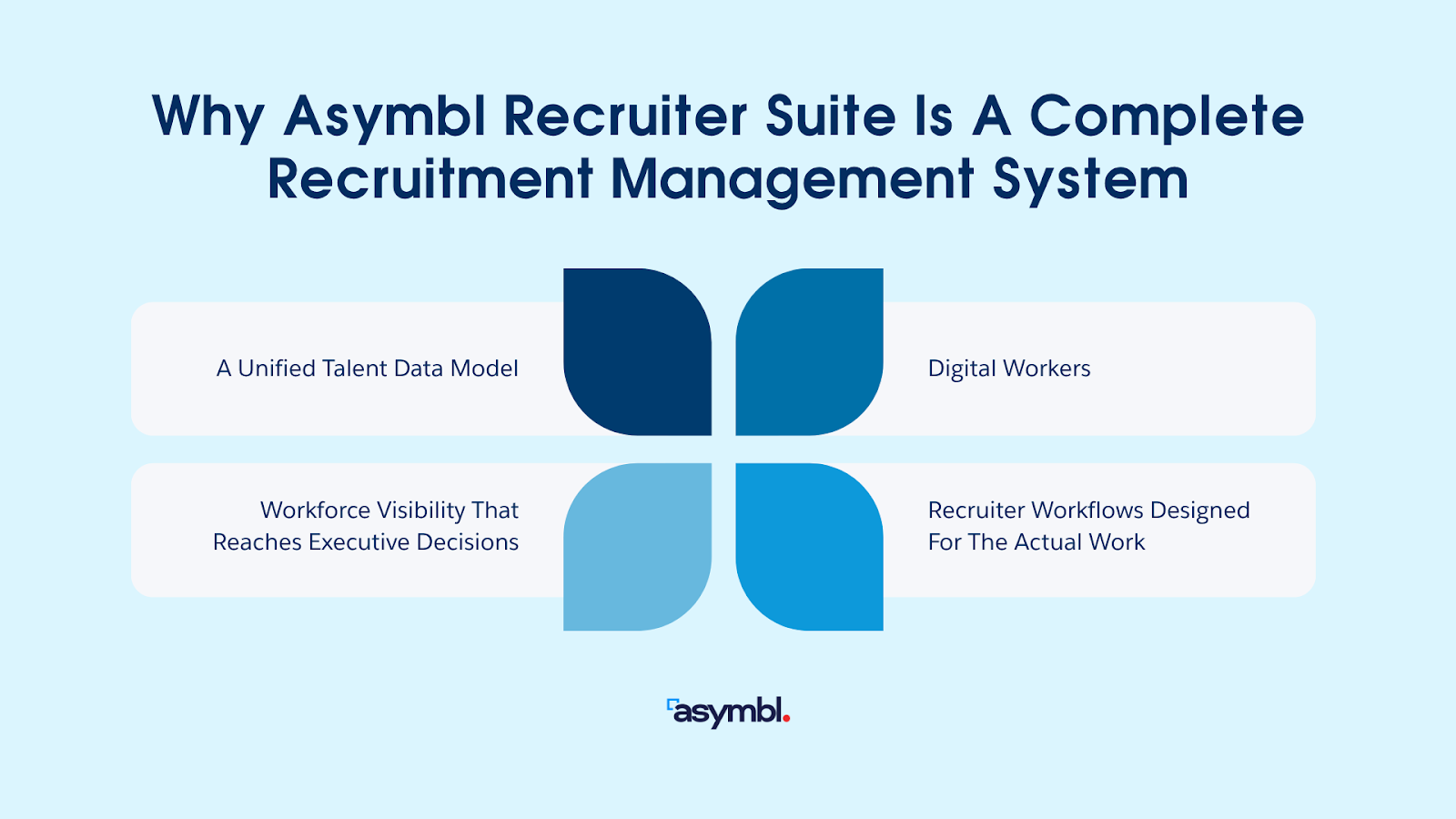
Asymbl Recruiter Suite is a purpose-built recruiting application layer that runs natively inside Salesforce. It operates within Salesforce, using the same data models, the same governance infrastructure, the same security protocols, and the same system of record that the rest of the business already trusts.
Asymbl Intelligence operates within that foundation as the talent intelligence layer. It captures the signals that recruiting systems typically lose like candidate intent, engagement history, job fit context, interaction patterns.
This intelligence feeds directly into the Recruiter Agent and Asymbl's digital workers, giving them the contextual foundation to act with precision rather than processing records in a vacuum.
The recruiting brain and the recruiting execution layer share the same data. That is what makes the orchestration coherent
The result is a recruitment management system that closes the gaps legacy platforms leave open.
1. A Unified Talent Data Model
When candidate records, hiring decisions, engagement history, and evaluation data live inside Salesforce rather than alongside it, the talent narrative stops fragmenting.
A candidate who applied two years ago, re-engaged through a nurture campaign, and is now being considered for a senior role has one coherent record, visible across the organization, connected to the broader workforce data that informs planning decisions.
Recruiter Suite enforces this through structured stage governance, standardized evaluation criteria, and engagement history captured at every touchpoint, all within the primary system of record rather than a secondary one that requires reconciliation.
2. Digital Workers
Asymbl's digital labor framework treats digital workers as role-based contributors with defined responsibilities, measurable performance, and governed decision logic rather than mere background automations running outside the system's accountability structure.
This reflects a broader shift in how organizations view talent operations. According to the Skills-based Organisation 2022 Report by Deloitte, 72% of business and HR executives agree that HR’s role will move away from managing employment to orchestrating work.
With Recruiter Suite, digital workers powered through Agentforce handle repeatable execution like job requirement validation, contextual candidate matching, interview scheduling coordination, automated follow-up sequences, and pipeline monitoring.
Every action those digital workers take is captured inside Salesforce and Asymbl, subject to the same audit trail and governance standards as any human recruiter activity.
This workforce orchestration closes the accountability gap that digital labor creates when deployed through disconnected tools. Human recruiters and digital workers operate from the same data, against the same performance standards, within the same governed environment.
3. Recruiter Workflows Designed For The Actual Work
Generic Salesforce configuration requires recruiting teams to build their own workflows on top of objects that were not designed for talent acquisition.
Recruiter Suite replaces that friction with purpose-built recruiting logic, including role-based stage configurations, structured interview coordination, offer governance and approval routing, and engagement and nurture workflows, all configurable without code.
This means recruiting teams get the precision of a purpose-built ATS without the data isolation that comes with running a standalone system.
4. Workforce Visibility That Reaches Executive Decisions
Since hiring data lives inside Salesforce rather than adjacent to it, the questions talent acquisition can answer change.
- Time-to-fill connects to the revenue ramp.
- Source quality connects to retention.
- Recruiter capacity connects to pipeline demand.
- Workforce composition connects to cost structure.
These are the same questions that have been difficult to answer reliably because the data needed to answer them was locked inside a system that could not connect to the broader business context. When recruiting operates inside the same platform as sales, finance, and operations, that connection exists by default.
For organizations already running Salesforce as their business operating system, Asymbl Recruiter Suite does not introduce a new system to manage. It extends the infrastructure already in place into the one function that has historically operated outside it.
Conclusion
Hiring today sits at the intersection of revenue readiness, operational capacity, and workforce design. Every role filled or delayed carries downstream effects that ripple across teams, product delivery, and market performance.
When recruiting systems operate as isolated applicant processors, those effects remain invisible until they appear as missed forecasts, stalled projects, or hiring surges that arrive too late.
Modern recruiting infrastructure has to do something fundamentally different. It has to preserve the full talent narrative across time, govern decisions consistently across both human and digital workers, and produce signals that business leaders can actually plan against.
Instead of asking whether the platform moves candidates through a funnel efficiently, ask whether it gives the business a reliable entry point into the workforce it is building.
If you are evaluating whether your current recruitment infrastructure was built for the workforce complexity you are managing today, see how Asymbl Recruiter Suite works inside Salesforce. Book a demo.
.webp)
12 Recruitment Metrics Every TA Team Should Be Tracking
Modern recruitment metrics need pipeline readiness and capacity. See 12 talent acquisition metrics that matter beyond speed.

The Right Fit Starts With a Conversation.
See what working together could look like.
.webp)