

What Your Best Recruiter Knows That Your ATS Doesn't

In leading product strategy at Asymbl, one constant surfaces in how recruiting teams interact with data: almost every firm has a few standout recruiters. They fill the hardest roles, remember candidate transitions from three years prior, and can name qualified candidates before a job description is even finalized. That recruiter operates with an extraordinary understanding of the candidate data already sitting in your system.
The structural disconnect between what that recruiter knows and what your applicant tracking system (ATS) surfaces is one of the most expensive problems in staffing technology. It's expensive because you're already paying for the data. It's sitting in candidate records, placement histories, notes fields, activity logs, and communication timestamps. Your ATS stores all of it and reads almost none of it.
Unread data is the real villain in staffing technology.
Your ATS reliably tracks applicants through workflow stages. It does that job well. What it leaves behind are the thousands of candidate data points sitting unread and disconnected systems, an invisible cost center that drains revenue without ever showing up on a software invoice.
The Knowledge Your Best Recruiter Carries
When a top recruiter places a senior infrastructure engineer, they don't start with a keyword search. They rely on deep pattern recognition built from hundreds of prior placements and dozens of subtle operational signals: communication logs, interview notes, historical placement outcomes, fee structures, and redeployment history.
They know that the candidate who spent four years at a mid-market SaaS company before moving to a hyperscaler and then to a startup is signaling something specific about their career trajectory. They know that the hiring manager who says "culture fit" means something different from the one who says "team dynamics." They know that a candidate's three-month gap in 2024 reflected a sabbatical rather than a termination, because they had a conversation about it two years ago.
This institutional knowledge spans three distinct dimensions:
- Trajectory reading: interpreting a candidate's career path as a continuous story with direction, rather than a static list of positions.
- Contextual memory: the accumulated understanding of candidates, clients, and markets that turns raw data into judgment.
- Signal weighting: knowing which data points matter for this specific role and which ones are noise.
None of these signals live in your ATS. They live in your recruiter's memory, and take them time to sort through and reason to a decision.
The Cost of Unread Data
Staffing firms have been collecting data for years: CRM integrations, job board imports, LinkedIn Recruiter syncs, internal referral tracking and spreadsheet management. In the last few years, the volume has accelerated with meeting transcripts, automated summaries of recruiter interactions, email and text correspondence captured inside the CRM, and richer candidate documents generated from every touchpoint. What hasn't grown is the firm's ability to interpret that data at scale.
The volume makes the problem structural. A firm with 100,000 candidate records has hundreds of thousands of data points across work histories, certifications, notes, placement outcomes, and communication logs. A recruiter reviewing 50 candidates a day touches a fraction of it. The rest sits unread.
Every time a recruiter opens a new search instead of finding the right candidate in an existing database, the firm pays for sourcing that was already completed. Every time a candidate goes uncontacted because their record didn't match a keyword query, the firm loses placement revenue it already earned the right to pursue.
Staffing leaders have tried intensive training: documenting recruiter habits, creating playbooks, and attempting to capture individual institutional knowledge. It works, partially, until the recruiter who wrote the playbook leaves or the market shifts faster than documentation can keep up.
How Talent Intelligence Reads What the ATS Stores
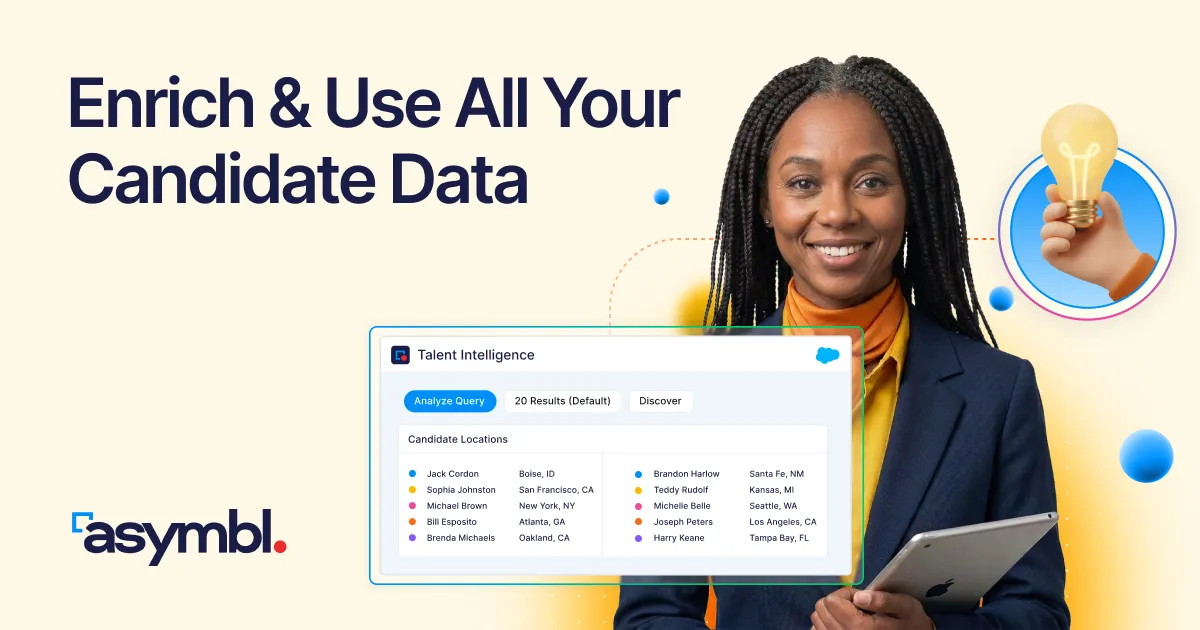
Every staffing firm has a version of this problem: years of recruiter judgment captured in the system, and nothing in the stack that reads it. Asymbl's Talent Intelligence is an AI candidate matching application with a reasoning layer designed to bridge the distance between stored data and understood data. It works with your existing system of record, whether that's Recruiter Suite or another ATS.
Talent Intelligence works from the candidate records already in your Salesforce org, so the data your team has spent years building is the data the search runs against. It works across the full set of candidate records in the org, interpreting career signals, progression patterns, and contextual notes that keyword queries reduce to flat string matches.
An important distinction: Talent Intelligence doesn't replicate a top recruiter's instincts. Instinct is the product of experience, context, and human pattern recognition that can't be fully digitized. What it does is take the parts of that judgment that were captured in the system, the written notes, the logged outcomes, the rated candidates, and make them legible and searchable, so one recruiter's captured judgment is available to everyone on the team. Every note a recruiter writes and every outcome the team logs becomes material this AI powered candidate matching application can read on the next search.
The combination is where the value shifts. A recruiter's memory is vivid, rich with context, shaped by years of lived experience. It's also imprecise. You remember that a candidate said something revealing about why they left their last role, but you can't recall the exact conversation or the exact date. You know the talent exists in your database. You just can't find it through a keyword filter. Talent Intelligence is literal and surgical where human memory is broad, and human memory is contextual. Paired together, a recruiter's lived experience and the product's ability to search comprehensively across every record in the system, they cover ground that neither covers alone.
Here's what that combination produces across the three dimensions your best recruiters already operate in:
Trajectory reading becomes systematic: Instead of one recruiter recognizing a career pattern in a candidate they've spoken with, Talent Intelligence surfaces similar patterns across thousands of records.
Contextual memory becomes institutional: Insights previously confined to personal notes are captured through structured data relationships that Talent Intelligence identifies and surfaces.
Signal weighting becomes consistent: Signal weighting becomes consistent: the same interpretation is applied to every search, rather than varying with whichever recruiter happens to be running it.
In practice, this changes how a recruiter starts a search. Instead of building a boolean string or selecting keyword filters, a recruiter can describe what they're looking for the way they'd describe it to a colleague: "mid-career technologist, half business and half technical, with a science background." Talent Intelligence returns candidates that match that profile across the full database, with reasoning for why each result fits. Boolean can't process that kind of query, traditional search and match can't either, but Talent Intelligence delivers where Boolean fails because it reads careers and context, rather than scanning for flat string matches.
The compounding effect is what changes the operating model. A firm that has been capturing its work for two years has more for Talent Intelligence to read than one six months in. That depth comes from what the team has recorded.
Your Data Is Already Doing the Work. If You Read It.
Systematically reading what's already inside your system is how institutional intelligence scales across every desk without depending on any single recruiter's memory.
Your ATS fulfills its mission as your system of record. Pair that reliable record layer with Talent Intelligence, and unread data transforms from an invisible cost center into your firm's most valuable recruiting advantage.
It operates alongside your system of record, turning passive records into surfaced insight. When your top recruiters capture their work, their judgment compounds inside the firm, powering every recruiter on the desk. Where this is heading is a system that learns from outcomes, weighting the signals that actually predicted successful placements and sharpening every search that follows.
See how Talent Intelligence turns your existing data into your strongest recruiting advantage in our latest webinar.

AI Workforce Strategy: Why Hiring AI Beats Just Deploying It
Successful AI adoption takes more than just tools. It requires structured onboarding, clear roles, and integrated workflows. See how Asymbl turns AI into digital teammates for real business impact.

The Right Fit Starts With a Conversation.
See what working together could look like.
.webp)