
Where Placement Meets Payroll: Why Staffing Firms Are Still Losing Margin Between the Timesheet and the Invoice

Watching a high-margin deal shrink while your team chases down contractor hours is proof that the real operational battle happens after the candidate accepts.
When executive teams evaluate technology investments, front-office sales velocity and candidate sourcing almost always get the capital. But whether that hard-won revenue turns into gross margin or evaporates between the timesheet and the client invoice is determined by operations.
Yet most agency systems treat time management as an isolated downstream task rather than an active operational layer connected to placement data from the moment a deal closes.
The moment a recruiter confirms a placement, data fragmentation begins. Candidate records sit in your ATS, contractor hours get chased down across standalone tools or email threads, and rate calculations require manual back-office reconciliation. This operational gap between placement and client invoice is where staffing businesses bleed margin, accuracy, and billing speed.
The Operational Drag Between Placement and Billing Execution
After sales and delivery teams complete a placement, candidate records, bill rates, and pay rules should flow instantly into operational workflows. What happens instead is that the transition from candidate start to revenue recognition carries structural risk because front-office momentum runs headfirst into back-office isolation.
Front-office recruiters optimize for pipeline velocity, while back-office operations inherit static records that require manual re-entry into external timekeeping tools and spreadsheets. Mid-cycle assignment dates shift or rate changes approved in the CRM leave back-office leaders operating completely in the dark, processing payroll against outdated parameters.
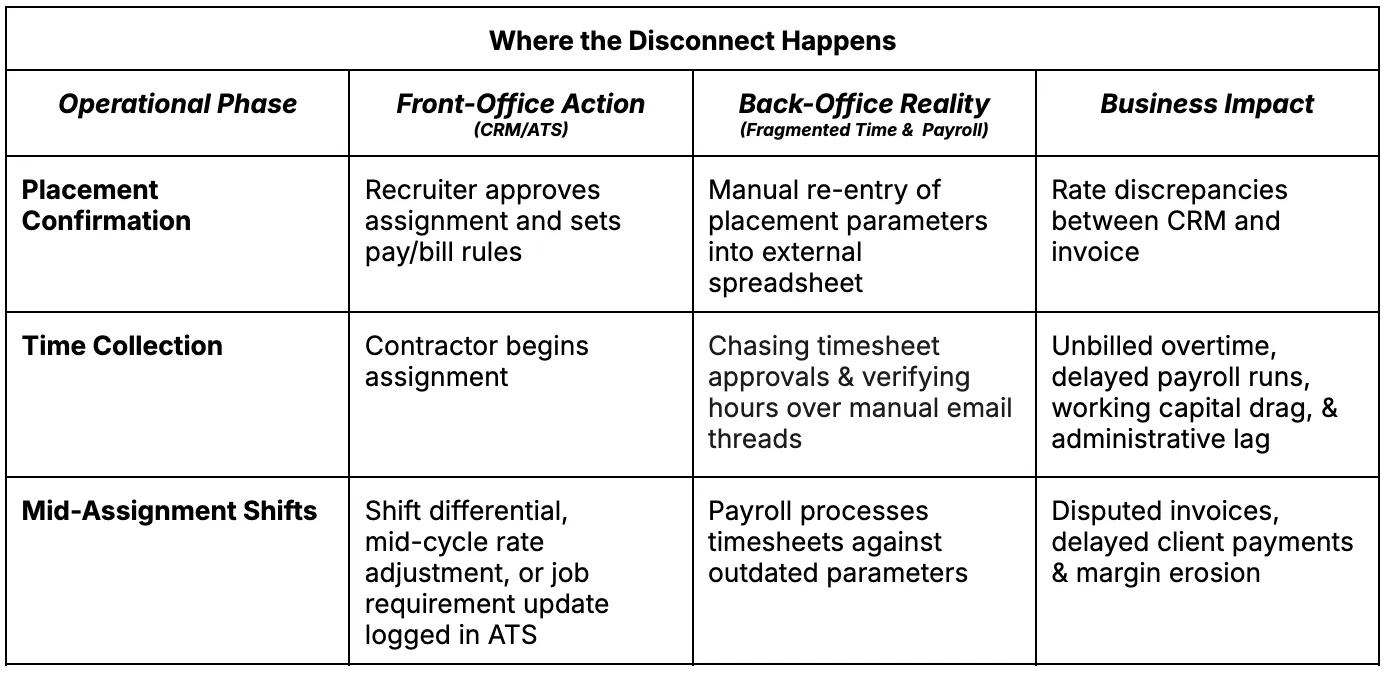
How Operational Disconnect Converts Into Gross Margin Leakage
Compounding margin erosion occurs when small rate variances, unbilled overtime rules, and approval bottlenecks accumulate across billing cycles. Complex pay rules across multiple jurisdictions present constant financial exposure for growing agencies.
- Unbilled Overtime and Shift Rates: Local overtime rules, meal break penalties, and weekend shift differentials require precise pay rule calculation. Generic time capture tools often fail to map these parameters automatically, forcing payroll teams into manual recalculations that introduce costly billing errors.
- Delayed Invoice Generation: Approval bottlenecks over email extend billing cycles. Carrying payroll for 30 to 90 days while waiting for client payment puts severe pressure on firm cash flow.
- Invoicing Disputes and Client Friction: Rate errors or incorrect hours surfacing on an invoice weeks after work occurs prompt clients to withhold payment on entire billing batches. Reconciling disputes post-disbursement forces back-office teams into reactive firefighting and damages client trust.
- Regulatory Compliance and Audit Exposure: For operations leaders managing temporary staffing or contract placements across multiple jurisdictions, regulatory compliance adds another layer of operational risk. Spreadsheet-based tracking creates wage audit vulnerabilities and penalty risks that directly threaten profitability.
How Standalone Time Capture Software Compounds System Friction
Bringing in a standalone timekeeping tool feels like an easy fix for back-office strain. But adding another application to a fragmented tech stack duplicates administrative overhead without surfacing the operational data recruiters and finance leaders need.
By operating outside your core ATS and CRM, isolated time capture software creates a compounding chronological breakdown across the assignment lifecycle:
- Data Export Loop: Back-office teams have to manually export placement records from the ATS, re-format candidate details for the timekeeping app, and re-key approved hours into accounting software. Every manual handoff introduces delay, administrative cost, and data entry error.
- Live Assignment Disconnect: Because time tracking operates in a silo, recruiters lose visibility into active contractor hours on live assignments. They cannot see whether a contractor is working full shifts, incurring unbilled overtime, or approaching the end of an assignment.
- Redeployment Miss: Lacking real-time assignment completion signals, recruiters miss the window to transition working contractors to open requisitions. Instead of redeploying proven, on-assignment talent, firms spend thousands on external job boards to re-buy candidates they already employ.
Capturing time in a separate application creates a static historical log, missing the live operational signals that protect margin and power candidate redeployment.
Unifying Placement, Time, and Invoicing Data Protects Gross Margin
Resolving operational drag requires connecting candidate placements, pay rules, and billing workflows inside one operating system. Running time capture directly alongside your front-office ATS allows timesheets to generate automatically from confirmed placement records without manual re-entry.
Anchoring your entire assignment lifecycle in a single source of truth transforms staffing business performance across three core areas:
- Automated Rate & Pay Rule Execution: Location rules, shift differentials, and overtime thresholds calculate automatically based on active placement terms, eliminating bill-rate errors before invoices generate.
- Compressed Cash Conversion Cycles: Automated routing and supervisor approvals remove email bottlenecks, allowing finance leaders to issue clean invoices faster and reduce payroll carry time.
- Proactive Candidate Redeployment: Real-time visibility into active contractor hours surfaces assignment end dates weeks in advance, giving recruiters the lead time needed to place working talent into new client requisitions before they hit the open market.
Sustaining gross margin requires an operational environment where sales, delivery, and time tracking operate together in real time.
See Asymbl Time in Action Watch our short demo on Time to see how connecting time capture directly to your ATS eliminates back-office reconciliation and protects gross margin.

How Recruiters and Digital Workers Run a Desk Together
Discover how human recruiters and digital workers run a shared desk inside Recruiter Suite to expand capacity and accelerate placement velocity.

The Right Fit Starts With a Conversation.
See what working together could look like.
