


.png)
Most conversations about an Agentforce SDR Agent start with what it automates, including tasks like lead qualification, outreach, and meeting scheduling, but they describe a generic sales agent.
A staffing firm's actual problem lives in signals a generic sales agent was never built to read.
- Expiring placements
- Job orders tied to accounts a client hasn't opened yet
- Redeployment windows that close in days.
A Salesforce AI SDR that only handles inbound leads misses all of it. In this blog, we will examine why staffing firms need a different SDR agent model than generic sales teams, three specific jobs a digital SDR can own inside Salesforce, and how to measure whether it actually protects sales coverage.
What is an Agentforce SDR?
An Agentforce SDR Agent is a Salesforce AI sales development representative that handles repeatable sales work such as lead qualification, prospect outreach, follow-up, answering questions, routing, and meeting scheduling. It operates within defined guardrails, taking action based on lead and account context rather than waiting for a human to trigger every step.
It can evaluate context, take action, escalate when human judgment is needed, and hand qualified opportunities to a sales rep with the relevant information already captured.
For staffing firms, that capability can extend beyond generic sales activity. An agent can also watch Salesforce for signals such as expiring placements, identify redeployment opportunities, qualify new client demand, and support candidate nurture. That is where the staffing use case starts to differ from a standard AI SDR.
Why Staffing Firm SDRs Have Limited Capacity
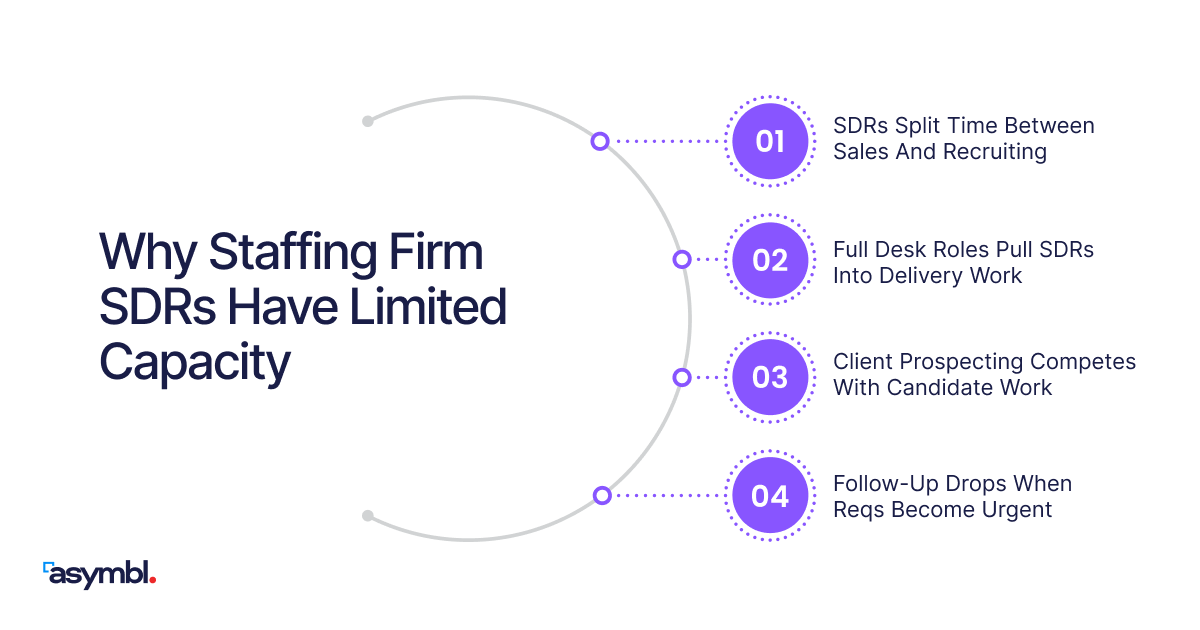
Staffing SDRs’ day gets pulled in different directions by client requests, open reqs, candidate issues, follow-ups, and urgent delivery work.
1. SDRs Split Time Between Sales And Recruiting
In staffing, SDRs often work across multiple functions, chasing prospects, responding to client questions, helping clarify job requirements, and supporting recruiter follow-through, sometimes across four or five open items in the same hour.
It creates constant context switching. A prospect who called in about a new account and a client asking why a candidate hasn't started yet land in the same inbox, competing for the same ten minutes, and the coverage gap widens every time the second one wins.
2. Full Desk Roles Pull SDRs Into Delivery Work
Full desk models make the capacity problem more visible. Sales activity and recruiting delivery sit close together, so urgent reqs pull attention away from prospecting the moment a client calls with a hard deadline.
The desk keeps moving, but top-of-funnel coverage gets thinner. A recruiter working a full desk can point to placements made this month and still have a pipeline of prospects who haven't heard from the firm in three weeks, because the desk rewards whichever work closes fastest this week, even when it costs next quarter's pipeline.
3. Client Prospecting Competes With Candidate Work
Staffing teams need new client conversations and candidate movement at the same time, and the two rarely compete on equal footing. When candidate work becomes urgent, prospecting often becomes the work that waits, since a candidate who might walk from an offer feels more urgent than a prospect who might sign a contract next month.
This delay compounds when every missed follow-up is tied to a possible job order. A prospect who goes quiet for two weeks does not usually complain. They just take the call from whichever firm reached out first.
4. Follow-Up Drops When Reqs Become Urgent
New reqs create pressure across the team. Recruiters need intake clarity, candidates need attention, and clients expect quick movement, all inside the same week a prospecting sequence was supposed to run.
Follow-up with earlier-stage prospects becomes inconsistent exactly when sales coverage should stay steady. The coverage gap does not announce itself. It shows up months later as a quieter pipeline and a sales leader asking why new logo volume slowed, without an obvious single cause to point to, because the individual missed follow-ups never got logged as failures.
Why Staffing Firms Need A Different SDR Agent Model Than Generic Sales Teams
By 2028, AI agents are expected to outnumber human sellers ten to one, yet fewer than 40% of sellers are expected to say those agents have improved their productivity, according to Gartner research.
The number of agents in a sales organization does not automatically translate into more productive sellers. For staffing firms, the problem is even more specific: an agent who cannot see placements, contract end dates, job orders, and candidate availability is adding sales activity without addressing the gaps that cost staffing firms revenue.
1. An Expiring Placement Is Also The Next Job Order
A client whose contractor is nearing the end of an assignment is not just someone to check in with. The account already is the source of the next job order, before the client has said a word about it. The clock on that opportunity started the day the original assignment was booked. Nobody has to remember to look for it to already be running.
Reading the account this way turns a routine check-in into qualification. A client with three contractors rolling off in the same month carries three active job orders sitting inside the redeployment blind spot, each one waiting for someone, or something, to notice before a competing firm does.
2. Hiring Demand Often Lives In Salesforce Before It Reaches A Form
A lead with budget but no hiring need may require nurture, whereas a lead with urgent openings may need immediate routing. The strongest of those signals often lives inside the firm's own Salesforce data. A contract end date or a placement record carries the demand signal, and no inbound web form would ever capture either one.
Reading placement and contract records directly means the agent finds demand before the client raises a hand for it. A form-based sales tool waits for the client to type a message. A firm's own Salesforce data already knows the assignment ends on the fifteenth.
3. A New Prospect's Urgency Has To Be Asked, Not Just Watched
Agentforce lead qualification should identify whether the prospect has open roles, hiring timelines, decision authority, and role complexity. A brand new prospect has not handed the firm any of that in advance, unlike an existing account whose contract data already tells the story. The agent has to ask for it directly, in the first real exchange, the way a human SDR would on a discovery call.
The lead moves to a human faster once urgency is confirmed, and the human opens the conversation already knowing why. A rep who gets routed a lead with "urgent, three open roles, decision authority confirmed" attached starts the call differently than one working a blind list, and the prospect notices the difference in the first thirty seconds even when they cannot name what changed.
4. A Clean Handoff Needs A Warm Job Order And A Warm Candidate
A weak sales handoff creates recruiting drag. Recruiters need clean client context, job requirements, urgency, and expectations before they can act. They also need candidates who are actually reachable.
Most job orders arrive with a cold list built the day the req opens, because sales and recruiting are running on separate systems that never talk to each other.
A digital business development representative (BDR) can deliver the first. A candidate nurturing agent can deliver the second. Recruiters get both at once, or the desk absorbs the gap between them the same way it absorbs every other coverage problem, by asking one person to do two jobs under a deadline.
The firms that measure recruiting drag rarely trace it back to the handoff itself, because by the time a role sits unfilled for three weeks, the missing context from intake is impossible to reconstruct.
5. The Agent Must Cover Three Different Jobs, Not One
The digital SDR should not optimize for meetings alone. In staffing, the same agent architecture has to run three different jobs at once:
- Engage new prospective clients on the sales team's behalf
- Watch existing placements, so redeployment outreach starts before a contractor's assignment ends
- Keep a candidate database warm enough to fill the role once the job order lands
A generic sales agent covers the first of those three and stops. Staffing capacity requires all three running at once, on the same data, because a job order sourced from redeployment still needs a warm candidate behind it, and a warm candidate is worthless without a job order to place them against.
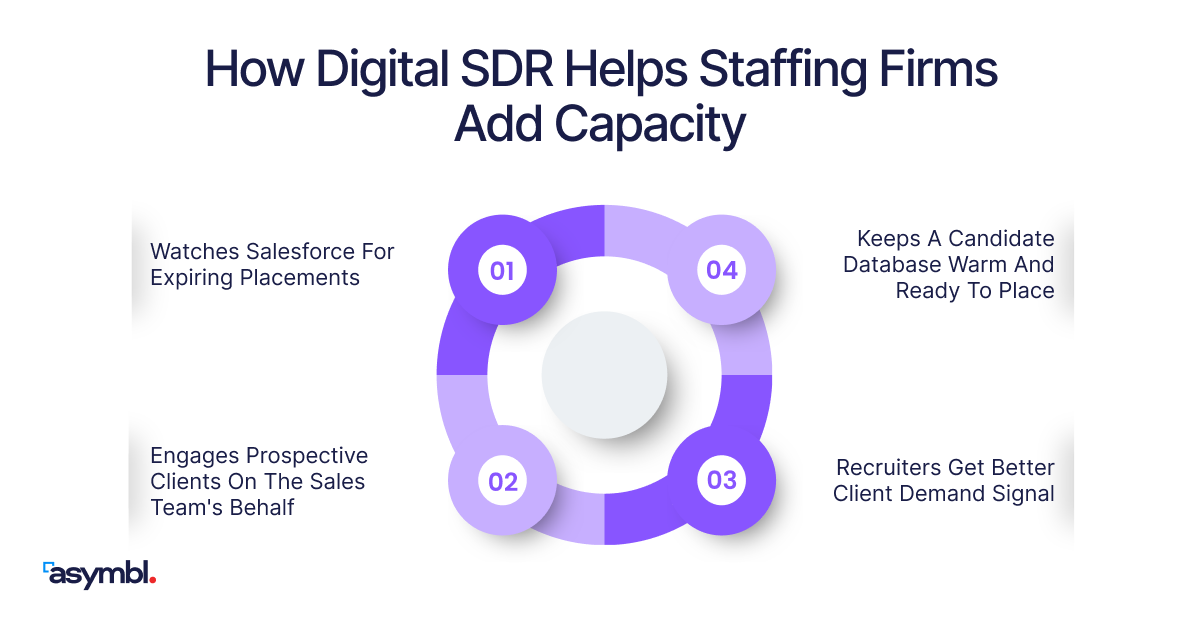
How Digital SDR Helps Staffing Firms Add Capacity
By the end of 2026, 40% of enterprise applications are expected to include task-specific AI agents, up from less than 5% today, according to Gartner research.
For staffing firms, adding an agent only creates value if it takes responsibility for work the team cannot consistently cover today, which means more than automating outreach.
1. Watches Salesforce For Expiring Placements
The Digital SDR monitors contractor assignments and contract end dates directly inside Salesforce, then starts redeployment outreach to the client before that seat goes empty.
The client sees continuity in place of a gap in coverage because the firm keeps a job order that a slower process would have lost to a competing staffing partner who called first.
The outreach starts on the date the data changes, call it the signal lag closing to zero, and never waits on the date someone remembers to check a spreadsheet or a calendar reminder three weeks late.
2. Engages Prospective Clients On The Sales Team's Behalf
The Digital SDR identifies and engages prospective clients on behalf of the human sales team, running qualification questions, outreach sequences, and meeting scheduling for accounts the team has not yet touched.
It works the volume a small SDR team cannot cover alone, running the same sequence across two hundred accounts that a human rep could realistically work through fifteen.
Human reps step in once a prospect shows real hiring intent. The agent absorbs the accounts that would otherwise sit untouched for a quarter while the desk handles whatever is loudest that week, and by the time a human rep gets involved, the prospect has already had two or three consistent touches rather than one rushed one.
3. Recruiters Get Better Client Demand Signal
A well-designed digital SDR captures the details recruiters need before a role reaches delivery, including role urgency, hiring volume, location, skill requirements, and client expectations.
A job order sourced from a redeployment alert arrives with as much of that context as one sourced from new client outreach, because both flow through the same signal capture rather than two disconnected intake processes.
Better signal reduces back-and-forth after handoff. A recruiter who gets a req with the urgency and headcount already attached starts sourcing the same day, saving the first call for candidates instead of re-asking questions sales already answered.
4. Keeps A Candidate Database Warm And Ready To Place
The same personalized outreach and nurture pattern that runs the digital SDR also runs a candidate nurturing agent, keeping a large talent database warm and engaged so recruiters have qualified candidates ready before a role even opens. This agent reports to recruiting. It closes a different gap than the redeployment agent closes on the client side.
A req opens with candidates already warm, ready before a search would have even started. The signal lag on the candidate side works the same way it does on the client side. The sooner the database reflects who is actually available, the sooner a recruiter can move on a role.
How Staffing Firms Should Measure Digital SDR Performance
AI can show clear results in individual use cases without having a meaningful effect on the business as a whole. McKinsey’s “State of AI in 2025: Agents, Innovation, and Transformation” Report found that 64% of respondents say AI is enabling innovation, yet only 39% report an EBIT impact at the enterprise level.
For a staffing firm, that gap makes measurement especially important. A digital SDR should not be judged by how many messages it sends or meetings it books alone.
The real question is whether it creates more qualified demand, protects redeployment opportunities, keeps candidates ready, and gives human teams more capacity to work the opportunities that matter.
1. Nurtured Candidate Growth Shows Placement Readiness
Nurtured candidate growth shows how many candidates a nurturing agent keeps warm and engaged, ready to move the moment a role opens.
It is the recruiting side of the same nurture pattern that keeps prospects warm on the sales side, tracked separately because the two audiences respond to different signals and different timing.
For staffing firms, this matters because the strongest placements often start weeks before a req exists. A candidate database that only grows when someone remembers to update it falls behind the activity trap in a different way, by looking static rather than merely noisy, which is easier to overlook in a monthly review because nothing about it looks obviously broken.
2. Redeployment Speed Protects Job Orders
Redeployment speed shows how quickly the firm moves from a contract end date landing in Salesforce to real outreach on the account. A slow response gives a competing staffing partner room to reach the client first, and the window on a redeployment opportunity is often measured in days.
Speed here protects a job order the firm already earned. A firm tracking this number for the first time usually finds the signal lag is longer than anyone assumed, because nobody was measuring the gap between the data changing and a human noticing, and the assumption that redeployment was already happening well enough rarely survives the first honest measurement.
3. New Client Meeting Conversion Shows Pipeline Growth
New client meeting conversion shows whether outreach to prospective clients is producing real sales conversations. Calendar activity on a weekly report can look busy without any of it being real. A hundred outreach sequences that produce three meetings with prospects who have no open roles is a worse result than twenty sequences that produce three meetings with prospects who do.
The metric should reflect qualified conversations with genuine hiring intent behind them, distinct from every meeting that got booked regardless of whether the account had an actual req attached to it. A sales leader reviewing this number alongside redeployment speed and pipeline contribution gets a fuller picture than any one of the three would give alone.
4. Pipeline Contribution Shows Revenue Impact
Pipeline contribution connects the digital SDR to revenue opportunity, whether that revenue comes from a new client engagement, redeployment outreach on an account the firm already serves, or a job filled faster because a candidate nurturing agent kept the right person warm.
For staffing firms, the question is whether the agent influences job orders, qualified accounts, and placement speed. Meeting volume alone answers none of that.
A firm that only tracks meetings booked is measuring the easiest number to inflate and the hardest one to connect back to revenue, since a booked meeting says nothing about whether the account ever produced a bill rate.
Attributing pipeline correctly across three different agent jobs takes more work than reading a single dashboard, but the alternative is a sales leader who cannot say whether the agent paid for itself.
5. Outreach Volume Must Lower Conversation Cost
Outreach volume only matters when it reduces the cost required to create a qualified sales conversation or a placement-ready candidate conversation, measured against what the same conversation would have cost a human SDR to generate alone.
More touches without better outcomes just creates noise at scale, on either side of the business. This is the activity trap in its purest form, a volume number climbing on a dashboard while the actual conversion rate behind it gets worse without anyone tracking the two side by side.
6. Human Capacity Shifts Toward Higher Value Work
The strongest sign of success is a shift in human work. Human SDRs should spend less time chasing routine follow-up and more time advancing strategic accounts that need judgment a digital agent was never built to apply.
Recruiters should spend less time re-sourcing candidates who were already available and more time on placement decisions.
Digital capacity becomes business capacity on both desks, sales and recruiting alike, and this is the one metric that cannot be gamed by running more sequences.
If human time has not moved toward higher value work six months in, the agent closed the coverage gap in name only, and the desk is paying for a tool doing work a spreadsheet reminder could have handled just as well.
Agentforce SDR Agent With Asymbl
Asymbl runs this same agent architecture inside its own sales pipeline before building it for a client, then rebuilds it around the specific job a staffing firm actually needs done.
Teddy Proves The Model Inside Asymbl's Own Pipeline
Teddy is Asymbl's own digital sales representative, built on Salesforce Agentforce to run the same sales pipeline that funds the company. He works 1,000+ leads a week and produced a 427% increase in prospect engagement, then hands off to human reps with full context, the same handoff discipline a staffing firm's own agent needs on the recruiting side.
The staffing firm's agent still needs its own job, built around what that firm actually needs done. Teddy closes a generic sales coverage gap. A staffing firm's redeployment blind spot is a different problem entirely, even though both run on the same underlying architecture.
Design, Onboard, And Coach Builds Accountability
Asymbl's Design, Onboard, and Coach framework gives every digital worker a defined job, a human manager, and measurable performance expectations from day one. Nothing goes live without that structure in place first, the same discipline that keeps a human hire from drifting without a manager checking in.
Accountability is what keeps a digital SDR performing like a managed teammate rather than an unmonitored script running the same sequence in month twelve as it did in week one, learning nothing from what worked or what a prospect ignored.
Custom SDR Agents Get Built Around Jobs To Be Done
Asymbl builds custom Digital Workers, including custom SDR agents for staffing firm customers around the specific job to be done. The build starts from what that firm actually needs, never a cloned version of an existing digital worker.
The job might be a digital BDR that engages prospective clients, an agent that watches Salesforce for expiring placements and starts redeployment outreach, or a candidate nurturing agent that keeps a talent database warm.
Each of those is a different job, designed, onboarded, and coached on its own terms through the same Design, Onboard, and Coach framework, even when two staffing firms are using the same underlying platform.
Digital Labor Advisory Turns Setup Into Capacity
Digital Labor Advisory starts by defining the job to be done, then configures the Salesforce workflow, structures human handoffs, and measures performance after launch, the same sequence that keeps a new hire from being thrown into a role without a plan.
The result runs deeper than Agentforce SDR setup. It is managed sales capacity inside the staffing firm's operating model, coached the same way a manager would coach a human rep who is underperforming against quota.
Salesforce Consulting Builds The Agent Right
Asymbl is a Salesforce Summit Partner with 600+ certifications and 1,000+ Salesforce projects completed behind it. Building an SDR agent inside Salesforce is not a quick configuration task. It requires knowing how Agentforce, the org's data model, and the sales process already running inside Salesforce all fit together, down to where a contract end date actually lives in the schema.
This depth is why the agent gets woven into the existing Salesforce environment rather than sitting next to it as a separate tool that has to be reconciled against the data the firm already trusts.
A firm evaluating an Agentforce SDR agent should ask exactly that question of any vendor: whether the agent reads and writes to the org's actual data model or works from an export that goes stale the moment a contract updates, and whether the answer changes once the agent has to act on a signal that only exists inside Salesforce.
What A Staffing SDR Should Actually Deliver
Two staffing firms can deploy the same Agentforce SDR Agent and end up with different businesses a year later. One firm points it at generic outreach and measures messages sent. The other builds it around the signals that actually drive staffing revenue, expiring placements, warm candidates, qualified job orders, and measures pipeline and redeployment speed instead.
Ask what job your digital SDR is actually doing right now. If the honest answer is "sending more emails," the agent is running someone else's playbook on your desk.
Asymbl designs, onboards, and coaches digital SDR agents around the specific job a staffing firm needs done, whether that is redeployment monitoring, new client engagement, or candidate nurture, built on the Salesforce environment the firm already runs on.
Book a demo to see what a digital SDR built for your actual job order signals could protect.
.webp)
You Cannot Orchestrate a Workforce You Cannot Build
The humans who can manage digital workers are the same people everyone is competing for. Workforce orchestration requires both recruitment technology and digital labor strategy working together.

The Right Fit Starts With a Conversation.
See what working together could look like.
.webp)