

AI In Talent Acquisition: A Hybrid Workforce Operating Mode
.webp)
A talent acquisition leader who walked their recruiting floor in 2026 would see five AI tools running and a recruiter still managing every transition between them. The tools draft outreach, summarize resumes, score candidates, and book interviews.
The recruiter still moves the candidate from one tool to the next, briefs the AI from scratch each session, and carries the context that no system holds.
This is the gap between AI investment and AI impact. Adoption is up across almost every recruiting function, and quality of hire, the metric most TA leaders are accountable for, has not moved with it.
The new tools are layered onto a workflow that was never redesigned to absorb them. The result is more activity, more drafts, more candidate touches, and the same coordination overhead the function had before AI arrived. Capacity does not expand when humans are still required at every handoff.
In this blog, we will examine why most AI in talent acquisition underdelivers, the structural limits of legacy recruiting workflows, the difference between AI as a tool and AI as a digital worker, and what hybrid workforce orchestration actually requires.
Current State Of AI In Talent Acquisition Workflows
The first generation of AI in talent acquisition was sold as a transformation, but what most organizations actually deployed was the acceleration of isolated tasks rather than the redesign of the workflow itself. Five patterns explain why activity has gone up while output has stayed flat.
1. Teams Use AI For Tasks, Not To Run Workflows
Most AI usage in talent acquisition follows the same pattern. A recruiter opens a tool, submits a prompt, receives an output, and continues the workflow manually. The workflow itself is unchanged, and it is one step slightly faster, but everything downstream still requires the same human coordination.
AI is being used in the way a faster search engine might be used, to retrieve or generate something for a workflow that humans still run end-to-end.
The recruiter is incrementally faster at isolated tasks while still operating the same fragmented, manual workflow underneath.
2. Prompt-And-Output Improves Speed, Not Structure
Prompt-and-output AI assistance adds a faster sub-step inside a process that still requires human coordination at every handoff. When outreach generation is faster, but follow-up is still manual and inconsistent, the gain disappears at the next step.
Speed at one point in a fragmented workflow does not compress overall time-to-hire. It shifts where the bottleneck is most visible. The hours the recruiter saved drafting a message reappear later, in scheduling chases, in feedback collection, and in offer drafting.
3. AI Features Hold No Context Between Sessions
Each time a recruiter prompts an AI tool, the conversation starts fresh. There is no memory of the candidate, the role history, the hiring manager preferences, or the pipeline context.
Recruiters compensate by re-entering context every session, briefing the AI from scratch, which erodes the time savings the tool was supposed to create. A system that forgets everything between sessions cannot carry a relationship. It just processes the instruction it receives at that moment.
Context is the difference between a tool and a workforce member. Tools execute prompts, whereas workforce members operate against a working memory of who the candidate is, what was said last quarter, and what the hiring manager has already declined.
4. No Role, No Ownership, No Performance Standard
An AI tool has no job description. It executes whatever it is asked, with no defined scope, performance expectations, or accountability for outcomes. There is no standard to measure against, evaluate how the AI is performing, what it contributed to the hiring outcome, or where it is falling short.
Without defined ownership, teams cannot determine whether AI is helping or generating noise. Adoption continues because the impact is not being measured. Activity and contribution are visible.
However, the fix sits in governance design, which most talent acquisition (TA) functions have never built around their AI deployment.
5. Humans Are The Bottleneck At Every Decision
Even when AI generates content, summarizes resumes, or drafts outreach, a human must review, approve, and act on every output before the workflow can advance.
The AI has not taken on process ownership. It made the human slightly faster at one sub-step while preserving every handoff point.
Capacity scales only when humans are removed from the steps that do not require human judgment. AI tools are not designed to produce that outcome. They generate outputs for humans to act on.
The result is a recruiting function with more activity, more drafts, more candidate touches, and the same coordination overhead it had before AI arrived.
Structural Limitations Of Legacy Talent Acquisition Workflow
Legacy talent acquisition workflows were built for administrative control, tracking applicants through a funnel, managing compliance, and filling requisitions. They were not built for learning, relationship continuity, or intelligent orchestration. These structural gaps are what prevent AI from compounding in value, regardless of which tools are added.
1. No Learning Layer In The Current Stack
Most applicant tracking system (ATS) platforms were built to move candidates through defined stages, but not to learn from what those stages produced. For example, they record that a hire happened, but do not capture why the hire succeeded or why the finalist did not advance.
When AI is layered onto a system with no learning mechanism, there is nothing for it to learn from. Recommendations come from external patterns, not the organization’s own hiring history.
The AI may get smarter in general, but none of that intelligence accrues to the organization’s own hiring history.
A learning layer is the structural feature that turns every hire into training data for the next one. Without it, every requisition is the first requisition.
2. Recruiting Data Is Fragmented Across Tools
The average talent acquisition stack runs several separate systems, including an ATS, customer relationship management (CRM), sourcing platform, scheduling software, assessment provider, and human resource information system (HRIS). Each system holds a fragment of the candidate record.
AI tools can only operate on data they can access. They cannot see across systems not designed to share data. Even when integrations exist, they sync records, but they do not create a shared intelligence layer. The AI sees a copy of a field, not a connected picture of the candidate relationship.
According to McKinsey’s “The State of AI in 2025: Agents, Innovation, and Transformation” Report, 39% of organizations attribute any level of EBIT impact to AI use, and most of those say less than 5% of their EBIT comes from AI. The pattern is the same across functions. AI without a unified data foundation produces fragmented value.
3. Context Lives In The Recruiter's Head
The most important context in talent acquisition (why a particular candidate is a strong fit, what the hiring manager actually weighted, what a candidate has turned down before) is rarely entered into a system. It lives with the recruiter.
When a recruiter leaves, that context leaves with them. The system retains the record-level data, but the intelligence about the relationship is gone.
Every replacement recruiter starts with a clean read of the database and none of the institutional memory the role actually requires. The cost of recruiter turnover lies in the relationships and judgment that are left with them.
4. No Relationship Management Built In
Most talent acquisition workflows are designed around a requisition rather than a relationship. A role opens, candidates are sourced, and the role closes. Candidate records go dormant, engagement stops, and the relationship resets.
Relationship management requires longitudinal engagement. Tracking where a candidate is in their career, when their contract ends, what roles they have expressed interest in, and what past interactions looked like.
A workflow built around requisitions can fill the role in front of it. Building the pipeline behind it requires a different design.
5. No Continuity Of Candidate Context Over Time
A candidate who applied two years ago, was named a finalist, completed an assessment, and represents a strong internal pipeline match exists in most systems as three disconnected records across separate identifiers. The history sits in three different places, and none of them are joined.
Without continuity of context, AI evaluates this candidate from scratch every time they appear in the workflow. The prior relationship is invisible to the system. The organization has already invested in this candidate relationship. The workflow is not designed to remember or use that investment.
6. Candidates Treated As One-Off Communications
When outreach tools fire messages without historical context, every interaction is cold. The candidate may have spoken to a recruiter 18 months ago, but the system does not reflect it. AI-assisted outreach at volume makes this worse with more messages, less context, and faster erosion of candidate experience.
The problem often lies in data architecture, instead of messaging, because the system was not built to use relationship history to inform the next interaction.
AI As A Tool Versus AI As A Digital Worker
AI as a tool and AI as a digital worker are two structurally different approaches with structurally different architectures:
AI As A Tool
An AI tool waits for instructions and produces an output, then stops. The workflow continues through whoever called it.
1. Prompt-And-Output Interaction Model:
A human opens the tool, writes a prompt, receives a generated output, and decides what to do with it. Every interaction is discrete and self-contained because the AI has no awareness of what came before or what comes next.
2. Single-Task Output Instead Of Workflow Ownership:
An AI tool completes the task it was given (write a job description, summarize a resume, draft an outreach message) and stops. The workflow continues through manual human coordination. The tool added a faster sub-step inside a process that is otherwise unchanged.
3. No Accountability Or Responsibility:
When an AI tool produces a bad output, there is no defined owner. The recruiter prompted it, and the tool generated it. Accountability sits informally with whoever issued the prompt.
4. No governance framework:
AI tools run without defined guardrails about what they should and should not act on, what constitutes acceptable output, and what requires human review. Quality control depends entirely on the recruiter's judgment and attention.
5. No Defined Role Or Operational Scope:
The tool will attempt any task it is given. A recruiter can ask it to screen, draft, research, or summarize, all without configuration for the specific operational context. Scope definition is what makes performance measurable.
Humans remain responsible for orchestration and decisions. Because no workflow ownership sits with the tool, humans must coordinate every handoff, manage every exception, and make every decision that advances the process.
The recruiter is managing around the AI, picking it up for individual tasks and resuming full process responsibility immediately after.
AI As A Digital Worker
A digital worker holds a role, executes within that role continuously, escalates when escalation is warranted, and is managed against a performance standard.
1. End-To-End Execution Across Workflows:
A digital worker handles the full process within its defined scope:
- Sourcing
- Initial screening
- Outreach sequencing
- Response management
- Scheduling, and
- Status communication, without a human handoff at each transition.
Escalation logic defines exactly when control passes back to a recruiter.
2. Defined Role, KPIs, Performance, And Operational Scope:
A digital worker has a job description with:
- Defined inputs
- Outputs
- Success criteria, and
- A reporting structure.
Performance is measurable in screen-to-interview conversion rate, scheduling turnaround, and outreach response rate. Scope definition is what makes the digital worker manageable, improvable, and accountable over time.
3. Accountability And Responsibility:
When a digital worker produces an outcome, there is a defined owner. Performance is tracked against standards. Contribution is visible at a team level, the same way human recruiter performance is visible in a review cycle.
4. Governance And Ongoing Oversight:
Digital workers operate within a defined governance framework. What they can act on independently, what requires human approval, and what triggers an escalation are designed before deployment.
5. Design, Onboard, Coach Framework:
Before a digital worker is deployed, its role is designed. Job description, workflow scope, escalation paths, and handoff protocols are established. After deployment, the worker is onboarded with active performance monitoring, then coached and recalibrated as data accumulates.
Digital labor is managed like human labor. Digital workers have performance reviews, recalibration cycles, and role evolution as the business changes. Configuration at go-live is the start of management.
Why The Conventional AI Approach Fails In Modern Hiring
A fragmented process running with AI becomes a fragmented process running faster, at higher volume, with less visibility into what is going wrong.
1. AI on Broken Systems Scales The Problem Faster
When AI increases outreach volume on a workflow with no relationship context, more candidates receive impersonal communication. The disconnection scales with the volume.
When AI-assisted screening runs on fragmented data, it filters at a higher volume using the same miscalibrated criteria. More candidates fall through the same gaps, faster. The workflow's structural problems become amplified rather than solved.
2. Fragmented Data Means AI Cannot Learn Or Improve
AI systems improve when they can correlate action to outcome:
- Which outreach triggered a response?
- Which screening criteria predicted a successful hire?
- Which candidate declined for what reason?
Fragmented data breaks this loop. When the action is logged in one system, and the outcome sits in another, there is no signal to learn from. Without a learning loop, AI in talent acquisition operates at a fixed level of performance. It does not adapt and runs the same patterns on new data indefinitely.
3. Unmanaged Digital Workers Create Silent Failure
Digital workers deployed without defined roles, success criteria, and escalation logic are unmanaged automations because no one owns the outcome, and no one measures performance against a standard.
What is a Digital Worker?
A digital worker is an AI-powered teammate that holds a defined role inside a hybrid workforce, spanning predictive, generative, agentic, and automated AI. It has a job description, KPIs, escalation logic, and a performance standard. It executes within its scope, escalates when warranted, and is designed, onboarded, and coached against measurable outcomes
According to a 2024 Deloitte Report on Autonomous Generative AI Agents, only 30% of Gen AI pilots make it to production, while the rest of them are running wild without a management structure behind them.
Silent failure is what happens when automations run, activity metrics accumulate, and no one can evaluate whether the system is producing what the business needs.
This is called AI purgatory, where the tools are active, the activity is visible, and the outcomes are unclear. Teams lose confidence in the technology without being able to name the cause.
4. Human Bottlenecks Persist Even With AI Running
If a workflow was designed for human decision-making at every step, adding AI tools does not change that design. It makes each step marginally faster while preserving every human handoff.
Capacity does not expand when humans are still required at every coordination point. The same number of people process a slightly higher volume with slightly more operational pressure.
Sustainable capacity expansion requires removing humans from the steps that do not require human judgment. Accelerating the steps humans still own does not produce that result.
AI tools cannot produce capacity expansion by design. They generate outputs for humans to act on. Changing capacity requires redesigning which steps humans own in the first place.
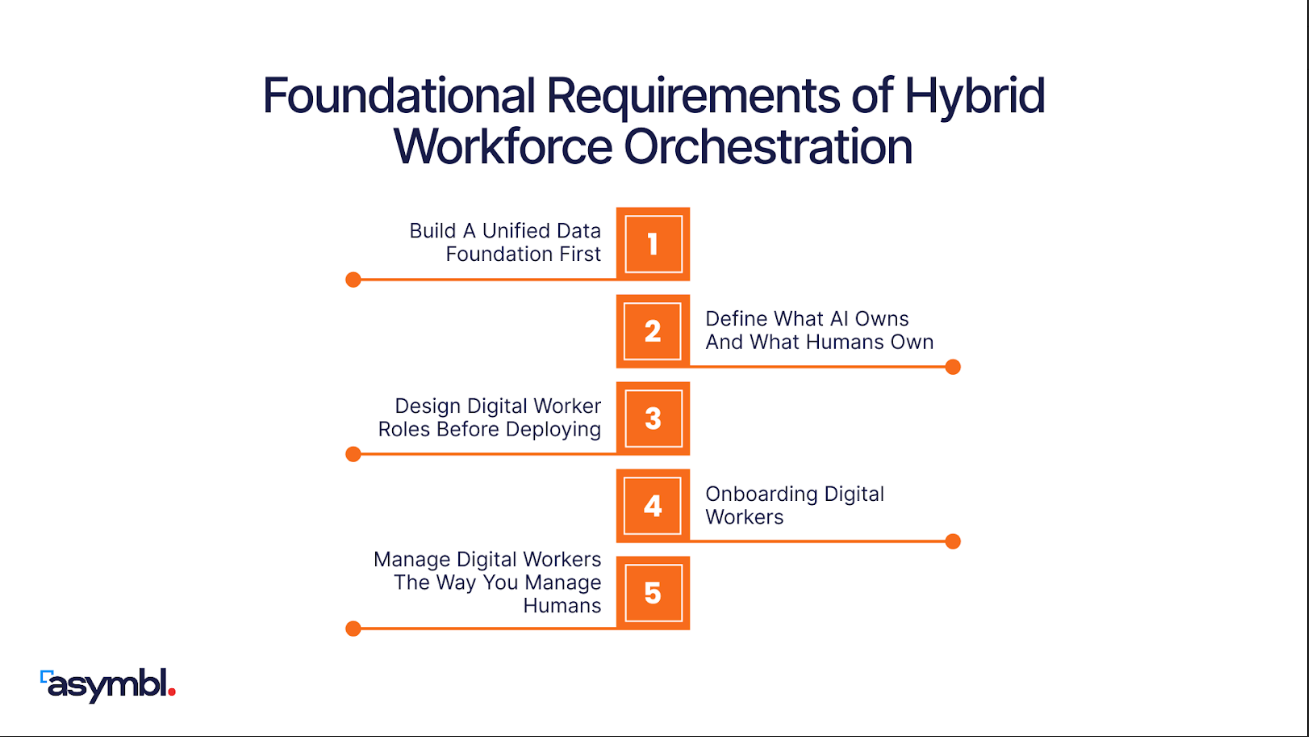
Foundational Requirements Of Hybrid Workforce Orchestration
Redesigning talent acquisition for human-digital execution is an operating model project that requires a platform capable of supporting it. Four conditions must be true before AI can compound in value.
1. Build A Unified Data Foundation First
A unified data foundation means candidate data, CRM history, hiring outcomes, assignment records, and post-hire performance live in the same environment, rather than synchronized between separate systems through middleware.
Integrations move records, but they do not create a shared intelligence layer. AI running on integrated data still sees fragments. The velocity is higher, but the information is incomplete.
On a unified foundation, every touchpoint updates the same record. AI sees the full relationship history. Recommendations improve as the record grows, closing the learning loop.
2. Define What AI Owns And What Humans Own
The division of labor must be made explicit before the technology is configured. Structured execution tasks like:
- Sourcing at volume
- Initial screening against defined criteria
- Outreach sequencing
- Scheduling and
- Status communication belongs to digital workers.
Judgment-intensive work like:
- Fit evaluation beyond stated criteria
- Hiring manager advisory
- Candidate relationship management
- Exception handling, and
- Offer negotiation belongs to human recruiters.
Without an explicit division, digital workers are deployed into ambiguous zones where neither party owns the outcome.
According to McKinsey’s 2025 Report on “State of AI: How Organizations are Rewiring to Capture Value,” workflow redesign has the single largest effect on whether organizations see EBIT impact from generative AI. Adding AI to an undivided workflow produces noise, whereas defining the workflow first produces capacity.
3. Design Digital Worker Roles Before Deploying
A digital worker without a defined job description, workflow scope, escalation logic, and performance standard is an unmanaged automation.
- Define the role:
- What does this digital worker handle?
- Where does it escalate?
- What are its inputs and outputs?
- Who owns its performance?
- Map the handoffs:
- When does the digital worker pass control to a human?
- What triggers the handoff?
- How does the human receive context at the moment of transition?
- Establish the performance standard:
- What does good look like?
- How is it measured?
- What triggers a recalibration?
Role design is the work that determines whether a digital worker performs in production or stalls in a pilot.
4. Onboarding Digital Workers
A digital worker that has been designed but not activated is a role that was never filled. Role design defines what the worker does, while onboarding is what makes it operational.
The digital worker onboarding process mirrors a human hire directly. It includes:
- System access: A new recruit gets an email address, a Slack or Teams profile, CRM access, ATS login, and calendar permissions on day one. A digital worker requires the same setup. It needs authenticated access to every platform it operates in, including the ATS, the CRM, the scheduling tool, and the communication channels, with permissions scoped to the role. Without provisioned access, the worker cannot act. Without scoped permissions, it cannot act safely.
- Process training: A human hire walks through workflows with a manager, learns how exceptions are handled, and shadows the team before running tasks independently. A digital worker is trained through the workflow configuration itself, its escalation paths, decision logic, and exception handling are the process documentation. The quality of the training is the quality of the configuration.
- Communication channels: New hires are introduced to the Slack channels they will monitor, the email threads they will own, and the teammates they will coordinate with. Digital workers are configured with the same: the channels they watch, the templates they use for outreach, and the handoff protocols that define how they pass work to human recruiters.
- Early performance checkpoints: Human hires have 30-60-90 day reviews. Digital workers need the equivalent. The first weeks of deployment are the highest-value window for catching calibration errors before they compound. Early monitoring is not the step that separates a digital worker who performs in production from an automation that was launched and never managed.
5. Manage Digital Workers The Way You Manage Humans
Once deployed, digital workers require ongoing management:
- Performance reviews
- Recalibration when they underperform
- Role evolution as the business changes.
The management logic mirrors human workforce management. Defined targets, regular review, coaching when standards are not met, and accountability when they are.
The organization that runs this discipline builds a digital workforce that compounds capability over time. The organization that configures and launches without ongoing management runs automations that drift.
Asymbl Recruiter Suite
Asymbl Recruiter Suite is purpose-built based on Salesforce. It is the operational data foundation for a hybrid recruiting team where human and digital workers operate on the same data, in the same environment, with defined roles and shared performance visibility.
1. Talent Intelligence
Talent Intelligence is the Recruiter Brain that powers Recruiter Suite. It scores candidates using pipeline history, interview feedback, assignment outcomes, and CRM context.
Running on the Salesforce data model, Talent Intelligence has access to the full candidate record across applications, engagements, and post-hire signals.
Scoring improves over time as the record grows, and every outcome (whether a placement succeeded, why a finalist declined, which submissions converted) feeds back into the model.
Matching tools score resumes against job descriptions. Talent Intelligence surfaces the signals digital workers and human recruiters act on, drawn from the full talent relationship management record.
2. Digital Recruiter
Rosa is Asymbl's pre-built AI-powered Digital Recruiter, built on Salesforce Agentforce that operates inside the recruiting workflow as a defined team member.
Rosa runs sourcing, initial screening, outreach sequencing, interview scheduling, and offer letter coordination at scale.
Escalation logic defines when Rosa hands off to a human recruiter. She has a job description, success criteria, and performance metrics, managed the way a human recruiter is managed.
In a production run inside Asymbl, Rosa reviewed 17,000 applications, pre-screened 1,800 candidates, scheduled 800 interviews, and supported 100 hires in 100 days with a 2-person human team.
The reported return on investment (ROI) was 1,529%. The human team handled what required human judgment, and Rosa handled what did not require human judgment.
3. A Roster Of Purpose-Built Digital Workers
Beyond Rosa, Asymbl runs a roster of digital workers across functions:
- Polly handles People Ops questions and answers in Slack and Agentforce.
- Theodore (Teddy) runs sales-side prospect engagement.
- Ben operates as a service-side Business Analyst in delivery engagements.
- Bradley and Atlas handle executive briefing and orchestration.
Each digital worker has a defined scope, job description, escalation logic, and performance framework. They are purpose-built roles with specific accountabilities. The roster operates alongside the human team on the same Salesforce data model. Every action, interaction, and outcome is captured in the same system of record.
4. Design, Onboard, Coach: Hiring The Digital Team
Asymbl applies the Design, Onboard, Coach framework to every digital worker deployment. The process mirrors what a strong manager does when bringing on a new hire.
- Design: The role is defined before the deployment. Job description, workflow scope, escalation paths, handoff protocols, and success criteria are established before the system is activated.
- Onboard: The digital worker enters the live environment with active performance monitoring. Early calibration catches and corrects errors before they compound into established patterns.
- Coach: Performance is reviewed on an ongoing basis. Digital workers are recalibrated as the business evolves and roles change. Capability compounds with management.
This is the management layer most digital labor deployments skip, and the reason most stall.
5. Recruiter Suite And Agentforce Explained
Recruiter Suite is Asymbl's talent relationship management application based on Salesforce. It houses the workflow, the data model, the pipeline views, the interview management, the offer tracking, and the reporting that recruiting teams operate inside.
Agentforce is Salesforce's agent platform. Rosa and Asymbl's other Recruiter Agents are built on Agentforce, which is what allows them to act inside Recruiter Suite with the same data and permissions a human recruiter would have.
Talent Intelligence layers on top, scoring candidates and providing the signals that digital workers act on.
The combination is what makes hybrid execution coherent with workflows, intelligence, and digital workers operate on the same foundation, on a single Salesforce data model, with no parallel systems to reconcile.
6. Customer Zero: Asymbl's Own Proof
Asymbl uses its own technology to run its own recruiting operations, an approach we call Customer Zero. The team operates on the same platform it builds and sells.
Asymbl is rapidly approaching 200 digital workers across 13 business functions and 30 systems, with a 5:1 output ratio (5x the output at one-fifth the cost).
2026 figures project $11M to $13M in productivity impact, $9M in net savings, and 56x total ROI for the business.
According to a 2025 Gartner Study on Recruiting Trends, the AI revolution is one of two forces reshaping how the function will operate by 2026. Asymbl is running that operating model already.
Conclusion
A workforce orchestration model treats digital workers like teammates, defines their roles, manages their performance, and gives them the data foundation to act on real signals instead of keyword matches.
It removes humans from the steps that do not require human judgment, so human recruiters can spend their hours on relationships, advisory, and hires that matter.
This is the operating model that corporate talent acquisition functions will be running in five years. The teams that build it now will set the cost structure and quality of hire benchmarks that the rest of the market will measure against.
To see how Asymbl Recruiter Suite is built for hybrid workforce execution, with Talent Intelligence as the Recruiter Brain and Rosa as a pre-built digital recruiter operating inside the same Salesforce data foundation, request a demo.
.webp)
AI in Staffing: 5 Ways Leading Firms Place Faster Today
How staffing firms use AI today, why bolt-on tools stall, and how native AI in staffing compresses time to place. Learn more

The Right Fit Starts With a Conversation.
See what working together could look like.
.webp)