
Staffing firms want more output without adding the same number of recruiters, but agentic AI tools were not designed around staffing workflows. Point solution tools automate individual tasks without connecting the work around them.
Internal builds can solve a specific use case but take months to develop and often remain tied to the desk or workflow they were built for. Internal builds can add real AI capacity, yet they rarely come with an operating model for managing that capacity across the firm. Agentic AI implementation therefore requires a framework for the following:
- Deciding where digital workers fit
- What they own
- How they work with human recruiters
- How their performance is measured
- How oversight changes as they take on more autonomy
In this blog, we'll map how agentic AI implementation changes workforce planning and identify the assumptions that can stall adoption.
We'll walk through a step-by-step framework for building an agentic workforce, show where digital labor can add capacity, explain how governance needs to scale with autonomy, and show how Asymbl puts the framework into practice.
How Agentic AI Changes Workforce Planning
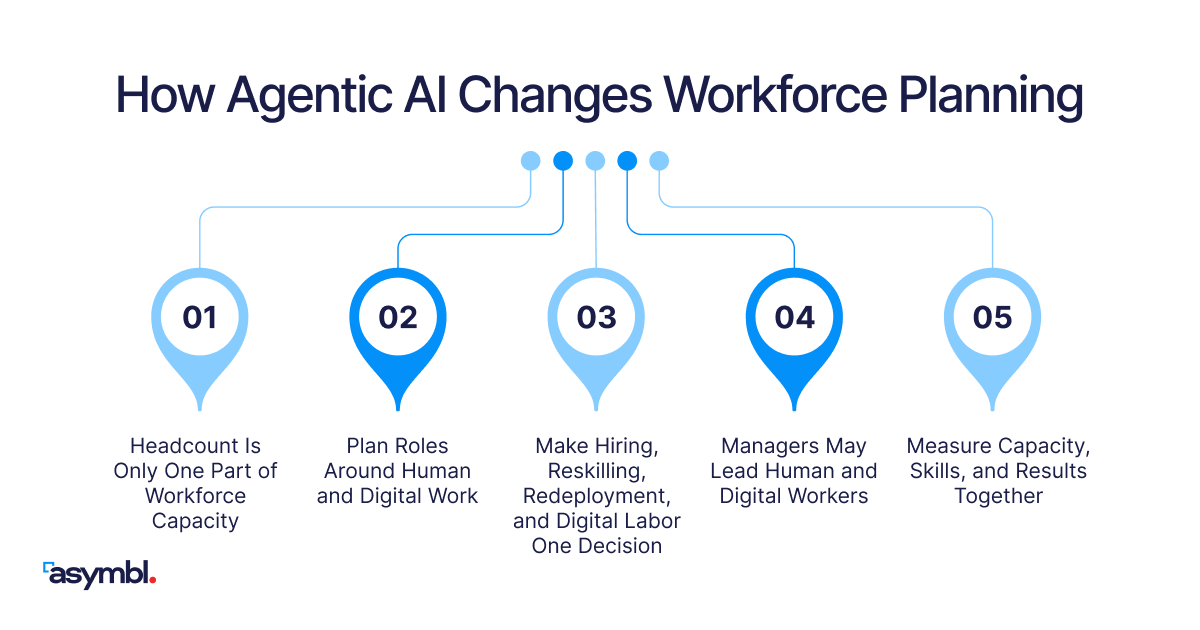
Capacity planning at staffing firms heavily relies on recruiter headcount. Agentic AI adds a second lever most firms haven't built into that plan yet.
1. Headcount Is Only One Part of Workforce Capacity
Your workforce capacity now has two parts:
- Recruiter headcount
- Digital capacity
Traditional capacity planning asks how many recruiters a desk needs, and it made sense when headcount was the only lever available. Once a digital worker can reliably hold a defined role, your total capacity becomes the sum of human capacity and digital capacity.
A plan built on headcount accounts for human capacity alone and measures half of what a desk can actually produce.
2. Plan Roles Around Human and Digital Work
Start capacity planning and allocation from the work. Ask what needs to get done, and who or what is best positioned to do it. For example, a desk filling a job order for a client doesn't need a human at every step of the process.
Sourcing talent for a high-volume job order might run better through a digital worker built for volume. Negotiating a counteroffer with placed talent needs a recruiter who knows the client relationship.
A digital worker handles the repeatable early stages, and a recruiter takes over once judgment and relationship carry the outcome.
3. Make Hiring, Reskilling, Internal Moves, and Digital Labor One Planning Decision
Weigh hiring, reskilling, an internal desk move, and onboarding a digital worker against the same capacity gap. You get a better answer than solving for headcount first and treating digital labor as a fallback.
You could solve a capacity gap on a specialty IT desk in a few ways:
- Hire another recruiter
- Train an existing recruiter into that specialty
- Move a recruiter over from a slower desk, or
- Onboard a digital worker to handle the sourcing volume
Firms that default straight to hiring are comparing options at different points in time. They typically consider digital labor once a job order takes too long to fill. This internal move shifts one of your own recruiters to a different desk. This is a different decision from redeploying placed talent to a new client assignment when one ends.
4. Managers May Lead Human and Digital Workers
A desk manager can lead and control both human workers and digital workers, each with defined work and expected output. As a digital worker takes on ongoing responsibility, it stops functioning like a tool the desk uses and starts functioning like an additional member of that desk.
A manager reviewing desk performance looks at a recruiter's pipeline and a digital worker's sourcing output in the same conversation. These aren't two separate reviews on two separate schedules.
5. Measure Capacity, Skills, and Results Together
Capacity, skills coverage, and output against goals belong in one view once a digital worker contributes measurable output. Staffing firms track this data separately, with desk capacity and fill rate in two separate systems. AI and automation are not measured in terms of capacity or impact created anywhere.
Once a digital worker closes meaningful volume on a desk, a manager needs one place to see all three things:
- What the desk can handle
- Which skills it covers
- What it actually produced last quarter
Splitting that data across systems leaves a basic question unanswered: how much of a desk's output came from a recruiter, and how much came from a digital worker? Without unified visibility, leadership can't accurately measure hybrid team productivity or the true capacity created across the desk.
Why Agentic AI Gets Harder at Workforce Scale
Once digital capacity counts inside the plan, you start building an agentic AI workforce across more than one desk.
What works cleanly with one digital worker on one desk doesn't scale as-is. It turns into coordination work once a dozen digital workers touch the same placement pipeline.
McKinsey, The State of AI in 2026: On the Road to ROI found that 44% of organizations now report AI scaling across the enterprise, up from 38% a year earlier. As AI moves from isolated deployments to enterprise-scale adoption, coordinating multiple digital workers becomes an operating challenge.
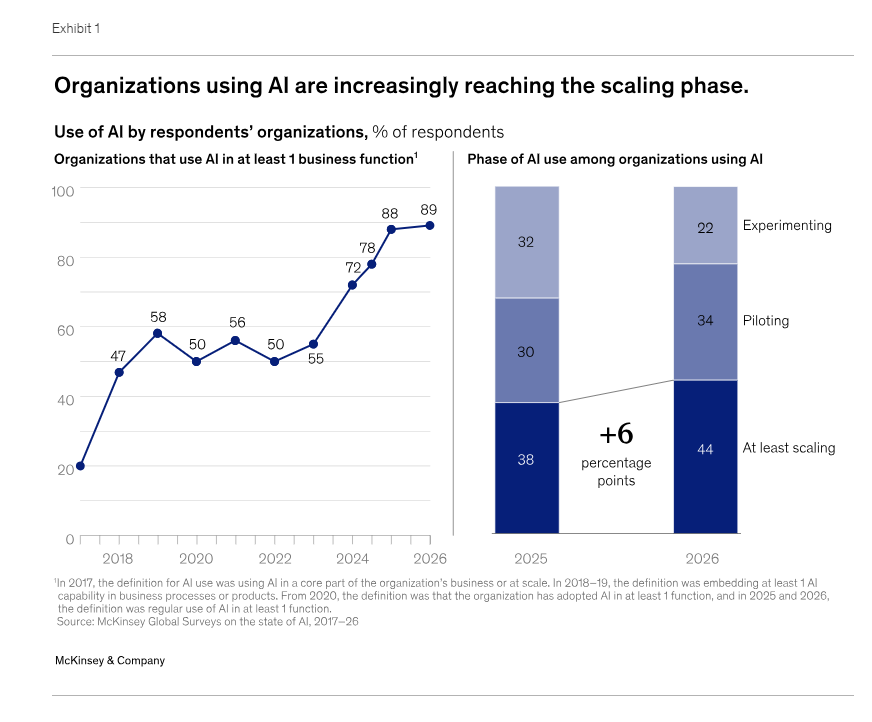
Source: McKinsey, The State of AI in 2026: On the Road to ROI
1. More Digital Workers Create More Dependencies Across the Business
Dependencies multiply because one digital worker's output becomes another worker's starting point, human or digital. A screening digital worker's output becomes a recruiter's shortlist. A scheduling digital worker's output becomes an interview calendar tied to a job order deadline.
A delay in one output shows up three steps downstream where nobody was watching for it. These dependency chains multiply as you add digital workers, and they need active management instead of running on the assumption that each one operates autonomously.
2. Human and Digital Workflows Need Clear Handoffs
A handoff between a human worker and a digital worker needs the same design attention as the task itself. Work passes from a recruiter to a digital worker, or back. An unclear handoff creates errors and delays you can't easily trace to their source.
Define the following:
- What triggers the handoff
- What information transfers with it
- Who owns the work at each point
Do this before the work starts moving. A recruiter who hands off a shortlist without flagging a client's specific preferences causes a problem. The digital worker then schedules interviews against incomplete information.
3. Digital Workers Need the Same Work Context as Humans
A digital worker without a human's history, systems, and context tends to make decisions that don't always fit your actual situation. A digital worker sourcing for a job order can lack visibility into why the last three submissions fell through. This context gap repeats the same mismatch a fourth time.
Context gaps like this compound as you add more digital workers. Each one needs the same access to history a person in the role would already have.
Asymbl Intelligence captures the judgment, context, and pattern recognition built up across every workflow and decision. This signal becomes available to every worker on the platform, human or digital. A sourcing worker pulling from that same signal already knows why the last three submissions to a client fell through.
4. Performance Becomes Harder to Standardize Across Digital Roles
Comparing performance across a handful of digital workers doing similar tasks is straightforward, but comparing it across dozens doing different jobs with different success metrics requires a shared framework, or review becomes inconsistent.
5. More Autonomy Requires More Oversight
The more independently a digital worker acts, the more monitoring, escalation paths, and audit infrastructure it needs. A human check happens less often in the moment. Oversight should scale up as autonomy increases, even when the instinct runs the other way.
A digital worker handling routine screening under close review is easy to correct mid-task. A digital worker approved to schedule client interviews and send offer paperwork on its own needs a stronger safety net.
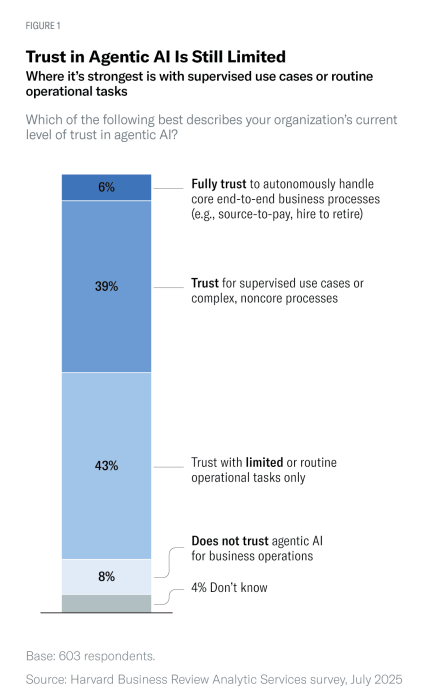
The 2025 Harvard Business Review Analytic Services report found that only 6% of respondents say their organization fully trusts agentic AI to autonomously handle core end-to-end processes. It includes processes like:
- Source-to-pay: A procurement process
- Hire-to-retire: An HR process that encompasses the entire employee lifecycle, from recruitment to offboarding.
Meanwhile, 43% trust agentic AI with limited or routine operational tasks, and 39% trust it for supervised use cases or complex, noncore processes.
The Assumptions That Make Agentic AI Harder to Scale
Gartner’s ‘Emerging Tech: Avoid Agentic AI Failure: Build Success Using Right Use Cases’ 2025 Report predicts more than 40% of agentic AI projects will be canceled by 2027. Escalating costs, unclear business value, and inadequate risk controls drive most of those cancellations. Each assumption below is one more way a rollout ends up in that category.
- AI Agents Are Treated as Tools Instead of Teammates: Plugging in an agent as a point solution caps how much responsibility it can ever take on. An agent is one component, whereas a digital worker is the fuller unit, built around a defined job and a measure of success. This is the way a role is defined for a human worker, too. A firm that stacks agents as point solutions ends up with an agent workforce nobody manages. A firm that builds AI digital workers ends up with accountable members of the team.
- Digital Workers Get Tasks Before They Get Roles: A digital worker without a job role, defined scope, or ownership is difficult to expand. Define a role up front, the way a job description defines a human's role. This gives a digital worker something to grow into, instead of a task to repeat.
- Businesses Train Digital Workers Instead of Coaching Them: A one-time setup treats a digital worker as a system configured once and left alone. The work changes and evolves faster than the setup. It needs ongoing feedback based on what it's actually producing. A new recruiter needs the same coaching past their first thirty days on the desk.
- Digital Workers Lack the Tools and Workspaces Humans Use: Your recruiters collaborate in shared systems, documents, chat channels, and meetings. Digital workers are frequently excluded from those same spaces. A digital worker can't always see the thread where a recruiter flagged a client's changed requirements. Without that context, the digital worker works from a version of the job order that's already out of date. Cut a digital worker off from your people's workspaces, and you cut off the context that makes its output reliable.
Accenture’s 2026 report, Generating Impact, found that 58% of executives say their organization is not ready to integrate AI agents with core enterprise systems, with legacy architectures continuing to block the move from pilot to production.
Workforce readiness is even lower: only 7% of executives say their own workforce is fully prepared for agentic AI.
- Digital Workers Operate Without a Clear Human Manager: When no one is accountable for a digital worker's output, decisions and mistakes fall into a gap that nobody owns. A digital worker might send client-facing scheduling messages with no named manager reviewing its patterns. It can then repeat the same small error for months before anyone notices. Escalation and performance review both assume a person is watching who was never assigned the job.
Agentic AI Implementation: How to Build a Strong Agentic Workforce
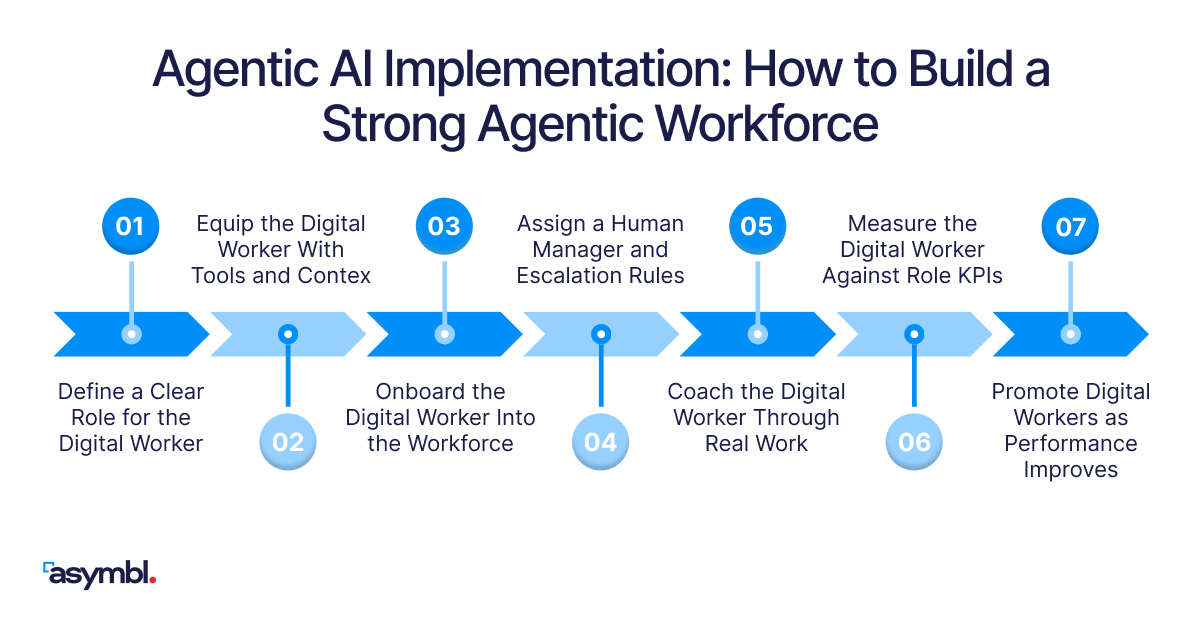
Each assumption above skips a step you'd never skip when onboarding a new team member. An agentic workforce is built one role at a time, and each AI digital worker that can actually hold a role follows a similar sequence. It is broken down into the following seven steps:
Step 1: Give the Digital Worker a Clear Role
A digital worker needs:
- A role
- Clarity of scope
- Responsibility
- Boundaries a job description gives a person
Don't leave it as a running list of tasks it happens to be doing. A digital worker can be built to source for three specific desks and escalate anything outside a defined range. Add hand-off of qualified talent to a recruiter, and that combination is a role.
Step 2: Give the Digital Worker the Tools and Context to Do the Job
Give a digital worker access to the same systems, data, and history a human in that role would use. This means the applicant tracking system, the client's requirements, and the record of what's been tried on a job order. It's not a stripped-down view built just for the task it started with.
A sourcing digital worker missing access to past submission history repeats an approach a client already rejected because it doesn’t have access to the context that restricts it from following the same approach.
Step 3: Onboard the Digital Worker Into the Workforce
Bring a digital worker into your existing workflows, teams, and reporting cadences the way you'd onboard a new recruiter. It joins the same handoffs a person in that role would join, and it gets access to the same channels. It also has a defined point where its work ends and a recruiter's work begins.
Step 4: Assign a Human Manager and Escalation Rules
Every digital worker needs a named human manager accountable for its output. Clear rules define when work escalates to a person. This manager reviews the digital worker's decisions the way a desk lead reviews a recruiter's calls.
Escalation rules define exactly what triggers a handoff. It includes:
- A client complaint
- A decision outside a set range
- A request the digital worker can't handle
Without a named owner, no one is accountable for the output of a digital worker.
Step 5: Coach the Digital Worker Through Real Work
A digital worker gets ongoing feedback based on actual outcomes, and the feedback should look at what the digital worker actually produced this month. It considers a missed nuance in a client's requirements, or a pattern in which submissions get rejected, and adjusts.
A digital worker coached this way improves the same way a recruiter does. A manager reviews their calls, points out what to change, and both improve through repeated, specific feedback tied to work.
Step 6: Measure Performance Against Role KPIs
You evaluate a digital worker against the same key performance indicators (KPIs) a human in that role would carry.
- A sourcing digital worker's KPI is qualified submissions per job order
- A scheduling digital worker's KPI is interviews completed on time
Measuring activity instead of outcome makes a digital worker look productive. It misses the result the role actually exists to produce.
Step 7: Promote Digital Workers as Their Performance Improves
A digital worker's scope expands as it proves reliable, the same way a person earns more ownership over time. A digital worker that has handled sourcing for six months might take on initial outreach next, then scheduling. Each expansion ties to demonstrated performance.
Where Agentic AI Can Add Workforce Capacity
A digital worker built through an efficient implementation sequence still needs the right work to do.
- Start With Work That Has Clear Outcomes and Repeatable Decision Paths: Start where the output is defined, and the decision process repeats, even when the details change. Screening a submission against a job order's stated requirements repeats the same decision logic every time. This makes it a strong fit for a digital worker. Negotiating a counteroffer changes with every client relationship and every placement, which makes it a poor one.
- Digital Recruiting Can Increase Recruiting Capacity: Recruiting runs a high volume of repeatable workflows, sourcing, screening, scheduling, and follow-up, well suited to a digital worker. Rosa, a Digital Recruiter built on Recruiter Suite, handles exactly that volume.
She extends what a desk can handle without needing headcount to grow at the same rate as job order volume. This means you can take on more open job orders without a proportional hiring push of your own.
The repeatable share of recruiting work, the sourcing and scheduling that consumes a recruiter's day, moves to a digital worker. This frees recruiters to spend more time on the relationships and placement decisions that actually close a job order.
- People Operations Can Extend Employee Support: Your own people ops function fields a high volume of repetitive requests, policy questions, status checks, and routine approvals. A digital worker can absorb a meaningful share of that volume.
Inside Asymbl's people ops function, Polly, a Digital People Operations Specialist, answers 80 questions a month, on average. Her average response time is two minutes, and she saves the team 480 hours a year.
She routes anything sensitive, a harassment concern or discrimination complaint, straight to a private HR channel. This splits the work cleanly: Polly absorbs routine volume while routing sensitive matters to a person, which a digital worker shouldn't handle.
- Use Digital Labor Where Capacity Gaps Are Persistent: Digital labor returns the most where a desk carries a standing, ongoing shortfall in capacity. A desk that's been short a recruiter for two quarters running has a persistent gap. This is worth solving with a digital worker built into the role.
A desk covering a temporary spike, a single large client ramping up over a month, needs short-term capacity addition. Contract staff or overtime often serve it better, since those options scale down as easily as they scale up.
Onboard a digital worker for a gap that closes in six weeks, and you've built capacity you won't need. This capacity goes unused once the spike passes.
- Keep Judgment, Relationships, and Sensitive Decisions Human-Led: Keep negotiation, sensitive judgment calls, and relationship management with your human workers. This is where the cost of a wrong call is highest and human context matters most.
A recruiter closing a placement reads a client's hesitation and weighs what the talent on the other side actually wants. They also draw on a relationship built over multiple job orders.
Rosa elevates recruiters to focus on what requires human judgment, building relationships and making placement decisions. She handles the volume around it.
How to Manage Agentic AI Risks Across the Workforce
The more autonomy a digital worker takes on, the more that decision becomes a governance question you have to answer.
2026 Deloitte State of AI in the Enterprise Report found that 74% of companies plan to deploy agentic AI within two years, but only 21% report having a mature governance model for autonomous agents.
The following best practices determine the governance standards for agentic AI implementation:
1. Define Accountability for Digital Worker Decisions
Clear ownership keeps responsibility from falling into a gap when something goes wrong. This ties back to the human manager assigned during onboarding. The same person accountable for a digital worker's output stays accountable when a decision needs to be explained or corrected.
2. Set Role-Based Access and Permissions
Limit each digital worker's access to what its role actually requires. This is the same least-privilege principle you already apply to human employee access. A sourcing digital worker doesn't need write access to payroll data. A scheduling digital worker doesn't need visibility into margin on a placement.
Scope access to the role a digital worker holds, regardless of which systems were easiest to connect during initial setup. This keeps the damage from a compromised or malfunctioning digital worker contained, instead of spreading firm-wide.
3. Establish Guardrails for Autonomous Actions
Guardrails define what a digital worker can do independently versus what needs your approval, especially for high-stakes or irreversible actions. Sending a routine scheduling confirmation needs no approval. Extending an offer or committing to pricing on a job order does need approval.
Reversing either after the fact costs more than the delay of getting a person to sign off first. Guardrails should scale with the consequences of a decision.
4. Maintain Audit Logs of Digital Worker Decisions and Actions
An audit log is a record of what a digital worker did and why. This record lets you review, explain, or correct it after the fact. Rosa is built to be governed and auditable from day one. A client might question why an interview got rescheduled, or why an offer went out with the wrong start date. The log answers it in minutes, instead of forcing a manager to reconstruct the sequence from memory.
5. Review Access and Controls as Roles Change
As a digital worker's responsibility grows through promotion, its access and guardrails need reassessment. A digital worker promoted from screening submissions to also scheduling interviews needs calendar access it didn't have on day one.
The guardrails around client communication need a second look at the same time. Leave access fixed at the setup while scope keeps expanding, and a digital worker ends up in a bad spot. It might have too little access to do its expanded job, or keep too much access left over from a stage it has already grown past.
How Asymbl Puts Workforce Orchestration™ Into Practice
Workforce Orchestration™ turns digital workers from isolated automations into managed members of the workforce. Asymbl connects their roles, workflows, human owners, performance metrics, and governance so digital and human workers operate as one system.
Asymbl Runs 200+ Digital Workers Across 13 Business Functions
Asymbl runs its workforce on the same role-first approach, with 200+ digital workers across 13 business functions and 30 systems. Each one is built around a defined scope, a human manager, and a KPI tied to performance. This scale didn’t happen by onboarding digital workers wherever a team asked for one.
Each digital worker went through the same design, onboard, and coach sequence covered in the implementation steps. A job description and a measure of success came first, then came a supervised onboarding into live work, followed by ongoing coaching through Asymbl's own managed services function.
Rosa and a Two-Person Recruiting Team Hired 100 People in 100 Days
Two recruiters and Rosa, the Digital Recruiter, processed 17,000 applications and hired 100 people in 100 days. This scale would typically need a larger recruiting bench without a digital worker absorbing the repeatable parts of the process.
This means the sourcing, pre-screening, and interview scheduling that consumed most of a recruiter's week before Rosa took it on.
The two-person team pre-screened 1,800 candidates and scheduled 800 interviews, with Rosa handling the volume behind each number. This let the recruiters spend their time on the parts of hiring that needed a person's judgment.
High-Performing Digital Workers Can Earn Greater Responsibility
Asymbl's own digital workers take on greater responsibility as their performance holds up, the same growth path a strong recruiter would follow. A custom digital worker built for one specific job scales its scope as it proves value.
Ongoing coaching and optimization refine its performance against defined KPIs after it's already live, not just during initial rollout.
Scale Agentic AI Implementation Without Rebuilding Every Time
The manager, the escalation rules, and the audit log stay in place as a digital worker's role expands. A sourcing worker promoted into scheduling keeps the same named manager. The guardrails adjust for the new scope instead of resetting to zero.
Agentic AI implementation done this way gives your workforce room to absorb whatever a digital worker takes on next. The future of AI agents in staffing belongs to firms with a structure in place to manage them. The desks that build this now spend the next AI cycle extending a structure they already trust. Desks that still layer agentic AI onto old workflows start over again.
Asymbl ran this same Design, Onboard, and Coach sequence across 200+ digital workers before offering it to clients.
Book a demo to see how Asymbl builds that same structure into your desks from day one.
FAQs
Agentic AI is AI that plans, decides, and acts across multiple steps of a task on its own, rather than waiting for a person to prompt each step. In workforce operations, that means a digital worker can source candidates, screen submissions, or schedule interviews across the full process, adjusting its approach as job order details change, instead of running a single fixed rule each time a person triggers it.
Agentic AI differs from traditional automation because it makes decisions and adapts across a multi-step process instead of executing one fixed rule per trigger. A scheduling macro sends the same reminder every time under the same condition. A digital worker scheduling interviews can weigh a candidate's stated availability, a client's calendar changes, and a job order's deadline together, then adjust its next action instead of stopping until a person re-triggers it.
Yes, in a growing number of jurisdictions. States including Illinois, Colorado, and New York City, along with the EU AI Act, require employers to notify candidates when automated decision-making tools are used in hiring, and some mandate consent or a right to request human review.
Yes, a digital worker can introduce or amplify bias if the data, criteria, or historical patterns it learns from already contain one. A screening digital worker trained on past shortlists that skewed toward certain schools or job titles will repeat that pattern at scale unless someone audits its criteria and outcomes regularly. Bias risk grows with autonomy, which is why screening criteria need periodic review against actual placement outcomes, not just initial setup.
Look for clean integration with your existing ATS or CRM first, since a platform that creates a parallel workflow adds administrative work instead of removing it. Beyond that, check how much the platform actually acts without a person prompting each step versus just surfacing suggestions, what human-in-the-loop controls and escalation options it offers, and whether it can clearly answer where candidate data is stored, retained, and who can access it.
Timelines vary by scope, but the pattern is consistent: a few weeks to design the digital worker’s role and align leadership, then several months to onboard it into live work and coach its performance as responsibility expands, the same Design, Onboard, and Coach sequence Asymbl runs internally. Firms that skip a clear role definition and a named manager up front are usually the ones still troubleshooting a year later.
The future of agentic AI for staffing firms depends less on new capabilities and more on how firms manage the AI digital workers they already run. The future of work with AI agents looks like blended desks, where recruiters and AI digital workers share one capacity plan, one accountable manager, and one set of KPIs. Firms that define roles, assign human managers, and scale governance with autonomy now can expand what their AI digital workers own as the technology matures. Firms that bolt agents onto old workflows will rebuild with every new release.


AI Resume Screening Tools: The 2026 Shortlist
Every AI resume screening tool on this list parses well. What separates them is what else they see, and whether the decision holds up later. Explore

The Right Fit Starts With a Conversation.
See what working together could look like.
