


AI resume screening tools handle parsing, ranking, and scoring resumes against documented criteria.
A desk evaluating AI resume screening tools is buying submission speed against every other firm racing to fill the same job order, and margin that depends on how many open reqs a recruiter can carry without the desk adding headcount. A screen that takes two extra days hands the shortlist to whichever firm submitted first.
Clients are also starting to ask staffing firms how their screening tools were vetted, so the purchasing decision has to hold up if a client asks about it months later.
In this blog, we will compare the strongest AI resume screening tools on the market in 2026, walk through the evaluation questions vendor demos rarely answer, and show where Asymbl fits for firms that want screening running inside the record instead of bolted on top of it.
Best AI Resume Screening Tools in 2026
Each AI resume screening tool evaluated on this list covers what the platform is, what it does, and who it fits best.
1. hireEZ
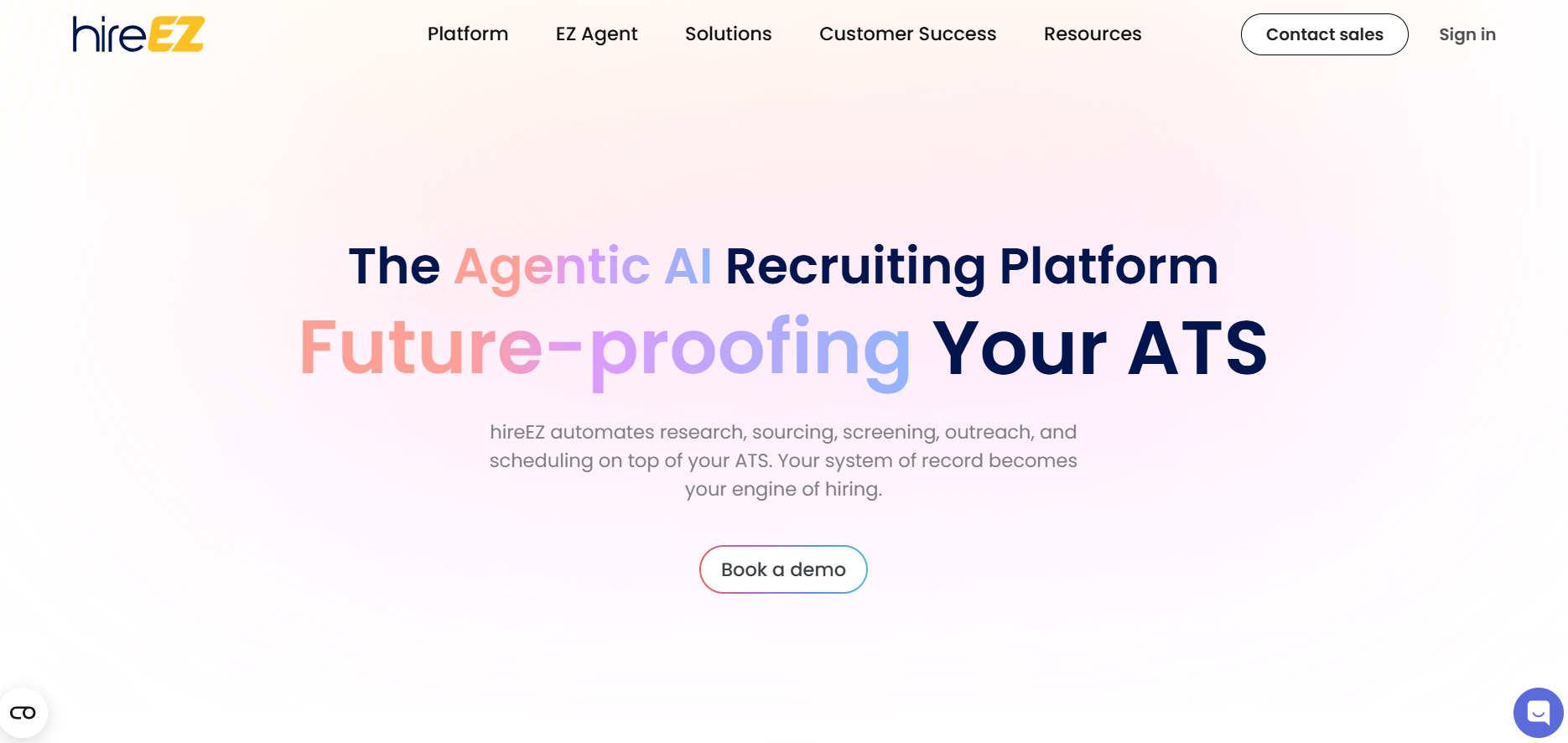
hireEZ is an AI-powered recruiting platform built around candidate sourcing and outreach automation, with a matching logic that also screens inbound applicants. Its EZ Agent searches profiles across the open web and a firm's own ATS to surface candidates against a job description, while Applicant Match ranks and verifies people who have already applied.
Key features:
- EZ Agent: Surfaces candidates across the open web and a connected ATS from a job description and candidate persona, showing why each match fits the role.
- Applicant Match: Ranks and verifies inbound applicants automatically and flags resumes that show signs of fraud.
- Machine learning refinement: Learns from candidates marked "Good Fit" or "Not a Fit" to adjust future search results toward or away from similar profiles.
- Enhanced matching algorithm: Uses behavioral and historical hiring data alongside resume content, in addition to keyword matching, to refine candidate recommendations.
Best for: Firms whose primary bottleneck is sourcing volume, with applicant screening running as a secondary layer over an outbound-heavy workflow.
Pricing: Custom
2. Asymbl
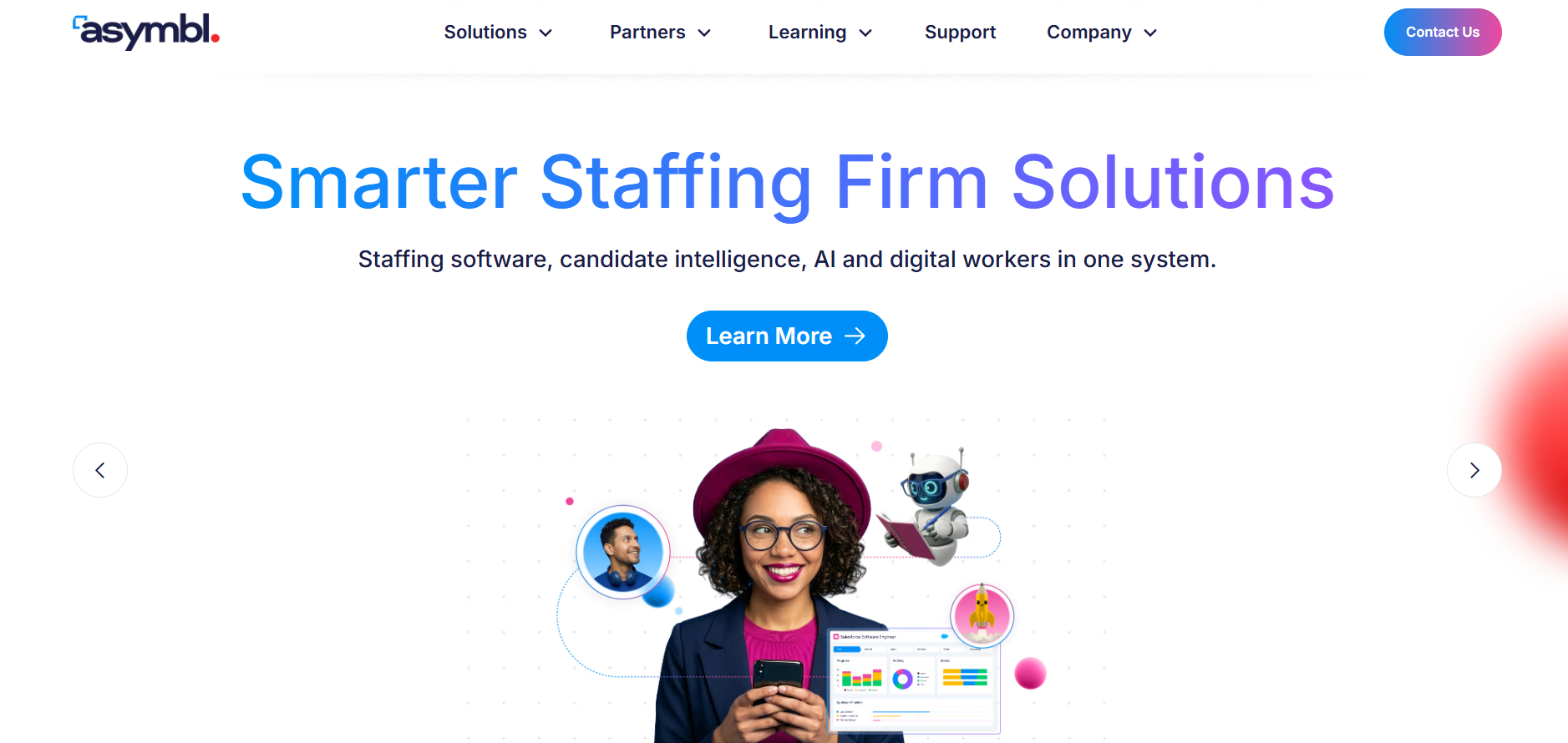
Asymbl offers talent relationship management solutions built for staffing and recruiting firms, combining an applicant tracking system (ATS), AI-powered candidate matching, and Rosa, a pre-built digital recruiter inside one connected environment, Recruiter Suite.
Screening runs inside the same system that holds job data, client context, and candidate history, so scores and reasoning stay attached to the record instead of living in a separate interface.
Key features:
- AI Matching Engine: Scores candidates against jobs and jobs against candidates, highlighting available, in-contact, and prior-placement pools with a breakdown of how qualifications map to role requirements.
- Candidate Intelligence: Generates AI-powered analysis and a placement-likelihood score for every candidate before a recruiter picks up the phone.
- Rosa, Digital Recruiter, Application Screening: Scores inbound applications against job criteria, surfaces the strongest candidates for review, and answers candidate questions around the clock.
- Resume and Job Parsing: Automates profile creation from resumes and job descriptions at batch volume, removing manual data entry during application spikes.
- Bias and Compliance: Flags biased search terms before a query runs and logs the full search history to build an audit trail of every search and modification.
Best for: Staffing and recruiting firms that want screening, matching, and the applicant record running on one connected system instead of stitched-together point tools.
Pricing:
- Asymbl Recruiter Suite starts at $60/user/month for Launch and $125/user/month for Premier
- Ultimate uses custom pricing and adds an autonomous Digital Recruiter
- Digital Labor Advisory is scoped by phase, while Agentforce packages cost $25K for Break-Fix and approximately ~$30K for Jet Pack, each delivered over four weeks.
3. Bullhorn
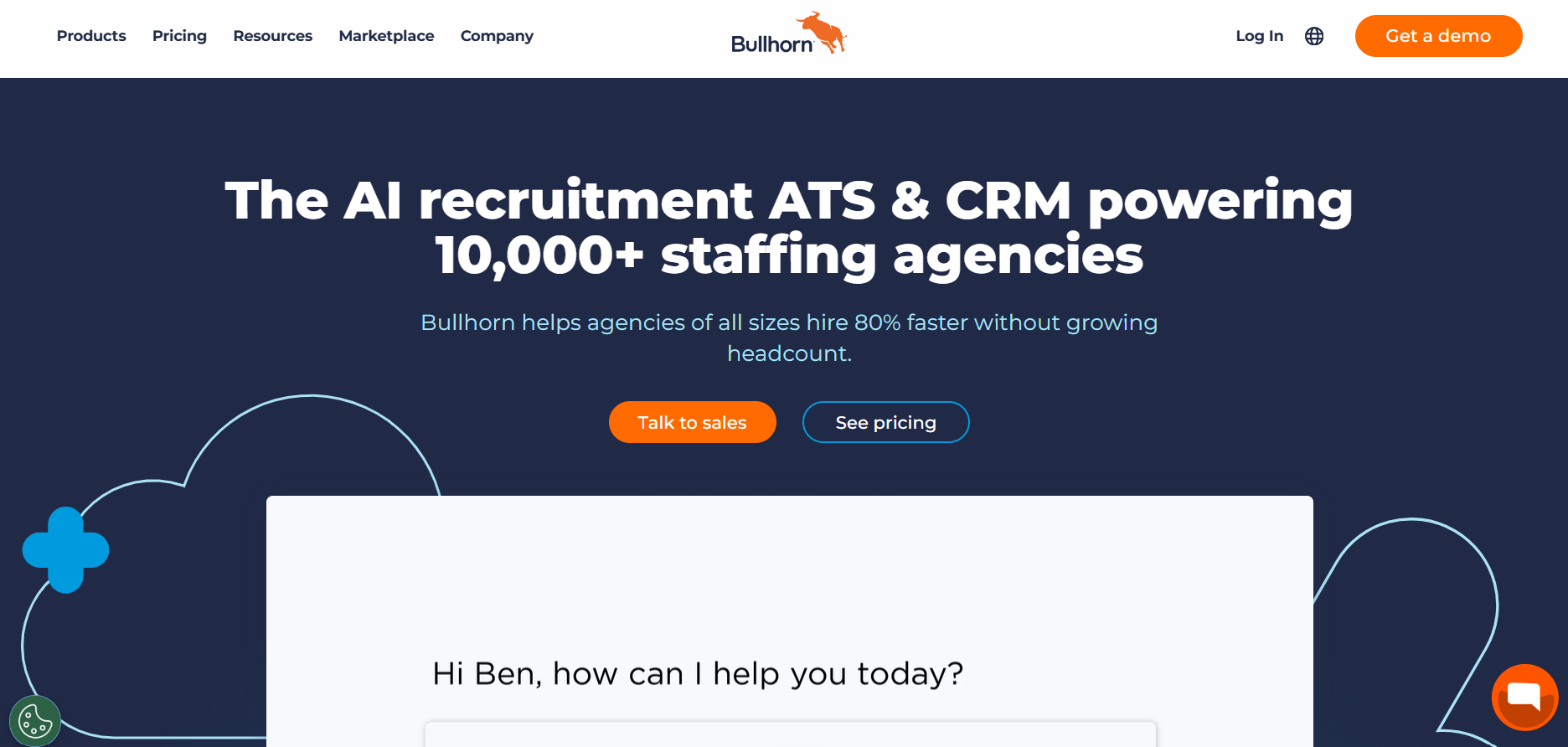
Bullhorn is a cloud-based recruitment and staffing software platform that combines applicant tracking and customer relationship management for staffing and recruiting firms. It is designed to manage recruitment operations across the staffing lifecycle, from candidate and job management through placement and related business processes.
Key features:
- ATS & CRM: Manages candidates, jobs, shifts, and clients within a unified staffing recruitment platform.
- AI Search & Match: Searches the candidate database, ranks candidates by fit, and provides matching insights for open jobs.
- Workflow Automation: Uses configurable workflows to automate emails, record updates, task creation, follow-ups, and candidate engagement.
- Interview Scheduling: Automates interview scheduling within recruitment workflows, coordinating the booking process between candidates and recruiters.
- Reporting & Analytics: Provides configurable reports, dashboard views, and real-time insights across recruitment and business activity.
Best for: Primarily intended for staffing agencies, recruitment firms, and enterprise recruiting organizations that need a centralized system for managing candidates, clients, jobs, and recruitment operations
Pricing: Bullhorn Starter costs $99/user/month, while Core costs $165/user/month. Pro, Max, larger-agency offerings, AI and automation products, and Recruitment Cloud require contacting sales for pricing. Bullhorn also offers additional products for onboarding, analytics, messaging, middle-office operations, and workforce management.
4. Greenhouse
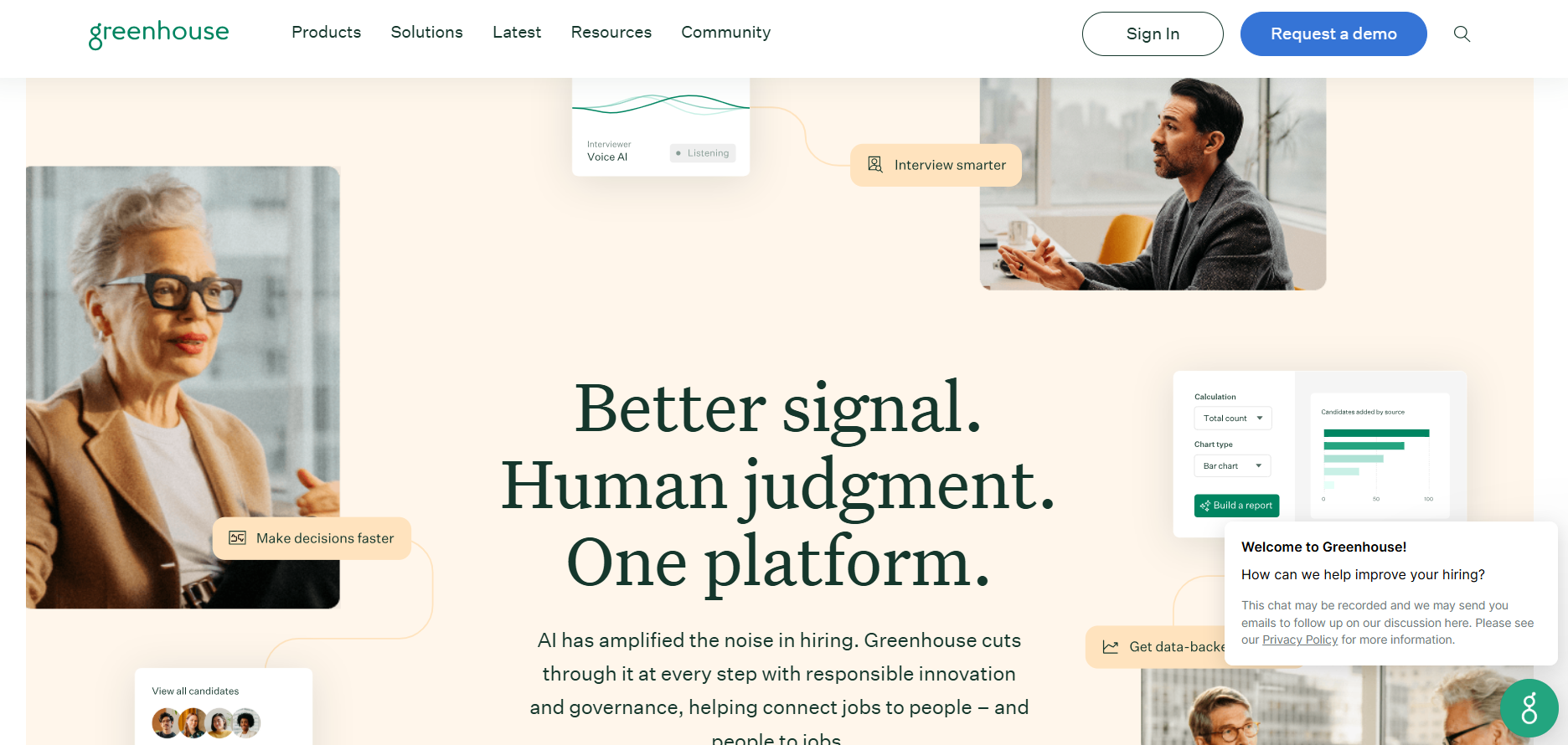
Greenhouse is an applicant tracking system with AI tools built into job setup, sourcing, application review, and reporting. Its AI reads the parsed text of a resume and generates a candidate summary and scorecard prompt for the recruiter, rather than issuing a pass or fail decision on its own.
Key features:
- AI candidate filtering and summaries: Reads parsed resume text to generate a scorecard summary for the recruiter, alongside offer forecasting and org-level AI toggles.
- Resume anonymization: Removes identifying candidate details from the review view to support blind, criteria-based screening.
- Configure > AI Tools: Centralizes AI settings across job setup, sourcing, application review, and reporting so admins control what is enabled where.
Best for: Firms that want AI assistance layered into an established ATS workflow, with a human recruiter making every screening decision.
Pricing: Greenhouse offers three custom-priced plans:
- Core for structured hiring and essential automation
- Plus for advanced automation, reporting, and configuration
- Pro for enterprise-level governance, security, analytics, and extensibility. Pricing depends on hiring volume, organizational complexity, and required capabilities.
5. Eightfold AI
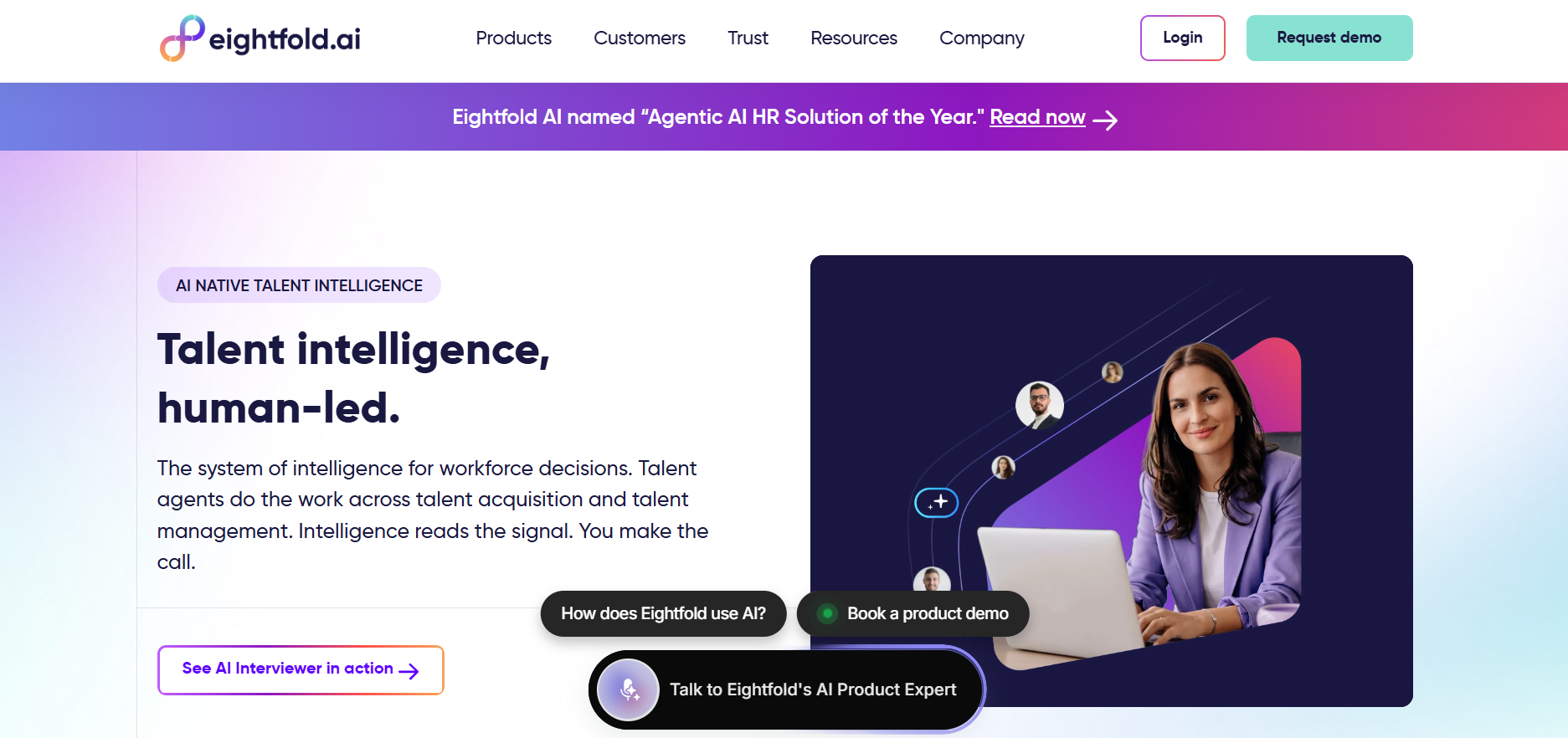
Eightfold AI is a talent intelligence platform that uses deep-learning models to match candidates to roles based on skills and capabilities rather than resume keywords or job titles alone. It draws on a large database of skills and career-trajectory data to score fit, surface past applicants and current employees as candidates for new openings, and recommend roles candidates are likely to succeed in.
Key features:
- Skills-based matching: Analyzes more than a million distinct skills and dozens of variables to score candidate fit beyond resume keywords.
- Career-trajectory data: Draws on a database of candidate career paths to help predict likely success in a role, alongside historical qualifications.
- Internal talent resurfacing: Surfaces past applicants, current employees, and alumni as candidates for new openings using the same matching model.
- Dynamic job calibration: Refines job requirements over time based on match outcomes to reduce overlooked candidates.
Best for: Large corporate employers running sourcing, screening, and internal mobility from a single skills-based data model.
Pricing: Custom
6. Workable
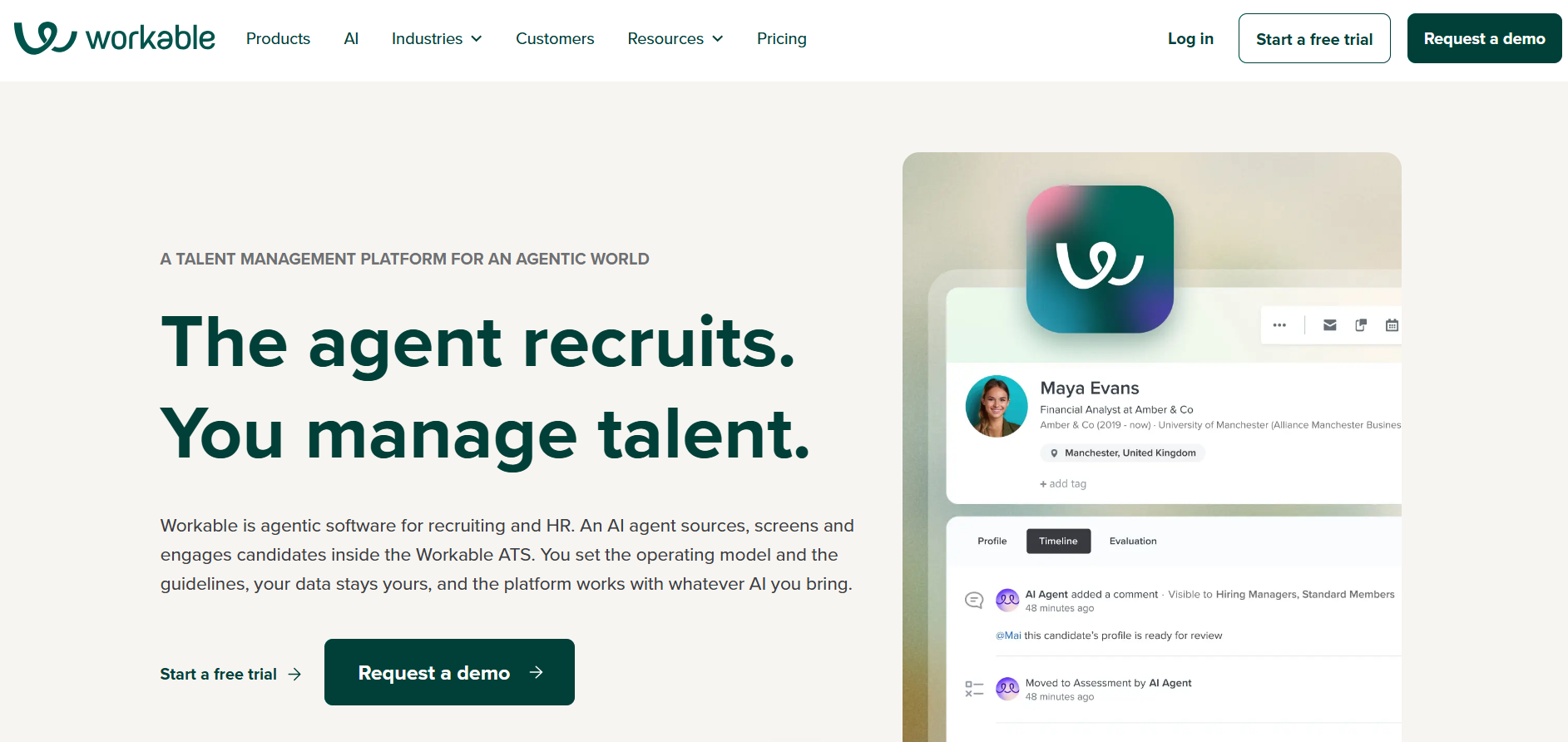
Workable is a hiring platform with AI resume screening built into its applicant tracking workflow. For each applicant, its AI scans the resume and produces a summary of how the person's skills and experience match the job requirements, using semantic matching rather than exact keyword search.
Key features:
- Semantic resume matching: Compares resume content to job requirements by meaning rather than exact keyword overlap, catching skills phrased differently than the posting.
- AI match scoring and ranking: Scores and ranks every applicant against the job description, with a summary explaining why each candidate ranked where they did.
- Resume anonymization: Extracts and anonymizes identifying resume details during initial screening to support evaluation based on qualifications.
- Protected-characteristic exclusion: Scoring model evaluates skills and experience signals only, excluding protected demographic characteristics from the score.
Best for: Small to mid-sized teams that want semantic screening built directly into a general-purpose hiring platform.
Pricing: Workable has three plans:
- Standard ($299/month)
- Premier ($599/month)
- Enterprise ($719/month)
All include recruiting and HR features, with higher tiers adding tools such as texting, video interviews, assessments, referrals, and performance management. Workable Agent is available as an add-on, with 3,000 free AI credits per month on Premier and Enterprise.
7. Loxo
Loxo is a talent intelligence and recruitment software platform built for recruiting firms, staffing agencies, executive search teams, and other talent acquisition organizations. It combines applicant tracking, recruiting CRM, talent sourcing, candidate engagement, people and company data, and AI within a unified recruitment system. Loxo is intended to manage the recruitment lifecycle in one platform, particularly for organizations that conduct ongoing candidate sourcing and relationship-based recruiting across multiple searches and roles
Key features:
- Recruitment CRM: Centralizes candidates, clients, conversations, notes, and activity history in one searchable database.
- AI Candidate Sourcing: Uses natural-language search, Boolean strings, filters, and AI matching to surface relevant candidates from available talent data.
- ATS Pipeline Management: Tracks candidate progress across jobs and lets teams configure pipeline stages, fields, and job templates.
- Workflow Automation: Triggers communications, scheduling, outreach campaigns, and AI-assisted submittal summaries based on candidate stage changes.
- Multi-channel Outreach: Builds campaigns for candidate and client engagement and connects outreach activity with recruitment records
Best for: Loxo is best suited for recruiting and staffing firms, executive search teams, RPOs, and in-house recruiting organizations that need ATS, CRM, sourcing, outreach, and talent intelligence in one platform.
Pricing: Loxo Core starts at $149/user/month, billed annually. Professional starts at $199/user/month and includes 2,500 credits per seat monthly. Enterprise pricing is custom. Additional credit capacity is available through 2×, 5×, and custom Boost options.
How to Evaluate AI Resume Screening Software
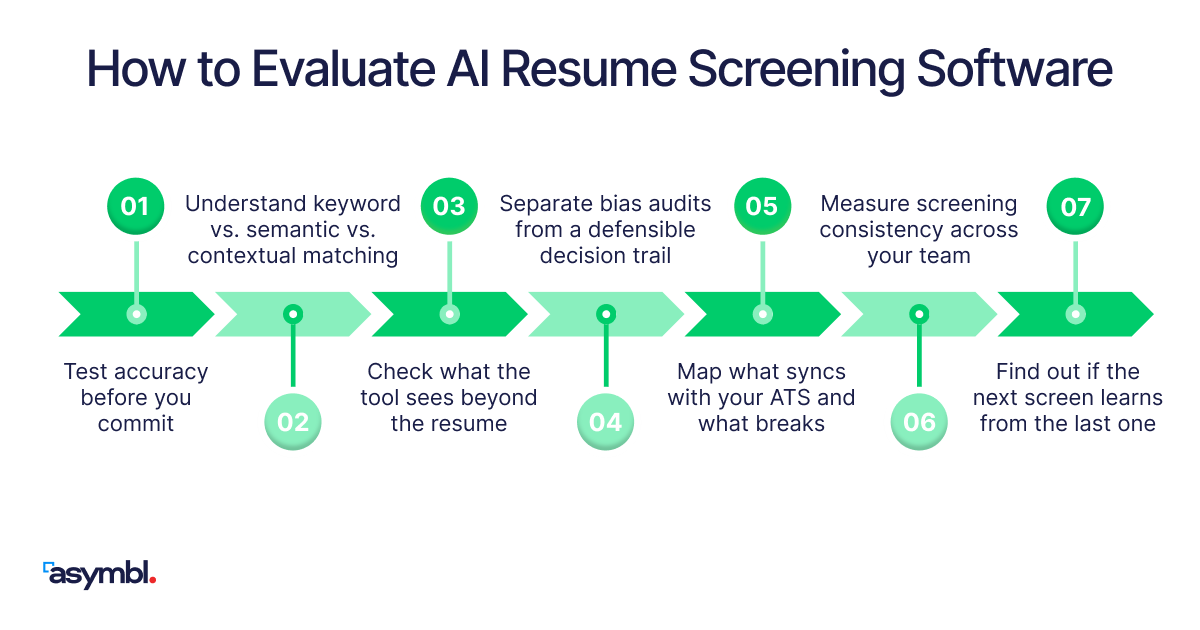
Staffing desks weigh submission speed and consistency across every recruiter on the desk. Vendors selling AI tools for candidate screening rarely volunteer answers to these questions on a sales call, which is exactly why a desk has to ask them directly before signing anything.
1. Accuracy you can test, not accuracy you are told
Testing the accuracy of AI resume screening tools directly means running the pilot on a role the desk fills repeatedly for one client. Since the desk already knows what a good submission looks like there and can score the tool's shortlist against outcomes, it can verify itself.
The challenge is handling the edge cases the vendor never talks about. For example:
- A candidate who changed job titles mid-career without a title bump
- A resume formatted for a different industry's conventions
- A skill listed under a synonym the model was never trained to recognize
2. Keyword, semantic, or contextual reasoning
- Keyword matching looks for terms
- Semantic matching compares the meaning of resume text against job text
- Contextual reasoning weighs what a term means for a specific role, a specific client, and a specific seniority level, which is a different and harder problem than matching two strings
Contextual reasoning is the only one of the three matching models that asks what the text strings mean for the specific req in front of the desk.
3. What the tool screens against besides the resume
A resume is a document a candidate chose to write about themselves, curated for a general audience rather than the specific job order in front of a recruiter.
An efficient AI screening tool should screen the following:
- Prior applications from the same person
- Previous interview feedback from other roles
- How a past submission landed with a specific client
- How someone actually performed on a prior assignment
Most screening tools see none of that context, because they attach to the candidate record from outside it rather than running inside the system that holds it.
The best AI resume screening software closes this gap by connecting to systems beyond the resume, but the market still treats the application as a standalone document, scored once and never revisited even after the candidate is hired, placed, or rejected for reasons that had nothing to do with skill.
4. Bias safeguards versus your own audit trail
The audit record a firm actually needs is evidence about the decision made on one specific person, on one specific date, in case that decision gets questioned later.
The regulatory bar for that documentation keeps rising. The NYC Consumer and Worker Protection requires an independent bias audit within the past year, a public summary of it, and 10 business days' notice to candidates before an automated tool evaluates them.
Colorado’s AI law, originally enacted as SB 205 and revised through SB 26-189, also establishes requirements for AI used in consequential decisions, including employment, making clear documentation and consumer-facing notices increasingly important when automated systems influence hiring decisions.
A 2025 New York State Comptroller audit of the law's enforcement found DCWP identified only 1 likely non-compliance case out of 32 employer and vendor disclosures reviewed, while the Comptroller's own review of the same 32 found at least 17 potential issues, which is the kind of enforcement gap that makes a firm's own documentation matter more.
A 2024 AIES study by Wilson and Caliskan (University of Washington) tested large-language-model resume rankers across roughly 500 resumes and job descriptions and found they favored white-associated names in 85.1% of paired comparisons and female-associated names in just 11.1%.
A 2025 Gartner report, “Mitigate Rising Candidate Fraud Through Identity Verification,” found only 26% of nearly 2,918 job applicants trust AI to evaluate them fairly, even though 52% believe AI is already screening their application.
Staffing firms carry the risk through client exposure instead, and clients are increasingly asking for documentation before they sign off on a vendor.
5. ATS compatibility and what breaks in the sync
Whether a score survives past the demo depends on what direction the data actually moves. Does the screen write its score and its reasoning back onto the candidate record inside the ATS, or does that history live only inside the vendor's own interface, invisible to the next recruiter who opens the file?
When a recruiter overrides a score, either because they know something the tool does not or because the client called with different priorities, does that override travel back into the system, and which system wins the next time the same candidate comes up?
A firm running three or four point tools that were never designed to share data ends up with three or four different versions of the context about the same candidate, and nobody on the desk can say with confidence which one is current.
6. Screening consistency across the whole team
Recruiting quality is unevenly distributed across recruiter desks. Senior recruiters make calls that newer ones cannot explain or replicate, because the signal a senior recruiter draws on, like what a client actually meant by a title, or which resume gaps matter and which do not, was never written down anywhere a screening tool or a junior recruiter could see it.
A screening tool that runs on the resume alone inherits that same unevenness rather than fixing it. It applies one consistent standard, but that standard is only as good as the criteria a single person configured it with.
7. Whether the screen improves the next one
When a screened candidate gets hired or placed and performs well, does that outcome change how the next screen scores a similar profile, or does the model stay exactly where it started?
A 2025 Gartner Survey found 88% of HR leaders say their organizations have not realized significant business value from their AI tools.
A firm that has placed the same type of role a hundred times over five years is sitting on the single best training signal available for that role, and almost no screening tool on the market today is built to take it.
Where Asymbl Fits
Asymbl's screening runs inside the same system that already holds pipeline history, interview feedback, assignment outcomes, and client context.
1. Talent Intelligence and contextual matching
Talent Intelligence builds its model of fit from pipeline history, interview feedback, assignment outcomes, and unstructured documents. Semantic search matches field-level data to field-level data, a skill listed against a skill required.
Talent Intelligence reasons across the full record the way a recruiter would, weighing what a gap or a title actually means for a specific client and a specific seniority level.
Candidate Intelligence returns a structured analysis and a placement-likelihood score for every candidate, and the AI Matching Engine breaks down exactly how a person's qualifications map to what the role actually demands.
Talent Intelligence also flags when a search query itself introduces bias, prompts the recruiter to refine it, and keeps the full search history as a record of every query and how it changed, the audit trail a bias conversation with a client actually needs.
2. Rosa, Digital Recruiter, for application screening
Rosa, a Digital Recruiter, is a pre-built digital worker with a defined job and a definition of success. Application Screening scores inbound applications against job criteria, surfaces the strongest candidates for recruiter review, and answers candidate questions around the clock, so every application gets a response, and every strong candidate gets seen.
Resume and Job Parsing handles batch intake at volume, so a spike in applications does not turn into a data-entry backlog.
Working alongside a two-person recruiting team, Rosa processed 17,000 applications, pre-screened 1,800 candidates, and scheduled 800 interviews, resulting in 100 hires in 100 days and a 47% increase in fill rate.
3. Screening inside the record
Digital Recruiter runs inside Recruiter Suite, which is Salesforce-based, so it sees candidate history, job data, client context, and pipeline without any of it being piped in from another system.
Staffing firms get consistency across the desk and screening output without adding recruiters, which protects margin per placement.
What AI Resume Screening Tools Still Can't See
Every platform on this list can screen a resume well by now, and that part of the market has matured. What still separates them is what the screener can see besides the resume itself, and whether the decision it produces survives being questioned by a client a year later.
The second question is going to matter more as more states rewrite their AI laws. A firm that can only point to a vendor's bias audit will be relitigating that conversation every time the underlying law changes. A firm whose own system holds the query history, the override record, and the reasoning behind every score will not.
Asymbl runs screening inside Recruiter Suite, so the audit trail, the override history, and the reasoning behind every score already live where the desk works. See how it scores against a real requisition. Book a conversation with Asymbl.
FAQs
AI resume screening tools use machine learning and natural language processing to parse, rank, and score job applications against a role's stated criteria, replacing manual resume review with automated shortlisting.
Accuracy varies by vendor and is difficult to verify from a comparison page, since most published figures come from the vendor's own test data rather than an independent benchmark. The reliable way to measure it is a pilot on a role a desk fills repeatedly for one client, scoring the tool's shortlist against outcomes the desk can already verify itself instead of trusting a vendor-reported number.
Keyword screening searches a resume for exact terms from the job description and misses candidates who describe the same experience differently. Semantic screening compares the meaning of resume text to job text using natural language processing, so it can match a skill that's implied through a project description rather than listed explicitly.
AI screening tools integrate with common applicant tracking systems, but integration quality varies in what actually moves between the two. The key question is whether the screen's score and reasoning write back onto the candidate record inside the ATS, or stay inside the vendor's own interface, and what happens when a recruiter overrides a score, since that override needs to travel back into the system of record to be useful later.
Pricing ranges widely by platform and by how much of the hiring workflow the tool covers beyond screening itself, from per-user monthly fees on lightweight ATS add-ons to consumption-based pricing on platforms bundling sourcing, matching, and screening together.
Proving ROI on an AI screening tool means tracking submission speed, placement rate from screened shortlists, and recruiter hours reclaimed against what those recruiters were doing before. The clearest evidence is a before-and-after comparison on the same type of requisition, using a pilot the desk designed and scored itself.

.webp)
Talent Acquisition Analytics for Decisions
Talent acquisition analytics works inside a loop. Learn how to calculate time to hire and the 5 metrics that matter.

The Right Fit Starts With a Conversation.
See what working together could look like.
.webp)