


.webp)
Most staffing firms have already put AI to work in the front office, but very few can point to a single placement that closed faster because of it. The tools deliver on their own terms.
Matching returns candidates in seconds, screening ranks a pile of applications in minutes, outreach reaches a volume no recruiter could work by hand. The time it takes to turn a candidate into a placement has barely moved.
AI in staffing was bought one capability at a time, each tool pointed at a single step and dropped into a stack that shares no common record. A recruiter still exports the shortlist, re-keys it into the applicant tracking system (ATS), and works the scheduling thread manually before the next stage begins.
None of that shows up as AI, and all of it is where the calendar days accumulate. The question most evaluations skip is simple. If every tool in the stack is already fast, what is holding the placement back?
In this blog, we will explore how staffing firms use AI today, why the gaps between tools have become the biggest constraint on placement speed, and why the way AI is built into a recruiting system matters as much as what it can do.
The Traditional Ways Staffing Firms Use AI Today
.png)
Each of the capabilities below is genuinely useful at the job it does. Before we get to what separates the leaders, it is worth being honest about what these tools deliver.
AI Matching to Surface Candidates Faster
Semantic search has replaced the Boolean string as the way recruiters mine the database. A recruiter describes the role in plain language, and the system surfaces best-fit candidates from records the firm already owns, ranked by relevance rather than literal keyword overlap.
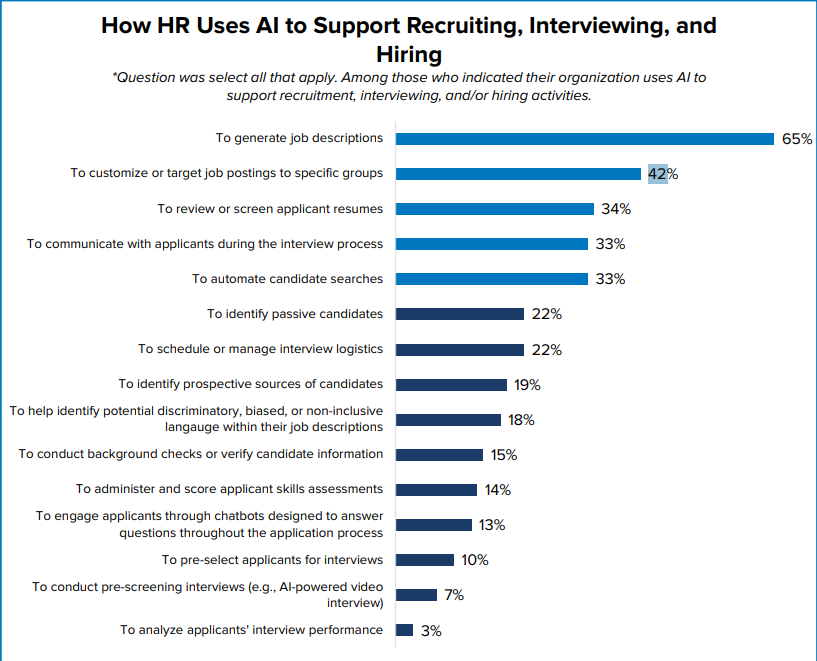
According to SHRM’s 2024 Talent Trends: AI in HR report, 42% among HR professionals who use AI for recruiting use AI to customize or target job postings.
Automated Screening and Ranking of Applicants
When a role posts and two hundred applications land, AI scores each one against the job, ranks the pool, and pushes the strongest candidates to the top. Hours of manual resume review per role become minutes of reviewing a ranked list.
A recruiter who used to spend a morning triaging inbound now opens a shortlist with the reasoning already done. What used to determine screening quality, which was whoever had time to read resumes that day, is no longer the constraint.
Personalized Candidate Outreach at Scale
AI drafts and sends outreach tailored to each candidate across a pool of hundreds, adjusting the message to the person's background and the role's requirements. What a recruiter could do for ten candidates a day, the tool does for a thousand.
Voice agents have extended this further. They now run first-pass screening calls around the clock, confirming availability, interest, and basic fit before a human recruiter ever interviews the candidate.
A candidate who applies at 9 AM gets a conversation at 9:05 AM rather than a callback slot two days out.
Automated Interview Scheduling and Coordination
Scheduling is where placements quietly die. A candidate says yes on Tuesday, the back-and-forth over availability runs through Friday, and by Monday, they have accepted somewhere else.
AI scheduling closes that gap. The system shares real-time availability, books the interview in one exchange, and absorbs the rescheduling churn without a recruiter in the middle of every logistics thread. The delay between interest and interview, one of the most common places a candidate goes cold, gets orchestrated out of the process.
AI-Generated Job Descriptions, Summaries, and Briefings
Job postings, interview summaries, and client briefings that used to consume a recruiter's afternoon can now be generated in minutes using AI.
Bolt-On AI vs Native AI: What Actually Makes the Difference
AI can be layered on top of the tools a firm already runs, or built into one connected recruiting system, and the two architectures produce different economics no matter how good the individual tools are.
A best-in-class screening tool bolted onto a fragmented stack will lose to an average one operating inside a connected system, because speed in staffing compounds across steps, or it does not compound at all.
Every gap between tools charges the firm twice, once in the recruiter hours spent exporting, re-keying, and reconciling, and once in the calendar days the candidate spends waiting while that work happens. The handoff tax never appears on an invoice, which is why firms keep paying it while scrutinizing every software line item.
Bolt-On AI vs Native AI, Side-by-Side Comparison
| Dimension | Bolt-On AI | Native AI |
|---|---|---|
| Where it sits | Layered on top of existing, separate tools | Built into one connected recruiting system |
| Data it sees | One step's data, in isolation | The full candidate, job, and pipeline record |
| What it improves | A single task | The end-to-end workflow |
| Handoffs | Manual, between disconnected systems | Automatic, inside one system |
| Governance | Added per tool, after the fact | Built into the data layer from the start |
| Net result | A faster step in a slow process | A faster process |
Bolt-on AI accelerates a step, produces an output, and hands the work back to a human to carry across the gap to the next tool. The gain is capped at the size of that single step.
Native AI works from the full record and carries the work forward itself. The output of matching becomes the input to screening without an export. The screening result triggers outreach without a re-key. Speed compounds across the whole process because nothing stalls at a handoff waiting for a person to bridge two systems.
What the Difference Looks Like in a Staffing Workflow
With bolt-on AI, the work moves like this:
1. A recruiter runs the sourcing tool against the job order and exports a candidate list.
2. The list gets loaded into a separate screening tool, which scores and ranks it.
3. The shortlist gets re-keyed into the applicant tracking system (ATS) because the two tools do not share records.
4. Outreach runs from a third tool, with responses tracked in an inbox.
5. Interested candidates get pushed into a separate scheduler.
6. The recruiter stitches the outputs together manually, while the client relationship and job order history sit in a sales system the recruiting tools cannot see.
With native AI, the same job order moves through sourcing, screening, outreach, and scheduling inside one system. The candidate record, job data, and client context travel with the work the whole way. Nothing is exported, re-keyed, or reconciled, and the recruiter's role shifts from carrying work between tools to making the judgment calls the system routes to them.
Why Bolt-On AI Can't Meet Modern Hiring Needs
The needs a staffing firm has to meet today are structurally different from the ones its tools were designed around, and bolt-on AI cannot close that gap no matter how many tools you add.
According to “Reinventing Enterprise Operations with Gen AI” 2024 Report by Accenture, the share of companies running fully modernized, AI-led processes nearly doubled year over year and still reached only 16%.
How Modern Hiring Needs Differ From Traditional
| Hiring Need | Traditional | Modern |
|---|---|---|
| Applicant volume | Manageable applicants per role | Floods of applicants across many channels |
| Speed | Days to weeks acceptable | Strong candidates gone in days |
| Candidate experience | One-way and firm-led | Consumer-grade, instant, and personalized |
| Sourcing | A job board or two | Many channels running at once |
| Economics | Grow by adding recruiters | Grow margin without adding headcount |
| Data | A handful of records to track | Fragmented across many systems |
Four of these factors deserve a closer look:
Application Volume Has Outgrown Manual Review
AI made applying nearly effortless, and volume per role climbed past what any team can review manually. A posting that drew forty applications five years ago draws hundreds now, many of them AI-polished and harder to differentiate on paper.
Finding applicants used to be the constraint. Processing them is the constraint now, and a firm that processes slowly is functionally invisible to the strong candidates buried in its own inbound.
Candidates Now Move in Days, Not Weeks
The best candidates are in multiple processes at once and accept offers within days. A workflow that pauses at every handoff, a day waiting on an export, two days of scheduling back-and-forth, loses those candidates before the firm ever gets to make its case.
Sourcing Spans Many Channels at Once
Talent now arrives from job boards, the firm's own database, referrals, and passive outreach in parallel. The work is no longer working one channel well. It is coordinating many channels at once, deduplicating what they return, and keeping a coherent picture of every candidate across all of them.
A stack of disconnected tools makes that coordination the recruiter's job. The person becomes the integration layer, and integration work produces zero revenue. Worse, it produces duplicate outreach.
When the sourcing tool, the job board, and the referral tracker each hold their own copy of the same candidate, that candidate hears from the firm three times with three different messages, and the firm looks exactly as disorganized as it is.
Margin Replaced Headcount as the Growth Lever
The traditional response to more volume was hiring more recruiters. In a margin-compressed market, that answer erodes the economics it was supposed to improve. Every added desk raises the cost base ahead of the revenue it produces.
Firms now have to grow output without growing the team at the same rate, which means the multiplier has to come from somewhere other than headcount. A tool that makes each recruiter incrementally faster at one task does not change that equation, and neither do five of them stacked together.
Why Those Needs Call for AI Built Into the System
.png)
Each of the four factors demands a connected system that a single-step tool cannot supply, no matter how well it performs its step.
Volume and Speed Demand the Whole Workflow, Not One Step
Meeting modern volume at speed means moving a candidate through every stage quickly. A bolt-on that compresses screening from four hours to ten minutes still delivers a candidate into a scheduling queue that takes three days.
Take the last twenty placements and map where the calendar days actually went. Very little of the elapsed time sits inside the steps the AI tools accelerated. Most of it sits between them, in queues, inboxes, and re-keying sessions that no tool was ever pointed at.
Responsiveness Requires AI That Acts on the Full Candidate Record
Responding to a candidate in real time means acting on their full history, their pipeline status, what they turned down last year, and how they have engaged with the firm before, all at once.
A bolt-on working from one step's data cannot see enough to act well. It either stalls and escalates to a human, which surrenders the speed, or it acts on partial context, which produces the generic outreach candidates have learned to ignore.
Margin Pressure Requires Capacity That Scales Without Headcount
Growing margin without adding recruiters means AI has to carry real execution as a managed digital worker rather than assisting a human one task at a time. A digital worker adds capacity that does not appear on the payroll.
According to “From AI Projects to Profits: How Agentic AI can Sustain Financial Returns” 2025 Report by IBM, 83% of executives expect AI agents to improve process efficiency and output by 2026.
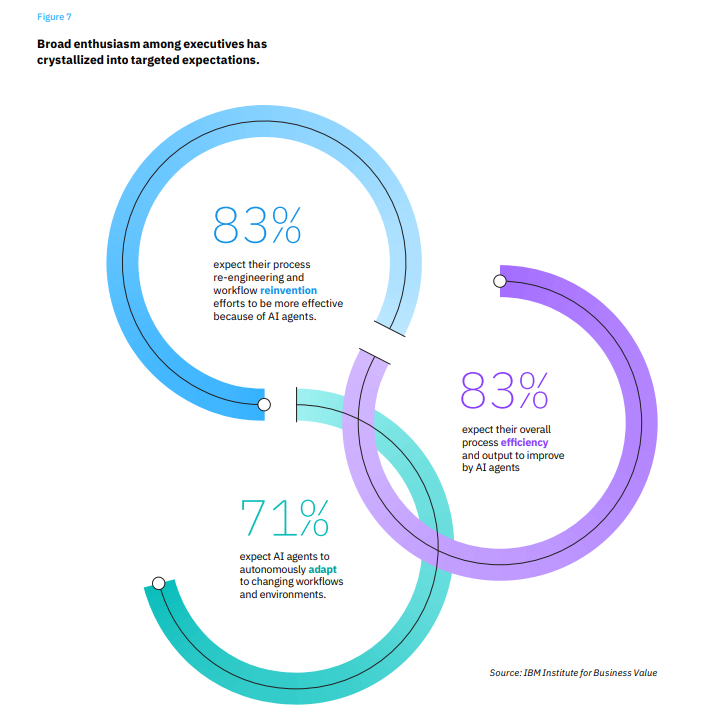
The expectation only becomes an outcome when the agent operates inside the system on connected data, where it can own work across stages instead of producing outputs a human still has to carry forward.
Compliance and Clean Data Require Governance Built Into the System
When AI drives more of the hiring decision, compliance and data quality have to be governed where the data lives.
- Screening criteria need audit trails.
- Outreach needs consent handling.
- Candidate records need one version of the truth.
A bolt-on stack governs none of this consistently, because each tool applies its own rules to its own slice of data after the fact. Ask a firm running six AI tools to produce a complete record of every automated decision made on a single candidate and watch how many systems the answer has to be assembled from.
Risk gets discovered in an audit rather than prevented in the workflow, and the cleanup lands on the same ops team that was supposed to be freed up by the tools.
How Asymbl Delivers Native AI for Staffing
Asymbl runs recruiting as one connected system on a Salesforce foundation, so AI operates on the full candidate, job, and client record as a managed digital worker rather than a tool layered on top.
Talent Intelligence: AI Matching on Connected Recruiting Data
Talent Intelligence is a reasoning engine that evaluates candidates the way an experienced recruiter would.
It scores fit using pipeline history, interview feedback, and assignment outcomes alongside the resume, so the candidate who performed well on a similar assignment two years ago surfaces ahead of the stranger with better keywords.
Most firms pay for net-new sourcing on roles their own bench could fill, because nothing in their stack can see the bench well enough to prove it.
Asymbl Talent Intelligence works from the full record with no separate system to sync and no blind spots about how a candidate has actually engaged with the firm.
A Digital Recruiter That Runs the Workflow End to End
Asymbl's Digital Recruiter, Rosa, handles sourcing outreach, application screening, interview scheduling, job description generation, and interview summaries inside one system, powered by Talent Intelligence at every decision point.
Look back at the five traditional uses from the top of this blog. Most firms run them as five separate tools with a recruiter bridging every gap. Here they operate as one digital worker moving a job order from open to placement, with a defined role, escalation paths to human recruiters, and performance measured the way any teammate's performance is measured.
This is what it means to treat AI as a workforce rather than a tool. The capabilities are the same.
The escalation design matters as much as the automation. The digital recruiter owns the volume work within its defined scope and hands control to a human at the moments that require judgment, a close call on fit, a sensitive client conversation, or an offer negotiation.
Recruiters stop being the integration layer between tools and go back to being what they were hired to be, which is the relationship engine of the firm.
Recruiter Suite: Native Skills From Day One
Recruiter Suite does more than unify recruiting data. It includes pre-built Skills that give staffing teams immediate automation without custom development or a long implementation project.
Firms deploy proven recruiting capabilities from day one and configure them to fit their process, without building AI workflows from scratch.
The out-of-the-box Skills cover the workflows recruiters perform every day, including:
- Job Management to create, update, and manage job records.
- Candidate Evaluation & Insights to analyze resumes, summarize fit, and surface key strengths and risks.
- Pipeline & Submissions to organize candidates, recommend next steps, and prepare submissions.
- Interview Management to coordinate scheduling and interview workflows.
- Communications & Outreach to generate personalized emails, messages, and follow-ups.
- Invocable & Batch Operations to automate repetitive recruiting tasks across large candidate and job datasets.
Since these Skills are built directly into Recruiter Suite, they work on the same connected recruiting data rather than relying on separate AI tools and disconnected integrations. They also become the building blocks Asymbl uses to accelerate custom digital workers as customers scale beyond day-one automation.
The Proof It Places Faster
A two-person recruiting team running the digital recruiter helped hire 100 people in 100 days, lifting fill rate by 47% while the agent, Rosa, handled 17,000 applications, pre-screened 1,800 candidates, and scheduled 800 interviews. The run saved $575,000 in hiring costs and returned 1,529% on the investment.
No bolt-on tool processes 17,000 applications into 800 scheduled interviews, because no bolt-on tool can carry a candidate from application to calendar without a human bridging the systems in between.
Conclusion
The next AI investment your firm makes s should start with a workflow. Map how a job order moves from opening to placement, then identify every place where work pauses because a recruiter has to move information between systems.
Those delays usually cost more than the tasks AI already speeds up. If a new AI tool cannot remove those handoffs and keep work moving on the same data, it will only make one part of the process faster.
Ready to see what native AI looks like on your own job orders? Asymbl's Recruiter Suite, Talent Intelligence, and digital recruiter run your matching, screening, outreach, and scheduling on one connected Salesforce foundation, so speed compounds across the workflow instead of stalling at handoffs.
Book a demo and watch a job order move from open to placement without any delays.
%252520(4).webp)
Rebuilding Workforce Capacity: Why Organizations Must Shift From Vertical Optimization to Holistic Design
How Agentforce enables workforce orchestration at scale by turning AI into digital labor, freeing humans for judgment, leadership, and system design.

The Right Fit Starts With a Conversation.
See what working together could look like.
.webp)