

.png)
Every AI recruiting platform promises faster hiring, better candidate matching, and less manual work. In a demo, many of them appear to deliver exactly that, yet organizations investing in AI recruiting software still find recruiters chasing interview feedback, coordinating schedules, and reviewing AI recommendations.
A platform that performs well in one environment can leave significant gaps in the other, making generic "best AI recruiting software" rankings an unreliable buying guide.
This blog breaks down why AI recruiting software is harder to compare than it appears, evaluates the leading platforms in the market, explains what staffing firms and corporate talent acquisition teams should prioritize differently, and provides a practical framework for building a shortlist that reflects the recruiting model you actually need to scale.
Why AI Recruiting Software Is Harder to Compare Than It Looks
AI recruiting software is often compared through feature lists, pricing pages, or AI capabilities. However, those comparisons rarely explain what the software is actually responsible for inside the hiring process.
1. Every Platform Now Claims AI, Automation, and Intelligence
Candidate sourcing, screening, matching, scheduling, engagement, and analytics all carry AI-powered recruiting tools now, making it increasingly difficult for buyers to distinguish one platform from another. Most AI recruiting capabilities fall into one of three categories:
- Generation: The platform drafts a candidate summary, a job description, or an outreach email for a recruiter to review and send.
- Evaluation: The platform scores applicants against role criteria using a reasoning engine trained on the firm's own pipeline and placement outcomes.
- Execution: The platform runs screening, outreach, and interview coordination as a defined job with success criteria and escalation rules attached, completing the work without a recruiter in the middle of each step.
According to SHRM’s “2024 Talent Trends: Artificial Intelligence in HR” Report, nearly two-thirds of organizations that use AI for recruiting use it to generate job descriptions, while another two in five use it to customize or target job postings to specific groups.
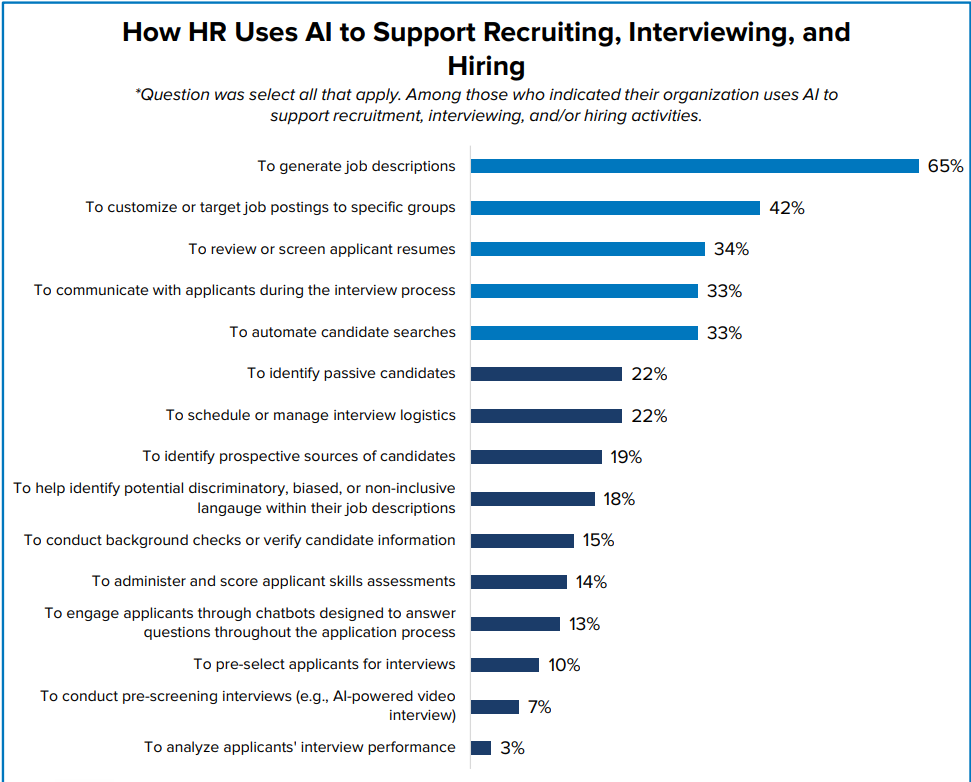
Around one in three use AI to review resumes, automate candidate searches, or communicate with candidates during the interview process. However, only 7% currently use AI for pre-screening interviews.
2. Feature Checklists Hide the Real Operating Model Difference
A checklist answers whether a platform has AI screening, a talent customer relationship management (CRM) layer, interview scheduling, analytics, integrations, and chatbot functionality.
However, it cannot show who owns the work after the feature runs. AI screening that produces a ranked list still leaves a recruiter to decide which candidates advance, to chase the hiring manager who has not responded, and to handle the candidate who needs an accommodation.
3. Staffing Firms and Corporate Teams Need AI for Different Reasons
A staffing firm buys AI recruiting software to increase placement speed, recruiter capacity, candidate redeployment, and client delivery quality while protecting margin on every deal.
Revenue is tied to placements, so anything that increases activity without increasing gross profit is a cost, and redeploying talent the firm already knows is often the highest-margin work available on any given day.
A corporate talent acquisition (TA) team buys into the same category to reduce time to hire, improve the quality of hire, protect the candidate experience, keep hiring managers accountable, and give leadership visibility into workforce readiness.
No hire generates revenue directly, so the pressure lands on quality, consistency, and the credibility of the function. A platform can serve one of these models well and leave gaps in the other, which is why a single ranked list rarely helps either.
4. The Best AI Hiring Platform Must Fit the Work
Most platforms can be configured to reflect a workflow stage, approval criteria, and template. Testing them against the complexity of an organization's actual recruiting process, with multiple stages, exceptions, and business rules, reveals whether they truly fit the work or simply support a templatized workflow.
The intelligent recruiting platform worth shortlisting acts inside the recruiting system with context, rules, and accountability attached. It knows the candidate's stage, the role's urgency, the client or hiring manager's requirements, and what has already been communicated, and it completes defined work against that context.
Best AI Recruiting Software for Modern Hiring Teams
.png)
With the differences between generation, evaluation, and execution in mind, the next step is comparing how leading AI recruiting platforms apply those capabilities in practice.
While each platform supports modern recruiting workflows, they differ in how deeply AI is embedded, how much recruiting work it can own, and the hiring environments they are designed to serve.
1. Asymbl
Asymbl is a workforce orchestration and talent management platform that combines recruiting, talent intelligence, and digital workers. It connects candidate, recruiter, hiring manager, and workflow data in one system, enabling AI to support sourcing, screening, interview coordination, talent intelligence, and recruiting execution.
Rather than automating isolated tasks, Asymbl is designed to orchestrate human and digital work together across the recruiting lifecycle, helping organizations run hiring workflows, workforce operations, and digital labor from a unified platform.
Key features
- Recruiter Suite: Runs the full hiring lifecycle on one system, connecting sales, recruiting, and talent data instead of scattering them across separate tools.
- Talent Intelligence: A reasoning engine that reads pipeline history, interview feedback, and placement outcomes to score candidates by fit, powering every search and match.
- Digital Recruiter (Rosa): A pre-built digital recruiter built on Agentforce that handles sourcing, screening, scheduling, and follow-up with full candidate and pipeline context.
- Asymbl Intelligence: A platform layer that captures judgment, context, and pattern recognition across every workflow and decision, feeding sharper signal to every product and digital worker.
Best for
Staffing firms and corporate talent acquisition teams seeking recruiting, talent intelligence, and AI-powered digital workers to automate complex hiring workflows and workforce orchestration.
Pricing: Asymbl offers subscription-based Recruiter Suite editions starting at $60/user/month (Launch) and $125/user/month (Premier), with custom pricing for Ultimate. Consulting and Digital Labor Advisory engagements are scoped per project, while fixed-fee Agentforce packages start at $25K (Break-Fix) and ~$30K (Jetpack)
2. Beamery
Beamery is an AI-powered talent lifecycle management platform that helps organizations attract, engage, hire, and retain talent from a single system. It combines candidate relationship management, workforce planning, skills intelligence, internal mobility, and recruiting workflows to create a unified view of talent.
By connecting hiring data with workforce insights, Beamery enables organizations to build long-term talent pipelines and make more informed hiring and workforce decisions across the employee lifecycle.
Key features
- Talent CRM: Centralizes candidate, alumni, and employee data collected from applications and internal HCM (Human Capital Management) systems into unified, segmentable talent communities.
- Skills Intelligence: An AI-built skills ontology infers skills from career histories and powers matching between candidates and open roles.
- AI-Driven Recommendations: TalentGPT delivers real-time talent recommendations based on evolving skills supply and demand data across the organization.
- Internal Mobility & Development: Gives employees visibility into open roles and career paths matched to their skills profile, alongside skills-gap analysis for HR teams.
Best for
Enterprises building long-term talent pipelines, internal mobility programs, and skills-based workforce planning alongside recruiting.
Pricing: Custom
3. Workday Recruiting
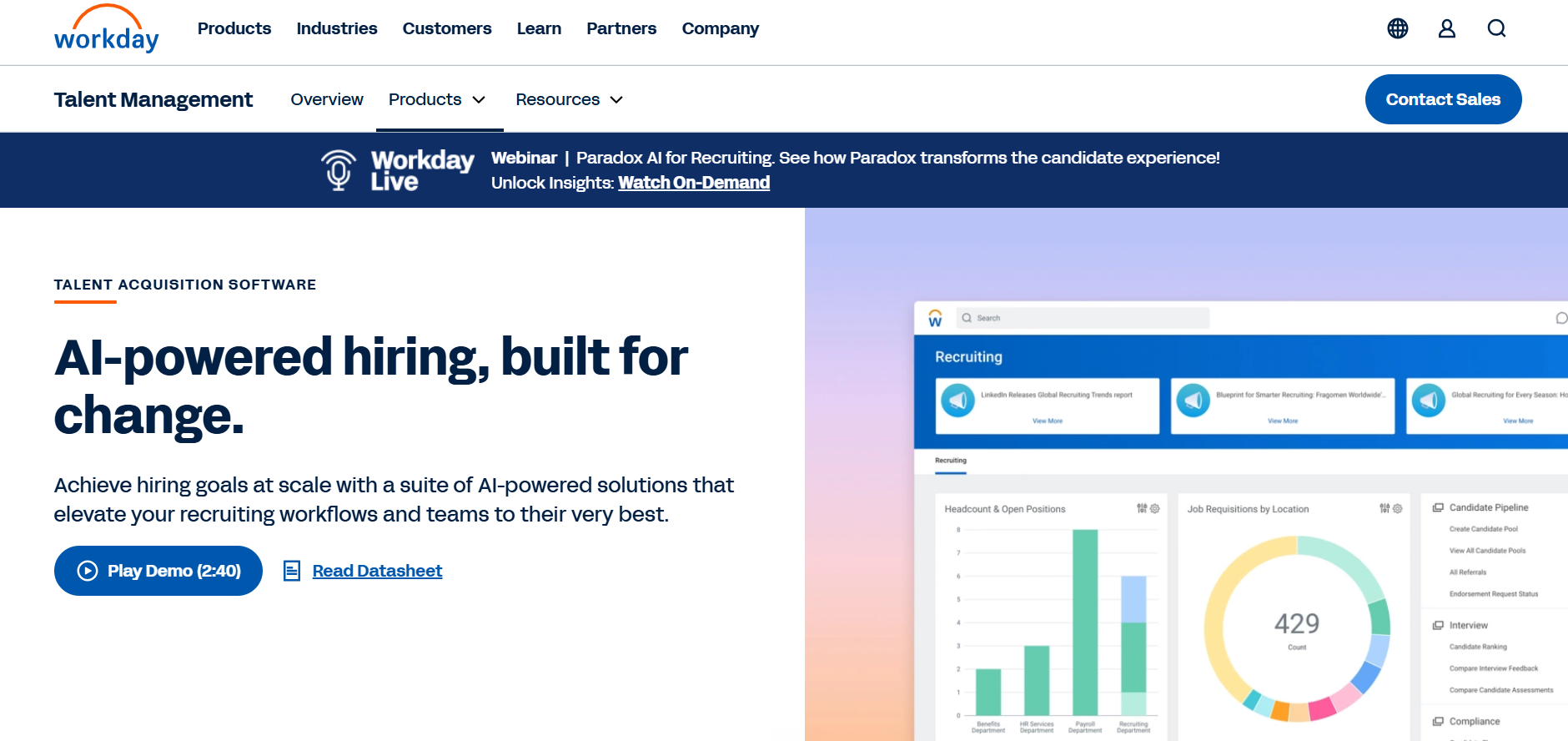
Workday Recruiting is a recruiting and applicant tracking solution built into the broader Workday Human Capital Management (HCM) platform. It enables organizations to manage job requisitions, candidate applications, interview processes, hiring workflows, and onboarding within a unified HR system.
Since recruiting operates on the same data model as other Workday applications, hiring teams can connect recruitment with workforce planning, employee records, and talent management throughout the employee lifecycle.
Key features
- Recruiting Agent (HiredScore AI): Takes on time-consuming tasks like scheduling and candidate suggestions to minimize time-to-fill and maximize recruiter productivity.
- Evergreen Requisitions: Continuously sources and hires for recurring roles without recreating job postings, supporting high-volume and repeat hiring needs.
- Bulk Candidate Actions: Disposition, advance, decline, and message candidates at scale, and process job offers in bulk through workbooks.
- Candidate Experience Agent (Paradox): Conversational AI streamlines interview scheduling and helps hiring teams move faster while improving the candidate experience.
Best for
Enterprises already using Workday HCM that want recruiting tightly integrated with HR, payroll, and workforce management.
Pricing: Custom
4. Oracle Talent Management
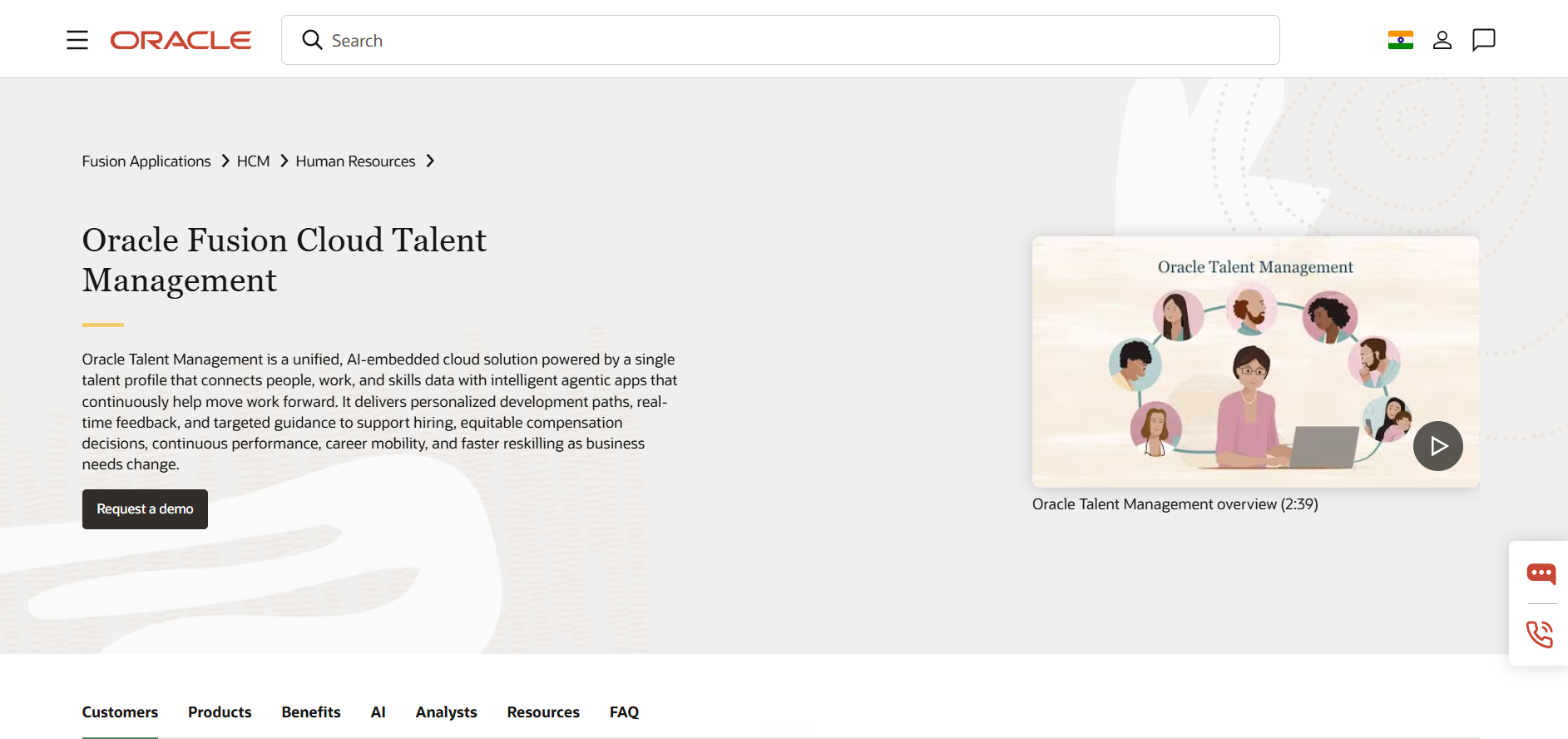
Oracle Talent Management is a cloud-based talent management suite that supports recruiting, onboarding, learning, performance management, career development, succession planning, and workforce growth.
Built within Oracle Fusion Cloud HCM, it provides a connected environment where employee, candidate, and workforce data share a common platform. The suite uses AI and skills intelligence to support hiring, talent development, and workforce planning across enterprise organizations.
Key features
- AI-Powered Candidate Matching: Identifies best-fit external and internal talent using AI matching, linking recruiting to skills, gigs, and succession planning.
- No-Password Application Process: Candidates apply without creating an account, reducing friction and drop-off during the application process.
- Recruiting Booster: Launches virtual hiring events, two-way text messaging with candidates, and faster interview scheduling from one toolset.
- AI-Designed Career Sites: Generative AI creates targeted, branded career sites with text and image content assistance, editable without developer help.
Best for
Large enterprises standardizing recruiting, talent management, and workforce planning on the Oracle Fusion Cloud HCM platform.
Pricing: Custom
5. SmartRecruiters
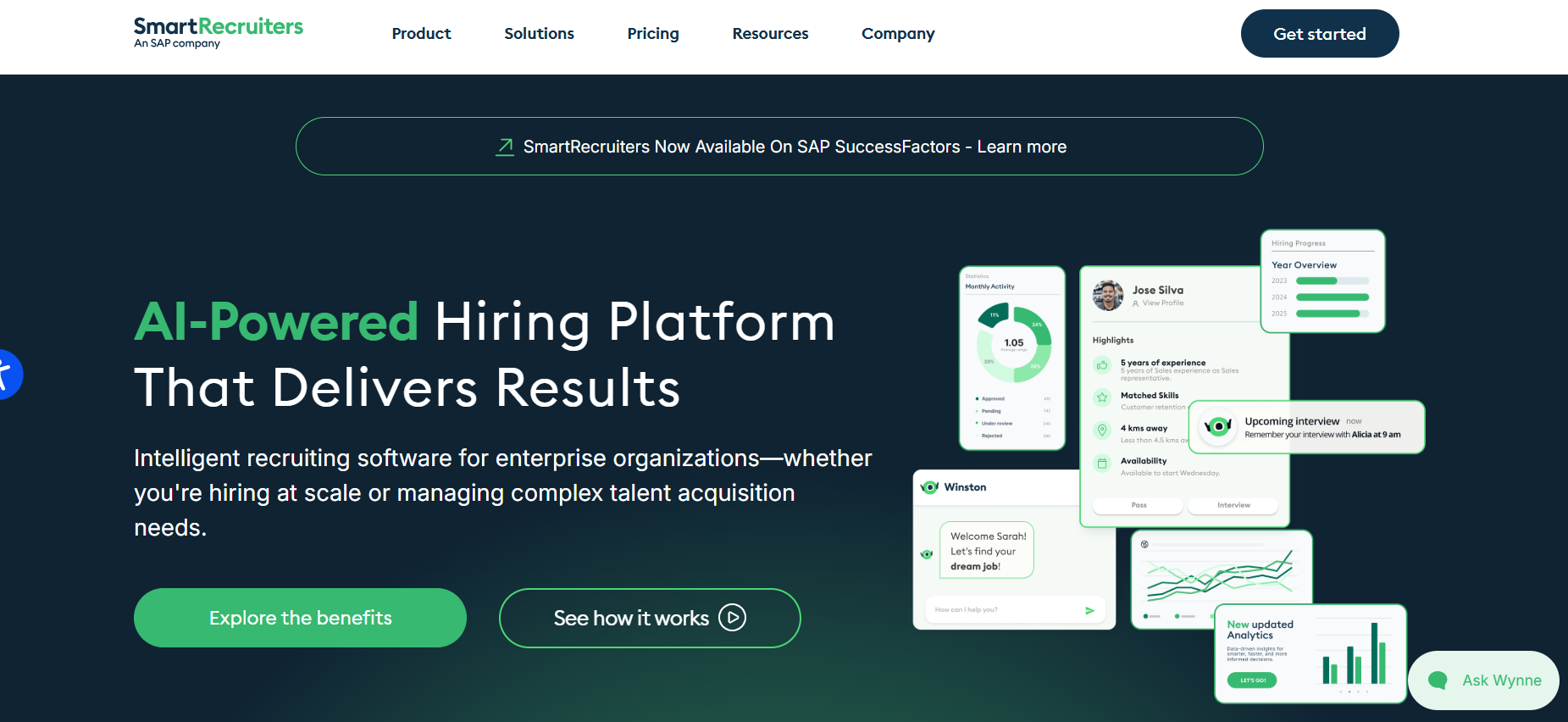
SmartRecruiters is a cloud-based talent acquisition platform that helps organizations manage recruiting from job creation through hiring. It combines applicant tracking, candidate relationship management, interview management, offer management, and recruiting analytics in a single platform.
SmartRecruiters also supports recruiting automation, AI-powered candidate matching, and integrations with HR and business applications, enabling organizations to manage hiring workflows across multiple teams and locations.
Key features
- Winston AI Layer: An agentic AI companion embedded across the platform automates screening, scheduling, and candidate communication to reduce manual admin work.
- AI Talent Matching Engine: Automatically ranks and matches candidates to open requisitions, cutting down time spent manually reviewing applications.
- Configurable Hiring Workflows: A drag-and-drop workflow builder lets teams customize approval chains, pipelines, and permissions for unique hiring processes.
- CRM & Text Recruiting: Built-in candidate relationship management and text-based outreach tools help teams source, nurture, and re-engage talent.
Best for
Enterprise recruiting teams seeking configurable hiring workflows, recruiting automation, and broad third-party integrations.
Pricing: Custom
6. iCIMS
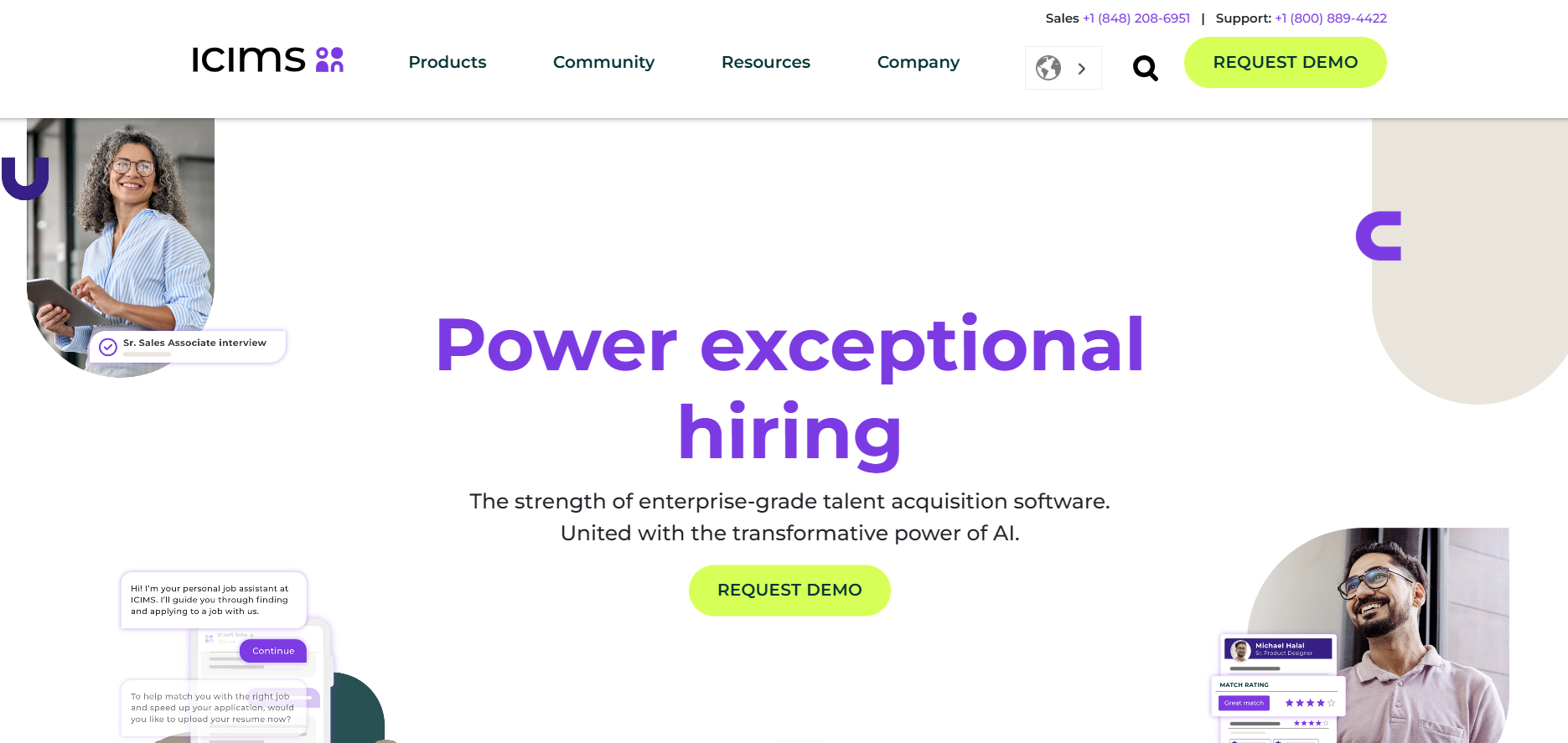
iCIMS is an enterprise talent acquisition platform that supports candidate sourcing, recruitment marketing, applicant tracking, interview management, onboarding, and employee mobility.
The platform combines AI-powered recruiting capabilities with candidate relationship management and workflow automation to help organizations manage the complete hiring process.
Key features
- Configurable ATS (Applicant Tracking System) Workflows: Supports multi-step recruitment workflows with conditional logic, tailoring hiring paths to complex, compliance-heavy processes.
- iCIMS CRM (Customer Relationship Management) & Talent Pools: Segments candidates by skill or experience and runs automated nurture campaigns to keep passive talent engaged.
- Digital Assistant & Text Engagement: AI-powered conversational chat and text-to-apply tools let candidates apply and get screened over SMS in 20+ languages.
- Career Site Builder: Creates branded, mobile-optimized career sites with employee videos and content carousels to strengthen employer brand.
Best for
High-volume enterprise hiring teams managing recruitment marketing, applicant tracking, and large-scale talent acquisition.
Pricing: Custom
7. Eightfold
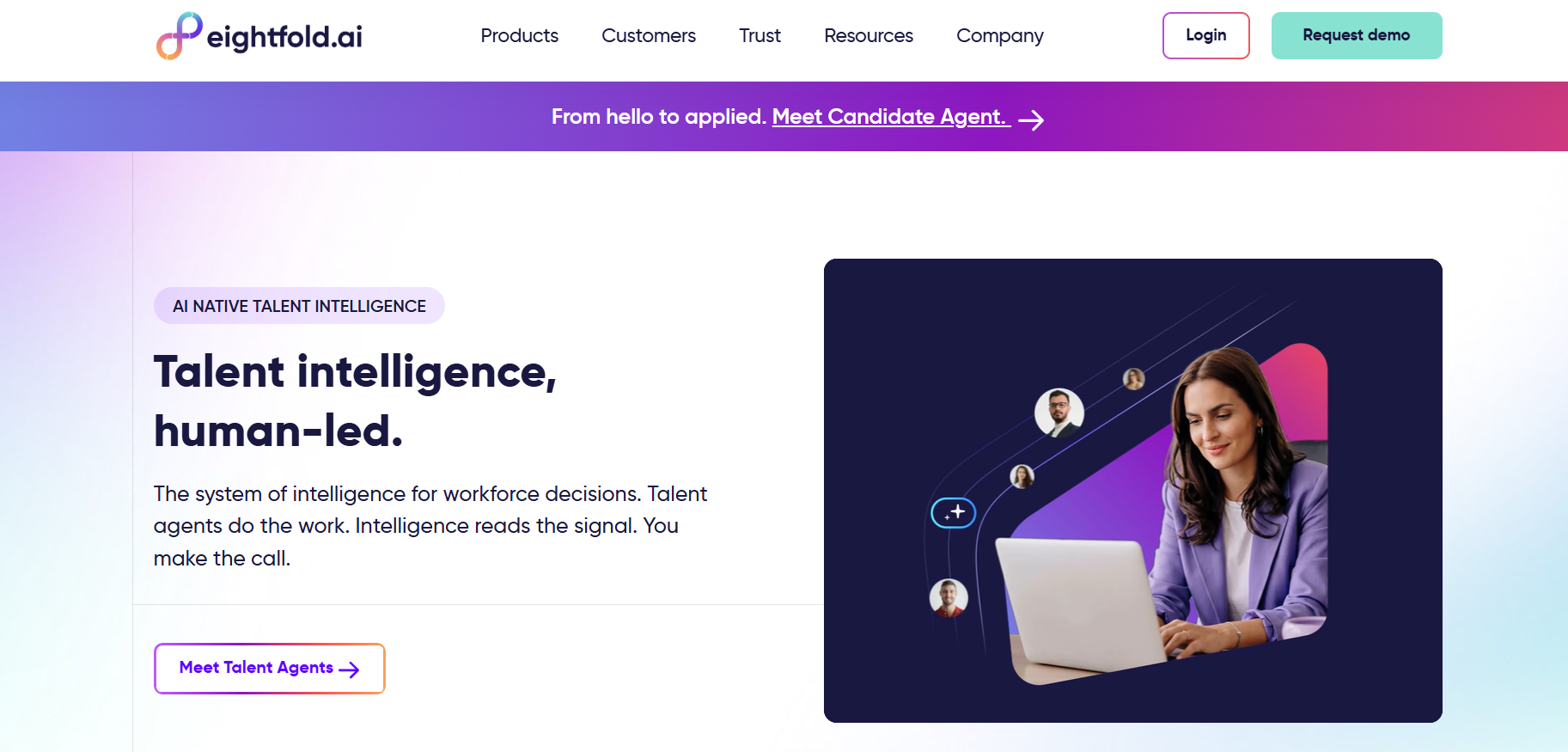
Eightfold AI is a talent intelligence platform that uses artificial intelligence to connect skills, experience, career potential, and workforce data across recruiting and talent management.
It supports recruiting, internal mobility, workforce planning, learning, and succession planning through a unified AI-driven skills foundation. The platform analyzes workforce data to help organizations identify candidates, match talent to opportunities, and support long-term workforce planning.
Key features
- Talent Intelligence Platform: Deep-learning AI taps a global talent dataset to surface best-fit candidates based on skills, capabilities, and real-time work context.
- AI Interviewer: Conducts and evaluates candidate interviews around the clock, summarizing each so recruiters walk in with context instead of a backlog.
- Talent Rediscovery: Continually refreshes profiles in an organization's existing talent network, surfacing past applicants who now fit open roles.
- Equal Opportunity Algorithms: Applies bias-mitigation algorithms to all AI recommendations, supporting DE&I goals with transparency.
Best for
Organizations adopting AI-driven skills intelligence across recruiting, internal mobility, workforce planning, and employee development.
Pricing: Custom
8. Bullhorn
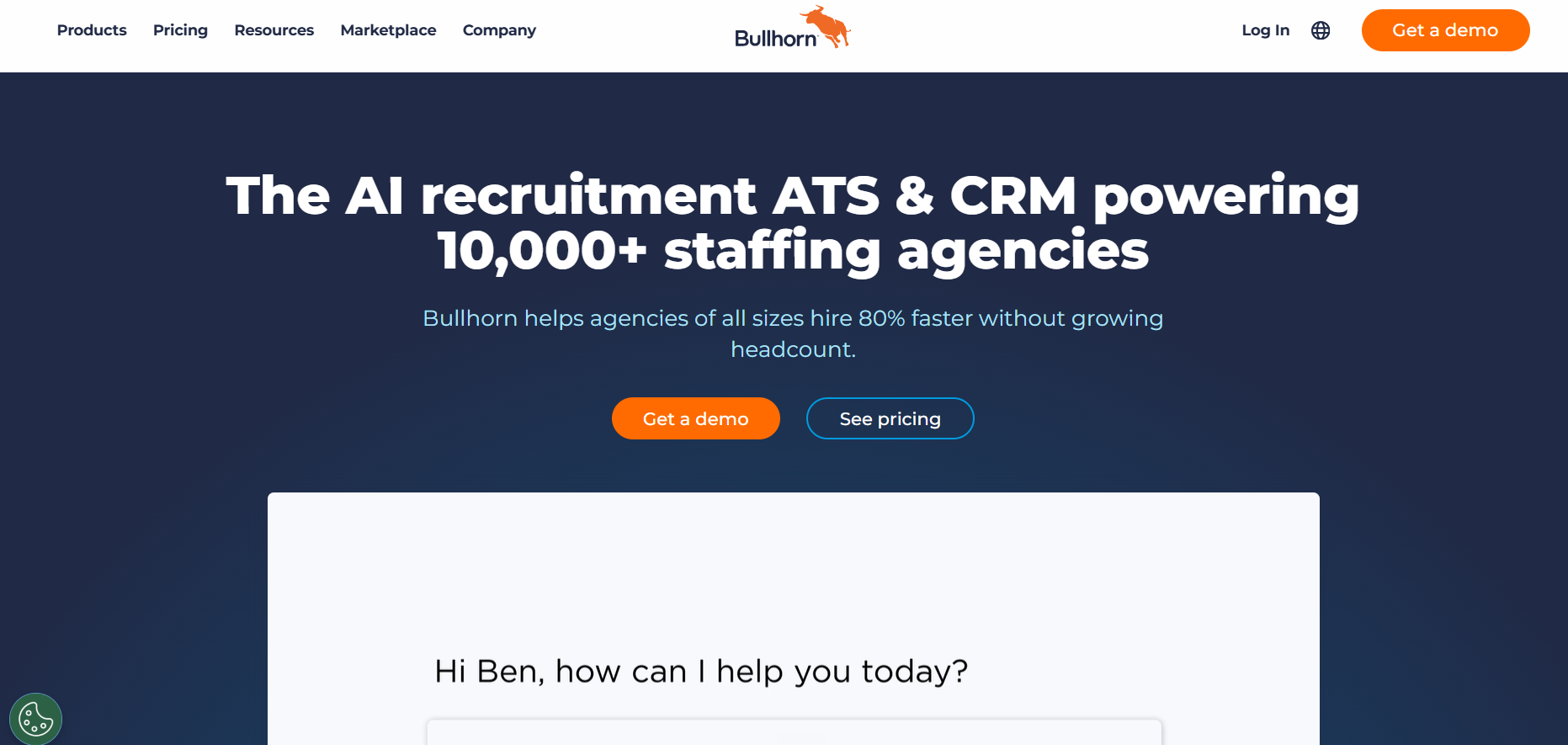
Bullhorn is a cloud-based staffing and recruiting platform designed for staffing agencies and recruitment firms. It combines applicant tracking, customer relationship management, job management, candidate engagement, sales workflows, and back-office operations within a single platform.
Bullhorn also incorporates AI-powered recruiting capabilities and automation to streamline recruiting processes while supporting the operational needs of staffing organizations.
Key features
- Unified ATS & CRM: Combines candidate tracking and client relationship management in one system so recruiters and sales work from shared data.
- AI-Powered Search & Matching: Uses AI to rank and match candidates against job orders, contributing to reported gains in placements and submissions.
- Resume Parsing & Fast Find: Automatically parses resumes into searchable profiles and enables keyword, skill, or location search across the database.
- Configurable Workflows & Reporting: Lets firms tailor fields, pipelines, and reporting to their specific staffing methodology.
Best for
Staffing firms and recruiting agencies managing candidate relationships, client sales, placements, and back-office operations in one platform.
Pricing: Bullhorn offers modular, quote-based pricing across its recruitment platform, AI, middle-office, and Recruitment Cloud products. ATS plans start at $99/user/month (Starter) and $165/user/month (Core), while Pro and enterprise solutions require custom quotes. Additional AI, automation, onboarding, analytics, and workforce management products are priced separately.
9. SeekOut
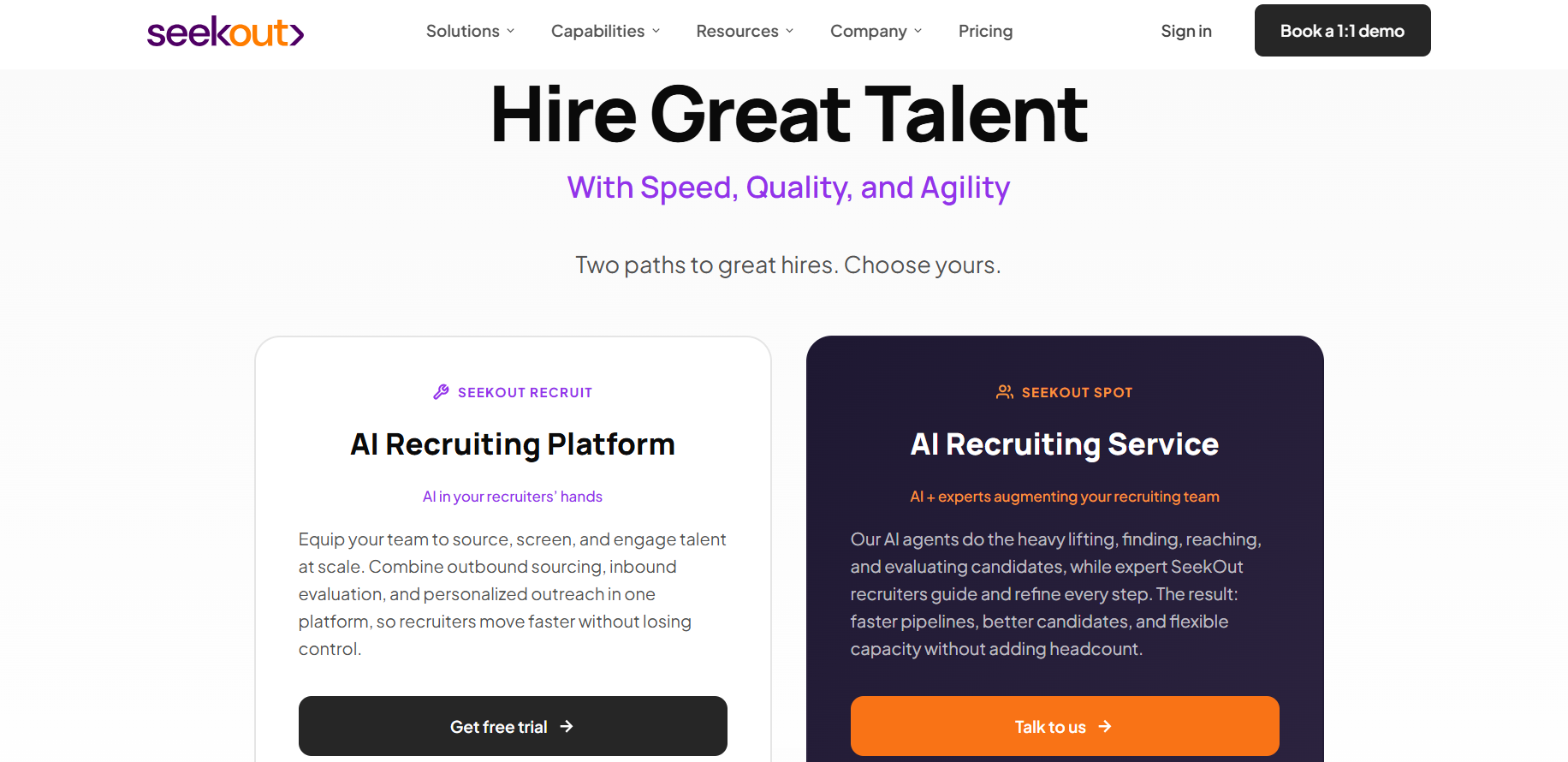
SeekOut is an AI-powered talent acquisition platform focused on talent search, candidate discovery, sourcing, and workforce intelligence. It combines external talent data, internal workforce insights, candidate relationship management, and AI-assisted recruiting tools to help organizations identify, engage, and manage qualified talent.
Key features
- Intelligent Search Across 1B+ Profiles: Searches LinkedIn, GitHub, patents, publications, and ATS data using AI understanding of skills adjacency and career trajectory, not just keywords.
- 300+ Power Filters: Layers filters including skills, security clearance, programming languages, and open-source contributions, plus Boolean or natural language queries.
- AI Screener: Conducts video interviews with inbound candidates, evaluates responses against defined criteria, and delivers qualified shortlists at scale.
- Talent Rediscovery: Surfaces previously sourced or applied candidates from an organization's own ATS data alongside new external sourcing.
Best for
Sourcing teams focused on discovering hard-to-find talent, building talent pipelines, and workforce intelligence.
Pricing: SeekOut offers a 14-day free trial for Recruit Core. Pricing starts at $179/month for individual recruiters. Team plans for Sourcing, Sourcing + Integration, and the Full Recruiting Funnel use custom annual, volume-based pricing. It also offers SeekOut Spot, an AI recruiting service with per-role, contract recruiter, and outcome-based pricing models.
10. Ashby
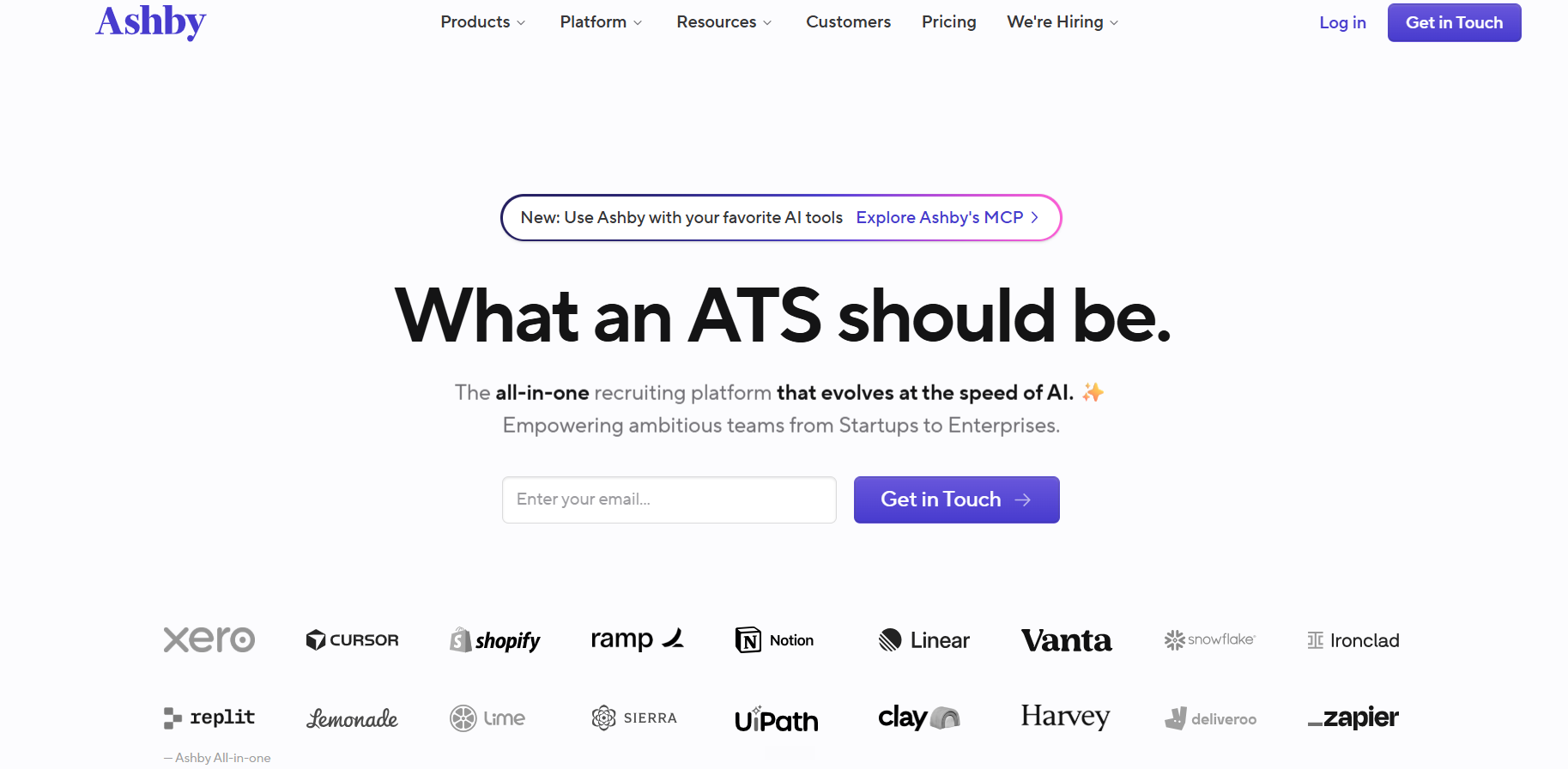
Ashby is an all-in-one recruiting platform that combines applicant tracking, recruiting CRM, interview scheduling, sourcing, analytics, and hiring operations within a single system.
The platform provides structured recruiting workflows, configurable hiring processes, reporting, and recruiting automation while maintaining a unified candidate record. Its integrated architecture enables recruiting teams to manage sourcing, interviews, and hiring activities from one platform.
Key features
- All-in-One ATS, CRM & Sourcing: Combines applicant tracking, candidate relationship management, and sourcing in one system, eliminating tool-switching.
- Ashby Assistant (AI Agent): A chat-based AI agent answers questions and takes action across pipelines and candidates using full data context.
- Custom Analytics & Dashboards: Self-serve report building across every recruiting field tracks funnel conversion and recruiter performance without spreadsheets.
- Automated Interview Scheduling: Coordinates multi-panel interviews and syncs calendars automatically, reducing manual scheduling back-and-forth.
- DEI (Diversity, Equity, and Inclusion) & Hiring Plan Tracking: Tracks diversity goals at every pipeline stage and visualizes hiring plan progress against forecasted activity.
Best for
Growing companies that want recruiting, scheduling, analytics, and hiring operations managed from a single platform.
Pricing: Ashby's Foundations plan starts at $400/month for organizations with up to 100 employees. Plus (101–1,000 employees) and Enterprise (1,000+ employees) use custom pricing based on company size, usage, and contract terms. Ashby Analytics is also available separately with usage-based pricing for organizations using another ATS.
11. Workable
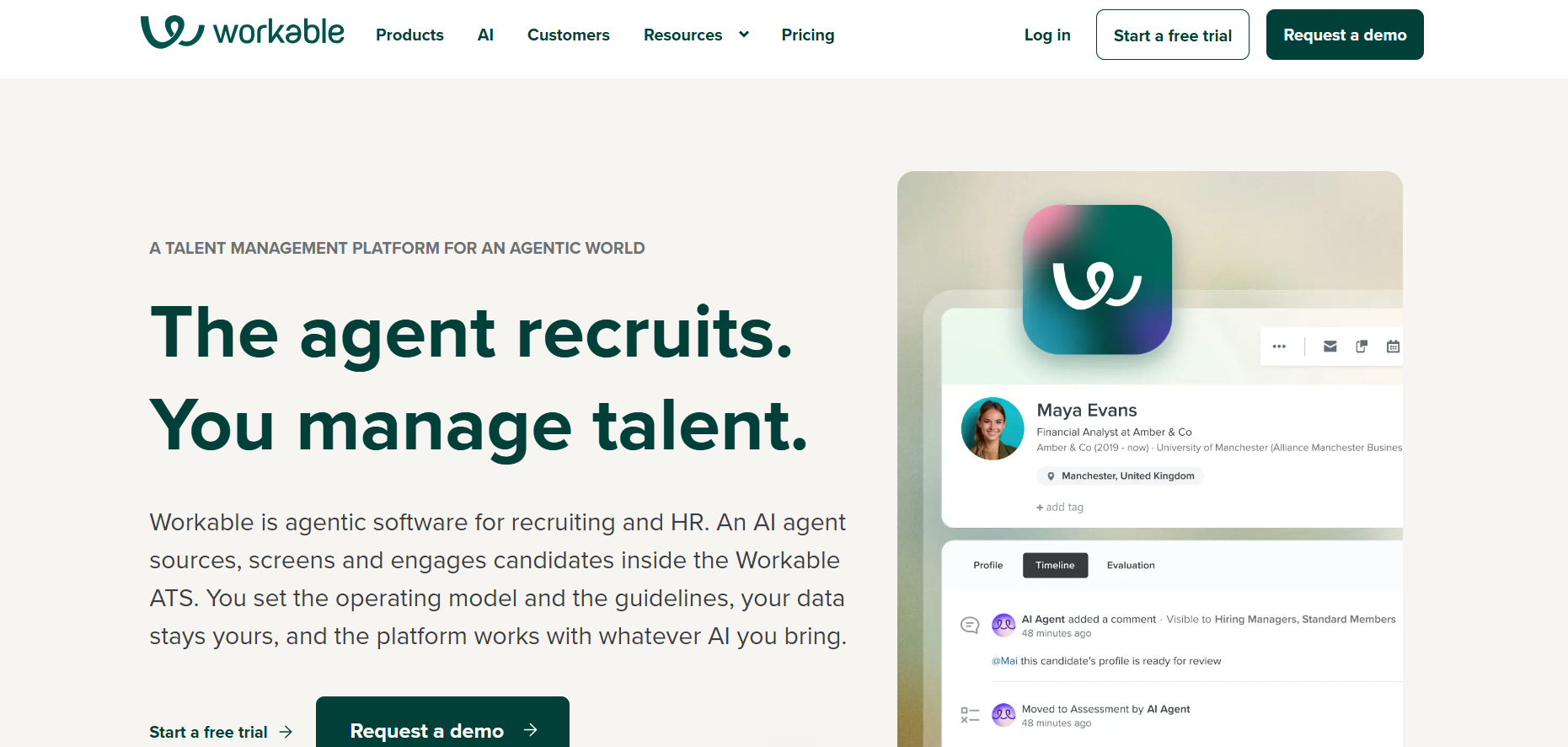
Workable is a cloud-based recruiting platform that helps organizations manage hiring through applicant tracking, candidate sourcing, interview scheduling, candidate evaluation, and hiring collaboration tools.
The platform supports recruitment marketing, AI-assisted candidate recommendations, communication workflows, and reporting within a centralized hiring environment. It enables organizations to coordinate recruiting activities from job posting through candidate selection using a single recruiting system.
Key features
- 400M+ Candidate Sourcing Database: Gives recruiters direct access to a large passive-candidate pool alongside posting to 200+ job boards in one click.
- AI Recruiting Agent: Sources, screens, and messages candidates against up to 14 job criteria automatically, verifying interest before reaching a recruiter.
- Interview Kits & Scorecards: Standardizes candidate evaluation with customizable interview kits and science-backed assessments across hiring teams.
- Custom Reporting Engine: Builds reports from any recruiting or HR field, combining tables, charts, and KPIs to track pipeline and diversity metrics.
Best for
Small and mid-sized businesses looking for an all-in-one recruiting platform with straightforward hiring workflows.
Pricing: Workable offers three plans: Standard from $299/month ($3,588/year), Premier from $599/month ($7,188/year), and Enterprise from $719/month ($8,628/year), with pricing based on company size. All plans include recruiting and HR features, while AI-powered Workable Agent uses separate usage-based AI credits.
What Staffing Firms Should Look For in AI Recruiting Software
Staffing firms evaluate AI recruiting software differently from corporate hiring teams because their workflows extend beyond filling open roles.
1. AI Must Support Client, Job Order, Candidate, and Placement Logic Together
Every submission, interview, and placement reflects a combination of client expectations, job requirements, candidate circumstances, and business constraints. An AI recruiting platform should be able to reason across all of them, including:
- Client urgency and the value of the account
- Job order requirements and start date
- Candidate fit against the work, not the keyword
- Candidate availability and assignment preferences
- Pay rate and bill rate
- Compliance readiness for the client and jurisdiction
- Prior placement history with that client
- Likelihood the placement actually closes
Ask the vendor to show a match recommendation and explain which of those eight inputs the model actually matched.
2. Recruiter Capacity Should Increase Without Weakening Margin Control
A desk can fill faster while gross profit per placement declines, because the workflow surfaced the order that was easiest to fill rather than the order that carried the best commercial intent.
Staffing AI has to support revenue quality alongside volume. In practice, that means rate, margin, client value, and fill probability are visible at the moment a recruiter decides what to work next, on the same record where the work happens.
3. Candidate Matching Should Work Across Open Orders
One qualified candidate frequently fits several roles, clients, shifts, locations, or assignment types at once.
A role-first model evaluates only the order currently on screen, so it routinely misses the stronger placement sitting one client over, and the revenue difference between those two outcomes never appears anywhere in the system because the second option was never surfaced.
The stronger model reads the candidate against every open order simultaneously, scoring on fit, availability, skill adjacency, relationship history, and placement likelihood together.
4. Redeployment Should Be Built Into the Recruiting Motion
Redeployment is the highest-margin placement type most staffing firms have available. The candidate is known, the performance history exists, compliance status is current, and the sourcing cost was paid on the previous assignment.
AI recruiting software should surface known talent before any search begins, reading previous placements, availability, performance, assignment preferences, compliance status, and client fit.
Ask the vendor what the system does on the day a contractor becomes available, and whether that event triggers anything at all without a human remembering to check.
What Corporate Teams Should Look For in AI Recruiting Software
In corporate recruiting, every hiring decision depends on coordination across recruiters, hiring managers, interview workflows, candidate data, and workforce priorities. The capabilities below highlight what AI recruiting software should provide to support that complexity while reducing manual work.
1. Hiring Velocity Must Improve Without Weakening Quality of Hire
AI helps when it identifies qualified candidates sooner, standardizes screening criteria across recruiters, reduces the administrative drag between stages, and keeps interviews moving.
It hurts when it produces a process nobody can explain, where candidates advance or exit on logic no recruiter can articulate to a hiring manager or a candidate who asks.
Test whether the reasoning behind a candidate decision survives inspection. A platform that scores a candidate and returns a structured breakdown of how their qualifications map to what the role demands supports faster hiring that a TA leader can still defend.
2. Candidate Experience Needs More Than Automated Messaging
Automated outreach, confirmations, and reminders improve responsiveness. A candidate who receives a same-day scheduling link and a clear next step is having a better experience than one waiting on a recruiter to find a free minute.
Responsiveness alone does not carry the experience. Candidate experience depends on context, which means the system knows the candidate's history, the role, the stage they are in, what has already been discussed, and what happens next.
Strong AI talent acquisition software preserves candidate history, role context, communication preferences, interview stage, and next steps across every touchpoint. Ask what a candidate in round three sees, and whether the system carries forward what rounds one and two established.
3. Hiring Manager Alignment Should Be Visible Inside the Workflow
Unstructured feedback, unclear decision rights, and slow review cycles absorb every hour of upstream speed, and the recruiter absorbs the follow-up work of chasing it.
The stronger model makes five things visible inside the workflow itself:
- Role criteria agreed at intake, so the standard is written down before the first interview
- Candidate evaluation against that standard, captured on the record
- Interview feedback with the reasoning attached, from everyone involved
- Delay, measured at the point where it occurs rather than inferred from time to fill
- Decision ownership, so it is clear who the process is waiting on
When a hiring manager's feedback consistently arrives late, that pattern becomes data a TA leader can act on rather than an anecdote a recruiter mentions in a one-to-one.
4. Screening Intelligence Must Stay Consistent Across Roles and Teams
AI screening should apply role-specific criteria consistently and preserve the reasoning behind every candidate movement. Structured evaluation that reads experience, trajectory, and prior outcomes against what the role demands makes screening more consistent and more explainable at the same time.
5. AI Should Help TA Leaders Prove Workforce Impact
The reporting of the function has to connect hiring velocity, quality, candidate conversion, recruiter capacity, role priority, and workforce planning in one view, which requires recruiting data to sit alongside the business data those outcomes are measured in.
If recruiting data lives in an applicant tracking system, employee data in a human resources information system, and business performance in a separate warehouse, quality of hire becomes a quarterly reconciliation project.
Where Most AI Recruiting Platforms Fall Short
Most AI recruiting platforms meet a good share of the criteria above and still leave recruiter capacity roughly where it was before the purchase. The patterns below explain why that keeps happening across the category.
1. AI Is Treated as a Feature Instead of a Defined Recruiting Role
AI usually generates summaries, recommendations, emails, and matching scores. The recruiter reviews the summary, checks the recommendation, edits the email, and remains responsible for every action taken on it.
The work changes from doing to verifying, and verification at volume carries its own load. A recruiter reviewing 200 AI-generated screening decisions has a different job than one making 200 screening decisions, and not obviously a smaller one.
A stronger model gives AI a defined recruiting role with scope, guardrails, handoffs, escalation rules, and measurable outcomes attached, the same structure a firm would define for a human hire.
2. Candidate Data Remains Fragmented Across Tools
- Applicant tracking system records hold candidate stage and status
- CRM notes hold the relationship history
- Email threads hold what was actually discussed
- Calendar tools hold the interview history
- Hiring manager feedback lives in messages nobody indexed
Fragmented data keeps the recruiter in the loop as the human integration layer, opening five systems to reconstruct what the automation could not see and then making the decision the system should have been able to make.
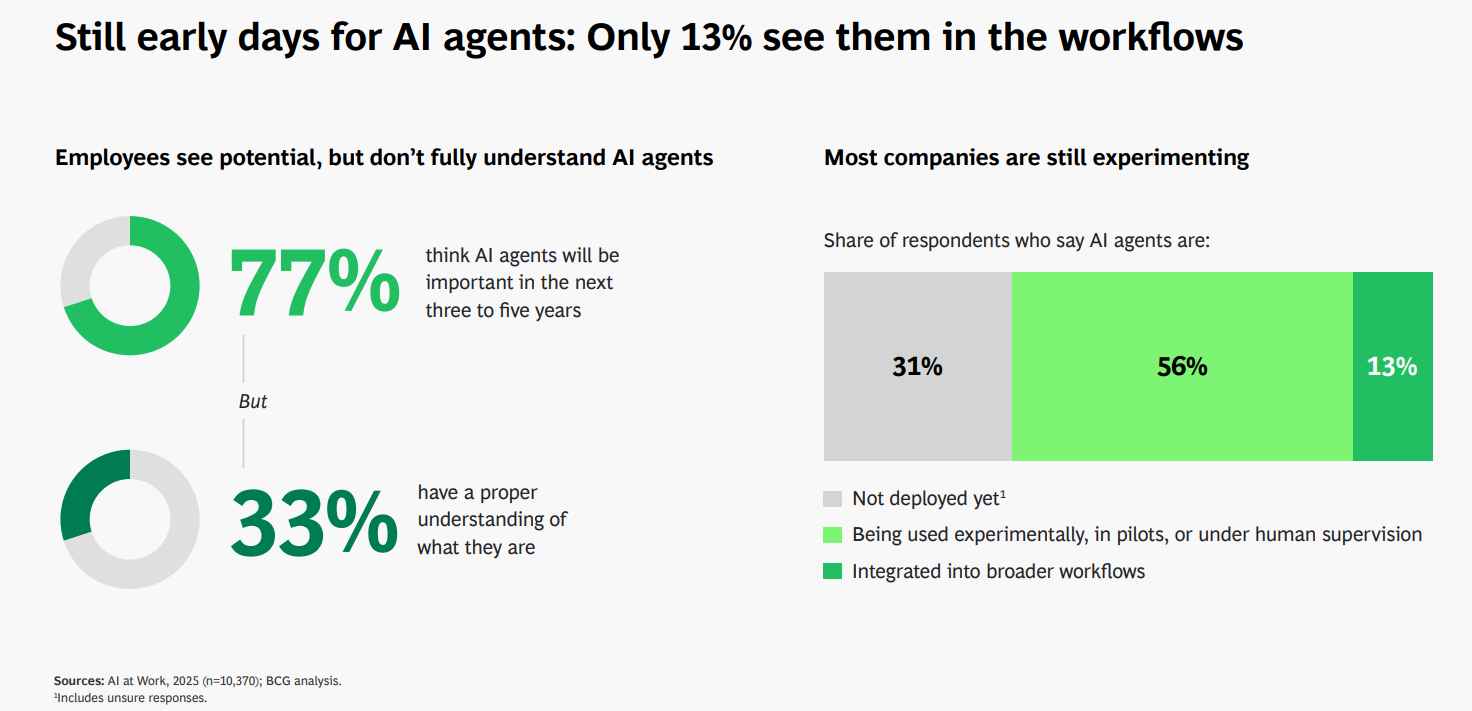
According to BCG’s AI at Work 2025 Survey of more than 10,600 employees, only 13% say that AI agents are integrated into workflows they actually use day-to-day.
3. Automation Moves Tasks Without Owning Outcomes
Outcome ownership requires the system to know whether the candidate actually advanced, whether feedback arrived, whether the client's need changed, whether the role's priority shifted, and whether the next action improved hiring progress.
A tool that books a meeting has completed a task. Whether the right candidate met the right interviewers, arrived prepared, showed up, and moved forward afterward with the correct next step triggered is a different unit of accountability, and it is the one a recruiter is measured on.
Automation that reduces keystrokes and leaves accountability untouched returns a fraction of the capacity the business case assumed.
4. Intelligence Does Not Compound Across Candidates, Roles, Clients, or Hiring Cycles
A compounding system captures outcomes, recruiter judgment, candidate behavior, client preferences, hiring manager feedback, placement history, and performance signals, then applies them to the next decision.
The hundredth role is screened more accurately than the first because the ninety-nine before it taught the model which signals predicted a successful hire and which did not.
Ask a vendor what their system knows now that it did not know at implementation. Platforms built on static data models describe configuration changes the customer made. Platforms with a learning loop describe patterns the system identified on its own.
5. Governance Is Added After AI Is Already in Motion
Buyers need visibility into decision logic, human oversight, bias controls, audit trails, permissions, escalation rules, and compliance obligations.
Corporate teams take this more seriously because they own the final hiring decision, which makes bias mitigation and data security requirements rather than preferences. Staffing firms carry it through client contracts and multi-jurisdiction compliance.
How to Shortlist the Best AI Recruiting Platform
.png)
Knowing where platforms fall short changes what a shortlist has to test for. The steps below turn that into a buying process a committee can run and defend
1. Start With the Recruiting Model You Need to Scale
Write the top five priorities before the first demo and rank them, because a vendor conversation will otherwise reorder them around whatever the product does best.
The ranking also settles arguments inside the buying committee. When the operations lead and the recruiting manager disagree about a platform, the disagreement is usually about which of the five priorities the decision should optimize for, and that is a question the committee can answer without another demo.
2. Separate AI Assistance From Digital Work Ownership
Four questions separate the difference between AI assistance and digital work ownership:
- Which tasks can the system complete independently? Name them specifically.
- Where does a human approve?
- When do exceptions escalate? Ask what happens when a hiring manager cancels, or a role changes priority mid-process.
- How is success measured?
3. Evaluate Whether Data, Workflow, and Intelligence Live in One System
Disconnected tools force recruiters to translate context between systems, which caps how much capacity AI can return. An integration exposes what it was configured to expose, misses what it was not, and operates on a delayed copy while the live record updates somewhere else.
Test it with a real scenario during the evaluation. Trace one candidate from first touch through hire and ask the vendor to show where each piece of context lives and how the AI reads it. Count the systems involved.
4. Test for Staffing-Specific or Corporate-Specific Fit
A staffing firm should test the platform against multi-client pipelines, job order priority, redeployment, sales-to-recruiting visibility, compliance readiness, and margin visibility. Run a scenario with three competing orders from three clients with different commercial terms and see how the system helps the recruiter choose.
A corporate team should test against structured screening, interview coordination, hiring manager feedback, candidate experience, reporting, and workforce planning. Run a scenario where a hiring manager cancels an interview two days out on a final-round candidate and see how much of the recovery falls to a human.
5. Prioritize Platforms That Connect Hiring Outcomes to Business Outcomes
Staffing leaders need visibility into revenue, margin, placement speed, redeployment rate, and delivery performance. Corporate TA leaders need quality of hire, speed, candidate conversion, hiring manager responsiveness, and workforce impact.
Ask each finalist to demonstrate the specific dashboard you would take to your board or your executive team, populated with the metrics you are actually accountable for.
Why Asymbl Fits the Next Generation of AI Recruiting Software
The criteria above describe what AI recruiting software has to support in practice. Asymbl was built around the same operating model, connecting recruiting, client, and intelligence workflows.
1. Recruiter Suite Brings ATS, Search, Engagement, and Workflow Into One Salesforce-Based Environment
Asymbl Recruiter Suite gives both staffing firms and corporate teams one Salesforce-based environment for applicant tracking, AI-powered search, candidate engagement, and workflow management.
Job management, pipeline management, interview management, offer and hire, contact management, and reporting run on the same foundation. Candidate history, client or role data, communication, workflow stage, and business outcomes share one record, so the signal that used to stall at every system boundary moves in one motion.
- For staffing firms, that means revenue and gross profit by recruiter and team surface in real time on the records the front office already works in.
- For corporate teams, it means recruiting outcomes connect to the post-hire and business data the function is measured on.
2. Talent Intelligence Turns Recruiting Data Into Reusable Hiring Signal
Asymbl Talent Intelligence is the reasoning layer that goes past resume structure and keyword matching, reading pipeline history, interview feedback, assignment outcomes, and unstructured documents into a continuously improving model of candidate fit.
Candidate interactions, recruiter judgment, role fit, hiring patterns, placement history, and workflow outcomes become part of the system's memory. Natural language search replaces Boolean expertise, so a recruiter who knows the role can search the way they describe it.
Every placement, every debrief, and every outcome makes the next decision stronger, which is the difference between intelligence that accumulates across roles, clients, and hiring cycles and intelligence that resets on every search.
3. Digital Recruiter, Rosa, Expands Capacity Through Defined Digital Work
Rosa, Asymbl Digital Recruiter, supports recruiting execution as defined digital work with a job to be done, motivations for success, and measurable outcomes attached.
It handles job description generation, candidate outreach at scale, application screening against role criteria, interview scheduling and rescheduling, interview summaries and hiring manager briefings, and offer letter generation.
Guardrails define what it completes independently and when it escalates, so recruiters manage by exception rather than by approval.
Rosa, Asymbl digital recruiter, helped a two-person recruiting team hire 100 people in 100 days, processing 17,000 applications, pre-screening 1,800 candidates, and scheduling 800 interviews, with a 47% increase in fill rate, $575K in hiring cost savings, and 1,529% ROI in the year it launched.
The Right AI Should Compound Recruitment ROI
- After your AI features run, how much of the decision, the chase, and the exception still lands on a recruiter?
- When a requisition closes, does anything the team learned during it change how the next one gets screened?
- If your CEO asked tomorrow what recruiting contributed to the business plan, could you answer from the system or would you need a week and a spreadsheet?
Teams that can answer all three from the platform are building an asset that improves every cycle. Teams that cannot are renewing a system of record with better vocabulary attached.
Book a demo to see how Asymbl maps to your recruiting model, your data, and the outcomes you are accountable for.
FAQs
AI recruiting software uses machine learning, natural language processing, and agentic AI to source, screen, match, engage, and coordinate candidates across the hiring cycle.
An applicant tracking system documents the hiring process by recording requisitions, stages, approvals, and offers, and AI features added to it accelerate individual steps inside that record. AI recruiting software changes who performs the work, assigning defined execution to digital workers with guardrails, success criteria, and escalation paths attached.
Staffing firms should test for job order priority logic, redeployment surfacing, margin and bill rate visibility at the point of decision, matching across all open orders at once, and sales-to-recruiting-to-compliance visibility on one foundation. Corporate teams need none of those and should test structured screening consistency, hiring manager accountability, candidate experience continuity across rounds, and reporting that connects hiring to workforce planning.
AI assistance proposes and waits for a human to act. Digital work ownership completes a defined job inside guardrails and escalates only what genuinely requires judgment. A digital worker carries a job description, success criteria, decision boundaries, and escalation rules, the same structure applied to a human hire.
Rank your five recruiting priorities before the first demo, since a vendor conversation will otherwise reorder them around whatever the product does best. Then apply four filters. Ask which work the system completes independently. Confirm that data, workflow, and intelligence share one foundation. Test the platform against your model's real exceptions rather than a clean demo case.
.png)
Start Your Agentic AI Implementation in Recruiting
Autonomous AI hiring tools stall without defined roles and escalation rules. See how to implement AI agents in hiring the right way
The Right Fit Starts With a Conversation.
See what working together could look like.
.webp)