



Staffing firms keep paying to re-buy talent they already know. Recruiters open LinkedIn for every new job order because the firm's own database feels outdated, and margin takes the hit every month. The people in a firm’s database are usually passive candidates, such as rolled-off contractors and silver medalists.
Recruiters can't see which contractors are ending an assignment and ready to redeploy because nobody tracks what happens to the rest after a search ends, so those relationships go cold.
A firm that keeps passive relationships warm skips the sourcing and qualifying steps of a cold search, and the process opens at the interview. On contingent work, that firm submits first and gets paid sooner, while the other firms work the order for free.
In this blog, we will look at why recruiting teams never get to passive candidates, what that costs your firm, and the five steps that build a pipeline that outlasts any single search.
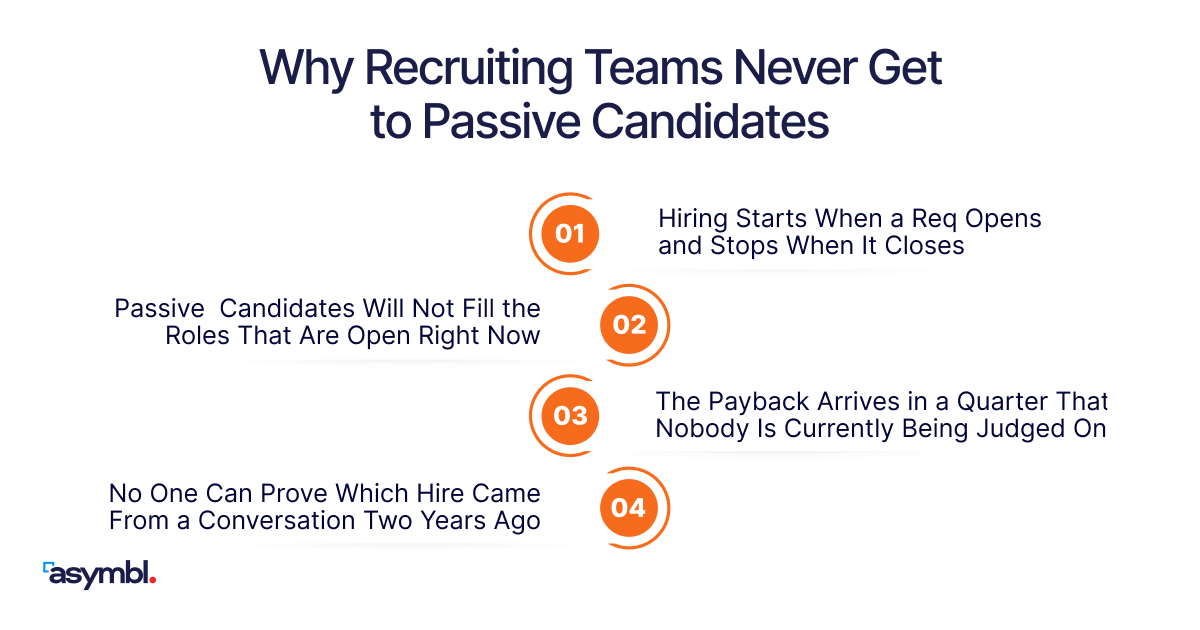
Why Recruiting Teams Never Get to Passive Candidates
Passive candidates get missed because recruiters have to prioritize active applicants, open job orders, interviews, and client submissions first. Searching old records, checking past assignment outcomes, identifying people who now fit a new role, and reaching out before a competitor does rarely makes the top of the day's list.
1. Hiring Starts When a Job Order Opens and Stops When It Closes
The recruiting function activates when a job order opens, and shuts down when that order closes. Approval comes through, the job goes live, sourcing starts, an offer goes out. Every handoff, SLA, and dashboard runs on that same window.
Sourcing passive candidates has no equivalent trigger, so it never gets a turn on its own. Recruiting becomes an episodic function inside a market that rewards firms for staying engaged year-round.
2. Passive Candidates Will Not Fill the Roles That Are Open Right Now
When a recruiter has five open job orders and a client waiting on a shortlist, a passive candidate conversation won't fill the role by the current deadline.
No matter how well that conversation goes, it doesn't fill a live opening, so the firm misses the time-to-fill targets.
Each recruiter is making the right short-term call, but the sum of those correct calls is a firm that never builds a pipeline. The capacity a pipeline needs keeps getting pulled toward whatever closes a job order today, and recruiters are already losing a big share of the week to admin work that technology should be handling:
- Screening resumes
- Scheduling interviews
- Updating records
- Chasing feedback nobody sent back
3. The Payback Arrives in a Quarter Nobody Is Currently Measuring
The payoff on a relationship built with a candidate today shows up when a matching role opens, which could be a quarter or a year later. The cost lands this week, in hours that had other uses: a submittal the recruiter didn't make, a follow-up call that didn't happen.
Leadership measures recruiting teams on time to fill, offers accepted, and job orders filled. All of these metrics are usually measured on a monthly or a quarterly basis, so the structure rewards whatever pays back before the next review and penalizes anything slower, no matter how much value the slower work eventually produces.
Sourcing a passive candidate doesn’t pay back immediately, which means it competes for hours against work that does, and it loses.
When hiring volume picks up, passive work is the first thing paused, right at the moment a warm pipeline would have paid for itself several times over. The teams under the most pressure to hire fast are the ones structurally least able to build the pipeline that would let them hire fast without the pressure.
4. No One Can Prove Which Hire Came From a Conversation Two Years Ago
Even when a passive relationship converts, nothing in the system traces the hire back to what actually started it. The record shows only the last touchpoint, an application, an InMail reply, or a referral, and that becomes the official source of hire. The eighteen months of contact that made the person willing to reply in the first place doesn't show up anywhere, because nobody built a field for it.
Gartner HR Research from February 2026 found that only 31% of recruiting teams use the labor market data to shape strategy.
Work that can't show a return doesn't survive a resourcing conversation. Given a choice between outreach that might close a role months out and a referral that closes one this week, the recruiter picks the referral every time. They should, because that's what their scorecard rewards. Everyone is responding correctly to an incentive that was never built with passive work in mind.
Pipeline work has no line on any scorecard, so no case ever gets built to staff it. Without staffing, there's no result to point to when the next budget conversation comes around. Every hiring cycle ends up looking like the last one for the same reason. Fixing this starts by answering two things most firms can't answer today:
- What work actually builds a pipeline
- Who's currently in the one they have.
From there, it means knowing where each of those people landed the last time the firm had a matching role.
The Cost of Ignoring Passive Candidates
Nobody attributes pipeline health to anything, so the team never sees a bill for skipping it. The bill still arrives, inside the metrics the team already reports on every week. Even so, nobody labels any line item as passive candidates.
1. Every search starts at zero, so time to fill never moves
Every search runs the same sequence: write the post, publish it, build the list, source, qualify, and schedule. Only then does the interview process start. Every step is there because no relationship existed before the search opened, and every step takes days.
Time to fill only improves by cutting steps out. The only way to cut a step is to have done it before the req existed. If a firm already knows a candidate, qualifying and interviewing the candidate are already done. Neither step has to happen inside the search. What's left is the interview and the offer, which is where most of the calendar time actually sits once sourcing is done.
Firms chase time to fill by adding recruiters, buying more job board spend, and subscribing to more sourcing tools. All of the spend and focus is towards sourcing, and there’s the least focus on qualifying, which is where a genuinely cold search loses most of its calendar time no matter how fast sourcing runs.
2. You compete for the smallest segment of the market and call it a talent shortage
The people actively applying in any given month are a small fraction of the larger candidate pool. Every competing firm is targeting the same fraction with the same job posts on the same two or three platforms.
The better a candidate is at their job, the less likely they are to be actively looking. This makes the most skilled and specialized people the least represented group in the exact pool every firm draws from.
Restricting a search to whoever happens to be looking this week is a self-imposed constraint. Calling the result a talent shortage describes the outcome without naming the cause. Every buyer showed up to the same narrow segment on the same day, and all of them skipped the rest of the market.
The candidates who would have been the strongest fit were reachable the whole time. They just weren't looking during the two or three weeks the search happened to run. A search built around who's looking this week will never reach them.
Firms that keep working passive candidates all year have a much bigger pool to pull from. The ones relying on applications are stuck with whoever showed up that week.
3. A Candidate Passed Over for One Client Could Be the Right Fit for Another Client
Losing a role at one client only rules a candidate out for that opening. The same person can be a strong fit for a different client, a different seniority role, or a different engagement type. The firm already has the interview notes from that earlier process, which explain:
- Why it ended
- What the client actually cared about
- How the candidate handled missing the offer.
Most firms don't pull that person into the next job order pipeline, and open a brand new search instead, paying again in recruiter hours to relearn what the firm already knew. The candidate didn't get worse between the two searches; the firm just stopped looking at what it already had on them.
4. An Engaged Pool Skips Straight to Conversation, Which Means Faster Time to Fill and Faster Payment
Every day a search stays open is a day the firm hasn't been paid. For a staffing business, time to fill is the cash conversion cycle. Fees land at placement, so every extra week a search runs is a week of revenue stuck on the wrong side of the invoice. Leadership measures every desk on how fast it turns a job order into cash.
On contingent and multi-vendor work, whichever firm submits first from a warm pool wins the placement, and the firm still drafting the job ad works that order for free. A candidate already in an engaged pool skips the cold-search steps entirely, so there's no post to write, no candidate to convince, and no screening cycle starting from scratch. The reply comes back in days, and the process opens at the interview.
A redeployment picks up at the conversation, while a new search picks up at the application, which is several fee-earning weeks behind it.
Gartner HR Research from June 2026 found that only 48% of candidates accepted their most recent job offer in Q4 2025, down from 85% two years earlier, which means a candidate with no relationship to the firm is more likely than ever to walk away at the last step.
5. Every Candidate You Already Know Is a Placement You Have Not Made Yet
A firm's passive candidate pool is made up of people who already applied, screened, interviewed, or worked a placement. Nearly all of them went passive because one specific search ended, and they stayed passive because nobody tracked what happened next.
Contractors roll off assignments on a date the system already shows months out. Placements finish their term and open back up on a schedule the firm knows. Every one of these people comes with a documented performance record and a knowable availability date, which makes them the strongest redeployment bet the firm has, well ahead of anyone it hasn't met yet.
A firm that doesn't track this ends up re-sourcing the role from scratch, which gives a competitor room to redeploy the exact person the firm built the relationship with.
How to Build a Passive Talent Pipeline for Future Roles
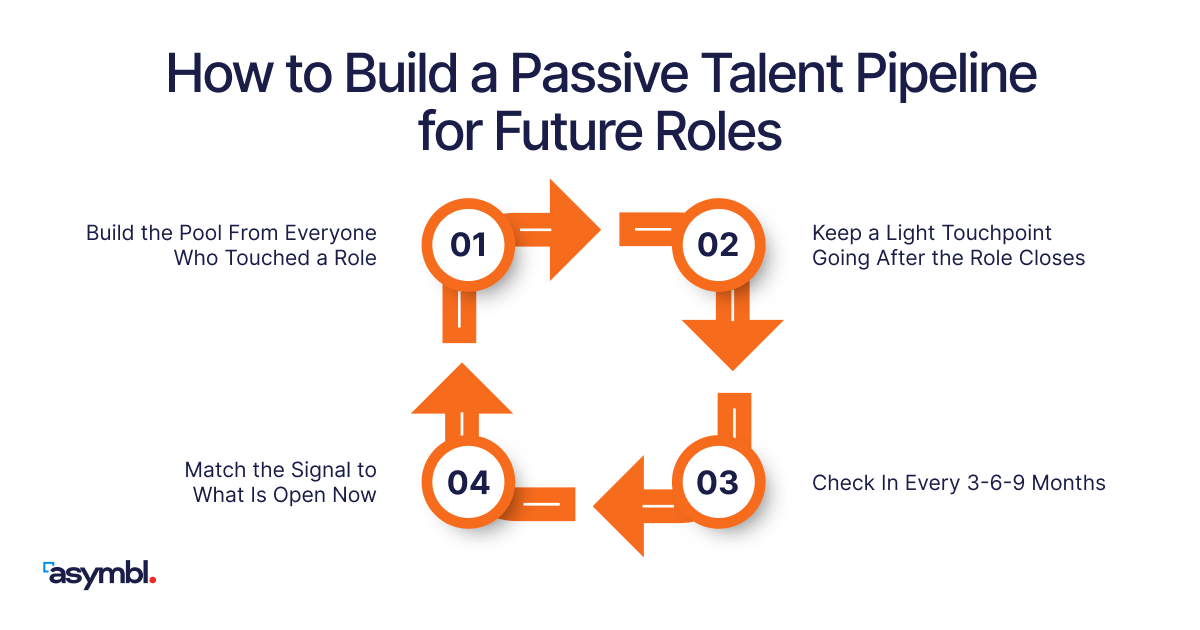
Filling what's open right now and building who the firm hires next are two different jobs, and most firms only staff the first one. The second one just needs a process that runs quietly in the background.
Step 1: Build the pool from everyone who touched a role, not just the people you hired
The pool should include anyone who:
- Interviewed
- Screened
- Referred
- Engaged for any role belongs in it, including the people who got close but didn't get the offer.
Firms often ask how to find passive candidates with an existing database of candidates within their CRM. They include:
- Silver medalists: The highest-intent group in the pool because they wanted the job and cleared the interview in the second position. They just lost to exactly one other person, on a factor that may not even apply to the next client.
- Hired or placed: This is the highest-signal group, because the firm has real outcome data on how they performed once they were onboarded. For a staffing firm, this group includes every contractor with an assignment end date already on file, which makes them the single most predictable redeployment opportunity in the business.
- Rejected: People rejected on a single requirement at one account, a location, a rate, or a certification. That one blocker often doesn't apply at a different client, a different seniority role, or a different engagement type.
This pool costs almost nothing to build. Every name in it came from work the firm already paid for once, through the original search. A sales team never treats a "no" as a reason to delete the lead. They log the reason, keep the record, and work the account again when the timing changes, sometimes years later.
When a new role opens, the instinct is to look for a new channel:
- A job board
- A subscription
- A fresh tool
The candidates who already know the firm, and who the firm already knows, are the channel. It was open the whole time.
Step 2: Keep a light touchpoint going after the role closes
Most firms stop contacting a candidate the moment the job order is filled. Reopening a conversation with the same candidate doesn't need a campaign. For example:
- A quick note when something relevant comes up
- A check that the phone number still works
- A short update on the firm or the market.
None of these activities have to lead to an interview or convert the candidate to be worth doing.
Keep the relationship active long enough to still be useful when there's a reason to use it. Someone who declined an offer last spring, or lost a role by one requirement, only stays reachable if the firm kept in touch during the months in between.
This is also the easiest step in the process. It takes minutes per person, and none of it requires deciding anything about fit yet. Fit gets decided later, at Step 4, when there's an actual role to decide against. Step 2's only job is making sure the door is still open when that moment arrives.
Step 3: Check in every 3, 6, and 9 months to catch a candidate before they start looking elsewhere
A candidate who isn't looking today may be open to talking three, six, or nine months from now.
A periodic check-in at those intervals captures the change in interest without waiting for the candidate to reach out first. It doesn't need to be elaborate. A short message asking how things are going does the job, because the point is just to start the conversation.
A promotion, a title change, or a shift into a new function is worth acting on outside the regular cadence, since it changes what the person qualifies for right away.
Step 4: Match the signal to what's open now and make the introduction
A tracked change is worth nothing until someone matches it against live demand. Whatever the signal is (a promotion, a title change, a manager who departed)left it means the same thing: the candidate no longer fits the role the firm originally had in mind for them, and probably fits a different one that's open right now, maybe even at a different client.
This is the step that turns months of light-touch contact into a placement. Skip it, and the pipeline is just a well-maintained list going nowhere. Run it consistently, and it starts to behave the way a sales pipeline already does. A lead goes cold for a year, then closes the moment the timing lines up, with no cold outreach needed to get there.
Step 5: Find passive candidates through outreach
Your internal database doesn’t have to be your only pipeline. When a role calls for a skill set or seniority the firm has never placed, passive candidate sourcing outside the database fills the gap. The three main approaches to sourcing passive candidates are:
- Targeted outreach: Build a short list against the role's real criteria, then send a personal message tied to something specific in the person's work instead of a templated InMail.
- Referrals: Ask placed contractors, clients, and silver medalists who they'd recommend. A warm introduction shortens the trust-building step.
- Professional networks: Industry communities, events, and alumni groups put recruiters in front of people who aren't browsing job boards.
Each of these starts a relationship from zero, so treat every new contact as a future database entry. Log the conversation, why it did or didn't convert, and a follow-up date. The person then joins the pool that Steps 2 through 4 keep warm, and external sourcing becomes an input to the pipeline instead of a one-off search cost.
Asymbl: The Unified Workforce Orchestration™ Platform
Matching a tracked signal to an open role manually works for a pool of a dozen candidates. It breaks down once the pool holds thousands of candidates across years of closed searches. Recruiter Suite, Talent Intelligence, and Rosa run that matching against one shared record.
Asymbl Intelligence Turns Every Interaction Into a Signal Someone Can Act On
Asymbl Intelligence is the platform underneath every Asymbl product, and it's built to learn from the context recruiters share. Every candidate carries a record that includes the following criteria:
- Skills
- Work history
- Communications
- Engagement patterns
- Behavioral signals
- A reason why the past conversation ended
Asymbl Intelligence captures:
- Emails
- Calls
- Interview notes
- Verbal client feedback
These usually exist in individual recruiters’ inboxes and vanish when they leave, but with Asymbl Intelligence, they get captured in the platform without any manual logging.
The same record is available to every recruiter and every digital worker on the platform, which means firm-level knowledge actually stays with the firm. Every closed process, whether it ended in a placement or not, feeds back into how Talent Intelligence scores the next match. The pool accumulates more context and candidates the longer a firm runs it, because the system is learning from outcomes.
Talent Intelligence Scores the People You Have Already Met Against the Role You Just Opened
Talent Intelligence makes large candidate pools usable in the following ways:
- Natural language search finds a person without Boolean expertise or an exact keyword match, so the firm's newest recruiter runs the same retrieval as its best one from day one.
- The matching engine scores fit in both directions, candidates against jobs and jobs against candidates, and surfaces available candidates, in-contact candidates, and prior placements on the same scale, in one view. Every person gets a placement-likelihood score before the recruiter picks up the phone.
Most recruiting tools cannot predict the next potential step for a candidate without completing the current step. Two candidates with near-identical resumes can score completely differently for the same role. Keyword search misses this entirely. Asymbl Intelligence catches it, because it captured that context the first time around.
Instead of running a cold pull from a database, the recruiter opens a ranked list of the strongest matches, including the people the firm has already met. The pool the firm already paid to build is the first place the search happens, not the last.
Contact Management Keeps the Relationship With the Team
Contact Management is part of Recruiter Suite, and all candidate and client-related context is attached to the contact record. Teams build and share segmented lists, email sends straight from the platform, and full communication history logs itself.
A recruiter picking up a two-year-old relationship can read the entire thread:
- What the last recruiter promised
- What the candidate said about relocating
- Why a previous submission stalled out.
This same context decides whether the next conversation feels personal or generic.
Rosa, a Digital Recruiter, and Skills
Rosa is a Digital Recruiter, running on Asymbl Intelligence. She handles the volume that's structurally impossible for a human team to keep up with:
- Outreach at scale
- Application scoring against role criteria
- Candidate inquiries
- Interview scheduling.
Each one of these actions runs against the same Asymbl Intelligence record the recruiter sees, which is what makes the outreach read as personal rather than templated. Rosa references the last actual conversation and the actual change in that person's situation.
Skills are Asymbl's pre-built agentic building blocks. They go live without custom development, so a trajectory-triggered cadence from the three-six-nine check-in runs on its own from the day the firm turns it on. Recruiters set the strategy, decide what a good fit looks like for each role, and take the reply that turns into a placement. Rosa carries the volume underneath, so the recruiter's day shifts toward the judgment calls that still need a person.
Inside Asymbl's own recruiting team, 2 recruiters and Rosa processed 17,000 applications and hired 100 people in 100 days.
The Passive Candidates You Already Have Compound in Value Every Quarter
The compounding effect of your passive candidate pool gives you a competitive advantage in a crowded job market. Every quarter a firm keeps building its passive pool while a competing firm doesn't is a quarter that firm pulls ahead on submittal speed, margin per placement, and client retention.
The gap doesn't close later, because a competing firm can't buy the eighteen months of context the pool now carries on candidates the client already knows.
Two years from now, a staffing firm running this system is filling job orders from a pool of proven talent, submitting first on contingent work, and holding onto accounts that a competing firm keeps trying to poach.
A firm still starting every search from zero is losing placements on speed, running thinner margins on cold searches, and adding recruiter headcount to hold flat.
Two questions worth sitting with before the next quarter closes:
- When a client sends a new job order, does the firm see who it has already vetted for that role, or does the search start cold every time?
- What happened to the candidates the firm almost placed last year? Are they in the pool, or did a competing firm redeploy them first?
Book a demo to see Asymbl Talent Intelligence run against your own candidate records and open requisitions, so a pool the firm already paid to build actually turns into placements and revenue.
FAQs
A silver medalist is one specific type of passive candidate within a broader group. Silver medalists reached the final interview stage and lost to one other finalist, not on qualification. The broader passive pool also includes rolled-off contractors, placed hires, and candidates rejected earlier on a single fixed requirement like location or rate. Only silver medalists carry that specific late-stage, near-miss context, which is why Talent Intelligence scores them separately the moment a similar role opens.
Track redeployment rate first: the share of placements filled from candidates already in the database rather than a fresh search. Then track response rate to reactivation outreach, time from a tracked signal (a promotion, an assignment ending) to submittal, and the percentage of silver medalists or rolled-off contractors placed within a year. Time to fill and reqs closed-won won't show this, because they measure the current search, not the pool feeding future ones.
The applicant tracking system or CRM a firm already runs holds most of what a passive pipeline needs: past applicants, screened candidates, and placed hires. The starting gap is usually process, not software. Nobody tags why a search ended or sets a follow-up date. A tagging convention and a check-in cadence layered on existing tools can start the pipeline before any platform decision comes up.
Incomplete or stale records describe the starting point most firms actually have, and a pipeline can start from there. Begin with whatever is verifiable now: contact details, last known role or assignment status, and the reason the last process ended. Records improve the next time each candidate is touched, rather than needing to be complete upfront. Waiting for clean data is itself the reason most pipelines never start.
The core practice applies to any recruiting function, though the payoff shows up differently. Staffing firms feel it in time to fill, cost per placement, and margin, because a fee depends on each match. Corporate talent acquisition teams see it in cost per hire and quality of hire, since redeploying a known silver medalist or former applicant skips the same sourcing and screening steps a cold search would need.

The Brain of Workforce Orchestration
Organizational memory is the layer that makes digital workers coherent. Learn how to build the brain before you need it.

The Right Fit Starts With a Conversation.
See what working together could look like.
