


The search for the best applicant tracking system has never been more urgent. Talent acquisition leaders are being asked to do more than fill requisitions. They are expected to accelerate hiring velocity, improve quality of hire, embed responsible AI into daily workflows, and demonstrate clear impact on revenue, retention, and workforce agility.
At the same time, most enterprise TA teams are still operating inside fragmented architectures. The ATS sits in one environment. CRM data lives somewhere else.
This limits visibility, slows decision-making, and makes AI nearly impossible to operationalize at scale. According to the State of Today's HR Technology and Integrations 2025 Report by HR Research Institute, a striking 81% of organizations say poor integration limits their ability to meet HR goals.
The best applicant tracking system unifies the systems and data, serving as the operational backbone for workforce orchestration.
Before redefining what “best” truly means for enterprise TA in 2026, let’s examine the platforms most buyers evaluate today and where they succeed, and where they fall short for modern corporate recruiting teams.
Best Applicant Tracking Systems in 2026
Most ATS platforms were built to solve the core problems, such as requisition management, resume tracking, interview coordination, and compliance.
Today, corporate talent teams are expected to demonstrate measurable impact, operationalize AI responsibly, protect the candidate experience at scale, and align hiring outcomes with overall business performance.
It requires deliberate architectural decisions regarding data unification, governance, and the integration of human recruiters and AI agents within the system.
The right choice for you depends on whether your goal is incremental improvement in applicant tracking or a coordinated, hybrid recruiting system designed to scale. The platforms below represent the most commonly evaluated options for recruiting teams in 2026.

1. Asymbl
Asymbl Recruiter Suite is a purpose-built architectural extension of the Salesforce ecosystem, engineered for Workforce Orchestration rather than static applicant tracking.
By unifying ATS workflows, AI-driven intelligence, and candidate engagement within the primary system of record, Asymbl ensures that talent acquisition operates with the same Institutional Governance and data integrity as the rest of the enterprise.
Unlike disconnected point solutions, Asymbl facilitates a Hybrid Workforce Model through the deployment of Digital Workers. These are not isolated AI tools. They are autonomous agents designed for Deterministic Execution within the flow of work.
By assigning clear roles, operational guardrails, and measurable KPIs to both human and digital teammates, Asymbl provides the orchestration necessary to scale hiring capacity without a linear increase in human capital expenditures.
Key features
- Salesforce-based ATS with unified candidate visibility: Asymbl Recruiter Suite operates natively within Salesforce, giving recruiters a unified view of candidates, hiring managers, and related interactions across every stage.
- AI-enhanced search beyond Boolean: Asymbl enhances search with natural language processing and interaction data, identifying candidates based on contextual relevance rather than exact term matches.
- End-to-end candidate engagement and nurturing: Recruiter Suite includes built-in engagement tools that manage outreach from first contact through onboarding. Recruiters can execute branded email and SMS campaigns, automate follow-ups, and track all interactions within the same platform.
- Configurable workflows using clicks, not code: Recruiter Suite allows teams to configure job-specific workflows using user-defined stages, sequences, and automation rules without heavy development.
- Recruiting agents with prebuilt templates: Prebuilt agent templates, topics, prompts, and actions allow teams to automate tasks such as drafting job descriptions, identifying qualified candidates, scheduling interviews, and summarizing interview feedback.
- Workforce intelligence layer: Asymbl Intelligence generates predictive hiring insights, surfaces bias patterns, recommends pricing or placement strategies, and automates workflow triggers based on structured and behavioral data.
Pros
- Unified data foundation in Salesforce: Recruiting runs in the same platform as customer and business data, reducing multi-system complexity.
- Modular, role-based pricing flexibility: The role-based licensing model allows organizations to align costs with functional usage, rather than paying for bundled “all-in-one” features.
- Designed for hybrid execution: AI agents or digital workers can be embedded into recruiting workflows with defined actions, without being bolted on as “AI features.”
- 360° workforce visibility: Asymbl Intelligence transforms structured CRM data, communications, and behavioral signals into predictive hiring insights and automated decision support.
- Strong workflow leverage for teams already on Salesforce: Operational alignment is easier when recruiting lives within the business's existing workflows.
Cons
- Best fit assumes a Salesforce strategy: If your organization is not committed to Salesforce as its operational backbone, the primary architectural advantage is reduced.
- Risk of buyer misalignment: If your evaluation lens is limited to an ATS feature checklist, you may overlook the broader value, as Asymbl is designed to optimize orchestration and measurable outcomes, not just applicant tracking.
Best for
- Mid-market and Enterprise recruiting teams that want recruiting to operate on a unified Salesforce data foundation, not a separate HR stack.
- TA leaders who are trying to move from task automation to hybrid workforce orchestration, where AI agents behave like digital workers with defined roles, actions, and governance.
- Teams that need high-volume execution without losing candidate experience and operational control.
Rating:
Rated 5/5 on Salesforce AppExchange.
2. Beamery
Beamery is a talent acquisition CRM and recruitment platform focused on proactive talent lifecycle management, candidate engagement, and pipeline nurturing rather than traditional applicant tracking. It emphasizes sourcing, relationship building, and long-term talent pool development, helping recruiting teams shift from reactive hiring to proactive talent strategy.
Key features
- Talent CRM and unified candidate profiles: Beamery centralizes candidate data, allowing recruiters to manage pipelines and engagement from a single relationship-driven interface.
- AI-assisted automation: Automation capabilities support candidate matching, workflow triggers, and recruiter productivity.
- Talent pooling and campaign management: Recruiters can build segmented talent communities and execute nurturing campaigns aligned with employer branding efforts.
- Skills-based workforce intelligence: Beamery emphasizes skills mapping and internal mobility insights to support broader talent lifecycle management.
Pros
- Strong candidate engagement infrastructure: Beamery excels at nurturing passive candidates and maintaining long-term talent pipelines.
- User-friendly and intuitive UI: The UI of Beamery is end-user friendly and designed to reduce clicks for recruiters.
- Enterprise-ready CRM architecture: Designed for large organizations managing complex talent pools across regions.
Cons
- Not a standalone ATS: Beamery typically requires integration with an applicant tracking system for full recruiting workflow execution.
- Opaque pricing structure: Pricing and packaging are opaque and tend to skew toward enterprise budgets.
- Lack of deep customization: Reporting dashboards and analytics lack deep customization.
Pricing
Beamery’s pricing is not publicly published and is typically tailored per enterprise contract.
Best for
Enterprises focused on proactive talent engagement, CRM-style recruiting workflows, and building long-term talent pipelines rather than solely tracking applicants.
Rating
Rated 4.1/5 on G2.
Rated 4.5/5 on Capterra.
Rated 4.5/5 on Software Advice.
3. Workday Recruiting
Workday Recruiting is the applicant tracking and talent acquisition component within the broader Workday Human Capital Management (HCM) suite. It centralizes hiring data with other HR functions, enabling recruiting processes to operate within an integrated HR ecosystem.
Key features
- Integrated HCM architecture: Recruiting operates natively within the Workday HR ecosystem, ensuring data consistency across functions.
- Automated workflows and requisition management: Workday Recruiting supports configurable hiring workflows, approvals, and structured interview processes.
- Embedded analytics and dashboards: Workday Recruiting includes built-in reporting and dashboard capabilities that surface hiring activity, pipeline health, and recruiter performance metrics within the broader HCM environment.
- Cross-device accessibility: Mobile-accessible interfaces for both candidates and recruiters, supporting application submission, interview scheduling, and status tracking across devices.
Pros
- Strong governance and compliance alignment: Centralized HR architecture supports regulatory and reporting requirements.
- Enterprise scalability: Well-suited for large organizations with global hiring needs.
- Comprehensive pipeline visibility and analytics: Structured visibility into requisitions, candidate stages, time-in-stage metrics, and overall hiring funnel performance.
Cons
- Complex configuration and learning curve: Usability and learning curve can be significant, especially for non-power users.
- Rigid HR-centered architecture: Workflows and navigation may feel rigid or unintuitive in certain hiring contexts.
- Opaque pricing and implementation costs: Pricing requires consultation and may include substantial service fees.
Pricing
Workday does not publicly list recruiting pricing separate from the broader HCM contract. Subscription fees are typically structured on a per-employee, per-month basis and negotiated directly with Workday, often with implementation and services fees added.
Best for
Large enterprises seeking a tightly integrated talent acquisition solution that aligns with HR, payroll, compliance, and workforce planning within a single HCM platform.
Rating
Rated 3.7/5 on G2.
Rated 4.4/5 on Capterra.
4. SAP SuccessFactors Recruiting
SAP SuccessFactors Recruiting is part of the broader SAP SuccessFactors HCM suite. It supports ATS functions within a full-suite HR platform designed to manage recruiting alongside talent management, performance, onboarding, and employee lifecycle tasks.
Key features
- End-to-end recruiting module: SAP SuccessFactors Recruiting supports the full hiring lifecycle, from requisition creation and approvals through candidate tracking, interview management, and offer processes.
- Global compliance and localization: SAP SuccessFactors provides localization support across regions, languages, and regulatory environments. It enables organizations to manage country-specific hiring requirements within a centralized system.
- Integrated talent management ecosystem: Recruiting connects directly with other SAP SuccessFactors modules, including onboarding, performance management, learning, and workforce planning.
- Enterprise reporting capabilities: The platform offers reporting tools aligned with HR metrics such as headcount growth, hiring velocity, diversity tracking, and compliance performance.
Pros
- Comprehensive HR suite integration: Recruiting data flows directly into broader talent management processes.
- Centralized governance framework: Offers strong compliance and administrative controls.
- Global scalability: Scales effectively for complex, global workforces.
Cons
- Complex user interface: Users report a steeper learning curve compared to modern ATS platforms.
- Lengthy implementation cycles: Enterprise configuration and deployment can extend timelines.
- Higher total cost of ownership: Implementation services and licensing can be costly at scale.
Pricing
SAP SuccessFactors does not publicly list pricing, but it is typically offered on an annual subscription basis.
Best for
Large enterprises prioritizing a comprehensive HR and talent management platform where recruiting is one piece of a unified workforce ecosystem.
Rating
Rated 3.9/5 on G2.
Rated 4.4/5 on Gartner.
Rated 2.1/5 on Trustpilot.
5. SmartRecruiters
SmartRecruiters is a cloud-based applicant tracking system positioned as a modern talent acquisition suite. It focuses on improving recruiter experience, enabling collaborative hiring, and supporting scalable recruiting workflows across mid-market and enterprise organizations.
Key features
- Core ATS and requisition management: SmartRecruiters offers a structured applicant tracking system, job requisition management, and interview coordination within a centralized hiring platform.
- Built-in CRM and candidate engagement: The platform includes CRM capabilities that allow recruiters to nurture passive candidates and manage talent pools.
- AI-powered candidate screening and matching: Higher-tier plans include AI-supported screening and matching tools designed to improve candidate identification and ranking.
- Advanced analytics and reporting: Premium plans offer deeper reporting and analytics features to monitor pipeline health and hiring performance.
Pros
- Modern, intuitive user interface: SmartRecruiters is frequently praised for its clean design and ease of use.
- Flexible plan structure: Multiple plan tiers allow organizations to scale features based on hiring complexity.
- Strong collaboration tools: Hiring managers and recruiters can collaborate within structured workflows.
Cons
- Customization limitations: Customization constraints when configuring highly complex or specialized workflows.
- Support variability: Customer support experience may vary depending on plan level and contract scope.
- Integration-dependent architecture: Broader data unification often depends on integrations rather than a single native data model.
Pricing
SmartRecruiters offers tiered plans. The Essential plan starts at approximately $14,995 annually. Professional, High Volume, and Complete tiers are quote-based. Pricing scales based on feature depth and organization size.
Best for
Mid-market and enterprise recruiting teams seeking a modern ATS with tiered expansion into AI and engagement features.
Rating
Rated 4.3/5 on G2.
Rated 4.2/5 on Software Advice
Rated 1.6/5 on Trustpilot.
Rated 9.3/10 on TrustRadius.
6. Lever
Lever is a talent acquisition suite that combines applicant tracking and CRM functionality within a unified recruiting platform. It is designed to support collaborative hiring and relationship-driven recruiting strategies. The platform emphasizes pipeline visibility, structured feedback, and improved recruiter–hiring manager alignment within a unified environment.
Key features
- Unified ATS and CRM architecture: Lever integrates applicant tracking and candidate relationship management in one system, allowing recruiters to manage both inbound applicants and passive talent pipelines without switching platforms.
- Pipeline nurturing and engagement workflows: Recruiters can build segmented pipelines, track candidate touchpoints, and manage structured engagement across stages to maintain consistent communication and improve conversion rates.
- Collaborative hiring and feedback tools: Hiring managers and interviewers can participate directly in structured workflows, submit scorecards, and provide real-time feedback within the system.
- Structured implementation and onboarding support: Lever provides guided onboarding and implementation support to accelerate adoption and reduce transition friction for recruiting teams.
Pros
- Strong collaborative hiring experience: Teams benefit from structured communication and feedback tools.
- High user satisfaction ratings: Lever receives strong ratings for usability and adoption.
- Unified ATS and CRM foundation: Combines tracking and engagement without requiring separate systems.
Cons
- Reporting limitations: Analytics and reporting depth can be limited or complex.
- Occasional performance and bug issues: User feedback references system bugs and resolution delays.
- Limited cross-functional business visibility: Post-hire outcome tracking and broader workforce analytics often require additional systems.
Pricing
Lever does not publicly list pricing. Subscription costs are customized and provided through vendor consultation.
Best for
Growth-stage and mid-market companies prioritizing pipeline engagement and collaborative hiring within a traditional recruiting framework.
Rating
Rated 4.3/5 on G2.
Rated 4.6/5 on Software Advice.
Rated 3.6/5 on Trustpilot.
7. iCIMS
iCIMS is an enterprise-grade applicant tracking system designed to support large, complex hiring environments. It provides a broad feature footprint across requisition management, candidate tracking, and global hiring workflows. The platform is widely adopted among large enterprises seeking structured processes and scalable architecture for high-volume recruitment.
Key features
- Enterprise-level requisition and candidate management: Supports end-to-end applicant tracking, including resume parsing, interview coordination, offer management, and candidate status tracking across complex hiring structures.
- Global hiring and compliance support: Designed to accommodate multinational hiring requirements, including regional regulatory considerations and localization needs.
- Configurable workflows for complex organizations: Offers customizable hiring processes that can be adapted to business units, departments, and varying approval structures.
- Analytics and performance dashboards: Includes reporting capabilities that provide visibility into time-to-fill, recruiter productivity, and pipeline movement across enterprise hiring functions.
Pros
- Scalable for enterprise hiring: Well-suited for large organizations with high-volume needs.
- Broad feature coverage: Covers most core ATS functionality within one platform.
- Strong market adoption: Widely used across enterprise recruiting environments.
Cons
- Complex configuration and navigation: Implementation and optimization can require significant setup and training.
- Integration-driven orchestration: Broader business visibility often depends on external integrations.
- Learning curve for administrators: Advanced customization may require dedicated system ownership.
Pricing
iCIMS pricing is not publicly disclosed and will be provided on consultation.
Best for
Large enterprises requiring a scalable ATS with global hiring support and structured workflows.
Rating
Rated 4.2/5 on G2.
Rated 7.8/10 on TrustRadius.
Rated 4.3/5 on Capterra.
Rated 4.3/5 on Software Advice.
8. Bullhorn
Bullhorn is an applicant tracking and CRM platform primarily designed for staffing and recruitment agencies. It combines candidate tracking, client management, and placement workflows into a unified front-office system. The platform is optimized for revenue-driven recruiting environments where placement velocity, client relationship management, and performance metrics are central to operations.
Key features
- Integrated ATS and CRM functionality: Combines applicant tracking with client relationship management, enabling recruiters to manage both candidate pipelines and client interactions within one system.
- Placement and revenue tracking workflows: Supports placement management and KPI visibility tailored to staffing-style performance measurement.
- Structured workflow automation: Enables standardized recruiting, submission, and placement processes across teams.
- Integration ecosystem and extensibility: Connects with additional tools and systems to expand functionality, depending on organizational requirements.
Pros
- Strong staffing-focused workflows: Optimized for agency and front-office recruiting environments.
- Robust client and candidate tracking: Provides visibility into placements and related KPIs.
- Ease of use for staffing teams: Frequently praised in agency environments for usability.
Cons
- Designed primarily for staffing firms: May require additional configuration for corporate talent acquisition teams.
- Performance issues reported: Some users cite occasional slowness.
- Custom pricing model: Total cost depends heavily on configuration and modules.
Pricing
Bullhorn uses quote-based pricing tailored to organization size, modules, and contract scope.
Best for
Staffing firms and recruitment agencies seeking integrated client and candidate management.
Rating
Rated 4.2/5 on G2.
Rated 4.4/5 on Trustpilot.
Rated 4.0/5 on Gartner.
9. Ashby
Ashby is a modern recruiting platform that positions itself as an all-in-one system combining applicant tracking, analytics, and AI-enabled workflows. It is particularly appealing to data-driven recruiting teams that prioritize reporting depth and structured hiring practices. Ashby emphasizes transparency in hiring metrics and aims to provide real-time visibility into pipeline performance.
Key features
- Unified ATS and structured hiring workflows: Covers requisition management, candidate tracking, interview scheduling, and structured evaluation processes within a centralized platform.
- Advanced analytics and reporting depth: Provides customizable dashboards and detailed reporting designed to support data-driven hiring decisions and pipeline optimization.
- AI-assisted recruiting workflows: Includes AI-supported tools that assist with sourcing, evaluation, and workflow efficiency.
Pros
- Strong analytics depth: Frequently praised for reporting capabilities and pipeline visibility.
- Modern user experience: Clean interface designed for high-growth teams.
- Transparent entry pricing: Published starting plans improve budget predictability.
Cons
- Custom pricing at scale: Larger organizations move into quote-based pricing tiers.
- Less enterprise legacy depth: May require additional systems for highly complex global environments.
- Architecture expansion required for orchestration: Broader workforce analytics may require integration with other platforms.
Pricing
Ashby lists a Foundations plan starting at $400 per month. Larger organizations require customized pricing.
Best for
High-growth and data-driven recruiting teams seeking strong analytics within a modern ATS platform.
Rating
Rated 4.7/5 on G2.
Rated 4.3/5 on Gartner
Rated 4.5/5 on Software Advice.
10. Workable
Workable is an applicant tracking system built for ease of use and rapid deployment, targeting small to mid-sized organizations. It focuses on delivering core hiring functionality without extensive configuration complexity. Workable emphasizes accessible pricing, intuitive design, and streamlined workflows for teams without dedicated recruiting operations infrastructure.
Key features
- Core applicant tracking and job distribution: Supports job posting across multiple boards, candidate management, and interview scheduling within a structured ATS framework.
- AI screening assistant and resume parsing: Includes AI-enabled tools designed to assist with resume review and candidate screening efficiency.
- Interview kits and structured scorecards: Workable provides standardized evaluation templates to promote consistent hiring decisions across teams.
- Compliance and data governance tools: Includes GDPR controls and candidate data management features to support regulatory requirements.
Pros
- Transparent pricing tiers: Clearly published pricing plans improve budgeting clarity.
- Ease of implementation: Known for fast setup and minimal onboarding complexity.
- Strong SMB usability: Designed for teams without dedicated recruiting operations staff.
Cons
- Add-on costs increase total spend: Additional capabilities, such as texting or video interviews, may require paid add-ons.
- Limited enterprise orchestration depth: Advanced workforce analytics and AI governance may require system expansion.
- Scalability constraints: May require migration as hiring complexity grows.
Pricing
Standard plan starts at $299 per month, Premier at $599 per month, and Enterprise at $719 per month, with optional add-ons available.
Best for
Small and mid-sized businesses seeking an easy-to-deploy ATS with transparent pricing.
Rating
Rated 4.5/5 on G2.
Rated 3.4/5 on Trustpilot.
Rated 4.4/5 on Capterra.
Evaluation Criteria For The Best ATS Software In 2026
Selecting the best recruiting technology in 2026 requires architectural thinking, not feature comparison. The wrong architecture creates silos. The right one creates leverage.
Corporate teams must evaluate not just what a system does, but how it connects data, orchestrates human and digital workers, and scales responsibly over time.
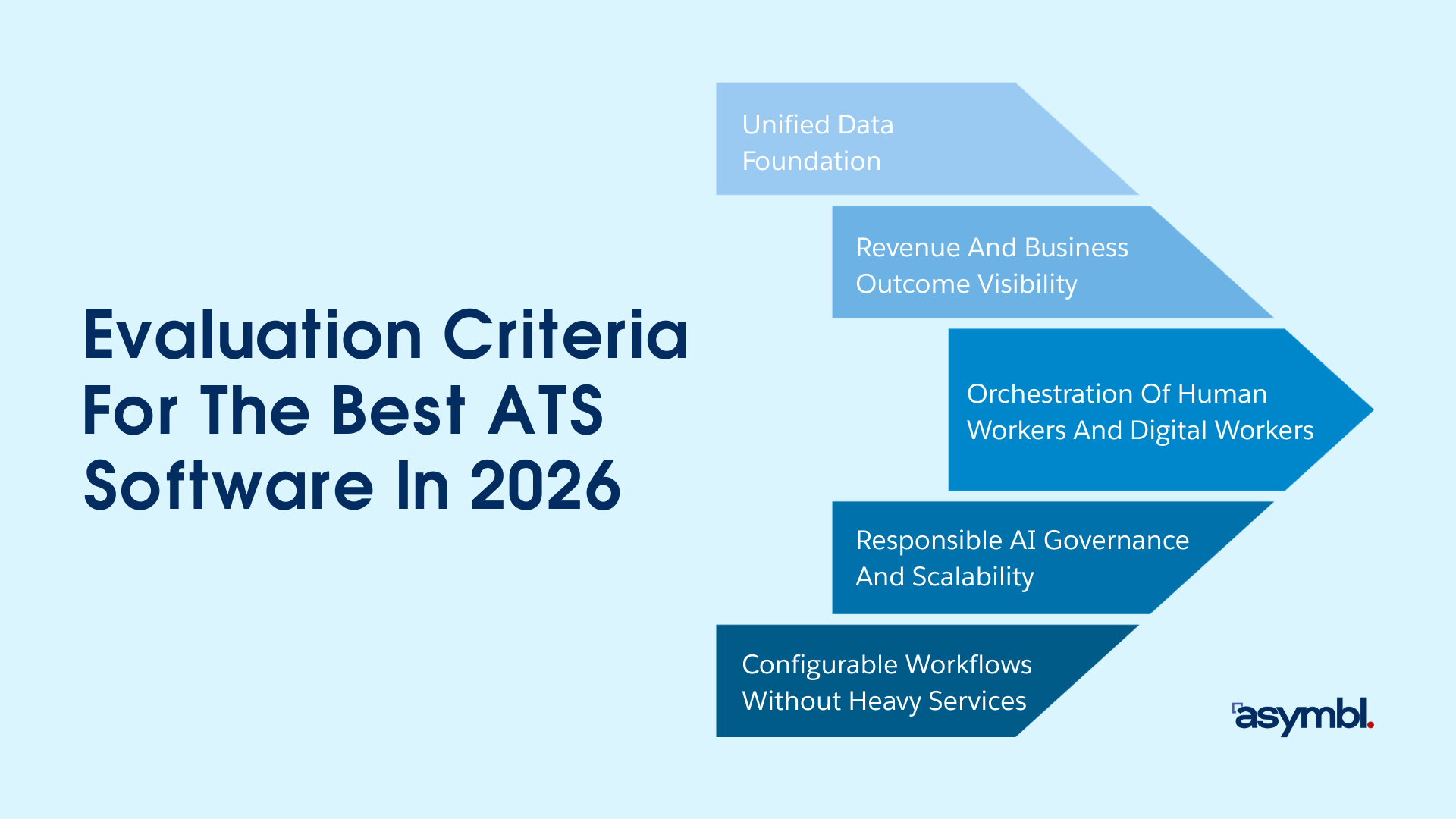
1. Unified Data Foundation
A unified data foundation means recruiting workflows operate inside the same ecosystem as CRM, revenue, operations, and post-hire data. It eliminates swivel-chair workflows and enables measurable impact.
It emphasizes unifying CRM, hiring, and post-hire data on Salesforce to reduce friction and improve visibility. Without a single data layer, orchestration remains theoretical.
What to evaluate :
- Map where candidate, hiring manager, and recruiter data currently lives. Count systems. Identify duplicate fields.
- Ask vendors to show how recruiting data connects to CRM and post-hire systems without custom integrations.
- Validate whether workflows, reporting, and automation operate on a shared object model or through middleware.
- Test a real scenario: Can you trace a hire from the first touchpoint to revenue impact or retention data?
- Confirm whether configuration updates maintain data integrity or create shadow objects and reporting drift.
- Review how automation is powered. Native flow-based automation reduces long-term technical debt.
2. Revenue And Business Outcome Visibility
Recruiting is the starting point for measurable business outcomes, not a transactional workflow. That framing requires dashboards that move beyond time-to-fill. If leaders cannot see impact, recruiting remains a cost center in perception.
What to evaluate:
- Define the business metrics that matter most, such as cost per hire, retention rate, and quality of hire.
- Ask vendors to demonstrate dashboards that connect recruiting activity to those metrics.
- Confirm that reporting is real-time, not batch exported.
- Validate whether recruiter performance and digital worker performance can be measured side by side.
- Ensure forecasting capabilities exist for pipeline health and hiring velocity.
- Stress test reporting by changing a workflow. Confirm dashboards adjust automatically.
3. Configurable Workflows Without Heavy Services
If every change in an ever-evolving recruiting process requires external consultants or custom code, agility slows and cost compounds.
Clicks-not-code configuration and native automation via Salesforce Flows reduce dependency on heavy development. Configuration must empower leaders, not lock them into service cycles.
What to evaluate:
- Ask who owns the configuration post-implementation. Internal admin or vendor?
- Request a live demonstration of modifying a workflow step in real time.
- Evaluate whether approval chains, interview stages, and engagement workflows can be changed without code.
- Review documentation standards for workflow governance.
- Assess how automation logic is structured. Is it transparent and modular?
- Calculate the total cost of ownership, including projected services over three years.
4. Responsible AI Governance And Scalability
AI inside recruiting must be auditable, explainable, and measurable. According to a 2025 McKinsey Report on Empowering People to Unlock AI’s Full Potential, only 1% of C-Suite executives believe their AI investments have reached maturity.
This emphasizes the need for defining roles, governance, KPIs, and structured onboarding for AI agents, which separates scalable digital labor from experimental pilots.
What to evaluate and what to do:
- Ask how AI decisions are logged and traceable.
- Validate whether scoring logic and matching models are explainable.
- Confirm that digital workers have defined roles, KPIs, and escalation paths.
- Evaluate data readiness. Are datasets structured, complete, and governed?
- Review how bias mitigation and compliance controls are enforced.
- Determine whether performance reviews exist for digital workers similar to human workers.
- Assess how new AI use cases are onboarded. Is there a repeatable framework?
5. Orchestration Of Human Workers And Digital Workers
Digital workers handle high-volume execution while human workers focus on trust, judgment, and relationship continuity. This requires orchestrating people and digital workers inside the same system of work. Digital workers must operate inside workflows, not alongside them.
What to evaluate and what to do:
- Identify which tasks are repetitive and high-volume versus relational and judgment-driven.
- Ask vendors to demonstrate digital workers operating inside the same workflow as recruiters.
- Validate how handoffs between digital and human workers are triggered and tracked.
- Confirm that both human and digital productivity metrics appear in the same dashboards.
- Evaluate whether digital workers can be onboarded incrementally without re-architecting the system.
- Ensure recruiters retain control over override decisions and relationship management.
The Shift From Applicant Tracking To Workforce Orchestration
Traditional applicant tracking systems focus on documenting process steps, such as opening a requisition, moving candidates through stages, and closing the role. This model assumes human recruiters perform all work exclusively.
Workforce orchestration reframes recruiting as a coordinated system where human and digital workers operate together inside the same flow of work. The focus shifts from managing tasks to designing roles, establishing governance, and achieving measurable outcomes.
These four disciplines define the difference between adding features and redesigning how recruiting work actually happens.
1. Defining Digital Workers With Role Clarity And KPIs
Digital workers are not generic automation scripts. They are defined roles within your labor pool. We emphasize defining the jobs to be done, motivations, and ownership before you begin onboarding.
A sourcing worker, a screening worker, or a scheduling worker should each have a clear scope of responsibility and measurable performance criteria. This discipline prevents overlap, confusion, and ungoverned automation.
In practice, this means you:
- Define the exact responsibilities of the digital worker, such as screening applications based on your predefined criteria.
- Establish performance metrics, including response time, screening accuracy, or scheduling turnaround.
- Assign operational ownership for performance reviews.
- Document escalation paths for when confidence thresholds are not met.
Without role clarity, technology creates noise. With it, digital labor becomes accountable.
2. Weaving Digital Labor Into Your Core Systems
Digital workers must operate inside the systems where business happens, such as Salesforce. When you onboard digital workers directly into your recruiting technology, you eliminate friction and preserve data integrity.
Operational implications include:
- Digital workers execute tasks inside your primary system, not through disconnected tools.
- Candidate data, communications, and workflow updates are logged on the same data objects for a single source of truth.
- Recruiters see digital actions in context, which removes the need for external dashboards.
- Automation respects your existing approval flows and governance structures.
3. Maintaining Governance And Coaching Loops
Digital workers require structured governance and continuous optimization to scale effectively. This turns your operating expertise into a configurable system of work.
Key elements of orchestration include:
- Defining decision rights between business and technology teams.
- Reviewing logged performance metrics on a recurring cadence.
- Establishing clear ownership for digital worker oversight.
- Creating structured improvement cycles based on performance data.
4. Measuring Impact Through Business Outcomes
Corporate teams traditionally measure stage progression and time to fill. Workforce orchestration measures impact at the business level, connecting recruiting activity to your strategic goals.
Impact measurement should include:
- Hiring velocity correlated with team productivity.
- Fill rate changes driven by digital screening or engagement.
- Capacity gains achieved without increasing headcount.
- ROI calculations tied to reduced cycle time or improved retention.
If your system stops at process metrics, orchestration has not occurred. True success is measured by your ability to grow.
Asymbl Recruiter Suite: Salesforce-Based Workforce Orchestration
Asymbl Recruiter Suite provides the essential foundation for workforce orchestration. It is not a disconnected tool. It operates as a native Salesforce solution that unifies sales, recruiting, and delivery data within a single system of record.
In this environment, candidate activity, hiring decisions, and post-hire impact live on the same data foundation. Digital workers, such as the Asymbl Recruiter Agent, function alongside human recruiters in the same flow of work. This creates a coordinated system where technology and people thrive together.
What Makes It Different
1. Onboarding Digital Workers Like Employees
Corporate teams treat AI as a generic script. At Asymbl, we believe digital workers require the same discipline as human hires. Our Digital Labor framework defines the jobs to be done, motivations, and KPIs before any work begins. Recruiter Suite applies this discipline directly to your recruiting workflows.
Each digital worker operates with:
- A defined scope of responsibility.
- Clear performance metrics.
- Guardrails that control decision boundaries.
- Documented escalation paths.
This approach reduces ambiguity and ensures that automation enhances your execution rather than distorting it.
2. Built-in Guardrails and Governance
Governance is not an afterthought at Asymbl. We embed digital workers within your existing Salesforce workflows where approval paths and role permissions already exist. This ensures that every action is compliant and controlled from day one.
Our governance model includes:
- Transparent logging of every digital action.
- Defined thresholds for automated decisions.
- Role-based access that mirrors your internal security.
- Structured executive oversight.
3. Unified Observability Across the Hybrid Workforce
Recruiter Suite measures both human and digital throughput in a single environment. Since your recruiting operates on Salesforce, your dashboards reflect recruiter activity, digital worker output, and pipeline velocity in one view.
This creates true observability for your leadership:
- Recruiters retain final judgment authority.
- Leaders see exactly how digital workers accelerate the pipeline.
- Performance comparisons remain data-driven rather than anecdotal.
The result is total clarity on how capacity is created and how it translates to business value.
4. Architectural Alignment Over Feature Layering
We designed the Recruiter Suite for orchestration from the start. By operating inside your Salesforce infrastructure, digital workers are woven into the same data objects and logic your recruiters already use. There is no secondary data layer to create drift or confusion.
This architectural alignment delivers structural advantages:
- Reduced operational friction: Recruiters and digital workers operate in the same workflows. This eliminates manual reconciliation and fragmented processes.
- Preserved data integrity: All updates write to the same objects. This prevents duplication and ensures your reporting remains accurate.
- Lower technical debt: Configuration changes occur within a single architecture. This reduces long-term maintenance costs.
- Compounding institutional memory: Data accumulates in one system of record. This strengthens your forecasting and matching accuracy over time.
Asymbl ensures your success is not defined by a go-live date, but by your continuous ability to grow.
2. Hybrid Workforce Orchestration
Hybrid workforce orchestration begins with a disciplined division of labor. This approach forces clarity on which parts of recruiting are execution-driven and which require human judgment. Without this clarity, digital workers either overreach or remain underutilized.
The Hybrid Division of Labor
- Digital Workers: These workers own repeatable, rules-based activities where consistency and speed are the priority. Activities like resume parsing, structured pre-screening, interview coordination, and workflow routing benefit from this reliable execution. These tasks gain accuracy when they are governed within a coordinated system.
- Human Recruiters: Our people should own ambiguity. Recruiters focus on defining success criteria with hiring managers, assessing culture contribution, and navigating stakeholder trade-offs. They protect the candidate's experience during sensitive conversations. These are high-value decisions that cannot be reduced to simple pattern matching.
The Operational Impact of Orchestration
For recruiting teams, orchestration produces measurable outcomes that move the needle for the entire business.
1. Increased Capacity Without Headcount Growth: As demonstrated by our results as Customer Zero, digital labor enabled us to hire 100 people in 100 days with only two recruiters. We increased fill rates and expanded capacity because execution scaled without the need for proportional headcount growth.
2. Measurable Impact Tied to Your Core Data: Orchestration allows leaders to measure recruiter performance alongside sales or delivery outcomes. Since Asymbl is Salesforce-based, you can see the direct ROI from onboarding digital workers in the same environment where your business happens.
3. Faster Hiring Cycles and Elevated Relationships: Digital workers accelerate response times and scheduling. This allows human recruiters to remain accountable for judgment and the quality of the relationship. As Customer Zero, our data shows that digital orchestration helped us achieve a 1,529% ROI while elevating our recruiters rather than replacing them.
4. Disciplined Governance for Enterprise Scaling: Many AI initiatives stall because of fragmented ownership. Asymbl’s Design, Onboard, and Coach framework provides executive alignment before any work begins. We provide defined operating models and structured optimization cycles. This ensures your journey into workforce orchestration remains disciplined, repeatable, and successful.
The best applicant tracking system in 2026 is not defined by resume parsing accuracy or user interface polish. It is defined by architecture.
If your recruiting system cannot unify data, embed digital labor, enforce governance, and connect hiring to business outcomes, it will cap your team’s impact.
Three questions for executive teams:
- Does our recruiting technology create institutional memory across hiring cycles?
- Are digital workers embedded inside our workflow with clear governance, or operating as disconnected features?
- Can we measure recruiting impact on business outcomes, or only track applicants?
The best system answers all three with clarity.
Workforce orchestration platforms such as Asymbl Recruiter Suite were designed around those questions from day one. Book a demo to explore why Asymbl is the right fit for your workforce orchestration strategy.
FAQs
An ATS primarily tracks hiring transactions: requisitions, stages, approvals, and offers. It is built to document the process. A workforce orchestration platform expands the unit of design from stages to roles, handoffs, and accountability across a hybrid recruiting team. In Asymbl language, that means recruiting runs as a coordinated system where human recruiters and digital workers share the same workflow, data foundation, and measurable outcomes, so teams can scale from human-only execution to hybrid execution without losing governance
Salesforce-native architecture changes visibility because recruiting data lives on the same foundation as the systems leadership already uses to run the business. Instead of stitching together ATS, CRM, and post-hire reporting, you can unify CRM engagement signals, hiring activity, and post-hire outcomes so TA and HR leaders can measure impact on revenue, retention, and business outcomes with less reporting lag and fewer “which number is right” debates.
Yes, when they are designed as defined roles with real actions inside the systems where recruiters already work. Asymbl describes digital workers as pre-built agents that can draft, source, screen, schedule, summarize, and coordinate using context from Salesforce and Asymbl Intelligence, so work gets executed in-flow rather than in a disconnected side tool.
It can be, mainly because complexity comes from data mapping, workflow redesign, integrations, and change enablement, not just moving records. The practical way to de-risk it is to treat migration as an operating model project with clear success metrics, phased rollouts, and a plan for data integrity and user adoption.
Governance works when AI is treated as digital labor with explicit ownership, defined performance management, and continuous coaching. In recruiting specifically, that means defining clear KPIs, auditability, escalation paths, and bias monitoring with humans retaining decision authority and providing the coaching loops that keep digital workers from decaying over time
.webp)
Search and Match Recruiting: Search, Match, Redeploy
Intelligent candidate matching goes beyond keywords to signals recruiters can defend to clients. See how AI should search and match candidates to score fit.
The Right Fit Starts With a Conversation.
See what working together could look like.
.webp)