


A recruiter who spends a morning toggling between Boolean strings and LinkedIn tabs already has a full list of candidates. However, they lack a system that turns discovery into a pipeline without a second round of manual work.
Staffing firms measure a sourcing tool based on placements per recruiter and margin protected by filling from the bench instead of sourcing net new. Corporate teams measure it in time to fill and whether the candidate who lost out four months ago ever resurfaces.
In this blog, we will review the leading candidate sourcing platforms, examine whether the sourcing layer belongs outside your system of record at all, and lay out the criteria that actually separate these tools once the demo ends.
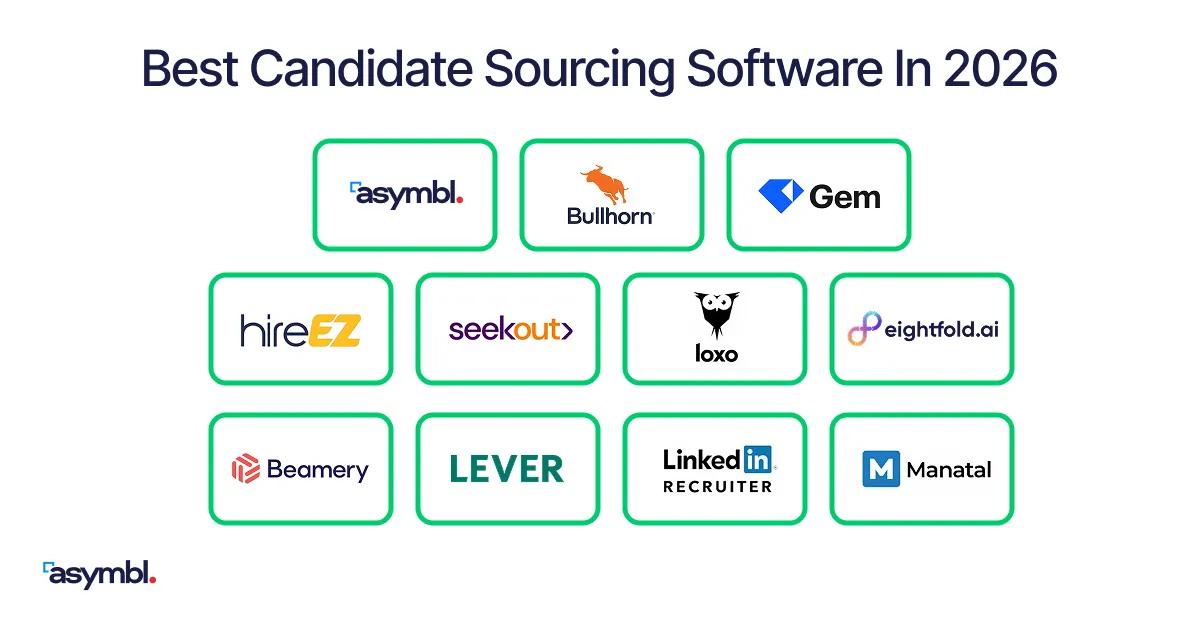
Best Candidate Sourcing Software In 2026
The IBM Global AI Adoption Index 2023 found that HR and talent acquisition ranks near the bottom of enterprise AI priorities, cited as an active use case by only 19% of companies exploring or deploying AI, well behind functions like IT operations and security.
The broader AI adoption gap does not mean recruiting technology has stood still. Candidate sourcing, in particular, has moved beyond basic database search, with platforms now using semantic matching, rediscovery, enrichment, and automated outreach.
1. Bullhorn
Bullhorn is a cloud-based applicant tracking system (ATS) and customer relationship management (CRM) platform that combines candidate sourcing, client relationship management, and placement workflows in one front-office system. The front-office system covers the full placement cycle, with sourcing as one workflow inside it, alongside email and workflow automation.
Bullhorn’s key features:
- AI Search and Match: Pulls candidates from the firm's own database and ranks them by fit against a job order, building searches from the job description automatically.
- Amplify Chat: An AI assistant answers questions about candidates, jobs, and clients from inside the platform using more than ninety prebuilt prompts.
- Unified front office: Candidates, jobs, shifts, and clients run in one system, connecting sales and recruiting on the same records.
- Workflow automation: Automates sourcing follow-ups, interview scheduling, and candidate status updates across the placement cycle.
- Email integration: Parses resumes and logs notes directly from Gmail or Outlook, with two-way tracking of every candidate conversation.
Best for
Staffing firms that want their ATS, CRM, and sourcing search running in one purpose-built front office.
Pricing: Bullhorn offers tiered pricing for staffing firms. Small-agency plans start at $99/user/month (Starter) and $165/user/month (Core), while Pro and Max require quotes. Larger agencies, AI/automation products, and Recruitment Cloud solutions are quote-based, with pricing tailored to company size and functionality.
2. Asymbl
Asymbl is a workforce orchestration company that helps organizations bring human and digital workers together through Recruiter Suite, Digital Workers, and Talent Intelligence. It connects talent, systems, data, and workflows to improve how teams hire, manage, and scale recruiting.
Asymbl’s key features
- Natural language search: Recruiters describe the candidate they need in plain language, and Talent Intelligence returns matches without requiring Boolean query syntax.
- Own-database search: Talent Intelligence scores pipeline history, interview feedback, and assignment outcomes alongside newly discovered candidates, drawing on data that resume text never captures.
- Rosa, Digital Recruiter: Rosa sends personalized outreach at scale, screens responses against role criteria, and moves qualified candidates into the active pipeline.
- Bi-directional Recruiter Suite sync: Matched candidates land directly in pipeline records, and every recruiting signal feeds back into the intelligence model automatically.
Best for
Staffing firms and corporate teams already running, or planning to run, recruiting on Salesforce, where sourcing needs to write directly into the system of record rather than sit beside it.
Pricing: Asymbl’s Recruiter Suite starts at $60/user/month for Launch, $125/user/month for Premier, and custom pricing for Ultimate. Digital Labor Advisory is scoped by phase: Design (60 days), Onboard (3–8 months), and Coach (6+ months). Agentforce packages include Break-Fix at $25K/4 weeks and Jetpack at ~$30K/4 weeks.
3. Gem

Gem is an AI-first recruiting platform that combines applicant tracking, candidate relationship management, sourcing, and outreach in one connected system, covering the hiring workflow from first contact through offer.
Gem’s key features:
- Natural language sourcing: Recruiters describe a candidate in their own language, and the system builds a tailored search across public profiles automatically.
- Real-time multi-channel search: Searches eight hundred million-plus public profiles alongside past candidates already in the connected ATS or CRM.
- Sourcing Chrome extension: Captures candidate profiles with one click from LinkedIn and more than twenty other professional platforms.
- Personalized sequencing: Builds multi-stage outreach that references a candidate's past conversations, interviews, and recent career moves.
Best for
Corporate TA teams that want sourcing, outreach, and pipeline analytics tightly linked in one system, whether layered on an existing ATS or run as the ATS itself.
Pricing: Gem uses custom pricing based on company FTE count for its full platform or ATS integrations. Startup pricing starts at $130/user/month for 1–10 FTEs with annual billing.
4. hireEZ
hireEZ is an AI-powered talent sourcing platform that searches across more than forty-five external sources alongside a connected ATS to surface both new and previously engaged candidates. hireEZ operates as a sourcing layer that sits in front of, and syncs back to, the applicant tracking system a team already runs.
Key features
- AI sourcing across 45+ sources: Searches the open web, deep web, and partner networks in one query, drawing candidates from platforms beyond a single database.
- Rediscovery: Automatically resurfaces past applicants already sitting in the connected ATS who match a newly opened role.
- Deep Search: Expands search parameters when an initial query returns too few strong matches, widening reach without starting over.
- Talent pool segmentation: Groups candidates by likely fit for future roles, with ongoing profile enrichment and engagement scoring.
Best for
Teams that want one search across a wide set of external sources plus their own ATS, without replacing the ATS itself.
Pricing: Custom
5. SeekOut
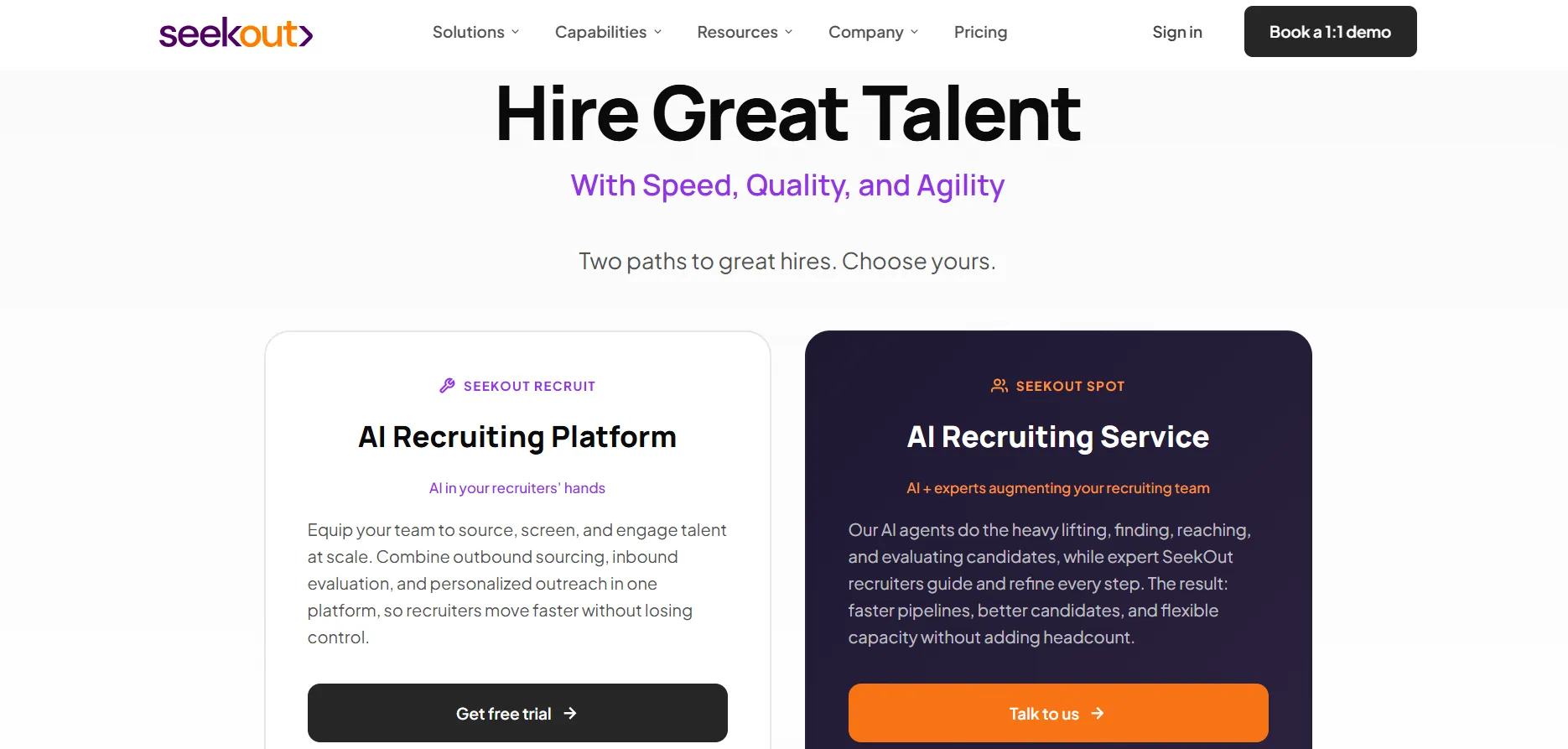
SeekOut is an agentic AI recruiting platform built for sourcing, screening, and engaging technical and hard-to-find talent, searching more than one billion profiles across external sources alongside a connected ATS. The platform is built around deep technical and diversity enrichment for specialized talent pools that are hard to reach through general keyword search.
SeekOut’s key features:
- Intelligent search: Searches more than one billion profiles across external sources and a connected ATS with AI that reads context rather than exact terms.
- AI screening and scorecards: Evaluates inbound applicants against custom rubrics through video interviews, producing reasoning tied to defined criteria.
- Talent Rediscovery: Surfaces silver medalists and past applicants already in the pipeline, scored against the same rubrics as new candidates.
- Personalized outreach: Engages passive candidates with AI-crafted, multi-touch messaging sequences tailored to each candidate's background.
- Talent Insights: Visualizes talent pools and labor market data to inform sourcing strategy and competitive positioning.
Best for
Teams sourcing specialized or technical talent where deep profile enrichment and diversity filtering matter more than search volume.
Pricing: SeekOut offers a 14-day free trial of Recruit Core. Recruit Core costs $179/user/month when billed monthly, or $ 149/user/month when billed annually. Sourcing, Sourcing + Integration, and Full Recruiting Funnel plans use custom, volume-based annual pricing. SeekOut Spot uses per-role, per-contractor, or outcome-based pricing.
6. Loxo
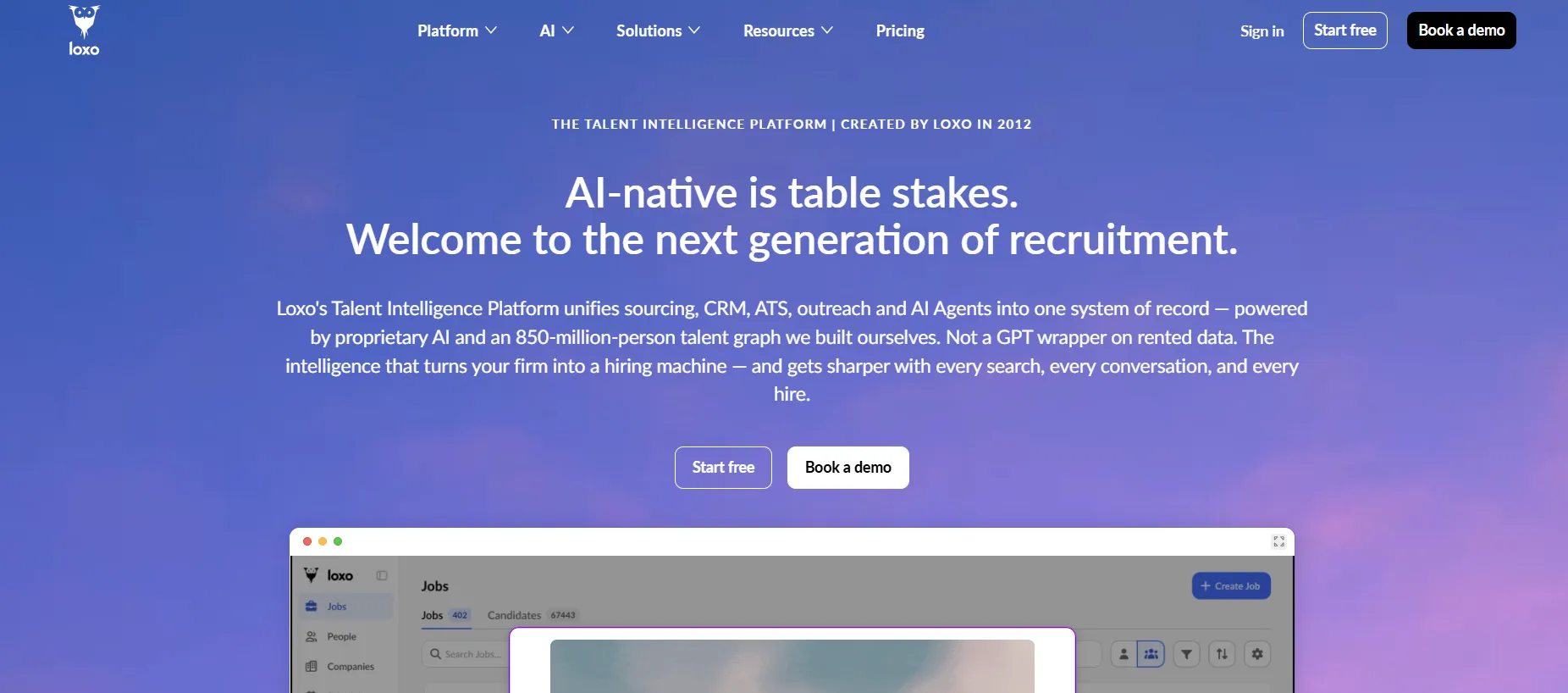
Loxo is an all-in-one recruiting platform combining an ATS, CRM, and candidate sourcing engine in a single system. Loxo Source searches internal relationships and external market data from more than 850 million professionals simultaneously, supporting natural language search, Boolean strings, and advanced filters in the same query.
Loxo’s key features:
- Unified sourcing: Searches internal relationships and external market data from more than 850 million professionals in a single query.
- Flexible search modes: Supports natural language search, Boolean strings, and advanced filters, letting recruiters search however fits the role.
- AI-powered matching: Analyzes candidate profiles and job requirements together to surface the strongest semantic matches first.
- Industry-specific datasets: Provides proprietary datasets for specialized sectors including healthcare, legal, and technology hiring.
- Self-Updating CRM Agent: Continuously verifies and refreshes candidate contact data across multiple sources without manual entry.
Best for
Agencies and boutique firms that want sourcing, CRM, and ATS running in one lighter-weight system built for their workflow.
Pricing: Loxo Core starts at $149/user/month, billed annually. Professional starts at $199/user/month, including the full agentic workforce and 2,500 credits/user/month. Enterprise pricing is custom. A 7-day free trial is available, while credits can be boosted 2×, 5×, or customized for additional capacity.
7. Eightfold
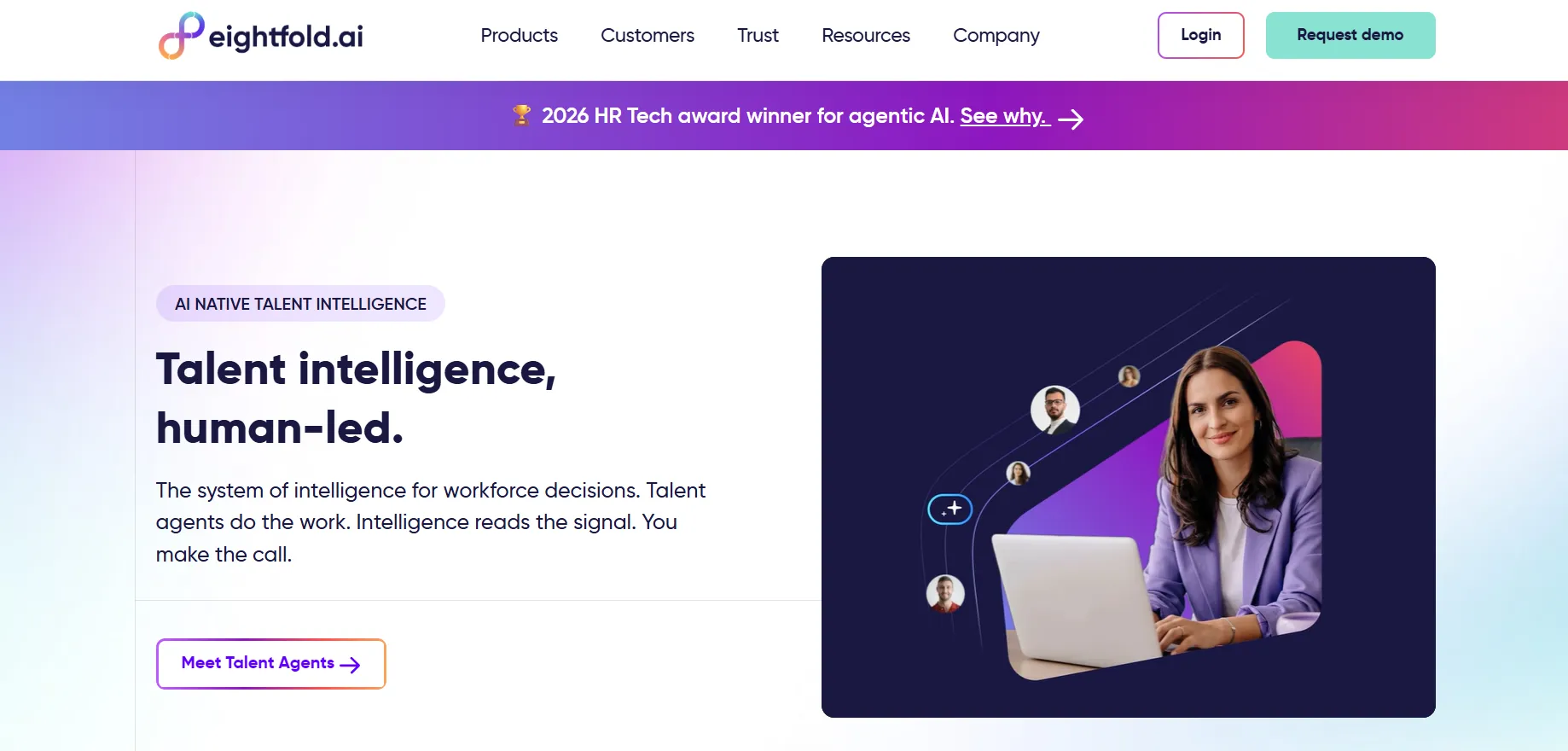
Eightfold is an AI-powered talent intelligence platform for talent acquisition and internal mobility, using deep-learning models trained on a continuously refreshed global data set to match people to roles. The platform covers career sites, requisition management, screening, interviewing, and offers in one integrated experience, with an AI Interviewer that runs structured evaluations across candidates.
Eightfold’s key features:
- Deep-learning candidate matching: Predicts career paths and matches people to roles using AI trained on a continuously refreshed global data set.
- Talent rediscovery: Surfaces past applicants and internal employees who fit a newly opened role, beyond keyword-matched resumes.
- AI Interviewer: Runs structured, multi-round interview evaluations in a single session, condensing what previously took separate rounds.
- End-to-end requisition workflow: Covers career sites, requisition management, screening, interviewing, and offers inside one integrated system.
Best for
Large enterprises that want workforce-wide talent intelligence spanning external hiring and internal mobility.
Pricing: Custom
8. Beamery
Beamery is a talent CRM built for proactive candidate relationship management and long-cycle pipeline nurturing, designed to run alongside an existing applicant tracking system. Ray, Beamery's agentic AI consultant, surfaces context-aware recommendations across the platform and speeds up recruiter workflows.
Beamery’s key features:
- Sourcing and Matching: Applies precision skills matching against open roles to identify qualified candidates from the talent pool.
- Talent CRM: Manages candidate relationships and pipeline nurturing on an ongoing basis, independent of any single open requisition.
- Talent Marketing: Delivers targeted, timed messaging campaigns to keep passive candidates engaged until a role opens.
- Career sites and chatbot: Engages candidates browsing a company's own job listings with AI-powered conversational responses.
Best for
Teams that want a dedicated relationship layer for long-cycle nurture and talent pooling ahead of a role opening.
Pricing: Custom
9. Lever
Lever is a recruiting platform that combines an applicant tracking system and candidate relationship management in one system. Native integrations connect the platform to a human resources information system (HRIS), assessment tools, and background check providers.
Lever’s key features:
- AI-powered screening: Surfaces best-fit candidates from inbound applications automatically, reducing time spent reviewing resumes manually.
- Candidate relationship management: Nurtures passive candidates and re-engages past applicants inside the same workflow as active pipeline management.
- Fraud detection: Layered safeguards flag identity mismatches and resume conflicts before a candidate reaches the hiring team.
- Workflow automation: Runs admin tasks, scheduling, and follow-ups on automation so recruiters spend less time on coordination.
- Native integrations: Connects to HRIS, sourcing, assessment, and background check tools to link recruiting with the rest of human resources.
Best for
Mid-market teams that want ATS and CRM functions unified without a heavier enterprise platform underneath them.
Pricing: Custom
10. LinkedIn Recruiter
LinkedIn Recruiter is a candidate search and outreach product built on top of LinkedIn's professional network, giving recruiters advanced filtering, InMail messaging, and recommendation tools across the platform's member base.
LinkedIn Recruiter’s key features:
- Advanced search filters: More than forty filters including title, location, skills, and proprietary signals like Open to Work status.
- AI-assisted recommendations: Surfaces candidates through engines like People You May Want to Hire and Similar Profiles, improving with usage.
- InMail messaging: Sends direct messages to candidates outside a recruiter's existing network, with response rates the platform reports as notably higher than standard email.
- Usage reporting: Provides InMail send, acceptance, and response rate data alongside broader recruiting activity trends.
Best for
Any team that needs reach into the largest actively maintained professional network available.
Pricing: Not available
11. Manatal
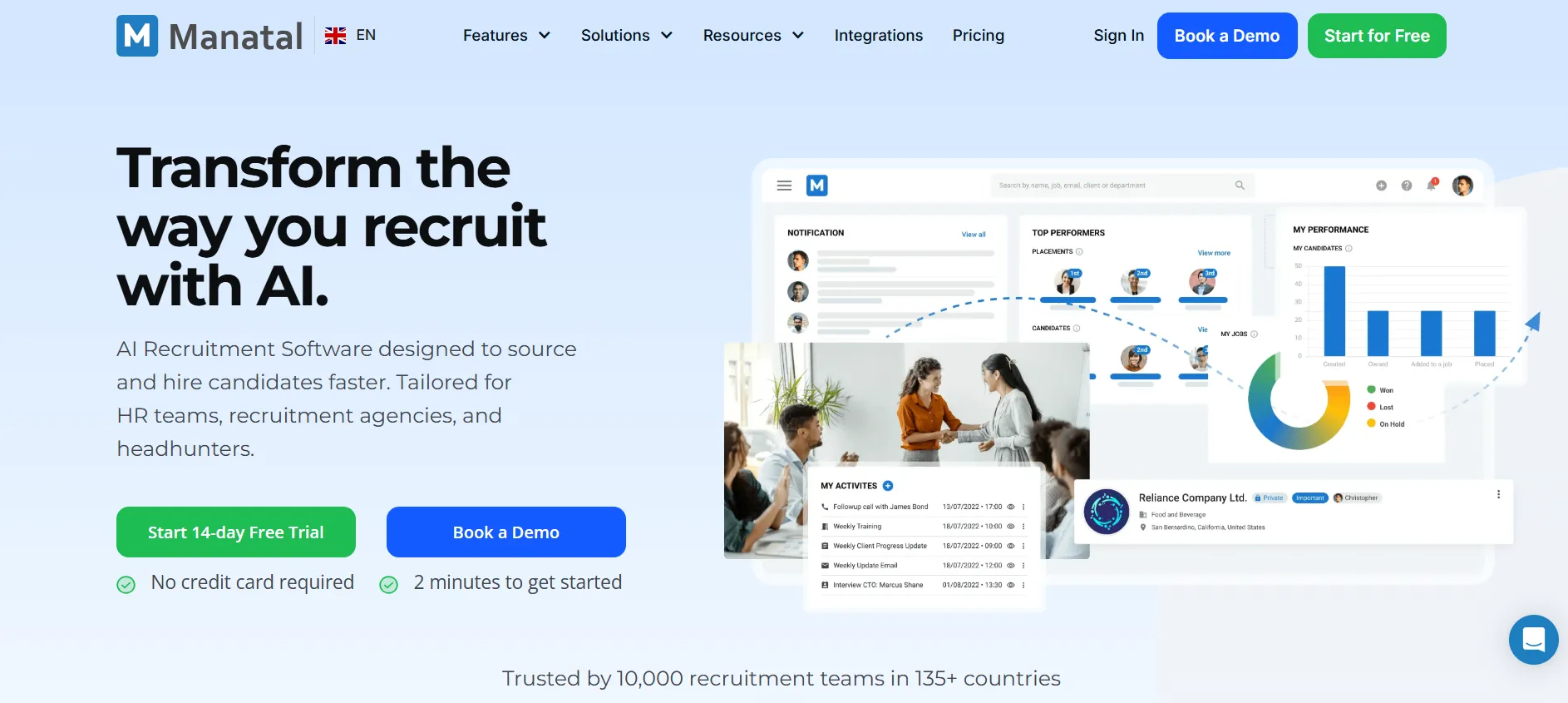
Manatal is a cloud-based applicant tracking system and recruitment CRM that combines candidate sourcing, pipeline management, and AI-assisted screening in one platform. Manatal sources candidates directly from LinkedIn, major job boards, and referrals inside the same interface used to manage the pipeline, with a mobile app extending access across devices.
Key features
- Multi-channel sourcing: Sources candidates directly from LinkedIn, major job boards, and employee referrals inside one interface.
- AI Advanced Search: Combines semantic search with Boolean filtering and relevance scoring to surface matches beyond exact keywords.
- AI Candidate Enrichment: Builds fuller candidate profiles using data drawn from beyond the resume itself.
- Drag-and-drop pipeline: Visualizes candidates across customizable hiring stages in kanban or list view for quick screening.
- Broad integrations: Connects to major job boards, HRIS and payroll systems, and collaboration tools including Zapier and Microsoft Teams.
Best for
Small and mid-sized agencies and in-house teams that want an affordable, all-in-one ATS with sourcing built in.
Pricing: Manatal offers three main plans: Professional at $19/user/month, Enterprise at $39/user/month, and Enterprise Plus at $59/user/month. A Custom Plan is available on demand. The AI Interviewer is an add-on, while all plans include core AI features and a 14-day free trial.
Should The Sourcing Layer Sit Outside Your System Of Record
Some platforms are built mainly to find candidates and pass them along, while others can take that work further because sourcing is already part of the system recruiters use to manage candidates, clients, and jobs.
So the bigger question is whether you need a separate sourcing tool in the first place, or whether your core platform should handle it.
1. Why Teams Buy A Separate Sourcing Tool In The First Place
ATS platforms process candidates who already applied: they track status, manage interviews, and generate offers. Sourcing software helps to reach candidates who never applied and, in most cases, never intended to. Staffing firms buy sourcing tools to keep the desk fed when the bench could not cover a requisition.
A job order comes in, the bench gets checked first, and when nobody on the bench fits, sourcing finds the candidate who protects the placement. Corporate teams buy sourcing tools for a different reason. Passive candidates are the only route to roles that inbound applications could not fill, and a platform that only processed who showed up had no way to reach the much larger group who did not.
2. What The Second Layer Costs In Sync, Seats, And Duplicate Outreach
A second sourcing layer costs money in seats, time in reconciliation, and trust in duplicate outreach, and none of the three show up as a single line item anyone reviews before renewal.
Seats are the most visible cost. LinkedIn Recruiter alone runs roughly eleven to thirteen thousand dollars a year per corporate seat, which sets a ceiling on how many people in an organization can source at all.
Sync is the cost nobody budgets for. A sourced profile has to travel from the sourcing tool into the system of record before it counts as pipeline. What typically lands is a name and a resume.
The reasoning behind why the tool surfaced the candidate rarely makes the trip, so the recruiter who picks up the record downstream has to reconstruct the thinking a second time.
Duplicate outreach is the cost candidates notice. Two systems with overlapping records are how a candidate already in a live process gets a cold outreach message, or how someone rejected six weeks ago gets sourced again as if the firm has no memory of them.
For staffing firms, this shows up directly on recruiter-level revenue, where a second license per producing recruiter is a straight hit to margin per head. For corporate teams, the cost shows up in candidate experience and in a compliance record now split across two systems instead of one.
Asymbl's Talent Intelligence exists specifically for firms in that position, already paying separately for a different tool to do matching that could run inside Recruiter Suite, the system they use every day.
This capability exists within the Recruiter Suite and removes the need for a second license, the sync gap, and the duplicate-outreach risk in the same move.
3. When A Separate Layer Is Still The Right Answer
A separate sourcing layer earns its cost under three conditions, and all three describe a talent pool the system of record was never going to reach on its own.
- Genuine net-new demand: A role the organization has never hired for before, in a function or seniority level with no history in the database to draw on.
- A database too small or too stale to hold the answer: Common in early-stage companies or in functions a firm has only recently started hiring for at volume.
- A population that lives somewhere a system of record has no reason to visit: Engineers who surface on developer platforms and open-source contribution graphs rather than LinkedIn, or specialists concentrated in communities a generalist ATS was never built to index.
The second layer earns its cost when it produces candidates the internal record could never have surfaced on its own. Re-finding people the organization already knows, screened, and forgot how to search for is a different outcome, and it does not justify the same renewal.
How To Evaluate Candidate Sourcing Software
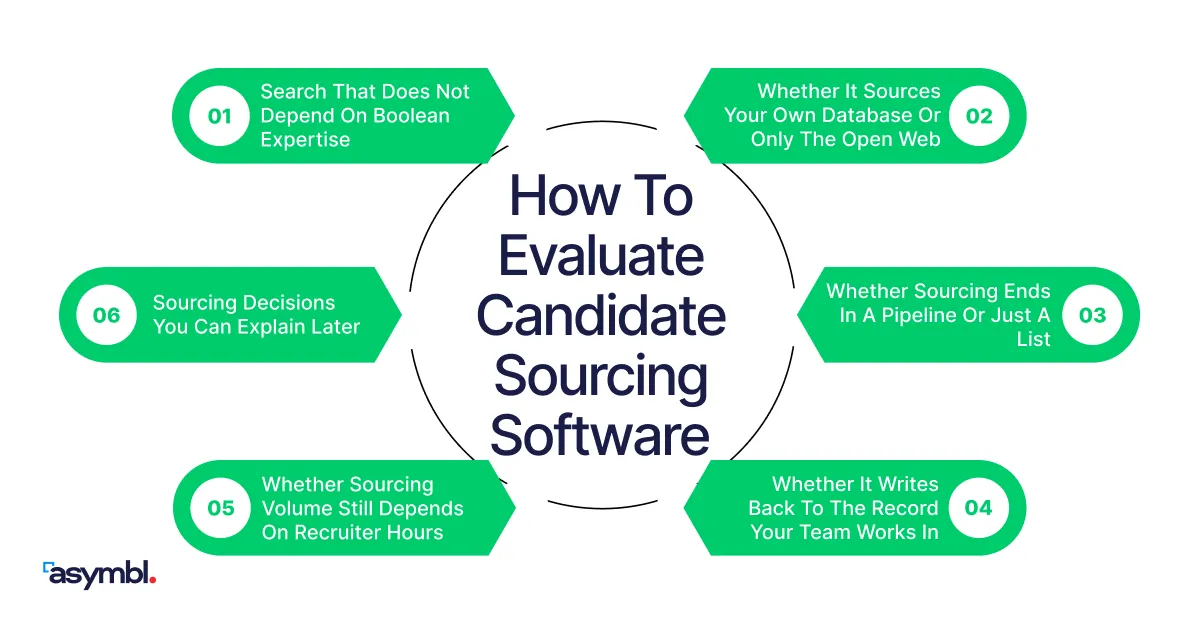
A long list of features does not necessarily make one sourcing platform better than another. Look at the stages of sourcing your recruiters spend the most time on, then see how well each platform handles those tasks from search through outreach and follow-up.
1. Search That Does Not Depend On Boolean Expertise
Have the vendor run a plain-language search from someone on the team who does not write Boolean, then have your best sourcer build the same search properly, and compare the two result sets side by side.
Boolean search returns literal matches and has no concept of adjacency or context, and it misses every candidate whose title does not match the vocabulary written into the string.
Semantic search improves on that by reading intent instead of exact terms. A reasoning engine goes further still, evaluating a candidate's fit the way an experienced recruiter would, weighing background and trajectory rather than matching fields to fields.
Sourcing capability that depends on Boolean expertise is capped by how many people on the team actually have that skill, which turns a tool purchase into a hiring bottleneck.
2. Whether It Sources Your Own Database Or Only The Open Web
Does the tool search a firm's own database, or only the open web? The answer decides whether the fastest, cheapest hire on the list ever gets found.
During the demo, have the vendor search your own candidate records instead of their index. Ask whether it can reason across pipeline history, interview feedback, and prior outcomes, or whether it only reads resume text the way a parsing engine would.
The cheapest and fastest placement available to any team is a candidate who has already been vetted, interviewed, and in some cases placed before.
- Redeployment and rediscovery protect margin directly: Re-engaging a proven candidate costs a fraction of net-new sourcing and reads to clients as lower risk than an unfamiliar name.
- A firm sourcing externally for a role its own bench could cover is paying twice for the same outcome.
- Silver medalists, prior applicants, and referral pools already chose to engage the employer once. Most of them are never surfaced again, because nothing in the stack can find them on anything but an exact keyword.
Asymbl's Talent Intelligence scores pipeline history, interview feedback, and assignment outcomes alongside new discovery, so a silver medalist from eight months ago surfaces in the same search as a candidate found today, ranked by the same fit criteria.
3. Whether Sourcing Ends In A Pipeline Or Just A List
Discovery is the easy half of the job. Qualifying, contacting, following up, and moving a person into an active process consumes the major part of a recruiter’s day, and a tool that stops at the list leaves every bit of that work with the recruiter who was supposed to be freed up by it.
Staffing firms should measure how fast a search becomes a submittal, since that gap is where placements are won or lost against a competing firm working the same job order.
Corporate teams should measure whether a sourced candidate enters the same process as someone who applied directly, or runs in a separate track that reporting never reconciles with the rest of the funnel.
4. Whether It Writes Back To The Record Your Team Works In
Ask three questions before committing to a platform:
- What data flows back to the system of record, in which direction, and how often?
- What happens when the two systems disagree about a candidate's status?
- Who owns resolving that conflict when it happens on a Friday afternoon with a client waiting?
A name, a resume, and an email address are usually updated. The reasoning behind why the candidate was surfaced, the fit score, and the search context that produced the match generally do not, which means the recruiter picking up the record downstream has to reconstruct the thinking from nothing.
Field mapping, duplicate-record rules, and ownership conflicts between two systems result in ongoing maintenance, and a connector that needs revalidating with every vendor release becomes a standing line item for a small operations team that was never consulted on the original purchase.
5. Whether Sourcing Volume Still Depends On Recruiter Hours
Ask how many candidates one recruiter can source, contact, and follow up with in a week using the tool, and ask whether that number changes as the volume increases.
Better search makes each of those hours more productive, but the hour stays the unit of capacity the whole system runs on. A team that doubles its requisition load on flat headcount needs sourcing volume that stops scaling with recruiter time altogether.
Personalized outreach running at scale, candidate questions answered around the clock, and follow-up sequences that run without a recruiter sitting in the middle of every exchange describe a digital worker owning structured execution.
Rosa, a Digital Recruiter, reviewed 17,000 applications, pre-screened 1,800 candidates, and scheduled 800 interviews at a volume no human team could match on its own, supporting 100 hires in 100 days with a two-person Asymbl recruiting team.
6. Sourcing Decisions You Can Explain Later
Ask the vendor to show why a specific candidate was ranked where they were, in the actual demo, against a real role, then ask whether that reasoning is recorded so that a recruiter can retrieve it six months later, or whether the score exists for a moment and disappears the instant the next search runs.
Staffing firms present candidates and the client makes the final call, so the exposure from an unexplainable ranking is mostly commercial and reputational, and a client who stops trusting the shortlist stops calling.
Corporate teams make the hiring decision themselves, which makes bias mitigation, regulatory compliance, and data security binding requirements for the tool from the start.
A Q1 2025 Gartner survey of 2,918 job candidates found that only 26% trust AI to evaluate them fairly. A ranking nobody in the organization can explain will not close that gap.
Choose Sourcing Software That Fits Your Recruiting Workflow
Candidate sourcing either writes into the system your team already works in, or it hands back a result your team has to carry the rest of the way alone.
Every search after that either repeats the cost or compounds the value. A tool that reaches outward and stops at a list adds a reconciliation project to every search, paid for in recruiter hours nobody tracks as a cost.
A layer that runs on the record turns the same search into a pipeline with the reasoning still attached, searchable the next time a similar role opens.
The next renewal conversation is the moment to test which one your team actually has, against a live search rather than a sales deck.
Asymbl runs sourcing inside Recruiter Suite, so a candidate found through Talent Intelligence lands directly in your pipeline instead of a list waiting to be reconciled.
If you want to see what that looks like against your own database, book a demo with Asymbl.
.webp)
IT Talent in the AI Era: Which Skills Matter Now?
IT talent skills are shifting faster than keyword matching can track. See how capability-level evaluation changes staffing placement outcomes.

The Right Fit Starts With a Conversation.
See what working together could look like.
.webp)