
10 Contract Staffing Software Features That Protect Margin

In Short
Contract staffing software is the system a staffing firm uses to manage contractors past the start date. It connects recruiting with assignments, timesheets, rates, and billing, so firms protect margin on every billed hour. Most recruiting tools stop at the placement record, leaving time, placements, and billing in separate systems. Asymbl Recruiter Suite and Asymbl Time keep placement and time data together, alongside existing payroll and billing providers. Recruiters see when contractors are wrapping up assignments, and leaders see gross profit by recruiter and team.
Introduction
A contractor sitting between assignments is revenue walking away. Most staffing firms with a contract book have lived some version of it. An assignment ended last Friday, and no one had a new role lined up. A contractor calls about a short paycheck, and the recruiter starts chasing timesheets.
Contract staffing software is the system a staffing firm uses to follow talent past the start date. It connects recruiting with the assignments, hours, and billing that come after placement. Permanent placement earns a one-time fee. Contract revenue recurs with every hour worked, so the work keeps going long after the start date.
Most recruiting tools were built to move talent toward a placement record. After that, time lives in one system, placements in another, and billing in a third. Billing cycles slip, and leaders can't see which clients are most profitable.
The right platform keeps placement and time data in one place, so your team can act before payroll locks.
In this blog, we cover why contract staffing needs more than recruiting software and the 10 features to look for. We also compare five platforms and show how to choose one built for long-term growth.
Why Contract Staffing Requires More Than Recruiting Software
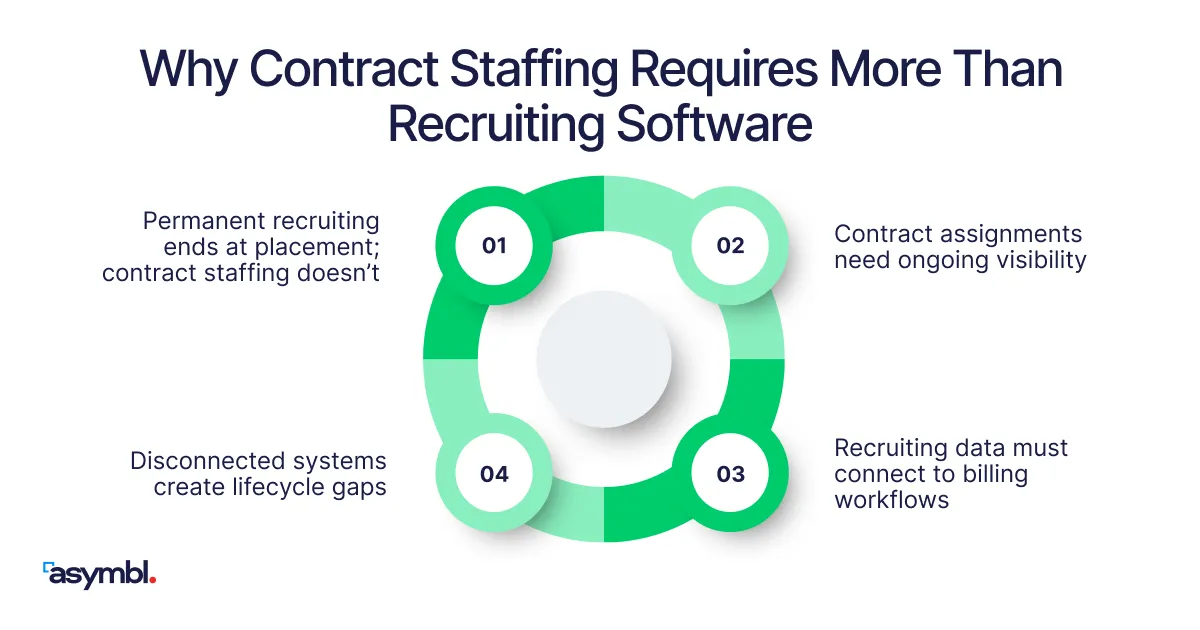
Contract staffing needs more than recruiting software because your firm earns revenue after placement, one billed hour at a time. Most recruiting tools stop tracking the contractor where those billed hours begin. Whatever fills that gap decides how much margin you keep.
1. Permanent recruiting ends at placement, while contract staffing continues
Permanent recruiting closes when the talent accepts the offer. Contract staffing opens a working relationship that lasts as long as the assignment.
A permanent fee is a one-time percentage of first-year salary. Nothing recurs, so the recruiter moves on to the next search. In contract staffing, your firm employs the worker and bills the client a markup on every hour worked. Revenue keeps arriving only while the contractor keeps working and the timesheets keep moving.
After the start date, three events can change any assignment:
- Extensions, when the client wants to keep the contractor longer
- Mid-project swaps, when the client asks to replace someone
- Temp-to-hire conversions, where the fee usually drops the longer the assignment has run
Contract recruitment software has to support recruiting activity and the operational work that follows each placement. With both in one record, your team can act on an extension or conversion the day it comes up.
2. Contractor assignments require ongoing operational visibility
Every active assignment needs someone watching its dates, status, and client, since each one changes while the contractor works.
For every active assignment, your team needs to see:
- Start and end dates
- Placement status and what the client expects next
- Which contractors are becoming available
- Which assignments could extend
Without that view, problems surface late.
An accounting contractor finishes a quarter-close engagement two weeks early. The client told the account manager, and the recruiter never heard about it. Or a client wants to extend a developer for another quarter, and the request waits in someone's inbox for days. Each miss costs you an extension, a redeployment, or some of the client's confidence.
Contract staffing software should show what happens after placement, so your team acts on an ending assignment weeks ahead. Start date, extension, and redeployment all belong in the same view.
3. Recruiting data must stay connected to assignment and billing workflows
Recruiting data has to follow the contractor into assignment and billing work. The details captured before placement shape everything after it.
The recruiter's notes, the contractor's skills, and the client's requirements set up the assignment. Rates, timesheets, and billing records then show what that assignment earned. Read together, these records explain which placements make money and why.
When recruiting, operations, and finance each keep their own copy, the records stop matching. An agreed bill rate appears in the recruiter's notes, and a different number lands on the invoice. Finance then can't reconcile what the firm invoiced, what it paid, and what the applicant tracking system (ATS) shows. The workaround becomes spreadsheets and Friday afternoon reconciliation calls.
Connected contract staffing software keeps one version of each record from first conversation to final invoice.
4. Disconnected systems create gaps across the contractor lifecycle
Disconnected systems create gaps at the moments that decide contract margin: the handoffs between recruiting, assignment work, and billing.
Many firms run an ATS, a separate contractor management platform, and a payroll or billing provider, with spreadsheets in between. Most staffing software grew out of point solutions that no one built to work together. Each tool works fine on its own. The trouble shows up between them.
The same problem shows up across industries. According to the 2025 IBM CEO Study, half of chief executive officers (CEOs) report piecemeal, disconnected systems from rapid investment. In a contract business, those disconnects land on the handoffs after placement.
In a contract business, the gaps show up in the same places:
- Talent history doesn't connect to assignment performance, so recruiters can't recall who did well with which client.
- Availability updates don't reach recruiting or sales, so a contractor rolls off before anyone pitches them elsewhere.
- The bill rate in the recruiter's notes doesn't match the invoice, so finance reconciles by spreadsheet.
Contractor lifecycle management depends on those handoffs working every time. A connected contract staffing platform closes the gaps by keeping recruiting, assignment, and operational data together.
The Key Features Staffing Firms Need in Contract Staffing Software
Closing those handoff gaps comes down to what the software tracks after placement. Feature lists across contract staffing agency software look similar, which makes vendors hard to tell apart in a demo. The useful test is whether each capability still works once a contractor is on assignment.
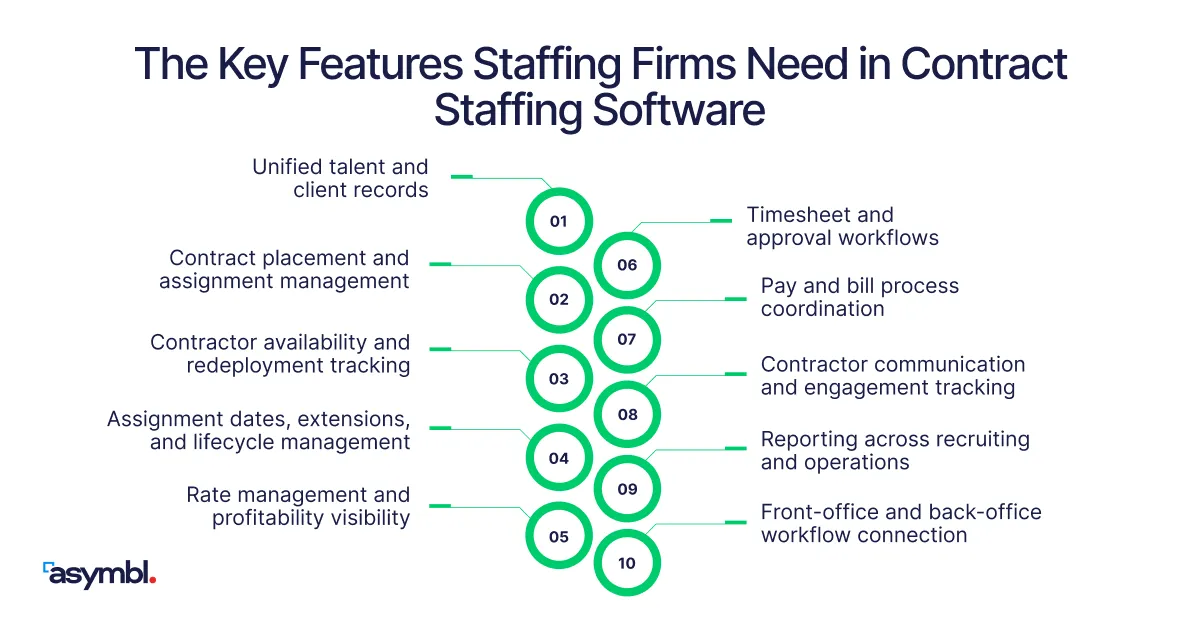
1. Unified talent and client records
Unified records put each contractor's history and each client's history in one connected view your whole team shares.
A talent record should hold skills, recruiting history, availability, communication history, and every previous assignment. A client record should show requirements, order patterns, and account history. Linked together, the two records show which contractors performed well at which clients.
A recruiter filling a new Java developer req can see who finished strong at that client last year. When a recruiter changes firms, the relationships stay in the record. Your firm keeps the talent network it spent years building.
Look for a contract staffing ATS and customer relationship management (CRM) system that share one record. Sales and recruiting then see the same client context, which means more repeat placements and faster redeployment.
2. Contract placement and assignment management
Contract placement software keeps tracking the placement after the contractor starts, so the record stays current throughout the engagement.
A live assignment record should hold
- Start and end dates, status, client requirements, and contractor details
- Mid-engagement changes, such as a new client contact or a revised schedule
- Onboarding and compliance documents, attached to the assignment they support
- A separate record for each placement when a contractor works two at once
Some contractors work two placements at once, so the software should track each one separately. Assignment management software that stops at the placement record pushes ops teams back into spreadsheets.
With live assignment data, your team can answer a client's question about any contractor in one lookup. Account managers walk into renewal conversations knowing exactly who is placed, where, and until when.
3. Contractor availability and redeployment tracking
Redeployment tracking shows when each contractor becomes available and which open roles they fit. You fill new reqs from talent you already know.
A contractor finishing an assignment is a known quantity. You've seen their work, the client feedback, and how they handle a ramp-up. Placing them again costs less than sourcing someone new, and it keeps their hours billing.
Contractor staffing software should surface end dates, recent assignment performance, and skills against your open pipeline. Recruiters then see who is ready to redeploy two weeks before the assignment ends. Redeployment becomes a team process, visible to everyone working the account.
Talent Intelligence, the reasoning engine inside Recruiter Suite, highlights top talent across available, in-contact, and prior placement pools. Recruiters see proven contractors before they open a new search.
Clients notice the difference. The firm that offers a proven contractor first often wins the next req, so sourcing starts with your own database.
4. Assignment dates, extensions, and lifecycle management
Lifecycle management tracks every assignment milestone, so extensions, renewals, and early endings reach the right person before they become problems.
Contract assignments rarely end on the date in the original agreement. A client extends a finance contractor through audit season. A software project wraps a month early when the client's budget changes. Each change affects pay, billing, and who's available next.
Software should flag upcoming end dates and open extension conversations with enough lead time to act. Ask vendors how the platform tracks assignment end dates and extensions, and who gets notified.
Earlier notice gives account managers time to propose an extension and recruiters time to line up the next role. Clients get continuity, and your firm avoids a gap in billed hours.
5. Rate management and profitability visibility
Rate management connects pay rates and bill rates to each assignment, so leaders can see the margin every placement earns.
Contract profitability is the spread between what you pay the contractor and what you bill the client. Overtime, mid-period rate changes, and burden costs all change that spread. When rates live in a spreadsheet, nobody sees margin until the invoice goes out. By then, a rate error has already reached payroll and the client.
Connected rate data shows gross profit by client, recruiter, and assignment as work happens. Leaders can spot an underpriced account or a recruiter whose placements earn below target.
Renewal conversations then start from documented margin data. You can raise a bill rate, adjust a markup, or walk away from an account with the numbers in hand.
6. Timesheet and approval workflows
Timesheet and approval workflows move hours from the contractor to the client approver and to payroll in one tracked process.
Timesheets decide whether the contractor gets paid correctly and whether the client gets an accurate invoice. A late approval delays both. Most staffing firms know the Friday chase. Recruiters email client supervisors, hunt for missing hours, and field calls about short paychecks.
Staffing timesheet software should include:
- Time entry from any device
- Automatic routing to the right approver, with status visible at every step
- Bulk approvals, so a client supervisor can sign off on dozens of contractors at once
- Audit trails on every change and rejection, which protect you when a client disputes hours
Contract staffing software with timesheets and approvals built in puts hours where recruiters can see them. Contractors get paid on time, and clients receive invoices that match the approved hours.
Asymbl Time is a Salesforce-based time tracking application built alongside Recruiter Suite, Asymbl's Talent Relationship Management software for staffing firms.
Placement data and time data live together, so a recruiter fielding a pay question has the answer in one place.
7. Pay and bill process coordination
Pay and bill coordination moves approved assignment data into payroll and invoicing accurately, with as few manual handoffs as possible.
- Recruiting sets the rates.
- Operations confirms the hours.
- Payroll and billing teams turn both into a paycheck and an invoice.
Each handoff is another chance for a number to change. Firms often carry payroll for weeks before client payment arrives, so a delayed invoice hits cash flow directly.
Many firms keep their existing payroll and billing providers and need the front office to feed them clean data. Pay and bill software for staffing should receive placement, rate, and time data it can process without rekeying. Ask whether the platform works with your current providers or requires you to switch back-office systems.
The strongest setups reconcile placement, time, and billing data before payroll runs.
Asymbl Time fits that setup. It works with a wide range of payroll and billing providers, so you keep the back-office tools you already have.
8. Contractor communication and engagement tracking
Communication tracking keeps every contractor conversation, assignment update, and future opportunity in one shared history.
Contractors stay in your network between assignments, and the next placement often depends on who stayed in touch. A shared communication history shows the last check-in, the last assignment update, and what the contractor said they want next. Any recruiter can pick up the relationship without starting over.
Automated reminders can handle routine touches, such as timesheet alerts and mid-assignment check-ins. Recruiters then spend their time on the conversations that lead to the next placement.
A contractor a month from finishing should hear from you before a competing firm calls. A contract recruitment CRM that logs communication history automatically makes that outreach timely and informed. Relationship continuity improves the contractor experience and keeps your redeployment pipeline full.
9. Reporting across recruiting and operations
Cross-functional reporting connects recruiting activity to operational outcomes, so leaders see which recruiting decisions produce billed hours and margin.
Recruiting reports usually stop at submittals and placements. Operations reports cover active assignments and hours.
A COO needs both in one view to answer questions like:
- Which recruiters place contractors who get extended?
- Which clients stay profitable after pay and burden?
- Why do one recruiter's placements extend while another's end early?
Leaders can then coach recruiters, reprice accounts, and plan recruiter capacity from the same numbers finance uses.
10. Front-office and back-office workflow connection
Front-office and back-office connection means a placement confirmed in recruiting immediately updates operations and feeds billing.
Sales and recruiting own the client relationship and the placement. Operations and finance own the hours, pay, and invoices. When the two sides run separate systems, someone keys in every placement twice. Each re-entry adds delay and another chance for error.
Few businesses have closed that gap, even at the operations level. According to the 2025 IBM COO Study, only 19% of COOs have fully built a data architecture that enables integrations across all functions.
Front office and back office staffing software should share one data foundation, even if payroll runs elsewhere. Sales can see which clients need more contractors. Recruiting can see who's coming available, and finance can check billing against approved hours.
Contract Staffing Software Platforms for Staffing Firms
Front-to-back connection is the hardest feature to judge in a demo, since every vendor shows a clean placement screen. The platforms below start from different places, including CRM, recruiting, and pay and bill. Where each one starts shapes how far your contract data travels before someone rekeys it. This comparison covers Salesforce-based staffing platforms and all-in-one staffing systems, the two setups contract staffing firms most often weigh when they want placement, time, and billing data connected.
A note on transparency: Asymbl publishes this comparison and is included within it. Every platform is assessed against the same criteria.
1. TargetRecruit
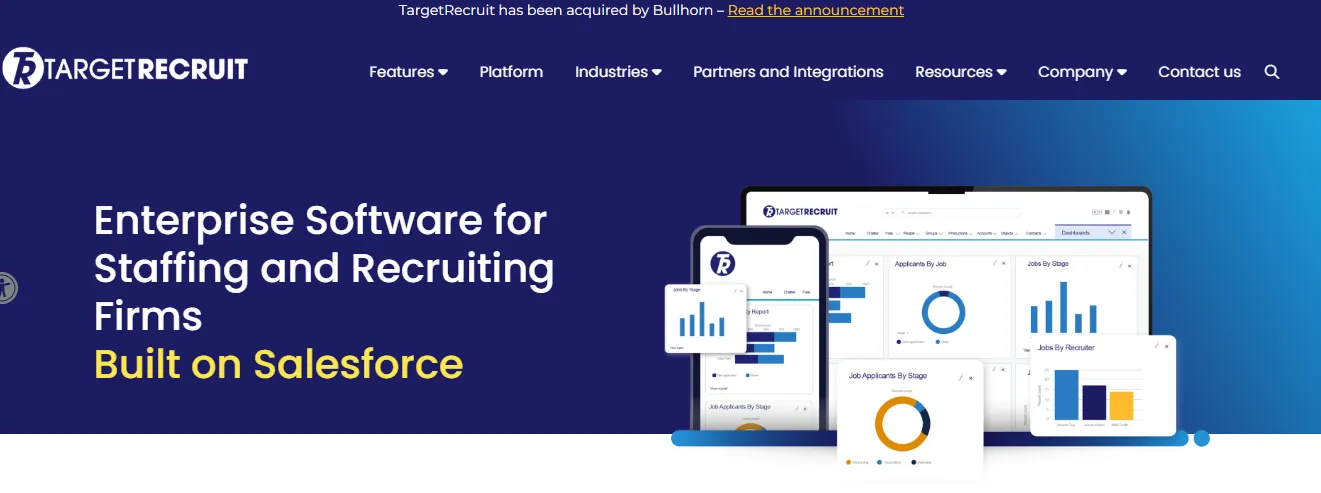
TargetRecruit is staffing and recruiting software sold as a Salesforce AppExchange app. It brings front-office, middle-office, and back-office work into one system. Staffing firms use it to run recruiting, placements, time capture, and pay and bill for contract workers. Its industry focus includes commercial and professional staffing.
Note: Bullhorn has acquired TargetRecruit, and the product is now part of the Bullhorn portfolio. The software suits firms that want recruiting and financial data stored together.
Key features:
- Automatch: Matches talent to jobs and jobs to talent automatically as new records arrive. Recruiters see likely fits without running manual searches.
- Rate Cards and Rate Rules: Configures position-based rates with future-dated and mid-week rate changes. Rate Rules handle pay scenarios such as Fair Labor Standards Act (FLSA) requirements.
- Time capture: Collects hours through a white-labeled Timesheet Portal, vendor management system (VMS) feeds, or time clocks.
- Automated invoicing: Splits invoices automatically and supports reverse billing, VMS and managed service provider (MSP) programs, sales taxes, discounts, and rebate accruals.
- Deal Sheets and margin tracking: Calculates assignment costs such as orientation, per diems, and taxes. Tracks actual versus expected margins on each placement.
Best for: Firms already working in Salesforce that want rates, time capture, and invoicing tied to their recruiting records.
2. Asymbl
Asymbl builds staffing software for professional and commercial staffing firms that place contract and temporary talent. The software connects recruiting, placement, and time tracking. Contract data stays in one place from first outreach to the final timesheet. Its staffing products include Recruiter Suite, a staffing ATS, and Asymbl Time, a time tracking application. Asymbl focuses on the staffing firm's front office, where sales and recruiting work from the same data. Firms keep the payroll and billing providers they already use for back-office work.
Key features:
- Offer & Placement: Recruiter Suite, a Salesforce-based staffing ATS, records placement completions and outcomes. Leaders see revenue and gross profit by recruiter and team as recruiters record each placement.
- Contact Management: Organizes talent and clients in one place and keeps every relationship at the firm level. Each contact shows a complete communication history automatically.
- Time and rate management: Asymbl Time captures hours on any device and calculates overtime rules and location-based rates automatically. It works with a wide range of payroll and billing providers.
- Approval workflows: Timesheets route to the right supervisors and delegated approvers automatically. Bulk operations let managers approve dozens of timesheets in seconds, with audit trails on every change.
- Redeployment visibility: Talent Intelligence highlights top talent across available, in-contact, and prior placement pools. Recruiters can offer a proven contractor before sourcing someone new.
Best for: Professional and commercial staffing firms that want placement and time data together. Firms keep their current payroll and billing providers. Asymbl has deployed some of the world's largest staffing firms on Salesforce across more than 40 countries.
3. Bullhorn
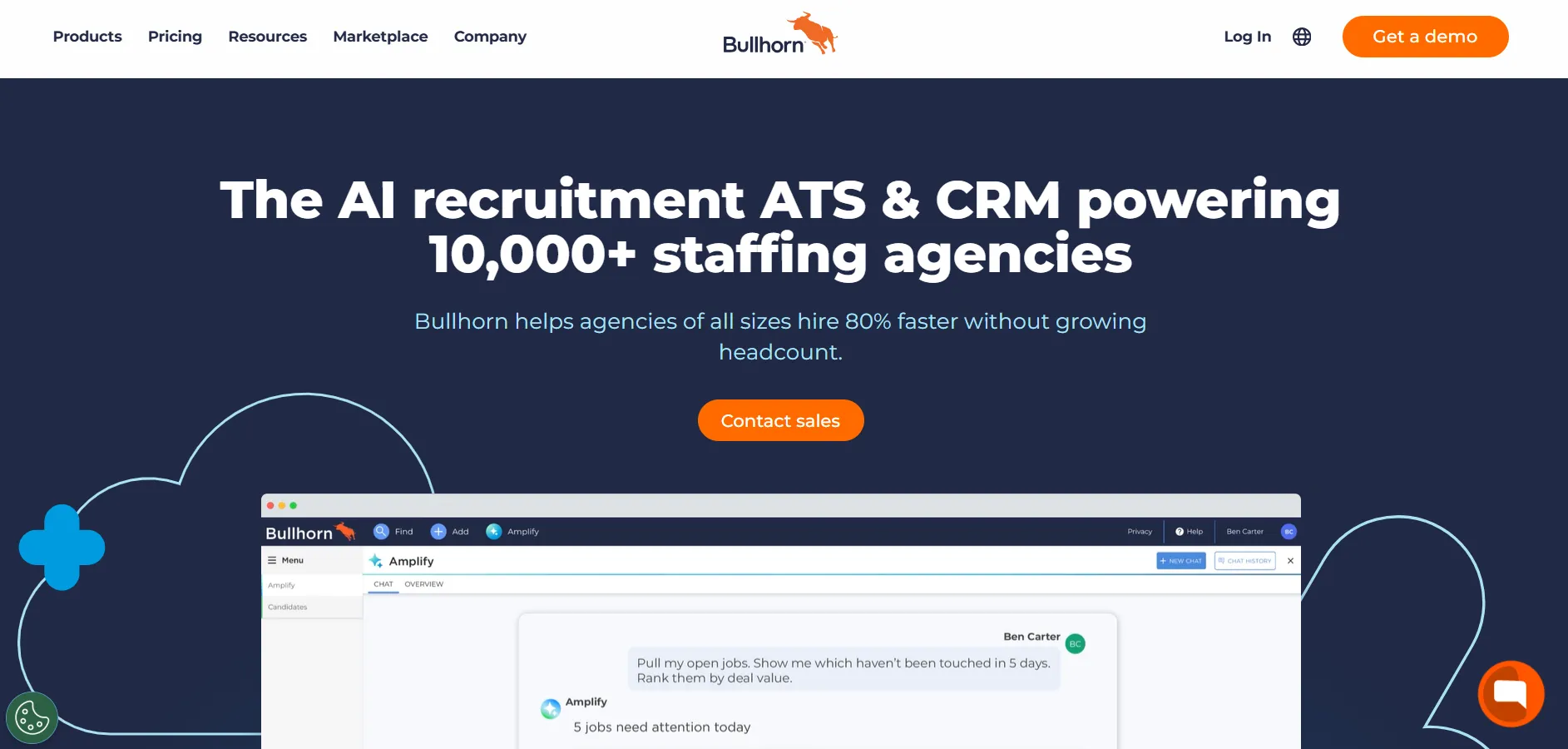
Bullhorn is recruitment software built for staffing and recruitment agencies. The company describes it as an artificial intelligence (AI) recruitment platform that runs an entire staffing firm in one system. An applicant tracking system and CRM form the center of the platform. Separate products extend it into onboarding, recruitment automation, reporting, and middle-office work such as time collection and invoicing. Staffing firms use Bullhorn to manage talent, jobs, shifts, and clients in a single system. The platform connects business development, recruiting, and operations teams around shared data.
Key features:
- ATS and CRM in one platform: Manages talent, jobs, shifts, and clients in one system. Sales and recruiting teams work from the same client and talent records.
- Middle Office time and invoicing: Collects time, applies configurable pay and bill rules, and builds invoices to client requirements. Includes VMS connections for client job orders and hours
- Mobile-first onboarding: Guides new workers through electronic document signing, federal and state requirements, and right-to-work checks in a mobile-first flow.
- Recruitment automation: Automates talent updates, interview scheduling, and job order approvals. Recruiters spend less time on follow-ups and routine admin.
- Reporting and analytics: Offers live recruiter dashboards, ad-hoc reports for leadership, and a combined view of recruitment and financial data.
Best for: Staffing agencies that want an established ATS and CRM, with separate products for onboarding, automation, and middle-office work.
4. Avionté
Avionté is staffing software built for staffing and recruiting firms. It brings recruiting, client management, payroll, billing, and reporting into one system of record. The company calls it a staffing intelligence platform for agency growth. The platform covers the contingent staffing cycle, from filling job orders to paying workers and invoicing clients. Firms with temp and contract books can run front-office and back-office work in one place. Avionté positions the software for high-volume contingent and temp staffing operations.
Key features:
- CRM and ATS: Manages job orders, talent search, submissions, interviews, and client accounts. Matching resurfaces qualified talent already in the database.
- Payroll and billing: Moves approved timesheet hours into pay runs. Builds client invoices from approved time, rates, and custom billing rules.
- Rate and tax handling: Supports hourly, salary, temp, contract, shift-based, and blended rates. Automates tax calculations and filings across multiple states and localities.
- Reporting and analytics: Includes over 150 standard reports and configurable dashboards for key performance indicators like gross margin. Users filter data by date, branch, client, and vertical.
- Open API and connectors: Connects to more than 100 trusted technologies through certified partners, certified connectors, and an open application programming interface (API). Data syncs across systems to reduce re-entry
Best for: Temp and contract staffing firms that want recruiting, payroll, and billing in one system of record.
5. Seven20
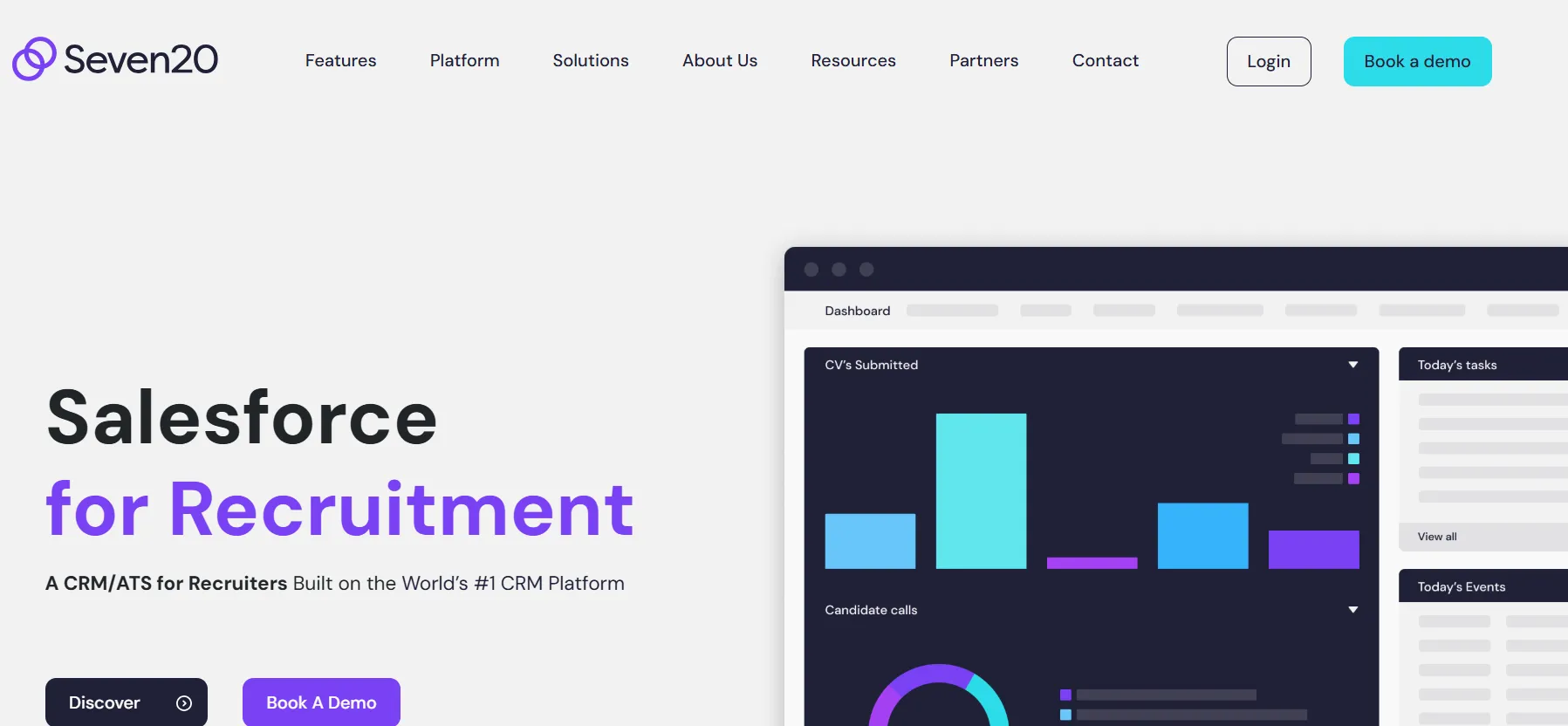
Seven20 is a recruitment CRM and ATS for staffing and recruitment agencies, built on Salesforce. The platform manages clients, contacts, talent, and placements on one shared record. It covers front-office work alongside mid-office and back-office tasks such as billing and compliance. Agencies can configure it for permanent, contract, temporary, executive search, and project recruitment. Its modular design lets each firm shape workflows, stages, and terminology around its own model. Seven20 suits agencies that want one system across sales, delivery, and finance teams.
Key features:
- Timesheet-to-invoice billing: Timesheets convert into invoice lines, and agreed rates apply from your terms of business. Seven20 supports day rates, split fees, and multi-currency billing.
- Placement-triggered workflows: A confirmed placement can trigger billing, compliance checks, and payroll data from the same record. Finance and operations teams skip manual re-entry.
- Contractor compliance rules: Validation rules apply per country and job type. The system checks documents on submission and sends expiry reminders before documents lapse.
- Client and candidate portal: A branded portal reads live CRM data. Contractors submit compliance documents, clients review shortlists, and suppliers submit talent under role-based access controls.
- Configurable job pipelines: Teams define stages and required fields per job type, with separate workflow logic for perm, contract, and temp. Placement records track extensions and contract renewals.
Best for: Agencies with mixed perm, contract, and temp desks that want one configurable CRM and ATS across teams.
How to Choose Contract Staffing Software That Supports Long-Term Growth
Platform profiles narrow the field, yet most shortlists end with vendors that look alike on paper. The deciding factor is how each one handles your contract data as assignments, extensions, and clients multiply.
Operational maturity shows up in growth. Accenture's 2024 research, Reinventing Enterprise Operations with Gen AI, measured operations readiness. Companies with fully modernized, AI-led processes achieved 2.5x higher revenue growth than the least ready peers. For a staffing firm, that maturity starts with how contract data moves.
1. Connect recruiting, assignment, and billing data
Choose software where recruiting, assignment, and billing data share one record, so decisions in one area reach the others.
Ask each vendor to walk through one placement from first outreach to invoice. Watch where the data changes hands. Every export, import, or rekeyed field is a handoff your team will own.
Connected data lets leaders trace a margin problem back to the rate set at placement. It also lets information technology (IT) teams consolidate the staffing vendor stack, which cuts maintenance overhead.
Migration risk belongs in this conversation too. Ask how the vendor moves your existing talent and placement records, and what downtime to expect. Zero downtime is achievable. Asymbl has delivered high-volume migrations from legacy ATS and CRM systems across dozens of customer environments with zero downtime. Those projects moved tens of millions of candidate records.
2. Maintain visibility across the contractor lifecycle
The right platform shows each contractor's status from first outreach through assignment completion, in one view your team shares.
Test it with your own scenarios.
Ask the vendor to pull up three scenarios live:
- An assignment ending in three weeks
- A pending extension
- A contractor with two active placements
If those take several screens or a report request, your team won't check them daily.
Visibility also has to reach the people closest to the contractor. Recruiters should see hours and end dates without asking operations. You can then act on changes before they become client escalations.
3. Support extensions, redeployment, and repeat placements
Contract staffing growth comes from repeat business, so choose software that makes extensions and redeployment easy to act on.
A firm that redeploys a contractor saves the sourcing cost and keeps the hours billing. Extensions do similar work for the client relationship, since they keep a trusted contractor in place.
Ask how the software identifies extension opportunities and tracks contractor availability against open reqs. Ask, too, whether it can match past contractors to new requirements using assignment history.
Your database becomes a sourcing channel you've already paid for.
4. Measure profitability across clients and assignments
Pick software that ties rates, hours, and placements to margin, so you can measure profitability by client, recruiter, and assignment.
Contract revenue can grow while margin falls. Underpriced accounts, unbilled overtime, and slow invoicing all reduce what each hour earns. Staffing leaders need rates, margins, client performance, and delivery metrics in one place.
Ask whether gross profit updates as clients approve time or only after month-end close.
Real-time data is fast becoming the norm elsewhere in the business. According to the 2025 IBM CDO Study, 74% of chief data officers have established mechanisms for continuous data collection, so data is available in real time or near-real time. Your margin data should meet the same standard.
With current margin data, you can decide which clients to grow, which rates to renegotiate, and where to add recruiters.
Turn Every Finished Assignment Into Your Next Placement With Contract Staffing Software
Every assignment your firm runs leaves a record of how the contractor performed and what each hour earned. Over a few years, those records become the most useful data your firm owns. They tell recruiters who to redeploy first. They show leaders which accounts can support a higher bill rate at renewal.
The history builds only when placement and time data land in the same record from day one. Records split across three systems rarely reconcile after the fact. Each quarter they stay apart is a quarter of assignment history your team can't search.
Firms that connect that data now gain more from every assignment that ends. Recruiter Suite and Asymbl Time keep placement and time data together from the first timesheet onward. Your existing payroll and billing providers stay in place.
Book a demo of Asymbl Time with Recruiter Suite. See how connected placement and time data turns every finished assignment into your next placement.
FAQs
Contract staffing software is staffing agency software built to run contract and temporary placements. It covers the work from first outreach through the final timesheet. Its central record is the assignment, which links the contractor, the client's job order, and the pay and bill rates. Temp, contract, and temp-to-hire desks all rely on it. Contract management and e-signature tools share similar names, yet they handle legal documents for any type of business.
Contract staffing software differs from an applicant tracking system (ATS) in the record it centers on. An ATS centers on the candidate and the job pipeline, so its work peaks at placement. Contract staffing software centers on the assignment, which carries rates, hours, end dates, and extensions. Many staffing firms keep their ATS and add contract capabilities through connected time and billing tools. Some firms move to a staffing ATS with contract features built in.
Contract staffing software improves contractor redeployment by turning it into a measurable process. Firms can track the redeployment rate, the share of contractors placed on a new assignment soon after one ends. The software also captures client feedback and assignment performance at roll-off, while memories are fresh. Recruiters can then filter past contractors by client fit and rehire eligibility. Leaders see which desks redeploy well and which let contractors drift to competitors.
Contract staffing software covers the full contractor cycle for a staffing firm, from recruiting through placement, time, and billing. Contractor management software usually covers only the post-placement side, such as onboarding, compliance documents, and payments. Many tools in that category serve businesses engaging independent contractors directly. Staffing firms that pair one with a separate ATS end up reconciling two records for each contractor. Check each product's intended user before booking a demo.
The best contract staffing software for an agency fits its desk mix, back-office setup, and existing systems. Firms keeping their payroll and billing providers need a platform that feeds those providers clean data. Firms wanting one vendor for payroll and billing may prefer an all-in-one system. Compare total cost, including per-user licenses, implementation, data migration, and add-on modules. Ask for references from firms with similar revenue, desk mix, and contract volume. For firms keeping their current providers, Asymbl Recruiter Suite with Asymbl Time keeps placement and time data together and works with a wide range of payroll and billing providers.
A staffing firm runs contract staffing software, while its clients run a vendor management system (VMS). Large clients use a VMS to release job orders to approved suppliers, collect submittals, and approve contractor hours. Your firm works inside each client's VMS to win and service reqs. Your contract staffing software should accept VMS job orders and approved hours without rekeying. Ask vendors which VMS platforms they connect to and how often data syncs.
Rebuilding Workforce Capacity: Why Organizations Must Shift From Vertical Optimization to Holistic Design
How Agentforce enables workforce orchestration at scale by turning AI into digital labor, freeing humans for judgment, leadership, and system design.

The Right Fit Starts With a Conversation.
See what working together could look like.