


A digital labor strategy is the deliberate framework a business uses to design, deploy, and manage digital workers alongside human teams, not as a technology rollout but as a workforce transformation. Organizations that approach this strategically see digital workers absorb high-volume, repeatable tasks while human capacity shifts to decision-making, client engagement, and higher-order work. This post covers the four critical blockers that stall digital labor adoption and Asymbl's three-step playbook design, onboarding, and coaching for building a hybrid workforce that delivers measurable, sustainable ROI.
What Is a Digital Labor Strategy?
A digital labor strategy is an organization's intentional plan for integrating digital workers, AI-powered agents, and autonomous systems into its workforce alongside human employees. Unlike a traditional technology implementation plan, a digital labor strategy addresses the organizational design, governance, change management, and cross-functional alignment required to make human and digital workers operate as one coordinated team.
The distinction matters. Companies that treat digital labor as a tool rollout typically see fragmented results, productivity gains in isolated pockets with no compounding effect across the organization. Companies that treat it as a workforce design challenge build systems where digital workers execute high-volume, repeatable tasks, freeing human capacity for the work that requires judgment, creativity, and relationship management. The result is not just efficiency; it is a fundamentally different operating model.
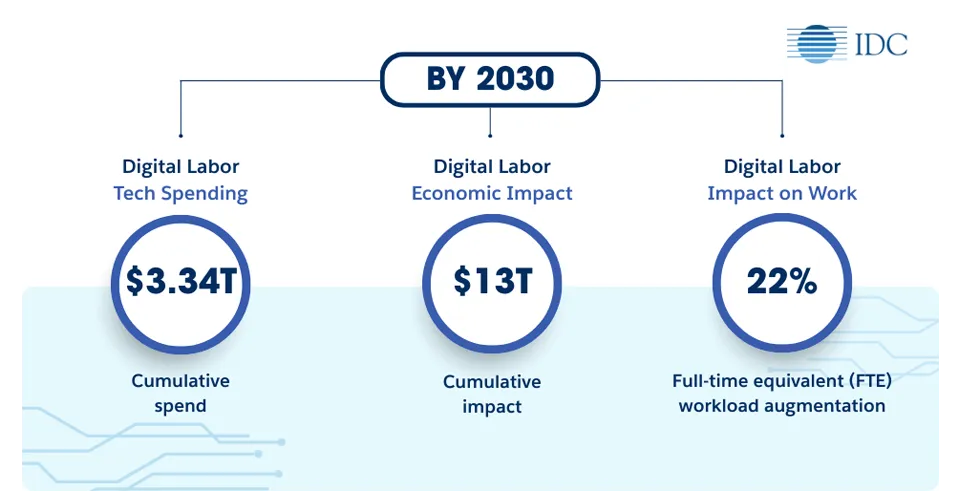
Your competitors aren’t using digital labor to eliminate jobs; they’re using it to outperform you. Digital labor, AI-powered members of your workforce, is rapidly becoming core to how work gets done. With the IDC's latest report projecting that digital labor will unlock $13T in global economic value by 2030 and absorbing 22% of full-time equivalent work, leaders must decide how to reorganize teams around this new reality.
The challenge? Chaotic adoption can undermine your entire workforce. Most organizations treat digital labor like a technology rollout when it actually requires workforce transformation. Leaders who approach this as an AI tool implementation instead of designing a hybrid workforce, will struggle with adoption, fail to capture ROI, and create friction instead of value.
At Asymbl, we help companies with this transition through workforce orchestration, the intentional design and management of hybrid teams using our three-step playbook: design, onboard, and coach.
What the IDC Data Really Means for Leaders
IDC’s analysis leaves little doubt: the barriers to digital labor adoption are rooted in organizational dynamics. Across IDC’s findings and broader research, four blockers determine whether digital labor becomes a performance multiplier or stalls entirely.
- Governance: We've seen companies stall because no one owns the digital worker's performance: oversight, safety, performance management, and continuous improvement. Each are all part of the ongoing optimization of digital labor through coaching and management, work that must be grounded in effective governance.
- Sequencing: Sequencing: Successful organizations design digital labor for outcomes rather than implementing it as a tool, sequencing adoption around the data, workflows and business results that matter most.
- Change Management: Helping teams see AI as a digital teammate has become central to change management, reshaping mindsets and expectations around how work gets done.
- Cross-Functional Alignment: Digital workers succeed when processes, data, and decision flows are aligned across functions, making cross-functional coordination essential.
IDC's research validates what we've seen firsthand: organizations aren’t going to win by sprinkling AI onto workflows. They'll win by adopting a platform model that orchestrates people, processes, and digital workers into adaptive, efficient, revenue-generating systems.
When the report projects workload augmentation, roughly eight hours per week of capacity returned to each worker, it describes workforce recomposition instead of displacement. Mundane execution shifts to digital workers. Human capacity is freed for decision-making, customer engagement, and cross-functional innovation.
But here's the gap: most companies expect productivity gains and cost efficiencies from AI, yet they lack the connective tissue to deploy digital labor at scale or measure its business impact. Instead of developing their operating environment, they're implementing point solutions and running into challenges that consistently hinder adoption.
Asymbl's Approach: Our Three-Step Playbook

Step 1: Design
Design is the foundation of any digital labor strategy. This is where organizations define what digital workers will do, what outcomes they are accountable for, and how they will interact with the human team members alongside them. The design phase includes mapping high-volume, repeatable workflows where digital labor can absorb execution, writing digital job descriptions that define scope and success criteria, and identifying the data and system access each digital worker needs to operate effectively from day one.
The most common design mistake is starting too broad. Organizations that try to automate an entire function in one motion almost always stall. The better approach is to sequence adoption around the workflows that deliver the highest ROI with the lowest organizational risk, building confidence, competency, and governance as the program scales.
Step 2: Onboard
Onboarding a digital worker is not a technical configuration exercise. It is an organizational integration process. Digital workers need to be introduced to the teams they will work alongside, embedded into the platforms and data flows they will operate within, and given clear boundaries for when to escalate to a human team member.
At Asymbl, digital workers are configured to operate inside Salesforce so they are woven into the existing workflows of each team rather than running as parallel systems that require separate management. The result is a team that treats digital workers as teammates from the first day of deployment, not as tools that need to be maintained separately from how work actually gets done.
Step 3: Coach
Digital workers are not set-and-forget deployments. Like human employees, they perform better with ongoing feedback, performance management, and continuous improvement. The coaching phase of a digital labor strategy involves monitoring digital worker output, identifying performance gaps, refining workflows based on real results, and scaling successful patterns across additional functions.
Asymbl's 92 digital workers operating across 10 business functions did not reach that scale through a single implementation. They scaled because each digital worker was treated as an evolving member of the team, coached, adjusted, and expanded as the organization built confidence in the model and clarity about where digital labor delivered the most value.
Asymbl's view is that success hinges on unifying digital workers, human workflows, data governance, and change management into a single, continuously learning system. The IDC's guidance: start with high-ROI areas, invest in data foundations, and support human-AI partnership, aligns directly with our platform philosophy: AI doesn't transform organizations; AI-enabled organizations transform themselves.
Rather than treating digital labor as another tool rollout, Asymbl helps companies design hybrid teams, define digital job descriptions, and operationalize digital workers as true teammates, ensuring organizations capture value, rather than chaos. Inside Asymbl, the conversation about digital labor is no longer hypothetical. It's operational. Every team has at least one digital counterpart, and we talk about human and digital workers as part of the same team because that's what they are. This approach recognizes that workforce orchestration, the intentional design and management of hybrid teams, is the critical behavior leaders need to adopt. It's not about implementing technology; it's about fundamentally rethinking how work gets done when digital workers can handle high-volume, repeatable tasks alongside their human teammates.
The operationalization follows a three-step playbook: define the roles and motivation, onboard into the flow of work, and coach and scale. By treating digital workers as new team members with clear job descriptions, proper onboarding into existing systems and processes, and ongoing coaching, Asymbl enables organizations to scale capacity and maximize human strengths. Digital workers are configured to work within platforms like Salesforce and woven into existing workflows rather than requiring extensive integration work. The result is measurable, sustainable impact: 3,789% ROI for our sales team, 1,529% for our HR team, and 92 digital workers operating across 10 business functions.
As leaders ask important questions about spending and impact, Asymbl’s approach offers a proven model for preparing organizations for the magnitude of change ahead. Digital labor is rewriting how value is created. And the next move belongs to leaders bold enough to redesign their organizations around it.
FAQs
Q1: What is a digital labor strategy and why does it matter?
A digital labor strategy is the intentional framework an organization uses to design, deploy, and manage AI-powered digital workers alongside human employees as part of a unified hybrid workforce. It matters because companies that approach digital labor as a tool rollout consistently underperform compared to those that treat it as a workforce transformation. A well-designed digital labor strategy addresses governance, change management, sequencing, and cross-functional alignment, the four blockers IDC research identifies as the primary determinants of whether digital labor adoption succeeds or stalls.
Q2: How do you build a digital labor strategy?
Building a digital labor strategy starts with designing the high-volume, repeatable workflows where digital workers can absorb execution and writing digital job descriptions that define scope and accountability. The second step is onboarding, which means integrating digital workers into existing platforms and workflows so teams treat them as teammates from day one. The third step is coaching, monitoring performance, refining workflows, and scaling successful patterns across additional functions. Organizations that follow this sequence see compounding returns as digital labor capacity grows across the business.
Q3: What is the ROI of a digital labor strategy?
The ROI of a digital labor strategy depends on where you deploy digital workers and how well they are orchestrated with your human workforce. Organizations that move beyond isolated AI tools where digital workers execute end-to-end workflows within an integrated platform consistently see the strongest returns. Asymbl's own digital labor strategy has delivered a 3,789% ROI for our sales team and 1,529% for our HR team, with 92 digital workers operating across 10 business functions. The key variable is not the technology, it is the strategy behind the deployment.
.webp)
Talent Acquisition Analytics for Decisions
Talent acquisition analytics works inside a loop. Learn how to calculate time to hire and the 5 metrics that matter.

The Right Fit Starts With a Conversation.
See what working together could look like.
.webp)