

Digital Recruiting Strategies to Close the Attribution Gap

Staffing firms need more placements without increasing the headcount, yet these firms are chasing this number without the data and systems designed to support it. Margin drops when net-new sourcing fills roles the bench should cover instead.
Redeployment rates stay low because nothing surfaces who is rolling off assignment against which open job orders. Attribution stops at the system boundary, so cost per placement by source stays an estimate almost everywhere it gets reported.
Staffing firms treat digital recruiting as a set of online tools, including job boards, social channels, and an applicant tracking system. Digital recruiting strategies need more than a longer tool list.
Marketing faced this same challenge decades ago. With unqualified leads coming in at scale, marketing built a discipline to convert them. Although recruiting bought tools, they are often acquired point solutions that never worked together.
In this blog, we will map marketing's structure and show what recruiting never built. We will lay out the digital recruiting strategies that close the gap for staffing firms.
What Digital Marketing is Built Like
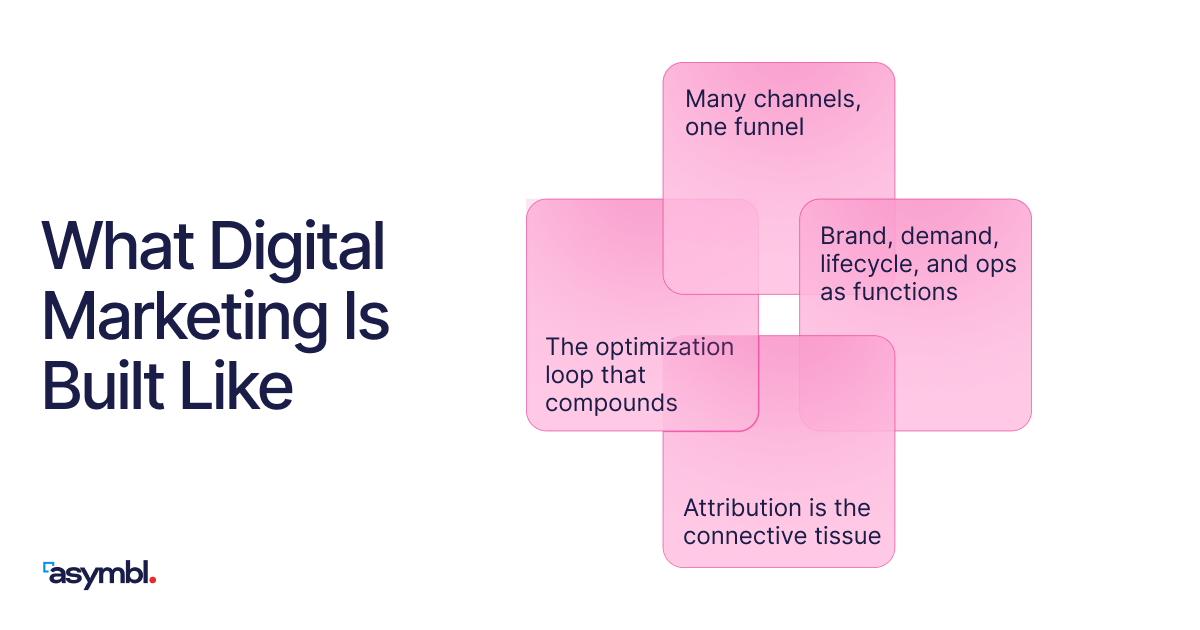
Marketing treats every channel as one coordinated system with a shared measurement foundation underneath it. This foundation is what a recruiting leader needs to see before borrowing any of marketing's tactics.
1. Many channels, one funnel
Marketing runs different acquisition programs, including paid search, paid social, organic search, email, events, content, and partnerships at the same time. Each channel and campaign reaches a different prospect at a different stage of the funnel.
Marketing never bets the entire budget on a single channel’s continued performance, instead, teams treat the channel mix as a deliberate allocation.
They change the channel mix monthly based on what each channel returned last month. Every channel then writes into the same funnel and the same record, so a marketer can compare them directly. A team might move a fifth of next month's budget from paid social to paid search. The decision depends on last week's cost per acquisition data, so no channel earns a permanent share of spend.
2. Brand, demand, lifecycle, and ops as functions
Marketing is categorized into specialized functions, each with its own people, skills, and targets. For example:
- Brand builds reach and recognition
- Demand generation drives volume
- Lifecycle marketing keeps existing customers engaged and buying again
- Marketing operations owns the systems and the data underneath every other function.
A demand generation manager and a lifecycle marketer answer to different targets, even inside the same team. A lifecycle marketer might send a renewal offer to a customer who bought eighteen months ago. Each function reports to a different set of targets, so nobody confuses a brand metric with a demand metric.
3. Attribution is the connective tissue
Attribution assigns every click an identifier, which follows the prospect through the site, the form, and the pipeline, all the way to the sale. Marketing teams read that one record for cost per click, cost per lead, cost per acquisition, and revenue by channel.
Without that identifier, budget allocation becomes opinion recorded in a spreadsheet. A media buyer with clear attribution data can defend a budget. A media buyer without it argues from instinct instead. Say paid search costs 40 dollars per lead and organic search costs 12 dollars per lead.
A marketing team shifts new budget toward organic within days. Multiply that gap by every lead the campaign generates, and the total cost of ignoring it becomes clear.
4. The optimization loop that compounds
Marketing teams cut creative that underperforms and raise spend on creative that converts. They adjust bids weekly based on results. Programmatic advertising formalizes that loop entirely.
Seed data builds audiences, and campaign management software automates distribution across channels. Dashboards track click-through to outcome, and those outcomes retrain the next buy. Each cycle costs less than the one before it, because the system already knows what worked.
A single ad running for six months without a bid change almost never happens in a mature marketing program. A team reviewing performance weekly catches a losing creative within days.
5. Why digital marketing for recruitment lags
Digital marketing for recruitment already has part of this system in place. Programmatic job advertising platforms manage bids directly and publish source-level reporting. Those platforms connect to an applicant tracking system (ATS), and their visibility stops at the application.
Recruiters decide placement quality downstream of the application, inside systems marketing tools cannot see. A programmatic platform can tell a team which ad produced an applicant, but cannot tell that team which applicant became a strong placement.
Two applicants might come from the identical job board ad. One becomes a strong placement within a year, and the other exits during the assignment. The ad platform reports both as one success, at the same cost.
A recruiting team paying for that reporting still can't answer whether the applicant it produced became a strong placement because the reporting stops exactly where the outcome that actually matters begins.
Digital Recruiting Was Never Built With the Same Discipline as Marketing
Marketing's channels, functions, attribution, and feedback loop were built with one shared goal and one system underneath them. Recruiting runs a similar channel mix without that shared goal or system.
1. Channels without a channel strategy
Staffing firms’ recruiters already run several channels, including job boards, LinkedIn, referrals, a careers page, and sometimes paid social. Few teams can say what share of last quarter's placements came from each channel, or what each channel cost them.
They renew that spend annually against a subscription instead of reallocating it quarterly against performance. Habit and vendor contract dates decide the resulting channel mix.
A job board renewal might auto-renew every March regardless of how many placements it produced last year, and nobody revisits that decision until the invoice arrives again.
A channel that produced zero placements last year often receives the exact same budget this year or less.
2. One recruiter runs every function
Recruiters, in staffing firms, handle brand, demand, lifecycle, and operations. They also schedule interviews and handle client relationships. Lifecycle work becomes the first casualty under pressure because, for a recruiter prioritizing the open requisition, nurture and re-engagement isn’t a priority.
Recruiters lose roughly a third of the week to administrative work their software should handle. Marketing would never ask one person to run brand, demand, lifecycle, and operations at once.
A single recruiter might source talent in the morning, screen resumes at noon, and update a client by evening. Lifecycle work simply has no time left in the day.
Marketing operations exists specifically so no single person has to own every function at once. This specialization is exactly what recruiting has never had room to build.
3. Attribution stops at the system boundary
Attribution is the largest structural gap of the four because tracing a placement back to its source channel requires the four systems to be connected.
In most firms, every system has a separate record, so the trail breaks at least once. Cost per placement by source stays an estimate almost everywhere teams report it. Placement quality by source usually goes uncalculated entirely. A single placement might start as a paid social click, but it can also move through three interview stages in the ATS, then land on assignment at the client.
No shared record or system connects those three steps automatically, and reconciling a successful placement manually across three exports takes a data analyst.
Staffing firms feel this gap directly, in margin left on the table every time the trail breaks. Closing it takes one system that tracks a record across all four systems.
4. Nothing feeds back, so nothing compounds
Marketing's feedback loop makes each acquisition less costly, whereas recruiting's cycle resets every time. People who never convert stay unengaged permanently.
Recruiters don’t record which messaging actually worked, so the next campaign starts from nothing. Which candidates a strong recruiter selects, and why, leaves no trace the next campaign can use. A recruiting program costs roughly the same per placement in year three as it did in year one, whereas a marketing program does not.
A marketing team can point to a specific audience segment that used to convert well. A recruiting team usually can't point to anything at all because nobody logs or documents the win and the strategy or playbook that made it possible.
5. What staffing firms lose to this
Staffing firms run marketing toward two audiences on one budget, clients and talent, often through the same person. The talent side pays twice because the net-new sourcing on roles the bench should already fill increases costs and lowers margin.
Redeployment rates stay low because the system doesn’t notify who is rolling off assignment against which open job orders. Databases fill with stale profiles nobody trusts, which is the asset the firm paid to build stops being usable.
When a top producer leaves, the relationships leave too, because the context and history of the relationship isn’t captured at the firm level. A firm can lose a decade of client relationships in the same week a single recruiter resigns, and no dashboard shows which accounts are actually at risk before that recruiter walks out the door.
Digital Recruiting Strategies That Compound
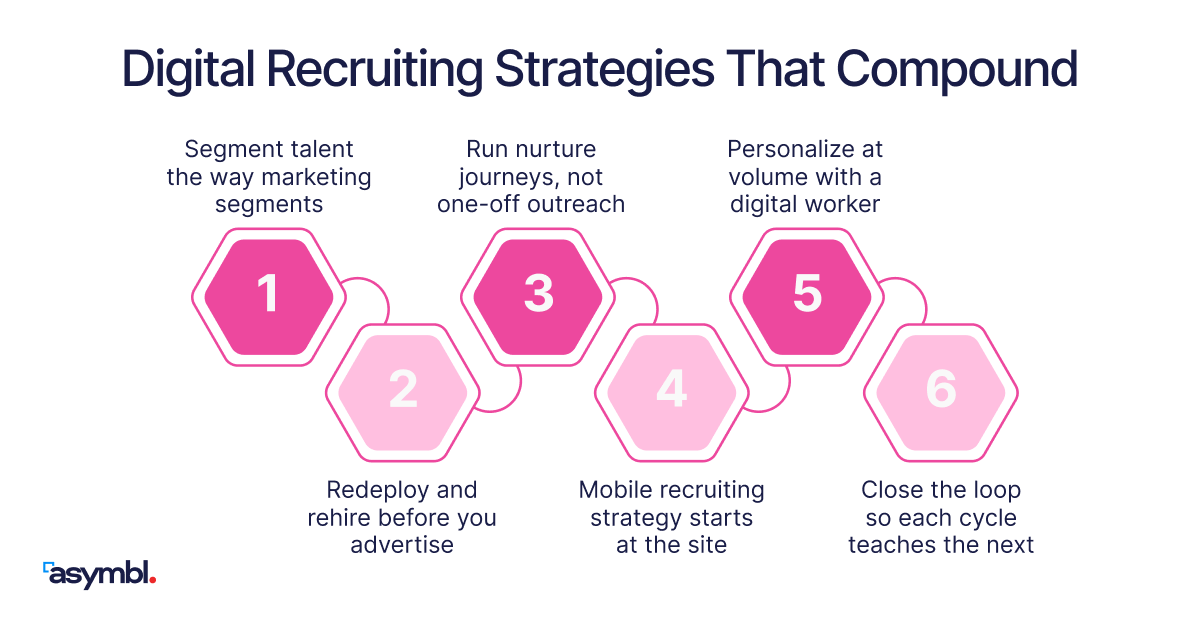
The strongest digital recruiting strategies turn existing talent, past interactions, and placement outcomes into inputs for the next hiring cycle.
1. Segment talent the way marketing segments prospects
Marketing never sends one message to an entire audience. It segments audiences by stage, intent, and fit, and writes personalized messages to each segment.
Recruiting segments by job role, so every candidate in the pipeline receives the same sequence regardless of fit or engagement recency. Useful segmentation runs on criteria that a job title can't capture:
- Available now versus open to a move
- Prior applicant versus never engaged
- Strong fit versus adjacent fit
- Skill family versus job title
According to Deloitte’s 2025 Global Human Capital Trends, 66% of managers and executives said their most recent hires were not fully prepared, with experience the most common failing.
Experience is an important signal for segmentation, but a job title or resume may not cover it efficiently. A model built from experience, pipeline history, and interview feedback can surface those differences earlier.
For example, a software engineer six months from a promotion behaves differently than one actively job-hunting. Recruiting usually sees only the resume, overlooking the other signals.
2. Redeploy before you advertise
Marketing spends heavily on existing customers, because retention costs less and the relationship already exists. Recruiting holds the exact same asset and rarely activates it. This is the highest-return strategy on this list. Marketing never has to rebuild a customer relationship from zero, and staffing doesn't have to either.
For staffing firms, this is redeployment. A contractor rolling off assignment carries no acquisition cost, a known track record, and an existing relationship. This combination makes redeployment the highest-margin fill available to a firm, well ahead of any net-new placement.
Sourcing the same skill set fresh from a job board can take weeks, and the firm that checks its own bench before opening a new job order fills the role faster
3. Run nurture journeys that compound
Marketing runs engagement journeys. Each journey adapts to what a person does, and continues for months without anyone sending a message manually. Recruiting runs outreach campaigns instead. It starts when a requisition opens and stops the moment it closes.
A recruiting journey looks different in practice:
- Sends content organized by skill family
- Invites people to relevant events
- Triggers role alerts by fit rather than by keyword
- Re-engages a candidate automatically when an assignment ends, or a role reopens.
A candidate with six relevant touches over a year responds differently, so a cold message about a new role doesn’t land well.
Journey automation has to read the same record as the hiring workflow, otherwise, the journey keeps messaging people who are already moving through an interview loop, which wastes everyone's time.
4. Mobile recruiting strategy starts at the site
Staffing sites still build their form for a bigger screen, but a mobile recruiting strategy means more than responsive design. It changes the application flow entirely:
- Talent applies without creating an account first
- The site asks for a resume only after the first touch
- The form captures information progressively, in short stages
- Async screening replaces phone-screen scheduling
An async screen replacing a phone call has to earn that trust on a five-inch screen. Removing a scheduling step alone isn't enough. Staffing firms convert a mobile applicant into a bench asset immediately. Otherwise, they lose that person to the next firm whose form loaded faster.
5. Personalize at volume with a digital worker
Marketing personalizes at scale through templates with dynamic fields, and accepts that the result reads somewhat generic. Recruiting cannot get away with templates and partial personalization.
A candidate weighing a career move notices a template within seconds. The requirement is capacity that doesn't come out of recruiter hours because a recruiter personalizing a hundred messages a day runs out of hours before running out of talent.
Marketing solved this by accepting generic output at scale. Recruiting needs the personalization marketing gave up on, delivered at the volume marketing already reached.
6. Close the loop so each cycle teaches the next
Closing the loop means outcomes flow back into the system that made the original decision. Recruiters can then see which segment converted, which journey produced applications, and which channel produced people who stayed.
Marketing calls it lookalike modeling built from converted prospects. Recruiting's version of lookalike modeling is built from candidates who joined and then performed well afterward.
The channel mix stops being a once-a-year renewal decision and becomes a quarterly allocation instead. Two sources can each produce one strong placement from very different volumes, ten applicants against two. Only a closed loop shows that difference.
A team that leaves six months of outcome data unused loses six months of learning it could have applied. This visibility separates a strategy that compounds from one that merely repeats.
Asymbl For Digital Recruiting
Asymbl brings these strategies together in one connected system, linking talent relationships, hiring workflows, intelligence, and digital workers. Instead of adding another point solution, staffing firms can run attraction, nurture, redeployment, and hiring from the same record.
Recruiter Suite for attraction and workflow
Applicant tracking systems stop at workflows, while outreach tools are limited to outreach activity. Each platform covers one stage of the candidate’s lifecycle because the respective processes and workflows are built in separate systems.
Recruiter Suite covers attraction, outreach, nurturing, and hiring workflow together, from first fill to close, in one connected system.
Contact Management holds every relationship at the firm level because the system logs communication history for every contact automatically. Pipeline Management gives a single and connected view across every job order, so a recruiter can act on many people in the pipeline at once.
Recruiter Suite is Salesforce-based, so placement data connects directly to the revenue and margin data the front office already tracks. A recruiter working inside one system never has to explain someone's history twice. Pipeline Management alone removes the need to check three separate tabs before updating a client.
Talent Intelligence for pools and redeployment
Talent Intelligence reads pipeline history, interview feedback, assignment outcomes, and unstructured documents into a working model of fit. This model goes well beyond resume structure or keyword overlap.
The AI Matching Engine scores talent against jobs and jobs against talent. It highlights available, in-contact, and prior placement pools. This answers the redeployment question directly. A recruiter no longer has to remember who rolled off assignment last spring. The list stays current automatically as new outcomes come in.
Search and Discovery runs on natural language, so segmentation stops depending on boolean skill filters. Candidate Intelligence returns a placement-likelihood score that turns a segment from merely defined into prioritized.
Segmented campaigns that run as journeys
A campaign that reaches an entire database instead of the group it's built for wastes the list. Outreach that only fires once a requisition opens never becomes an ongoing journey.
Recruiter Suite's Contact Management builds and shares segmented talent lists across a team, and a campaign then runs against the exact group it's meant for, active and passive talent alike.
Rosa's Intelligent Candidate Outreach draws on that same segmentation. Messages then run as an ongoing journey, tailored automatically to each person's profile and the role.
Rosa, The Digital Recruiter for outreach at scale
Rosa, the Digital Recruiter, is a pre-built digital worker with a defined job and a definition of success. Intelligent Candidate Outreach sends messages to large pools, and Rosa tailors each one to the person's profile and the role.
Recruiters set the strategy, and Rosa carries the volume. Rosa also generates job descriptions, screens applications against set criteria, schedules interviews, and produces structured interview summaries. This capacity gain spans multiple steps in the hiring process. A recruiter still makes the final call on everyone Rosa surfaces.
Rosa expands the pool a recruiter can actually work in a single day. A two-person team could never reach that volume manually within the same window.
Two recruiters and Rosa hired 100 people in 100 days together, and increased fill rate by 47%. Along the way, Rosa alone processed 17,000 applications, pre-screened 1,800 candidates, and scheduled 800 interviews.
One record from first click to fill
Asymbl Intelligence captures the judgment, context, and outcomes accumulating across every workflow and decision. It makes the signal available to every recruiter and every digital worker, so the next cycle starts better informed.
A recruiter opening a new job order next quarter starts with everything the last cycle learned already loaded in. A staffing firm growing over several years never has to migrate that history to a new system.
Staffing firms see which sources produce redeployable talent and which sources actually reduce margin.
Evaluate Digital Recruiting Strategies By ROI
Every recruiting software decision should demonstrate what it can improve, and how it helps you measure it. A channel that generates applicants but cannot be tied to placements, a nurture tool that cannot surface redeployment opportunities, or an AI tool that saves recruiter time but creates more downstream work is not delivering measurable ROI.
For staffing firms, evaluate each tool against four outcomes:
- Cost per placement: Can you trace a placement back to the channel, campaign, and recruiter that produced it?
- Redeployment rate: Can the system identify contractors rolling off assignment who match open job orders before you source externally?
- Recruiter capacity: How many hours of sourcing, screening, scheduling, and follow-up does the tool remove from the desk?
- Placement quality: Can you connect the original talent source to outcomes such as retention, assignment completion, or repeat placements?
Does the tool improve one of these numbers, and does that improvement flow back into the same record? If it requires a separate export to prove the result, the system is adding another reporting problem rather than closing one.
Asymbl connects Recruiter Suite, Talent Intelligence, and Rosa to the same underlying record, which lets staffing firms measure where talent came from, identify who should be redeployed, automate high-volume recruiting work, and feed placement outcomes back into future decisions.
Book a demo to see how that connected model works in practice.
FAQs
Digital recruiting strategies are the deliberate, ongoing practices a staffing firm uses to find, segment, and convert talent across channels. The approach is borrowed from how marketing runs its own funnel.
Digital recruiting and recruitment marketing operate on different timelines. Digital recruiting strategies govern how a firm sources, segments, and converts talent against open job orders right now. Recruitment marketing runs continuously and independently of any specific opening. It builds brand awareness and interest among people who haven't applied yet. Recruitment marketing generates the audience. Digital recruiting strategies decide how that audience gets segmented, nurtured, and converted once a role opens.
Digital marketing for recruitment applies marketing's own toolkit to recruiting. Paid and organic channels, segmentation, nurture journeys, and attribution all carry over, aimed at sourcing and converting talent.
Yes, text messages consistently outperform email in recruiting outreach. Text response rates often run substantially higher than email, frequently in the double digits. Texts also get read and answered within minutes rather than sitting in an inbox for days. Any SMS outreach program still needs documented consent to stay compliant with texting regulations.
Redeployment returns the most for the least new spend. A contractor rolling off assignment carries no acquisition cost, a known track record, and an existing relationship. This combination makes checking the bench before opening a job order the highest-margin move available. Segmentation costs almost as little, since it runs on data a firm already owns.
.webp)
What Is Digital Labor and Why It's Not the Same as AI Agents
Salesforce built sound AI architecture. Most companies deploy it wrong. Asymbl's workforce orchestration approach treats digital labor like talent, delivering measurable ROI where IT projects fail.

The Right Fit Starts With a Conversation.
See what working together could look like.
.webp)