

Best Executive Search Software for Recruiting Firms in 2026

Executive search is different from filling a role from a resume and job description. At the VP and C-suite level, the firm guides a client through a leadership decision that can take months and involve multiple stakeholders.
The reasoning behind each executive search decision often lives with the individual recruiter who ran it. When the recruiter leaves, those relationships leave with them.
Executive search software needs to preserve that context across the entire search. It should connect the client mandate, talent evidence, stakeholder feedback, relationship history, and recruiting activity so the team can make decisions from the same information.
A generic applicant tracking system (ATS) tracks which pipeline stage talent has reached. A recruiting customer relationship management (CRM) system logs activity and relationships. Executive search draws on both at every decision point, which is why the ATS and CRM have to work from the same information.
In this blog, we will look at what makes executive search different. We will cover where an ATS or CRM alone falls short. We will also outline what recruiting firms should look for in executive search software and compare five platforms firms are evaluating in2026.
Challenges Recruiting Firms Face When Placing Executive-Level Talent
Recruiting firms face four main challenges when placing executive-level talent:
- revenue lands later than the work
- every recommendation carries higher reputational risk
- the client has to be part of the process, and
- context has to survive across a long search
A single search runs for months and evaluates a handful of senior leaders. Every step routes through multiple client stakeholders. All of it puts pressure on quality, trust, and continuity long before the assignment produces revenue.
1. Longer Search Cycles Delay Revenue Realization
An executive assignment can occupy a recruiter's or partner's capacity for months. Some firms charge in stages across the search. Others get paid only when the placement lands.
Whichever model a firm runs, the same tension holds. The recruiter and partner carry more of the load across a longer stretch of the search, all of it before the placement fee arrives. Firm leadership needs to see which searches are progressing, which have stalled, and how open assignments affect revenue for the quarter. Without visibility into search progress and revenue impact, they can't forecast or reallocate capacity.
Running the search faster still matters, but pushing the talent forward just to compress the cycle can cost the firm more than the time it saves. The risk grows the moment the client realizes a fast search came at the cost of thorough work.
2. Every Talent Recommendation Carries Greater Reputational Risk
Every talent the firm submits at the executive level puts its own judgment on the line. The client is trusting the firm to identify leaders who are credible for the specific problem the business needs solved, and this judgment goes well beyond matching experience and credentials to a job description.
The Deloitte Private's 2026 report, Setting the Table: Succession Planning Strategies for Family Business Legacies, found how wide the gap can get. 61% of family businesses have at least one family member interested in the CEO role. Fewer than a quarter, only 23%, believe that person is actually ready for it.
Being interested in a role and being ready for it are two different things. Telling those two apart is exactly the judgment a defensible recommendation demands. A long slate of loosely qualified names signals the firm didn't do that work.
The consequence is not just a lost placement fee. It shows up as:
- A lost retainer on the current search
- Lost referrals to other businesses in the client's network
- Lost client trust that takes years to rebuild
The firm's value comes from narrowing the market with intelligence, and being able to explain exactly why each person belongs in the conversation.
3. Executive Search Requires Closer Collaboration With Client Stakeholders
The recruiter can't build a complete picture of executive fit from the talent side alone. The client holds context the recruiter has no other way to see:
- the business priorities behind the role
- the leadership environment the person will step into
- the board's expectations of the next leader
- what successful leadership actually looks like inside the business
The context often sharpens as interviews progress. The client hears the talent against the mandate for the first time.
The recruiter brings market knowledge and evidence on each person on the shortlist. The client brings what only the client can see. The search works when both sides keep exchanging what they know. It breaks when the recruiter screens talent alone and hands the client a shortlist to approve.
4. Long-Running Search Processes Create More Context to Capture and Preserve
Every conversation in an executive search generates context the next decision will draw on. That context takes many forms:
- The client sharpening the mandate on a call
- The talent explaining a decision that reframes their track record
- An interviewer flagging a concern the next round needs to probe
- A partner adding history from a relationship that predates the search itself
Across months, that information scatters across emails, calls, notes, interview feedback, and individual memory. The cost shows up once the person who held that reasoning steps away. At that point, another recruiter, partner, or client stakeholder can't reconstruct it.
Those pressures don't ease once a firm picks its software. An ATS and a recruiting CRM each solve one piece of the problem.
Why an ATS or Recruiting CRM Alone Is Not Enough for Executive Search
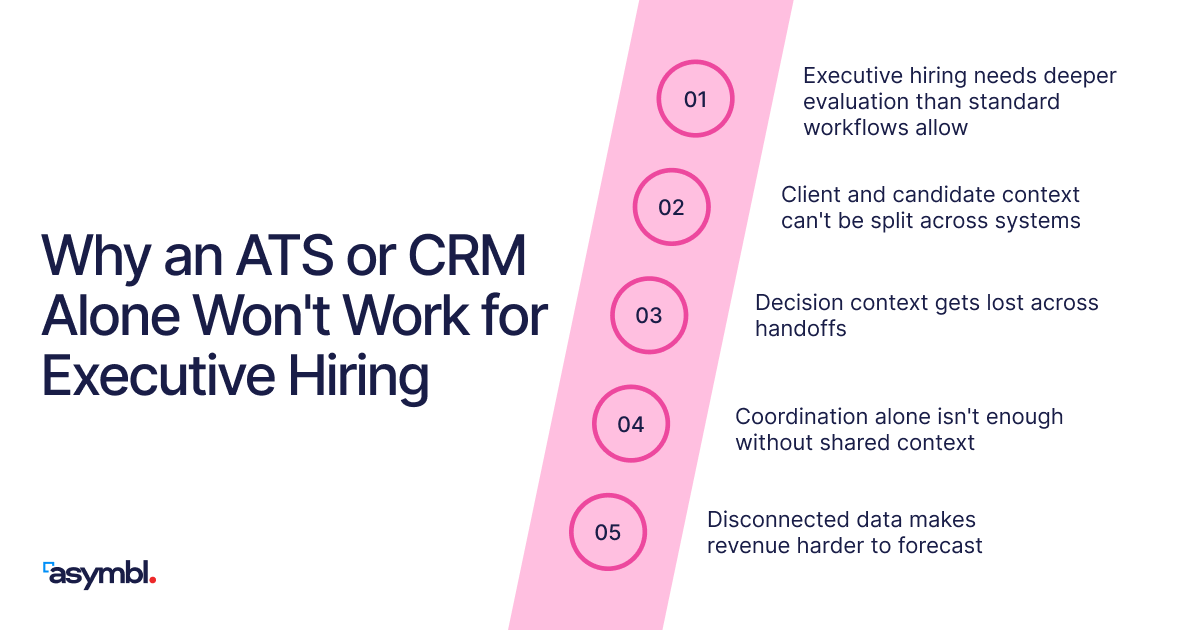
An ATS or recruiting CRM alone is not enough for executive search because each is built for a different job. An applicant tracking system (ATS) is built to move volume through a pipeline. A recruiting CRM is built to log relationships and activity. Executive search is neither high-volume nor a series of touchpoints, but a small number of long, high-stakes assignments where a single decision draws on both systems at once.
The 2025 IBM CEO Study found half of surveyed CEOs say the pace of recent investment has left their organization with disconnected, piecemeal technology.
1. Executive Search Requires a Different Approach to Talent Evaluation and Decision-Making
Executive search depends on a deeper body of evidence than experience, skills, credentials, and location alone. The shortlist has to weigh:
- the scope of previous leadership
- accomplishments
- career trajectory
- comparable business situations
- prior interactions with the firm
- interview feedback against what the client actually needs
Resume parsing and keyword matching make information searchable, but they cannot carry the whole evaluation model. A search platform for executive recruiting has to empower the team to assemble and interpret these signals in one view. The final judgment still belongs to the recruiter and the client. The software's job is to make sure they're judging from the full picture, not a resume screen.
2. Client and Talent Context Cannot Live in Separate Systems
A recruiting firm runs two connected bodies of work at once. The client side holds the relationship, the business opportunity, the role requirements, feedback, and commercial value. The talent side holds sourcing, engagement, qualification, and interview history.
Different workflows can support each side, but separating their data makes the search harder to read as a whole. The talent only makes sense against what the specific client needs. A client opportunity only becomes commercially concrete once there is credible recruiting progress behind it.
Disconnected sales and recruiting systems create exactly this kind of gap. Signals get lost between the two sides, and nobody has full visibility into how a single search is actually going.
Asymbl’s Recruiter Suite puts client and talent activity on the same connected record. This way, the sales side of a search and the recruiting side of it are reading the same information.
3. Critical Decision Context Can Get Lost Across Interviews, Conversations, and Handoffs
Executive decisions build up across conversations. On one search, three different people can each be holding a different piece of the decision:
- A client stakeholder flags a strength the next round needs to probe further
- The recruiter already knows why the leader left a previous role, and never wrote it down
- The partner who made the original introduction holds relationship history nobody else on the team saw
When those inputs stay scattered, every handoff drops part of the picture. The next recruiter or partner has to rebuild the reasoning from scratch. Executive search software has to preserve the reasoning behind the activity so the next person can continue the decision.
4. Automating Coordination Is Not Enough Without Shared Context
Automation moves an executive search forward only when it runs from the search's own data. Scheduling, reminders, follow-up sequences, and talent communication all draw on the same context:
- The talent's current pipeline stage
- The latest input from the client
- Who needs to join the next conversation
- What follow-up is still outstanding
When automation runs outside that context, it stops saving time. The recruiter still has to interpret the situation, move data between systems, and tell the automation what to do next. A follow-up sequence that doesn't know the talent already dropped out sends the wrong message. A scheduling tool that doesn't know the client's stakeholder changed books the meeting with the wrong person.
5. Disconnected Recruiting Data Makes Long-Cycle Revenue Harder to Forecast
A talent pipeline doubles as part of the firm's commercial pipeline. Operations leaders need to see which searches carry credible talent momentum and which client assignments have stalled. They also need visibility into where recruiters are spending their time, and how the work is likely to convert into placements and revenue.
When business development runs in one system and recruiting progress in another, forecasting turns into a manual interpretation exercise. Someone has to redo that work every time the team needs an accurate number. A search that looks stalled in the CRM might actually be one signed contract away from a placement fee.
The recruiting system already holds that information, but the forecast never sees it. Unifying that visibility across the front office is what turns a busy pipeline into a forecastable one.
What Should Recruiting Firms Look for in Executive Search Software
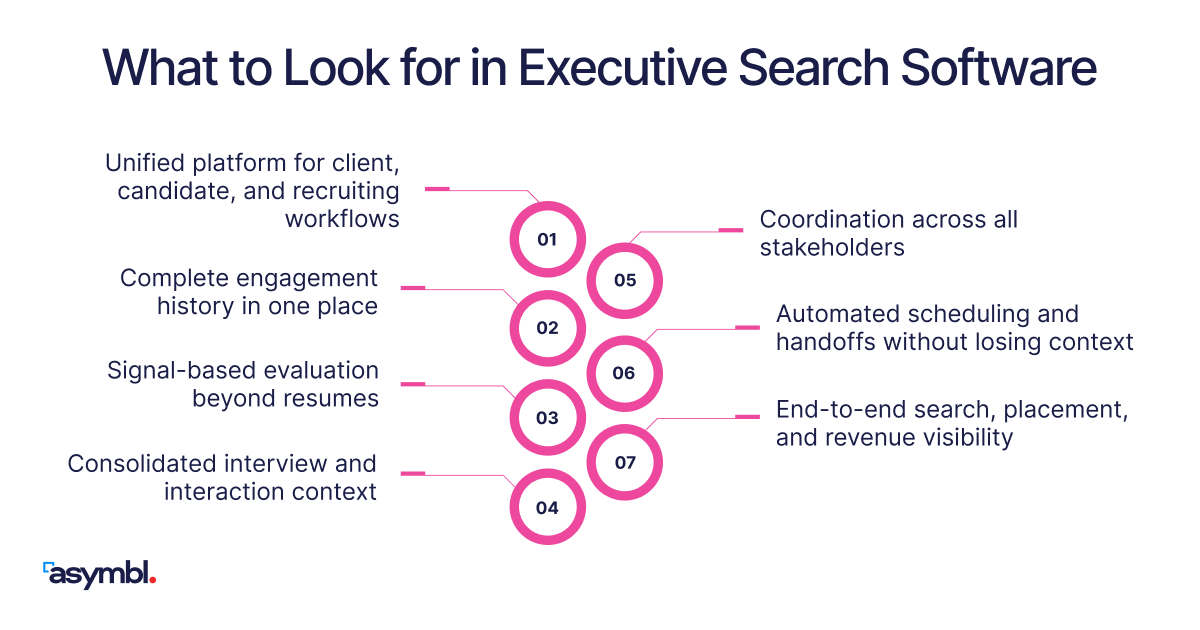
Executive search software should connect both sides of every assignment in one place, protect the firm's relationship history across engagements, and give leadership clear visibility into how each search is progressing toward a placement.
These criteria apply whether a firm is evaluating an executive recruiting ATS, a retained search CRM, or a standalone set of executive search tools.
1. A Connected Platform for Client, Talent, and Recruiting Workflows
The client, the assignment, and the talent should behave like parts of one connected record. A recruiting firm should be able to
- move from a client opportunity into the active search
- see the talent pipeline behind it
- follow the activity connecting the two
All of this should happen without switching tools.
The functions don't need to carry the same product label, but they do need shared information and continuity across them. If the recruiter is still doing the integration work manually, the platform isn't solving the problem it was bought for.
2. Complete Relationship and Engagement History in One Place
Executive recruiting compounds knowledge over time. Previous searches, talent conversations, client feedback, interview history, calls, notes, and past outcomes all sharpen the next decision. This history should belong to the firm rather than to the individual recruiter who built it, so the relationship survives past any one person's tenure.
Asymbl’s Recruiter Suite contact management keeps that history at the firm level, with communication history captured automatically for every contact.
3. Signal-Based Talent Evaluation Beyond Resumes and Keyword Matching
An executive search platform should guide recruiters toward talent fit using more than the text on a resume. The signals that shape a strong match include:
- Accomplishments and leadership scope
- Career progression
- Prior recruiting history with the firm
- Interview feedback and outcomes
- Specific requirements of the client mandate
A keyword search can surface names that contain the right terms, but it cannot weigh these signals against each other or tell a recruiter why one leader fits a mandate better than another. That gap carries real cost at the executive level, where a wrong placement ripples across the organization.
Asymbl's Talent Intelligence closes that gap by evaluating talent-to-client fit the way a recruiter would, weighing accomplishments, progression, and engagement history against the mandate's requirements rather than returning a percentage match score.
4. Consolidated Context From Interviews, Conversations, and Talent Interactions
Recording that an interview happened and preserving what the team learned from it are two different capabilities. An executive search platform should bring both together by capturing:
- Interview notes and structured feedback
- Communications with the talent
- Prior interactions across earlier searches
- Activity from other team members on the same assignment
This matters because executive searches run across several rounds and several decision-makers. Without a consolidated view, each person at the next stage walks in with a partial picture.
5. Coordination Across Recruiters, Clients, Talent, and Other Stakeholders
Executive recruiting moves through more hands than a single internal handoff. Partners, researchers, recruiters, client stakeholders, and executives each participate at a different stage.
The software should make ownership and progress visible and support structured feedback collection. It should also coordinate interviews and keep everyone working from the same current information.
A partner covering for a recruiter out on leave should be able to step into an active search mid-stream. The system already shows where it stands.
6. Automation for Scheduling, Follow-Ups, and Handoffs Without Losing Context
The value of automation in executive search depends on whether it can use the context the platform already holds. A follow-up that already knows the talent's current stage and last interaction is more useful than a generic sequence running beside the system of record.
Automation should remove coordination work without separating that work from the search itself. Scheduling, reminders, feedback requests, follow-ups, and internal handoffs, all these tasks consume recruiter capacity without requiring the same judgment as evaluating a leader.
Automating them makes sense, but only if the automation stays connected to the search record. The moment it runs as a separate workflow with no awareness of what just happened in the search, it creates more cleanup than it saves. The goal is keeping the administrative work around that decision from slowing it down.
7. Search, Placement, and Revenue Visibility in One View
The economics of a recruiting firm connect search progress, talent movement, placements, client pipeline, and expected revenue. This holds true even when they live in separate software modules today.
The platform should make those connections visible to operations and firm leadership in one place. Without that, a firm ends up with one dashboard for recruiting activity and a different one for revenue, with no clear line between the two. Reporting that ties recruiter activity to placements to revenue is where leadership can actually see whether the firm's work is converting into results.
5 Executive Search Software Platforms for Recruiting Firms
The right executive search software should connect client, talent, and assignment workflows in one place, preserve the firm's relationship history across engagements, and give leadership visibility into how searches convert into placements. The five platforms below serve this category.
A note on transparency: Asymbl publishes this comparison and is included within it. Every platform is assessed against the same criteria.
1. Loxo
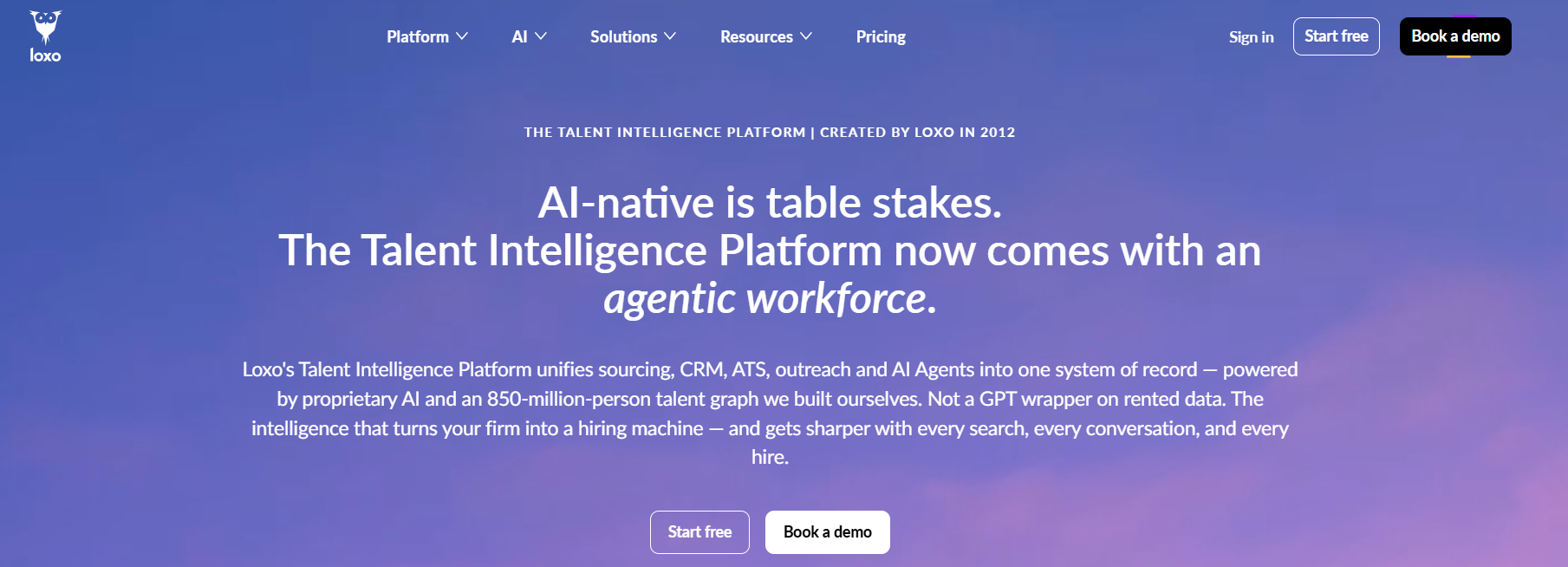
Loxo is a recruiting platform combining an applicant tracking system, recruiting CRM, sourcing database, and outreach automation in one system. It also offers a dedicated solution built for executive search and executive recruiting agencies.
Key features:
- Natural Language Talent Search: Covers the sourcing database and internal talent records using plain-text queries instead of Boolean syntax.
- AI Talent Matching: Analyzes job requirements against the talent pool and returns a ranked list of candidates for the role.
- Self-Updating CRM: An automation agent keeps talent records current without manual data entry from recruiters.
- Hiring Manager Portal: Shares configurable pipeline visibility with clients and collects their feedback directly in the platform.
- Omnichannel Outreach Automation: Builds and manages multi-channel outreach campaigns, with an AI tool for drafting talent messaging.
Best for: Firms that want sourcing, outreach, and talent and client relationship management consolidated into one self-service platform without a lengthy implementation.
2. Asymbl
Asymbl is a Unified Workforce Orchestration™ Platform for staffing and recruiting firms. It combines
- Recruiter Suite, a Salesforce-based Talent Relationship Management (TRM) application built for staffing workflows, with the applicant tracking system (ATS) capabilities staffing firms expect. It connects sales, recruiting, and operations in one environment.
- Talent Intelligence, an AI reasoning engine for talent matching.
- Rosa, a Digital Recruiter, who handles sourcing, screening, and scheduling
For executive search, the judgment on a placement still rests with recruiters and client stakeholders. Asymbl's role is keeping relationship history, talent signals, and recruiting activity connected in one record, while Rosa, a Digital Recruiter, takes on the scheduling, outreach, and follow-up around that decision, so recruiters can spend their time on the judgment calls.
Key features:
- Talent Relationship Management: Recruiter Suite connects sales, recruiting, and operations in one environment, with job, pipeline, interview, and offer management. Contact history stays with the firm, so relationships survive past any one recruiter's tenure.
- AI-First Talent Matching: Talent Intelligence surfaces the right people using ATS, CRM, email, call, interview, and outcome data. The reasoning engine evaluates fit instead of returning a keyword score, so the shortlist weighs fit the way a recruiter would.
- Digital Recruiter Execution: Rosa handles job description generation, outreach, application screening, interview scheduling, and interview summaries inside the same system of record.
- Cross-Workflow Intelligence: Asymbl Intelligence captures judgment and context across every workflow and makes that signal available to every worker, human or digital, on the platform.
- Revenue and Pipeline Reporting: Recruiter Suite tracks placement activity, pipeline health, revenue, and gross profit by recruiter and team in real time. Leadership sees how the business is performing without a manual roll-up.
Best for: Firms that want client and talent context, relationship history, and recruiting activity connected on one record, with a reasoning engine and a digital recruiter both drawing from that same data.
3. Bullhorn
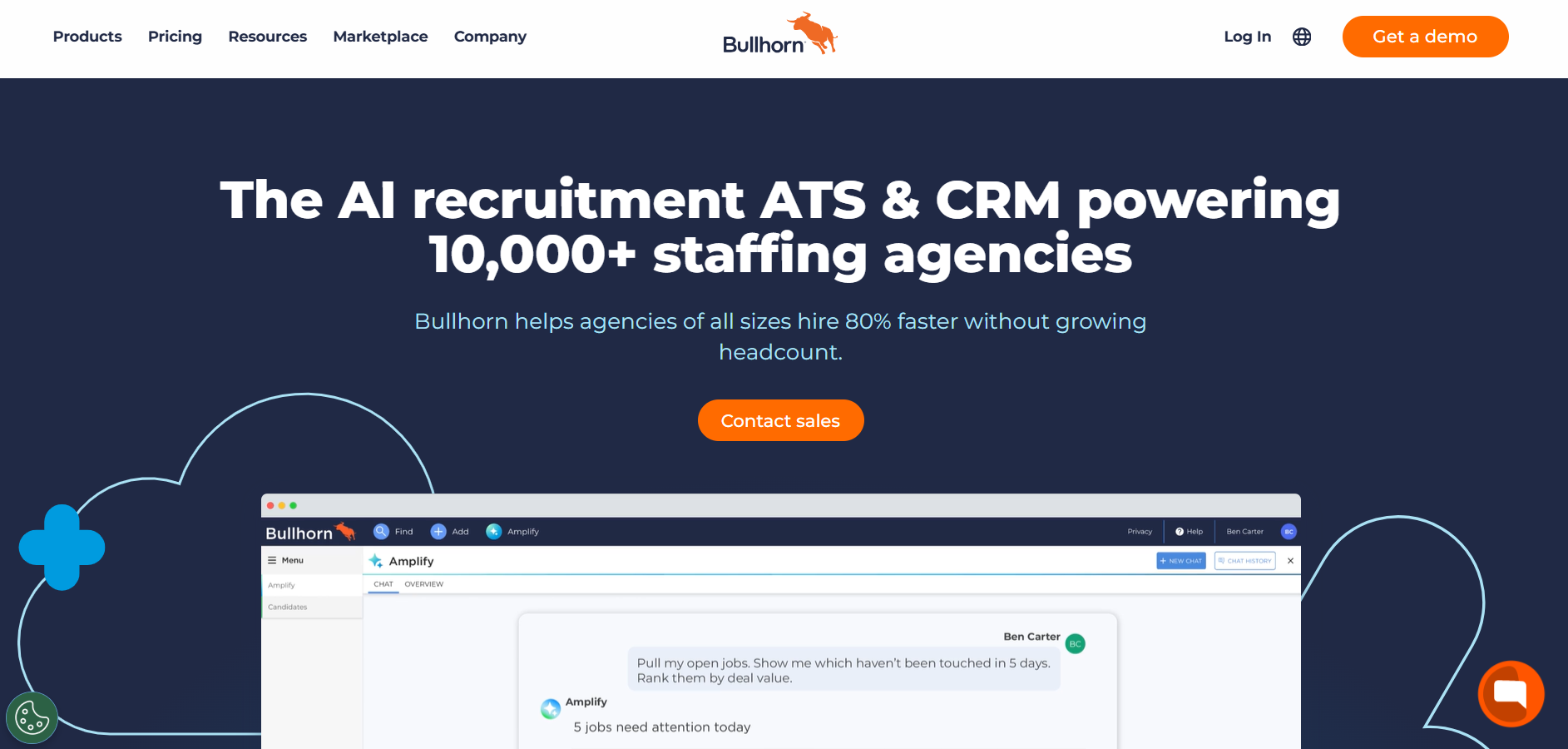
Bullhorn is a recruitment and staffing software provider built for staffing and recruiting agencies. It combines applicant tracking with a relationship-focused CRM designed around long engagement cycles, confidential pipelines, and off-limits management, covering the full search lifecycle from talent research through placement.
Key features:
- Confidential Pipeline and Off-Limits Management: Tracks talent and client engagement with controls for confidential searches and off-limits restrictions specific to retained search.
- Client Collaboration Deliverables: Branded progress reports and talent summaries with real-time collaboration tools connecting partners, researchers, and client stakeholders.
- Revenue and Utilization Analytics: Tracks pipeline health, consultant utilization, and revenue forecasting through customizable dashboards with Power BI integration.
- Outlook and Office 365 Integration: Lets users manage talent, client, and assignment data directly from their inbox without switching between systems.
- GDPR Compliance Support: Automates consent requests and generates documentation of data retention purpose and legal basis.
Best for: Firms whose operating model already resembles retained or dedicated executive search, where confidential pipeline management and branded client deliverables are central to how the business runs.
4. Seven20
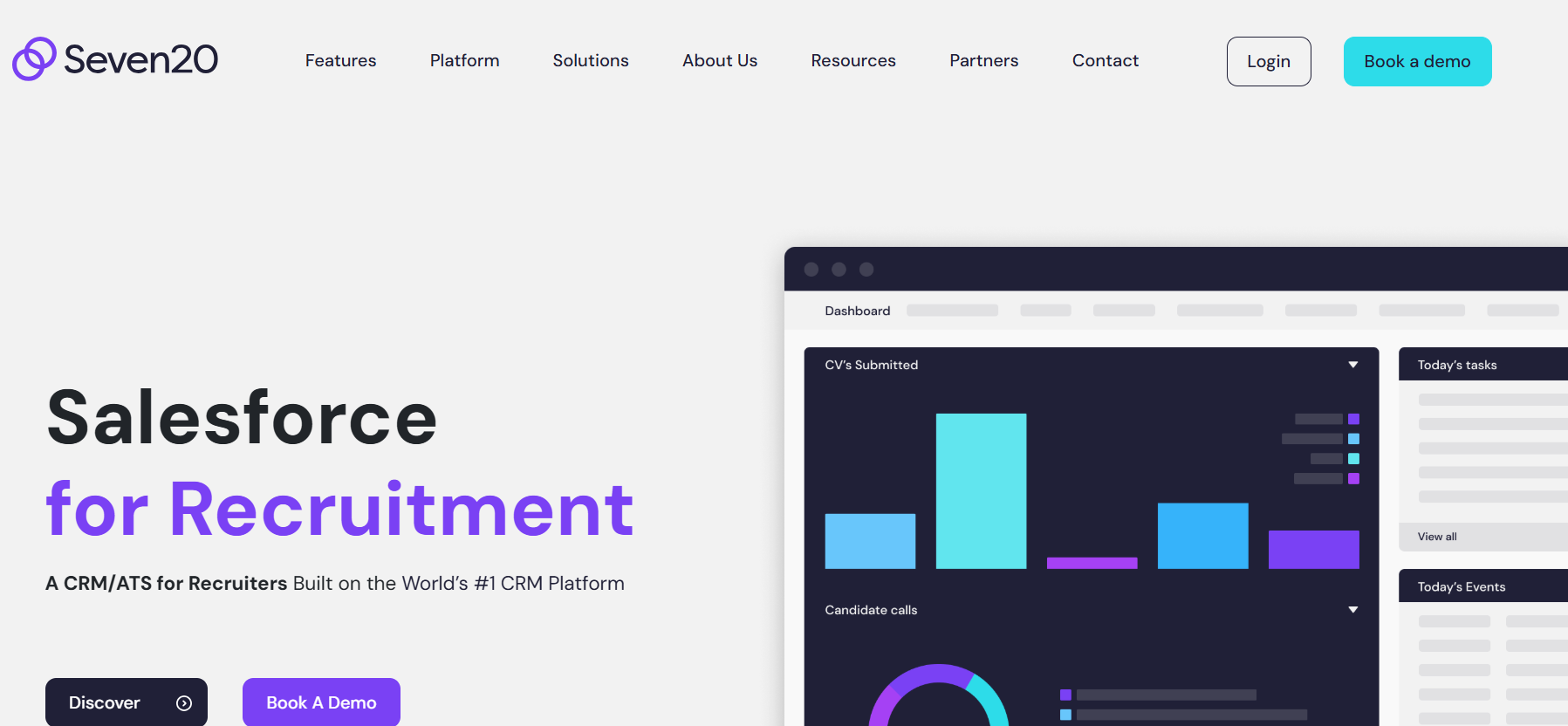
Seven20 is a recruitment CRM and applicant tracking system built on the Salesforce platform. It offers configurable workflows for permanent, contract, temporary, RPO, MSP, and executive search placements, all sharing one underlying record. For executive search specifically, Seven20 supports custom billing structures for mapping projects, retainers, and final placements.
Key features:
- Executive Search Billing Model: Supports custom billing structures for mapping projects, retainer stages, and final placements, distinct from split-billing and rate-card models used for other recruitment desks.
- Pipeline Management and Forecasting: Tracks talent and deal pipeline alongside revenue forecasting inside the same CRM used for client and contact records.
- Configurable ATS Workflows: Supports custom interview stages, longlists, and talent search settings tailored to each recruitment model the firm runs.
- Pay and Bill Operations: Manages timesheets, approvals, and back-office billing alongside recruiting data on one connected platform.
- Reporting and Dashboards: Tracks recruitment metrics in real time across front and back office through custom reports.
Best for: Firms already running on Salesforce, or firms that run executive search alongside several other recruitment models and want one CRM and ATS foundation across all of them.
5. CEIPAL
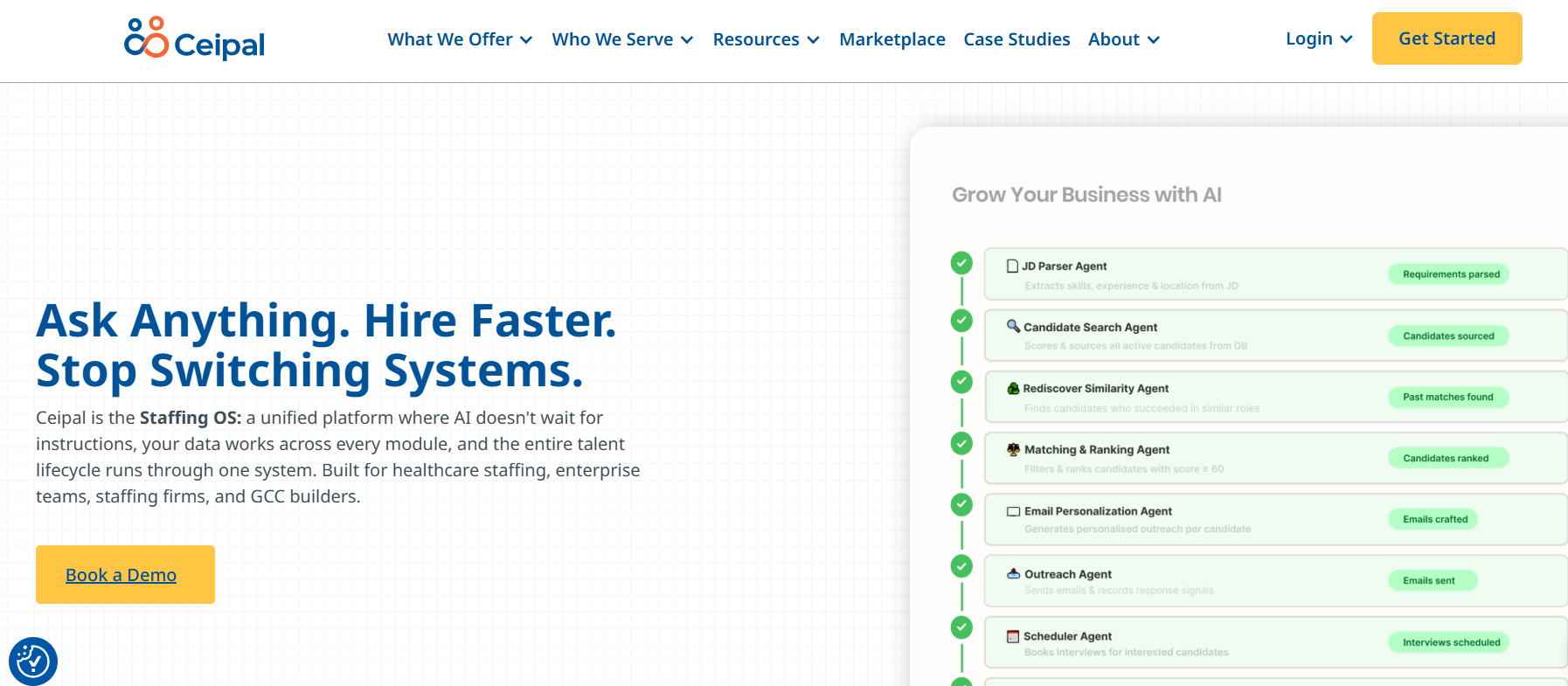
CEIPAL is a cloud-based staffing platform combining an applicant tracking system, vendor management system (VMS), and workforce management tools. It serves staffing agencies, healthcare staffing teams, corporate recruiters, and managed service providers. Executive search is one part of CEIPAL's wider mix, rather than the platform's central focus.
Key features:
- AI Talent Matching and Ranking: Scores and ranks candidates against job requisitions using AI-powered recommendations across the existing talent pool.
- Job Board and VMS Distribution: Posts openings and syncs talent data across more than 50 boards and portals at no added cost.
- Automated Resume Harvesting: Gathers resumes for open requisitions without manual sourcing work.
- SOC 2 Type 2 Compliance: Holds Service Organization Control 2 (SOC 2) Type 2 certification, with credentialing and compliance tracking for regulated staffing segments like healthcare.
- Recruitment Analytics Dashboards: Customizable, role-specific dashboards with real-time KPI tracking and interactive reporting.
Best for: Staffing businesses that need one operational platform across multiple recruiting models, where executive search is part of a broader mix.
Conclusion
Executive search software has to hold client, talent, and assignment context together across a long search. Every completed assignment should leave the platform with more context to draw on, so relationship history and talent signals carry forward into the next search instead of resetting to zero.
A platform that keeps that context connected compounds in value over time. A platform that treats each search as a blank pipeline never gets past its starting point.
Asymbl connects client, talent, and recruiting activity on one record from the first search onward. Book a demo to see how Recruiter Suite and Talent Intelligence hold that context for your team.
FAQs
Executive search software pricing varies widely by vendor and model. Some platforms price per user per month, in a range similar to Asymbl's own foundational and AI-matching editions ($60 to $125 per user), while others price by custom quote based on firm size, search volume, or module mix. Executive-search-specific platforms and enterprise implementations often use custom quotes.
Most executive search software implementations take between a few weeks and three months. The timeline depends on how much of the platform a firm adopts and what it's migrating from. A configuration-light rollout on an existing Salesforce org sits at the shorter end. A full replacement of a legacy ATS and CRM, including historical data migration, sits at the longer end.
Most executive search software integrates with email platforms like Outlook or Gmail, letting recruiters log activity without leaving their inbox. Many also connect to LinkedIn Recruiter or similar sourcing tools for talent research.
Executive search software handling sensitive talent and client data should support role-based access controls and audit trails. It should also carry recognized certifications such as SOC 2 Type 2. Region-specific requirements matter too, like GDPR consent management for talent data.
Retained search software needs to support staged, milestone-based billing tied to launch, shortlist, and placement. Firms pay retained fees in installments regardless of outcome. Contingency search software leans more heavily on speed and submission tracking. Multiple firms may work the same role, and only the firm that places the talent gets paid. Some platforms support both models with separate, configurable billing structures rather than forcing one workflow on every desk.
The same category of software works for boutique and large firms, but the right deployment model differs by size. A two- or three-person boutique firm needs fast, self-directed setup with low administrative overhead. A larger or multi-service firm more often needs support for several recruitment models, deeper reporting, and a dedicated implementation.

Where the Sales-to-Recruiting Gap Drains Staffing Firm Revenue
Your database is full. Your pipeline is empty. A staffing firm's data lives in four systems. See what that's really costing them.

The Right Fit Starts With a Conversation.
See what working together could look like.
