

.png)
High-volume hiring software optimizes for speed and volume. Staffing firms running job orders across multiple clients know that faster time to fill alone doesn't protect the business.
Margin recovery depends on filling more job orders without growing the recruiting team. High-volume hiring platforms are built to move applications quickly, leaving placement revenue exposed once the offer goes out. It promises scale, but staffing firms need hiring capability that holds up across peak seasons.
In this blog, we will compare the best high-volume hiring software for staffing firms in 2026 and explain the structural reasons why the platform optimizes for speed over placement outcome.
Best High-Volume Hiring Software in 2026
If you're hiring at scale, the right high-volume hiring software should help teams automate repetitive workflows, move candidates through the pipeline faster, and maintain a consistent hiring process as volume increases.
1. Ashby
Ashby is an all-in-one recruiting platform that combines an applicant tracking system, interview scheduling, sourcing, CRM, and analytics in one product. It is built primarily for startups and high-growth companies that want a configurable hiring workflow.
Key features:
- Visual Pipeline: Gives instant visibility into pipeline status across every open role, with clear next steps surfaced for each candidate.
- Activity Automation: Templated hiring workflows trigger scheduled interviews, template emails, and take-home assessments based on conditional logic.
- Structured Interview Plans: Standardizes evaluation with briefing views, custom feedback forms, and interviewer instructions attached to each stage.
- Quality of Hire Surveys: Collects and analyzes post-hire feedback through customizable forms to measure hiring outcomes over time.
- AI Fraud Detection and Feedback Summaries: Flags suspicious applicants automatically and highlights strengths and review areas from raw interviewer feedback.
Best for: Growth-stage companies building a hiring process for the first time at scale, where configurability and built-in analytics are important.
Pricing: Ashby offers three All-In-One plans based on company size. Foundations costs $400/month for companies with up to 100 employees, with a 10% annual discount. Plus targets 101–1,000 employees, while Enterprise is for 1,000+ employees, both with usage- and company-size-based pricing. Analytics for existing ATSs is usage-based.
2. Asymbl
Asymbl is a Workforce Orchestration™ platform built for staffing and recruiting firms running high-volume front offices. It combines Recruiter Suite, a talent relationship management solution, with Talent Intelligence and an AI reasoning engine on a single Salesforce-based record.
Workforce Orchestration™ coordinates human recruiters and AI digital workers as one connected workforce instead of adding AI features onto an existing applicant tracking system (ATS).
Key features:
- Pipeline Management: Real-time Kanban, List, or Split views across every job order and the talent moving through it, with bulk actions and applicants processed from any job board without leaving the platform.
- Contact Management: Saves every relationship at the firm level, with full communication history captured automatically for every client and talent contact.
- AI Matching Engine: Surfaces top talent across available, in-contact, and prior pools using a reasoning engine that evaluates fit rather than a percent-match score.
- Resume and Job Parsing: Automates profile creation and batch-processes high-volume intake, so a peak spike doesn't create a manual data-entry backlog.
- Job Description Generation and Screening: Rosa, a Digital Recruiter, drafts job postings, screens applicants against job criteria, and schedules interviews against defined key performance indicators (KPIs).
Best for: Staffing firms that want screening, scheduling, and the resulting placement connected to the same record their front office runs on, rather than a standalone applicant tracking system.
Pricing: Asymbl’s Recruiter Suite has three editions: Launch at $60/user/month, Premier at $125/user/month, and Ultimate with custom pricing. Launch provides the Talent Relationship Management (TRM) foundation, Premier adds Talent Intelligence, and Ultimate adds an autonomous Digital Recruiter. Agentforce packages are also available, including Break-Fix at $25K and Agentforce Jet Pack at ~$30K for four weeks.
3. Beamery
Beamery is a talent lifecycle management platform built around a Talent CRM, a searchable database of a company's past applicants and employees with AI matching and skills intelligence. It is designed for enterprise employers managing sourcing, internal mobility, and workforce planning alongside an existing applicant tracking system rather than replacing one.
Key features:
- Talent CRM Database: Centralizes past applicants and employees into profiles that surface skills and fit at a glance, with the ability to build targeted candidate pools.
- Silver Medalist Resurfacing: Automatically resurfaces previously assessed candidates who weren't hired to shorten time to hire on similar open roles.
- HCM Data Integration: Pulls employee data directly from HCM systems so internal and external candidates can be evaluated in the same view.
- Compliance Automation: Includes consent campaign management and configurable data residency options built for high-volume candidate data processing.
- Workflow Automation: Removes manual data entry and system switching across sourcing and outreach steps, with automated handoffs between recruiters.
Best for: Large enterprises that already run a separate applicant tracking system and want a CRM built specifically for sourcing, resurfacing past candidates, and internal mobility alongside an existing applicant tracking system.
Pricing: Custom
4. Bullhorn
Bullhorn is an applicant tracking system and customer relationship management (CRM) system built for staffing and recruiting agencies. It centralizes candidate, client, and job data in a single cloud-based database, covering the front-office workflow from job posting through placement.
Key features:
- Unified Database: Centralizes candidates, jobs, shifts, and clients in one system, with full conversation history tracked across team members to reduce duplicate entries.
- Email Integration: Two-way sync with Gmail and Outlook lets recruiters parse resumes, add notes, and create tasks directly from their inbox.
- AI-Powered Search and Match: Builds candidate searches from job descriptions without Boolean syntax and continuously scans for fit as new candidates enter the database.
- Workflow Automation: Triggers candidate updates, interview scheduling, and job order approvals automatically based on real-time activity in the platform.
- Amplify AI Assistant: A library of prebuilt prompts speeds up drafting job postings, interview questions, and resume summaries, with support for custom prompts.
Best for: Firms that want the deepest bench of middle and back-office add-ons already built around a single ATS and CRM, since Bullhorn's ecosystem is the widest of the five for staffing-specific operations.
Pricing: Bullhorn offers plans for agencies of different sizes. Small agencies can choose Starter for 1-2 users at $99/user/month, or Core for 3 users at $165/user/month, while Pro and Max require custom quotes. Larger agencies can choose Growth, Enterprise, or Bullhorn One. AI, automation, middle-office, onboarding, and Recruitment Cloud products are also available with custom pricing.
5. Workable
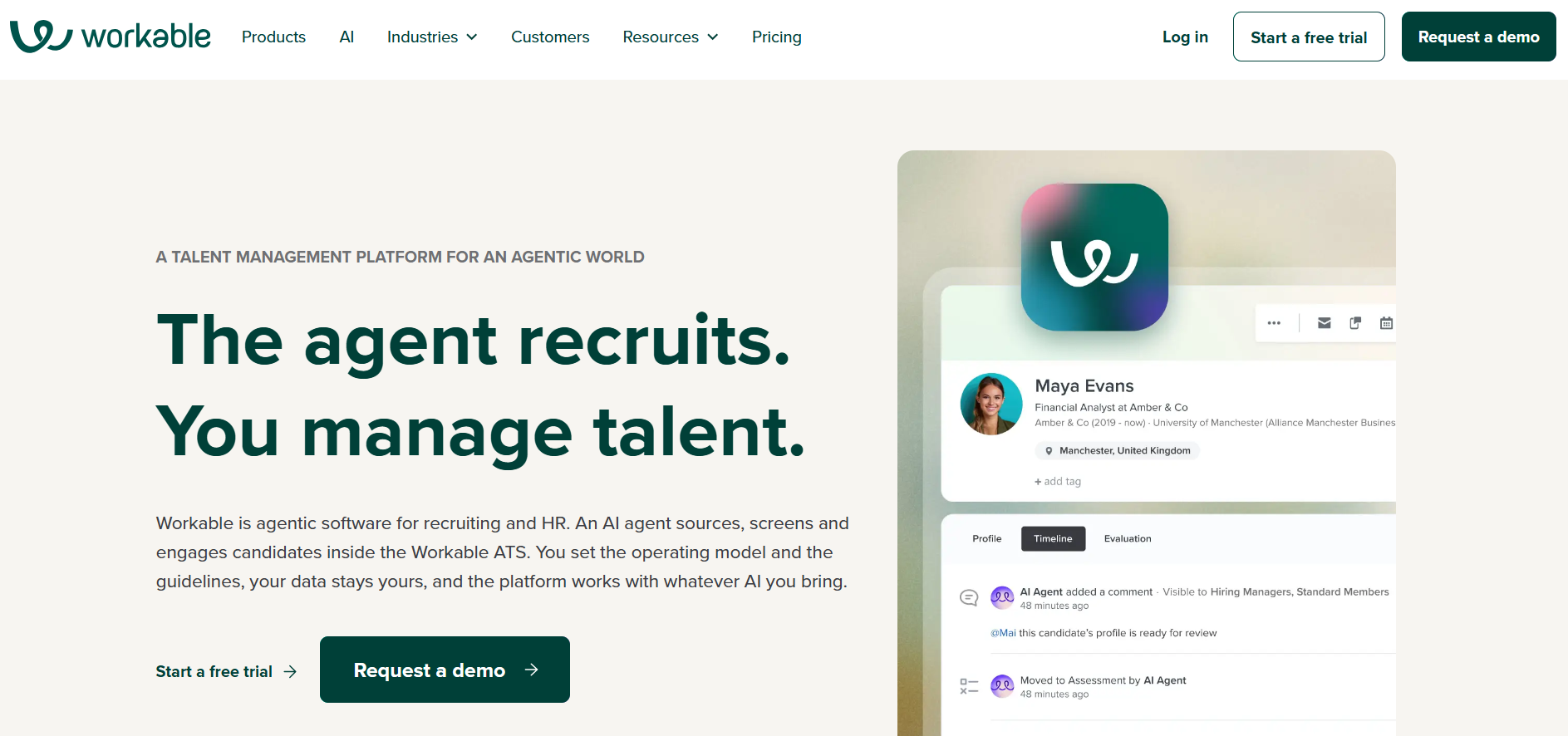
Workable is a hiring and HR platform that combines an applicant tracking system, candidate sourcing, a careers page builder, and onboarding and people-management tools in one platform. It is built for small and mid-market businesses that want a single system covering the hiring process through the early employee lifecycle.
Key features:
- Job Board Distribution: Posts to more than 200 free and premium job boards simultaneously from a single submission.
- Candidate Sourcing Pool: Gives access to over 400 million searchable candidate profiles with AI-powered recommendations and customizable filters.
- AI-Assisted Screening: Uses semantic analysis for skill matching, anonymized screening that hides identifying details, and automated resume parsing.
- Candidate Self-Scheduling: Lets candidates book interview slots directly, with automatic calendar sync and time zone detection.
- Custom Report Builder: Creates reports from any recruiting or HR data field, exportable to Excel, CSV, or PDF on automated schedules.
Best for: Smaller staffing firms and other small to mid-market businesses that need broad job board reach and a straightforward applicant tracking and onboarding system without a large configuration project.
Pricing: Workable offers three plans: Standard at $299/month, Premier at $599/month, and Enterprise at $719/month, with annual pricing available. All combine recruiting and HR features. Premier and Enterprise include additional tools such as texting, video interviews, assessments, referrals, and performance management. Workable Agent is available as an add-on using AI credits.
Where High-Volume Hiring Tools Break
Every platform in this comparison can automate screening, scheduling, and outreach at scale. However, the differences appear months after implementation, when the system is handling full hiring volume. At that point, performance usually comes down to five structural factors:
1. Built To Process Applications, Not Hiring Cycles
Every requisition in a high-volume hiring platform is modeled as an event with a start and an end. However, the same client can reopen the same job order against the same seasonal peak and the same local labor pool every year, but the platform treats each job order as a new one.
When a job order closes, the tool records the placement and closes the funnel. Everyone who applied and wasn't placed, often several hundred people per role, becomes an empty record in a database nobody queries again.
The talent rejected in October because the role was already filled is very often the exact person a client needs in March. Generic hiring software doesn’t resurface the same candidate for redeployment because of a lack of context or memory.
Staffing firms re-source the same local labor market every peak instead of returning to it. Sourcing spend and screening hours get spent twice on talent the firm already evaluated once, and that talent never becomes a redeployable asset the firm can place again without starting over.
2. The Intelligence Sits Outside Where Hiring Happens
Screening and scheduling in high-volume hiring platforms are services attached to an applicant tracking system, separate from the record the system runs on.
- The screening logic behind a decision
- The full message history of a candidate record
- The scheduling record all live inside the vendor's interface.
The talent record back in the firm's own system says rejected and carries no reasoning behind it.
Staffing firms already split front-office data across an applicant tracking system, a CRM for client relationships, and spreadsheets someone maintains manually. A volume-hiring system added alongside becomes a fourth place the context lives, and sales and recruiting end up working from different pictures of the same job order.
Adding a fourth system of record turns every question spanning sales and recruiting into a manual reconciliation. When a top producer leaves or the vendor contract ends, the reasoning behind every past screening decision leaves with it.
3. Knockout Rules Instead Of Contextual Screening
High-volume hiring platforms reduce screening criteria to rules a machine can apply instantly. They include:
- Knockout questions
- Availability checkboxes
- Keyword filters
Five thousand applications across forty client sites is not a problem any firm can staff with individual judgment calls, so rules are the only thing that scales.
The signals that actually predict whether someone finishes an assignment don’t show on the application. For example:
- Commute distance measured against the actual shift pattern being filled
- Performance on a prior assignment at a similar site under a similar supervisor
- Whether someone applied to three of the firm's open job orders or just one
These contextual criteria don’t fit into knockout questions. Semantic matching narrows the gap without closing it, since it compares the words on the application against the words on the job order.
4. Speed Is Measured, The Outcome Is Not
Every high-volume hiring platform measures and reports speed and volume, and the marketing follows the same script. However, they don’t measure qualitative metrics and signals like:
- Client retention rate
- Quality of hire
- Redeployment rate
- Candidate retention rate
Retention through the first ninety days of an assignment is one of the hardest problems in frontline, but it is also one of the hardest to measure.
Placement quality is a combination of multiple factors, including the client's satisfaction with the fill, early performance of the candidate, and whether the placement completes its term. All these metrics are measured and reported from different platforms, and they are often disconnected.
According to Gartner (ReimagineHR, October 2024), only 28% of recruiting leaders are currently measuring the quality of hire metric. Even among those who do, 57% rank quality of hire among their top three metrics to improve, while just 6% are confident in their ability to measure it effectively.
For high-volume hiring, that measurement gap becomes even more consequential because a platform can optimize speed and volume without showing whether those hires actually perform, stay, or satisfy the client.
The cost of a poor hire compounds over time without the software ever flagging it because the role filled in three days by someone who leaves in thirty just moves the cost onto the next job order and puts the client relationship.
5. AI Ships As A Toggle, Not As A Worker
AI often ships as a tool or a feature, such as:
- Auto-screen
- Auto-schedule
- Auto-message
It doesn’t include:
- A definition of success
- Measurable KPIs
- An escalation path
- A manager accountable for how it performs
AI automation scales whatever process was already running, inconsistencies included. At volume, that multiplies drift instead of surfacing it. The same pattern shows up well beyond hiring.
According to IBM’s 2026 Tech Leader “Redefining the Tech Leader’s Mandate: Building the IT foundation for Agentic AI at Acale” study, enterprises expect a 38% increase in the number of AI agents they deploy by 2027.
As each agent can make hundreds or thousands of decisions a day, that creates hundreds of thousands of autonomous decisions for technology leaders to oversee. The governance gap is already visible, with 77% of organizations reporting that AI adoption is outpacing their governance capabilities.
Nearly 60% of technology leaders cite security and compliance concerns as a top barrier to scaling AI agents, while two-thirds say they are accountable for outcomes from AI systems they do not fully control.
A high-volume hiring platform's screening AI is a smaller, more specific version of the same gap.
High-volume hiring that holds up across multiple hiring cycles is connected, contextual, and continuous.
- Connected means screening and scheduling write to the same record that holds the placement and everything that happens to that candidate record afterward
- Contextual means evaluation reads what the firm already knows about this person and this job order, alongside whatever the application states
- Continuous means the pipeline persists between peaks, so each cycle opens warmer than the last one closed
A platform that fills a job order quickly and a platform that builds a hiring capability that compounds across cycles can look identical in a sales call. The difference only surfaces once volume is actually running through the system.
What To Look For In High-Volume Hiring Software
- Job orders that don't carry forward
- Reasoning that lives outside the record
- Screening that can't read context
- Metrics that stop at the offer
- AI with no accountable owner
Turning these criteria into a shortlist means asking questions a standard feature checklist doesn't cover. The following five questions separate a platform that fills roles from one that builds a lasting hiring capability:
1. Does It Work On The Talent You Already Have?
Typical high-volume hiring platforms can't do this without manual work. Surfacing prior applicants and previously placed talent against a live job order should happen automatically, inside the same search a recruiter already runs.
When a client posts the same role it posted last season, does talent who completed a similar assignment in good standing in the past show up automatically, ranked against the live opening?
Question: Show us a job order where the top-ranked talent includes people the firm has already placed?
2. Does The Screening Decision Live On Your Record?
When a platform declines someone, the criteria it applied and the stated reason need to land on the talent record inside the firm's own system, where anyone reviewing that decision later can actually find them.
The client makes the final hiring decision on most placements, although the staffing firm screens and shortlists the candidates. When a client questions why someone was screened out, or a rejected applicant raises a claim against a role the firm sourced for, the firm needs the reasoning on record to answer for it.
3. Does It Understand Context Or Apply Filters?
- Rule-based filters check whether a box was ticked
- Semantic matching compares the meaning of two documents against each other
- Contextual reasoning weighs what an answer actually means for this job order, this shift, and this role, which is a different capability from either one.
Hand the platform two applications that look identical on paper. One person lives twenty minutes from the company location and previously completed a similar assignment on a similar shift pattern. See whether the platform suggests the candidate. If it doesn’t, there’s probably no filter.
4. Can You Trace A Placement To Its 90-Day Outcome?
Retention reporting, segmented by source, screening path, client, and job, mostly doesn't exist inside the hiring tool itself. Whether the platform reports retention at ninety days broken out that way is the specific question worth asking, since a single firm-wide retention number describes a population nobody actually manages.
5. Is The AI A Worker With A Job, Or A Feature?
Ask for the job description because AI doesn’t have one, whereas a digital worker should have one.
- What it owns
- What it recommends
- What it escalates
- What it never touches on its own
Ask what KPIs it's held to, such as:
- Screening output
- Scheduling efficiency
- Response rate
- Protocol adherence
Also ask who reviews its performance, and on what cadence. If nobody can answer that last question specifically, the AI never graduated past being a feature.
Asymbl For High-Volume Hiring
Asymbl approaches high-volume hiring as recruiting that runs on the same record as the rest of the business, instead of a separate system layered outside it.
1. Recruiter Suite for volume pipelines
Recruiter Suite is Asymbl's talent relationship management solution for staffing and recruiting firms, covering job management, pipeline management, interview management, offer and placement, contact management, and reporting.
- Pipeline Management gives a live and consolidated view of talent across every job order in Kanban, List, or Split view, with actions taken on multiple records at once and applicants processed from any job board without leaving the platform.
- Job Management assigns workflow templates automatically from the firm's own criteria and pushes process updates across active job orders
- Contact Management holds every relationship at the firm level rather than the recruiter level, with communication history captured automatically. This is the direct answer to whether a platform works the talent a firm already has. Prior applicants and previously placed talent stay visible because the record holding them never resets between job orders, and never walks out the door when a top producer leaves.
Reporting gives operations leaders visibility into pipeline health and placement activity without waiting on someone to pull a spreadsheet together manually.
Interview Management standardizes how every recruiter evaluates talent, with templates and structured feedback attached to the record where a recruiter, a sales lead, or a client can all find it, instead of scattered notes and one person's memory of how an interview went.
2. Talent Intelligence for contextual screening
Talent Intelligence reads pipeline history, interview feedback, prior outcomes, and unstructured documents into a model of fit, instead of relying on resume structure and keyword overlap alone. Semantic search matches field-level data to field-level data so you can search the way you think, instead of in keywords.
Talent Intelligence reasons across the full record the way a recruiter would, which is the direct answer to whether a platform understands context or just applies filters.
The AI Matching Engine highlights top talent across available, in-contact, and prior pools, surfacing people the firm has already placed directly inside the screening step, instead of as a separate search someone has to remember to run
Bias and Compliance flags are built into the same search, so a recruiter sees a warning before running a query that would skew the pool.
Search and Discovery runs on natural language, so a recruiter or a sales lead can query the talent database without Boolean search skill.
Rosa, Digital Recruiter
Rosa, the Digital Recruiter, is a pre-built digital worker with a defined job and a stated definition of success, built and reviewed the same way a human hire would be.
Rosa generates job descriptions, sends outreach to talent at scale with content tailored to each person, screens applications against job criteria, and schedules interviews, including timezone coordination and briefing materials for the interviewer.
She also produces structured interview summaries and drafts offer letters for review before they go out. Rosa’s KPIs are documented rather than assumed, and they include:
- Resume screening output
- Interview scheduling efficiency
- Screening compliance rate
- Time to fill and time to hire
- Headcount avoidance
Inside Asymbl's own recruiting team, a two-person team paired with Rosa processed 17,000 applications, pre-screened 1,800 candidates, scheduled 800 interviews, and hired 100 people in 100 days. That work drove a 47% increase in fill rate.
Placement outcomes and front-office connectivity
Recruiter Suite keeps recruiting data connected to placement outcomes and the revenue and margin reporting the rest of the front office already runs on, instead of that data stopping at the offer the way it does in a standalone applicant tracking system.
Offer and Placement closes the loop on every hire inside the same system where the screening and scheduling happened, recording placement completions and gross profit by recruiter and team rather than treating the offer as the finish line.
When the placement, the job order, and the screen that produced it live on one record, tracing a no-show or an early departure back to the decision that led to it becomes a query instead of a research project.
Asymbl Intelligence captures the judgment, context, and outcomes accumulating across every workflow and decision, and makes that signal available to every recruiter and every digital worker on the platform. Next season's screen gets built on what actually happened this season, instead of starting over from the same knockout rules that ran the peak before it.
The Next Test For High-Volume Hiring Software
High-volume hiring software should not be evaluated by how quickly it can process applications. The more important question is what happens to the talent, context, decisions, and outcomes after the hiring cycle ends.
A platform that only optimizes screening, scheduling, and time to fill can make a high-volume process faster without making it better. The stronger systems carry talent forward between job orders, preserve the reasoning behind decisions, evaluate candidates in context, measure what happens after placement, and give AI a defined role with accountable ownership.
That is the difference between processing hiring volume and building a hiring capability that improves with every cycle. Before choosing a platform, test it against those five conditions rather than its feature count.
See how Asymbl connects screening, scheduling, and placement outcomes on one record. Book a demo.
FAQs
High-volume hiring software is technology built to move large numbers of applicants through screening, scheduling, and placement for the same or similar roles across multiple job orders at once.
An applicant tracking system manages the hiring workflow for individual job orders, one role and one pipeline at a time. High-volume hiring software adds bulk actions, automated screening and scheduling, and cross-order coordination built for filling the same role across dozens of client locations simultaneously.
Fill rate and time to fill measure speed, but placement revenue, gross margin per placement, and redeployment rate measure whether that speed is actually building the business. Day-one show rate and 90-day retention determine whether a fast fill turns into repeat business from the client or a redo at the firm's cost.
Reducing early attrition starts with screening for fit signals that predict retention, like commute distance and prior performance in similar shift patterns, rather than only availability and keyword matches. Compressing the gap between offer acceptance and first shift, standardizing onboarding across client sites, and feeding 90-day outcomes back into the next round of screening are the levers with the most direct effect on early attrition, and on whether a client renews the order.
Automated screening creates compliance risk when the criteria behind a decision aren't recorded on the talent's record and can't be reconstructed later. The client makes the final call on most placements, but the staffing firm still carries the exposure when a screening decision can't be explained, whether that's a client dispute or a discrimination claim tied to a role the firm sourced for.
High-volume hiring software is typically priced per seat or per user each month, with cost scaling by the number of recruiters, desks, or client sites using the platform. Staffing firms should request quotes scoped to their actual desk count and peak volume rather than comparing list prices alone.
.webp)
High-Volume Recruiting: Where Manual Workflows Break
High-volume recruiting needs priority logic before more volume hiring software. See how to screen, qualify, and hire at scale without quality drift.

The Right Fit Starts With a Conversation.
See what working together could look like.
.webp)